XC3 Weaponlight

Archive for the ‘Press Release’ Category

Wild Things Calls Off Acquisition By Mission Ready Services

Tuesday, September 5th, 2017

Mission Ready not able to meet financial obligations to complete the deal.

Middletown, R.I., (July 28, 2017) – Wild Things LLC, a leading manufacturer of technical outerwear for the U.S. Military, law enforcement and consumer markets, today announced that its acquisition by an affiliate of Mission Ready Services (MRSI), signed on March 8th 2017, has been cancelled due to MRSI’s failure to pay the purchase price in accordance with the terms of the promissory note executed at closing. Per the terms of the agreement, Wild Things’ prior investors will receive a break-up fee from MRSI and will continue to operate the business independently from MRSI.

“This is a very disappointing outcome for all of the parties involved in this deal,” said Ed Schmults, President of Wild Things. “However, Wild Things will be fine back on our own. No customers, suppliers or employees will be impacted by this. Our bookings are up significantly so far this year and we are looking forward to continued growth and success.”

The two companies kept the Wild Things business separate pending full satisfaction of the promissory note so the operational impact to Wild Things is negligible. The two companies worked well together and intend to explore ways to work together in the future.

Task Force Dagger Foundation And East Carolina University Team Up To Explore Underwater WWII Sites

Monday, September 4th, 2017

Task Force Dagger Foundation partners with East Carolina University’s Maritime Studies Program to explore and research WWII sites in the western Pacific.

Dallas, Texas (PRWEB) August 01, 2017

Task Force Dagger, a nonprofit organization that supports all U.S. Special Operations Command service members and their families, is joining forces with the East Carolina University Department of History’s maritime studies program to explore and research WWII underwater archaeological sites in the western Pacific.

Dr. Jennifer McKinnon investigates a Kawanishi H8K Japanese seaplane. (Photo by Jon Carpenter)

Dr. Jennifer McKinnon investigates a Kawanishi H8K Japanese seaplane. (Photo by Jon Carpenter)

Task Force Dagger, a nonprofit organization that supports all U.S. Special Operations Command service members and their families, is joining forces with the East Carolina University Department of History’s maritime studies program to explore and research WWII underwater archaeological sites in the western Pacific.

The maritime studies program has several faculty and staff that work on military-related and WWII archaeological sites all over the world.

Associate professor Dr. Jennifer McKinnon has been working on military sites in the Pacific for nearly 10 years. In partnership with Ships of Exploration and Discovery and the local community of Saipan, McKinnon developed the WWII Maritime Heritage Trail: Battle of Saipan in 2009. The heritage trail consists of nine underwater U.S. and Japanese sites in Saipan’s crystal-clear, tropical lagoons. The sites include amphibious vehicles such as landing vehicles and tanks, aircraft, and shipwrecks, all lost in the 1944 Battle of Saipan.

McKinnon said that the partnership with Task Force Dagger is a boon for continuing to research these sites. “Active military and veterans have an incredible firsthand knowledge of warfare, tactics and military material,” she said. “Their knowledge and experience has the potential to contribute so much to the research we are conducting in the Pacific. It really is a reciprocal relationship.”

Charles “Keith” David, managing director of Task Force Dagger and retired U.S. Army Special Forces, said the organization is looking forward to solidifying the collaboration through a memorandum of agreement and seeking grant funding for the project.

The Task Force Dagger Foundation will join McKinnon and the maritime studies program next summer in a special recreational therapy adaptive event that trains special operations command service members in scuba diving and underwater archaeology. The team will then travel to Saipan to continue locating and recording WWII underwater archaeological sites.

TFD is looking forward to the relationship with ECU and building a program through which veterans and active service members can train in archaeological methods and assist in future efforts to recover lost service members whose remains are still lost at sea

For more information about Task Force Dagger visit www.taskforcedagger.org. For more information about the WWII Maritime Heritage Trail visit www.pacificmaritimeheritagetrail.com.

Contact: Dr. Jennifer McKinnon, mckinnonje(at)ecu.edu, 252-328-6788

BE Meyers to Attend MSPO Expo In Kielce, Poland

Monday, September 4th, 2017

B.E. Meyers & Co. Inc. will be attending the 2017 MSPO EXPOSITION in Kielce Poland at the Targi Kielce Exhibition and Congress Centre on September 04 – 07.

Visit us and CENREX at MSPO booth ZC-9 to learn more about the IZLID, GLARE, and MAWL series of lasers, as well as some new and exciting products that are scheduled for release soon.

To connect with the B.E. Meyers & Co. team to schedule a meeting, please contact us at: sales@bemeyers.com.

The International Defense Industry Exhibition (MSPO) is one of the largest military equipment showcase events in Eastern and Central Europe. It features appearances from over 400 exhibitors spanning a wide range of defense sectors, and is attended by representatives from across the globe. Since 1993, the MSPO has promoted innovation in the defense industry, and is a hub for featuring new technology and applications.

US Army Paratroopers Testing Airborne Tactical Assault Panel 

Monday, September 4th, 2017
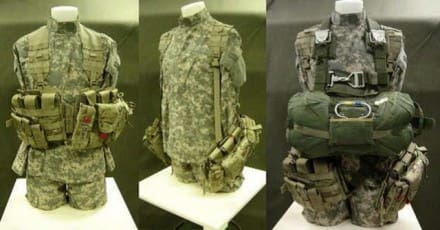
The Airborne Tactical Assault Panel (ABN-TAP) rigging configurations. (Photo Credit: Photo courtesy of PEO Soldier)

The Airborne Tactical Assault Panel (ABN-TAP) rigging configurations. (Photo Credit: Photo courtesy of PEO Soldier)

Fort Bragg, North Carolina — For the first time since their inception, Army Airborne forces will soon be fielding a new fighting load system tailored to the paratrooper’s unique requirements.

“The Airborne Tactical Assault Panel (ABN-TAP) was developed with the paratrooper in mind and will allow the paratrooper a greater degree of comfort, mobility and safety during static line airborne infiltration operations,” said Rich Landry of the U.S. Army Soldier Systems Center laboratories in Natick, Massachusetts.
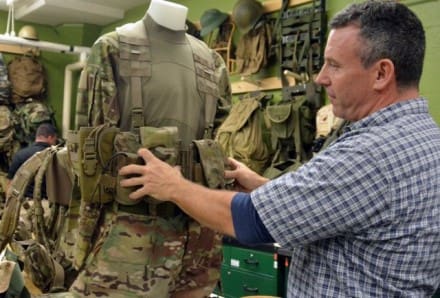
Rich Landry of the U.S. Army Soldier Systems Center laboratories in Natick, Massachusetts, demonstrates key design features included in the Airborne Tactical Assault Panel (ABN-TAP) based on Soldier input. (Photo Credit: Photo courtesy of Natick Research laboratories)

Rich Landry of the U.S. Army Soldier Systems Center laboratories in Natick, Massachusetts, demonstrates key design features included in the Airborne Tactical Assault Panel (ABN-TAP) based on Soldier input. (Photo Credit: Photo courtesy of Natick Research laboratories)

Typical Airborne troops say the legacy load carrier systems have some drawbacks.

Previous designs must be worn under the T-11 parachute harness, which is less than optimal because it does not allow for a proper fit of the main parachute harness, and moves the T-11 reserve activation handle further away from the paratrooper’s grasp.

ABN-TAP enables Soldiers to rig the fighting load under the parachute harness but below the reserve parachute.
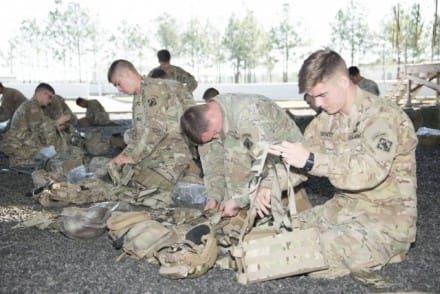
Soldiers from the 57th Sapper Company, 27th Engineer Battalion, 20th Engineer Brigade, assemble the Airborne Tactical Assault Panel (ABN-TAP) during New Equipment Training at Fort Bragg, North Carolina, before putting it through operational testing. (Photo Credit: Jim Finney, Combined Technical Services, Airborne and Special Operations Test Directorate, U.S. Army Operational Test Command)

Soldiers from the 57th Sapper Company, 27th Engineer Battalion, 20th Engineer Brigade, assemble the Airborne Tactical Assault Panel (ABN-TAP) during New Equipment Training at Fort Bragg, North Carolina, before putting it through operational testing. (Photo Credit: Jim Finney, Combined Technical Services, Airborne and Special Operations Test Directorate, U.S. Army Operational Test Command)

“This will allow paratroopers to properly adjust the T-11 parachute harness to their specific sizing requirements and keep the T-11 reserve parachute handle well within reach,” said Sgt. 1st Class Ian Seymour, Test NCO from the Airborne and Special Operations Test Directorate (ABNSOTD) here.

The ABN-TAP design actually draws its lineage from the older Load Bearing System (LBE) used with the T-10 and MC1-1 parachute systems by paratroopers for decades.

Soon after the Global War on Terror began, all branches of the armed services rushed to modernize field equipment to meet the rigors of modern combat and allow for the constant presence of body armor, according to Mike Tracy, deputy test division chief at ABNSOTD.

“With the vest/plate carrier systems seeing overwhelming Soldier acceptance, the task of providing the paratrooper with a modern design compatible with current parachute systems is challenging to say the least,” Tracy said.
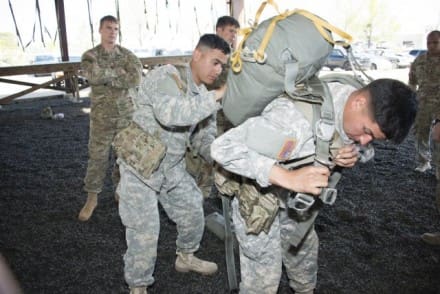
Paratroopers assigned to the 57th Sapper Company, 27th Engineer Battalion, 20th Engineer Brigade, Fort Bragg, N.C., practice "buddy rigging" the Airborne Tactical Assault Panel (ABN-TAP) at the 82nd Airborne Division Advanced Airborne School during New Equipment Training. (Photo Credit: Michael Zigmond, Audio Visual Production Specialist, Airborne and Special Operations Test Directorate, U.S. Army Operational Test Command)

Paratroopers assigned to the 57th Sapper Company, 27th Engineer Battalion, 20th Engineer Brigade, Fort Bragg, N.C., practice “buddy rigging” the Airborne Tactical Assault Panel (ABN-TAP) at the 82nd Airborne Division Advanced Airborne School during New Equipment Training. (Photo Credit: Michael Zigmond, Audio Visual Production Specialist, Airborne and Special Operations Test Directorate, U.S. Army Operational Test Command)

The ABN-TAP bridges this gap by providing both new and old capabilities to the paratrooper.

Tracy explained that ABN-TAP allows not only for rigging under the parachute harness and reserve, but can be rapidly adjusted to serve as a “chest rig” design upon landing.

“Ground troops consider this to be the most efficient design under current operational conditions,” said Tracy.

“Operational testing using Airborne paratroopers, collects data which truly allows the Army to evaluate the suitability and safety of the ABN-TAP when worn during static line Airborne operations and follow-on missions,” Tracy said.

Before testing Soldiers participated in New Equipment Training (NET), which included familiarization with the system, fitting and proper rigging of the ABN-TAP with the T-11 parachute system.

Following NET, Soldiers conducted live parachute jumps from a C-17 high performance aircraft at 1,250 feet above ground level over Sicily Drop Zone here.

More senior Soldiers participating in testing were optimistic about the proposed rigging procedures.

“Having jumped the LBE system earlier in their careers, this proven rigging method signals a simple approach to a complex problem,” said Leon Price, senior ABNSOTD test officer.

“I think I benefitted personally by being a part of this,” said Spec. Aaron Adams, a Combat Engineer with the 57th Sapper Company, 27th Engineer Battalion, 20th Engineer Brigade. “I enjoyed participating in the testing because it allowed me to provide direct input into the test and I will get to see it once it is fielded to the Airborne force.”

“Any time Soldiers and their leaders get involved in operational testing, they have the opportunity to use, work with, and offer up their own suggestions on pieces of equipment that can impact development of systems that future Soldiers will use in combat,” said Col. Brad Mock, the director of all the Army’s Airborne testing.

Upon completion of testing, the ABN-TAP could potentially be issued to Army Airborne forces worldwide, signaling the first steps in modernizing the combat loads of thousands of paratroopers.

~~

The U.S. Army Operational Test Command is based at West Fort Hood, Texas, and its mission is about making sure that systems developed are effective in a Soldier’s hands and suitable for the environments in which Soldiers train and fight. Test units and their Soldiers provide feedback, by offering input to improve upon existing and future systems with which Soldiers will ultimately use to train and fight.

The Fort Bragg, North Carolina-based ABNSOTD plans, executes, and reports on operational tests and field experiments of Airborne and Special Operations Forces equipment, procedures, aerial delivery and air transportation systems in order to provide key operational data for the continued development and fielding of doctrine, systems or equipment to the Warfighter.

Crimson Trace Offers Options For GLOCK Gen5 Pistols

Sunday, September 3rd, 2017

Glock Gen 5 with Crimson Trace Laserguard LG-639G

(Wilsonville, OR)— Crimson Trace is offering many laser sight options for the newly released GLOCK® G17 Gen5 and G19 Gen5 semi-auto pistols. Among those options include: the Laserguard® laser sight LG-637 with red laser diode and the Laserguard LG-637G with green laser diode; the Laserguard LG-639 (red) and LG-639G (green) laser sights; and the Laserguard LG-436 laser sight. The Crimson Trace Laserguard LG-452 green laser sight will also fit those GLOCK pistols. In addition, the soon-to-be released Crimson Trace Laserguard Pro with LED white light and laser diode—the LL-807 with red laser diode and LL-807G with green laser diode—will fit the new GLOCK G17 Gen5 and G19 Gen5 pistols. Manufacturer Suggested Retail Prices for Crimson Trace laser sights begin at $249 for the LG-637 laser sight.

The Crimson Trace Laserguard family is one of many laser sight and tactical light products the company offers that securely fit firearms by GLOCK and many other manufacturers. Full details are available at www.crimsontrace.com and Crimson Trace products can also be purchased across America at more than 2,500 retailers.

Crimson Trace now offers more than 30 laser sights, firearms lights, and combination units for installation on nearly all GLOCK pistols. This quantity is greater than the number of laser sight products offered for GLOCK pistols by all other laser sight manufacturers combined.

For owners of the new GLOCK G17 Gen5 and G19 Gen5 pistols, Crimson Trace’s innovative Laserguard Pro laser sights combine a 150-lumen LED white light within a compact housing along with either a red (LL-807) or green (LL-807G) laser. Features of the Laserguard Pro include Crimson Trace’s Instinctive Activation™ firearm laser sight engagement system located under the trigger guard, a master on/off switch on most models, and easy-to-use elevation and windage adjustments. An adjustment wrench and battery are included in each package. All of these innovative products are covered under Crimson Trace’s Free Batteries for Life program.

In addition to its laser sight products, Crimson Trace now also offers special packages complete with form-fitted concealed carry holsters crafted by Blade-Tech® for several GLOCK firearms. Crimson Trace offers a variety of Glock holster solutions to give consumers a wide choice of performance and price options. More details are at www.holsterresourceguide.com.

Crimson Trace products for GLOCK pistols can also be easily installed without modification of the firearm —or special gunsmith skills. For more information on Crimson Trace products, dealers, dealer locations, and to obtain a free copy of the 2017 catalog, visit www.crimsontrace.com or call 800-442-2406. Crimson Trace is widely recognized as the leader in establishing laser sights as standard equipment of firearms.

About Crimson Trace Corporation
Based in Wilsonville, Oregon, Crimson Trace Corporation is recognized as the leader in establishing laser sights as standard equipment on concealed-carry and personal-defense firearms. For more than two decades, the company has provided America’s firearms owners, law enforcement officers and military units worldwide with the largest selection of award-winning laser sights and tactical lights products. Those innovations include: Lasergrips® laser sights, Laserguard® laser sights, LiNQ™ wireless operated laser and light systems and Lightguard® lights for firearms, each with Instinctive Activation firearm laser activation technology. Additional product lines include the Defender SeriesTM and Rail Master® firearms accessory platforms. Full details are available at www.crimsontrace.com or by calling 800-442-2406.

NTOA Announces New Advanced Response Police Officer Course

Friday, September 1st, 2017

In response to recent critical incidents, the NTOA designed its latest course to meet the needs of officers who might not be assigned to tactical teams, but still require advanced skills.

Doylestown, Pa. (August 2017) – The National Tactical Officers Association (NTOA) is pleased to announce its newest course, Advanced Response Police Officer, to its impressive roster of continuing education and training resources. In the wake of recent critical incidents, today’s law enforcement officer needs to be more prepared than ever. The Advanced Response Police Officer course was designed to meet the needs of officers who might not be assigned to a tactical team, but who still require advanced skills to respond appropriately before a tactical team arriving. This is a 40-hour (five-day) course, comprised of 10 classroom and 30 practical hours.


Photo courtesy of Laura Fogarty.

The Advanced Response Police Officer course is designed to provide officers with enhanced training, skills, and techniques to survive ambush and unexpected threat situations. Focusing on practical application of skills learned, this course is conducted primarily in the field or on the range. It is designed for any police officer wanting to enhance his or her survivability in any environment. Topics include the use of various pieces of equipment, tactical movement, tactical combat casualty care, live fire drills, scenario-based decision-making, rescues and counter-ambush tactics.

Upon completion of the course, attendees will be familiar with the fundamentals of tactical movement, ballistic shield operations, mechanical breaching, interior building clearing tactics for two- and three-man teams, tactical movement in open air and urban environments, Tactical Emergency Casualty Care (TECC), officer/citizen down rescues and counter-ambush survival tactics.

To learn more about hosting a class at your agency, please visit www.ntoa.org/host-training-courses.

For more information on the National Tactical Officers Association, visit www.ntoa.org or call 800-279-9127. Join the NTOA today and start receiving the benefits of better training and stay on top of the ever-changing and challenging world of law enforcement.

Optics 1, Inc (Safran) I-CUGR Selected for USMC Sniper Range Finder Program

Friday, September 1st, 2017

Bedford, New Hampshire, August 23, 2017

Optics 1, Inc. (Safran) announced today that its Integrated Compact Ultralight Gun-mounted Rangefinder (I-CUGR) has been selected by the United States Marine Corps (USMC).

The I-CUGR is a small, lightweight, and rugged weapon-mounted laser rangefinder with integrated illumination and aiming lasers that will give USMC the ability to quickly range targets without taking hands off their rifles — providing more accurate first round hits.

“We appreciate the opportunity to continue working closely with the U.S. Marine Corps in providing the Marines with superior technology that provides precise and accurate targeting solutions,” said Jose Andrade, Optics 1 Business Development Manager and a retired USMC Sergeant Major. “The selection of the I-CUGR solidifies the confidence in our commitment to providing technologies that are light yet powerful and are critical to the success of the USMC’s mission requirements.”

The I-CUGR has been designed by Optics 1 leveraging proven rangefinder technology from Safran Electronics & Defense. Production will take place in Bedford, New Hampshire at Optics 1. The initial order is for 315 units with deliveries beginning this year.

For more information: www.optics1.com or www.www.safran-group.com

SureFire Ryder 22-Mini Suppressor Now Shipping

Thursday, August 31st, 2017

Fountain Valley, CA—SureFire, LLC, manufacturer of the world’s finest—and most innovative—illumination tools and tactical products, is proud to announce the launch of the all new SF RYDER™ 22-MINI suppressor. The RYDER 22-MINI offers the same great benefits to that of the RYDER 22-S only now in a more compact, shorter overall length with minimal increase in sound attenuation. The 22-MINI is optimized to strike the perfect balance between length, weight, and sound for rifles. The 22-MINI features heat-treated stainless steel baffles that offer increased durability and is capable of handling pressures of 17 HMR and .22 WMR ammunition—even full-auto fire. These simple-to-maintain suppressors are easy to disassemble and clean, thanks to individually numbered and indexed baffles that provide quick, easy reassembly. A fluted aluminum body helps reduce weight. The stainless steel back section utilizes a 1/2 X 28 single-point-cut stainless steel thread that quickly and securely attaches to the host weapon.

Learn More: www.surefire.com/sf-ryder-22-mini