Register Now for SOF Week

Archive for the ‘SOF’ Category

A Legacy Cemented: 91st Civil Affairs’ Fox Company Stands Down

Thursday, March 19th, 2026

FORT BRAGG, N.C. – With a final roll in front of family, friends and alumni, the guidon of Fox Company, 91st Civil Affairs Battalion, 3rd Special Forces Group (Airborne), was cased on March 6. This marked the formal inactivation of a unit whose work was pivotal to U.S. Army missions across Africa, the Middle East and the Indo-Pacific.

The ceremony, steeped in military tradition, symbolized the end of the company’s mission as part of a broader transformation within U.S. Army Special Operations.

The strategic realignment is designed to maximize adaptability to the complex and evolving security environments across Africa, the Indo-Pacific and the Middle East, where Fox Company’s Soldiers have been continuously deployed for the past 15 years.

While the unit’s guidon will no longer fly, the missions it supported are ongoing. The inactivation is not an end, but a transformation, with the company’s operational lineage and its Soldiers being integrated into Special Operations restructure.

“From day one, the mission was clear and the tempo was high. Fox Company didn’t just meet the standard; it set the standard. By 2012 its Soldiers were spread across a vast expense of Trans-Sahara, from Somalia to Nigeria,” said U.S. Army Maj. Kristopher Levy, the 91st Civil Affairs Battalion executive officer and former Fox company commander, as he reflected on the unit’s history. “The following year they were in the mountains of Afghanistan.”

Operating in environments where trust is the ultimate currency, Civil Affairs Soldiers from Fox Company served as the essential link between military commanders and the civilian populations around them. Their primary role was simple; understand and engage the human terrain. This included advising local and national leaders on governance, facilitating humanitarian assistance, and coordinating with non-governmental organizations to support regional stability.

“To the Soldiers of the 91st, this is a moment not just to remember Fox Company’s history, but the immense responsibility entrusted to all of us as you witness constant change in the world and challenges on the horizon. We are reminded of a stark truth that we do not choose the time or place of the next call,” said U.S. Army Lt. Col. Micheal Veglucci, commander of the 91st Civil Affairs Battalion, as he addressed the Soldiers and alumni of Fox Company. “It is for this reason that we must remain ready, professional, prepared, and deeply committed to the mission.”

These Soldiers worked alongside U.S. forces, partner forces, allies, and local leaders, often in remote and austere locations. Civil Affairs Soldiers help villages secure a clean water source, advise local officials on public services, or simply building rapport with community elders. Their efforts were critical to mitigating conflict and fostering long-term security. This work behind the scenes was fundamental to creating the conditions necessary for broader mission success, helping to counter malign influence and deny sanctuary to extremist organizations.

For the Soldiers attending the ceremony, it was a moment of reflection.

“It’s true, Fox Company was established in October 2010, however the official history fails to mention how the company was initially a collection of freshly minted Civil Affairs NCOs and officers straight out of the qualification course mixed with groups from other organizations,” said Retired Command Sgt. Maj. Angelo Gutierrez.

Although their company is now part of history, the skills of the Soldiers of Fox Company remain in high demand. The Fox Company Soldiers will be reassigned, bringing their invaluable experience and regional expertise to other Special Operations units supporting U.S. Africa Command, U.S. Pacific Command and U.S. Central Command.

As the guidon is cased, it marks the conclusion of a long chapter of Civil Affairs history. Yet, the legacy of Fox Company remains etched in the strengthened partnerships and stabilized communities it left behind, a testament to the quiet professionals who lived up to their commander’s charge.

Fox Company’s guidon may be rolled up and stored away, but to those who served under it, one thing remains, the essence of the 91st Civil Affairs Battalion and its never-ending legacy.

Story by SGT Lee Heaton 

3rd Special Forces Group (Airborne)

Med-Eng Pleased to Support United States Department of War with Delivery of Sensor Capabilities Contract Previously Announced by Cadre Holdings

Tuesday, March 10th, 2026

Company Providing Mission-Critical Blast Exposure Monitoring System to Preserve and Maintain Readiness for Warfighters

OGDENSBURG, NY — As originally announced by Cadre Holdings, Inc. (“Cadre”), on November 19, 2025, Med-Eng, LLC, a world leader in personal protective technologies against blast and a subsidiary of Cadre, was awarded a 5-year Indefinite Delivery / Indefinite Quantity (IDIQ) contract with a maximum value of $50 million by the United States Department of War (DoW) to deliver and support the Blast Exposure Monitoring (BEMO) Program. The BEMO systems, including sensor hardware and related software, measure and record blast overpressure exposures experienced in training operations as part of a DoW Brain Health program.

First delivery under the contract is underway and follows a competitive 5-year funded development program to improve methods for identifying blast overpressure exposures impacting the warfighter while using heavy weapon systems and conducting explosive breaching in dynamic combat and training environments. Once deployed, real-time updates will be available for team leaders, commanders, and medical personnel, enabling rapid triage decisions and dynamic adjustments to tactics, techniques, and procedures (TTPs).

Med-Eng General Manager Rob Reynolds commented, “I am extremely proud of the Med-Eng team for the tireless efforts they have shown throughout this multi-year program and since contract award in late 2025. At each phase of the open competition, the team showed its ability to listen, evolve and deliver. This is the latest demonstration of how Med-Eng can leverage its deep understanding of blast threats to develop new, technology-based solutions that will help the short and long term health of the warfighter. This capability will form a key part of monitoring the effects of blast overpressure exposures during training and will significantly increase the empirical data knowledge base of the military medical community. We look forward to supporting the customer through the delivery phases and to developing our sensor capabilities to meet evolving threats.”

Med-Eng has been a pioneer in the development and fielding of body-worn blast sensors since 2006. This latest generation is a significant step forward in the convergence of hardware, mobile device apps, and intuitive dashboards to bridge the gap between blast overpressure events and longitudinal brain health monitoring. This will help team leaders, medical staff, and senior leadership to utilize powerful decision-making tools based on tracking both single event and cumulative blast overpressure exposure.

Green Berets Hone Drone Proficiency with Advanced Training

Tuesday, March 10th, 2026

FORT CARSON, Colo. — High winds tear across the tactical range — tumbleweeds pass and debris swirls but a tactical drone maneuvers steadily through the sky, locked on course and unmoved by the elements. This moment reflects the culmination of three demanding weeks of training.

Green Berets from the 10th Special Forces Group (Airborne) completed an intensive training program from Feb. 9 to 27, conducting exercises both in the classroom and across multiple tactical ranges on Fort Carson. The Advanced Drone Course taken by the Soldiers is designed to expand operational capabilities and enhance small unmanned aerial system employment across the modern battlefield.

The course, led by instructors from 4th Battalion, 10th Special Forces Group (Airborne), brought together Green Berets, alongside a Soldier from the 4th Infantry Division. Throughout the training, students developed hands-on proficiency in soldering, assembling, programming and piloting small UAS platforms.

The course emphasized technical mastery and tactical integration, reinforcing that drones are not a substitute for core Soldier skills but an additional asset that increases precision, adaptability, and lethality during reconnaissance and combat operations.

“This is simply another tool in a Soldier’s kit but its impact depends on how well we understand and employ it,” said Sgt. 1st Class Jovani Vasquez of the 4th Combat Aviation Brigade. “Our adversaries recognize that too. This technology is increasing worldwide, and enemy forces and terrorist organizations are actively using it. We must remain just as adaptive and informed to maintain the advantage.”

As the rhythm of warfare continues to evolve, UAS platforms have become increasingly central to operations. Over the past two decades, the battlefield has expanded beyond traditional ground maneuvering, requiring Soldiers to adapt to threats and opportunities in the air domain. The Advanced Drone Course reflects the Army’s commitment to ensuring units remain agile and prepared to meet emerging challenges.

Upon completion of the course, graduates are capable of independently maintaining and repairing their systems in austere environments. Soldiers are trained to troubleshoot malfunctions, replace components, and conduct basic modifications to sustain mission effectiveness.

“If the motor goes out, they now have the ability to re-solder a new motor, fix it, and continue the mission,” said a UAS instructor from 4th Battalion, 10th Special Forces Group (Airborne). “If your M4 jams, you don’t stop — you find a solution. The same mindset applies to drones. Soldiers need to perform basic repairs and keep the mission moving.”

By investing in advanced drone training, the 10th Special Forces Group (Airborne) reinforces its ability to adapt to the evolving character of warfare. The course equips Soldiers with the technical skills and problem-solving mindset needed to build, repair, and employ small unmanned aerial systems in any environment. As technology reshapes the battlefield, initiatives like this ensure Green Berets remain agile, self-sufficient, and ready to maintain the advantage.

By SGT Zachary Myers

1st Special Forces Group (Airborne) Parachute Riggers Make History on Joint Base Lewis-McChord

Monday, March 2nd, 2026

JOINT BASE LEWIS-McCHORD, Wash. — Parachute riggers assigned to Group Support Battalion, 1st Special Forces Group (Airborne) successfully executed the first drop of a Joint Precision Airdrop System (JPADS) at Joint Base Lewis-McChord (JBLM) on Feb. 12.

After nearly three years of planning and coordination with JBLM range control, the successful proof-of-concept demonstration facilitates future training and operational capabilities for 1SFG(A) and other adjacent units assigned to JBLM.

The JPADS is a self-steering, GPS guided airdrop platform consisting of a canopy and an autonomous guidance unit, capable of landing within 100 meters of its target. The demonstration unit notably utilized Modular Autonomous Guidance Unit 3.0 which incorporates GPS denied vision guided capability.

During the demonstration, the system carried a payload of 535 pounds suspended weight and was released from a CH-47 Chinook helicopter 4,750 above ground level.

The drop was followed by a military freefall pass simulating a Green Beret Operational Detachment Alpha (ODA) team securing the payload on the ground. Then 1SFG(A) parachute riggers conducted a proficiency jump, where all rigger personnel jumped with a static line parachute that they packed themselves, demonstrating confidence in their product.

Chief Warrant Officer 2 Wade Head, Group Airdrop Systems Technician, emphasized the operational significance of the capability.

“This is important because we can provide sustainment to the warfighter from a distance, that keeps the aircrew and aircraft safe.”

Operationally, ODA teams from the 1SFG(A) employ JPADS to deliver equipment and mission-critical items. These can be dropped at a desired impact point or sent to a pre-determined location for later retrieval. In some instances, a military freefall ODA pushes the JPADS first, immediately followed by an airborne operation, resulting in the personnel and equipment arriving to the desired impact point simultaneously.

“Now [the ODA teams] will be able to get their infiltration training locally, versus going to Yakima or somewhere else.” Said Sgt. 1st Class Mia Schwartz, Senior Airdrop Operations NCO.

A mixture of unit representatives from 2nd Ranger Battalion, 75th Ranger Regiment, 593rd Corps Sustainment Command and I Corps, attended the event to observe the demonstration. The Washington Army National Guard supported the event providing a CH-47 Chinook helicopter for the JPADS and airborne operations.

Planning the JPAD training came with challenges, particularly due to the installation’s proximity to adjacent roadways, neighborhoods and nearby towns. Organizers worked to mitigate risks while demonstrating the system’s precision and reliability. Most notably JBLM range control assisted 1SFG(A) with navigating safety protocol and ensuring safe implementation. This coordination provides a template for adjacent JBLM units to replicate similar training in the future.

The ability to train JPADS operation underscores the importance of the logistical support provided by the Group Support Battalion to mitigate interdiction of ground and sea lines of communication to the Special Forces Operators. By successfully completing this training both 1SFG(A) and conventional forces assigned to JBLM can better prepare for future operations.

By SGT Alec Byrd

From Backpacks to Bird’s-Eye: Drones Transforming EOD at Hurlburt Field

Wednesday, February 11th, 2026

Across a stretch of open terrain at Hurlburt Field, Florida, two 1st Special Operations Wing Airmen began a race between machines. One guided a ground robot toward a simulated casualty, its treads working across dirt and grass. The other launched a small unmanned aerial system, or drone, which reached the site within seconds. From above, the drone’s camera streamed a clear view of the scene before the robot made it halfway there.

It’s a new kind of flight reshaping how Explosive Ordnance Disposal Airmen execute their mission—and how the Air Force strengthens readiness through innovation. Before the adoption of modernized drones, EOD teams relied primarily on heavy robotic platforms to inspect potential explosive threats. The systems still provide valuable standoff capability but require vehicle transport and setup time, limiting their use during dismounted operations. In those scenarios, Airmen may have to approach hazards themselves.

Compact and portable drones can now be carried in a backpack and launched within minutes. Operated from a safe distance, they stream real-time imagery that helps Airmen assess hazards without approaching them. The drones give teams an unmatched view of any environment. They combine optical and thermal cameras for day or night operations with advanced 3D scanning that produces precise digital models in minutes, whether documenting blast sites or mapping entire airfields.

Drone imagery can be used to establish a visual reference of a runway and to collect updated imagery after an incident. The data helps civil engineers quickly identify changes or damage, supporting timely clearance actions and repair planning to resume air operations.

Built-in artificial intelligence also allows drones to operate with a high degree of autonomy. The system can identify and track targets, hold position, and navigate around obstacles with minimal operator input. These capabilities boost mission tempo and efficiency while augmenting the work of Airmen, keeping them out of harm’s way and allowing them to focus on critical decision-making.

Drones have not yet replaced every function of traditional robots, but the two technologies currently complement one another on the battlefield. “The big thing [a drone] doesn’t currently have is manipulation,” explained an 1 SOW Airman. “I can’t pull a battery off something or flip something over [with a drone], but a robot can.” Still, drones are increasingly assuming tasks once limited to ground platforms, expanding options for commanders and reinforcing the Air Force’s ability to adapt faster than its adversaries.

Introducing any new technology brings challenges, but EOD Airmen at Hurlburt Field have moved quickly to overcome them. Through local innovation projects, the team acquired and tested drones early, giving them a head start in integrating the capability into daily operations. “We’ve had the ability to work through a lot of the growing pains much faster,” said a 1 SOW Airman. “Now we’re able to disseminate those lessons throughout the career field.”

That progress continues as Airmen refine training and certification standards while identifying where drones provide the most operational value. “A lot of this is going to fluctuate based on use cases, because we all have a general idea of how we’d want to use this… but there’s still a lot to learn,” said an Airman.

1 SOW Airmen emphasized that the success of drone integration depends as much on institutional understanding as on technology itself. They said progress requires high-level advocacy to navigate the policies and risk assessments that come with operating in shared airspace, along with trust between ground units employing the systems and aviation communities managing them. As one Airman explained, the future fight will rely on an enterprise that adapts quickly and learns from those already proving what’s possible.

At Hurlburt Field, 1st SOW EOD Airmen are showing how small systems can yield big results. The shift from large ground robots to backpack-sized drones is transforming how they detect, respond, and recover—bringing speed, precision, and safety to every mission. “These are coming. This is the way of the future,” said a 1st SOW Airman. “If it’s not in your shop currently, it probably will be in the very near future. Get ready.”

Story by Alexandra Broughton 

Headquarters Air Force, Office of the Director of Civil Engineers

USSOCOM Rapid Capability Assessment Event 20-24 April 2026

Tuesday, February 10th, 2026

SOFWERX and ICWERX, in collaboration with USSOCOM’s Directorate of Science and Technology (S&T) and the Central Intelligence Agency’s (CIA) Directorate of Science & Technology (DS&T), will host the seventeenth Rapid Capability Assessment event (RCA17) 20-24 April, 2026, in Chantilly, VA, with the theme “Field-Forward Operations – Future Challenges for SOF and the IC in Data Dense Environments.”

Field-forward operations refer to the real-time or near real-time collection, processing, analysis, and dissemination of intelligence information in the field or at the source to support mission planning and tactical decision making. These activities rely on advanced technologies, including diverse sensors, smart systems, distributed networks, communication platforms, and AI-driven analytical suites. While these technologies offer significant advantages by providing actionable insights in real-time, they also introduce vulnerabilities (e.g., data reliability and accuracy, cybersecurity, processing speed, and energy efficiency). Addressing these vulnerabilities is crucial for maximizing the potential of these technologies while minimizing risks, thereby enabling mission success.

To address these challenges, SOF & the CIA will need to:

  • Develop a vision for the future challenges posed by data dense intelligence operations
  • Identify and understand risks, vulnerabilities, and adversarial actions that threaten these operations and take appropriate measures with partners and allies at machine speed
  • Develop plans and policies to enable operational advantage in global field environments and exploit dual-use capabilities
  • Identify, recruit, and train for the skillsets required to conduct future interagency field-forward operations 

Participants will also have the opportunity to provide input to other teams who are working in other focus areas: 

  • Advanced Analytics: Explores how Artificial General Intelligence (AGI)-like systems and Mixture of Experts models can assist with intelligence analysis, with a focus on ethical and secure deployment.
  • Mapping Building Infrastructure: Investigates conventional and unconventional methods of integration with intelligent building systems such as lighting, fire suppression, and HVAC.  
  • Novel Energy Sources: Focuses on efficiently generating, storing, and managing power in low-profile installations, including heat mitigation techniques for confined or off-grid environments.
  • Data Communications/Exfiltration: This focus area has two prongs: one focuses on globally dispersed, low-power edge sensors that can operate independently while triggering more complex systems through tipping and cueing; the second explores secure, high-throughput, and low-signature data transmission in both fixed and mobile environments.  
  • Edge Device Optimization: Focuses on maximizing processing efficiency of globally dispersed, low-power edge sensors that can operate independently while triggering more complex systems through alerting, tipping, and ranging. 

The outputs from the event include:  

  • A subsystem-level architectural breakdown of the capabilities developed during the event  
  • Identified risks, constraints, policies, regulations, etc., impacting the capability
  • Analysis of the ways and means through which the capability may achieve desired effects  
  • Initial market research of potential technology performers with appropriate expertise
  • A technology development roadmap to identify potential paths forward to implementation 

USSOCOM S&T has developed and refined a unique process, the Innovation Cycle, to engage technology pioneers and leaders to discover and develop high risk, innovative, and disruptive concepts, capabilities, and technologies for future on-boarding.  

A predecessor event, Innovation Foundry 17 (IF17), was the first phase of the Innovation Cycle and was focused on idea generation. RCA17 will build upon this foundation by bringing together experts from industry, academia, and national laboratories, to collaborate with Special Operations Forces (SOF) and CIA personnel to decompose the IF17 outputs through facilitated exercises using systems engineering frameworks.

For more information, visit events.sofwerx.org/rca17.

Submit NLT 26 February 11:59 PM ET

U.S. Citizens Only

* image by Grok

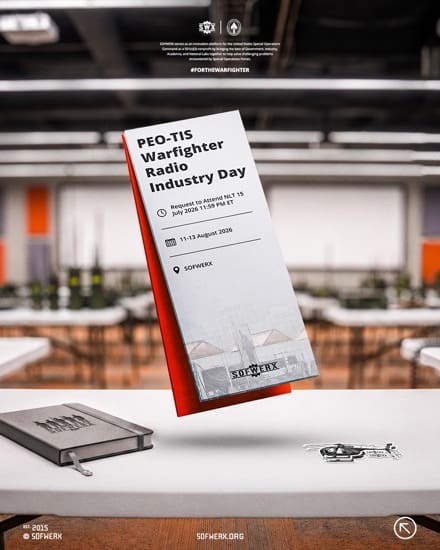
SOFWERX – PEO-TIS Handheld High Frequency Radio Industry Day

Thursday, February 5th, 2026

SOFWERX, in collaboration with USSOCOM Program Executive Office Tactical Information Systems (PEO-TIS), will host an Industry Day on 3 March 2026, to gain a better understanding of the current market and the technical capabilities of Handheld High Frequency (HF) Radio systems. 


USSOCOM has a critical need for reliable and secure Beyond-Line-of-Sight (BLOS) communications for dismounted warfighters operating in a variety of challenging environments, including areas with limited or no satellite coverage. Handheld HF radios are a key component of our communications strategy, providing a resilient and autonomous solution for long-range voice and data transmission.

This event is seeking information on handheld HF radios that are currently available or could be readily adapted to meet USSOCOM’s operational requirements. PEO-TIS is interested in capabilities that are lightweight, rugged, and offer advanced features to enhance communications in contested environments.

Request to Attend NLT 11 February 2026 11:59 PM ET

U.S. Citizens Only

U.S. Companies Only 

For more information, visit events.sofwerx.org/peo-tis-handheld-hf-radio-industry-day.

Draganfly Selected to Provide Draganfly Flex FPV Drones and Training to US Air Force Special Operations Command Units in Partnership with DelMar Aerospace

Monday, February 2nd, 2026

Tampa, Fla. —  February 2, 2026 — Draganfly Inc. (NASDAQ: DPRO; CSE: DPRO; FSE: 3U8A) (“Draganfly” or the “Company”), an award-winning developer of drone solutions, software, and robotics, today announced an award to provide Flex FPV Drones and Training to U.S. Air Force Special Operations Command units with partner DelMar Aerospace Corporation, a leading provider of advanced uncrewed aircraft systems (UAS) training, tactics, techniques, and procedures (TTPs), for U.S. Government customers. 

The partnership with DelMar brings together Draganfly’s operationally proven uncrewed platforms with DelMar Aerospace’s expertise in delivering cutting-edge, mission-relevant UAS instruction to Government operators. Initial training activities include First Person View (FPV) UAS instruction, with a comprehensive curriculum covering FPV assembly, repair, flight operations, advanced mission planning and execution. 

The award is to provide foundational FPV training with Draganfly Flex FPV Drones to U.S. Air Force Special Operations Command units. Training will take place at DelMar Aerospace’s Camp Pendleton UAS range training facility, a controlled environment purpose-built to support advanced instruction that replicates a range of battlefield scenarios. The first training cohort is scheduled to begin in mid-February. 

Draganfly’s Flex FPV serves as the modular backbone for future small UAS configurations, uniquely capable of meeting evolving Department of War operational requirements. The Flex FPV’s innovative design enables rapid transition across operating profiles, allowing a variety of flight characteristics and payload capacities to be deployed with a single unit. This adaptability enables widespread adoption via a common training and sustainment baseline while providing a unique and compelling value proposition to any tactical drone program.

 “Our shared focus is on readiness and combat capability,” said Cameron Chell, CEO of Draganfly. “Partnering with DelMar Aerospace helps ensure operators are training on systems and tactics designed for real-world conditions, with the Flex’s modularity and reliability required to adapt as missions and threats evolve.” 

DelMar Aerospace will lead instruction delivery, curriculum development, and standards alignment, ensuring training remains tactically relevant while compliant with U.S. Government contracting and security requirements. 

“This collaboration is about developing operators who are prepared to employ uncrewed systems effectively in demanding environments,” said Stanley Springer, DelMar Aerospace’s Chief Operating Officer. “Our focus is disciplined training grounded in combat-proven TTPs and operational realism.” 

This announcement reflects ongoing work in support of U.S. Government programs. Specific operational details are not being disclosed.