FORT BENNING, Ga. – One clear morning a few months ago, among the tall pines and broad sprawl of Fort Benning, 1st Sgt. Kevin L. Sipes phoned someone he knows over at the big unit here that trains Soldiers for the Infantry.
It was late March, a time when the COVID-19 pandemic had brought restrictions on military travel. Many newly-trained Soldiers were on hold, waiting to be shipped to their first units.
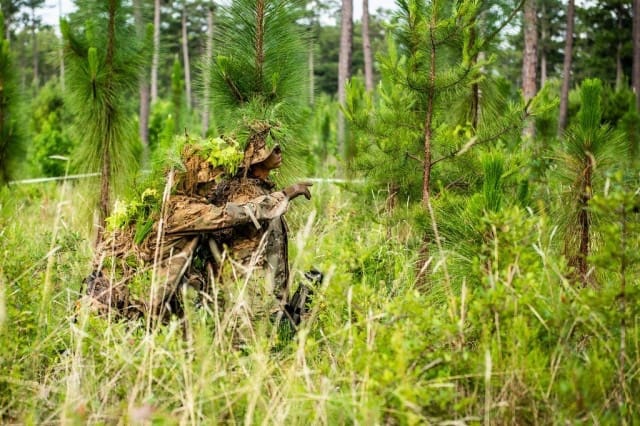
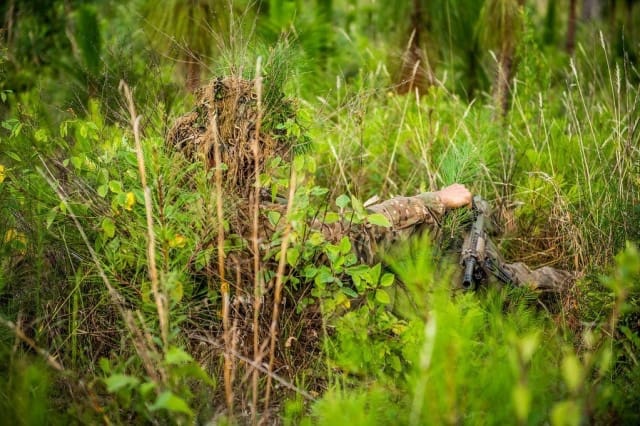
Sipes had an idea on how Fort Benning could help the whole Army, by adding to the quality of its sniper units. Snipers are exceptionally good marksmen. They’re specially trained in spotting and killing enemy targets, ideally on the first shot. They’re also trained to gather eyes-and-ears battlefield intelligence that can help commanders manage the fight.
Fort Benning’s U.S. Army Maneuver Center of Excellence trains them through its seven-week U.S. Army Sniper Course, which is part of MCoE’s U.S. Army Infantry School here.
He’d had the idea for about two years, long before the pandemic. But “it kind of got put on the backburner,” he said.
“Then the COVID situation happens, and there were trainees that were here on Benning that weren’t going anywhere for a while,” said Sipes. “COVID-19 was sort of the catalyst to make it happen,” he said. “It was sort of a no-brainer.”
So, he thought, now’s the time for another try.
The call was to Sgt. Maj. Vincent M. Lewis, operations sergeant major of the 198th Infantry Brigade. The brigade runs Infantry One-Station Unit Training, or OSUT, which trains Soldiers to serve with the Infantry.
Sure, said Lewis, come on by.
With Sipes was Capt. Zach Lemke. Lemke commands Charlie Company, 1st Battalion, 29th Infantry Regiment, 199th Infantry Brigade. Sipes is the company’s first sergeant. It’s Charlie Company that runs the Sniper Course.
“We popped in – ‘Hey good to see you’ – and got right to the point,” Sipes said.
He made the pitch to Lewis: How about giving new Infantry OSUT Soldiers the chance to volunteer for sniper training while they’re still right here at Fort Benning?
Sipes recalls Lewis’ answer: “‘He said, ‘Man, that sounds like an awesome idea. How do you plan to do it?'”
“We talked about it for about 30, 45 minutes, just laying out the groundwork for what we we’re trying to accomplish,” Sipes said.
Their idea, Sipes told Lewis, was to offer Infantry OSUT Soldiers a chance to volunteer for a kind of five-day tryout for the formal, seven-week Sniper Course. It would condense the course to key sniper basics.
“Obviously, if you go to a basic training company full of privates and you asked, ‘How many of you wanna go to sniper school?’ every single one of ’em’s gonna raise their hand, basically, I would assume.” – Capt. Zach Lemke, commander, U.S. Army Sniper Course, Fort Benning, Georgia
We’d put them through the training, he told Lewis, and if they show the right degree of mental sharpness and other aptitudes, we’ll send them on to the Sniper Course.
Then, if they made the grade in the Sniper Course, those recent OSUT graduates would arrive at their new units sniper-qualified, and stamped virtually from the start of their Army service formally schooled in the best, state-of-the-art, sniper skills and methods.
Infantry units may train their own Soldiers to serve in their sniper squads, but they sometimes decide they want to send a Soldier to Fort Benning for formal sniper training at the Sniper Course’s level of quality. Taking some of the Army’s newest Soldiers and putting them through the Sniper Course – especially while they’re here already – would be “a win-win,” Sipes said.
“The units won’t have to work as hard to train a Soldier,” he said. “They are ready to succeed on day one. The only thing they lack is experience within the job, but that can be done through training. They’ve met the requirements. They know how to perform the specialized tasks. Now they just need the experience that comes from working in that organization.”
Lewis took it to the brigade leadership, Sipes said, including Command Sgt. Maj. Ronnie E. Blount Jr., who in turn discussed it with Col. Dave Voorhies, the brigade’s commander at the time.
“They came back and told us we were good to go,” said Sipes. “It took about a week to 10 days to get the final approval on it. We created the schedule, sent it over to them.”
The 198th helped with finding volunteers, said Lemke.
The brigade’s drill sergeants formed up the trainees, Lemke said, told them there was a chance to try out for the Sniper Course, then asked for a show of hands. Among Soldiers who’d enlisted for the Infantry, the chance to specialize as a sniper had warrior appeal. Hands went up.
“Obviously,” said Lemke, “if you go to a basic training company full of privates and you asked, ‘How many of you wanna go to sniper school?’ every single one of ’em’s gonna raise their hand, basically, I would assume.”
To be considered, candidates while in OSUT would have to have gotten the highest possible marksmanship score, which is “Expert,” and have a score of at least 270 on the Army Physical Fitness Test, or APFT. And they’d have to be in the Army’s Infantryman job category, which it codes administratively as 11B, commonly referred to as 11 Bravo.
The brigade’s drill sergeants jotted their names and sent forward a list of 20 who met the requirements, said Lemke.
“We got a list of names probably within the next 48 hours,” said Sipes, “and then we went and picked them up and started to train ’em. So from flash to bang was probably 18 days or so.”
They’re calling the five days’ training the OSUT Soldier Sniper Assessment, Lemke said.
Charlie Company instructors teach the sniper-hopefuls how to spot targets, how to estimate the distance from themselves to the target, how to gauge the wind’s movements so they can adjust for it in taking their shot, how to use a sniper’s high-tech optical gear to trace the path of a shot. They’re also taught basics of stalking a target, and are tested on their ability to fire the M110 sniper rifle, using live ammunition.
But throughout the five days the trainers also put a keen eye on whether a candidate has the “cognitive ability” to absorb the instruction, including its many technical fine points, and then apply it all properly,” Sipes said.
Sipes consulted a sports psychologist who works at Fort Benning for tips on how best to evaluate each candidate’s “ability to receive new information, learn how to apply it, apply it, and then work to improve performance in the future,” he said.
Charlie Company ran the first assessment April 20 – 24 and a second May 11-15.
Ten OSUT Soldiers went from the Assessment into the Sniper Course’s Class 4, which ran April 27 to June 12 and started with a total of 47 students. Fourteen graduated, four of them OSUT Soldiers who’d gone through the Assessment. Two OSUT Soldiers washed out and the remaining four were allowed another try, in Class 5, which began May 18 and ends July 2, Lemke said.
As the time approached to run another Sniper Assessement, the 198th sent Charlie Company another list of 20 candidates.
Class 5 started with a total of 36 students and is now at 29, 11 of them OSUT graduates who had gone through the Assessment, Lemke said.

Lemke and Sipes think the results of Class 4 – four out of 10 OSUT Soldiers who were still virtual rookies to the Army making it to Sniper Course graduation – suggests the effort to seek sniper candidates from Infantry OSUT right at Fort Benning, has big potential.
“And that’s only gonna improve over time as we master how we assess them and select,” said Sipes. “That was our first two attempts, he said of the OSUT-Sniper Assessment-Sniper Course. effort. “We’ve taken notes on how to improve it and it’ll only get better.”
But that wasn’t the only encouraging sign, Lemke and Sipes said.
Of those four OSUT graduates who completed Class 4, two achieved special distinction: one received the Top Shot award for highest marksmanship scores in the class. Another took the Fieldcraft Award for top grades in stalking, target detection, and range estimation, Lemke said.
“We have these Soldiers here, on post, already,” said Sipes, “that are brand new, hungry, they’re physically fit. They’re already in that training mindset.”
“We can see the potential of these Soldiers immediately out of OSUT,” said Lemke, “we can measure it, train them, and the send them to the force ready. That’s an extremely important thing for the Army.
“This allows us to take a lot of the training burden off of units,” Lemke said. “I can send a Soldier onto his next duty station already sniper-qualified, and that unit doesn’t have to make any other investment and send them back to Fort Benning. They don’t have to reinvent the wheel. He’s coming straight out of OSUT, receiving that training and then arriving at your unit, ready to perform that duty.”
“If this program can continue and we continue to send out qualified snipers to the force,” said Lemke, “this helps build the sniper capability in our Army.”
By Franklin Fisher, Fort Benning Public Affairs