FirstSpear TV

Archive for the ‘weapons’ Category

British Army Seeks New Special Operations Brigade Rifle

Saturday, August 7th, 2021

Earlier this year the UK Ministry of Defence announced the formation of a “Ranger Regiment” which will be the core of a new Army Special Operations Brigade.

One interesting feature of this new unit is that it will not be issued the SA80 bullpup pattern L85A3 currently standard issue for UK forces. Instead, the MOD has issued a tender for a “Armalite Rifle (AR) platform Alternative Individual Weapon (AIW) System.” Sure, it’s a new rifle for the Bristish Army, but this isn’t as big of an issue as some might claim, considering certain UK Special Forces units already use several alternative rifles and the Royal Marines have adopted the Colt Canada C8.

The AIW system will consist of:

1. A Rifle System (comprising of a Rifle and Signature Reduction System); and

2. An Optic System

The AIW system will be a 5.56mm Armalite Rifle (AR) platform, optimised for use with L15A2, a 62gr 5.56×45 NATO ball round, equivalent to SS109. For the purposes of this tender, an AR platform is defined as being gas operated with a rotating, locking bolt.

The rifle should have a non-reciprocating charging handle.

The rifle’s controls are to include: a magazine release, working parts release and a rotating selector lever that incorporates a safe setting.

The rifle is to have a standard configuration, not bullpup, with the magwell in-front of the trigger housing.

The rifles upper and lower are to be mated using industry standard pivot / takedown pins located at the front and rear of the lower receiver.

Signature Reduction System: The Signature Reduction System is to be detachable, to enable the operator to configure the Rifle System to meet operational requirements.

Optic System: The Optic system is to complement the Rifle and should be ballistically matched to the stated ammunition nature and supplied barrel length.

Offerors, which are referred to as Economic operators, may only submit a Rifle System from one OEM and an Optic System from one OEM. The Rifle and Optic do not have to be the same OEM.

This is a relatively short notice tender. Economic operators only have until 18 August to submit their basic proposals. The MOD will then evaluate proposals and select a maximum of six Economic operator systems to evaluate with a minimum quantity of 88 and maximum quantity of 528 AIW per type.

The MOD states that anticipated delivery of the trial AIW Systems to a UK MOD Location is required by December 2021 or March 2022 at the latest.

One successful economic operator will be awarded a contract for the Rifle and One successful economic operator will be awarded a contract for the Optic. This could be the same economic operator being awarded the contracts for the Rifle system and Optic system to enable the Authority to procure the Full Operational Capability (FOC) circa 3,000 systems with options for the Total Fleet Requirement circa 10,000 Systems for a period of 10 years.

Warrior East 21 – SIG SAUER MHX

Thursday, August 5th, 2021

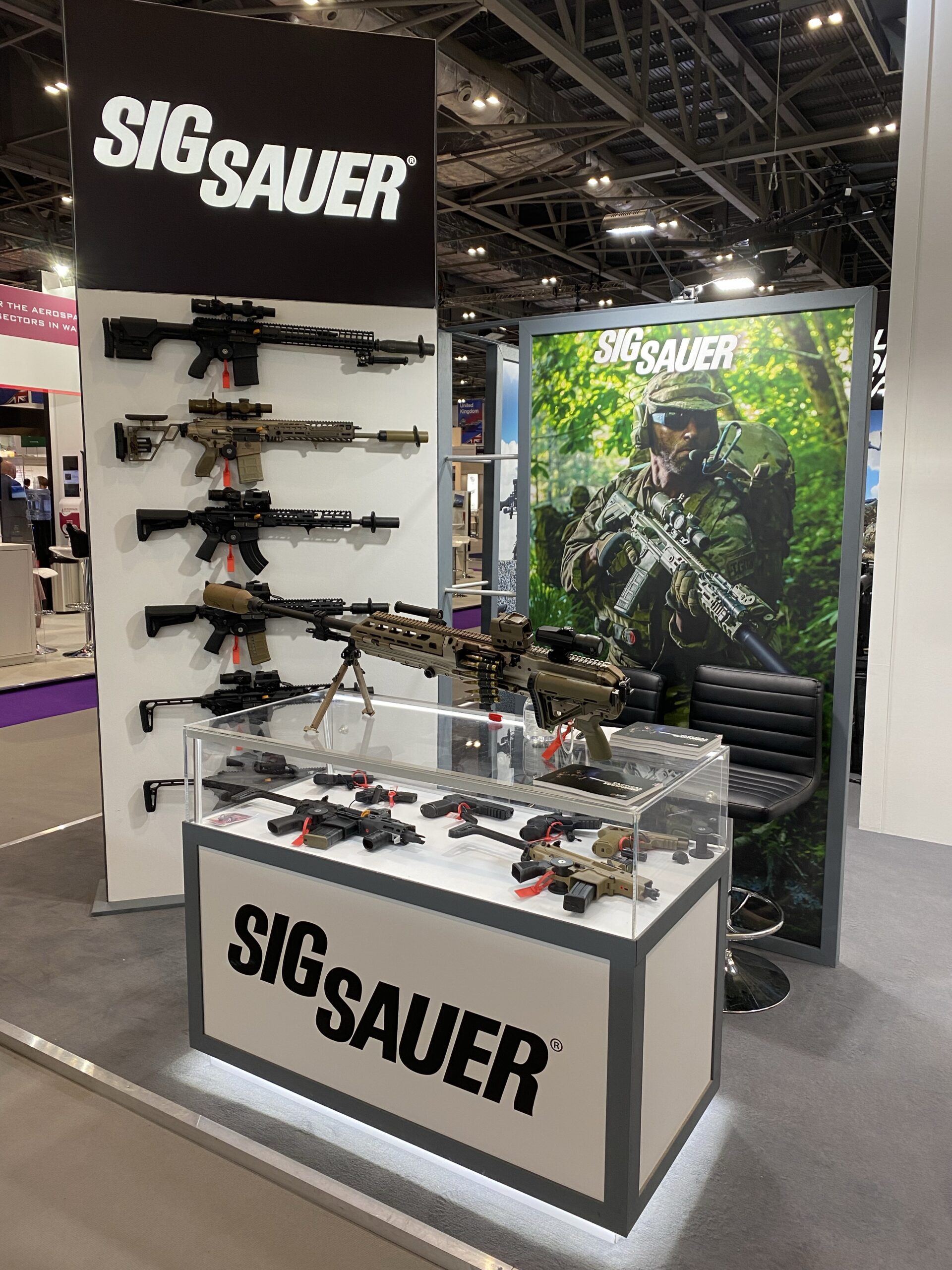
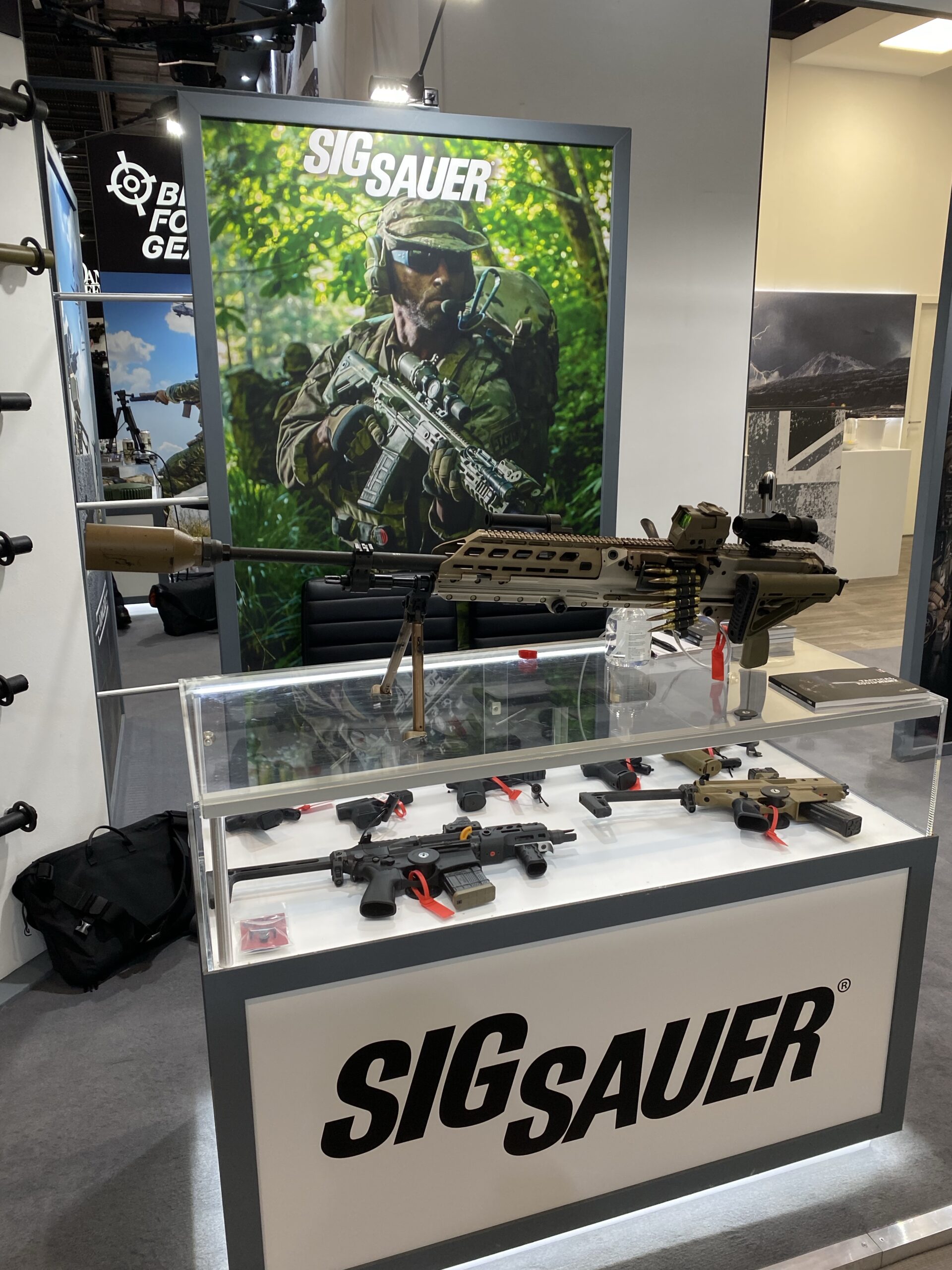
When the Army selected the SIG P320 as their new Modular Handgun System, they truly adopted a modular system. The serialized part is the Fire Control Unit and everything else can be swapped out. Already, several organizations have considered ways to use this modularity, like Air Force Office of Special Investigations which wants a sub-compact carry pistol.

At Warrior East, SIG displayed a simple brown box which, when opened, contained the parts needed to convert a standard MHS M18 into an “MHX”, based on SIG’s X-Carry configuration. This kit is based on the OSI requirement for an M18 Gun Conversion Kit, but the reality is that there is a wide variety of OEM and after market parts and accessories which will work with the P320 platform to make it more effective for certain applications. For instance, you’ll note that while MHS is Coyote on color, OSI desires a Black pistol, to blend in better with their plain clothes, law enforcement role.

Expect more organizations to swap parts on their MHS as they complete fielding and units become more comfortable with the platform and what it can do.

Units and agencies can procure SIG products shown during Warrior East by contacting Atlantic Diving Supply.

EOS Demonstrates Precision Firepower

Tuesday, July 27th, 2021

Huntsville, Alabama – EOS Defense Systems USA, Inc. (EOS DS USA), successfully demonstrated the precise lethality of its Remote Weapon Stations (RWS) to U.S. Military observers at the Crew Served Weapons (CSW) Industry Range Day event on Red Cloud Range, Fort Benning, Georgia, July 14-15, 2021.

The first-time event, which included a live fire and static display, was sponsored by the office of the Product Manager, Crew Served Weapons, from Picatinny Arsenal, New Jersey, and included participation from members of the U.S. Army, Air Force, Marines and SOCOM.  

EOS R400 with M230LF and Javelin ATGM

CEO of EOS DS USA, Retired Brigadier General Phil Coker said, “We appreciate the innovative approach offered by the team from Program Executive Office Soldier Lethality and their willingness to host industry in this outstanding event.”

EOS took full advantage of this unique opportunity to showcase its world class RWS systems by mounting two medium-gimbal R400S RWS on HMMWVs, one firing the Northrop Grumman percussion-primed M230LF, 30x113mm cannon and the other the Dillon Aero M134D, 7.62mm Gatling Gun.  EOS also displayed the light-gimbal R150S RWS, mounted on the Polaris DAGOR, firing the M2, .50 caliber heavy machine gun and capable of supporting the Javelin anti-tank guided missile (ATGM).


EOS R400 with Dillon M134D

The R400S / M230LF combination was the only 30mm system demonstrated to achieve first round hits on every target out to the maximum distance available on the range. It demonstrated EOS’ signature RWS precision by placing accurate bursts, at high-rate of fire, on successive targets at multiple ranges. The R400S also demonstrated how it transforms the Dillon M134D into a devastating point engagement system.  By precisely applying the Dillon M134D‘s trademark firepower the R400S reduces rounds expended and increases stowed kills.

EOS R400 w/ M230LF Engaging Targets

Coker stated, “This inaugural event that gave us an opportunity to showcase the EOS family of Remote Weapons Stations.  The R400S provides the U.S. Military with a critical capability in the modern, near-peer fight allowing for the employment of precise medium caliber firepower to counter potential future adversaries on the battlefield. At the same time, the R150S provides a fully stabilized platform with high end day/night sensors for light and ultra-light mobility platforms. The R150S is designed to mount next generation weapons and enhance the lethality and survivability of specialized formations.”  

EOS R600MC RWS

EOS also exhibited, for the first time, its R600 Missile Carrier (R600MC) in the static display area. This unique platform provides to the U.S. Warfighter a medium-caliber cannon RWS with the added anti-armor punch of four, ready to fire, Javelin missiles (2 x twin missile pods on either side of the RWS). This prototype system, in development with the cooperation of the Javelin Joint Venture, aims to provide mechanized elements with the firepower to engage multiple armored threats. EOS plans to conduct a live fire evaluation of this system at the end of 2021.

EOS Defense Systems USA, Inc., headquartered in its 80,000 ft2 manufacturing facility in Huntsville, Alabama, and its Australian parent company, Electro Optic Systems Pty Ltd have been providing industry leading RWS systems to allied and partner nations’ security forces for more than 30 years, including the delivery of the R400S and R150S to the Australian Defence Force in support of the Land 400 Phase 2 and 3 programs.

eosdsusa.com

U.S. Army Live-Fire Exercise at Fort Benning Demonstrates Future Lethality of Kongsberg Remote Weapon Systems

Friday, July 16th, 2021

Kongsberg systems still superior in accuracy, reliability and network capabilities

JOHNSTOWN, PENN., July 15, 2021 – During a multi-day demonstration at Fort Benning, Georgia, KONGSBERG Defence and Aerospace used four different remote weapon systems to demonstrate future lethality and cutting-edge capabilities which can be leveraged by the more than 17,000 systems already fielded in the U.S. military’s current inventory. This also was the first ever demonstration where multiple targets were engaged using multiple unmanned platforms simultaneously.

The ground-breaking demonstration was held at the U.S. Army Maneuver Center for Excellence and spanned July 14-15, 2021. Two light combat vehicles and two unmanned ground vehicles were each equipped with different configurations of the KONGSBERG CROWS-Javelin (CROWS-J) and Protector RS6 Remote Weapon Station (RWS), all while networked to one another through the Common Protector Interface (CPI), the standard in remote lethality architecture for U.S. Army and U.S. Marine Corps remote weapon systems.

“KONGSBERG remote weapon systems are powerful force multipliers, especially with the addition of Multi-User, Multi Station (MUMS) capabilities and network advancements that bring incredible value to the U.S. military and allied forces as we continue to earn and prove our position as the remote weapon system of choice for deployment across a broad range of platforms,” said Scott Burk, vice president of Business Development at KONGSBERG Defence and Aerospace. “Our continued investments in the architecture and platforms overall maximize the U.S. military’s current inventory, training and provisioning while providing groundbreaking advancements in capability. We wanted to demonstrate new capabilities – rather than competencies we’ve long ago qualified for the Department of Defense – and we are pleased the engagements were flawless.”

QinetiQ North America’s Robotic Combat Vehicle-Light (RCV-L) unmanned vehicle was among the platforms used, demonstrating advanced network lethality capabilities and innovations that meet the needs of the Army and other customers well beyond the next decade. The CROWS systems also simultaneously demonstrated Tech Refresh’s backwards compatibility with legacy CROWS systems.

Further, KONGSBERG continued to showcase its PROTECTOR RS6 platform by successfully firing XM914 (30x113mm) from a lightweight, Flyer Defense Ground Mobility Vehicle (GMV). The RS6 RWS is the system selected by the U.S. Marine Corps for the Marine Air Defense Integrated System (MADIS) program. This firing followed immediately after the successful firing of Javelin anti-tank missiles from the same systems for the US Army at Redstone Arsenal in Alabama in May. This further validates the inherent flexibility of the RS6 design, which allows users to address a broad range of threats and operational needs – C-UAS, SHORAD, ATGM, Maneuver Support, Manned / Unmanned Teaming (MUM-T) – from a single system.

With more than 20,000 systems delivered worldwide and 14 years of CROWS experience, KONGSBERG will continue to support the soldiers with new systems, capabilities and features meeting tomorrow’s requirements while maintaining, supporting and keeping up to date a wide range of CROWS variants and support equipment. All CROWS and RWS systems are produced in the KONGSBERG Johnstown, PA facility. Continuing the execution of this contract secures 3,000+ jobs, both directly and through the KONGSBERG U.S. supply chain. With systems sold to 26 nations, KONGSBERG is the world-leading provider of remote weapon stations.

The Special Relationship Between the Israeli Special Forces & Barrett Firearms

Monday, July 12th, 2021

Over the past decade the Israeli Special Forces (SF) and Barrett Firearms have developed a special relationship leading to early adoption of Barrett models as well as the introduction of unique variants.

Barrett weapons first entered service in Israel in the early 1990’s when the Israeli Defence Forces (IDF) SF procured few M82A1 samples for remote EOD work. Few years later in the mid-1990’s the weapon was mass issued to both regular and special units as an anti-material weapon. A decade later in 2008, the IDF adopted the H-S Precision Pro Series 2000 0.338LM as its first standard large caliber sniping platform, and most M82A1 was taken out of service.


IDF sniping platforms on display. Left – a Barrett M82A1, right – an H-S Precision Pro Series 2000 HTR (photo: IDF).

In the early 2010’s, YAMAM, Israel’s Tier 1 domestic counter terrorism and hostage rescue unit, was seeking a standard multi-caliber platform to replace a wide variety of sniping rifles used at the time, including PGM 7.62mm and 0.338LM rifles. With European manufactures’ continuous reluctance to provide small arms and subsequent parts support to Israel due to political reasons, the preference was to procure a U.S. made weapon. Eventually, in 2013 YAMAM selected the MRAD, making YAMAM one of the first units in the world to adopt it, alongside the Norwegian Special Forces, and years before its adoption by the U.S. military as the MK22.


YAMAM sniper armed with a Barrett MRAD during training (photo: IDF)

Few years later, the IDF SF were looking to replace both the H-S Precision Pro Series 2000 0.338LM, which was found to be less than ideal for hard military usage as well as the aging M24, which entered service in 1996 as the IDF standard issue 7.62mm sniper platform and was worn out after 20 years of intense service. Informed by the YAMAM successful experience MRAD, the IDF selected it, with the first rifles entering service in 2017.


IDF SF sniper armed with a Barrett MRAD during training (photo: IDF)

At the same time, the IDF SF had a unique need for a new integrally suppressed sniping platform. The platforms used at the time such as the PGM, were aging and lacking in parts support due to their European origin. The IDF SF approached Barrett with the problem, and within a short period of time Barrett provided a unique integrally suppressed variant.


IDF integrally suppressed Barrett MRAD on display (photo: Israeli MOD).

Finally, in recent years the IDF SF were looking to replace the KAC SR25 that entered service in the early 2000’s as a short-medium sniping / DMR type rifle, and were worn out after 20 years of intense service. Again Barrett proved to be a responsive partner and fast tracked its yet to be released REC10 7.62mm platform for trials. The IDF indeed ending up selecting the REC10 with the first SF units being issued the platform in 2020.  


IDF Counter Terror School Instructor armed with a Barrett REC10 during training (photo: IDF).

With the adoption of the MRAD and the REC10, which are currently gradually replacing the H-S Precision Pro Series 2000, the M24 and the SR25 in service with the IDF SF, Barrett-made rifles are well positioned be the primary sniping platforms used by the IDF SF for years to come. It is still to be seen if either platform will be adopted and issued to regular IDF units, but as common with many militaries, weapons and gear initially used exclusively by SF units are sometimes cascaded to regular units few years later.

Daniel is the editor of www.isayeret.com, a website dedicated to the Israeli Special Forces community, including units, weapons and gear.

SOFWERX – SOF Small Arms Weapons Assessment Event Series

Monday, July 12th, 2021

SOFWERX, in collaboration with USSOCOM PEO SOF Warrior (PEO-SW), will host a series of Assessment Events (AE) to identify solutions for:

1) Lightweight Machine Gun Medium (LMG-M)

2) Medium Range Gas Gun – Assault (MRGG-A)

3) Medium Range Gas Gun – Sniper (MRGG-S)

USSOCOM seeks to enter into non-FAR or FAR-based agreements with Industry, Academic, and National Lab partners whose solutions are favorably evaluated by USSOCOM PEO-SW Subject Matter Experts. As such, the AE is considered competitive in the same manner as a Broad Agency Announcement (BAA) or Commercial Solutions Opening (CSO), and solutions will be evaluated independently of one another primarily for technical merit.

It will consist of four phases:

Phase 1 – 09 July 2021 to 02 August 2021 Submissions to the Assessment Event (AE)

Phase 2 – 03 August 2021 to 10 August 2021 Downselect

Phase 3 – 31 August 2021 to 02 September 2021 Assessment Event (AE)

Phase 4 – Path Forward

Only Phase 4 is a live fire event. Up until that point, only technical merits will be evaluated so have your paperwork together. The performance spec for each weapon is coated at the links above.

SOCOM is kicking all of these AEs off simultaneously so they’ll have their hands full. If you plan to submit weapons to more than one category, or multiple candidates for any of the weapons sought by SOCOM, you must submit separate packages for each one. Additionally, you must submit by 2 August.

Quite frankly, the 338 NM Lightweight Machine Gun Medium is the greatest improvement in US small arms capability in over half a century. Not only is SOF interested, but so is the Marine Corps. Although the Army is currently concentrating on next generation squad weapons, this capability for the Platoon is just a few years out. This is the opportunity to get your solution evaluated.

For more information, visit events.sofwerx.org/sofweapons

Australian Army Direct Fire Support Weapon NCO Course Students Put New M4 Carl Gustaf to the Test

Sunday, July 11th, 2021

Army Headquarters staff had to shout over the burst of 7.62mm rounds coming from the adjacent range as they briefed the group of junior NCOs gathered to evaluate and qualify on the new 84mm M4 Carl Gustaf multi-role weapon system.

The students in the Direct Fire Support Weapon (DFSW) NCO course, held at the School of Infantry, were among the first to fire the shorter and lighter revamped recoilless rifle, the fourth iteration of a design that dates back to the 1940s.

The cadre of acquisition staff from Canberra visited Singleton to collect feedback after the course of 18 students had fired sub-calibre and high-explosive rounds, with the evaluations to be used to inform the rollout of 600 M4 units over the next five years.

Initial impressions of the weapon were positive, according to Lance Corporal Benjamin Wright, a 2IC in the 8th/9th Battalion, Royal Australian Regiment’s, DFSW Platoon.

“The safety catch has changed; it’s now a push-through instead of a slide,” he said.

“It’s a bit easier to get at with your thumb, easier to hit with gloves and when you’re under a bit of stress.”

Another new addition is the make-safe capability.

This locks the cocking lever from moving forward, allowing soldiers to move with the weapon at the action condition.

The make-safe condition will be added to unit standard operating procedures, according to Lance Corporal Wright.

“It will give us the ability for quicker engagements,” he said. 

“If we’re doing a tank stalk, we can load one round into the 84mm, and the number two can still have his three rounds on his back.”

Other differences include the weight and length of the weapon.

The M4 is 2.6kg lighter and 6.6cm shorter than the current M3. There is also the option to fit a fire-control system to improve accuracy.

By Private Jacob Joseph, Australian Army

UVision Showcases Advanced Anti-Armor Capabilities of its Hero-120 and Hero-400EC Loitering Munition Systems

Friday, July 9th, 2021

DEFEA 2021, Athens, Greece. July 13-15. Hall 3, booth G13

Tel Aviv, July 8, 2021. Uvision Air Ltd. – a global leader in Loitering Munitions Systems of all sizes for a variety of missions – will present its Hero-120 and Hero-400EC Loitering Munition systems with anti-tank capability, providing an all-inclusive solution for countering MBTs (main battle tanks). Hero Loitering Munition systems provide an accurate, effective, and highly lethal response to hard targets, and are able to locate hidden targets, track them and attack at significantly longer ranges than commonly available anti-tank guided missiles (ATGM).

As members of the HERO series of loitering munition systems, both the Hero-120 and Hero-400EC can carry multi-purpose warheads for extended lethality against a wide range of targets, as well as having unique attack capabilities from any direction and angle, including top attack. With long-endurance and low acoustic, visual and thermal signature, the systems can locate, track and strike static and moving targets with pinpoint accuracy. The ability to launch Loitering Munitions from a remote-controlled multi-canister launcher provides effective deployment of the Hero systems from a variety of platforms – air, land and sea – away from enemy lines.  

“Uvision develops and delivers the most advanced & innovative Loitering Munition systems today,” says Major General (Ret.) Avi Mizrachi, CEO of Uvision.  We are happy to participate in DEFEA for the first time, as part of our mission to strengthen our presence within the clients in the region. We anticipate that this exhibition will pave the way for new collaborations in the area.”

At DEFEA, Uvision will feature the following systems (Hall 3 booth G13):

Hero-30 Loitering Munition System- developed and manufactured by Uvision, the Hero-30 incorporates a high level of precision attack and abort capabilities. This simple-to-operate system enable front-line forces to initiate operations, as well as to respond to any enemy target or threat that arises, and eliminate it with extreme accuracy.  The Hero-30’s advanced capabilities include striking targets with high tracking precision and lock-on, a last-second-mission-abort, and re-engagement for a second attack attempt or change of target. Its versatile installment configurations (man-packed, vehicle mounted or stationary) make it ideally suited to a diverse range of operational scenarios. 

Hero-120 Loitering Munition System – a mid-range, anti-armor loitering munition system which meets the complex requirements of the modern battlefield.  Hero-120 is a high-precision smart loitering munition system with a unique aerodynamic structure that carries out pinpoint strikes against anti-armor, anti-material and anti-personnel targets, including tanks, vehicles, concrete fortifications, and other soft targets in populated urban areas. The Hero-120’s high-precision capability ensures minimal collateral damage. Its wide range of multi-purpose warheads enables the operational user to  effectively engage all targets.

Hero-400EC Loitering Munition System – a long-range, high-precision loitering munition system with a low acoustic, visual and thermal signature that can locate, track and strike static and moving targets with high accuracy, and minimal collateral damage. Precision strike capabilities, extended endurance of up to two hours, and a multi-purpose warhead ? including concrete piercing, anti-tank, and anti-personnel that handle different types of targets with exceptional accuracy ? enable long-range and versatile missions. Due to its exceptional maneuverability, the Hero-400EC provides an advanced mid-air abort capability that enables automatic re-entry into loitering mode, re-engagement, or return to the recovery area using a parachute.

Hero Training and Simulation System – realistic virtual training for the Hero series of Loitering Munitions. With three configurations – classroom, portable and embedded in the operational control unit – presents a comprehensive solution for Hero operators, enabling a higher level of training flexibility. The classroom configuration provides a robust simulation solution with a rich and versatile scenario generator for multiple trainees. The portable and embedded field simulator configurations give Hero operators continuous hands-on training, at various levels, during deployments, maintaining the highest level of operational proficiency and readiness – anytime, anywhere.

www.uvisionuav.com