FirstSpear

Archive for the ‘weapons’ Category

Special Operations, 82nd Airborne Snipers Test New Modular Precision Rifle at Bragg

Saturday, September 25th, 2021

FORT BRAGG, North Carolina — Operational testing of the Army’s newest generation sniper system — the MK-22 Precision Sniper Rifle (PSR) — marks the project’s final hurdle before fielding.

“The modular nature of the PSR allows it to be tailored to meet mission requirements and is appealing to airborne Snipers who are typically armed with long-barreled precision rifles of a single caliber offering,” said Sgt. 1st Class Marcus Love, Airborne and Special Operations Test Directorate, Test Noncommissioned Officer.

Because of the single-caliber offerings, snipers requiring additional capabilities must deploy with additional weapons. The PSR can be configured for multi-calibers by the Sniper in the field and requires no higher level maintenance to reconfigure. It will also extend engagement ranges for both anti-material and anti-personnel target engagements.


“The increased engagement range will keep Snipers safer and increase the options for the local commander employing these combat multipliers,” said Sgt. Austin Stevens, a Sniper assigned to the 1st Battalion, 325th Airborne Infantry Regiment, 2nd Brigade Combat Team, 82nd Airborne Division.

“With a folding stock and removable suppression system, the PSR will provide airborne Snipers a more compact load during airborne infiltration operations without reducing their lethality while providing a precision rifle platform more conducive to their combat environment,” said MK-22 Project NCO Sgt. 1st Class Jonathan Copley.

Spc. Michael Liptak, a Sniper with Headquarters & Headquarters Company, 2nd Battalion, 325th Infantry Regiment immediately identified the attributes of accuracy in regards to the MK-22. “I was surprised at the accuracy and the straightforward approach to testing the PSR,” he said.

Prior to testing, Snipers from across the airborne and special operations community took part in new equipment training which included familiarization with the system, maintenance, target engagement, system configuration and zeroing procedures.

For Spec. Nathanael Keffer, a Sniper with 2nd Battalion, 508th Infantry Regiment, the PSR’s versatility to adapt to multiple mission sets was a marked advantage. “The PSR is a very versatile weapon system that can be tailored to meet multiple mission requirements,” said Keffer.

Mr. Larry Harris, ABNSOTD Deputy Chief of Test said, “The critical task in testing any small arms platform intended for use by airborne forces is ensuring zero retention of the primary optic subsequent to airborne insertion. “This is a critical gauge of the Paratrooper’s lethality during airfield seizure and other follow-on operations.”

To evaluate this performance measure of the PSR, the ABNSOTD test team applied the organization’s mobile weapons boresight collimator to the rifle after jumping to make sure the Sniper’s pre-mission zero was not degraded by shock during the jump.

“This process establishes a baseline for sight reticle locations prior to and post airborne insertion,” said Miles Crawford, Test Technology Branch Chief, ABNSOTD. “Testers can monitor any shift in the weapon sight reticle that may have been induced by shock associated with static line parachutes,” Crawford said.

Story by Mr. Mike Shelton, Airborne and Special Operations Test Directorate, U.S. Army Operational Test Command

Photos by Mr. James Finney, Audio Visual Production Specialist, Base and Test Support Services contractor

US Navy Selects Kongsberg to Help Develop Autonomous Target Recognition for USMC Weapon Systems

Friday, September 24th, 2021

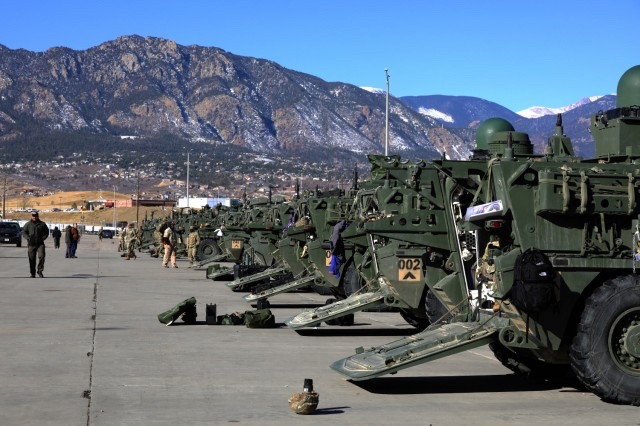
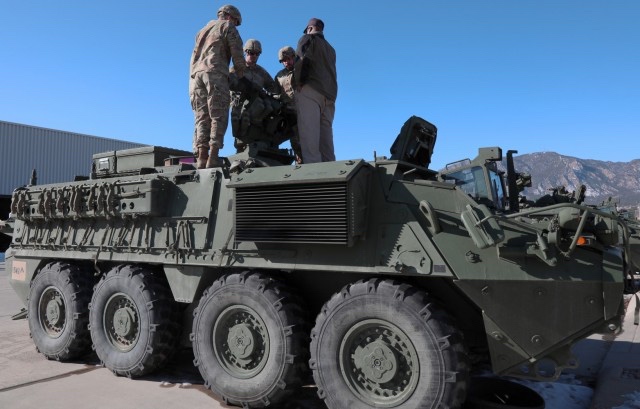
JOHNSTOWN, PENN., Sept. 23, 2021 – The U.S. Naval Surface Warfare Center, Dahlgren Division (NSWCDD) and Kongsberg Defence & Aerospace have signed a Cooperative Research and Development Agreement (CRADA) to demonstrate a weapon system with autonomous target identification, recognition and engagement. NSWCDD develops the Automated Remote Engagement System (ARES) that increases the efficiency of remote weapon systems and remote turrets which will be integrated onto Kongsberg Remote Weapon Stations to evaluate technology performance at a system level and support the demonstration of a weapon system for autonomous target identification, recognition, and engagement. The common goal is to demonstrate this performance on Kongsberg’s latest weapon systems that will be fielded in the U.S Navy such as the Tech Refresh Common Remote Operation Weapon System (CROWS), the RT20 turret on the Amphibious Combat Vehicle (ACV) and the Marine Air Defense Integrated System (MADIS).

Kongsberg’s selection for the CRADA follows on the heels of several other Marine Corps programs started in the last two years. In addition to the fielding of CROWS on ACV and the Amphibious Assault Vehicle (AAV), Kongsberg’s RS6 30x113mm RWS was selected for the MADIS program, its RT20 30x173mm turret was selected as the ACV medium caliber weapon system, and various Kongsberg RWS are the weapon systems on the prototypes selected for the Advanced Reconnaissance Vehicle (ARV). For the CRADA, Kongsberg is leveraging work it has already done as the remote lethality architecture provider for the U.S. Army’s Robotic Combat Vehicle (RCV) program.

Kongsberg brings more than twenty years of remote-control weapon technology of different sizes, complexity and payloads and is an ideal partner for this co-development effort with NSWCDD. While continuing to perfect its systems, Kongsberg has developed a fire control system that can be wireless operated and controlled by a robotic operator. This independently funded fire control system for RWS and medium caliber turrets is capable of interacting with ARES and will be demonstrated through this CRADA.

Kongsberg is the world’s leading manufacturer of RWS, having delivered nearly 20,000 units to more than 20 countries worldwide. Kongsberg is also the sole provider of RWS and remote turrets to the U.S. Army and U.S. Marine Corps. All RWS and remote turrets bound for U.S. customers are manufactured in the Kongsberg Johnstown, Penn. facility. The company takes great pride in its continued support to, and for the United States, U.S. employees, and U.S. supply base.    

For more information, visit kongsberg.com.

DSEi 21 – SIG SAUER

Tuesday, September 21st, 2021

SIG SAUER is represented in the UK by Edgar Brothers so despite the decreased amount of participation by American companies, they were still on hand at DSEi. Although their display was much smaller than what you’d normally see for such a major brand, there are some great unicorns in these photos.

ARMAX Journal

Saturday, September 18th, 2021

Armax is the peak international publication promoting the scholarship of contemporary arms. As a core discipline within the field of arms and armour studies, the study of contemporary arms engages with a broad range of academic areas including history (particularly contemporary, military, science, and technology history), war and conflict studies; ballistics; design and technology studies; museum studies; and forensic science.

Armax is a multidisciplinary journal publishing research from scholars around the world. In addition to full-length research articles and shorter research notes, Armax publishes book reviews, conference reports, obituaries, and other material relevant to the contemporary arms studies community. Armax is published by Helios House Press on behalf of the Cody Firearms Museum, with two issues annually.  All research submissions are double-blind peer reviewed.

To subscribe, visit www.armaxjournal.org.

DSEI 21 – Colt M5 Carbine

Thursday, September 16th, 2021

Colt, Colt Canada, and their new parent company CZ Group displayed a multitude of firearms at DSEi.

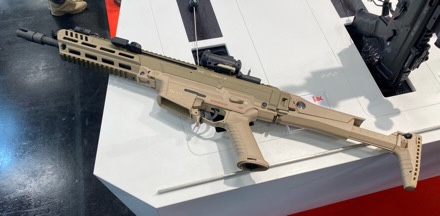
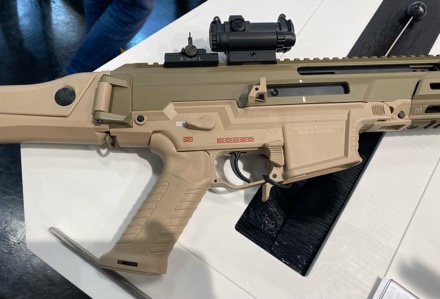
One of the weapons that caught my eye was the latest upgrade to the M4 Carbine, which Colt calls the M5. It features a completely redesigned lower receiver with full ambidextrous controls and a new upper receiver and rail design for increased rigidity, while retraining the ability to change rails, lost with a monolithic design.

Above you can see several variants.

The latest addition to the ambidextrous controls is a Bolt Catch at the right side of the Carbine which can be manipulated with fore finger or thumb.

The upper receiver has some upgrades as well. They’ve incorporated an anti-torsion lug to the upper, extending the front of the receiver. This facilitated a free float Barrel. Additionally, the Foreend is M-Lok compatible, with a Picatinny Mil Std 1913 Rail along the top.

The M5 Carbine is offered in 5.56 NATO, .300 BLK and 7.62 x 39. Barrel lengths vary depending on caliber. For instance, the 5.56 model is offered with 10.3″, 11.5″, 14.5″, 16.1″ and 20″ Barrels.

The M5 Carbine is also available in a Sub Compact Weapon configuration in 5.56mm with 10.3″ Barrel and .300 BLK with a 8.5″ and 10.5″ Barrel as well as a 9mm Sub Machine Gun with 9″ Barrel.

Beretta Launches M9A4

Tuesday, September 14th, 2021

Beretta has just announced the M9A4 which is based on the design of the 92F/M9 series with new modern features that include a red-dot optic compatible slide, a beveled magazin e well, and texturized Vertec-style thin grips.

www.beretta.com/en-us/m9a4-full-size

DSEi 21 – Aimlock RS1

Tuesday, September 14th, 2021

The Aimlock RS1 is a weapon stabilization system which can be mounted to UAS like this Alta Drone. It will accept weapons up into the .30 range and the mechanism mitigates recoil as well as facilitating aiming and remote firing. They also offer an autonomous fire control solution.

The RS1 is a miniaturized version of the RM1 seen below which will accept crew-served weapons like the M240 but all the way up to the new .338 NM guns. It can be mounted on small vehicles like the MRZR or used on a tripod in overwatch.

Aimlock systems are available in the UK from Edgar Brothers PMD.

Spectra Group Receives Another SlingShot Order from Major European Customer

Monday, September 13th, 2021

Spectra Group, the specialist provider of secure voice, data and satellite communications systems, has received an order for their SlingShot satellite communications system from an undisclosed European ministry of defence. The order is for specialist use by troops currently deployed on remote operations globally. This announcement coincides with DSEI taking place in London 14-17 September where Spectra Group will be exhibiting on stand H6-107.

Spectra Group’s SlingShot system is unique in that it can be integrated with in-service UHF and VHF tactical communications radios to extend the range from 30km to 1000(+) km on the move, in all conditions. By integrating SlingShot and Inmarsat’s L-TAC satellite service with in-service radios, the deployed troops have immediately gained communications capability that would otherwise not be available. In addition to Beyond Line of Sight (BLOS) voice, SlingShot includes a data capability supporting critical applications such as situational awareness tools; GPS tracking; reporting and other data messaging without the requirement for ground-based line-of-sight rebroadcasting infrastructure. Enabling an extension of the in-service radios with the robust SlingShot system also means that troops do not need to carry both VHF radios (for line-of-sight) and UHF TACSAT radios (for strategic rear link). With SlingShot, a single radio can carry-out both functions. Finally, the small omni-directional antennas utilised with SlingShot provide manpack, land, sea and air platforms, with real-time Comms on the Move (COTM) rather than Comms on the Pause, as experienced with traditional TACSAT systems.

In March 2021, the British Armed Forces announced that they had equipped regular Army units with Spectra Group’s SlingShot system, as they deploy on Operations and Exercises, to enable tactical satellite communications across the area of operations. At the time, Major General Jonathan Cole, Director of Information and CIO of the British Army, said: “SlingShot is a fantastic addition to our communications inventory, delivering vital capability to deployed troops. Of particular note is the fact that the training burden is minimal as the system is effectively a ‘bolt-on’ to our current BOWMAN radios. SlingShot is a game-changer in allowing our troops to operate at reach without the additional requirement to deploy more troops to provide rebroadcast capability when operating at Battle Group level and below. I am delighted to be working with Spectra on the fielding of such an important capability”.

Simon Davies, CEO of Spectra Group, said: “We are very pleased to receive yet another order from a European specialist user group. We have seen SlingShot become a battle-winning capability used by Special Forces across the globe, but we’re delighted to see our SlingShot system now being procured for use on operations by this new customer for the first time”. He added: “The beauty of SlingShot is that it can be “plugged into” any in-service tactical radio system. Numerous Armed Forces, including the British Army, are leading the way with this kind of approach to the integration of SlingShot but we’re now seeing other global forces, including the USA, adopt a similar strategy to meet every Beyond Line Of Sight communications scenario”.