SIG SAUER - Never Settle

AUSA 21 – Joint Communications Unit

October 13th, 2021

The Joint Communications Unit is a technical unit of the United States Special Operations Command charged to standardize and ensure interoperability of communication procedures and equipment of the Joint Special Operations Command and its subordinate units.

They are always seeking the best communicators in DoDs for a special duty assignment with the Joint Communications Unit.

AUSA 21 – GM Defense Infantry Squad Vehicle

October 13th, 2021

GM Defense had three versions of the US Army’s Infantry Squad Vehicle on hand which is based on the commercial Chevrolet Colorado ZR2. The ISV-5 version shown above is an new assault model.

The ISV-9 (above) is the model selected by the Army, configured to carry the squad. It incorporates a GM Duramax 2.8L turbo Diesel engine paired with a Hydro-Matic 6-speed transmission.

The final version is an electric drive variant of the ISV-5 with a hydrogen fuel cell leveraging GM’s experience of 3.2 million miles with the technology.

AUSA 21 – B&T SPC9

October 13th, 2021

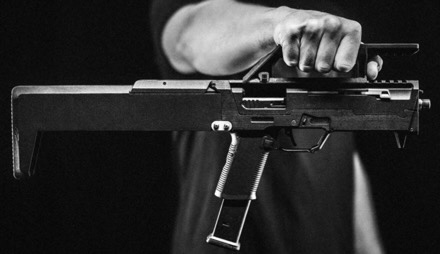
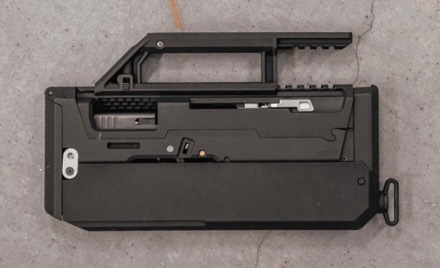
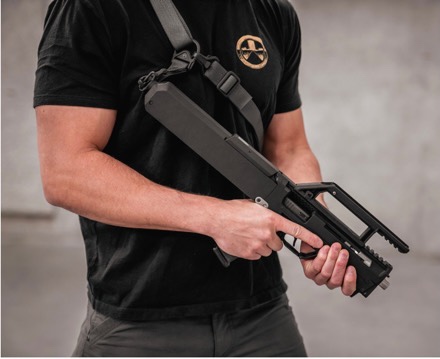
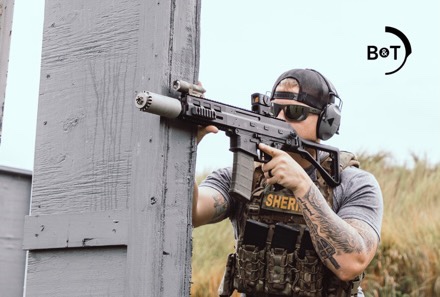
You might look at the new SPC9 and call it a frankengun from Brügger & Thomet because it combines features from the APC9 and the AR-family at the request of a European customer who wanted an AR-style charging handle and buffer tube to accept a variety of stocks. B&T took their contract-winning APC and went to work. They also added features found on the MP5: a 3-Lug suppressor mounting and an additional, folding, non-reciprocating, cocking handle located above the barrel. This cocking handle is also swappable from left to right.

Feeding is from a proprietary magazine, or it can be modified by the user to accept 9mm Glock double stack or SIG P320 magazines.

One interesting feature is the hydraulic buffer which offers a very low recoil impulse.

B&T delivers their guns ready to go out of the box, fitted with an Aimpoint T1.

www.bt-arms.com

AUSA 21 – Ghost Robotics x SWORD Defense Systems

October 13th, 2021

Ghost Robotics showed off the capabilities of their quadrupedal unmanned ground vehicles.

While most of the payloads are ISR related, one really stood out. The Special Purpose Unmanned Rifle (SPUR) is a 6.5 CM rifle package from SWORD Defense Systems designed specifically for use with the Vision-60 quadruped.

Remotely operated, it incorporates a sight and features safe, chamber, clear, and fire capabilities that allows for safe and reliable deployment of the weapon system, the operator can load and safe the weapon at a distance. These features also provide the operator the ability to clear malfunctions, and safely unload the platform prior to recovery.

The suppressor is the CGS Group Hyperion K.

UVision and Rheinmetall Sign Strategic Partnership Agreement for Loitering Munitions – Targeting a Leading Position as a Full Solution Provider in Europe

October 13th, 2021

UVision Air Ltd. and Rheinmetall have signed this week a strategic partnering agreement for loitering munitions. The agreement leverages both companies’ capabilities to provide the European market with precise, combat-proven weapon systems. The Hero family of loitering munitions will be available to European customers to satisfy contemporary and emerging operational requirements.  

Through this partnership, UVision and Rheinmetall will offer end-to-end solutions for loitering munitions to the armed forces of Europe. Rheinmetall will take the industrial, technological and commercial lead for enhancing the capabilities of the weapon system; UVision will make available the Hero loitering munitions, based on in-depth technological expertise and operational experience. The parties plan to integrate the combat-proven Hero series into Rheinmetall’s portfolio of manned and unmanned vehicle platforms, launchers, battle management systems and armoured vehicles like the Lynx.  

The Hero family of loitering munitions comprises several models. Designed for different missions,  from short to medium and long ranges and flight  times using various warheads, the Hero series of  high-precision loitering munitions provides  operational forces with combined intelligence,  surveillance, reconnaissance (ISR) and strike capabilities, allowing them to independently locate, track and engage time-sensitive, low-signature targets. These advanced munitions can loiter in the air in a clandestine manner for an extended period of time; locate and track the enemy; help to validate targets; and carry out a precise strike. The Hero system can abort an attack in mid-air; re-enter loitering mode; and then resume the attack, or re-assign targets, thus minimizing collateral damage and providing operational forces with unsurpassed tactical flexibility on the modern battlefield.

“Entering the market for loitering munitions is an important strategic step for us”, notes Dr Alexander Sagel, head of Rheinmetall’s Division Weapon and Ammunition. “In doing so, we are systematically pivoting to meet changing customer requirements and growing market demand. We aspire to provide our customers with high-tech solutions. Together with UVision, we will be offering products made in Europe for the European market to address growing European demand. With this partnership we aim to occupy the leading position in Europe. Building on our mutually reinforcing capabilities, we will also establish a strong foundation for developing new products together.”

Major General (ret) Avi Mizrachi, UVision’s CEO, adds: “Teaming up with Rheinmetall is a major step for UVision, which is meant to provide our operational customers with the advanced even greater technological advantages, along with European quick support and training abilities. By adding and integrating our Loitering Munitions to Rheinmetall’s vast portfolio of munitions, warheads, combat platforms and battle-management systems already in use by leading military forces, we can now offer many of European allied forces much broader and more complete solutions to their Defense needs”.

www.rheinmetall.com

www.uvisionuav.com

www.uvisionusa.com

PDW Raider Field Pant EC T-Fit

October 13th, 2021

Full Featured Field Pant in Soft-Shell and Tailored Fit

Prometheus Design Werx introduces their best-selling Raider Field Pant in their cool weather weight, 9 oz Expedition Cloth soft-shell fabric and new tailored fit. Built as a fall/winter weight, rugged field pant, this style is a non-cargo design in a clean utility appearance with a trimmer fit. Designed for the outdoors and today’s active EDC user in mind. A total of 11 pockets to stash and organize as little or as many EDC items as needed. PDW’s Expedition Cloth is a technical, 2-layer soft-shell fabric with a wind blocking smooth face, brushed interior, DWR finish, and 4-way stretch. Dedicated EDC Tool Pockets, dual no-twist custom made delta rings for keychain-carabineer clip points, 4 welt pockets and double layer articulated reinforced knees round out these pant’s features. Produced with industrial grade triple needle stitching on all major seams. Built to last in California, USA.

The Design and R&D Team at PDW states:

“We took our bestselling pant, tuned it for fall/winter wear and are introducing a new tailored, trimmer fit. For those looking for fully capable field pant in a modern contemporary cut, these are for you. The Expedition Cloth is of a durable, heavier 9 oz weight and all the best technical properties of a soft-shell. Our Raider Field Pant has been worn on just about every continent, by all types of users, on the trail, off the trail, down range, overland, on the job and off the grid. One of the best and few, great American made, everyday field and utility pant.”

The Raider Field Pant EC T-Fit will be available in All Terrain Brown, and Universal Field Gray.

The Raider Field Pant EC T-Fit will be available on October 13th, 2021 via their website, prometheusdesignwerx.com.

Introducing the Thyrm VariArc M-LOK

October 13th, 2021

Helmet Light Mount with 360? Rotational Indexing

Sunnyvale, CA – Thyrm® is excited to announce that the VariArc® Helmet Mount is now available for helmets with M-LOK® rails. Featuring positive indexing at forward, umbrella and admin angles, the VariArc mount directs light right where you need it with a quick twist.

The VariArc helmet mount features locking teeth biased to the forward position, keeping your light aligned for the most critical uses; but with a firm twist, the VariArc mount unlocks and rotates through 8 additional lower-force index points for administrative tasks and diffused lighting options. Its small footprint and low-profile keep things tidy and the 1913 picatinny rail allows for maximum compatibility with visible and IR lights. Its reinforced polymer construction is built to remain fully functional through extreme temperatures, dirt, dust, sand, water, drops on concrete, and other rough handling. 

Features include:

Positively locks in the forward index position

Picatinny accessory rail with 3 slots and 4 ridges

Retention holes on both ends for dummy wiring critical gear

Durable, reinforced polymer construction with steel hardware

Compatible with M-LOK slots

Available in black and flat dark earth colorways

As with all Thyrm products, VariArc mounts are designed and made in the USA.

To learn more or purchase, head to www.thyrm.com or your favorite Thyrm dealer. Government orders: gov@thyrm.com

Air Guard’s 104th Medical Group Trains on Medical Care, Combat Tactics

October 13th, 2021

HARTFORD, Connecticut — Members of the 104th Medical Group attended a two-day Tactical Combat Casualty Care course through the Center for Education, Simulation & Innovation with Hartford HealthCare Sept. 18-19, 2021, in Hartford, Connecticut.

During the interactive event members were taught the goals of TCCC, which are to treat the casualties, prevent additional casualties, and complete the mission. They were also taught the three phases of TCCC; care under fire, tactical field care, and tactical evacuation care.

“TCCC is a new secretary of defense medical initiative that can be used by all members while deployed in theater or during home station emergencies,” said Staff Sgt. Mike Reynolds, 104MDG aerospace medical technician. “During this specific training, 104MDG members went through live action scenarios, hands on skills, and critical thinking situations to perfect their knowledge of combat related casualties.”

According to Rob Lanouette, Department Consultant for the Tactical Medical programs at CESI, good medicine can be bad tactics if you don’t do the right thing at the right time.

“The TCCC course is important in that it is designed to integrate medical care and tactics in a combat environment,” said Lanouette. “TCCC addresses those differences.”

Lanouette went on to describe the purpose of the three phases of care. During the care under fire phase, treatment is limited to suppression of hostile fire, moving the casualty to cover and controlling massive hemorrhaging.

Tactical Field Care is the care rendered to the casualty once the casualty and rescuer are no longer under effective fire. A more in-depth assessment and treatment are rendered.


Tactical Evacuation Care is the care that is rendered during transport by aircraft, vehicle or boat to a higher role of care. The care that was rendered in the Tactical Field Care is continued in this phase. More advanced care may be rendered as additional equipment may be carried by the evacuation unit.

Reynolds said mastering the three phases can play a critical role in saving lives.

“It is important for all military members to be trained in the basics of TCCC so if a situation ever occurs, life can be maintained until the next level of care can be accomplished,” said Reynolds. “This was a great training for the members who participated because it gave us a chance to perform under pressure and to really test our knowledge, not to mention the comradery that was felt throughout the training.”

On the second day of training, the 104MDG Airmen were required to participate in a final scenario. This scenario was a culmination of the TCCC objectives that were learned throughout the course and is designed to simulate an austere environment. Audio and visual devices, environmental conditions and physical activity were utilized to induce stress that is often found in those environments.

Lanouette, also a prior Marine who served as a paramedic for 28 years and state trooper for 21 years, said he was impressed with the work ethic and ability of the 104MDG members to complete the 16 hour course successfully.

“The 104th did a great job representing the Air Forces Medical Services mission by displaying their commitment to delivering trusted care,” said Lanouette. “As the coordinator of the final scenario, I had asked a lot from them. I may have taken some of them out of their comfort zone during this mentally and physically demanding final scenario. The 104th was able to meet the objectives of the course and should be proud of this accomplishment.”

By Randall Burlingame, 104th Fighter Wing