Salomon Forces Genesis MID GTX

US Army Selects Four Contractors for Engineer Autonomous Breaching Capability to Automate Battlefield Breaching Operations


July 10th, 2026

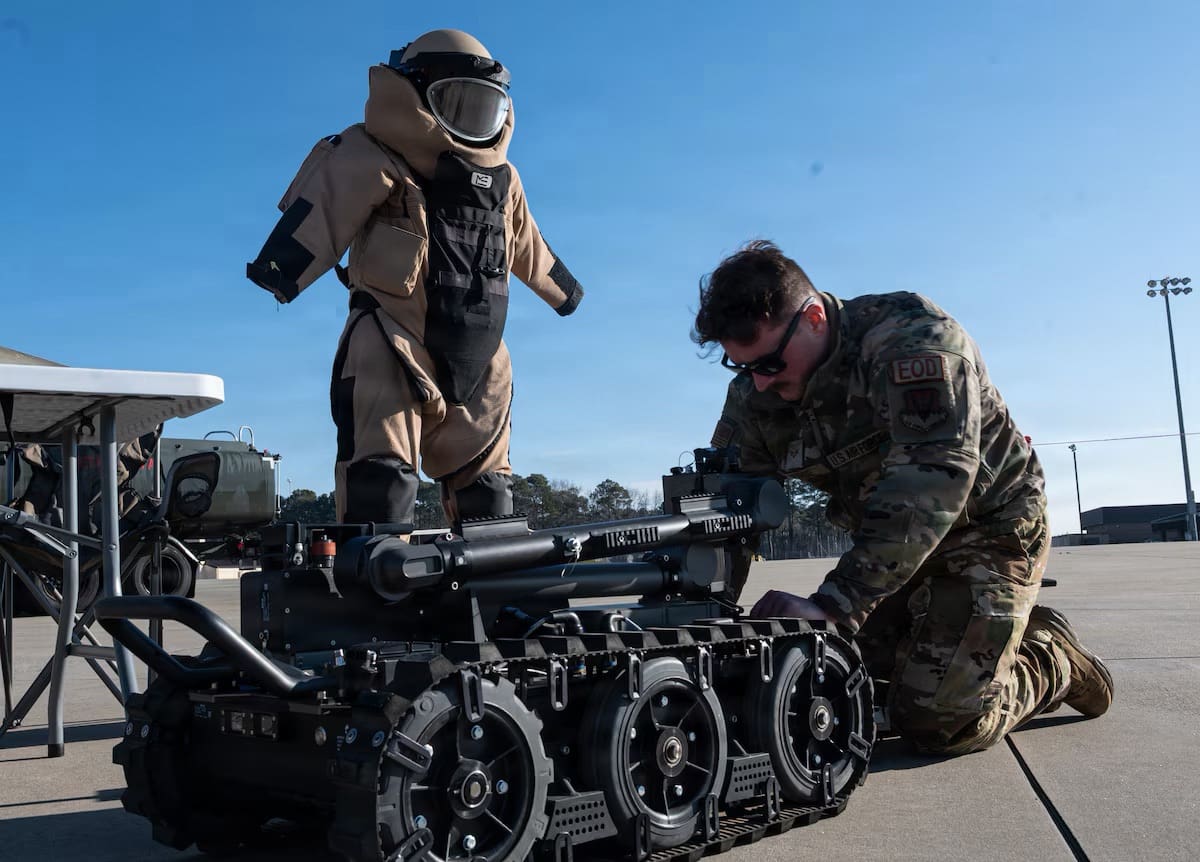
DETROIT ARSENAL, Mich. – The Capability Program Executive Mission Autonomy announced today the selection of four companies for the Engineer Autonomous Breaching Capability (EABC) initiative, a key effort to modernize engineer support for Soldiers on the battlefield.

This project will develop and prototype autonomous systems capable of rapidly breaching complex obstacles and minefields under direct observation and fire, minimizing personnel exposure and ensuring the safe passage of follow-on forces. The selected contractors will provide advanced robotic systems designed for beyond-line-of-sight autonomous control, directly enhancing the Army’s ability to conduct multi-domain operations.

The four selected companies – Caterpillar (Irving, Texas), Forterra (Clarksburg, Md.), IDV USA (York, Pa.) and Overland AI (Seattle) — were chosen for their innovative approaches to autonomous breaching. Their proposed technologies range from autonomous commercial equipment to purpose-built robotic platforms, both featuring modular payloads to support varied breaching requirements.

Formal contract awards for the EABC initiative are expected to be finalized in the coming weeks. Once awarded, the project will advance into a series of demonstrations and assessments, culminating in a Transformation in Contact unit assessment in early 2027. This rotation will allow the Army to collect direct, unit-level feedback to inform the production decision for the next generation of autonomous engineer systems.

By Ashley John

NATO Selects Saab’s GlobalEye

July 9th, 2026

At the NATO summit in Ankara, Türkiye, Secretary General Mark Rutte announced that NATO will begin formal negotiations with Saab regarding the acquisition of up to ten GlobalEye Airborne Early Warning & Control (AEW&C) systems. 

At this point, Saab has not signed a contract or received an order related to the announcement.

NATO has identified the need to replace its existing AEW&C capability as part of a broader effort to modernise and strengthen the Alliance’s surveillance and situational awareness capabilities. The announcement by the NATO Secretary General confirms that Saab’s GlobalEye is NATO’s chosen solution for its future AEW&C capability.

“We are honoured and proud to support NATO in its next-generation AEW&C capability. We are confident that GlobalEye is the right choice for the Alliance, delivering proven capability, adaptability and long-term operational advantage. Today’s announcement clearly positions GlobalEye as the world-leading solution for advanced airborne early warning and control. We look forward to the next steps in the negotiations,” says Micael Johansson, President and CEO of Saab.

GlobalEye will enable the Alliance to monitor vast areas of land, sea and air, significantly enhancing NATO’s ability to detect and respond to a wide range of threats. GlobalEye combines Saab’s Erieye Extended Range radar with an advanced suite of sensors and a multi-domain Command and Control (C2) system, on a Bombardier Global 6500 aircraft. As an AEW&C system, GlobalEye provides long-range detection with high update rates, capable of identifying low-observable and stealthy threats, as well as drones, ballistic and hypersonic missiles, even in complex environments characterised by heavy clutter and electronic jamming.

Saab will now proceed to formal negotiations with the NATO Support and Procurement Agency (NSPA) to secure a contract.

New Autonomous Monitor Prevents Drone Crashes in Real Time

July 9th, 2026

University of Houston Engineer Develops Safety System to Protect Drones from Sudden Hazards
Key Takeaways:

  • A University of Houston engineer developed a real-time safety system that helps quadrotor drones avoid crashes.
  • The new technology can prevent accidents caused by unexpected events like a gust of wind or anything that pushes the drone off course.
  • The research moves advanced drone safety technology forward.

HOUSTON, July 7 — A University of Houston engineer has built a new safety monitor system for the operation of quadrotor drones that can keep them on course and out of danger in real time.

Typically, a drone follows directions of its pilot or onboard software, but if there is an unexpected occurrence, like a gust of wind, the drone can be thrown off course and head for danger. That’s when this new system would step in, enabling the drone to stay within safety limits to complete its task. 

The quadrotor (or quadcopter), the most popular type of drone, is powered by four rotors, is extremely agile and can hover with precision. Because it’s easy to fly, and fits nicely into tight spaces, it is popularly used in everything from structural inspections to photography. 

Marzia Cescon, David C. Zimmerman Assistant Professor of Mechanical & Aerospace Engineering at the UH Cullen College of Engineering, calls her new system a “safety supervisor.” She announced the system in the American Society of Mechanical Engineers Digital Collection.

The safety supervisor is actually a new module onboard the drone. Cescon created it to guarantee run-time assurance, a safety mechanism that continuously watches the system while it is flying. To keep the drone safe, the module monitors the drone’s tilt and position in real time.

“You can think of it as an invisible fence that defines where the drone can safely be. Whenever the ‘safety supervisor’ predicts that the drone will get dangerously close to the fence and potentially crash onto it, the algorithm we designed pushes it away from it,” said Cescon, who developed and tested the supervisor algorithm in the UH Advanced Learning, Artificial Intelligence and Control laboratory.

Technically, the supervisor is implemented as a Control Barrier Function, that is a mathematical tool used to decide if the drone is approaching danger, and if so, takes control of the flight to keep things safe.  

“This work advances the state of the art by showing how CBF-based RTA schemes can be reliably integrated with standard optimal controllers and deployed on real hardware, highlighting practical tradeoffs between various implementations. The work fills an important gap between CBF and RTA theory and deployable real-world control systems,” said Cescon.

Savox Communications and Beechat Network Systems Collaborate to Extend MissionCore with Tactical MANET Connectivity

July 9th, 2026

Espoo, Finland – Savox Communications today announced a collaboration with Beechat Network Systems to evaluate interoperability between the Beechat Kaonic 1S next-generation secure mesh radio and the Savox MissionCore system. The collaboration aims to extend MissionCore’s ability to deliver resilient voice and data connectivity across mounted and dismounted operations. The companies have formalised the collaboration through a Memorandum of Understanding.

Savox MissionCore is an open and interoperable mission platform designed to modernise battlefield networks with limited disruption. Built on a software-defined, modular, IP-based architecture, it integrates voice, video, and data into a scalable C4ISR environment, helping defence forces connect existing assets and transform operational data into actionable situational awareness.

Through the collaboration, tactical MANET connectivity is introduced into the MissionCore environment via the Kaonic 1S, a rugged software-defined radio designed for secure, decentralised communications in denied and infrastructure-free conditions. The architecture supports connectivity across soldiers, vehicles, drones, and other mission nodes, enabling a self-forming and self-healing communications layer at the tactical edge.

The interoperability evaluation extends MissionCore beyond mounted systems into the dismounted domain, enabling mission-critical voice, data, and sensor information to move more efficiently between command elements, deployed units, and remote assets. This supports improved situational awareness and faster operational decision-making.

The collaboration will focus on validating interoperability across dismounted, mounted, and sensor-enabled scenarios, including integration with situational awareness applications and remote sensor connectivity.

Jerry Kettunen, CEO of Savox Communications, said:

“Modern operations require seamless movement of mission-critical voice and data across the battlespace. Our collaboration with Beechat demonstrates how MissionCore can integrate MANET capabilities to support connectivity in denied and degraded conditions.”

Nicholas Quinn, CEO of Beechat Network Systems, said:

“Kaonic 1S is designed for secure, decentralised communication without reliance on fixed infrastructure. Integrating this capability with MissionCore highlights how resilient connectivity can support coordination and situational awareness in complex environments.”

Beechat is part of the NATO DIANA 2026 cohort, reflecting its role in advancing dual use communications technologies for defence and security applications. In Finland, VTT Dual Use Launch Pad serves as a NATO DIANA accelerator site focused on strategic technologies including advanced communications, 5G/6G and quantum technologies.

www.savox.com

SIG SAUER Recognizes Medal of Honor Recipients with Commemorative Firearms

July 9th, 2026

NEWINGTON, N.H., (July 9, 2026) – SIG SAUER, an industry-leading manufacturer of cutting-edge firearms, electro-optics, ammunition, and advanced concepts, recognized four Medal of Honor recipients for their sacrifice, service, and commitment and presented each soldier with a commemorative SIG SAUER pistol.

At the SIG SAUER Experience Center in Epping, N.H., Master Sergeant Earl D. Plumlee, Staff Sergeant David G. Bellavia, Staff Sergeant Salvatore A. Giunta, and Staff Sergeant Ryan M. Pitts, received commemorative SIG SAUER M17 pistols. The SIG SAUER M17 and M18 are the official sidearms of America’s Armed Forces.

Master Sergeant Plumlee, Staff Sergeant Bellavia, Staff Sergeant Giunta, and Staff Sergeant Pitts were each awarded the Medal of Honor for their service during the War on Terrorism and for unique acts of bravery that risked their own lives to save and protect others. Their stories of extraordinary heroism can be viewed at the Congressional Medal of Honor Society website.

About the Commemorative SIG SAUER Pistol

  • The SIG SAUER Medal of Honor M17 pistol was designed from concept to production by SIG Custom Works, an exclusive program at SIG SAUER to engineer and build-your-own customized pistol. The Medal of Honor M17 pistol is hand-polished with a black chrome finish and features gold-plated controls.
  • The grip is American walnut sourced from Appalachia with high-grade figuring and with the Medal of Honor medallion featured on both sides. The sight plate is also engraved to match the Medal of Honor ribbon.
  • Each firearm has a unique engraving on the left side of the gun with each Medal of Honor recipient’s name and rank, as well as their rank earned at retirement.

In line with its mission to support the military, SIG SAUER has a strong history of recognizing U.S. servicemembers, including in 2019 presenting a commemorative SIG MK25 pistol to Medal of Honor recipient Command Master Chief Britt Slabinski and releasing a short documentary honoring his service. In 2025, the SIG SAUER Experience Center Museum hosted a tribute display for Medal of Honor recipient Captain Larry L. Taylor showcasing his heroic service in Vietnam. In 2026, SIG recognized the U.S. Army’s 250th anniversary at the Pentagon with commemorative M17 pistols for the Secretary of the Army and Army leadership.

Burlington Celebrates Commissioning of State-of-the-Art Dyehouse at Raeford, NC Manufacturing Facility

July 9th, 2026

Demonstrating Significant Investment in Domestic Manufacturing and Support of the U.S. Military

RAEFORD, N.C. — July 7, 2026 — Burlington Industries (“Burlington”), a leading U.S. manufacturer of advanced textile solutions, today celebrated the commissioning of its newly modernized dyehouse at its manufacturing operation in Raeford, NC, marking a significant investment in the future of domestic textile production and the continued support of the U.S. military.

The commissioning ceremony brought together company leaders, employees, community partners, and elected officials to recognize the completion of the project and the important role the Raeford operation continues to play in America’s textile manufacturing base.

“Our Dyehouse investment demonstrates our confidence in the Raeford operation, our employees, and the critical role this facility plays in supporting those who protect our freedoms, ” said Jeffrey P. Pritchett, Chief Executive Officer of Elevate Textiles, the parent company for Burlington.

“We are proud to continue a legacy of serving the military while strengthening American manufacturing capabilities right here in North Carolina. ”

The Raeford facility produces the specialized fabrics used in military dress uniforms and remains the only U.S. manufacturer producing these fabrics domestically. The Raeford operation currently supplies fabrics supporting dress uniform programs for the Air Force, Army, Coast Guard, Marines, Navy, and Space Force.

“As we celebrate this investment, we also celebrate the employees whose dedication and expertise have made the Raeford operation an industry leader for more than 70 years,” said Guy Lucas, President of Burlington. “Their commitment to excellence has helped ensure that military personnel across all six branches of the U.S. Armed Forces receive the highest-quality uniform fabrics. This new state-of-the-art dyehouse is an investment in our future, but it is also an investment in our people, giving them the tools and technology needed to continue that tradition well into the future.”

A ribbon-cutting ceremony featuring company leaders and attending officials formally marked the commissioning of the new dyehouse. Burlington extends its sincere thanks to U.S. Representative Richard Hudson, NC Representative Garland Pierce, Raeford Mayor John K. McNeill III, Hoke County Board of Commissioners Chairman James Leach, and Hoke County Commissioner Mary Blue McCollum for their attendance and continuing support.

As Burlington looks to the future, the company remains committed to investing in its employees, supporting the communities in which it operates, and preserving critical domestic manufacturing capabilities that serve both national defense and the U.S. textile industry.

Tilak Military – Bivy Bags

July 9th, 2026

Tilak has just completed a run of their new bivy bag. These are definitely on the heavier side and designed to be reliable and durable.

Made of a three-layer material with an ePTFE-based membrane, the bottom section is seamless and shaped like a tub. It is designed for a sleeping bag, but in a pinch, it can also accommodate a sleeping pad. There is also space at the foot end for a small backpack, shoes, or spare clothes.

Left had opening with a two-way zipper covered by a flap along its entire length, so rain can’t get in.

The face section of the upper part can be fastened using three Velcro panels, or hung on a loop so it doesn’t rest on the face.

Offered in Khaki.

migbytilak.com/en-global/products/bivy-bag

Warfighter Milestone: Soldiers Successfully Remote Fire Next Generation Obstacle Emplacement Capability Autonomous Volcano

July 9th, 2026

PICATINNY ARSENAL, N.J. – Marking the latest milestone in its history, the Army has expanded the capabilities of the M139 Volcano System with the first remote firing of the Autonomous Volcano next generation obstacle emplacement capability.

The demonstration took place at Camp Grayling, MI on May 19 during three days of hands-on training and included distinguished visitors from the United Kingdom’s Assistant Head Ground Maneuver Directorate – Col. James Fern, the Engineer Commandant, Col. Tim Hudson, and Future Capabilities Director, Col. Hector Montemayor.

The Autonomous Volcano system uses the reliable M139 Volcano mine dispenser, which can lay up to 960 mines to create a barrier about 120 meters wide and 1,100 meters long. It is mounted on the Palletized Load System (PLS) A1 truck and operates with an autonomous By-Wire/Active Safety Kit.

Autonomous delivery of obstacles is a massive force multiplier that shapes the battlespace at tempo. The Autonomous Volcano systems preserves combat power by removing engineers from the danger zone and forward line of troops while simultaneously allowing multi-vehicle remote firings that enable friendly forces to disrupt the enemy before they can react. This new technology also provides digital precision by automatically logging and injecting exact obstacle coordinates directly into the Common Operating Picture for seamless joint coordination.

In the first live-fire scenario, four Soldiers from the 576th Combat Engineer Company – Armored, 4th Engineering Battalion remotely fired M88 cannisters from a M139 Volcano for the first time marking a major milestone in advanced autonomous mobility for battlefield shaping.

The second scenario highlighted the robotic autonomy of the system and consisted of emplacing two distinct fix/disrupt minefields autonomously in two separate areas simultaneously. Autonomous Volcano achieved its objective with no human interference necessary.

The M139 Volcano was developed in the 1980s during the latter years of the Cold War and consists of a Volcano dispensing system mounted on the Heavy Expanded Mobility Tactical Truck (HEMTT). The move to an autonomous variant involved integrating the system into a PLS with the Forterra autonomy stack. “Autonomous Volcano leverages low-cost modernization to turn a legacy platform into a high-yield autonomous asset – securing asymmetric overmatch and closing a critical area-denial gap,” said Col. Vinson Morris, Project Manager Close Combat Systems (PM CCS). “It’s an example of how the Army is embracing the ‘fight tonight’ concept where readiness is not a static goal but a continuous process of adaptation and improvement.”

A joint program between the Army and the UK, Autonomous Volcano exemplifies collaboration both with international partners and within the Army. Both the CPE & AE and CPE AS worked together, within PAE AS&A, to support the project by combining their expertise and bringing together vehicles managed by CPE Combat Logistics and munitions developed under the Product Manager Terrain Shaping Obstacles (PdM TSO) team within the PM CCS office.

PdM TSO worked together with U.S. Army Combat Capabilities Development Command’s (DEVCOM) Armaments Center and Ground Vehicle Systems Center (GVSC), and industry partner Forterra to ensure seamless interoperability between platforms and munitions enabling enhanced operational effectiveness and streamlined logistics.

“This joint effort aligns directly with integrated deterrence. Our partnership with the UK on this development ensures seamless allied interoperability and shared Research and Development, strengthening our combined coalition posture,” said Bernie Theisen, Chief Technology Officer, DEVCOM GVSC.

By leveraging the expertise of the PAE AS&A team, the Volcano system demonstrates the Army’s ability to deliver integrated solutions that address complex battlefield requirements. This collaboration exemplifies the power of the Army Transformation Initiative.

After the successful proof-of-concept demonstration at Camp Grayling, the Autonomous Volcano program will demonstrate its capabilities at Project Convergence Capstone 6 at Fort Irwin, CA to transition from prototyping to operational testing. On July 13, Soldiers will operate the system in multiple realistic scenarios; then on 29 July it will be part of the “Best of Breed” demonstration to the Secretary of the Army.

By Michael Chambers