SIG SAUER - Never Settle

3rd Special Forces Group Kicks Off ‘War Horse’ Lethality Exercise at Fort Bragg

October 9th, 2026

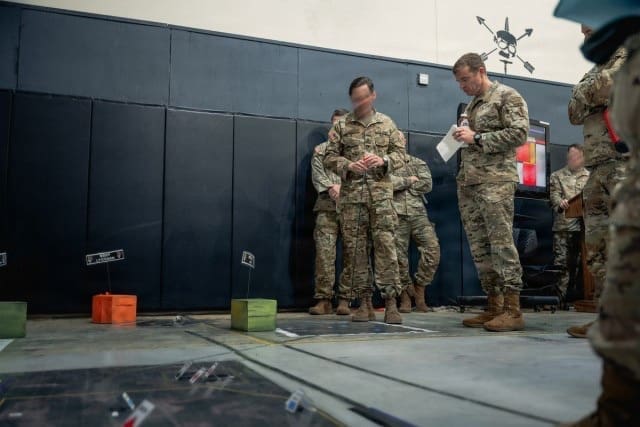
FORT BRAGG, N.C. — Soldiers from across the 3rd Special Forces Group (Airborne)’s Advanced Skills Company kicked off the unit’s first baseline lethality exercise to bolster the Group’s ability to tackle evolving global threats. Coined “War Horse,” 3rd Group is standardizing the baseline training pathway, building readiness and enhancing combat lethality for the Special Forces Operational Detachment Alphas, known as SFOD-A.

Across the Special Forces regiment, the ODA serves as the building block to execute unconventional warfare. Teams consist of 12 Army Special Forces Soldiers: a detachment commander, an assistant detachment commander and 10 highly skilled Soldiers with advanced training in weapons, intelligence, technical communications, medicine and engineering. Together, the ODA is highly autonomous, designed for self-sufficiency and independent operations in hostile, denied or politically sensitive environments.

Across 3rd SFG(A), ODAs are adopting a new way to build operational readiness. Over the next eight weeks, the unit will assess more than 100 ARSOF Soldiers as they train on tasks across seven warfighting functions, developing combat effectiveness and building readiness for future operational requirements.
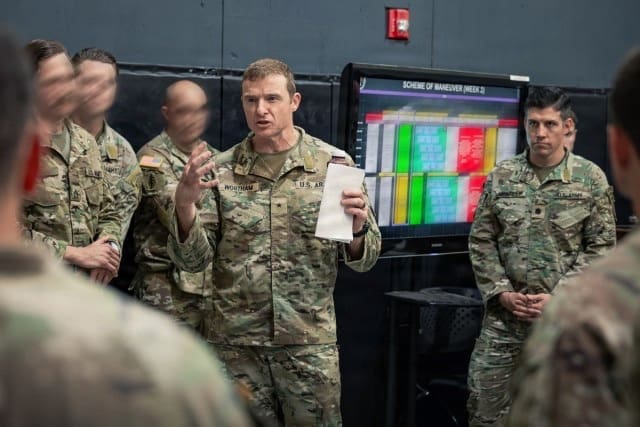
“Developing a centralized baseline lethality training model enables the Group to standardize training across our ODAs while maximizing the use of our resources,” said Army Col. Anthony Heisler, commander of 3rd Group, emphasizing the criticality of implementing War Horse across the Group. “This training is preparing our formation to fight and win under the most demanding and disadvantageous conditions. The nation’s expectation of us is simple; fight and win in any environment and War Horse will help us deliver on that commitment.”

War Horse, which pays homage to the group’s nickname as the “warhorse of the regiment,” consists of six distinct modules designed to build individual and team-level readiness. Special Forces Soldiers begin training with academic instruction, building a shared understanding of Special Operations’ role in large-scale combat operations, and how evolving global threats shape the operational environment.

“War Horse is designed to assess our Green Berets on 22 baseline lethality tasks to ensure we are ready to operate in a variety of different environments with partners from across the Joint Force,” said the commander of 3rd Group’s Advanced Skills Company. “We built this exercise to codify the foundational skills of our Special Forces, replicating the most complex and dynamic environments to ensure the Group is ready to execute the most demanding missions across the world.”

After a week of academics, ODAs develop tactical operations procedures, working with seasoned Special Forces Soldiers to strengthen their foundational knowledge of executing battle drills in a multitude of environments. A week of building this tactical proficiency helps ensure Special Forces Soldiers are prepared to conduct tactical mission planning and execution during the following module.

In the two weeks following tactical skills development, the Advanced Skills Company will put the Green Berets to the test, assessing combat readiness by testing tactical proficiencies throughout a variety of different combat scenarios. Special Forces Soldiers initial movements are conducted throughout Uwharrie National Forest, a key training site used in the assessment of Soldiers vying to earn the Green Beret during the Special Forces Qualification Course’s Robin Sage exercise. The infiltration is designed to test ODAs’ movements across mountainous terrain, rapid decision-making, and combat readiness under a variety of different conditions.

Following training at the Uwharrie National Forest, ODA’s return to Fort Bragg, continuing to build upon skills developed over the previous two weeks. For the next three weeks, teams of Special Forces Soldiers continue to build readiness, executing live fire ranges, employing and calling for indirect fire systems, conducting dismounted maneuvers during both day and night and completing an immersive medical training scenario that ensures detachments are prepared to operate independently with minimal logistical support.

At the end of War Horse, ODAs take lessons learned and continue team-level training progression specific to missions across Africa, 3rd SFG(A)’s area of responsibility.

3rd Group mans, trains, equips, educates, and globally deploys scalable Special Forces, Civil Affairs and Psychological Operations elements to conduct Special Operations by, with, and through, partners, surrogates and allies to solve problems on behalf of Geographic Combatant Commanders, Theater Special Operations Command Commanders, U.S. Ambassadors and the nation.

By MAJ Justin Zwick
Kopin Secures Additional $18.6 Million US Army IBAS Award for Color MicroLED Technology

October 8th, 2026

Cumulative IBAS funding reaches $34 million as Kopin accelerates U.S.-based development and manufacturing of next-generation military MicroLED displays
WESTBOROUGH, Mass.–Kopin Corporation (NASDAQ: KOPN), a leading provider of application-specific optical systems, optical interconnect devices for data centers and high-performance microdisplays for defense, training, enterprise, industrial, consumer and medical products, today announced it has secured an $18.6 million sole?source award from the Office of the Secretary of War (OSW) through the U.S. Army Contracting Command (ACC) under the Industrial Base Analysis and Sustainment (IBAS) program.

The award represents the second major US Government investment dedicated to advancing Kopin’s color MicroLED microdisplay technology. The latest award brings Kopin’s total IBAS funding to $34 million. The additional funding will support development of two more MicroLED display configurations designed for specific ground-soldier and pilot applications while accelerating Kopin’s efforts to establish and expand U.S.-based MicroLED manufacturing capabilities.

Continued and Accelerating U.S. Government Investment in Kopin MicroLED Technology

The additional $18.6 million award represents continued U.S. government investment in Kopin’s MicroLED technology and its potential role in next-generation military visual systems while enabling Kopin to accelerate onshoring the MicroLED manufacturing processes, ensuring that the advanced display components essential to future defense and commercial systems are designed and built, in the United States.

“Securing additional IBAS funding represents significant continued validation of Kopin’s MicroLED technology and its importance to next-generation U.S. defense systems. Combined with our previous IBAS investment, the U.S. government has now committed $34 million through IBAS to advance MicroLED technology. This enables Kopin to accelerate the development and U.S.-based manufacturing of additional high-performance MicroLED displays designed for next-generation soldier and pilot systems while separately enabling the foundational MicroLED platform technology for our AI Interconnect products,” said Michael Murray, Kopin’s CEO.

Supporting More Army Programs of Record

With the expanded funding, Kopin will develop two additional MicroLED displays purpose-built for specific ground soldier equipment and missions and for pilot HUDs. With this support, Kopin can meet the specific and demanding requirements of the advanced MicroLED displays for next?generation visual systems that demand exceptional brightness, rugged durability, power efficiency, and, reliable performance in all operational environments. These capabilities improve situational awareness for soldiers in the field and also open the door for wider integration into future weapon sights, helmet?mounted systems, and augmented?reality platforms—ultimately helping shape the Army’s modernization roadmap for years to come.

Strengthening Kopin’s Strategic Growth Path

This second?round award validates Kopin’s advanced position and roadmap for MicroLED displays for U.S. military applications and programs, and underscores the company’s commitment to advancing U.S.–made displays and optical solutions. With expanding program awards across defense, medical, enterprise, and AI infrastructure markets, Kopin is expanding its position as a trusted, critical technology supplier—delivering breakthrough visual and optical components that enable customers to innovate faster, operate more efficiently, and meet the rising demands of modern systems.

BLADE Selected for Phase II of GroundBreaker 1 Demonstration

October 8th, 2026

FREDERICKSBURG, Va., Oct. 8, 2026 /PRNewswire/ — BLADE announced today that HDT Robotics, LLC, doing business as BLADE, has been selected to advance to Phase II of the GroundBreaker 1 unmanned ground vehicle demonstration with its Hunter WOLF multi-mission unmanned ground vehicle.

The selection follows the Government’s technical evaluation of BLADE’s Phase I solution brief and advances Hunter WOLF to a live hardware demonstration scheduled for October 19-23, 2026, at Camp Grafton, North Dakota.

GroundBreaker 1 is designed to evaluate unmanned ground vehicle technologies for potential employment across tactical and non-tactical missions. During Phase II, Government evaluators will assess technology maturity, operational readiness and cross-domain interoperability.

“Hunter WOLF was built for exactly this kind of challenge,” said Tom Van Doren, President, Robotics Sector at BLADE. “This is a mature, mission-ready platform that has been tested alongside warfighters in demanding environments. GroundBreaker 1 gives us the opportunity to demonstrate why the Hunter WOLF is ready to support the warfighter now.”

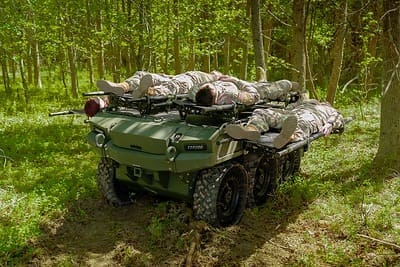
The Hunter WOLF is a multi-mission unmanned ground vehicle engineered to reduce soldier workload, extend operational reach and keep personnel farther from dangerous tasks. Its adaptable architecture supports missions including tactical logistics, intelligence, surveillance and reconnaissance, casualty evacuation, communications support and other mission-critical applications.

Designed for complex and austere environments, Hunter WOLF combines high payload capacity, off-road mobility, onboard power and autonomous and remote-control capabilities. The system has been evaluated through military exercises and training events and has supported operational use in Ukraine, providing BLADE with real-world insight into evolving unmanned ground requirements.

The GroundBreaker 1 selection comes as the Department of War places increasing emphasis on rapidly fielding autonomous and robotic systems capable of operating alongside warfighters. Following Phase II, companies whose demonstrations are successfully evaluated may be invited to Phase III to submit a full proposal for a Prototype Other Transaction Authority award.

Galvion Showcases Cortex EVO HALO Upgrade Pathway for US Army NG-IHPS at AUSA 2026

October 8th, 2026

Galvion, a global leader in the design and manufacture of innovative head systems, power and data management solutions, and integrated soldier systems, will showcase a new Cortex™ EVO HALO integration concept for the U.S. Army’s in-service Next-Generation Integrated Head Protection System (NG-IHPS) at AUSA 2026 in Washington, D.C., October 12–14, Hall E, booth 7917.

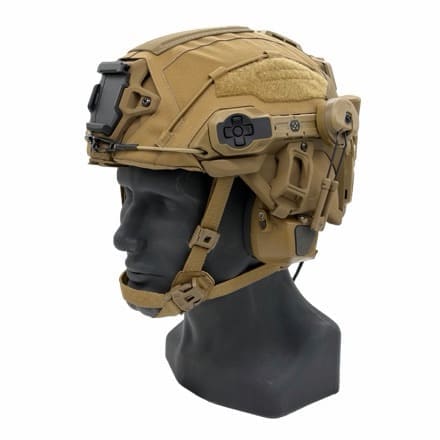
The NG-IHPS concept marks the latest evolution of Galvion’s Cortex EVO architecture and the first time EVO HALO has been integrated onto a non-Galvion helmet. Designed as an externally mounted implementation of Cortex EVO, HALO provides a potential pathway to introduce advanced power, data and headborne capabilities onto both new and fielded helmet platforms, without requiring replacement of the underlying protective system.

First introduced in its deeply integrated Embedded configuration at SOF Week 2026, Cortex EVO brings protection, power, data and compute together within a unified headborne architecture. The HALO configuration, introduced on Galvion’s Batlskin Caiman® helmet at Eurosatory 2026, extends that same architecture through an externally mounted approach, providing greater flexibility for integration across existing helmet platforms.

Applying EVO HALO to NG-IHPS takes that approach a step further. By adapting the architecture to a non-Galvion helmet, the concept illustrates how advanced headborne capabilities could be introduced to the U.S. Army’s fielded NG-IHPS fleet while continuing to leverage the existing protective platform.

The approach provides a potential upgrade path as soldier-worn technologies and operational requirements continue to evolve.

The NG-IHPS configuration is being developed to support integration with current and emerging soldier-worn technologies, including the Enhanced Night Vision Goggle-Binocular (ENVG-B) and Binod platforms. Through its common power and data backbone, Cortex EVO can support visual augmentation, sensing and awareness technologies, digital communications and other headborne capabilities within a unified system environment.

Galvion’s AlertCentr™ software enables mission-relevant information to be managed at the headborne level, including configurable visual and audio cueing designed to allow operators to access and act on critical information without diverting attention to secondary devices. The open architecture also enables Galvion-developed and third-party technologies to operate within a common system environment.

Jonathan Blanshay, Founder and Executive Chairman of Galvion, said: “Modernization doesn’t always have to mean replacing proven equipment. Embedded EVO shows what is possible when integration begins at the helmet design stage, while HALO provides another pathway for helmet systems already in service. By integrating EVO HALO onto NG-IHPS, we’re showing how an existing protective platform could evolve to support new capabilities as requirements and technologies advance, while preserving the investment already in place.”

USSOCOM HICAR Update

October 8th, 2026

A version of this article first appeared a few weeks ago in Issue 38 of our weekly Soldier Systems Digest newsletter. It was prompted by a vendor demonstrating their candidate carbine leading many to believe the program had already selected a carbine. That is not true. The article has been slightly modified from the original to clarify some points. This is a link to the article we posted after the program was announced in June. It details the requirements. We’ve learned a lot since then.

What HICAR is…

A USSOCOM effort to field a new Stoner-pattern carbine capable of firing the high pressure, 5.56mm cartridge known as M855A1+.

The cartridge has been under development with Federal on behalf of Picatonny Arsenal for several years and referred to as “5.56 Max.”

The cartridge uses Federal’s Peak alloy case technology to deliver chamber pressures in excess of 80,000 psi. This was originally developed for the 7mm Backcountry cartridge.

What HICAR is NOT…

It is not an Army program.

It is not going to replace the 900,000+ M4 carbines currently in Army service.

The Army currently has no plans to adopt M855A1+ ammunition. However, they have paid for its development and are monitoring the program closely.

NGSW remains the Army’s primary small arms modernization effort. In fact, the Army is moving forward with fielding of the XM8 carbine to replace the M7.

The Program as it stands…

There are currently three competitors in down select who will deliver rifles to the command very soon to undergo live fire evaluation. All three companies were directed to NOT publicly acknowledge their participation, so if a company is showing you what they’ve got, they aren’t part of the program.

USSOCOM has POMed (budgeted) for both rifles and ammunition and is dedicated to this program. They currently have courses of action which procure full weapons as well as an Upper Receiver Group-only option. This is why the candidate systems must be M4 compatible.

Numbers are not being publicly disclosed but I would put them as similar to USMC M27 numbers, eventually.

FY27 will see the command down select to one candidate weapon and transition to an OTA for rapid procurement in FY28.

The ammunition…

I have concerns over referring to the ammo as M855A1+. While the HICAR must be capable of shooting standard pressure rounds as well as the new ammo, the inverse isn’t true for legacy M4s. It’s quite possible that high pressure rounds will end up in standard M4s. This is particularly the case for enablers who will likely not be armed with HICAR but embedded within SOF formations operationally. Will this result in catastrophic failures? No, but those high pressure rounds will certainly curtail the life of the M4. However, the danger does exist that an M4 firing M855A1+ may face broken bolt lugs or other failures during a fire fight.

It is my understanding that the ammunition has been safety certified, including passing an obstructed barrel test on an M4A1.

I assert the ammo absolutely needs a new nomenclature and DODIC. I’m also not a fan of the “hyper” velocity moniker. We may one day actually create true hyper velocity ammunition which is in excess of 5,000 fps. This ammunition, while impressive, doesn’t even approach that velocity.

An additional point is that the current developmental ammo (M855A1A+) is tightly controlled and not available outside of this program. I fully expect the ammunition to change over time, as they continue to dial-in its performance. That means, anyone outside of the program is producing their own ammunition. There is currently NO commercially available high pressure ammunition.

While I fully believe that high-pressure ammunition is the future, it faces a serious commercial challenge.

The Sporting Arms Ammunition Manufacturers’ Institute sets industry standards for ammunition. When a new ammunition is proposed, SAAMI certifies both the cartridge and chamber. This is because the chamber must be capable of safely firing the ammunition it is associated with.

Most companies in industry will be reticent to offer new ammunition which has not been built to a chamber spec. In this case, .223 for commercial sales. For years we’ve heard about the “dangers” of firing military-grade 5.56mm NATO ammunition in .223 chambers. Consequently, many commercial carbines use barrels chambers for 223 Wylde instead. However, those concerns are laughable compared to the pressures we are seeing with high pressure ammo.

Considering what happens to 300 BLK ammunition fired in .223 carbines, fear mongering will assuredly ensue in firearms social media once commercial high pressure ammunition is introduced.

We are likely stuck in a chicken-or-the-egg cycle, at least in the near-term as ammunition companies weigh whether or not it is worth loading ammunition for firearms that don’t yet exist in great numbers. This is the same thing that happens every time a new caliber is introduced.

The future is high pressure but I believe the military will lead the way in its adoption.

Eric Graves

Founder, SSD

Photo by K. Kassens 

United States Army John F. Kennedy Special Warfare Center and School


If you’d like to subscribe:


Subscribe

* indicates required

Soldier Systems Daily will use the information you provide on this form to be in touch with you and to provide updates and marketing. Please let us know all the ways you would like to hear from us:

You can change your mind at any time by clicking the unsubscribe link in the footer of any email you receive from us, or by contacting us at ssd@soldiersystems.net. We will treat your information with respect. For more information about our privacy practices please visit our website. By clicking below, you agree that we may process your information in accordance with these terms.

We use Mailchimp as our marketing platform. By clicking below to subscribe, you acknowledge that your information will be transferred to Mailchimp for processing. Learn more about Mailchimp’s privacy practices.

Intuit Mailchimp

Qualcomm Government Technologies and OKSI Announce Collaboration to Deploy OMNISCIENCE Autonomy Software Portfolio

October 8th, 2026

Partnership brings AI/ML-enabled autonomous capabilities to defense platforms, optimized for the Qualcomm® QCS8550 and scalable across Qualcomm’s IoT processor portfolio

LOS ANGELES — OKSI and Qualcomm Government Technologies, Inc. (QGOV), a division of Qualcomm Technologies, Inc., today announced a collaboration to deploy OKSI’s OMNISCIENCETM autonomy software portfolio on Qualcomm technologies. OMNISCIENCE delivers AI/ML-enabled capabilities through computer vision — including visual navigation, object detection and recognition, mission execution and more — purpose-built to bring autonomy to unmanned platforms operating in complex, communications-constrained environments. The software portfolio has been optimized for the Qualcomm® QCS8550 processor and is designed to scale across Qualcomm Technologies’ broader IoT processor portfolio, providing platform developers and defense system integrators with a flexible, production-ready path to deploying edge AI capabilities at scale. The collaboration will be showcased at the Association of the United States Army (AUSA) Annual Meeting 2026, taking place Oct. 12-14 in Washington, D.C.?

OKSI’s OMNISCIENCE is offered as either individual containerized capabilities or tightly coupled, interoperable modules providing next-level autonomy and adaptability to virtually any air platform. Users can operate truly autonomous missions. Qualcomm technologies deliver the on-device AI inference, computer vision processing and advanced image signal processor (ISP) capabilities that OMNISCIENCE relies on for real-time autonomous decision-making at the edge.

“With OMNISCIENCE on the Qualcomm QCS8550 processor, autonomy stops being a multiyear development program and becomes a design-in decision,” said Chris HolmesParker, CEO, OKSI. “Platform developers can source at volume against manufacturing infrastructure that already exists. They will be equipped to upgrade autonomy across a fielded fleet or stand up an entirely new product line from the same proven portfolio, moving at the speed of a software release and the scale of a production supply chain.”

The Qualcomm QCS8550 processor’s heterogeneous compute architecture supports dynamic performance and power scaling, enabling optimized size, weight and power (SWaP) profiles suited to space- and energy-constrained deployments. Platform providers leveraging Qualcomm processors with OMNISCIENCE benefit from an open Ubuntu Linux-based software environment with access to Qualcomm acceleration technologies and compatibility with widely used open-source AI and computer vision frameworks — reducing integration complexity and accelerating time to deployment. Together, OKSI and Qualcomm Technologies are enabling a new class of edge-intelligent autonomous platforms designed for reliable performance in the most demanding environments.

“The industry is entering a new era in which intelligent systems do more than respond — they understand context, make decisions and take action,” said Kim Koro, Senior Vice President, Qualcomm Government Technologies, Inc. “Making that vision real requires an ecosystem, efficient edge compute and platforms that can scale across devices and missions. Together with OKSI, Qualcomm Technologies is helping move autonomy beyond demonstrations and toward deployable, mission-ready capabilities that can operate across connected fleets and demanding environments.”

Plasan and Asfir 4X4 to Unveil Stormer: A Light Tactical Special Operations Vehicle (SOV)

October 8th, 2026

Designed to rapidly deploy up to 12 personnel with mission-configurable capability

AUSA | Washington, D.C. | September 12-14, 2026 | Booth #2407

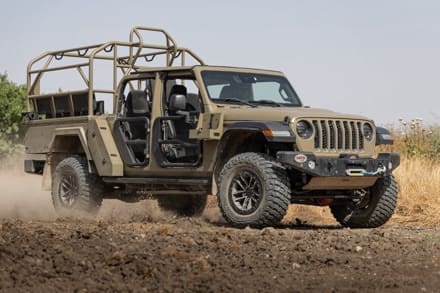
Oct 7th, 2026, Plasan and ASFIR 4X4 will unveil the new STORMER, a highly modular light tactical vehicle designed to meet the evolving requirements of special operations forces, reconnaissance units, rapid-response teams, and other missions where mobility, payload capacity, rapid deployment, and operational flexibility are critical.

Modern military and special operations forces increasingly require a vehicle capable of rapidly transporting larger teams, mission equipment, and casualties across challenging terrain while remaining easy to deploy, maintain, and sustain.

To address this need, Plasan and ASFIR 4X4 developed STORMER, a versatile tactical platform that combines the logistical simplicity of a commercial vehicle with the capability and flexibility required for demanding military operations.

Designed to carry up to 12 personnel and more than 1,000 kg (2,200 lb.) of payload, STORMER combines a proven commercial vehicle platform with a reinforced chassis and driveline, high off-road mobility, and a highly configurable mission architecture. Designed for airborne transport and rapid deployment, the vehicle enables forces to move personnel and mission equipment across demanding terrain.

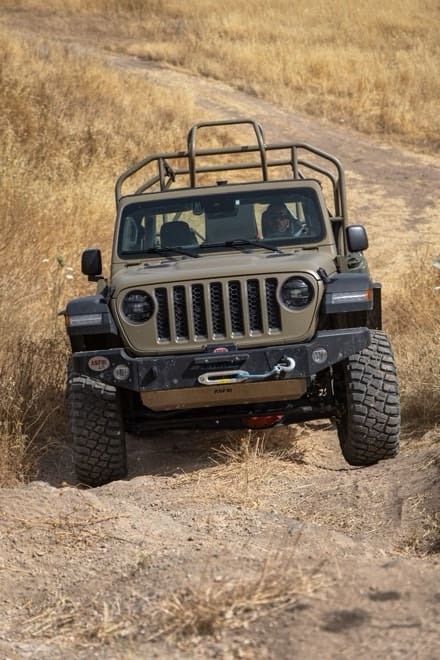
At the heart of STORMER is a rugged Jeep® Gladiator-based commercial off-the-shelf (COTS) platform, enhanced through Plasan’s automotive engineering expertise. The vehicle is powered by a 280-horsepower, 3.6-liter gasoline engine paired with an eight-speed automatic transmission, providing the power and drivability required for demanding operational environments.

The vehicle’s reinforced chassis and driveline, including upgraded Dana axles, are designed to support increased payload and durability while maintaining the mobility expected of a tactical vehicle. A modular roll-over protection system (ROPS) provides enhanced occupant protection while supporting 360-degree visibility and situational awareness.

STORMER is designed to adapt rapidly to changing mission requirements. Its configurable rear platform can support troop transport, logistics, medical evacuation (MEDEVAC), weapons, and specialized mission equipment, including radar, counter-UAS solutions, communications systems, and an electric winch. A three-position folding rear door enables rapid troop ingress and egress, secure transport of mission equipment, and a stretcher configuration for casualty evacuation.

The vehicle also incorporates a 24-volt electrical system, blackout driving capability, a communications console, and multiple antenna mounting points, supporting the integration of customer-specific mission systems. The extensive use of commercially available components is intended to simplify maintenance, logistics, and long-term sustainment.

STORMER builds on Plasan’s more than 40 years of experience in survivability, vehicle protection, and automotive engineering, as well as its proven track record with the SandCat family, which is in service across five continents. Developed in collaboration with ASFIR 4X4, STORMER combines Plasan’s defense engineering and survivability expertise with ASFIR 4X4’s extensive experience in off-road vehicle systems and components.

“STORMER was developed to address a growing operational requirement for a rapidly deployable platform capable of carrying larger teams and mission equipment without compromising mobility. By combining a proven commercial platform with Plasan’s engineering expertise, we created a highly adaptable vehicle that can be configured for multiple missions while remaining simple to operate, maintain, and sustain.”

Moshe Elazar, CEO, Plasan

“Our collaboration with Plasan enabled us to transform a proven commercial 4×4 platform into a practical and highly capable tactical solution. STORMER delivers the mobility, flexibility, and robustness required by demanding users while maintaining the reliability and supportability of a commercial vehicle platform.”

Tzachi Oz, CEO, ASFIR 4X4

US Army Releases ‘How the Army Fights’ Operational Warfighting Guidance

October 8th, 2026

WASHINGTON — The U.S. Army today released How the Army Fights, new operational warfighting guidance that provides a common framework for translating tactical success into campaign-level advantage for the Joint Force.

Developed by the Vice Chief of Staff of the Army, How the Army Fights builds on the Army’s multidomain operations doctrine by explaining how the force employs land power at the operational level of war. The guidance aligns how the Army organizes, trains, equips and sustains its formations for contested, high-intensity conflict.

“The challenge is on us as the leaders of the Army to make the decisions that are needed for the Army today,” said Acting Secretary of the Army Adam Telle. “This guidance provides a clear framework for focusing the Army’s efforts and ensuring the force is prepared to fight and win.”

The framework organizes Army land power through four interdependent operational elements:

  • Convergence creates and exploits positions of advantage by synchronizing effects across domains.
  • Strike degrades and destroys enemy systems through lethal and nonlethal fires at range.
  • Close Battle closes with and defeats enemy forces, seizes key terrain and consolidates gains.
  • Endurance postures, protects and projects combat power across time, distance and contested conditions.

Together, these elements enable operational maneuver and connect battlefield actions to campaign outcomes. Convergence and Endurance establish the conditions for success, while Strike and Close Battle deliver decisive effects.

How the Army Fights reinforces that the Army must maintain its technological edge while recognizing that war remains a human endeavor. The guidance addresses the integration of advanced capabilities, including uncrewed systems, artificial intelligence-enabled tools, resilient networks and precision fires, while underscoring the enduring importance of Soldier judgment, discipline and leadership.

“Technology will extend our reach and strengthen our combat power, but war remains a human contest of wills,” said Vice Chief of Staff of the Army Gen. Christopher C. LaNeve. “Our Soldiers remain our decisive advantage.”

The guidance directs the Army to prioritize operational readiness for the pacing threat, defend the homeland as a strategic base for power projection, and strengthen posture, interoperability and resilience with allies and partners. It also recognizes the need to sustain combat power across vast distances and under persistent adversary pressure.

How the Army Fights is unclassified and available for public download on Army.mil.

By U.S. Army Public Affairs