GORE-TEX Professional

Army Electronic Warfare Prototypes Reach First CONUS Brigade

July 3rd, 2018

This article discusses the fielding of EW Systems to the 1st Infantry Division. However, similar systems have also been fielded to the European-based 2nd Armored Cavalry Regiment and 173rd Airborne Brigade. In fact, those forward deployed systems have been used to conduct the first live Electronic Attack scenarios since the end of the Cold War.

FORT RILEY, Kan. — For today’s commander, having a clear picture of the battlefield is almost as much about understanding the electromagnetic spectrum as is it about reading a map.

To better equip and train brigades to compete against near-peer adversaries with sophisticated electronic warfare, or EW, capabilities, the U.S. Army recently delivered new EW prototypes to the 1st Brigade Combat Team, 1st Infantry Division ‘Devil’ Brigade, marking the first unit stateside to receive the systems after completing fielding to select Europe-based units in February.

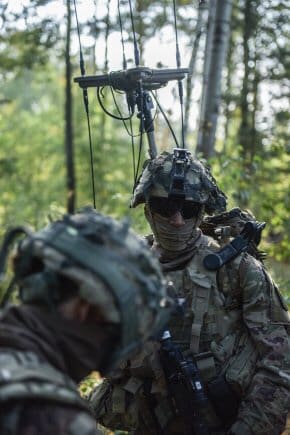
Staff Sgt. Kristoffer Perez, Cyber Electromagnetic Activities section, 1st Armored Brigade Combat Team, 1st Infantry Division, points toward a nearby objective during the final day of training with his section’s new electronic warfare equipment at Fort Riley, Kan. The 1st Brigade Combat Team, 1st Infantry Division is the first unit stateside to receive the systems after completing fielding to select Europe-based units in February. (Photo Credit: U.S. Army photo by Sgt. Michael C. Roach, 19th Public Affairs Detachment)

The training in the United States prepares the units for future potential deployments where they will use the new technologies in theater, and helps spread updated electronic warfare technology, knowledge and tactics throughout the force.

“This is really driving us to answer the question, ‘how do we, as EW professionals, get better tactically?'” said Warrant Officer 1 Christopher Mizer, an electronic warfare technician with the 1st Brigade Combat Team, 1st Infantry Division. “Up until recently, the EW sections have been mostly planners on the brigade and battalion staffs, as well as the higher level. Now, our EW Soldiers can effectively move and maneuver and support the other warfighting functions with equipment on the ground, and that’s really driving us in how we train from here on out.”

This integrated package of EW capabilities, consisting of mounted, dismounted, and command and control systems for electronic sensing and jamming, were fielded to the 1st Brigade Combat Team, 1st Infantry Division at Fort Riley in March. In May and June, the unit’s electronic warfare officers, or EWOs, had a chance to use the equipment at the Army’s National Training Center at Fort Irwin, located in California’s Mojave Desert.

Sgt. 1st Class Gregory Robinson (left), Electronic Warfare noncommissioned officer in charge, 1st Armored Brigade Combat Team, 1st Infantry Division, works alongside Staff Sgt. Susan Bradbury, Electronic Warfare noncommissioned officer, 1st Armored Brigade Combat Team, during the final day of training with their new electronic warfare equipment at Fort Riley, Kan. in April 2018. (Photo Credit: U.S. Army photo by Sgt. Michael C. Roach, 19th Public Affairs Detachment)

Yet instead of working alongside the rest of their brigade at the NTC, which will come later this year, the EW Soldiers of the 1st Brigade Combat Team, 1st Infantry Division were at the NTC to participate as part of the Opposing Force, or OPFOR. The EWOs were able to push the equipment during operational scenarios by electronically locating the “blue” or friendly forces on the battlefield, passing that information to the OPFOR commander and even applying some jamming effects against the friendly forces.

“This was our initial test of the equipment away from home station in a realistic operational environment,” said Sgt. 1st Class Gregory Robinson, electronic warfare non-commissioned officer in charge with the 1st Brigade Combat Team, 1st Infantry Division. “When our brigade goes to the NTC later this year we’ll be able to integrate the equipment within our organic brigade, using the equipment in the same environment but this time against the OPFOR.”

The systems are prototypes that serve as an interim solution until the Army’s enduring EW programs of record can be fielded. Together, they provide electronic protection, as well as the ability to detect and understand enemy activity in the electromagnetic spectrum, and disrupt adversaries through electronic attack effects.

“Recognizing this is a prototype system, it is still a step in the right direction,” Mizer said. “We haven’t had a system within the electronic warfare community that looks at the electromagnetic spectrum and forces Soldiers to think through what they are seeing, how that affects their commander’s mission, and how they can affect the spectrum to enable the commander.”

The Army Rapid Capabilities Office and Project Manager EW & Cyber developed and delivered the prototypes in response to an Operational Needs Statement from U.S. Army Europe. The 1st Brigade Combat Team, 1st Infantry Division is the first brigade to receive the equipment and train with it in the continental United States. Units in Europe, including the 2nd Cavalry Regiment, 173rd Airborne Brigade and 2nd Armored Brigade, 1st Infantry Division were provided the equipment and have also used it operationally in exercises this spring, including Saber Strike and the Joint Warfighting Assessment.

Together these units in Europe, and now the 1st Brigade Combat Team, 1st Infantry Division, are adapting electronic warfare techniques for the brigade and below and providing valuable feedback on how to employ or “fight” the systems on the battlefield. The prototype fielding and training has also provided a chance for the different units to examine how to task organize cyber and electronic warfare personnel as they integrate the systems within their formations.

“If we did nothing electronic warfare-wise until we actually field a program of record EW system, we would be significantly farther behind,” Mizer said. “We wouldn’t know how to integrate them, operate them, maintain them or fight those systems when we get them. This is really informing that process. It’s forcing our EW Soldiers to look at the intellectual problem of determining how you fight an EW system. That’s something the Army hasn’t really done in almost three decades.”



That input is helping to feed information back into the enduring solutions. This approach, where the RCO worked with the program of record developer PM EW&C to adapt existing systems and incorporate emerging technologies to provide new EW effects and meet an emerging threat, enabled the Army to rapidly move an interim solution to the field in 12 months. The Army will continue this phased fielding approach, which incrementally builds EW capability through direct Soldier input and as new technologies are made available.

At the NTC, for example, the 1st Brigade Combat Team, 1st Infantry Division Soldiers were able to work directly with equipment developers on improvements to the systems, some of which could be incorporated over the next several months.

“We were able to work with the engineers and identify items that needed to be fixed,” Robinson said. “We expect some improvements shortly before we take the equipment back to our brigade’s rotation at the NTC later this year. We did point out that the systems need a more user-friendly interface and improvements are needed with the integration between the mounted and dismounted systems so we can get better end results from the information we’re receiving.”

By Nancy Jones-Bonbrest, U.S. Army

You Never Know Where They’ll Show Up

July 3rd, 2018

Thanks J for this photo taken at Irazu Volcano east of San Jose, Costa Rica.  He said it was cold at 11,000 feet.  Temperature with wind was around 40, San Jose is in the low 80s/upper 70s, most days.

TAC SHIELD Introduces The 1.75″ Cobra Riggers Belt

July 2nd, 2018

Pinehurst, NC – TAC SHIELD® has introduced the latest in every day carry and survival solutions, The Cobra® Riggers 1.75” Belt. The double lever Cobra® Buckle is rated at 2,000 lbs. The double wall 7,000 lb. webbing provides the strength needed while offering a comfortable soft edge design that doesn’t dig into your sides. The forged steel V-Ring buckles are load tested at 2,500 lbs. giving the user peace of mind during emergency situations. Belts are designed with strong hook and loop for fast and secure sizing adjustment with a trim finish.

TAC SHIELD® belts are proven in the battlefields around the globe by American Warfighters and are available from many leading Tactical Sport and Military Retailers across the country. All products are backed with a Lifetime Warranty by people you can trust!

Please visit www.TACSHIELD.com for more information and other Proven Gear!

TacJobs – TYR Tactical Seeks Arizona-Based Veterans

July 2nd, 2018

VETERANS WANTED! Immediate openings at our Peoria, Arizona Facility.

Summary of Position:

The Production Armor Worker is responsible for a variety of different tasks in the production of soft and hard armor goods.

www.tyrtactical.com/news/details/current-employment-opportunities

Shooting On BSA’s Only 1000 Yard Rifle Range

July 2nd, 2018

I spent last week with my youngest son, and other members of his Boy Scout Troop, attending the Summit Experience at the Summit Bechtel Reserve, just outside of Beckley, West Virginia. One of our activities was the Barrels, a shooting sports concentration which includes 12 ga shotgun as well as rifle in .22, .223, and .308.

The Summit Experience is a sampler of the various activities available at SBR, meaning that we only got a half day in any particular area. However, SBR offers a focused program called the Marksman. This program offers three full days of shooting sports and archery, with participants staying near the ranges. While they concentrate in the fundamentals, they get to apply them to some great opportunities.

One of the additional components of the Marksman, is the chance to shoot on BSA’s only 1000 yard range. Not only that, they get to fire a Savage MSR-15 chambered in 224 Valkyrie.

When I was offered a chance to visit the range, I jumped at it. I was already surprised to see Scouts shooting larger calibers than .22 during our range visit. I had to see what else they have in store.

Think about this for a second. You’ve got new shooters learning the safe and responsible use of a variety of firearms as well as how to use them effectively. This next generation of firearms owners also gets to shoot one of the most popular available, an AR-pattern rifle in one of the newest calibers. They also get instruction in the use of the optic, in this case, an 18x Bushnell LRTS Tactical. To top it off, they are taught how to use this combination to successfully hit targets at 1000 yards!

The view is impressive and the layout of the range is easy to follow. What will fool you, are the distances involved. They start at 200 yards and go all the way out 1000, but because of the steep incline, it looks like more distance between targets than actually exists. This phenomenon is very evident in the 700 yard and beyond distances.

You can see in the rifle photo that participants learn how to use Kestrel weather meters as well as Bushnell CONX laser range finders which connect via Bluetooth to the Kestrel. These tools are imperative due to the distances and elevations involved in this range layout. But these successfully surmounting these challenges result in even better marksmen.

Already a success, this is its first year in operation. Next year, they plan to expand the width of the range, from an abandoned power line clearcut, by another 15 feet. Additionally, they want to improve the shooting platform as well as the road leading to it.

Marksman program participants also receive training in pistol marksmanship, starting with the use of an indoor, Laser Shot Range. Additionally, there is a STEM component to the course, with participants learning about the science behind firearms. It’s an impressive program, with even more improvements coming in the future.

This team is taking BSA’s shooting sports program to a whole new level. Hopefully, as the word gets out on this outstanding opportunity, more youth and adults alike, will take advantage of it.

To learn more, visit www.summitbsa.org/programs/national-high-adventure-base/focused-programs/the-marksman.

SOLKOA Survival Systems Launches New Website

July 2nd, 2018

SOLKOA Survival Systems is my favorite company for survival gear. Recently, they relaunched their website, adding the entire PRO-level Modules line as well as additional components and kits with over 50 unique items.

Additionally, based on recent demand from deploying warfighters whose units are unable to make organizational contract purchases through SOLKOA, they’ve now made several restricted kits available for individual purchase for active duty military, sworn law enforcement, or other at-risk government personnel deploying overseas. After vetting their credentials they can purchase kits with expanded capabilities that are normally restricted by ITAR or general sale to the public at large.

Now with the new website up, S3 intends to launch even more S3 components, task-focused modules/paks, and complete kits throughout the coming months including a Traveler line for global business and recreational travelers, as well as some new container form factors for carrying and packing your S3 contingency gear.

Lastly, as part of this launch and to celebrate our Independence Day, S3 is offering a sale of 10% off all products and free shipping for any retail orders over $50. The code for the discounts is: FREEDOM10 and will be good from now through midnight on July 4th, 2018.

www.solkoasurvival.com

You Never Know Where They’ll Show Up

July 2nd, 2018

“The End of Saber Strike 2018” at Kazly Ruda Airfield in Lithuania.

Taken after a three week NATO exercise which brought the 2d Cavalry Regiment

from Germany through Czechia, Poland, Lithuania, and Latvia then back.

Thanks MW!

BSA’s Summit Bechtel Reserve’s Summit Experience

July 1st, 2018

This is a wrap up of the seven part feature I wrote about a recent, week-long visit to Boy Scouts of America’s Bechtel Summit Reservation. To learn more from BSA, visit www.summitbsa.org/programs/national-high-adventure-base/summit-experience.

Day One

A few years ago, the Boy Scouts of America opened the Summit Bechtel Family National Scout Reserve, a 14,000 acre high adventure camp near Buckley, West Virginia thanks to a donation of $50 million from the Stephen D Bechtel, Jr Foundation.

So far, the Summit Bechtel Reserve (SBR) has been used for two National Scout Jamborees as well the Centennial celebration of the Order of the Arrow. When such events aren’t under way, it serves as the Paul R Christen High Adventure Base, joining the other three bases currently in operation.

This summer, I’m attending SBR along with my youngest son and other members of our Scout Troop. SSD has quite a few readers who were either Scouts growing up, or still participate in the Scouting movement. I thought it would be worthwhile to chronicle our experience.

When I was a Scout I attended the 1981 National Scout Jamboree at Fort AP Hill, Virginia, as well as Philmont Scout Reservation in New Mexico. During the last two Jamborees, I visited my sons at SBR and I was very impressed with the facility.

SBR boasts multiple distinct program areas: The Park (skateboarding), The Trax (BMX), The Pools (scuba and swimming), The Cloud (popular science & robotics), The Bows (archery sports), The Barrels (shooting sports), The Ropes (challenge courses in the trees), The Rocks (climbing, bouldering and rappelling), The Zip (zipline), Low & High Gear (mountain bike headquarters locations connecting over 36 miles of downhill and cross country mountain bike trails), The Canopy (canopy tours). Additional activities include ATV riding along with white water rafting and climbing in the nearby countryside.

The high adventure base offers several focused programs, concentrating on activities in the various program areas such as the Marksman which includes shooting sports and archery. We selected the Summit Experience, as it gives a taste of each of the areas.

In true Scouting fashion, just as we drove up to the JW and Hazel Ruby Welcome Center, it started pouring. Fortunately, check in was inside.

EF172AEE-B4E3-490B-9E0E-4D21D4ED2376

We had a few hiccups with paperwork, but overall, the experience was slow, but painless.

2FDF8BAB-2CCE-476A-9A4E-C147346ECF00

We were assigned to Camp B which is close to the CONSOL Energy Bridge making main camp, known formerly as Lonnie Poole Gateway Village, quite convenient. Although our tents were already set up, we had to swap one out due to a broken zipper and holes. Shower and restroom facilities are located close by.

Dinner was tasty and consisted of turkey and mashed potatoes with carrots and rolls with pumpkin pie for dessert. Drinks were water, lemonade, Powerade and fruit punch.

It is a seven-day program and today was essentially devoted to in processing. Over the next few days we’ll tell you about our impressions of the program.

Day Two

We had a great day today. It started out early with breakfast kicking off at 0630, followed by a quick meeting to discuss the day’s schedule which would include a service project in the morning and white water rafting after lunch. Next was flags, with the requisite pledge of allegiance as well as Scout oath and law.

We organized into a larger group with another crew from Ozark, Missouri and were bussed to a nearby football field, located at a local closed high school, to help revitalize it for use by youth sports leagues. We were joined by a couple of local volunteers wielding chainsaws in order to clear small trees. We got quite a bit done and others will continue the job until it is complete. Service to the local community is a big part of what SBR does. Completion of this project also helps our Scouts earn a sustainability award while at camp.

After being bussed back to SBR, we ate a quick lunch and prepared for a white water rafting trip. Although it is an add-on with additional cost, it was worth it. The excursion is conducted by an offsite vendor, in the New River Gorge. We spent about two hours on the water, first learning how to control the boat as a team, and then negotiating multiple rapids during our journey. Although our boat crew was an ad hoc team comprised of Scouts and leaders from various locations, we had the opportunity to sit in different positions on the boat, giving us new perspectives of how the boat behaves on the river. If you’re looking for a great guide, ask for Chas who is a wealth of knowledge. Unfortunately, I was unable to bring a camera on the white water rafting trip.

Although it rained off and on all day, it didn’t dampen anyone’s spirits. The temperature remained cool, which was great for the service project and we were already wet from the river.

Evenings are capped off with a variety of activities. Unfortunately, I have to prepare stories for the website, so I am unable to participate. However, my son enjoyed some additional time out on the water.

Today’s meals consisted of do it yourself breakfast burritos in the morning, pulled pork sandwiches with fries and chicken fingers for lunch, and Hawaiian chicken with baked potatoes and corn for dinner. Granted, they weren’t the tastiest meals I had ever had, but they gave us the energy we needed for the day’s activities.

I’m looking forward to seeing what tomorrow brings.

Day Three

Day three kicked off with a breakfast of pancakes, eggs, cheesy eggs, tater tots and sausage patties. Right after our meal the colors were raised and we participated in our daily ritual of reciting the Pledge Of Allegiance, Scout Oath and Scout Law.

Our first event was Canopy. After a being issued harnesses and helmets, there was a brief training period. Then, we negotiated a course of ziplines back and forth across a valley. Staff members accompanied us through the course and set up our equipment on each obstacle.

In addition to ziplines, we also crossed two bridges and made two rappels.

Due to the distance between the events, we had lunch just we were diminishing up at Canopy. It consisted of breaded chicken strips with bread if you wanted to make a sandwich, chips, fruit and granola bars.

The afternoon was spent at Rocks which features is the largest manmade, outdoor climbing facility in the world. Constructed of concrete by Eldorado Climbing Walls, the formations were painted by a company which does work for Disney.

Summit Experience participants are provided with helmets, harnesses and shoes for the afternoon’s climbing. SBR uses Trublue self belay devices for safety and the facility offers routes with varying degrees of difficulty. The most challenging is the Black Mamba route.

There are also bouldering stations.

Participants in Rocks get the opportunity to rappel from a 40′ Tower.

Rocks was capped off with “a leap of faith” where participants are attached to a Trublue auto belay device and run out from a tower. The device gently lowers them to the ground. Fun was had by all and at the end of the day, we had 12 Scouts with a little confidence in themselves.

We hiked to the dining hall and ate a supper of Hamburgers, Hot Dogs, Beans, and Tater Tots.

One final note to potential attendees of the Summit Experience. Although not all of the shower facilities feature hot water, there are a few, scattered throughout the campground. While the weather has been cool and rainy, it was worth it to take warm shower last night and wash off the river after our white water rafting trip yesterday.

Tomorrow, it’s Barrels and Bows!

Day Four

Once again, we arose to another fun-filled day at SBR. After a breakfast of French toast sticks, eggs and sausage patties we raised the flags and recited the Pledge of Allegiance, Scout Oath and Scout Law. It’s quite an experience to hear hundreds of young people simultaneously pledge to lead good lives and restores some faith in mankind.

Today, our agenda included Barrels with its shooting sports focus and Bows, which features archery.

The hike to Barrels took quite awhile due to both distance and elevation changes along the route.

During our orientation, we went over the NRA’s three rules of firearms safety. Next, the instructor went over the principles of marksmanship, eye dominance and general range admin.

First up was shooting clays. The shotguns we used were MX5 12 ga Automatics by Turkish manufacturer Emperor Firearms.

Next, we transitioned to rifles. We fired .22 Savage Mk II rifles equipped with Weaver 4-9x or Bushnell 4-9x scopes at bullseye paper and various steel targets to gain confidence. Next we moved to a 100 yd Steel target range where we fired Savage Axis rifles in .223 and .308.

We ate lunch of cold cuts at Barrels due to its distance from the dining hall and then hiked to Bows.

After a brief introduction by the Bows team which included archery fundamentals and safety, we were issued 20 lbs Matthews Genesis compound bows and split into two groups. One group went to the 40/60 Range, engaging static targets at 40 and 60 meters respectively. The other group went to shoot at 3D animal targets in the woods from close although unknown, distances and angles. Can you see the 3D targets in this photo?

This photo depicts the types of targets the archers engaged. The dinosaurs were only in the 40/60 Range.

At the static range they engaged targets at 10m while playing ‘bake the cake’ which is a competition where an archer has five arrows and must hit white (flours), blue (water), red (heat) and yellow (eggs), but not black which burns the cake. In the event an archer burns his cake, he can burn others by shooting into an opponent’s black ring.

EF4CC771-58D5-4E9C-BA6D-EF99EFCD0539

Action archery consisted of thrown targets similar to sporting clays, with all of the archers attempting to hit the target. Can you see the target and arrows in this photo?

Whether first timers or old hands, skills were learned or improved and fun was had by all.

We wrapped up the day with a hike back to base camp for a dinner of Slaw Dogs, Chicken and Dumplings with cornbread and green beans.

Tomorrow is Mountain Biking and the Big Zip!

Day Five

This is the fifth day of our trip to BSA’s Summit Experience. We’ve combined with a contingent from a Boy Scout Troop in Yorktown, Virginia, which is just across the water from our home of Chesapeake. So far, we’ve had an amazing experience, meeting people from all over America and learning new skills. Today, we attended Low Gear, Ropes and Big Zip.

This morning’s breakfast was chicken and waffles, along with scrambled eggs. Afterward, the camp conducted a flag ceremony and we recited the Pledge of Allegiance, Scout Oath and Scout Law.

We hiked to Low Gear, a mountain Biking activity. We were issued helmets and bikes and then given instruction on how to ride on the trail. Everyone participated in a group ride of about three miles which included down and uphill including switchbacks, mud holes and jumps. After that, smaller groups negotiated various other trails. In all, SBR boasts 32 miles of dedicated mountain bike trails.

We ate a lunch onsite, consisting of cold cuts for sandwiches, sunflower seeds and cookies.

Every training site features water for the participants, often in the form of water buffalos.

The hike to our next event was very short. Ropes is SBR’s version of a COPE (Challenging Outdoor Personal Experience) Course where various elevated rope and cable obstacles must be surmounted in order to progress further in the course.

Built by Bonsai Design, it has a common entry point with several choices of obstacles to negotiate to get to the end. From above, it resembles a spiderweb. As you can see, it exists right in the trees, with very little was cut back to accommodate the course. The finale is an assisted rappel from a platform about 30 feet in the air.

The hike to our last event of the day, the Big Zip, takes about 45 minutes up a winding mountain trail. But the opportunity to go in excess of 50 mph down this 3,000 ft long zip line, makes it worthwhile.

Dinner was cheese tortellini or a sausage and chicken gumbo with green beans and garlic bread.

Tomorrow is The Trax and The Park.

Day Six

Today’s schedule for our Summit Experience included the Park and Trax. We had eggs, pancakes, tater tots and ham. While it wasn’t bacon, ham comes in a close second on the pig edibles scale.

Next, we lined up by activity for flags. After the requisite Pledge, Oath and Law, instructors from the various areas led crews to their facilities.

First up was the Park, a skateboarding experience. Scouts were issued Helmets along with Elbow and Knee Pads. The Skateboards were passed out based on shoe size. Next, they given very extensive instruction in how to safely ride a skateboard. Apparently it paid off, because no one was hurt.

There is plenty of space to skateboard.

The Crew had wraps for lunch and then hiked to Trax. Once again, they were issued Helmets along with Elbow and Knee Pads. Since they take such a beating, the bikes were very simple, with a rear brake.

There are three progressively more difficult dirt tracks. They include bumps, jumps and turns. After establishing the fundamentals, the Scouts moved on to the next course. The final track is set up for racing, and race they did.

Day Seven

Well, this is it. Our week at the Summit has come to a close.

Last night we had a closing ceremony where we received our participation patches and said our goodbyes to the staff.

We woke up and quickly packed up our camp. Next, we hiked to a breakfast of french toast sticks, breakfast potatoes, eggs and cheesy eggs. We completed the day with a drive back to the Tidewater of Virginia.

Post Script

The trip was fantastic. Personally, I’ve never packed so many varied experiences into a single week. It is also unique among the BSA High Adventure Bases as it offers individual choice in program selection as well as access to those with handicaps or special needs. I highly recommend it to fellow members of BSA.

Here are some admin notes about camp for those of you considering going.

The base camp is well laid out, designed to become a sizable city, every other year. There are power stations scattered throughout the camp.

Likewise, water stations are all over and allow the simultaneous filling of multiple bottles or reservoirs.

img_2244.jpg

Call it a blessing or a curse, the base camp has extensive Wi-Fi access thanks to an AT&T network leftover from the National Scout Jamboree. In fact, I used it to provide my coverage of the experience.

Finally, follow the packing list. I didn’t think I would need a jacket in June, but it got down into the low 60s. Also, you’ll do lots of hiking during the day. I found light hikers worked best as you are almost always on a path or road.

SBR provides tents and cots. Take care of them as best you can. They are used a lot and show signs of wear. We had to swap a few out due to tears.

There is a small trading post which has some items like sleeping bags, solar chargers, T-shirts, souvenirs and sundries. But, they don’t have major items.

If you participate in the White Water Rafting adventure add on, photos are available and can be viewed on Thursday and Friday at the trading post.

There is plenty to do, and quite a few things I didn’t cover during the daily summaries. For example, each evening from 6-8 PM, there are mini versions of most of the activities available right at Action Point which sits between our camping area and the dining hall/trading post. Participants can skate board, BMX, zip line, swim and climb, all accessible from a short walk. Additionally, the staff holds a skit night to entertain the attendees as well as a cultural festival.