TYR Tactical

Reptilia Launches AGS 30mm 20 MOA Mount

October 29th, 2026

New 30mm configuration brings 20 MOA cant and a low mounting profile to the AGS family

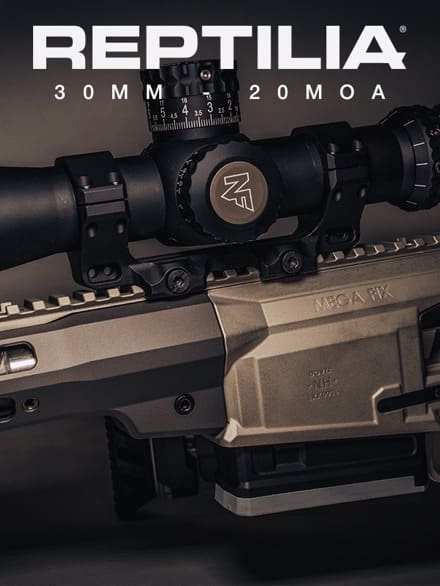
October 29, 2026 — Reptilia announces the launch of the AGS™ 30mm 20 MOA Mount in black, expanding its mounting options for modern bolt-action rifles.

The new configuration pairs a 30mm scope diameter with a 1.34-inch optical centerline height over rail. Its built-in 20 MOA cant supports extended-range applications by helping shooters retain more usable elevation adjustment within their optic.

Machined from 7075-T6 aluminum billet, the AGS features a one-piece body and Reptilia’s anti-snag clamp design. A spring-loaded nitrided steel clamp and flush-fitting hardware secure the mount to M1913 Picatinny rails while maintaining a compact profile.

Key specifications

  • Optic tube diameter: 30mm
  • Optical centerline height over rail: 1.34 inches
  • Built-in cant: 20 MOA
  • Weight: 148 grams
  • Finish: Black Type III hardcoat anodize
  • Manufactured in the USA

The AGS 30mm 20 MOA Mount is available beginning October 29, 2026, priced at $349.95. For product details and ordering, visit the AGS product page.

Arc’teryx Pro Raises Funds for SOC-F During DC Launch of Tactician Line

October 29th, 2026

During the recent AUSA Annual Meeting, Arc’teryx Pro hosted a private evening at their new Georgetown brand store.

While Tactician has had limited exposure at other industry events such as SHOT Show and Operator Expo, this was the first time many had the opportunity to get a close look at Arc’teryx Pro’s latest take on a combat clothing ensemble.

There was even an interview period with one of the line’s designers as well as an end user who trialed the garments before they were finalized.

The 200 attendees also raised $2800 to benefit the Special Operations Care Fund during a raffle for a shopping spree at the store.

I can tell you the store was packed. It was great to see old friends but also make new acquaintances.

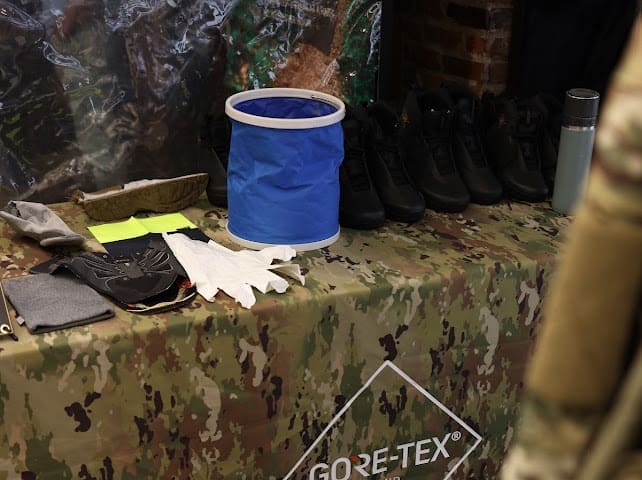
GORE-TEX Professional featured a one-person rain room and offered the chance for attendees to don boots and outer garments featuring GORE-TEX materials to see how well they work. To make things even more interesting they hosted a trivia challenge with prizes for the most accurate and fastest results.

So far, the Tactician line consists of the AR Shirt, AR Pant, and Field Shirt which serve as a field, training, and combat uniform.

Get your Tactician clothing at your favorite Arc’teryx Pro dealer.

Hands-On Experiment: User Experimentation Accelerates Technology Adoption

October 29th, 2026

In 2025, the Department of War (DoW) articulated delivering at speed as a top priority. Putting technology and capabilities into the hands of warfighters as fast as possible, when they need it, even ahead of need, can help warfighters maintain lethality and overmatch adversaries on the battlefield. Along with fielding the equipment faster, it must also be adopted and willingly used by warfighters for it to be effective. Sometimes adoption can be a bigger hurdle than clearing the process to fielding. Warfighters may opt out of using some equipment because it is not mission operable. It could be too heavy, counterintuitive, or there could just be an easier way to get the job done.

To overcome those challenges, the Portfolio Management Executive for Chemical, Biological, Radiological and Nuclear Defense (PME CBRND) is bringing together scientists and engineers who are developing systems to interact with and observe warfighters in relevant operational scenarios using actual equipment—a process commonly known as experimentation— to identify areas of improvement and develop equipment that suits warfighters’ needs. This partnership has been successful in speeding up the acquisition process and ensuring technology adoption.

“To accelerate timelines, we have to get technology in front of the warfighter as early as possible,” said Jerrett Davis, deputy joint product lead for the Joint Project Manager for CBRN Special Operations Forces (JPM CBRN SOF). “Through experimentation, we can host demonstrations where our user groups evaluate and down-select from a range of S&T, government, and commercial equipment. This process provides a validated starting point that ensures the capability we build is not only adopted but is also delivered at the speed of relevance.”

Both experimentation and demonstrations are critical to ensuring that warfighters have a voice in the acquisition process. Experimentation increases knowledge in a specific domain, while demonstrations present and confirm what is already known. Experimentation identifies specific areas of uncertainty, custom designs and conducts experiments to address that uncertainty, whereas with demonstrations, the uncertainty has already been resolved.

“Experimentation and demonstrations are an important part of the process within the special operations community because they can be flexible and move faster given the urgency of the mission. Now we’re trying to expand experimentation efforts and spread the knowledge of how to incorporate it into non-SOCOM [Special Operations Command] programs,” said Osa Penny, director of strategic stakeholder engagements for PME CBRND.

Traditional acquisition is a regimented, sequential process that flows from requirements to science & technology to testing, acquisition and ultimately fielding. Although the user receives the final product in the end, they are not always intertwined in the process. Sometimes this results in a capability that is no longer relevant; or it may be difficult to use, unwieldy to hold; or a host of other issues that could have been adjusted if the user was able to provide early and consistent input. Experimentation maintains the traditional sequence but puts feedback and warfighter touchpoints at the center of the process, allowing for direct feedback and suggestions.

Experimentation exercises are designed using relevant warfighter operational concepts. During these exercises, PME CBRND engineers and their technology developers observe warfighters using the systems in various scenarios, actively capturing data and feedback for consideration into system refinements.

Recognizing the utility of experimentation in the development process, PME CBRND and its partners at the U.S. Army Combat Capabilities Development Command Chemical Biological Center (DEVCOM CBC) created a space to conduct experimentation outside of formal exercises called the Foundry.

The Foundry is an established collection of functions and services designed to build, integrate, and assess potential capability sets for rapid delivery. It provides an opportunity for technical and operational evaluation to assess technical viability, interoperability, operational relevance and implementation factors. The current CBRN defense enterprise Foundry is located at DEVCOM CBC at Aberdeen Proving Ground, Maryland.

“If we can secure service member buy-in ahead of Milestone B [the decision point where Service leadership decides if a product is mature enough to move forward into development], we can ensure resources are not wasted on developing a capability that will never be used during operations,” said Joshua Liles, assistant program manager, JPM CBRN SOF.

Liles leads several experimentation efforts with USSOCOM. He said that many of the methods SOCOM uses to speed up acquisition can be applied to non-SOCOM programs, but doing so requires thinking outside of the box and a willingness to pursue the ‘art of the possible.’

“There are many mechanisms available to support flexible agile acquisition, and some program managers are just not aware of them,” said Liles. “Many were trained to think of things in one way, but today in 2026, we have options. If PMs can think more along the lines of ‘what if we could?’ and then seek ways to accomplish it rather than trying to fit their program into a predetermined model, we can expand the possibilities and see unconventional solutions.” Some of those mechanisms include Title 10, Section 4023, Other Transactional Agreements, and rapid prototyping opportunities, all of which could pave the way for incorporating experimentation into the process earlier.

In 2026, a team working on handheld detectors successfully used Title 10, Section 4023 (a dedicated legal authority that allows the military to rapidly purchase or acquire emerging technologies and prototypes for testing and experimentation), bypassing the standard, lengthy federal procurement process to accelerate innovation to purchase commercial-off-the-shelf (COTS) detector systems to use for warfighter experimentation during the 2026 Dragon Shield Exercise.

The team first investigated if there were any relevant commercially available systems submitted by vendors through the Joint Enterprise Technology Tool, the CBRN defense enterprise’s industry connector. When a few looked promising and fit within the requirements, the purchase was made under Title 10, Section 4023. They then created scenarios where warfighters tested the systems in would-be operational environments. Based on the feedback provided at that event, the team down selected two viable systems that will be further adapted and modified when the program officially starts in FY27. Starting the program with systems they know users will like and use allows system developers to focus on refinement using warfighter data points to help clear Milestone decisions faster.

In FY27, PME CBRND and its Joint Project Managers intend to have increased presence at experimentation events to include programs that support military communities beyond special operations forces. With a cross functional team that meets frequently to discuss logistics, strategy, and constantly keeps an eye on COTS technologies that are available for experimentation events, PME CBRND plans to get technology in the hands of warfighters as early as possible to learn, iterate and field.

By Kelly Burkhalter

Captec Group Appoints Stephen Fasham as Group CEO

October 28th, 2026

Fareham, UK, 27 October 2026 – The Board of Captec Group Plc is pleased to announce the appointment of Stephen Fasham as Group Chief Executive Officer, succeeding the Group’s founder, Max Toti. The appointment forms part of a planned succession to support the Group’s next phase of growth, with Max Toti remaining on the Board as a non-executive director.

From the humble beginnings of a one-person business in 1985, Max Toti has developed Captec into a leading international company in specialised computing and complex integrated systems, serving sectors including defence, energy, healthcare and transport. Throughout that development, he has maintained a focus on engineering computing hardware around customer requirements, establishing an approach that continues to shape Captec today. As Founder and a major shareholder, he will continue to support the business as an ambassador for the company.

The appointment follows Captec’s acquisition of a majority stake in German industrial PC specialist Spectra. Through Spectra, the Group has also developed a global strategic partnership with Cincoze, the Taiwanese rugged computing manufacturer. These developments extend the Group’s geographic reach and product portfolio, adding computing platforms that complement its engineering, systems integration and lifecycle support. Spectra continues to operate under its own name and established management. Together, Captec and Spectra are targeting turnover of more than £100 million.

Stephen Fasham brings experience in building, leading and integrating international technology businesses. He helped establish Covelya Group as Chief Operating Officer before becoming Chief Executive Officer in 2021. Working with its leadership, he grew the business into a global underwater technology group, with manufacturing across the UK, Denmark and Canada, and nearly tripled revenue before its acquisition by Kraken Robotics in 2026. His work included integrating acquisitions, building leadership teams and developing Covelya’s defence business through the formation of Forcys.

An engineer by profession, Stephen Fasham studied at the University of Cambridge. His career has progressed from engineering and product development to strategic and commercial leadership, in sectors ranging from telecoms and aerospace to subsea and defence.

Max Toti, Founder of Captec Group, said:

“Growing Captec into an international group has been an extraordinary journey, made possible by the commitment of our people and the trust of our customers and partners. I am proud of what we have built together. Stephen brings the engineering knowledge and leadership experience to take Captec forward, and I look forward to supporting him as he builds on these foundations.”

Ed Spurrier, Non-Executive Chairman of Captec Group, said:

“On behalf of the Board, I would like to thank Max for 41 years of leadership. Few founders build a business of Captec’s standing, and fewer plan its succession with such care. Stephen’s experience of growing and integrating international engineering businesses makes him the right person to lead the Group’s next phase.”

Stephen Fasham, Group Chief Executive Officer of Captec Group, said:

“Max has built a business with deep engineering expertise and customer relationships earned over decades, and the same qualities stand out at Spectra. I look forward to building on those strengths across the Group as it grows internationally, helping more customers meet demanding hardware requirements and supporting the systems they depend on for years to come.”

49North Signs MOU with UNWAVE for Joint Production and Support of Counter-UAS Systems

October 28th, 2026

Brings Canadian defence integration and sustainment expertise to partnership with Ukrainian counter-drone manufacturer
49North, a wholly owned subsidiary of MDA Space Ltd. (TSX: MDA) (NYSE: MDA), announced today that it has signed a Memorandum of Understanding (MOU) with UNWAVE, a Ukrainian counter-drone technology manufacturer, to collaborate on the joint production and support of counter-uncrewed aerial systems (C-UAS).

The collaboration supports Canada’s efforts to assist Ukraine and aligns with the Joint Declaration on Enhancement of the Defence and Security Cooperation between Ukraine and Canada announced on September 10, 2026.

49North’s ability to manage complex defence programs and provide long-term engineering support complements UNWAVE’s counter-drone expertise, positioning the partners to help address Ukraine’s evolving defence requirements while strengthening industrial ties between the two countries.

With expertise in advanced sensing, secure digital mission systems and in-service support, 49North draws on more than five decades of trusted Canadian defence delivery and prime contractor execution. That includes nearly two decades of military drone delivery including the provision of Heron uncrewed aerial systems for Canadian operations in Afghanistan and drone services supporting Intelligence, Surveillance, and Reconnaissance (ISR) operations in Ukraine. This operational experience provides a foundation for integrating and sustaining C-UAS technologies in demanding environments.

Quote

“Keeping pace with evolving drone threats requires engineering, integration and sustained support to keep technology relevant. By leveraging UNWAVE’s counter-drone expertise and 49North’s defence capabilities, we see an opportunity to advance joint production and support systems that address Ukraine’s evolving needs. This partnership builds on our history of supporting Ukraine with Canadian technology and gives us a path to deepen that contribution.”
– Joe Armstrong, President, 49North

Tesseract Ventures Launches Innovation Initiative to Develop Synthetic Brick Technology Kits

October 28th, 2026

Collaboration will combine a synthetic modular building system with Tesseract’s technology, software, autonomous systems, and field-deployable capabilities across Defense, Construction, Critical Infrastructure, and Agriculture.
TAMPA, Fla., Oct. 27, 2026 — Tesseract Ventures today announced a strategic innovation initiative focused on developing a new generation of rapidly deployable, technology-enabled infrastructure called Tesseract Synthetic Brick Technology Kits.
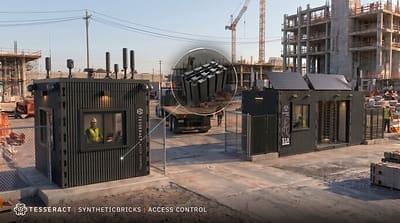
The initiative will combine Lok-N-Blok’s modular synthetic building technology with Tesseract’s experience developing integrated hardware, sensors, communications, artificial intelligence, autonomous systems, drones, access control, digital twins, robotics, and command-and-control technologies.

Rather than beginning with a traditional steel shipping container, trailer, or permanent building and then modifying it to accommodate technology, Tesseract Synthetic Brick Technology Kits are envisioned as purpose-designed systems in which the structure and technology are engineered together from the beginning.

Lok-N-Blok would provide the modular structural building components, while Tesseract would design the finished operational capability around customer requirements. Depending on the application, a kit could incorporate RF shielding, power, communications, sensors, cameras, access control, displays, edge computing, autonomous systems, drone storage and launch capabilities, robotic fabrication equipment, and Tesseract software.
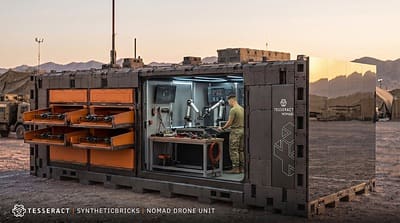
The objective is to create systems that can be designed digitally, packaged efficiently, transported in compact form, assembled near the point of use, integrated with technology, expanded as requirements change, and potentially disassembled and redeployed to another location.

“We see an opportunity to rethink the relationship between infrastructure and technology,” said John Boucard, Founder and CEO of Tesseract Ventures. “Instead of putting our technology inside a box that was designed for something else, Tesseract Synthetic Brick Technology Kits allow us to design the structure around the mission. Lok-N-Blok gives us an exciting modular foundation from which we can create intelligent environments for some of the most demanding industries in the world.”

Initial Tesseract Synthetic Brick Technology Kit concepts are expected to address four core markets:

Defense — Tesseract Nomad drone operations systems, forward command environments, communications nodes, sensor hubs, Smart Secure Spaces, and Tesseract Forge fabrication and maintenance capabilities.

Construction — secure environments, modular NODE guard stations, workforce access-control environments, project command centers, meeting and training spaces, digital plan rooms, and autonomous drone inspection stations.

Critical Infrastructure — remote operations centers, utility inspection hubs, distributed sensor stations, emergency-response facilities, drone deployment systems, and communications infrastructure.

Agriculture — field operations centers, autonomous drone stations, equipment and sensor hubs, communications facilities, and distributed farm intelligence environments.

A single Tesseract Synthetic Brick Technology Kit could begin as a relatively small access-control or monitoring station and expand into a larger connected secure operating environment as customer requirements evolve. Standardized structural components could be combined with standardized Tesseract technology packages, allowing new configurations to be created without redesigning an entire system for every deployment.

The collaboration also creates the potential for Tesseract to develop repeatable technology packages such as Access & Security Kits, Smart Space Kits, Drone Operations Kits, Communications Kits, Sensor Kits, and Forge Fabrication Kits that can be incorporated into different structural configurations.

“Lok-N-Blok was created around the idea that construction could become more modular, efficient, and adaptable,” said John Lewis, CEO of Lok-N-Blok. “Tesseract brings a powerful technology layer to that idea. Together, we have an opportunity to explore how modular construction can become the foundation for intelligent, rapidly deployable operational environments.”

Under the proposed initiative, Lok-N-Blok would serve as a strategic supplier of the modular synthetic structural system, while Tesseract would lead application design, technology integration, customer configuration, software, autonomous systems, deployment, and lifecycle capabilities.

The initiative represents a shared vision for a new class of infrastructure:

Build only what the mission requires. Ship it efficiently. Assemble it rapidly. Connect it intelligently. Reconfigure it when the mission changes.

About Tesseract Ventures

Tesseract Ventures is an American invention and manufacturing company developing integrated hardware, software, autonomous systems, artificial intelligence, and command-and-control technologies for Defense, Construction, Critical Infrastructure, and Agriculture. www.tesseractventures.io/syntheticbricks 

ZeroTech Optics Launches Adjustable BDC Turrets with Tool-Free Adjustable Impact Markers


October 28th, 2026

Five customizable distance markers deliver an adaptable alternative to fixed BDC dials while keeping traditional elevation markings in view.

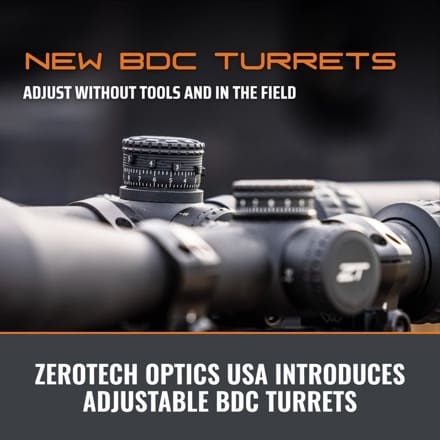
Nashville, TN — ZeroTech Optics announces the release of its Adjustable BDC Turrets, giving hunters and target shooters a customizable alternative to fixed, laser-engraved bullet-drop-compensating dials. Built around five Adjustable Impact Markers (AIM), the system combines quick distance references with tool-free marker adjustment while retaining the scope’s traditional elevation markings.

A custom BDC dial is only as useful as the data behind it. Changes in ammunition or shooting conditions can leave fixed yardage markings out of step with a rifle’s actual trajectory. The Adjustable BDC Turret lets shooters reposition their markers to match updated, verified ballistic data rather than order another engraved dial.

Each numbered AIM sits above the traditional MIL or MOA scale, preserving both a personalized distance reference and conventional dialing information. Shooters can use their preset markers when the data matches their setup or return to the standard elevation markings when a different correction is needed.

A top-mounted selector releases one marker at a time while keeping the others locked, allowing individual references to be changed without disturbing the rest. Once the markers are positioned, the selector returns to its locked setting. AIM adjustments require no tools; initial aftermarket installation or alignment may require tools.

That flexibility has practical applications beyond a single load or hunting season. Hunters can establish markers for pre-ranged clearings, while target and competition shooters can configure them for known-distance targets. As loads or conditions change, the same markers can be reset to reflect newly verified data instead of committing the shooter to a permanent set of yardages.

Key Features

• Five Adjustable Impact Markers: Individually set and lock personalized distance references.

• Tool-free marker adjustment: Update presets using the top-mounted selector.

• Traditional elevation markings: Retain conventional dialing references beneath the AIM markers.

• Reusable customization: Reset markers when ammunition or environmental data changes.

Compatible Riflescopes

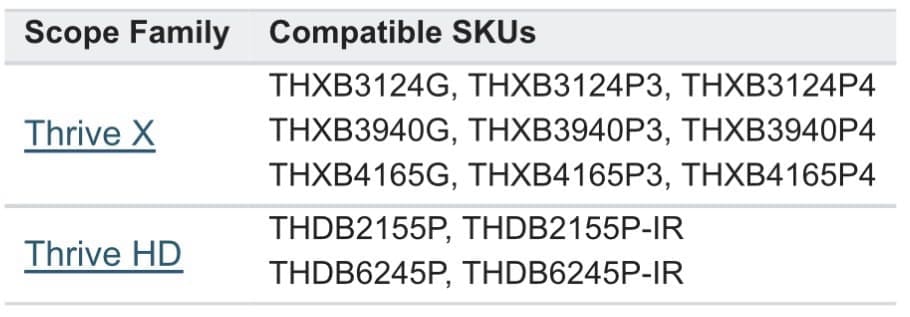
The Adjustable BDC Turret is compatible with the following B-designated ZeroTech riflescope models:

Compatibility is model-specific. Confirm the exact riflescope SKU before ordering.

For product details, visit the Adjustable BDC Turret product page.

XS R3D 2.0 Night Sights Now Available for CZ P-09 Nocturne Pistols

October 28th, 2026

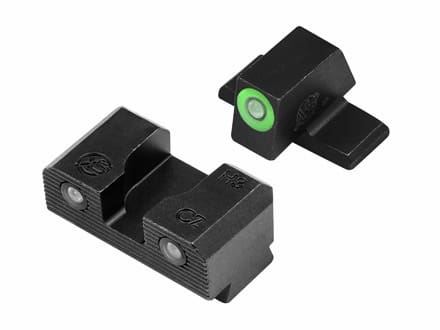
Fort Worth, Texas (October 27, 2026) – Owners of CZ P-09 Nocturne pistols can now upgrade their factory sights with intuitive, fast, and accurate R3D 2.0 night sights. Designed for self-defense, these 3-dot notch and post sets come with a green or orange Glow Dot front sight with tritium in the center. The dual-illumination design of the front sight makes it larger and brighter than the two rear tritium dots, driving focus to the front sight and downrange target. The wide rear notch design also provides more visible indexing for increased speed and accuracy.

“Our R3D 2.0 night sights give gun owners an edge over most factory sights by helping them get on target faster and more accurately when every fraction of a second counts,” said Addison Monroe, Digital Marketing Manager, XS Sights. “Improved capability and increased preparedness lead to greater confidence, and our goal has always been to give gunowners purpose driven tools to help them shoot better.”

XS sights are backed by a Limited Lifetime Warranty. The company also offers a 12-year illumination warranty on all tritium products. For more information, visit www.xssights.com.