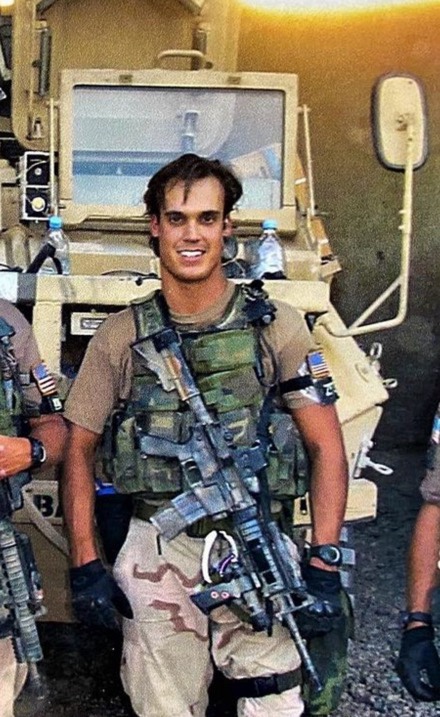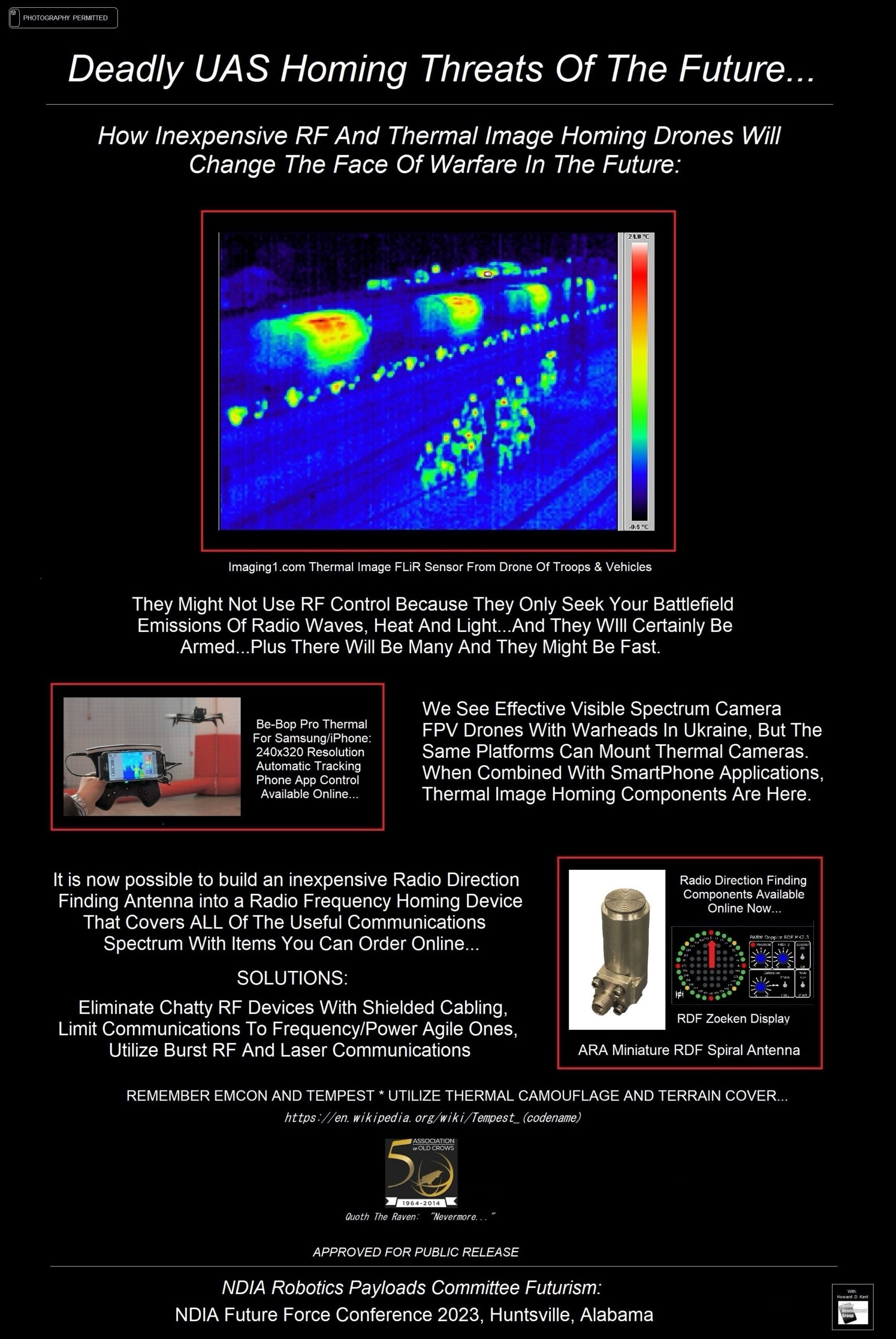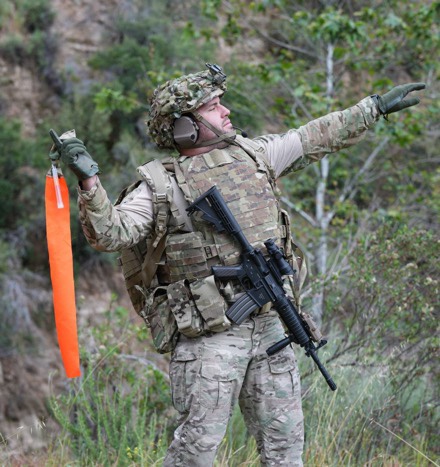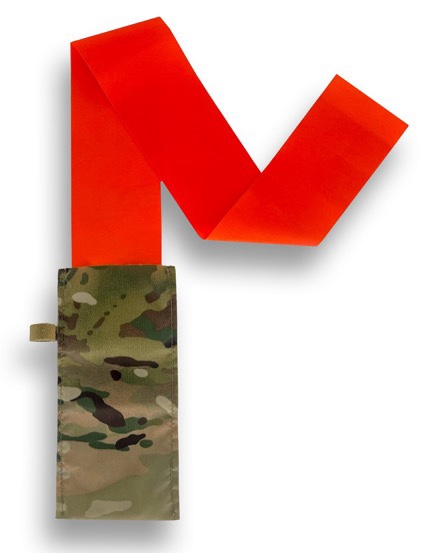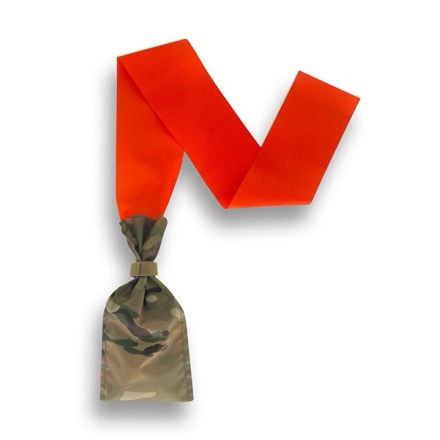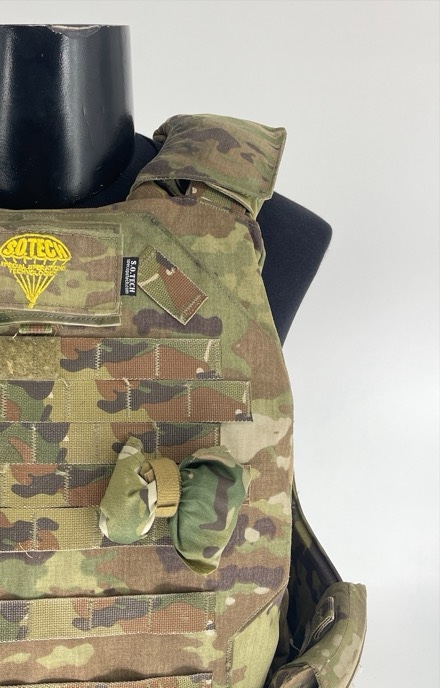
BOSS-Xe from Wilcox Industries

Spiritus Systems Presents Shake Down: The Machine Gunner’s Kit

August 22nd, 2023

In this episode of Shake Down, Adam Holroyd goes over kit considerations for crew served belt-fed weapons and the nuances of a machine gunner’s kit.

www.spiritussystems.com

Misty Mountain Mountain Mobility Sit Harness

August 22nd, 2023

Since 1985, Misty Mountain has been providing customers with strong, durable, comfortable harnesses for climbing and vertical activities. The last two decades, we’ve been working directly with military and tactical operators to provide them with gear tailored to their specific needs. Our Mountain Mobility series takes the operators’ heavy duty belts, and makes them part of a modular harness solution. For 2023 we redesigned the MM Operator Belt and Leg Loops, and these new harnesses are quickly becoming the choice of Special Operations Forces. 




The MM Operator Belt is a load rated gun belt featuring a new laser cut CORDURA Polymer composite outer layer for mounting mission essentials. The two piece system has a 1.5″ wide lightweight liner belt with Velcro loop outer for holding up trousers. The 1.75″ wide load rated nylon outer belt mounts securely onto the liner belt, and features front and rear attachment loops and the load rated AustriAlpin Cobra buckle. Suitable for edge restraint, the MM Operator belt can be used while tethered into rotary wing aircraft for safety. 


MM Cobra Light Leg Loops can be added to the belt with an enclosed auto-locking carabiner to create a full strength sit harness, UIAA Safety Label approved, suitable for fall protection. The MM Cobra Light Leg Loops are made from US woven 2″ wide nylon, and feature auto-block loops for rappel backup, and 1″ AustriAlpin Cobra buckles. These leg loops stow easily around the operator’s waist until deployed, making them suitable for high speed operations.

MM Cobra Leg Loops (not Light), have the same features as their lighter counterpart, and additionally, they have closed cell foam padding and elastic leg loop hold up straps. These comfortable leg loops are a better choice for operations where longer harness hangtime is anticipated. Auto-locking carabiner is included with MM harnesses. All Misty Mountain tactical gear is made in the USA and Berry Amendment Compliant. 

The harness is available in Black, Coyote, MultiCam and MultiCam Black in sizes Small – XLarge.

Please contact Misty Mountain at phone # 828-963-6688, or customerservice@mistymountain.com, for further information and quotes. Orders can be placed online at mistymountain.com

Minot AFB Develop Prototype Gloves for Extreme Cold Temperatures

August 22nd, 2023

MINOT AIR FORCE BASE, N.D. (AFNS) —  

Minot Air Force Base’s innovation cell, also known as Atomic Spark, brought another innovative solution to the mission.

Atomic Spark is an agency that accelerates grassroots innovations within Minot AFB, providing both a voice and conduit to turn powerful ideas into operational capabilities. The newest innovative solution brought forward to the cell … gloves.

“Innovation can start with any Airman; they are the subject matter experts and know how to solve the problems,” said Capt. Matthew Matuszak, 91st Missile Wing Atomic Spark director. “Atomic Spark helps refine and elevate the Airman’s idea so that it can be seen by a decision maker.”

With frigid winter temperatures that can reach 50 below zero, Airmen working outdoors are exposed to extreme weather. This makes gloves an essential item in the winter. The standard-issue gloves currently used by many Airmen may protect them from the elements but don’t offer the dexterity and movement needed to perform duties easily. A custom, heated glove was identified as a potential solution by the 54th Helicopter Squadron during a recent IGNITOR outreach project with their unit. Commercially-available gloves did not offer the right amount of dexterity, comfort and insulation required by the mission.

“You can’t effectively employ your weapon system or the hoist if you can’t feel your fingers in the winter,” said Staff Sgt. Mathew Brown, 54th HS flight engineer. “The previously issued version had some limitations, so it was determined that an improved glove was needed.”

These issues were brought to the IGNITOR group, a working group whose goal is partnering with Minot AFB units to identify feasible contractual, facilities or process improvement solutions to tactical problems.

The IGNITOR group saw the need for a custom heated glove opportunity that spanned several career fields across both the 5th Bomb Wing and the 91st MW. Atomic Spark brought the idea for custom heated gloves to base leadership and assisted with drafting the required documents to request innovation funds at the Air Force level. As a result, custom heated gloves are now being developed to not only help Airmen assigned to the 54th HS, but all base personnel working in extreme weather conditions.

“It can be difficult to get good training in ambient temperatures of 20 below zero or lower if you’re only thinking about how cold you are so anything that can help you focus on the task you’re accomplishing in the aircraft only makes you and your squadron better,” Brown said.

Minot AFB’s custom glove proposal was selected by Air Force Chief of Staff Gen. CQ Brown, Jr. as the recipient of a portion of his Momentum Innovation Fund. The next step in the process involved the 5th Contracting Squadron soliciting and awarding a contract prior to the winter.

The Atomic Spark and IGNITOR teams at Minot AFB have shown no signs of stopping their streak of innovation, having acquired over $45 million in Small Business Innovation Research funding in just under two years. These funds allow Minot AFB to identify small businesses that can provide solutions to the warfighter in a faster, more efficient manner.

“Atomic Spark is critical to Team Minot’s innovation goals, having been extremely successful obtaining Department of Defense innovation funds,” said Lt. Col. Stephen Kroft, 5th CONS commander. “The partnership between Atomic Spark and IGNITOR has been a key factor in turning Team Minot into a hotbed for innovation.”

Atomic Spark and IGNITOR have more than 40 projects currently in the works. Custom heated gloves won’t be the last innovation coming from Minot AFB as Airmen work hard to improve not only the base but the Air Force as a whole.

By Airman 1st Class Alexander Nottingham, 5th Bomb Wing Public Affairs

Rheinmetall Opens Lynx Infantry Fighting Vehicle Factory in Zalaegerszeg, Hungary – Europe’s Most Advanced Plant for Armoured Vehicles

August 21st, 2023

Rheinmetall officially opened its new factory in Zalaegerszeg on 18 August 2023.  The new plant marks a major milestone for Rheinmetall and underscores the Group’s commitment to Hungary. In future, this cutting-edge facility will produce the Lynx infantry fighting vehicle, the world’s most advanced IFV.  


“The opening of Rheinmetall’s new factory in Zalaegerszeg is a significant step for our company and a sign of our close ties with the government and armed forces of Hungary, an EU partner and fellow NATO member state”, declared Armin Papperger, chairman of the executive board of Rheinmetall AG. “We’re proud to be part of the growing industrial community in Zalaegerszeg and look forward to working with local partners and drawing on local talent. Hundreds of people are working together here in Zalaegerszeg to produce top-notch military systems for the Hungarian armed forces as well as export customers.”

Headquartered in Zalaegerszeg, Rheinmetall Hungary Zrt. focuses on the development and manufacture of state-of-the-art tracked and wheeled armoured vehicles for the Hungarian military, especially the new Lynx infantry fighting vehicle. 

Rheinmetall plays an important part in Hungary’s “Zrínyi 2026” initiative, which aims to reequip the country’s armed forces with locally produced modern equipment. 


The Hungarian defence ministry has contracted with Rheinmetall, Europe’s foremost maker of systems and equipment for ground forces, to supply it with the world’s most advanced tracked and wheeled armoured fighting vehicles, including associated services.  

Rheinmetall sees Hungary as a home market to be supplied with Hungarian-made products. In this context, a new, extremely well-equipped development, production and test centre is now being built on a 33-hectar site in Zala County in southwest Hungary, including an EMV/ CLIMA chamber and a firing tunnel. In designing the plant, special emphasis was placed on the latest industrialization principles as well as flexibility, growth potential, efficiency, the implementation of advanced transport and logistics concepts and cutting-edge production techniques.  In the quality control domain, a 3D measurement cell will guarantee fast, permanent, automated assurance of component quality, setting a new standard here as well. Over the next few years, another 350 new jobs are planned at the Zalaegerszeg plant. 

Rheinmetall supplying state-of-the-art tracked and wheeled armoured vehicles and associated services.


The contract encompasses 209 Lynx KF41 in seven variants, plus 18 combat support vehicles, including Büffel/Buffalo 3 armoured recovery vehicles, as well as 38 military trucks.  In addition, the contract incorporates products and services such as simulators; training and instruction; and an initial stock of spare parts and maintenance support. Throughout the Lynx’s decades-long anticipated lifespan, spare parts and regular maintenance will be needed to ensure operational readiness. 

In a first production phase, Hungary will be supplied with 46 Lynx systems configured as infantry fighting vehicles or for a command & control role, plus nine Büffel/Buffalo 3 ARVs, all of which will be made in Germany. Delivery has already begun. In a second phase, a joint venture will build and ship a further 172 Lynx systems and various combat support vehicles in Hungary.  
The new factory will do more than just contribute to the regional economy. It will also promote innovation and the creation of highly qualified jobs. Looking ahead, Rheinmetall plans to keep investing in the plant in order to increase production capacity and integrate new technologies. 

In setting up this factory, Rheinmetall is signalling its confidence in the growth potential of the Hungarian economy and the skills and abilities of Hungarian workers. By creating jobs and fostering special knowledge, Rheinmetall is helping to further strengthen the Hungarian economy and defence industry, simultaneously establishing its ultramodern, future-proof Lynx infantry fighting vehicle – equipped with advanced high-performance sensors and the Lance weapon station – in the global market. 

Creomagic to Provide Advanced Live Video and Communication Solution for Tier-1 Military K9 Unit

August 21st, 2023

Ness Ziona, Israel – August 21st, 2023 – Creomagic Ltd., a pioneering communications manufacturer based in Israel, has been awarded a significant contract by an undisclosed Tier-1 defense customer to provide lightweight tactical video and communication kits tailored for K9 operations. The contract is estimated at hundreds of units worth several millions of US Dollars.


K9 operational dog and its human handler – Illustration (Credit: Israel Defense Forces)

Creomagic will showcase its communication technology portfolio, including its newly released CreoHub HP man-portable radio, at the upcoming Defence & Security Equipment International (DSEI) exhibition in London, UK (September 12 to 15, 2023; booth H1-116).


CreoHub personal kit with wearable video camera and tactical computer

The new K9 systems will enable live video and voice transmission from K9 dogs to their human handlers and team leaders, ensuring uninterrupted near-real-time footage and voice in hostage release situations, search and rescue missions and other complex operational scenarios.

The contract is a result of a competitive test campaign conducted in various operational settings, ranging from private houses and public buildings to city markets, forestry, basements, and mountainous areas. Throughout these tests, Creomagic’s communication systems demonstrated law latency video transmission, telemetry and voice commands.

“K9 dogs play an invaluable role in military, law enforcement, and rescue units worldwide, often operating in environments that are inaccessible to human operators” noted Alex Shapochnik, CEO of Creomagic. “During these missions, our communication systems need to meet not only the highest performance requirements but also to provide comfort and ergonomic functionality for the dogs. Most importantly, we are proud to help our customers save lives”.

SOFWERX – USSOCOM Enterprise Training Solution Collaboration Event

August 21st, 2023

SOFWERX, in collaboration with USSOCOM Program Executive Office-Services (PEO-SV), will host a Collaboration Event on 19 September, 2023, to identify, collaborate, and find solutions to streamline the acquisition, purchasing, and scheduling of enterprise training. The purpose of this effort is to alleviate the burden on units of ordering and purchasing required training multiple times throughout the year.

The goal of this series of events is to identify capabilities for a tool that will enable government stakeholders to sort through a menu of available training options from available companies. The tool should allow customers to rate companies’ past performance and allow units to purchase and schedule training without resoliciting and/or renegotiating a contract or purchase order. Ideally, the tool will also provide firewalls to protect company proprietary data and ITAR information and reside on the unclassified network.

See more details at events.sofwerx.org/enterprise2.

Request to Attend NLT 05 September 2023, 11:59 PM ET.

The Baldwin Files – The Tools I Carried (Part 2)

August 21st, 2023

In this iteration of the series, I am going to drill down on individual survival kits. In truth, every item a soldier wears or carries is supposed to contribute to his or her survival. Boots to headgear. Everything serves a purpose and helps the soldier stay alive and successfully complete the mission. However, when most people talk about a “survival kit” they are thinking about a much smaller package of last-ditch “emergency” items tailored to the operating environment and potential contingencies. I, for one, chose items to fill a kit like that based on what I consider the “more likely and most dangerous” survival scenarios I might realistically face – not the apocalypse. So, that is the specific kind of survival kit I will mostly focus on.

At the highest end of that concept is the multipocketed Pilot’s Survival Vest that military aircrews and some others wear filled with issued survival gear. The one in the picture above was used from the 1960s thru the 90s. On the other end, would be the handful of useful items I started carrying in my uniform pockets early in my career that was my de facto first survival kit; and – as would likely be the norm for an entry-level soldier even today – it was very minimalistic. It was an issue “Utility Knife’ by Camillus (the design dating back to WWII), Zippo lighter, P38 (issue can opener on my dog tag chain), several packets of C Ration Toilet Paper (TP), and book matches. Yes, the TP was there to wipe my rear in case of any inconvenient gastro-intestinal “emergency,” but it was also handy to start fires. And, not so surprisingly, my last kit, 35 years later, still included a Swiss Army Knife (SAK – a more versatile version of the Camillus knife), a Bic lighter, a P38, and MRE TP. The classics may evolve, but they never go out of style.

In the interim, I did add, and would recommend, a number of other useful items to consider. Now, I am not going to tell anyone what is “right” or “wrong” to carry in their personal survival kit. For one thing, I do not want to argue with anyone about the relative value of this or that item. Secondly, identifying adequate and appropriate contents of a survival kit involves very subjective decisions that each person ultimately must make for themselves. After all, you are gambling your own life on these choices. Certainly, the relative experience and training of the individual and the potential survival environment should inform those selections. Someone snowmobiling in the backwoods of Wisconsin in the winter, obviously, has different potential environmental risks to mitigate than someone on a cross-country summer ATV trip in the desert Southwest.  

Of course, advice from a more experienced individual or other information sources, like a Survival Manual, is also useful. As I said, I am not going to dictate a particular packing list. However, I can and will explain what I carried – and chose not to carry, over time – and why. I will also throw in a couple of tips that seemed to work out for me. Here is one more caveat. I, and other people who are formally trained and experienced “survivalists,” RARELY get themselves into a situation where they have to put their carefully assembled survival kit to the ultimate test. Indeed, most instruction in any formal survival training program is simply intended to give a person confidence that they have the requisite basic skills and aptitude to assemble the minimal tools that are desirable to facilitate survival. This pre-crisis preparation – hopefully – serves to effectively “inoculate” them against the first and most dangerous threats to survival anyone faces when put in a real-world life-or-death survival situation – panic and despair!  

Most reputable Survival Manuals, like the Army’s FM 21-76 (above top left), talk about the psychological challenges and list and talk through the process of selecting survival kit items in some detail. I suggest reading a good book on the subject and getting some education before spending money on any alleged, guaranteed to survive any situation, “perfect” kit someone is trying to sell. Not to say there are not legit “store-bought” survival kits out there; just that this is definitely an area where it pays to be an informed consumer. Reference military vs commercial gear. The stuff that I have on display in the attached pictures, based solely on availability and my work needs at the time, is clearly military-centric. However, there are suitable civilian alternatives for all this paraphernalia. The fact is, some of the gear that I chose to carry or a fighter pilot would have in his vest – like a survival beacon/radio – is not necessarily relevant to a non-military survival situation anyway.

There are several survival “rules” or principles that I found useful to follow when putting a kit together and I will mention them as we go along. I want to emphasize a couple up front. I learned that it was smart to think in terms of layering and redundancy. If it is a critical tool – say a blade or firestarter – it pays to have more than one. Even several. When I was working, I usually had five or six blades of different lengths on me somewhere. A clip blade in my pants pocket, a Leatherman on my plate carrier, a field knife on my gun belt, a machete on my ruck, and a Victorinox brand SAK in my last-ditch “pocket” survival kit.

As I became more knowledgeable and had more experience, there were a couple of categories of items that I generally did NOT choose to include in my own individual survival kits even though they were routinely issued in official kits. One is first aid items. Not that I did not consider those medical items important, but rather because I did not find it useful to mix the two functions. I did not want to dig through Bandaids and Motrin to find a firestarter or vica versa. Therefore, I kept medical gear segregated in a first-aid kit attached to my first- or second-line gear. My smaller “omega’ survival kit would initially be in an outside pocket of my ruck but would be moved onto my person if and when the situation changed for the worse.

The other major category was food and food procurement items. If one has a rucksack full of food when circumstances go south, by all means, hang on to that ruck as long as you can. However, it seems to me that if you still have all your gear – including food – you might just be ‘extreme camping” and are not yet in a true survival situation. Normal – rather than emergency – fieldcraft would still apply. Food items are generally bulky to the point that they will not readily fit in a small, austere survival kit container anyway. As for food procurement, I did not find elaborate fishing kits or snares (not shown) worth the space either. The fact is, if someone is healthy, they can go days without food; and one would very likely expend more energy hustling to procure the food than would be gained in eating it. Moreover, if one eats improperly prepared fish or game, food poisoning might very well result – turning a bad situation much worse. Starvation is NOT likely to be your most pressing challenge! Ignoring the grumbles of your stomach, and using that limited space for something more immediately relevant, is almost always the wiser choice.

For instance, in a survival situation, hydration is significantly more important than food. So, having some means to purify and then carry water is essential (below left). The only item I would consider more important than addressing that basic need, is a compass. That simple tool is vital for getting me from where I am to where I would rather be. I would never want to be without it. Having a reliable means – or two, or three – to start a fire as well as a blade and lashing material to build a hasty shelter should also be a very high priority. Items that can be used to signal possible rescuers would be next: signal mirror, signal panel, and whistle would be some examples. Of course, soldiers who may find themselves in an evasion situation must contemplate how to use tools like that effectively to attract the attention of “friendlies” while simultaneously avoiding drawing unwanted attention from those who are less than friendly.  

Let us talk about multitools. I have some examples in the first picture (above, top right). I am fond of the Victorinox brand of SAK. I prefer the “mid-sized” varieties like: Climber, Huntsman, Mountaineer, and Ranger. If space is tight, there are smaller versions with fewer tool options. The tools I find most useful are: a large blade, small blade (backup), bottle opener, can opener, scissors, and corkscrew. For Leathermans, I prefer the WAVE, but the original PST will do – again, especially if space is limited. The Leathermans have most of the same tools as the Victorinox knives, minus the corkscrew, but plus the plyers. Now, I must admit I have never had to use the corkscrew to open a bottle of wine or anything else with a cork. However, I read somewhere a long time ago that “a Gentleman should never be without a corkscrew.” That still seems like sound life advice to me. And, if that hypothetical unopened wine bottle ever challenges me, I will be ready with the solution.    

In terms of firestarters (below left), the military has issued several good choices. The Doan Magnesium Firestarter has been around for a long time. The Sparklite is another tried and true veteran. Cigarette lighters, as well as book and stick matches work well and, because of their almost universal familiarity, they do not require much additional training to be used effectively by even inexperienced people. The classic “flint and steel” (not shown) is NOT a good survival choice in most cases because of the relatively heavier weight and – more significantly – because of the training and practice required to use those tools reliably under stress. It is instructive to note that our pioneer ancestors – who literally started fires almost every day – happily put away their flint and steel as soon as manufactured stick matches became widely available.

Candles are very useful items as well in this category. They can supply critical heat and light, especially in a small shelter but require enough ventilation to be safe in that kind of enclosed space. Beyond that, candles can help buy time. That is, matches light for perhaps as little as ten seconds. A spark from one of the other devices will extinguish even faster. If you use the match or spark to light a candle – even small ones like birthday candles (below, next to the full-sized candle) – the flame will now last for several minutes – or longer with larger candles. There are a lot of “tricks of the trade” for fire starting that I do not have the space to cover here. I will refer you back to a manual and I am sure there are videos out there as well. I will just caution that it takes actual practice and repetition to do it right. There is an art to building and sustaining a fire in the right place and fashion so that it efficiently warms a shelter space for your benefit while effectively diverting detrimental smoke and fumes away so that you do not suffocate yourself.

Another major category of survival items to consider is “cordage” (above right) I already mentioned that some kind of cord is essential to lashing together a hasty shelter, or raft, or litter, or travois, or some other useful jury-rigged apparatus that someone might need to construct in an emergency. There is a lot of good quality cordage available in various diameters. The small gauge stuff that is used as a “dummy cord” for survival vests would be one example. However, the classic answer to just about anybody’s cordage needs is 550 Cord, a.k.a. “Paracord.” The secret to 550 Cord’s wide-ranging utility is that it is eight nylon cords in one. With seven strands inside a sleeve that can be separated and used individually for multiple tasks. Caution: I am talking specifically about military issue Type III 550 Cord. That is the only kind I can recommend with full confidence. There are some top-quality commercial brands available as well – especially if one has a need for cordage in non-military standard colors. However, there are also a lot of commercial options out there that may or may not be of the same quality, reliability, or strength. Caveat Emptor!

I mentioned earlier that food procurement would be relatively low on my priorities. The kind of survival situation I anticipate would last days not weeks. However, if I still had food on me or was able to scrounge some up along the way I would certainly eat it. That is why I carry one or more tool(s) with a can opener, bottle opener, and corkscrew in the first place. As a rule, food in intact cans or jars has likely already been cooked/pickled/salted/preserved, etc., and can be consumed safely out of the container once it is opened. Still, most canned foodstuff will probably be more palatable if it is heated. That is if the situation allows for a fire to be built for cooking.

I do not want to insult anyone’s intelligence, but I thought it was advisable to add this tip. Most soldiers in the military today have only eaten field rations from retort pouches (MREs) – not cans. Many folks who camp, hike, or hunt, today use the same kinds of pouch meals. If they use cans at all, they cut the lid of the can completely off – as they would at home – dump the contents into some kind of backpacker’s pot to do the actual cooking; and simply discard the original can. In the days of C-Rations, one of the first things a soldier learned was how to open a can so that the lid would form a functional handle. Then the can and contents could be heated directly on a campfire or with a heat tab. As my example shows (above top right), the can should be opened only approximately ¾ of the way and the lid bent back. This provides a solid handle that can be used (preferably with gloves) to put the full can on the heat source. If it gets too hot, or gloves are not available, the plyers of a Leatherman can be used to safely grab the lid/handle instead.

What do I think are the barest minimum of items that need to be carried in a survival kit? I have just three that I consider absolute “must haves.” A multitool, firestarter, and compass. Any container I use for a kit has to be at least big enough for those three items. In smaller “Altoid Tin” sized containers (below left) I use more compact versions of the critical items to optimize the space available. However, if possible, I prefer “full-sized” tools because they are easier to manipulate when hands get numb from cold or manual dexterity is otherwise compromised. I have used Altoid Tins and similar small containers mostly for kits I put on field knife sheaths (below center). The first clear plastic container on the left is meant to carry a pack of smokes and a book of matches. I call this my “glove compartment” kit because I have had one in each of my vehicles for many years. I also used to give these to friends as starter” survival kits.

The larger plastic green and orange boxes (above) were originally intended for first aid kits. But they serve well for slightly more comprehensive survival kits. The other two clear plastic boxes (above right) have been part of military survival kits since the 1960s and I used them throughout my career. They were still in the system when I retired in 2011. They came in short and tall versions. The taller one fits very nicely in an ALICE ammunition pouch. That is where I carried mine until ALICE was superseded by other gear. After that, I tucked the kit away in various belt pouches (examples shown above)). As I mentioned, I kept them assembled in an outside ruck pocket until needed. Later, I transitioned to small fanny packs (above right) since I found them to be quicker and simpler to don in an emergency. That eventually became my setup until I retired.

After I retired, I realized I needed to rethink my kit container. The plastic box was adequate because I also habitually carried a metal canteen cup or titanium cup to: heat water to sterilize it, melt snow, or to cook. I could not do any of that with just the plastic container. So, instead of going back to carrying a canteen cup in addition to my survival kit container, it seemed much more efficient to use the canteen cup and lid – or another similar-sized metal container with lid (2 examples below on the right) – to store the survival kit in the first place. I found that I could fit all the items from my old “standard” kit in the canteen cup. And the whole thing still fits neatly in a small fanny pack.

Here is what I have now in my new standard survival kit (left to right): signal mirror, SAK, Bouillion Cubes, Charms hard candy, compass, P38, signal panel, Firestarter, matches, candle, roll-up commercial water storage bags (2), water purification tablets, whistle, backup compass, and folding Spork. Bouillion Cubes and Charms? Wait a minute. Did I not just spend multiple paragraphs arguing against including foodstuffs in a minimalistic survival kit? I did and I stand by every word. But, plot twist! I strongly recommend consideration of these two items specifically as justifiable exceptions for strictly non-dietary reasons. I have spoken many times about the dangers of hypothermia and dehydration. In both cases, getting fluids – preferably warm/hot drinks in the case of hypothermia – inside someone BEFORE they go down hard with either of these all-too-common casualty-producing issues is the proper prophylactic.

As we all know, warm water is very unpalatable unless flavored. That usually means that: cocoa, tea, coffee, or bouillon, must be added before the heated water can be consumed. I chose bouillon cubes because they take up the least amount of space; and purely for their medicinal rather than nutritional value. The hard candy? Again, not for the minimal nutritional potential of the individual pieces. Instead, the candy is there for its psychological value. You read that right. Someone in a No Shit survival situation is facing potential imminent death. That reality is daunting. Feeling despair or even being on the verge of panic is natural and debilitating. These negative feelings must be overcome by the individual. A single piece of candy can be a self-reward for every small but positive accomplishment. For example, things like: completing a shelter, starting a fire, finding a water source, or moving two kilometers closer to “home base and safety “earns” one piece. Yes, it is a mind game. But it is a game that has been shown to work to lift a person’s spirits; and, therefore, increase their chance for survival.

Of course, it is smart to inspect, reevaluate, and perhaps update, a kit’s contents on a regular basis. I always have and always will continue to do that. Not unlike changing the batteries in a smoke alarm twice a year. What works for me may not be relevant to you and the survival situations you think you might face. Learn about the environment you will be working in or traversing. Study weather and climate patterns; is the area prone to monsoon rains, or flash flooding, or sudden extreme temperature changes; identify flora and fauna that is edible and those that are poisonous or otherwise dangerous. Make sure you show up dressed and equipped appropriately for the conditions. I would caution you not to fall into the trap of trying to have something in your kit for every conceivable situation. Then you end up with a rucksack – a very large rucksack – full of items you do not need and will likely end up ditching if the circumstances truly become dire. Know your limitations and stay safe! Survive and thrive!

De Oppresso Liber!

LTC Terry Baldwin, US Army (Ret) served on active duty from 1975-2011 in various Infantry and Special Forces assignments. SSD is blessed to have him as both reader and contributor.

Lieutenant Colonel Baldwin’s “The Tools I Carried (Part 1)” can be read here.

DSEI 2023 Places International Integration at its Core as Scandinavian, Baltic, Asia-Pacific and North American Defence Companies Ramp Up Presence

August 21st, 2023

London, 16th August 2023

Defence and Security Equipment International (DSEI) returns to ExCel in London this year from 12th-15th September. The event is set to host prominent companies in the defence field from over 50 countries from regions all over the world. There are 36 country-specific international pavilions.

Russia’s illegal invasion of Ukraine looks to have influenced the scale of the presence of this year’s international exhibitors, with the event seeing a significant uptake in companies from the Scandinavian region. This comes after Finland joined the NATO alliance in April this year, with Sweden awaiting ratification for its membership.  Placing international cooperation at the forefront, DSEI is expected to host representatives from not only the UK armed forces, but also the NATO alliance and the respective defence and security organisations from nations across the globe.

In the Estonian pavilion, among the exhibitors is Milrem Robotics, a leading autonomous machine and system developer which delivered its flagship unmanned ground vehicle (UGV) to Ukraine last year. Estonia, a key NATO ally, has increased its presence at the event, booking a space three times larger than in 2019 to showcase its industry’s cutting-edge solutions. Similarly, Slovak Republic company KONŠTRUKTA – Defense has to date supplied a number of self-propelled howitzers to the Ukrainian war effort. Making its first appearance at DSEI, KONŠTRUKTA will showcase new products in ammunition and electronic systems.

In addition, the Swedish pavilion will be representing high-tech companies, including Carmenta, who has developed cutting-edge geo-spatial software that enables the visualisation and analysis of geospatial information.

DSEI is also attracting companies from wider afield, notably from the Asia-Pacific region, reflecting the larger effort to bolster defence ties and capabilities. South Korean company, Hanwha Systems, will be demonstrating its wide range of solutions in the defence sphere. Of significance, is Hanwha’s involvement in military reconnaissance satellite programmes and avionics solutions, both of which play key roles in fixed wing, rotary wing and unmanned aircrafts. Its UK subsidiary, Hanwha Phasor, will be showcasing its satellite communications flat panel antenna for undisrupted multi-orbit connectivity.

This year, the North American pavilion welcomes more 225 companies that encompass a broad span of cross-domain capabilities, from unmanned aerial systems to fire suppression systems to lightweight protective armour. Over 90 of the companies will be exhibiting for the first time proving that the US and Canada is a serious growth market for DSEI. Outside the North American pavilion, household North American defence companies will also be exhibiting such as Northrop Grumman, L3Harris and Raytheon.

With a strong international presence, DSEI offers possibilities for companies across the world to establish meaningful relationships and collaborate with Governments, suppliers and industry – both SMEs and large organisations.

Grant Burgham, DSEI Director, commented:  

“It is hugely encouraging to have so many international companies in attendance at this year’s DSEI. DSEI offers a valuable opportunity in the biennial defence trade show calendar to connect UK companies and their international counterparts, promoting cooperation and bi-lateral trade with international allies. Cooperation is a crucial component in stimulating technological advancement, and by giving companies from all over the globe this platform, it will no doubt further our own capabilities as a nation and those of our allies”.

www.dsei.co.uk