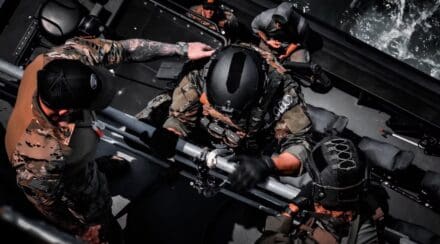
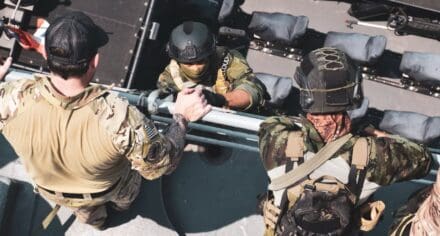
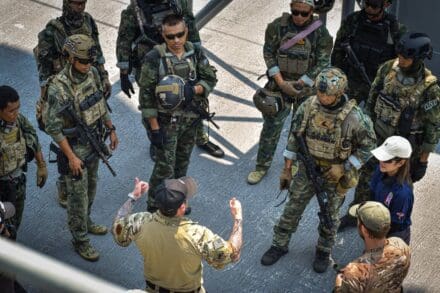
The Canadian Army Trials and Evaluation Unit (CATEU) trialed mounting a C9 machine gun to an assault boat.

This capability would provide assault boat occupants force protection during combat operations.


The Canadian Army Trials and Evaluation Unit (CATEU) trialed mounting a C9 machine gun to an assault boat.

This capability would provide assault boat occupants force protection during combat operations.


The issue of poor foreign language capability among SOF operators, particularly US Army Special Forces, rolls around about once a decade, usually flip flopping with the lack of racial diversity within SOF.

Last month, the Government Accountability Office released a report entitled, “Special Operations Forces: Enhanced Training, Analysis, and Monitoring Could Improve Foreign Language Proficiency.”
No kidding, even the title belies what any amateur detective could tell you. What’s amazing is that if it’s so obvious, why isn’t it being done? I mean they sound like simple, measured responses to any training deficiency. As is generally the case, the situation is more complicated than you’d expect.

The GAO found that for the last several years, SOCOM did not meet its language proficiency goals. This has long been a challenge within Army SF which has relied on its language capability to interact with foreign forces, both government as well as civilian.
About 20 years ago, the Marine Corps got into the SOF game with the formation of Det 1. Basing itself off of traditional Marine capabilities, it had a serious special reconnaissance and direct action bent and it was really good at it. But SOF is political and Det 1 was an experiment. There was no interest in yet another SR/DA unit in the mix. The only way the Marines could get a permanent component within USSOCOM was to agree to pick up some of the Foreign Internal Defense missions traditionally accomplished by Army SF who were themselves concentrating on SR and DA missions during the GWOT. The Marines set up what was known as the Foreign Military Training Unit.
For the Marines, this new mission meant cultural and language proficiency. Initially, the Marine Corps embraced the mission, but today, MARSOC looks much different and has settled back to mission sets it is more comfortable with. Regardless, they’ve retained language capability for their Critical Skills Operators and MARSOC is where SOCOM finds its lowest language capabilities, joining Special Forces’ long struggle with the issue.
Both the Army and Marine components of SOCOM know there’s an issue and are trying some things out. For instance, a few months ago, Army students with 2nd Special Warfare Training Group participated in a language trading course hosted by Marine Raiders. The experience included instructors from the SWCS course. It’s a step in the right direction.
I’d hazard a guess, having served as a linguist in the command, that SOCOM has never met its language proficiency goals. Much of the problem is that on top of the many mission essential tasks an operator must maintain proficiency in, the command as well as the operator’s parent service dumps loads of HR-focused annual training requirements. There aren’t enough days in a year to do it all. The GAO report acknowledges that there are competing training requirements.

However, based on this chart, you’ve got to wonder why Army SOF personnel are getting three times the amount of training of SOF Marines. Sure, they’re both facing lots of required training, but culturally, the Army side seems to pay more attention to the capability. Regardless, they are both falling woefully short of the minimum 80 hours of foreign language training per year.
One of the GAO’s findings is that commanders aren’t being held accountable for unit members not attending language proficiency training. Less than half of SOF personnel attend the training, so the question is, “Why?” Tracking the issue might help, but commanders are already being tracked for many other training requirements there isn’t enough time in the calendar to fulfill.
To me it seems like a cultural issue. If they want effective language capabilities then they are going to have to demand it at the unit level and that falls on commanders, at all levels.
The average SFOD-A or 12 man A-Team commander is a Captain who gets about 24 months of command time. For the vast majority of Special Forces officers that is his only action guy time. Consequently, he is going to hope for an operational deployment and fill as much of the rest of his command time with training on the more exciting aspects of his mission letter, like weapons training, infil skills, and so on. For most, the last thing he is going to want to do is spend a couple of months with his team in language immersion training. Now, put the Warrant Officer in charge for a while and he’s going to insist on it, particularly if it’s down range somewhere and away from the flagpole. While the Captain is focusing on the Officer Efficiency Reports which are going to make or break his career, the Team Technician and the Team Sergeant are looking at the long view and the investment in personal and well as team capabilities. I can only imagine that MARSOC faces similar challenges.
Historically, when SF teams have needed language capabilities they relied on one or two of their guys who are either native speakers or are just good at picking up languages to carry the weight. During the GWOT, teams were assigned interpreters or ‘Terps because so many teams were regionally focused on other areas and their trained languages were all but useless in the Middle East. This latter circumstance helped further erode focus on inherent language capabilities both within SOF as well as associated enabling intelligence specialities.
This leads to another major challenge, the breadth of language requirements within the command.

Based on 2020 requirements for required languages and associated proficiency levels (level 1 for basic survival to level 3 for professional proficiency), the Theater Special Operations Commands within the Geographical Combatant Commands identified 80 foreign languages.
Generally, the armed services want to limit their language programs to those which it has a likelihood to encounter operationally. It’s just easier to manage.

Note this report lists the command’s language requirements. While the intelligence community holds its actual linguist requirements close to the chest, it’s well known that the low density requirements exist because of SOF requirements. For example, I was a French and Haitian-Creole linguist. Those duty positions were unique within SOF, whereas Russian, Chinese, Spanish, and Arabic linguists are found across DoD.
As you can imagine, the management aspects of this enterprise, consisting of 80 languages with linguists in five components is rather daunting. What’s more, it’s rare that you’ll have the right linguists at the right place, at the right time due to the enormity of the mission set and the limited number of SOF personnel. Such a situation led to the use of local interpreters discussed earlier.
It’s no wonder USSOCOM is investing in Artificial Intelligence / Machine Learning capabilities to assist with language translation challenges. However, these technologies may be able to also assist with training, particularly in low denisty languages which are more difficult to arrange training for.
It should be mentioned that both Naval Special Warfare Command and Air Force Special Operations Command suspended their command language programs making the Army and Marine components the focus of this report. Neither of those commands did any better in maintaining proficient linguists when they had programs.
However, all of the SOF components continue to have assigned linguists whether or not they have a command language program. They are generally a mixture of operations and intelligence personnel. Intelligence language programs may be managed separately due to occupational specialty requirements.
On a final note, this report focuses solely on the capability of 18-series, PSYOPS, and Civil Affairs personnel on the Army side and Critical Skills Operators for MARSOC. It does not include the assigned linguists within the intelligence community assigned to these units even though some of my examples stem from my experience as a Crypto-Linguist with 3rd Special Forces Group in the 90s and observations as an intelligence officer assigned to Air Force and Joint SOF units later in my career.
There’s no easy answer here, but it starts at the unit level. If they focus on languages and regional cultural skills, they will develop them. Another training status slide at MacDill isn’t going to improve the outcome.
You can read the full report here.

ABERDEEN PROVING GROUND, Md. — Army researchers have developed an innovative design for immediate on-the-ground chemical and biological assessment, giving traditional everyday laboratory equipment a new purpose for Soldiers in the field.
The invention, known as the pocket detection pouch, or PDP, was granted a patent on July 26, 2023, for its unique design that enables a one-way flow of a chemical or biological liquid sample that can be assessed and preserved in a lightweight, pocket-sized pouch.
The invention itself was deliberately designed to be “low-tech,” with the purpose to provide simple, immediate, and easily readable test results in the field while reducing the size, weight, and burden that traditional detection equipment imposes on the warfighter.
The idea for the PDP began at the U.S. Army Combat Capabilities Development Command Chemical Biological Center and was brought forward through the collaboration of two researchers at the organization — Ms. Kelley Betts and Dr. Jennifer Sekowski.
Betts, a research scientist and an Army wife, understood that every ounce carried by a Soldier during deployments matters, and wondered if there was a way to combine both a chemical and biological detection capability into a single, easy-to-use platform using something readily accessible — like an inexpensive plastic bag.
She decided to use her knowledge and expertise to develop a customizable chemical and biological assessment tool that was small, lightweight and could fit easily in the pocket of every warfighter. Betts developed the initial prototype in her kitchen using everyday resealable sandwich bags and a heat-sealer. “I found a way to come up with multiple individual chambers within the bag, and that’s how the one-way flow for liquids was born,” said Betts.
In this episode of CB Defense Today, public affairs specialist, Jack Bunja, interviews Doctor Jennifer Sekowski, a molecular toxicologist at the Center and inventor of the Pocket Detection Pouch (PDP), and Yusuf Henriques, founder and CEO of IndyGeneUS AI.
DEVCOM CBC Video by Ellie White
Betts then introduced the idea to Sekowski, who further helped to develop the prototype and proposed the technology to the Innovative Development of Employee Advanced Solutions program at DEVCOM CBC where she was awarded $50,000 over the span of six months to further develop the technology.
Gathering information and garnering feedback from other scientists, researchers, and warfighters within the Center allowed Sekowski and Betts to further refine their invention by increasing the size of the flap opening, reducing the size of the pouch and including a self-loading feature that allows the end user to tailor the PDP for different scenarios.
During refinement, the pair maintained the idea to reduce the burden to the warfighter by making the asset easy to use, lightweight, inexpensive, power-free with little debris footprint, and enabling the ability of containment. “It is one of the least expensive projects I’ve ever done, and one of the most successful,” said Sekowski.
The final design allows for a pouch that collects a sample into a main chamber which then flows into individual testing channels that are perforated at the bottom and housed in an external chamber. It is essentially a bag within a bag. “Other people have developed other, small form factor platforms, but in the end, we were able to demonstrate that our device is worthy of a patent because of the design,” said Sekowski.
The design has been able to gain further support and funding for production on a larger scale. The team has been able to partner with IndyGeneUS AI, a veteran- and minority-owned business dedicated to the field of medical technology, to further the development of the PDP. “We’re very fortunate that we were able to patent it and that allowed us to work with IndyGeneUS AI. They are going to help us find funding to do that engineering work to make it a commercial product,” said Sekowski.
With both the patent and partnership in place, Betts and Sekowski plan to continue developing the product further, working with IndyGeneUS AI to make the PDP commercially available. “I would like to see it in the hands of Soldiers, in the hands of people, where it can make a big difference in the world,” said Betts.
By Aeriel Storey
Defense Distributed bills their Serial Covers as “The solution to maintaining privacy while still looking cool.”

You get three segments of 3M-backed self-adhesive Cordura material to prevent your serial numbers from being easily visible and traceable, particularly when posting photos online. Offered in multiple colors amd patterns, the shapes were
configured around a Mil-Spec M4 lower receiver.

Available from defensedistributors.com but of course, you could do this yourself. However, if you buy them Defense Distributors you support their development of other products.
defensedistributors.com/product/serial-cover-for-ar15
An independent analysis of filters recovered from Ventus’ TR2 Tactical Respirator, worn during various weapons training exercises, revealed the presence of 32 different heavy metals and compounds after just a single day of use
Toronto, Ontario, Nov. 02, 2023 — Ventus Respiratory Technologies, a company pioneering a new standard of respiratory protection for law enforcement, the armed forces, and first responders, has conducted a comprehensive study to illustrate the filtration efficacy of its TR2 Tactical Respirator, and to provide quantitative evidence of airborne hazards in weapons training environments.
“The TR2 is unique in the market, being the only CE-certified respirator that is purpose-built for military and law enforcement personnel, to protect them from toxic exposure,” said Arjun Grewal, CEO of Ventus, who previously spent 20 years with the Canadian Armed Forces. “Chronic exposure to particulates such as those produced by combustion has been shown to pose a significant health risk.”
“Particulate” refers to a type of air pollution consisting of a complex mixture of tiny solid particles and liquid droplets in the air. The TR2 has demonstrated its ability to filter out ?99% of solid airborne particulates down to 0.06?m and 97% of oil-based particles down to 0.3?m.
About The Study:
The study consisted of weapons training exercises with participants wearing Ventus’ TR2. These took place in multiple live training scenarios often experienced by Special Forces and SWAT teams. This included indoor firing ranges, outdoor firing ranges, and close-quarter battle (CQB) shoot houses.
Following this, the respirator filters were removed and analyzed by an independent lab to learn the level and volume of airborne contamination present. “The TR2 protects the wearer’s airway and respiratory system, our filter is a critical layer of protection between the toxic air present in these environments and the body. The findings were surprising.”
Results:
An average of 32 different compounds including heavy metals and known carcinogens were identified in all TR2 filters including aluminum, antimony, bismuth, copper, iron, lead, potassium, sodium, strontium, and uranium, with levels consistently exceeding daily exposure thresholds for each chemical, as established by the World Health Organization (WHO) and the National Institute for Occupational Safety and Health (NIOSH).
Access the full report here:
“These concentrations of heavy metals and carcinogenic compounds are very concerning, particularly considering that the filters examined were worn for a single day only, whereas real-world users typically participate in similar activities 10-15 times per month,” added Grewal. “Respiratory protection has lagged, or simply been non-existent, compared to eye and ear protection requirements for these activities for far too long. The rate of respiratory illness in military personnel is roughly three times greater than for the average population. This study is critical to educate users and leadership of the clear and present risks.”
Short-term exposure to these and other particulate matter can cause airway restriction, reduced oxygenation, slower cognition, diminished performance, and acute respiratory illness. Longer-term exposure to high particulate loads can lead to chronic illness and disability.
Ventus is backed by ONE9 and Kensington Capital. ONE9 is Canada’s first and only venture capital fund and accelerator focused purely on national security and critical infrastructure technologies.

CANNON AIR FORCE BASE, N.M. —
The 27th Special Operations Wing hosted its annual Service Member of the Year Competition Oct. 10-13 at Cannon Air Force Base, N.M.
Twelve Air Commandos tested their technical prowess, grit and leadership abilities during a week of competitions that included the Air Force Physical Fitness Test, weapons qualification and assembly, a written academic test and a six-mile ruck/run.
Senior Master Sgt. Adam Hardy, 6th Special Operations Squadron senior enlisted leader, stated that he believes the individual selected as the 27th SOW Service Member of the Year must exemplify pride in being an Air Commando, possess the physical fitness required to complete any mission, and demonstrate exceptional performance and superior leadership.
During the events, Air Commandos from a range of career fields were pushed to their limits as they vied for the title of 27th SOW Service Member of the Year and the chance to represent the 27 SOW at the U.S. Special Operations Command level, where they will compete against other joint service members in similar events.
“The point of this competition is to identify the individual from our Wing who most embodies the Warrior Ethos. Professional, credible and capable Airmen deserve to compete against the finest warriors in the DOD, and I’m incredibly excited to be able to put Cannon AFB’s Airmen on the radar of our sister services,” Hardy said. “Our nominees are not from Special Tactics; they are from career fields all over the base, and the Wing’s nominee will compete in an environment that is unfamiliar, against opponents who are incredible in their own right.”
27th Special Operations Wing Public Affairs

OVERLAND PARK, Kan. – October 31, 2023 – Blackhawk®, a leader in law enforcement and military equipment for over 30 years, congratulates sponsored tactical athlete Zach Rodman for winning the Men’s Elite Division of the Tactical Games Georgia Regional Event.

In two seasons of competing as a Blackhawk-sponsored tactical athlete, Rodman has racked up a pair individual Tactical Games wins and ranked seventh or higher two more times. Competing alongside teammates Jared Halbert and Ehea Schuerch, Rodman has also won a team title and finished second and third in two other Tactical Games team events.
A longtime police officer from Indiana, Rodman runs a full suite of Blackhawk gear including the T-Series® L3D holster, Jacket Slot Leg Strap Adapter, Foundation Series Tac Nylon plate carrier and belt.
“To say I’ve been proud to represent Blackhawk the last two years is an understatement,” said Rodman. “It’s easy to promote and back a company whose products you believe in.”



Rodman uses Blackhawk gear to not only compete at the highest levels in the Tactical Games, but also as an instructor at the Tactical Games Athlete Camp. During the three-day course, Rodman helps train new athletes with course curriculums covering shooting, fitness, and gear.
To learn more about Rodman and the gear he uses in the Tactical Games, visit Blackhawk.com.