XC3 Weaponlight

MWW 22 – CACI Mono Backpackable Electronic Attack Module 3.0

November 10th, 2022

Mono Backpackable Electronic Attack Module 3.0 from CACI is capable of detecting, identifying (via library), locating (including direction finding) and defeating (through various RF means) most small Unmanned Aerial Systems. The frequency range is 30 MHz to 6 GHz.


Not only does it look for UAS but also associated signals such as cellular comms, range extenders, BlueTooth, PTT comms, WiFi, Mode-S/ADS-B and digital as well as analog video.

The system can be used independently or networked with other BEAMs in a self-forming network, with a single operator to increase range.

BEAM integrates with TAK and has been integrated with other C-UAS systems.

MWW 22 – goTenna Pro Deployment Kit 2

November 10th, 2022

goTenna has upgraded their Pro Deployment Kit with a new tablet-based software application server which replaces the old Raspberry Pi server. It also offers geolocation visualization of the goTenna Pro X2 mesh networking devices. There are 30 in the kit which also acts as a charging device. The system offers AES256 encryption via Android and it allows you to stand up comms completely off grid.

MWW 22 – Microtech Knives

November 10th, 2022

Microtech’s first model is the L-UDT. Created in 1995 it remains one of their most popular models. Featuring a grooved, contoured aluminum handle with jimping along the top of the handle that carries onto the spine of the blade.

Government customers contact Gov@MicrotechKnives.com

MWW 22 – Turbine One Frontline Perception System

November 10th, 2022

Turbine One’s tagline is “AI/ML for the Comms-Contested Battlefield” and after learning about what they are doing, that sums it up quite nicely. For those of you unfamiliar with the terms, AI/ML means Artificial Intelligence and Machine Learning. Those both sound like ominous futuristic concepts but Turbine One’s Frontline Perception System (FPS) makes it not only real, but user friendly.

Unlike current systems fielded with vendor-locked software which cannot move between sensors or devices, FPS combines open system architecture across any network, even in in comms-contested environments, and sensor data fusion.

FPS can be deployed on entire enterprise, desktops, laptops and End User Devices whether connected to a network or not. In fact, it’s optimized for use at the operator level.

It deploys algorithms at the tactical edge to characterize sensor data and provide relevant information to the user. The user can also interact with the system, introducing new items of interest without having to code using their AutoML.

Here you can see an example of the AI identifying a gun. Just prior to taking this photo the system was programmed using AutoML to characterize the pistol after identifying it in several images. It was just that simple.

Finally, TurbineOne routinely partners with third parties to deliver ML to the frontlines.

www.turbineone.com

GSOF Modern Warfare Week 2022

November 10th, 2022

Global SOF Foundation’s Modern Warfare Week was held this week at Fort Bragg. We’re going to share some new capabilities that you won’t normally find on SSD.

Happy Birthday Marines!

November 10th, 2022

InterRoC Research Project – Rheinmetall HX trucks Demonstrate Automated Driving Capabilities

November 10th, 2022


On behalf of Germany’s Federal Office for Bundeswehr Equipment, Information Technology and In-Service Support (BAAINBw), Rheinmetall is currently conducting the InterRoC research and technology project. The abbreviation stands for Interoperable Robotic Convoy. In the last weeks, the impressive capabilities of this high-tech approach to autonomous driving were on display at two remarkable events.

The InterRoC project encompasses two HX2 military trucks from Rheinmetall, each equipped with an autonomy kit, and which alternate in accordance with the leader-follower principle. With this principle, the first vehicle is always driven manually, while the pursuit truck (or trucks) drives autonomously in its path. These are manned only by a backup driver, who can intervene in case of a malfunction. Here, it is not just the so-called primary functions, such as steering and accelerating, that are controllable; secondary functions like starting the engine, the lights, differential locks, etc., are as well. The current project uses an autonomy kit (A-Kit) furnished by the German authorities, and originally provided by the US government under a project agreement. Rheinmetall’s role in the programme includes modifying the basic vehicles and integrating the autonomy function, together with commissioning and testing.

Proven interoperability: a US-German convoy
As part of its Autonomous Ground Resupply (AGR) project, the US Army uses the same A-kits in its Oshkosh trucks that Rheinmetall uses for InterRoC. This makes mixed US-German convoys possible. This was tested in an operational demonstration (OPDEMO) from 26 September to 7 October at the US Army’s Grafenwöhr Training Area in Bavaria.

The intensive preparations paid off, with the first two-vehicle convoy already on the move the second day. During these two weeks, a convoy consisting of five vehicles tested every conceivable operating mode of the system in multiple variants. In the process, 1,051 km were driven autonomously. It is worth noting that the entire convoy overcame a gradient of 40 percent, with the A-Kit operating the differential locks.

Furthermore, the vehicles were able to operate continuously for over 75 minutes without manual intervention. The maximum convoy length was 1,100 metres.

Dynamic reconfiguration of the convoy proved possible with minimal idle time.
All in all, the tests turned out to be a complete success for everyone involved, resulting in numerous valuable findings.

Success at ELROB 2022
In early summer 2022, in the presence of German government officials, InterRoC vehicles had already taken part in the international European Land Robot Trial (ELROB) event.

ELROB is Europe’s toughest field test for unmanned systems. It is an open, multinational competition in the realm of robotics, sensors and autonomy, drawing participants from universities as well as civilian industry and the defence sector. It takes place every two years at a military installation. This year’s event was held at an exercise area near Vienna, 30 May to 3 June.

Participants have to contend with various scenarios and overcome multiple challenges, conceived in close cooperation with military users. Completion of the tasks is evaluated by a team of experts.

Participating for the first time with the InterRoC research and technology project in the event’s Convoying category, Rheinmetall’s small team took second place, finishing behind the University of the Bundeswehr in Munich.

This year’s challenges strained the specified capabilities of the vehicles and A-Kit alike, but the creative Rheinmetall team, reinforced by colleagues from RMMV Austria, largely succeeded in overcoming these.

In addition to the evaluated scenarios, Rheinmetall also carried out an autonomous driving presentation for a throng of interested visitors at the test site. The vehicles clearly captured the crowd’s imagination and proved highly popular.

Work Begins on Fort Bragg VOLAR-Style Barracks

November 10th, 2022

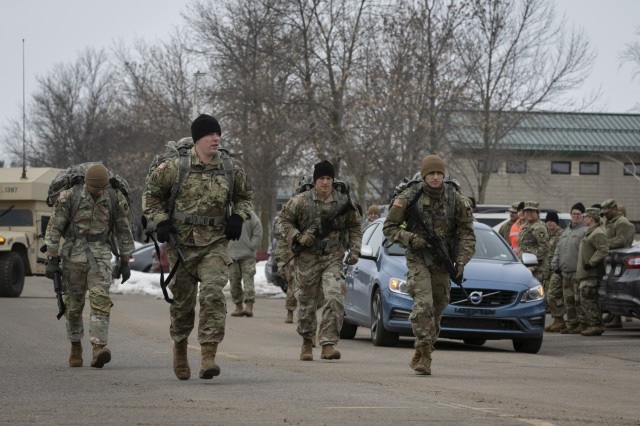
FORT BRAGG, N.C. — The Department of Defense awarded two contracts totaling over $36 million for renovations, repairs and revitalizations to barracks on Fort Bragg Sept. 28, with a future contract for demolitions still pending.

These contracts are part of the accelerated approved funding and will focus on the VOLAR-style barracks, built in the 1970s, that were identified as unsustainable back in early August.

At that time, leadership made the decision to do an early removal of Soldiers from the Smoke Bomb Hill Barracks that were slated for future demolition and renovations. This decision started a multi-week endeavor to relocate the over 1,100 Soldiers.

“When we started the process, it was kind of like doing a jigsaw puzzle with none of the pieces having a picture,” explained Brian Adkins, the Fort Bragg Directorate of Plans, Training, Mobilization and Security director. “We had over a 1,000 of pieces and no idea what the picture was supposed to look like. We had to come together with a plan to move the over 1,000 Soldiers from the affected barracks.”

The team, consisting of housing, engineering, legal, finance, maintenance, transportation, and multiple military units, met twice a day to provide updates to the process and present any issues they may have run into.

“It was a very coordinated process in which housing was intimately involved,” said Adkins. “Just for clarity, our teams are not experts for this sort of movement, but what we are good at is coordinating, synchronizing, and integrating everyone’s efforts. We continue to refine every day on where we are at, making sure to understand the full scope of it, and then trying to balance it. I mean, it really entailed not only Smoke Bomb Hill Soldiers, but every other unit on the post.”

Adkins said Fort Bragg had to consolidate service members to make space for those affected by the degradation of the volar-style barracks.

“We didn’t want to put one Soldier here, one Soldier there,” explained Adkins. “We wanted to maintain some degree of unit integrity, at least at the squad level or above.”

Adding to the challenge of keeping unit integrity, service members also have a day job – missions to accomplish and training to complete.

“In many cases, they still had deployments and we were wedging this in in the middle of that,” added Adkins. “So, it was just an enormous number of moving pieces that we normally didn’t have.”

As the power projection platform, Fort Bragg is ready to deploy at a moment’s notice and has multiple procedures already in place for rapid Soldier movement. These movements are basic muscle memory for the units and the supporting Department of Army civilians; however, this large-scale movement was a first for the installation.

But the Smoke Bomb Hill Barracks situation is more of a challenge because it is not muscle memory and involves several units include U.S. Army Special Operations Command, XVIII Airborne Corps, 20th Engineers, and Medical Command. In all actuality, all major commands on the installation were impacted as service members consolidated to make room for the service members on Smoke Bomb Hill.

Through teamwork, the units and organizations involved created a deliberate plan and a coordinated approach to tackle the barracks issue. The garrison continues to work with Soldiers in helping with the relocation from transportation, the movement of household goods to additional financial support.

In addition to the movement piece, the transportation office added stops to the free Fort Bragg Shuttle Service ensuring affected service members are able to get around post and to their areas of operations.

Adding to Adkin’s analogy of the jigsaw puzzle, the outline of the puzzle is set and now Fort Bragg is able to support the required transportation and financial assistance to fill in the big picture.

“It is our utmost responsibility to ensure [living areas for our service members] are clean, safe and functional,” said Command Sgt. Maj. Thomas Holland, XVIII Airborne Corps commanding sergeant major. “The means of how Soldiers were able to report issues are just as old, if not older, than the barracks themselves. They really didn’t have the space or ways to communicate issues to anyone other than their local chain of command on what they’re seeing in their barracks as frequently or intensively as they needed to.”

Holland added that many service members may feel nervous or fearful of talking with senior leaders but understands that each voice matters and can lead to better solutions. If there is an issue with their living or working facilities, work orders need to be submitted through the Army Maintenance website and the Fort Bragg Directorate of Public Works housing phone line, 910-396-0321.

“The culture of the XVIII Airborne Corps is the spirit of innovation — we know there is an idea trapped somewhere in that squad,” said Holland. “In this case there is an experience, a perspective, trapped in every squad within the Fort Bragg community and we want to untap that perspective as fast as possible so that we can get the appropriate resources to that Soldier — that is our ultimate goal.”

Those resources begin with the approved $105 million for fiscal year 2022 to renovate five Smoke Bomb Hill Barracks and $18 million to demolish 11 barracks from the same area, along with around 100 other facilities on Fort Bragg. Another $29 million has been set aside for other barracks around the installation.

“The Savannah District is leveraging the expertise of the entire USACE enterprise, to include Huntsville and Omaha Districts, to support Fort Bragg’s urgent effort to address the concerns at the Smoke Bomb Hill barracks complex,” said Col. Joseph Geary, U.S. Army Corps of Engineers, Savannah District, commander. “In coordination with the installation, we provide the technical expertise and rapid contracting capability to build the quality facilities that our Soldiers expect and deserve.”

The Army has since published an Execution Order in the beginning of October directing Army senior leaders to conduct comprehensive assessments of all facilities worldwide, with an emphasis on Soldier barracks as key to the overall infrastructure. Army units will physically inspect all barracks rooms, focusing on mold and assessing any other health, safety or functionality issues that require immediate correction.

This effort is directed in preparation for the upcoming Facility Investment Plan wargame and will incorporate facility walk-throughs to validate senior leader requirements with eyes-on knowledge and understanding of needs.

The Army will then develop a comprehensive strategy for planning, programming, and addressing long-term concerns. The FIP is the Army’s planning method for identifying, analyzing, and prioritizing Army facilities investment requirements across a 10-year horizon.

The Army and its leaders will holistically address everywhere service members, civilians, and their Families work, live and train. The Army will ensure a healthy living environment for all service members eliminating any issues that are adversely affecting readiness, resilience, and quality of life.