Aquaterro

Archive for 2013

Gentex Awarded Integrated Helmet Protection System Contract For U.S. Soldier Protection System

Tuesday, November 19th, 2013

Gentex Corporation was awarded a contract of $1.3 million for Phase 1 Development Testing of the Integrated Head Protection System (IHPS) component of the Soldier Protection System (SPS) by the U.S. Army. A multiple sequential contract, the overall contract value opportunity is $18 million.

The Gentex IHPS consists of an advanced, lightweight ballistic shell, an adjustable suspension system with an improved impact liner, a high stability retention system, a maxillofacial system (including visor and mandible), and passive hearing protection. The new system will be light weight with enhanced ballistic and non-ballistic protection, while providing superior comfort and fit, as well as earlier donning and doffing.

The contract was awarded by the U.S. Army Contracting Command – Aberdeen Proving Ground (ACC-APG), which provides comprehensive contracting support to meet the needs of the Joint Warfighter worldwide.

www.gentexcorp.com

I.C.E. Training And PDT Technologies Launch Reality-Based Training Program For Civilian Personal Defense Market

Tuesday, November 19th, 2013

Program Promotes Higher Training Standards by Incorporating Military/Law Enforcement Methods in Mainstream Defensive Firearms Instruction

ALAMO, Calif. – November 18, 2013 – I.C.E. Training, one of the nation’s leading defensive training companies, and Practical Defense Training Technologies (PDT), a reality-based training solutions provider, have partnered to present the Reality-Based Training Instructor Development Program. Although gun ownership has risen dramatically in recent years, training has lagged behind, creating a huge gap between the number of civilians who own firearms, and those who have had sufficient training. Launching in January 2014, this program leverages reality-based training methodologies to improve standards in mainstream defensive firearms instruction. The program is designed for RBT instructors, NRA certified instructors, concealed carry weapon (CCW) and personal defense/home defense instructors. Some of the nation’s top civilian training companies, including 10X Defense, Safer Faster Defense, Bearco Training and Echo-5 Training Group, are among the first to be certified under the program.

A mainstay in the military and law enforcement communities, reality-based training provides the conditioning, decision-making skills and stress inoculation that can save lives in real-world scenarios. The Reality-Based Training Instructor Development Program safely and responsibly integrates RBT into mainstream defensive firearms instruction. Created by I.C.E. Training, this 30-hour program combines distance education, classroom sessions and scenario experiences such as home defense, vehicle CCW, public space CCW and armed robbery. Once certified, students will also receive a RBT product package that includes non-lethal training ammunition (NLTA) and PDT Technologies’ professional-grade personal protective equipment (PPE). The use of PDT’s professional-grade PPE, such as the Force 1 helmet, neck protector, chest protector and hand armor, enables course participants to learn military/law enforcement methods of progressive skill development using non-lethal training ammunition.

“The addition of a Reality-Based Training Instructor Development Course is a natural evolution,” said Rob Pincus, a nationally recognized defensive firearms instructor and owner of I.C.E. Training. “I’ve been involved in high-level RBT since 2000 and have been training others to teach for almost that long. The state of the industry, as well as non-lethal training equipment, have advanced to the point that quality force-on-force experiences should be available to the average person learning to defend themselves, their families and their homes. Teaching instructors how to conduct safe and effective reality-based training is the next step.”

Rob Pincus is also the developer of the COMBAT FOCUS Shooting program and the Personal Defense Video DVD Series. For well over a decade, he and his instructors have provided training to military special operations personnel from the U.S. Army, Air Force and Navy, law enforcement and security officers, and civilians interested in the defense of their families and homes. Pincus has published three books and written for a variety of trade media outlets including the Personal Defense Network. He appears as an instructor on television programs including The Best Defense and S.W.A.T. Magazine TV.

“Reality-based training exists today because of irrefutable data sets from the field supporting the validity of immersion-type training,” said Gordon Potter, president of PDT Technologies and a 15-year veteran of U.S. Army Special Forces. “What is so promising about partnering with I.C.E. Training is the way I see them shaping the future of dynamic critical incidents. I.C.E. continues to define the need for a broader understanding of sciences, neuroscience, physics, and physiology to effectively engage the whole person in personal defense training. Through this program, civilian trainers can add a dimensional difference to their existing programs and have the opportunity to use the same training products, techniques, and methodologies that have proven successful in the military and law enforcement worlds.”

Pricing and Registration

The Reality-Based Training Instructor Development Program will be held monthly across the nation beginning in 2014, with the inaugural course kicking off in Las Vegas on Saturday, January 18 after SHOT Show. The program will take place at Battlefield Vegas, a premier military-style training complex located just one block from the Las Vegas strip. The program is priced at $1499, which includes a $300 course fee and a product package comprising:

· Three (3) full sets of PDT’s personal protective equipment. Designed for non-lethal training ammunition engagement, each set includes the Force 1 helmet, neck protector, padded hood, chest protector, groin protector, hand armor, and a marking knife for CQB training.

· 500 rounds of non-lethal training ammunition (5.56mm marking cartridges)

· One (1) M-4/AR-15 conversion bolt.

The $300 course fee is due as a deposit upon registration. Upon successful completion of the course, students will be able to complete their purchase of the product package for $1199. An upgrade fee applies for 9mm marking cartridges and a handgun conversion kit. Those who do not pass the course are ineligible to purchase the product package. Students must be certified firearms instructors (NRA, law enforcement agency, private sector certification, etc.) prior to attending the classroom portion of this program in order to be eligible for testing and certification. To register, please visit www.icetraining.us.

www.pdt-tech.com

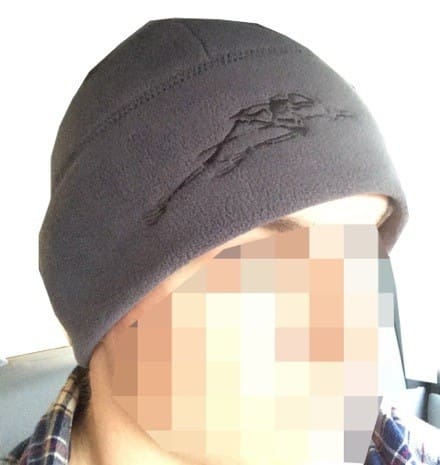
Wolf Grey Beenie from MATBOCK

Tuesday, November 19th, 2013

20131118-150422.jpg

MATBOCK is offering Wolf Grey fleece beanies and they will donate 10% of your total order amount to One Team One Fight to support the families of the warriors who have given their lives for our freedom.

www.matbock.com

Regulated Emission Collimated Ocular Interruption Laser from BE Meyers

Tuesday, November 19th, 2013

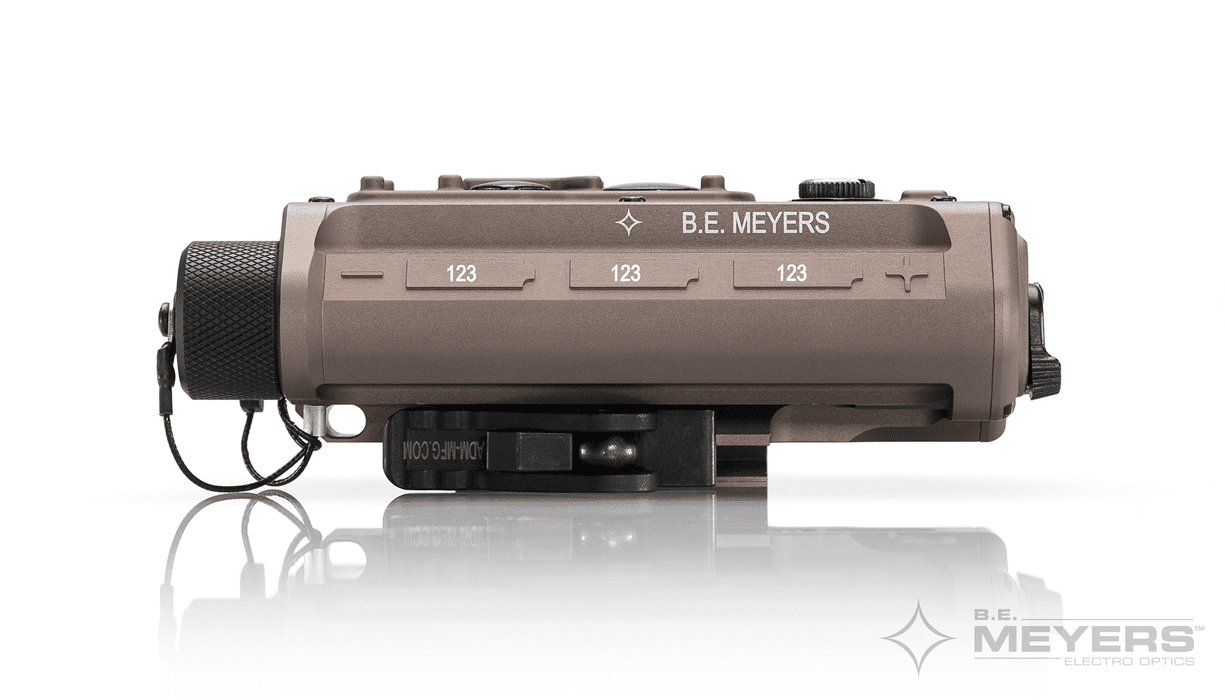
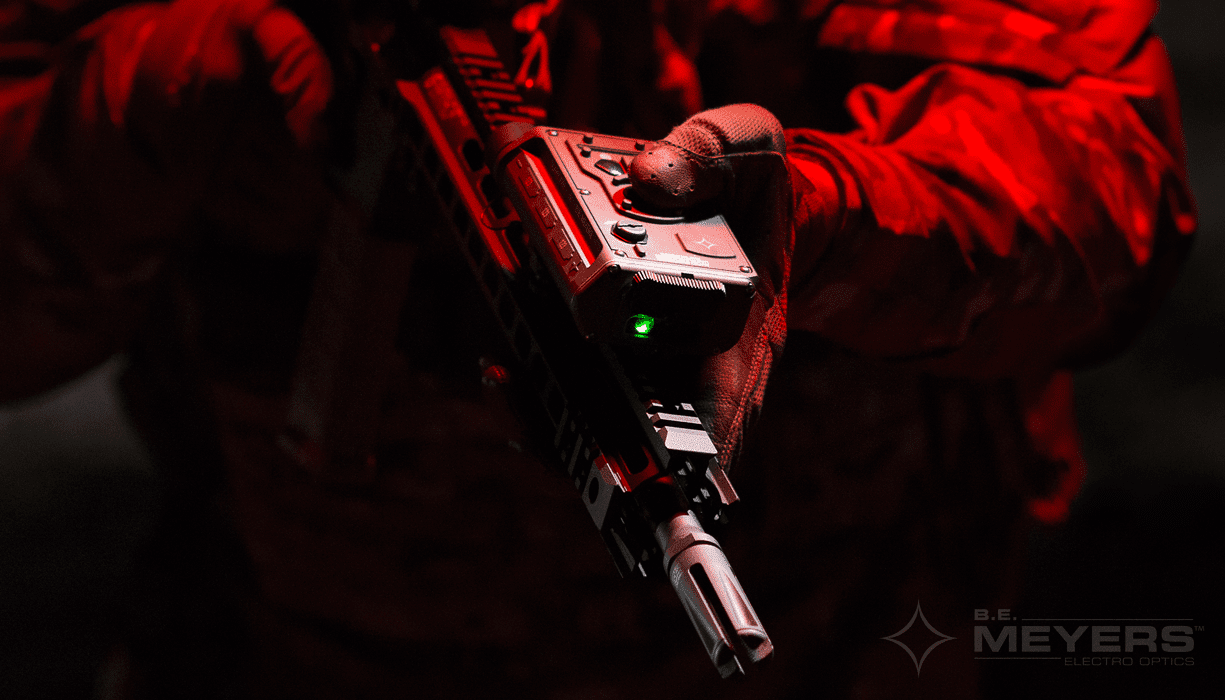
The GLARE Regulated Emission Collimated Ocular Interruption Laser (RECOIL) is BE Meyers’ entry for the Marine Corps’ Ocular Interrupter Program, a weapon borne non-lethal laser that delivers a bright beam of light that produces a dazzling or glare effect on a closing target to warn and/or suppress potential threats through increasing levels of visual degradation.

BEM_VPS_02

It features constant EyeSafe technology that delivers the precise amount of laser light to the target no matter if they are as close as 0 meters or as far out as 2,000 meters. That right amount is as determined by the standard irradiance guidelines established by US Navy S&T. It does this by determining the distance to the target and raising or lowering the irradiance (power of the beam) based on that distance. This means constant maximum allowable power on target and constant safe power and target.

BEM_VPS_03v2

If you are familiar with other Escalation Of Force devices you know that they are long and resemble a light saber. Some of these are difficult to adapt to a weapon. The GLARE RECOIL is Mil Std 1913 compatible with a built-in throw lever attachment and is rectangular with a similar size to an AN/PEQ-15. It is powered by 3 x CR123A batteries. The thing that I was most excited about was the new cover. You may notice in the top photo the rectangular lens. The cover rotates 360 degrees and can be lowered into place to protect the lens or spun up and out of the way for use. It has small detent stops so it will not spin uncontrolled. I really like the aesthetic and it gives the device a smooth look.

BEM_VPS_04

While it was developed to support the USMC JNLWD Ocular Interrupter Program, GLARE RECOIL is based on proven technology already fielded in over 35,000 EoF products. What’s more, it’s available now for for sale to approved US entities (i.e. DoD) per DoD and/or FDA regulations), or to an approved foreign entity per DoS/DTSA regulations.

www.bemeyers.com

Arc’teryx LEAF Softshells

Tuesday, November 19th, 2013

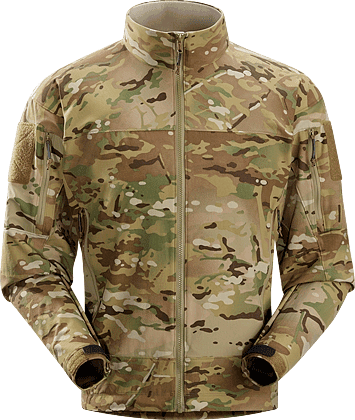
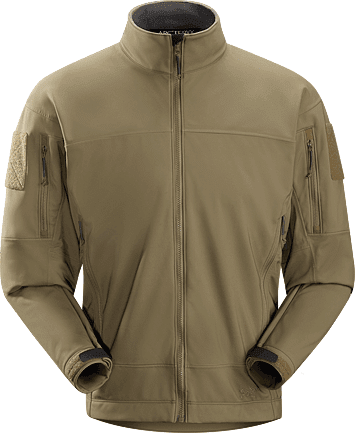
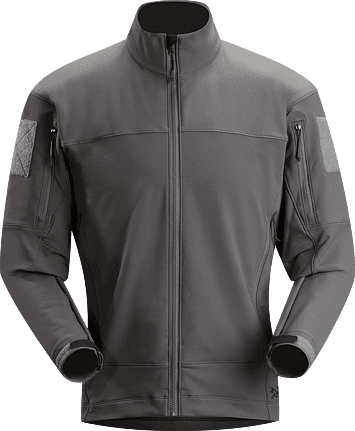
Arc’teryx LEAF offers several softshell jacket options. There’s the Combat Jacket, Minotaur, Drac and the old classic, the Bravo Jacket. Each is different in order to suit different needs.

Combat Jacket

Combat-Jacket-MultiCam
Tweave® Durastretch® fabric
Features a heavy softshell and can be used as an alternative to a Level 5 jacket
Two zippered hand pockets, Two chest pockets with laminated zippers and Two sleeve pockets with Velcro® patches on sleeves as well as Pit Zips
Available in Crocodile and MultiCam

Minotaur Jacket

Minotaur-Jacket-Crocodile
Features sightly insulated WINDSTOPPER® fabric
Incorporates Two high-volume hand pockets with zips, Two sleeve pockets with Velcro® patches on sleeves and Pit Zips
Available in Crocodile and Wolf Grey

Drac Jacket

Drac-Jacket-Wolf
Features Burly™ Double Weave
Two zippered hand pockets and Two sleeve pockets with Velcro® patches on sleeves as well as Pit Zips
Larger waist for layering
Available in Crocodile and Wolf Grey

Bravo Jacket

Bravo-Jacket-Black
This the original LEAF softshell, it features a clean look
Featuring Fortius 3.0™ stretch softshell
Internal chest pocket and Two high-volume hand pockets with zips
Available in Black, Crocodile and Wolf Grey

BCM Gunfighter History – Vol 1: The SCUD Hunter Carbine

Tuesday, November 19th, 2013

We recently published a photo from Larry Vickers that showed a rebuild of the carbine he used in the Model Prison Raid during the Invasion of Panama. In chapter 1 of the new web series BCM Gunfighter History, LAV gives the rest of the story behind that gun.

THE SCUD HUNTER CARBINE
BY LARRY VICKERS
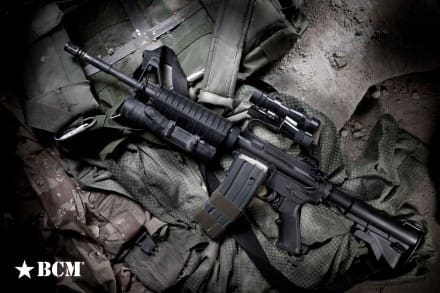
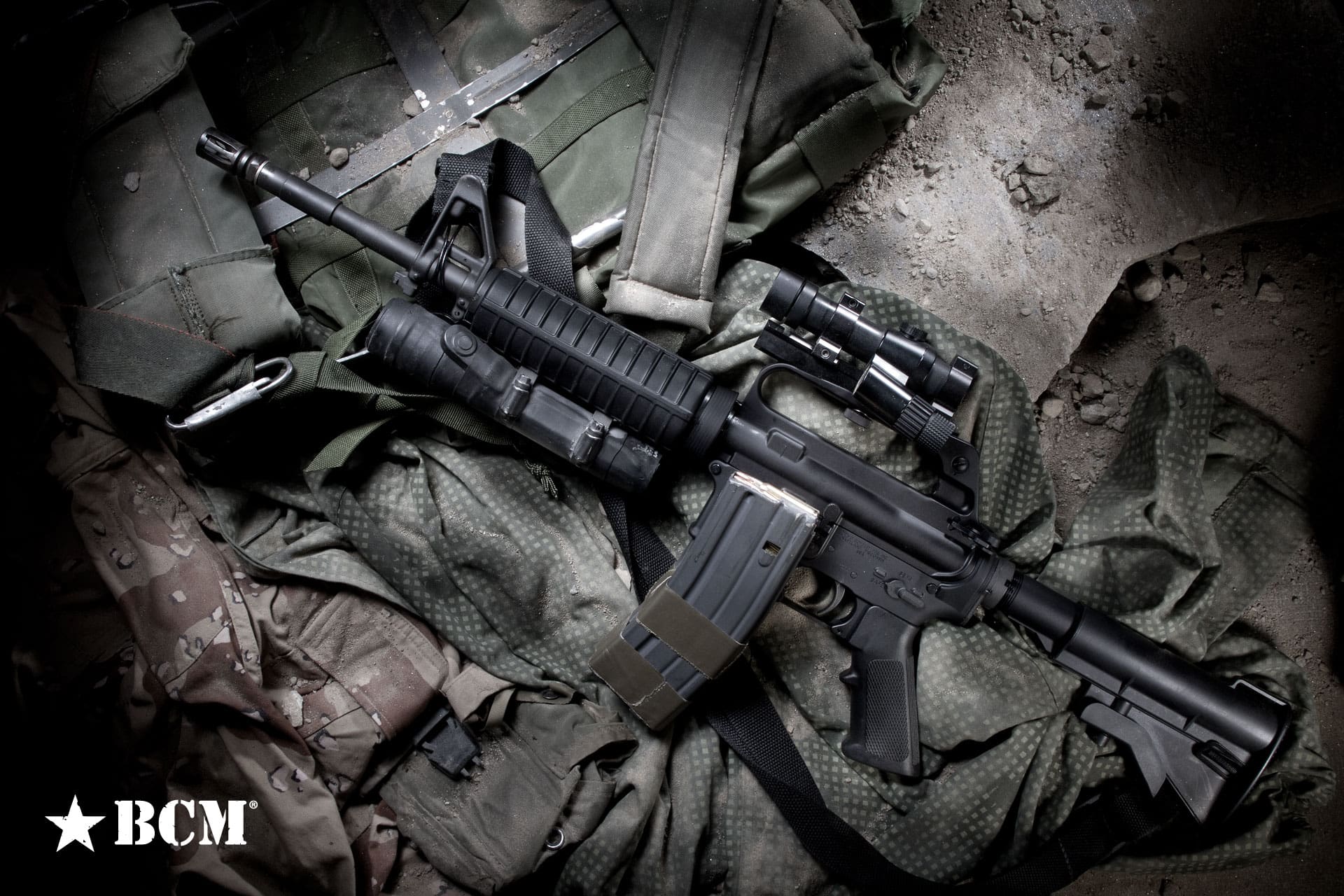
SCUD Hunter Carbine

When I checked into the Operator Training Course (OTC) at 1st SFOD-Delta in late 1988, I was issued a brand new, straight from Colt, base carbine. The official Colt designation was Model 723, but we simply referred to those carbines as CAR-15s. To be honest, I was initially very unimpressed.

In OTC, we completed a basic rifle marksmanship class with accurized M14s and after shooting those guns, with excellent triggers, the Mil-Spec trigger on my CAR-15 was terrible. I also distinctly remember only one failure-to-feed malfunction in OTC with my CAR-15; but after that, I honestly do not remember a single stoppage the entire time I used that weapon. Colt was building some of the best carbines in their history at that time and mine was a prime example. It was an excellent small-arm that performed for me its entire service life.
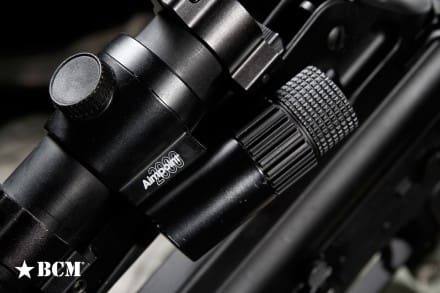
Aimpoint 2000

This CAR-15 was the first individual weapon I had ever used with a red dot sight; in this case an Aimpoint 2000. Experience with it made me realize that target engagements with a red dot optic vs iron sights were much quicker and more accurate across the spectrum from daylight to low light. This started my relationship with Aimpoint that continues to this day. They are quite simply the best red dot optics, in my opinion.

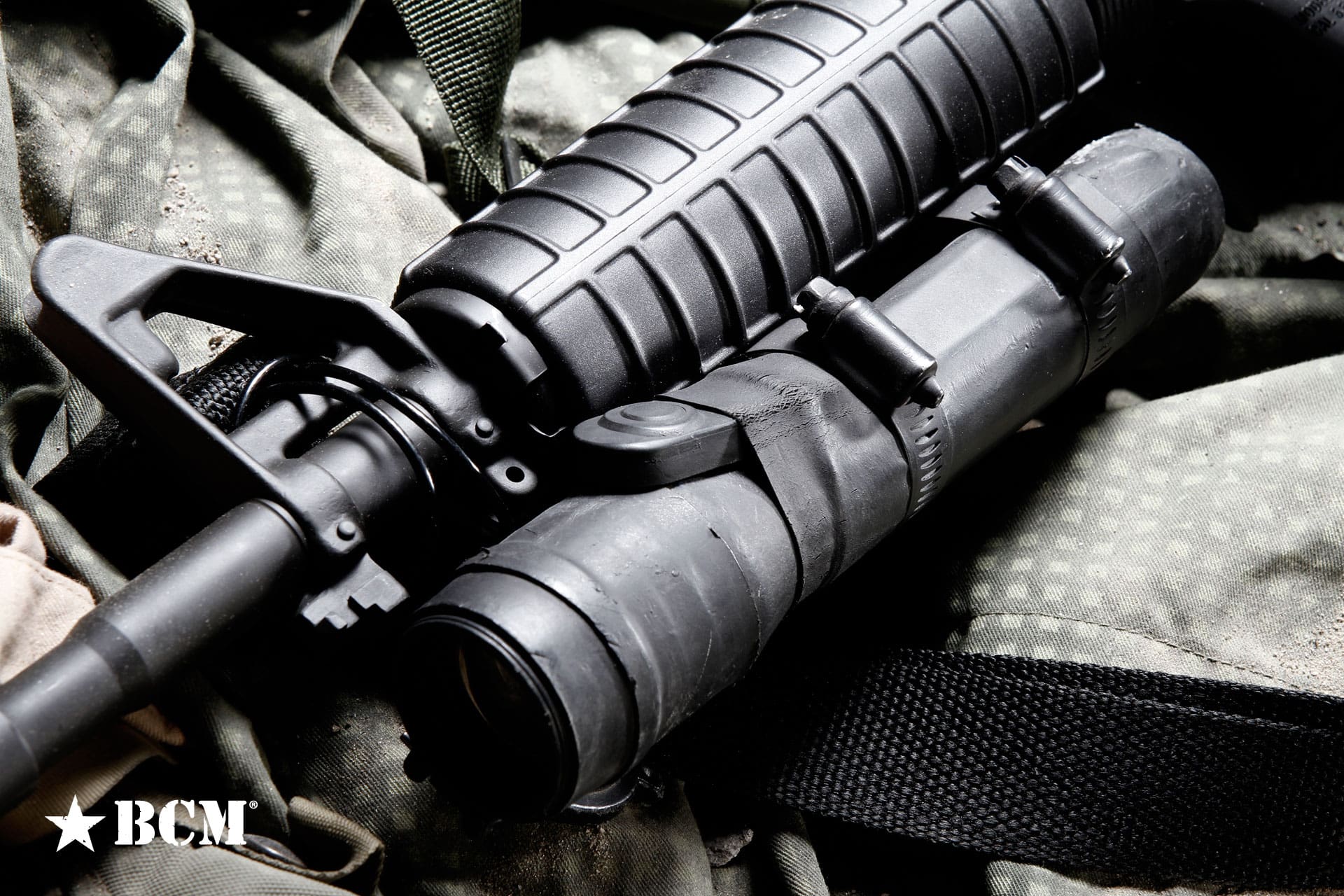
In addition, a waterproof SCUBA dive flashlight painted black was installed underneath the bottom handguard via hose clamps, and then our commo guys wired the flashlight for push button activation. It worked well for the intended purposes but they were replaced in short order once Surefire 6P flashlights came online. 1988 was a long time before Surefire weapon lights hit the market and became the industry standard.
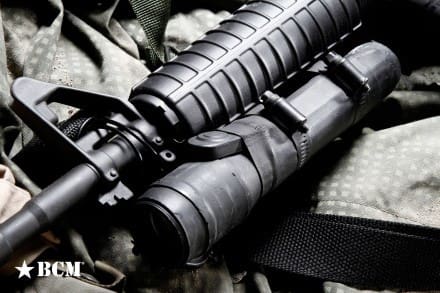
SCUBA Flashlight

The buttstock was a standard two-position Colt retractable. Very lightweight for sure, but it had a sloppy fit to the buffer tube compared to later aftermarket stocks. Our armorers would mill a third buttstock position at the shooters preference once an Operator determined his correct length of pull while wearing body armor. This setup worked quite well, with my only real complaint being the previously mentioned sloppy fit of the buttstock to the buffer tube.

Last but not least, I used an easy to adjust two point sling on my CAR-15 and later my issued M4 carbine that, little did I know, would lead to some great things in the future. I would use my knowledge and experience gained with that sling and combine it with Ashley Burnsed’s commitment to quality to make the Blue Force Gear – Vickers Combat Applications Sling; a sling that has now been sold in the thousands to our military as well as LE and civilian shooters and was recently adopted as the preferred M4, M27 IAR and M16 sling by the US Marine Corps.
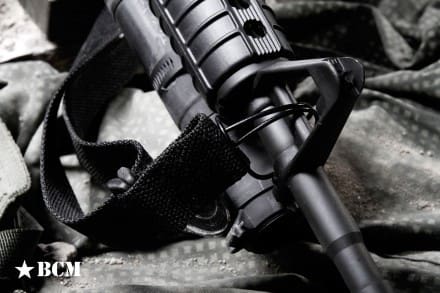
Sling Modification

It all started for me, with that original CAR-15 I used during my time in Delta Force.

SCUD HUNTING
SCUD hunting wasn’t a mission we anticipated – regardless, our Squadron was prepared for it. The Squadron Commander, a forward thinking Vietnam MAC-V SOG Recon Team vet with extensive combat experience, had “read the tea leaves” months earlier and instituted a refined Desert Mobility Skills Package that would be a critical “tool in the toolbox” for us in this mission.

Based on his experiences in Vietnam, the commander of Coalition forces, General Schwarzkopf, was not a fan of SOF (Special Operations Forces). He was, however, very pro-Delta Force. The Unit had been providing security for him during the buildup to Desert Storm and Schwarzkopf developed a great working relationship with the guys who worked for him.

When Desert Shield became Desert Storm, Iraqi SCUDs immediately began hitting targets inside Israel with the goal of bringing Israel into the war, fragmenting Coalition forces. The Coalition included several Middle Eastern nations who were steadfastly opposed to Israel’s existence and might disengage from the war effort, rather than fight “alongside” Israeli troops.

Coalition or not, the Israelis were not going to let Saddam attack their country with impunity. Aircraft were standing by to cross the border into Iraq, when the National Command Authority delivered an assurance to the Israeli government – the US had finally deployed its most elite troops to locate and destroy the SCUD TELs.

With our Advanced Desert Mobility Skill Sets fresh and in place, our Squadron was first to go.

Delta deployed far behind enemy lines, watching the main routes of travel that the Iraqis were using to launch SCUDs from. Once identified, airstrikes would be called in to eliminate the TELs. Our tactics had immediate and positive results. The accuracy of the SCUD missiles dropped dramatically, as the Iraqi SCUD crews rushed through proper set up and missile targeting to avoid being killed by US aircraft. In the end, Israel stayed out of the war and Kuwait was liberated from Iraqi occupation.

This remains the most memorable time of my life and is precisely why I joined the Delta Force. Shortly before, I had been involved in the rescue of Kurt Muse from the Carcelo Modelo Prison in Panama City. From the deserts of Iraq to the jungles of Panama, this was the right place at the right time in history.

Up until this point, the military was largely using variants of the M16 full-size rifle and SOF was using H&K MP5s. The first organization that thought outside of that box and used a weapon that bridged the gap between sub guns and rifles, was Delta Force. The customized CAR-15s issued by Delta became the main drivers for the modification/customization capability available on all M4 Carbines issued today.

The issue CAR-15 (Colt Model 723) served me well in Panama and Iraq, but everyone on the ground in Delta quickly came to the same conclusion. We essentially had a 200 meter carbine in terrain where we could see the enemy approaching from over a mile away and to engage them effectively, we needed 7.62 NATO battle rifles. A limited number of M14s had been employed by our snipers, but we did not have enough to go around. In addition, while the platform is certainly reliable, bringing it up to modern standards still remains a challenge. In the early 1990’s, when no aftermarket accessories where available, it was a time-intensive process that few armorers were capable of. Since then, there has been a resurgence in both improved M14 parts and accessories, as well as battle rifles in general. This resurgence can be directly traced back to SOF battle rifle use in Desert Storm.

SOF in general has been a catalyst for improving and reinventing things that were set in stone. SOF legend Major Richard Meadows, the man I consider to be the first Delta Operator, was involved with not only MACV SOG but was a team leader on the Son Tay Prison Raid, arguably one of the most influential SOF missions in history. Delta Force grew from that kind of outside-the-box thinking.

It was the Son Tay Raiders who first fielded a red dot sighted weapon system, and it was Delta who picked up the ball with Aimpoint sighted CAR-15s. Every Soldier, Sailor, Marine and Citizen who uses a tricked out M4 style carbine today owes a debt of gratitude to individuals like Major Meadows, the Son Tay raiders and the Operators of the Delta Force for pushing the limits of the AR style carbine into one the most successful fighting weapons in the history of the US Military.


Author Tom Kratman Talks Military Training

Tuesday, November 19th, 2013

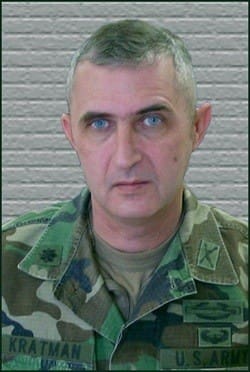
Tom Kratman is an author of military science fiction but unlike many authors, he is a Veteran having served as an enlisted Soldier and commissioned officer, retiring as a LTC from the USAR. Below is an excerpt from an article he wrote on military training for his publisher, Baen Books. Politically correct, he ain’t. But that’s the point.

ON TRAINING FOR WAR, PART 1

20131118-082929.jpg

Axiom One: The functions of training, the reasons we train, and all training can do for us, boil down to five things: Skill Training, Conditioning, Development, Selection, and Testing of Doctrine and Equipment.

The armed forces have a serious doctrinal lack when it comes to explaining why we train and how we do. Since they can’t articulate things like, “No, Doctor, Ranger School sucks in the way it does because we are conditioning and selecting, not merely teaching skills,” we get changes demanded from unqualified amd ignorant people, with credentials that bear no particular relationship to train for war.
I’ve spent, by the way, a number of decades since I first floated this axiom around, looking for a valid argument against it from anyone entitled to an opinion. I still haven’t gotten one, beyond the merest quibble. Every practicing trainer would probably recognize these as valid, even if they wouldn’t necessarily articulate them in exactly the same way.

The five functions should not be looked at as things that can be added up, to come to an approximation of a unit’s or individual’s training status. To even hope to do that you would have to be able to measure some immeasurables. Forget it; all the really important things can’t be measured, while all the really measurable things aren’t very important.

But if you could measure everything, trying to add their values together would still be the wrong way to look at it. After all, a soldier or a battalion, be they ever so skilled, are still worthless if they lack the courage to stand in line of battle, or to press the assault home. Instead, the proper way to look at them would be as things that must be multiplied by each other, with any factor being a zero causing the total to be worth zero, even if one approached infinity. Of course, again, since most of these are anywhere from difficult to impossible to measure, you’re not going to get a true value. The important thing to remember is that a zero in one is a zero overall, and even a serious weakness is one means weakness overall.


It’s also worth remembering that there is crossover. Better shooting ability, a skill, requires a degree of physical conditioning, but also conditions greater confidence, for example. Greater confidence develops greater trust and unit cohesion. I will treat these functions as distinct, for the most part, the better to illustrate them. But they are actually much fuzzier, with much more crossover, than that. They also apply in different ways at different levels, while some are appropriate to leaders, not so key to followers, and still others are collective, applying not just to everyone but to everyone in a unit together.

Be sure to read the entire article at www.baen.com.

What Do You Think About Trolls?

Monday, November 18th, 2013

20131118-091923.jpg

An associate sent this graphic to me. What do you think?