GORE-TEX WINDSTOPPER

Archive for September, 2025

‘A Major Win for UK industry’: Defence Industry Representatives Hail New MOD Scheme to Create Defence Inward Investment

Tuesday, September 9th, 2025

Industry representatives have lauded the announcement by the Government’s new Defence Industrial Strategy to create a new scheme to drive UK economic growth through a defence inward investment scheme when buying defence equipment from overseas.

The Defence Industrial Strategy, published today (8 September 2025) said that the MOD will launch a new defence inward investment scheme known as ‘offset’ next year – arguing that the policy “can be an effective way to create opportunities for firms to enter global supply chains, boosting the domestic industrial base, creating jobs and supporting economic growth”.

Director General of Make UK Defence Andrew Kinniburgh has described the announcement as a “major win for UK industry”.

The trade body, which represents over 700 SMEs in the defence industry, has been campaigning for the UK Government should draw inspiration from 53 other developed nations with similar policies such as Norway, Poland and South Korea and adopt a defence inward investment plan, or offset regime, as a central pillar to the UK’s growth mission and to strengthen our industrial capacity.

Earlier this year, Make UK Defence argued that such a scheme could allow up to 90% of the economic value of defence contracts going overseas to go back into the UK economy over a ten-year period, unless it was deemed necessary for national security reasons. Companies could achieve this in multiple ways such as creating new UK jobs, utilising UK supply chains with both large and small businesses, creating novel technologies and investing in skills training and apprenticeships.

Make UK Defence point to the successes other countries with similar policies such as Poland, which secured $6bn (£4.4bn) in inward investment following their F-16 acquisition in 2003. In 2023, the country also secured £200 million inward investment from the WILSA anti-aircraft and anti-missile programme. 

The trade body now want to ensure the MOD utilises the new defence inward investment scheme to incentivise the utilisation of SMEs in the defence industry and to support industries supplying critical raw materials the Defence Industrial Strategy identified as critical to UK Defence, such as steel and semiconductors.

Make UK Defence Director-General Andrew Kinniburgh said:

 “The MOD’s commitment to design a new defence inward investment plan – something Make UK Defence has spent months campaigning for – is a major win for UK industry.

“By adopting this plan, the Government will deliver more work for UK based companies, including primes, mid-tiers and SMEs, and help to fulfil the defence dividend – unlocking private investment in UK jobs, skills, and supply chains across the nations and regions.

“We look forward to continuing to work closely with the MOD to ensure the new defence inward investment plan delivers for all of industry, including SMEs, and boosts economic growth across the UK.”

BLADE Cuts Down Drones at Project Flytrap 4.0

Tuesday, September 9th, 2025

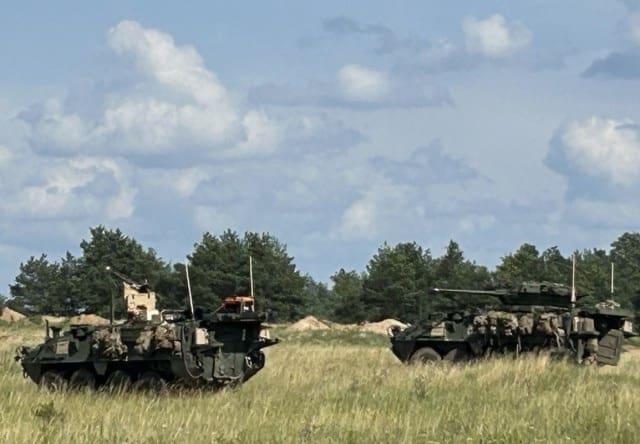
BEMOWO PISKIE TRAINING AREA, Poland — Soldiers from the Army’s 2nd Cavalry Regiment detected, tracked, engaged and defeated multiple drones at ranges between 500 and 800 meters using the Ballistic Low Altitude Drone Engagement, or BLADE, system from a Stryker vehicle at the Bemowo Piskie Training Area in northeast Poland during a live fire event for Project Flytrap 4.0 on Aug. 1.

“Some of those (drone) threats were being flown simultaneously, so the system defeated one target then quickly targeted and defeated a second target in a matter of seconds,” said David Goldstein, counter-unmanned aerial systems (C-UAS) lead for the Combat Capabilities Development Command Armaments Center.

The Armaments Center ran the BLADE science and technology project from 2016-2019 to develop a capability to counter drone threats. BLADE leverages — and enhances — a system operated throughout existing Army formations, the Common Remotely Operated Weapons Station, or CROWS.

As a remote system mounted on different types of Army vehicles, CROWS allows an operator to fire a weapon while remaining protected inside. Using an array of optics, a viewing screen and motorized gimbals and controls, the operator can effectively select and engage targets.

With BLADE, a precision radar and C-UAS fire control software is integrated with CROWS hardware and software to assist operators in identifying, tracking and pointing the weapon to a continually calculated intercept point to enable the difficult challenge of destroying enemy drones.

Capable of functioning with numerous weapons, the BLADE/CROWS combination at Project Flytrap included an M2 .50 Caliber machine gun firing multi-round bursts.

BLADE also participated in several Project Flytrap non-firing training scenarios using the radar for detection, tracking and other simulated defensive actions, according to Goldstein.

Starting in late July, Project Flytrap 4.0 was the final iteration of the C-UAS training events where Soldiers from the 2nd Cavalry Regiment and 1st Royal Yorkshire Regiment, United Kingdom, tested new C-UAS capabilities in combined exercises meant to develop and inform the future of anti-drone tactics and technologies.

“Project Flytrap is part of a series of training events designed to test and refine new counter-unmanned aerial systems technologies and tactics to respond to the evolving threat of drone warfare,” said Col. Matt Davis, transformation chief and exercise director of V Corps, Project Flytrap, during a press engagement.

Previous Flytrap events were focused on command-and-control systems and countering small UAS sensors, said Goldstein. “We were invited to come out to the latest Flytrap with our BLADE and CNALT systems because they wanted to see more kinetic capabilities,” said Goldstein.

The CNALT software plug-in, also being developed by the Armaments Center, is an application that provides tactical fire control and visualization tools to reduce time in the kill chain — the cycle of finding and identifying targets, prioritizing and coordinating attacks. Time is critical in military operations with targets in constant motion and considering that potential targets threaten harm to friendly forces.

Soldiers took 15 minutes on new equipment training for CNALT operations, said Marc Sanzari, chief of the Armaments Center Networked Lethality & Collaborative Autonomy Branch. During various training scenarios, CNALT successfully ingested real-time sensor data from the BLADE Precision Fires Radar, classified UAV tracks, and generated actionable engagement recommendations for BLADE and the Stryker commander.

For BLADE, getting the components to Project Flytrap 4.0 and operational, tested the abilities of engineers and technicians to meet the Army and DoD challenge to get new drone capabilities into the hands of Soldiers quickly and with the fewest constraints.

“Within two weeks of request, the system was installed and operational and ready for Soldier touch point training,” said Jonathan Gann, an Armaments Center mechanical engineering technician specializing in autonomous weapons.

Gann was part of an Armaments Center team who shipped the BLADE components from Picatinny Arsenal, New Jersey to Poland and conducted a field expedient installation of an existing CROWS on a Stryker vehicle to make it operational as a BLADE system.

After the installation, Gann met with Soldiers to discuss the tactics, techniques and procedures for BLADE operations within unit formation while stationary and on the move. He noted that Soldier feedback from the live-fire event provided insights on future improvements for BLADE, but also, “it highlighted the possibilities of UAS engagement in a dynamic environment,” said Gann.

“I was able to understand the fundamental workflow for the system and gunner actions within one hour of seeing the BLADE for the first time,” said Maj. Jared Whitaker, deputy chief G-31 from V Corps, who as a leader observed the entirety of the drone engagements in a seat between the gunner and radar operator.

Whitaker, who is proficient in operating CROWS, said that compared to ground engagements there were added steps in counter-drone operations. Schooling on the radar was necessary, as was additional training to become fluid during rapid reactions while performing counter drone scenarios.

“I found that the ability to engage UAS using a CROWS has gone from impossible to possible with the addition of BLADE,” said Whitaker.

After achieving Technology Readiness Level Six in 2019, BLADE has participated in various C-UAS exercise and engagements, such as Project Convergence, the Maneuver Fires Integrated Exercise and Red Sands – Operation Hard Kill.

Operation Flytrap has become the latest BLADE knowledge builder.

“The Armaments Center continues gathering insights from participating in C-UAS events and is transitioning the technology to current programs of record for near-term fielding opportunities, said Goldstein.”

By Timothy Rider

Ceremonial Opening of New Ammunition Factory: Turning Point at Rheinmetall-Speed

Monday, September 8th, 2025

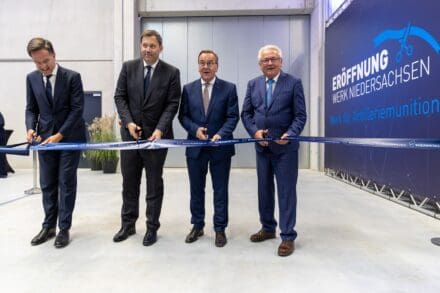
Rheinmetall has taken Europe’s largest ammunition factory in Lower Saxony into operation in order to meet the urgent needs of the armed forces in Europe. The technology group has invested almost €500 million in the construction of the production facility at the Rheinmetall site in Unterluess (Celle district), which was completed in a record time of just 15 months.

The presence of many dignitaries from Germany and abroad highlighted the importance of the occasion. Guests present were Vice-Chancellor and Federal Minister of Finance Lars Klingbeil, Federal Minister of Defence Boris Pistorius, NATO Secretary General Mark Rutte and General Carsten Breuer, Chief of Defence of the German Armed Forces. The highest-ranking guest was Rumen Radev, President of Bulgaria. Olaf Lies, Minister-President of Lower-Saxony, also attended the ceremony, as did many other high-ranking persons, including guests from the United States of America, Latvia and Lithuania.

In future, up to 350,000 artillery shells are to be produced annually in Unterluess at the new Lower-Saxony plant (Werk Niedersachsen), which covers an area of around 30,000 m2. The first 25,000 rounds are to be produced before the end of this year. Next year, 140,000 rounds are scheduled for delivery, with full capacity to be reached in 2027. In addition to that, the production of engines for artillery rockets is planned for the year 2026. Rheinmetall CEO Armin Papperger: “After having accelerated the production to the maximum until 2027 and then being at full capacity, the Werk Niedersachsen will be the largest ammunition plant in Europe, if not the world”.

In total, this will create up to 500 jobs – 350 at the plant in Lower-Saxony and a further 150 in the rocket engine production, which is still under development. Hundreds of more jobs will thus be created in areas such as supplementary services and suppliers.

The supply of ammunition is essential for restoring the defence capabilities of Germany and its European allies. Rheinmetall takes on the responsibility as a leading manufacturer and is investing at large-scale at various locations. Most recently, in the summer of 2023, the Düsseldorf-based group spent around €1.2 billion on the acquisition of Spanish manufacturer Expal Systems. Rheinmetall plans to produce a total of around 1.5 million artillery shells per year from 2027 onwards throughout its production network, which also includes sites in Spain and South Africa.

The urgency of the defence alliance’s need for ammunition was underscored in Unterluess by a major order from NATO member Romania, which was placed just before the inauguration ceremony began. Radu-Dinel Miru??, Romania’s Minister of Economy, and Armin Papperger, CEO of Rheinmetall AG, signed a Letter of Intent which is the basis for the next steps. Together with partners, Rheinmetall plans to invest around €550 million in the new plant in Romania.

Federal Minister of Defence Boris Pistorius: “Your success means security for our country”

The politicians praised the importance of the plant for Germany and Europe: “We are herewith investing in our security”, emphasised Federal Finance Minister Lars Klingbeil in his speech. The Vice-Chancellor also reiterated: “This plant indicates that we are taking action”.

Federal Minister of Defence Boris Pistorius addressed Rheinmetall and the defence industry as a whole: “We want you to be successful, because your success means security for our country”. And then continued: “You, the industry, deliver what is important: speed and substance”. He also categorized Germany’s efforts to increase arms production for the armed forces massively in the context of alliance policy: “NATO must become more European so that it can remain transatlantic”.

NATO Secretary General Mark Rutte emphasised in his speech: “Strong and successful is exactly what Rheinmetall is”. He cast a warning glance at the massive armament efforts in Russia and China: “Their military build-up points in a clear direction: they are preparing for long-term confrontation and competition – with us”.

Rheinmetall CEO Armin Papperger accented: “From the groundbreaking to production in just 15 months – that’s a real turning point at Rheinmetall speed”. Since the ground-breaking ceremony in February 2024 and in just over a year of construction work, Rheinmetall has created the possibility to independently meet the requirements of the German Armed Forces from national production in the future and, if required, to guarantee independent deliveries to partner countries. “Our new national production facility is setting standards and will, above all, ensure the supply of the German Armed Forces”. Rheinmetall is not limiting itself to Germany when it comes to building such plants: “This means that we can also erect comparable plants in other NATO-countries within a very short time, thus creating a pan-European defence ecosystem”, Papperger emphasised. “For example, we have already launched specific projects in Lithuania and the United Kingdom, with more to follow”.

Rheinmetall in Unterluess

The traditional site in Unterluess, which Rheinmetall has been operating in the Suedheide region since 1899, is currently the Group’s largest worldwide with 3,200 employees. Two companies are based here: Rheinmetall Landsystems GmbH and Rheinmetall Weapon and Munition GmbH. Unterluess is also an important location for Rheinmetall IT Solutions GmbH. Alongside the ammunition production, the site’s activities also focus on the development and manufacture of weapon systems. At the same time, Rheinmetall maintains its competence centre for the development, construction and support of tracked vehicles here.

The company owns an area that covers a total area of about 60 square kilometres which is largely used as a firing and testing range. Nevertheless, large parts of it are also used for forestry. 

SOFWERX – SBIR 25.4 Release 12

Monday, September 8th, 2025

USSOCOM has announced Small Business Innovation Research (SBIR) 25.4 Release 12 ans will soon be accepting proposals.

SOCOM254-007: Acoustic-based UAS Rainbow Oscillation Refraction Architecture (AURORA)

SOCOM254-008: Silencing with Acoustic Rainbow Emitters (SWARE)

SOFWERX will host a virtual Q&A session for the areas of interest on 16 September at 12:00 PM ET.

Submissions Open 24 September 2025.

Register for the Q&A here.

xTechHumanoid Competition Militarizes Humanoid Technology for Soldiers

Monday, September 8th, 2025

WASHINGTON— The U.S. Army xTech Program, in coordination with the Joint Humanoid Community of Collaboration, launched the xTechHumanoid competition. With up to $490,000 in cash prizes and $1.25 million in potential follow-on awards, the competition seeks transformative humanoid technologies that enhance warfighter survivability, sustain combat power, and operate effectively in complex, high-risk environments.

xTechHumanoid aims to identify and accelerate the development of prototype militarized humanoids capable of working alongside Soldiers in diverse operational settings. The competition will assess the current state of humanoid technology and evaluate key subsystems—such as artificial intelligence, sensors, and power systems—to identify scalable commercial solutions with near-, mid-, and long-term potential.

Finalists will participate in a live experimentation event with Department of Defense experts and end-users to validate technology readiness, refine system performance, and ensure solutions meet Army mission needs.

xTechHumanoid plays a strategic role in shaping future DOD investments, research and development priorities, and integration pathways for humanoid systems. The competition will also inform doctrine, training, and force structure—ultimately positioning these technologies as force multipliers on the modern battlefield.

Competition Overview

The Army seeks small and large businesses across the globe to participate, engage with DOD experts, and refine their solutions to meet Army needs.

Part One: Concept White Paper (Aug. 6 – Oct. 1, 2025)

  • Eligible vendors must submit a five-page concept white paper and an optional three-to-five-minute video outlining their technology, viability, and its benefit to the military.
  • Up to 10 applicants—including up to six white papers for baseline humanoid systems and up to four white papers for advanced humanoid subsystems—will receive $25,000 and an invitation to the next round.

Strategic Collaboration

  • Selected participants from part one can explore strategic collaborations with fellow finalists or industry partners to help shape innovative humanoid solutions for the finals and beyond. Collaboration remains optional and will not affect selection decisions.

Part Two: Final Experimentation Event (Summer 2026)

  • Finalists will participate in a live experimentation event in August or September 2026, showcasing their solutions to a panel of Army and DOD experts.
  • Up to two winners with baseline humanoid systems will receive a prize of $75,000 each, and up to three winners with advanced humanoid subsystems will receive a prize of $30,000 each.
  • The government may award follow-on contracts to one or more competition winners, with each award drawn from a total funding pool of up to $1.25 million.

Eligibility Requirements

xTechHumanoid is open to nonprofit and for-profit organizations, including large and small businesses, in both domestic and foreign territories. Vendors must obtain a Commercial and Government Entity (CAGE) code or North Atlantic Treaty Organization (NATO) Commercial and Government Entity (NCAGE) code to process payments and must be incorporated in and maintain a primary place of business in the U.S. or a foreign country.

Vendors must not be U.S. federal government entities, foreign government entities, or employ a U.S. federal employees acting within the scope of their employment. Additionally, vendors must not currently be under contract, agreement, or providing similar capabilities to the government for related work.

About the Army xTech Program

The Army xTech Program is the Army’s premier tool for scouting and accelerating dual-use technologies that directly enhance Soldier readiness and mission success. Through dynamic prize competitions like xTechSearch, xTech identifies breakthrough solutions and opens doors for nontraditional companies to engage with and deliver capabilities to the Army. Since its launch in 2018, xTech has awarded over $30 million in non-dilutive cash prizes across 45 competitions—fueling innovation pipelines and delivering transformative technologies that matter on the battlefield.

Stay Updated

Subscribe to email updates or check the Army xTech website for the latest information. Follow us on Facebook, LinkedIn, YouTube, and Flickr. For inquiries, contact the Army xTech mailbox.

By Sarah Hepburn, Office of Army Innovation Programs


Any references to commercial products or services are not, and shall not, be construed as, official Army or DOD endorsements.

The Gentex Mask Light Microphone

Monday, September 8th, 2025

Hands-Free Illumination and Clear Communication Built for Mission Success.

In demanding cockpit environments, aircrew can’t afford to compromise on visibility or communication. That’s why Gentex created Mask Light Microphones, fully integrated solutions that combine Night Vision Imaging Systems (NVIS)-compatible cockpit lighting with high-performance communications in single, streamlined units. Available in both Dynamic and Amplified versions, these systems give aircrew the tools they need to operate effectively in low-light conditions while maintaining clear and effective comms.

The Mask Light Advantage

By integrating a high-intensity white LED directly into the external microphone subassembly and an activation switch into the internal microphone subassembly, the Mask Light delivers reliable, hands-free, supplemental cockpit lighting for map reading, equipment checks, and other tasks without disrupting night vision or compromising safety. The fully integrated design eliminates the need for separate light mounts, reduces snag hazards, and keeps essential functions right where you need them.

Dynamic and Amplified Options for Every Platform

Mask Light Dynamic Mic (MLDM) – Powered by long-lasting CR2 batteries, this version integrates seamlessly into Gentex oxygen masks that do not draw from aircraft-supplied power, such as the MBU-20/P, MBU-20A/P, andsome HA/LPs. With a four-level brightness adjustment and rugged, Safe-to-Fly construction, the MLDM is built for maximum reliability in both fixed wing and rotary wing operations.

Mask Light Amplified Mic (MLAM) – Designed for platforms like the F-35 and F/A-18—and fully approved for use by the Department of the Air Force and Department of the Navy in all variants of the F-35—this aircraft-powered version integrates into Gentex F-35, MBU-23/P, and someHA/LP oxygen masks. With adjustable brightness, NVIS compatibility, and no batteries required, the MLAM offers continuous mission-ready performance.

Mission-Driven Design

Both models are tested to withstand windblast and ejection seat forces exceeding 600 KEAS, ensuring they remain secure in the most extreme conditions. Built to MIL-STD requirements, protected against environmental threats, and optimized for ease of installation, the Mask Light Microphones deliver an unmatched level of safety, performance, and integration.

For decades, Gentex has equipped the world’s elite aircrew with innovations that enhance mission effectiveness and protect those who serve. The Mask Light Microphones carry that legacy forward, ensuring aircrew have the illumination, clarity, and confidence to succeed in every mission.

Click the following links to learn more

Mask Light Dynamic Mic

Mask Light Amplified Mic

The Dread and Fear of Kings – Fall 2025 Showcase – Alexandria, VA

Monday, September 8th, 2025

The Dread and Fear of Kings will be showing our entire collection in Alexandria, Virginia on Friday November 14, and Saturday, November 15 at a private location. This invite only event will also premier new designs that will not be offered or even shown online until later in 2026.

Creative Director, Jon Chang, and Product Manager, Michelle DeMoras, will be present to fit and discuss any pieces in our collection. We will have a full range of sizes and colors, minus our made to measure pieces, available for purchase if you wish to add one of our pieces to your collection.

Each appointment is private.

To RSVP complete the form at thedreadandfearofkings.com/rsvp_alexandria and we can reserve a time to meet. Thank you for your interest in our very unique offering. We continue to deliver capability in an elevated form, made and sourced without any inputs from China or any other authoritarian regime.

First of the First: 11th Air Task Force Becomes First Air Task Force To Deploy

Monday, September 8th, 2025

SAIPAN, Northern Mariana Islands —  

The 11th Air Task Force became the first U.S. Air Force air task force to deploy in July, starting with its participation in exercise Resolute Force Pacific (REFORPAC), the Air Force’s largest contingency response exercise in the Pacific, in Saipan, Northern Mariana Islands.

Based in Davis-Monthan Air Force Base, Tucson, Arizona, the 11 ATF is one of six task forces activated across the Air Force in 2024. It is composed of about 350 Airmen from a handful of units, including Davis-Monthan; Nellis Air Force Base, Nevada; and Holloman Air Force Base, New Mexico.

The 11 ATF has spent the last nine months completing training requirements in an expedited Air Force Force Generation cycle, which is built to enable Airmen to train and exercise together before being operationally employed together as part of a team. This is a change from how the Air Force traditionally has filled deployment billets, when Airmen were pulled from bases across the force and often didn’t meet until they arrived downrange.

According to U.S. Air Force Col. Brett Cassidy, 11 ATF commander, the ability to train together during deliberate field training exercises and unit events was a critical factor in the team’s mission readiness when they arrived on the field.

“It was a unique opportunity for the team to come together over the entire year to get to know one another, dive into the challenges on the ground here immediately and tackle them with success, because we had that background built up over the previous year of training,” Cassidy said. “We were ready and capable as soon as we arrived to get right into the mission.”

REFORPAC served as the 11 ATF’s final 400-level certifying exercise, allowing the 11 ATF to utilize all its training as a team before continuing the rest of its six-month deployment in the Pacific. Conducted through the month of July, REFORPAC was part of the first-in-a-generation Department-Level Exercise series, a new way the Air Force is exercising to conduct large operations in contested, dynamic environments. The aim was to improve interoperability and multilateral cooperation, leading to a stronger, more capable, deterrent force.

The DLE series encompasses all branches of the Department of Defense, along with allies and partners, employing approximately 400 U.S. and coalition aircraft and more than 12,000 members at more than 50 locations spanning 3,000 miles.

During the exercise, the 11 ATF, alongside the 11th Combat Air Base Squadron, supported the 563rd Rescue Group’s efforts as a mission generation force element. Their mission was twofold:provide Command and Control and base operating support-integration. This included logistics, operational setup, special staff functions such as the chaplain and medical support, security forces, airfield management and more.
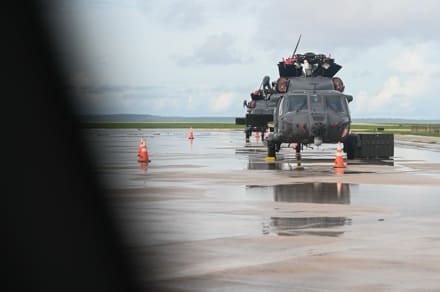
All these teams came together to prepare for and react to exercise mission injects that ranged from a simulated downed F-22 pilot to a simulated Small Unmanned Aircraft System attack that knocked out part of the task force’s communication system, forcing members to implement contingency plans to ensure critical actions were still taken and relayed to the broader team.

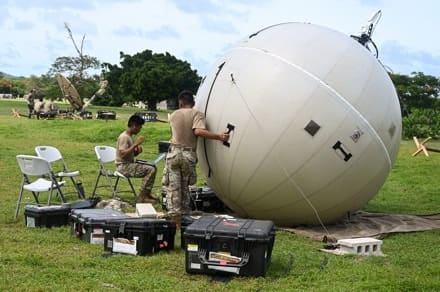
Building from the ground up with the aid of local contractors and partners, the 11 ATF established internet communications within hours and supported aerial missions within days. Airmen also integrated with local authorities to utilize a civilian runway, enabling the 563rd RQG’s HH-60W Jolly Green II helicopters and HC-130J Combat King II aircraft to land and take off whenever necessary.

Another challenge was the sheer distance involved in some of the exercise injects, especially when the 563rd RQG was tasked with supporting efforts off the island.

“When we look at the long distances in the Pacific, the huge range that’s require for logistics and sustainment, it was a unique opportunity for our Airmen to work really dynamic problems in more isolated, austere locations over these long distances,” Cassidy said. “They had to figure out how to make the mission work in this large integrated whole of hundreds of aircraft and thousands of Airmen working through this contingency scenario.”
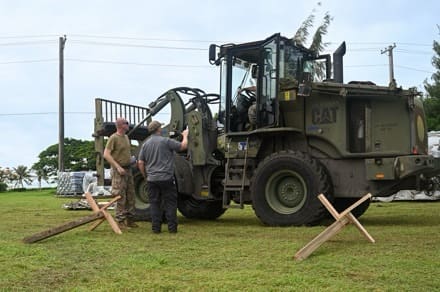
Besides the exercise injects and other training, 11 CABS Airmen also dealt with real-world challenges that included a tropical storm, a tsunami warning and a responding to humanitarian scenarios.

Ultimately, REFORPAC refined the 11 ATF’s ability to execute dispersed operations and generate airpower under challenging conditions, while giving its Airmen the chance to practice the Mission Ready Airman concept.

“The Mission Ready Airman concept is about trust,” said U.S. Air Force Chief Master Sgt. Sharreen Taylor, 11 ATF command chief. “It goes back to that teaming concept, where the Airmen have gotten to work together, learn how to trust each other and then really jump in. Airmen work together, building trust and taking initiative. They don’t wait to be told what to do; they proactively step up and fill in where they’re needed.”

Taylor pointed to several instances of Airmen stepping out of their primary job duties throughout REFORPAC, from finance Airmen helping establish a perimeter fence to airfield management Airmen helping with logistics. This also occurred as the 11 ATF integrated with squadrons from the 563rd RQG as Airmen from both groups worked together to solve problems and achieve the mission.

“Our Airmen nailed it during REFORPAC,” Taylor said. “We were able to come into an environment that we’ve never been in, and set up a camp in minimal time, along with a complete communication structure. Every task our Airmen were given, they succeeded; they were ready to overcome any contingency. They truly embraced the Mission Ready Airmen concept, and they truly embraced the things that the Air Force asked us to do.”

The 11th ATF’s role in REFORPAC highlighted its ability to function as a deployable, self-sustaining force, showcasing its adaptability and capability to operate similarly to a traditional Air Force wing. REFORPAC also gave the Department of the Air Force the chance to see air task forces in action, especially as the 11 ATF practiced Agile Combat Employment in a dispersed, austere environment. ATFs, which replace the Expeditionary Air Base model, are the next evolution of the Air Force’s progress toward the Deployable Combat Wing and a significant milestone in the Air Force’s journey toward modernization and readiness to ensure and maintain a competitive advantage over the pacing challenge.

“Air task forces like the 11 ATF are critical because they help us glean the lessons and observations necessary to continue improving our force generation concepts, ultimately helping make sure that the future combat wings are designed and ready to get after missions that help our joint forces and joint commanders who need them in the theater,” Cassidy said. “We’re not going to get it perfectly right as we work through these iterations, but we’re moving forward, and we’re doing it in a way that’s going to pull lessons for the Air Force at a critical time when we need to make sure that the Air Force is continuing to shift forward and be prepared for the next major contingency.”

By 2nd Lt Grace Brandt, 11 ATF