FirstSpear

Archive for the ‘Advertiser’ Category

BFG Monday: Every Movement Has a Cost

Monday, July 13th, 2026

A Soldier pauses at a trail intersection beneath a canopy that blocks what little moonlight remains. Through night vision, familiar terrain has changed. Colors are gone. Depth is harder to judge. The field of view has collapsed into a narrow green window.

Ahead, the patrol continues moving quietly through the dark. A route needs to be marked. A danger area may need to be identified. A casualty collection point could need to be established before the night is over.

The mission does not stop because it is dark. It simply becomes more demanding.

US Marine Corps photo by Lance Cpl Oscar Ocampo

Darkness changes the cost of simple tasks. Under NODs, navigation, security, communication, terrain, spacing, and threat awareness are all competing for attention at the same time. What feels routine in daylight can become slow and deliberate at night. Every reach, every search, and every extra step matters more.

That principle applies to every piece of equipment a Warfighter carries. Medical gear must be reachable. Magazines must be retrieved without hesitation. Radios must be easy to locate and manipulate under stress. Marking equipment is no different.

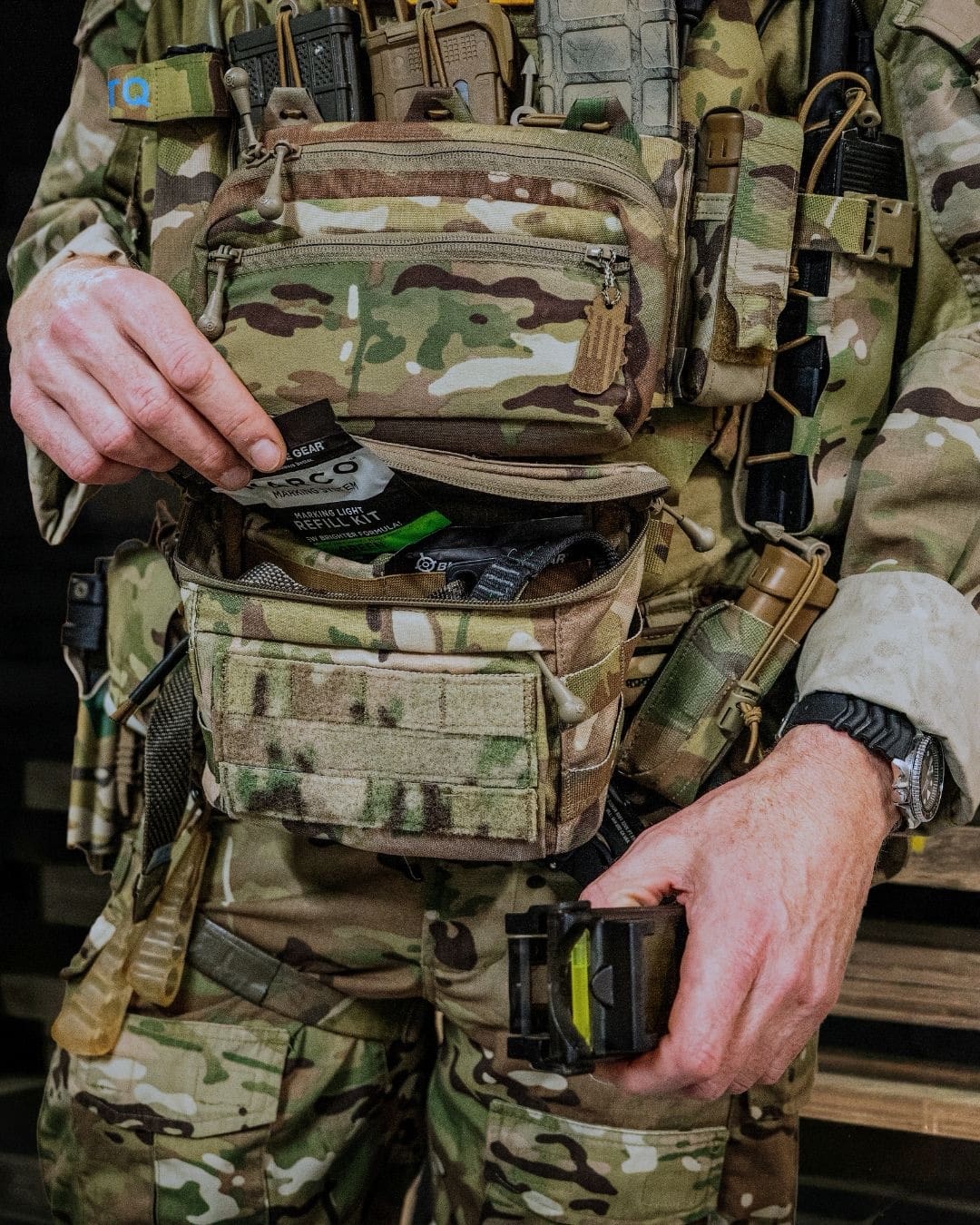
Chemlights remain one of the simplest marking tools available. No batteries. No programming. No setup. They work when they are needed, which is why they continue to be used for route marking, room marking, hazard identification, training lanes, and casualty collection points.

The problem has never been the chemlight itself. The problem has always been how users have had to carry and deploy them.

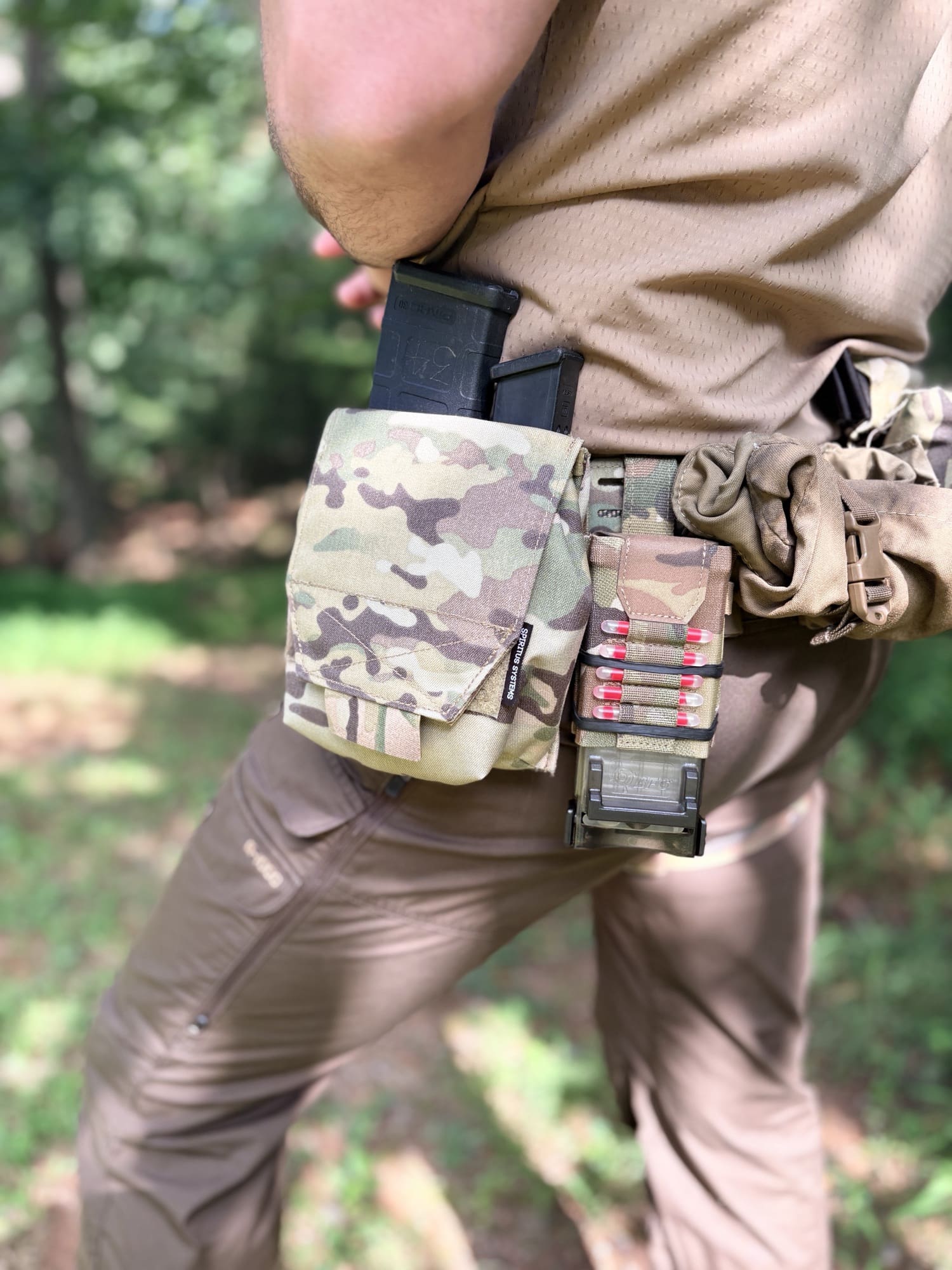
For years, the common solution was improvised. Individual chemlights were taped to reduce output under night vision, bundled together with 550 cord, and carried in groups based on color or mission need. It worked because users made it work, but it was never clean. Bundles add bulk. Cord creates clutter. Different colors have to be sorted. Individual lights have to be separated, activated, and deployed, often while wearing gloves, moving over uneven terrain, and maintaining awareness of everything happening around the user.

None of those actions are complicated on their own. Together, they create friction at the exact moment the user needs fewer things competing for attention.

That problem led Blue Force Gear® to develop the MARCO® Dispenser line. The MARCO 1.5 organizes thirty 2-inch chemlights in a compact package with a footprint similar to an M4 magazine, giving users a cleaner way to carry and deploy marking lights without loose bundles, tangled cord, or unnecessary bulk.

Instead of searching through a bundle and separating a light from a tether, the user can remove and activate a chemlight with a simple two-finger motion as it leaves the dispenser. The result is not just faster deployment. It is a more consistent workflow when consistency matters.

That difference is easy to overlook until the conditions get worse. Low light has a way of exposing unnecessary movement. Gloves reduce dexterity. Terrain slows the pace. Communication becomes more deliberate. Peripheral vision is limited. The user is already processing less information through a narrower view of the world, which makes every additional task more expensive.

Marking should not become one of those tasks.

Whether identifying a route, marking a danger area, supporting a training lane, or establishing a casualty collection point, the goal is not simply to carry chemlights. The goal is to place light where it is needed with as little interruption as possible. Equipment should support that process, not add another problem to solve.

Small efficiencies matter because they compound. One less reach. One less search. One less unnecessary movement while working through a complex problem in the dark.

The best gear does not change the mission. It removes friction between the user and the task. Every movement has a cost. The right equipment makes sure those movements are not wasted.

For units seeking to increase survivability and operational performance through reduced load carriage by upgrading to Helium Whisper, contact the Blue Force Gear Military Department or visit BlueForceGear.com.

Buyer Beware – Fake Phokus Research Website

Sunday, July 12th, 2026

A fraudulent website is impersonating Phokus Research Group and selling fake versions of our products under our name, using our images and product listings.

It is NOT affiliated with us and is NOT an authorized seller.

Our ONLY official store is phokusresearch.com

If you see steep “discounts” or offers that seem too good to be true on any other site claiming to be Phokus, do not enter your payment information.

Please report and share to protect our community.

Questions? Contact us directly at phokusresearch.com/contact.

FirstSpear Friday Focus: Shadow Pack

Friday, July 10th, 2026

Not every mission looks like one. The FirstSpear SHADOW PACK was designed to offer a low-profile solution for carrying short rifles, sub-guns, or shotguns without advertising the fact. Its soft, non-tactical exterior blends into urban environments and plain-clothes operations where discretion isn’t a preference; it’s a requirement. Fully adjustable shoulder straps and a quick-release sternum strap keep the pack secure and allow for rapid removal when speed matters. 

Feature Call-Outs:

  • DISCREET, NON-TACTICAL EXTERIOR
  • LIGHTWEIGHT, DURABLE CONSTRUCTION 
  • QUICK-RELEASE STERNUM STRAP
  • CARRIES SHORT RIFLES, SUB-GUNS, AND SHOTGUNS

At its core, the SHADOW PACK combines lightweight, durable construction with a purpose-built interior designed around the mission. Multiple interior and exterior pockets provide organized storage for magazines, tools, and mission-specific gear, while a rear zippered compartment keeps small essentials accessible and out of sight. Available in Black, Multicam Black, and Stone/Manatee Grey/Rust, the SHADOW PACK delivers covert capability without unnecessary bulk or compromise.

Built for military personnel, law enforcement officers, and prepared professionals who demand reliable equipment, the SHADOW PACK delivers low-visibility carry without sacrificing organization or access. Purpose-driven, covert, and comfortable; it brings discreet capability to those who need it most. FirstSpear is the premier source for cutting-edge tactical gear for military, law enforcement, and those who train. For more information, visit First-Spear.com.

SIG SAUER Recognizes Medal of Honor Recipients with Commemorative Firearms

Thursday, July 9th, 2026

NEWINGTON, N.H., (July 9, 2026) – SIG SAUER, an industry-leading manufacturer of cutting-edge firearms, electro-optics, ammunition, and advanced concepts, recognized four Medal of Honor recipients for their sacrifice, service, and commitment and presented each soldier with a commemorative SIG SAUER pistol.

At the SIG SAUER Experience Center in Epping, N.H., Master Sergeant Earl D. Plumlee, Staff Sergeant David G. Bellavia, Staff Sergeant Salvatore A. Giunta, and Staff Sergeant Ryan M. Pitts, received commemorative SIG SAUER M17 pistols. The SIG SAUER M17 and M18 are the official sidearms of America’s Armed Forces.

Master Sergeant Plumlee, Staff Sergeant Bellavia, Staff Sergeant Giunta, and Staff Sergeant Pitts were each awarded the Medal of Honor for their service during the War on Terrorism and for unique acts of bravery that risked their own lives to save and protect others. Their stories of extraordinary heroism can be viewed at the Congressional Medal of Honor Society website.

About the Commemorative SIG SAUER Pistol

  • The SIG SAUER Medal of Honor M17 pistol was designed from concept to production by SIG Custom Works, an exclusive program at SIG SAUER to engineer and build-your-own customized pistol. The Medal of Honor M17 pistol is hand-polished with a black chrome finish and features gold-plated controls.
  • The grip is American walnut sourced from Appalachia with high-grade figuring and with the Medal of Honor medallion featured on both sides. The sight plate is also engraved to match the Medal of Honor ribbon.
  • Each firearm has a unique engraving on the left side of the gun with each Medal of Honor recipient’s name and rank, as well as their rank earned at retirement.

In line with its mission to support the military, SIG SAUER has a strong history of recognizing U.S. servicemembers, including in 2019 presenting a commemorative SIG MK25 pistol to Medal of Honor recipient Command Master Chief Britt Slabinski and releasing a short documentary honoring his service. In 2025, the SIG SAUER Experience Center Museum hosted a tribute display for Medal of Honor recipient Captain Larry L. Taylor showcasing his heroic service in Vietnam. In 2026, SIG recognized the U.S. Army’s 250th anniversary at the Pentagon with commemorative M17 pistols for the Secretary of the Army and Army leadership.

Prometheus Design Werx Releases the Apex Boonie Hat

Wednesday, July 8th, 2026

A modern refinement of the Vietnam-era RECCE boonie. Custom-milled 2-way stretch NYCO+ Ripstop. Bug-proof NoSeeUm mesh liner. Made in Vietnam, the country where the boonie hat was born.

San Francisco, CA — July 8, 2026 — Prometheus Design Werx announces the Apex Boonie Hat, a modern interpretation of a Vietnam-era field classic built on the RECCE short brim, a custom-milled 2-way stretch NYCO+ Ripstop shell, a bug-proof NoSeeUm mesh liner, and a cinching crown fit system. It’s available now for $59.00 USD, available in three colorways: Universal Field Gray, All Terrain Brown, and Ranger Green.

FROM THE JUNGLES OF VIETNAM TO THE RECCE BRIM

The boonie hat is one of those rare pieces of equipment that transcended its origins so completely that most people wearing one today have no idea where it came from. It started as improvised headwear sewn by Vietnamese tailors from salvaged parachute fabric, made its way into the field with American troops in the early 1960s, and within a decade became standard issue across all branches of the U.S. Armed Forces. For over half a century the design held. That kind of longevity does not happen by accident, it happens when a piece of equipment solves a problem so well that no one can improve on the core concept.

The Apex Boonie is built on the RECCE cut, a field modification born with Vietnam-era reconnaissance teams who trimmed their brim widths to improve peripheral vision during close-quarters jungle movement. It is a refinement, not a reinvention: identify what works, understand why it works, then apply contemporary materials science without losing the functional DNA that made the original essential.

THE HAT

The shell is a custom-milled 6.8oz NYCO+ Ripstop – 55% cotton, 42% high-tenacity N6 nylon, 3% spandex. The nylon delivers durability, quick-dry performance, and resistance to rot and mildew. The cotton contributes breathability and a natural hand feel. The 2-way stretch, a feature no standard boonie offers, lets the hat conform to the wearer’s head, pack flat without permanent creasing, and return to shape after being rolled into a pack or stuffed into a cargo pocket.

Ventilation runs through soft, low-profile slit vents rather than the stamped, corrosion-prone metal eyelets of the original, each backed by NoSeeUm mesh, the same fine-weave netting used in high-performance backpacking tents, to block insects while allowing airflow through the crown. The interior is finished with a synthetic micro-suede sweatband that wicks moisture and resists odor over all-day wear. A cinching crown system with custom nylon toggle locks dials in fit, and a cinching chin strap secures the hat during active movement and high wind. Classic foliage and accessory loops run the crown, with a rear loop panel for cat eyes, insignia, or reflective tape, and an interior map pocket rounds out the build.

MADE IN VIETNAM

The Apex Boonie Hat is made in Vietnam, the country where the modern boonie hat was born. The sewing workshops that produced the first locally made boonies in the 1960s established a garment manufacturing tradition that today serves the world’s leading technical outdoor and premium apparel brands. Making the Apex Boonie in Vietnam is a direct acknowledgment of that lineage; a homecoming.

SPECIFICATIONS

Materials:

– 6.8oz, 55% Cotton / 42% High Tenacity N6 Nylon / 3% Spandex NYCO+ Ripstop

– 70D Nylon Ripstop

– Poly Synthetic Micro-Suede

– Nylon NoSeeUm Mesh

– Custom Nylon Slotted Buttons and Toggle Locks

– Poly Flat Lace / T40 Nylon Thread

Features:

– Custom-Milled 2-Way Stretch Technical Ripstop Fabric

– Bug-Proof NoSeeUm Mesh Liner

– Soft, Low-Profile Slit Vents for Airflow

– Synthetic Micro-Suede Sweatband

– Cinching Crown Fit System with Chin Strap

– Interior Map Pocket

– Foliage/Accessory Loops and Rear Loop Panel for Cat Eyes, Insignia, or Reflective Tape

Sizing:

– S/M: 6.5″ – 7.375″ head circumference

– M/L: 7.375″ – 7.75″ head circumference

Get yours at prometheusdesignwerx.com/collections/instock/products/pdw-apex-boonie-hat-recce.

Galvion Cortex EVO Update

Tuesday, July 7th, 2026

Fourteen years ago, Galvion was awarded its first helmet contract with NATO. Since then they have worked to improve the fit and function of their helmets as well as integrate communications and computing capabilities. The result is the second release in the Cortex ecosystem, EVO.

A year ago we showed you Galvion’s Cortex system, promising that eventually, it would move beyond an appliqué to become fully integrated into the helmet. With EVO, Galvion has delivered on that promise. 

Right up front it’s important to acknowledge that Galvion made it very clear to us, Cortex EVO isn’t a helmet, it’s a platform.

EVO offers full integration of enablers and is lightweight with a small form factor. Ultimately it could be described as “slick.” You don’t encounter a helmet covered in cables. Starting with a ballistic core and building outward, Cortex EVO integrates embedded power/data pathways and features an outer lightweight composite shell.

During the development of Cortex EVO, Galvion started with what most of us would consider the inside out. Essentially, Galvion embedded the capabilities developed for Cortex within the helmet. They refined their electro-optical / communications platform and then sandwiched it between the  ballistic inner and outer composite shell. This approach was based on operator feedback who were satisfied with each of the individual capabilities provided by modern headborne systems but were dissatisfied with the integration of them into a single platform.

Technically, they have taken Cortex to the next level. Not only is EVO the nexus of information for the operator but it also serves as a node in a larger network, connecting the eyes and ears to the system but also offerering onboard processing. Likewise it can share computational demands with the operator’s End User Device with the connection accomplished through a single cable lead.

As part of a “get your head out of your TAK” effort, Galvion has also rolled out AlertCentr, which interfaces with Tactical Awareness Kit and features configurable visual and audio cues so operators can react to alerts.

One interesting feature that the full headborne hemlet integration of EVO has afforded is that the computational module incorporates thermal signature management. The platform is also programmable and upgradable as additional capabilities are developed with plug and play capabilities for new enablers as they roll out.

The Galvion team also showed me how the same technology can be applied to a standard helmet, like their Caiman. This EVO HALO configuration has all the same technology and capabilities delivered in a system that can be added to an existing helmet with minimal retrofitting. This slick and lightweight. And while a little heavier than the fully embedded system, it offers a great upgrade path for existing Users

Another important feature for EVO is that it is fully manufacturable at this point and can be maintained at the unit with minimal training. This is not a science project and is ready for unconstrained trials. In fact, Galvion representatives told me that they want to see the platform out there in full operational use.

www.galvion.com

BFG Monday: A Med Kit Is Only Useful If You Can Actually Get to It

Monday, July 6th, 2026

Casualties rarely happen when gear is laid out neatly on a tailgate.

They happen in vehicles, in the dark, in tight spaces, during movement, under stress, and usually when nobody has extra time to sort through equipment. In that moment, the question is not whether a Soldier, law enforcement officer, or first responder has medical gear somewhere on their kit. The question is whether that gear can be found, accessed, and put to work immediately.

That difference matters.

Tourniquets, pressure dressings, chest seals, and other trauma supplies have become standard equipment across military, law enforcement, and emergency response communities. Carrying that equipment is important. But carrying medical gear is not the same as being ready to use it.

A med kit buried behind other equipment, mounted too far back on a belt, trapped under layers of load carriage, or difficult to open with one hand may technically be present. But present is not the same as ready. If the user has to fight the setup before treating the casualty, the gear is already working against the mission.


U.S. Air National Guard photo by Master Sgt. Sarah M. McClanahan

Under stress, fine motor skills deteriorate. Decision-making narrows. Tasks that seem simple during equipment layout become harder when the environment is loud, dark, confined, or chaotic. That is why medical gear placement deserves the same level of thought as the contents of the kit itself.

A tactical med kit should be positioned around real use, not just available space.

Can it be reached with either hand?

Can it be accessed while seated in a vehicle?

Can another team member find and deploy it if the casualty cannot?

Can critical items be identified quickly in limited visibility?

Can the kit be opened without dumping the contents or fighting unnecessary closures?

Those questions matter because medical readiness is not measured by how much gear is carried. It is measured by how quickly the right equipment can be employed when seconds matter.

Most warfighters and armed professionals already carry more than enough. Radios, ammunition, comms gear, breaching tools, protective equipment, sustainment items, and mission-specific equipment all compete for limited real estate on the body. As the loadout becomes more complex, medical gear can get pushed into whatever space is left.

That is where problems begin.

An IFAK or trauma kit should not be an afterthought. It should be treated as mission-essential equipment that has to be reachable, identifiable, and secure without becoming a burden. Belt-mounted medical kits, MOLLE-mounted medical pouches, and carrier-mounted trauma kits all have their place, but the location has to match the user, the mission, and the environment.

A patrol officer working from a vehicle may need a different setup than an infantryman moving under load. A member of a tactical team may need the kit accessible to others. A range instructor or prepared citizen may prioritize a smaller belt-mounted trauma kit that can be reached quickly without adding unnecessary bulk.

The right answer depends on the job.

The better way to think about it is not simply, “Do I have a med kit?” It is, “Where should I carry a med kit so it can actually be reached under stress?”


U.S. Marine Corps photo by Sgt. Jorge Borjas

Blue Force Gear® medical kits were built around that reality. The Micro Trauma Kit NOW!® and Trauma Kit NOW!® are designed to keep trauma supplies organized, protected, and accessible without adding unnecessary bulk. The removable insert keeps the contents together, while the BLIP® pull tab allows the kit to be deployed quickly when fine motor skills are compromised. Belt-mounted and MOLLE-mounted options give users the ability to place the kit where it actually makes sense for the mission, not just wherever there is leftover space.

That is especially important when the person who needs the gear may not be the person using it. In a real emergency, another member of the team may be the one reaching for the kit. If they cannot find it, open it, or identify what is inside quickly, valuable time is lost.

Emergencies do not reward preparation on paper.

They reward action.

And action starts with being able to reach the equipment that matters most.

Medical readiness is more than checking a box on an equipment list. It requires thoughtful placement, reliable access, and consistent training. Teams that evaluate trauma equipment through access, not just inventory, are better positioned to respond when seconds matter.

If the kit cannot be reached with either hand, found by another member of the team, or opened when conditions are less than ideal, the setup needs to be reconsidered.

The best medical gear in the world cannot help if it cannot be reached.

That is the reality Blue Force Gear designs for. The Micro Trauma Kit NOW! and Trauma Kit NOW! are built to cut through those critical seconds of hesitation, keeping life-saving supplies exactly where you need them, organized, visible, and ready when hands begin to shake and fine motor skills start to fade. When stress closes in and time slips away, there is no room to search or fumble. In the moment that matters most, access is not just important. It is everything.

For units seeking to increase survivability and operational performance through reduced load carriage by upgrading to Helium Whisper, contact the Blue Force Gear Military Department or visit BlueForceGear.com.

Mehler Systems Establishes “Mehler Systems Asia” to Drive Strategic Growth and Operational Excellence in the APAC Region

Sunday, July 5th, 2026

FULDA, GERMANY, 3 July 2026

Mehler Systems, a global leader in ballistic protection and tactical gear solutions, is pleased to announce the establishment of Mehler Systems Asia (MSA). This strategic expansion further strengthens the group’s global market position and reinforces its structural footprint in the highly dynamic and strategically important Asia-Pacific (APAC) growth region.

Accelerating Development Through Regional Integration

By operating in close proximity to leading suppliers and advanced manufacturing networks, Mehler Systems is creating a robust operational foundation designed to significantly accelerate development cycles. The new entity will leverage the deep expertise of highly qualified local professionals to streamline operations, foster regional innovation, and respond to global market demands with unprecedented agility.

“The establishment of Mehler Systems Asia marks a pivotal milestone in our global growth strategy,” said Dr. Mario Amschlinger, CEO of Mehler Systems. “To maintain our position as an industry leader, we must be exactly where our supply chains and future markets intersect. MSA allows us to deepen our relationships with key regional partners, optimize our sourcing structures, and uphold the uncompromising quality standards our customers rely on worldwide.”

A Commitment to Sustainable Sourcing and Uncompromising Compliance

In addition to further expanding its strategic sourcing structures, Mehler Systems Asia will maintain a dedicated focus on the sustainable development and qualification of regional suppliers. The establishment of MSA ensures rigorous compliance and meticulous specification management at a local level. Ultimately, this initiative will further strengthen the company’s established leadership in quality, reliability, and operational excellence across its entire product portfolio.

About Mehler Systems:

Mehler Systems Group is an international and global leader dedicated to exceptional ballistic protection and tactical-gear solutions for law enforcement, the military, and special forces.*

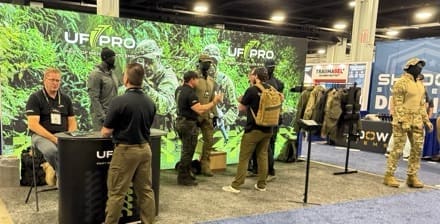
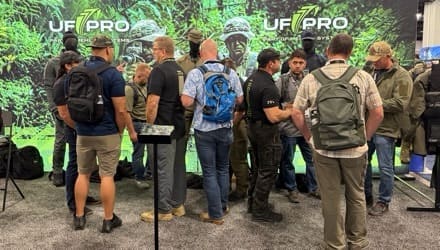
The Mehler Systems Group is home to the brands of Mehler Protection, Lindnerhof, and UF PRO. Mehler Protection is known for its body and platform armour solutions, UF PRO is an expert in top-tier tactical garment systems, while Lindnerhof stands out for its innovative carrying solutions and tactical equipment.

With a presence in over 40 countries, Mehler Systems has established itself as a leader, known for its innovation and dedication to raising the bar in the industry over the past four decades. For more information about Mehler Systems, please visit mehler-systems.com