TYR Tactical

Archive for the ‘Army’ Category

First Army National Guard Soldier Graduates Air Force Multi-Domain Warfare Officer Course

Thursday, December 30th, 2021

Successfully operating in a multi-domain warfighting environment will require all of our nation’s services and components to train and fight together. It may be a challenge, but that challenge is one U.S. Army Capt. Craig Simmon of the Michigan National Guard took head-on. Simmon spent 20 weeks and countless hours on academics and training to become the first joint member and only Army Soldier to graduate from the Air Force’s Multi-Domain Warfare Officers course, Hurlburt Field, Florida.


“The course was a very good experience,” said Simmon, officer-in-charge of supply, 3rd Battalion, 238th General Support Aviation Regiment, Michigan Army National Guard. “The student body at the course was awesome. The Air Force is grabbing Airmen from all the different career fields to create the new Thirteen Oscar career field.”


 
The 18 graduates were the fifth class to complete the course run by the 505th Command and Control Wing at Hurlburt Field, Florida.
 
“The training encompassed operational level air component planning,” said Simmon. “It tied in almost the entirety of an air component campaign with an emphasis on space and cyber. The end goal was to have graduates who could go to joint staffs, air staffs or different planning groups and come up with solutions to challenges.”


According to the 505th CCW public affairs office, the main course focus areas include the Air Operations Center; Air Force Forces staff; joint planning process for air, joint air targeting cycle; Agile Combat Employment; Integrated Air and Missile Defense; information operations; non-kinetic operations; and seminars with each joint and functional component.
 
Simmon applied to attend the course in part due to joint courses he has attended in the past and his additional role in the Michigan National Guard’s largest all-domain exercise as Northern Strike’s lead rotary-wing planner. Northern Strike is held annually at the National All-Domain Warfighting Center in Northern Michigan.
 
“There was a lot of value added for me. It gave me a much better understanding of how the air component works, plans, and operates,” said Simmon. “I had never really been exposed to anything in the space and cyber domains before, so having insight on those capabilities means I know whom to talk to in order to get the desired effects.”


 
Simmon’s experience in large-scale, joint exercise planning and Army rotary-wing aviation meant his attendance was beneficial to the course as well.
 
“The expertise and partnerships with joint forces are critical to mission success when providing holistic approaches to operational planning for air component commanders,” said U.S. Air Force Maj. Mark Scott, 705th Training Squadron Thirteen Oscar course director. “The attendance of the first joint student was invaluable in providing our air component planners a different perspective to ensure operational-level planning is not only synchronized, but integrated across all components”
 
While Simmon can’t don the title of a Thirteen Oscar, he is one of three Michigan guardsmen who have successfully completed the course. His drive to improve set an example for any MIARNG soldiers thinking about attending in the future.
 
“It was a good experience, and I am glad I had the opportunity to go,” said Simmon. “I look forward to using the information I learned in the future.”

The next Multi-Domain Warfare Officer Initial Skills Training class begins in January 2022 with class 22A and aims to continue improving upon operational C2 in order to deliver solutions for air component commands.

To learn more about the Multi-Domain Warfare Officer career field or training visit the following websites: intelshare.intelink.gov/sites/C2/13O and www.milsuite.mil/book/groups/13O.

The 705th TRS reports to the 505th Test and Training Group and 505th Command and Control Wing, both are headquartered at Hurlburt Field, Florida. 

By Deb Henley
505th Command and Control Wing
Public Affairs

US Army Hosts Mountain Warfare Course in Djibouti

Tuesday, December 28th, 2021

DJIBOUTI — Five U.S. Army Mountain Warfare School instructors with the Vermont Army National Guard travelled to Djibouti to teach a five-day Joint Expeditionary Mountain Warfare Course to service members from France’s 5th Overseas Interarms Regiment (5e RIAOM) at the Arta Range Complex, Dec. 12-16, 2021.

The course consisted of knot tying, rope management, rappelling, fixed rope techniques, hauling systems, ascension techniques, lowering systems, basic mountain casualty evacuation and portable stretcher training. Upon successful completion of the course, the students received the prestigious Ram’s Head device and a certificate of completion during a graduation ceremony.

“Any time we can have information sharing and collaboration, it’s beneficial for us as well as our partner forces,” said Sgt. 1st Class Dustin Dearborn, an instructor at the U.S. Army Mountain Warfare School. “Even the experienced service members were able to take something away from this course.”

Mountain qualified Soldiers from the 1-102nd Infantry Regiment (Mountain), Task Force Iron Gray, Combined Joint Task Force – Horn of Africa (CJTF-HOA), assisted Vermont’s instructors with the course. The 1-102nd Infantry Regiment (Mountain) is a unit within the 86th Infantry Brigade Combat Team (Mountain), the only active mountain brigade in the U.S. Army. The 86th IBCT (Mountain) and the Army Mountain Warfare School are both headquartered Vermont.

“Our task force is honored to host this joint training event and further demonstrate our interoperability and continuous cooperation with the French military,” said Lt. Col. Frank Tantillo, Task Force Iron Gray commander. “Because of joint trainings like this, we are all more ready to succeed at our missions and allow future task forces to continue carrying on these partnerships for years to come.”

This is the first time the Army Mountain Warfare School has conducted mountain training for French service members in Djibouti. For years, French forces have routinely invited U.S. service members to participate in the French Desert Commando Course in Djibouti. During Task Force Iron Gray’s deployment to the Horn of Africa, 53 Soldiers successfully completed the grueling 12-day course, earning the foreign identification badge.

The Joint Expeditionary Mountain Warfare Course was a way for the U.S. Army to give back by including foreign nation service members from France’s 5e RIAOM, and share specialty skillsets that strengthen the relationships among the international forces working together in the region. Thirty-two French service members from the 5e RIAOM successfully completed the Joint Expeditionary Mountain Warfare Course.

“This is part of a mutual cooperation between the U.S. and the French,” said French Capt. Benoit Malet, Commander, French Desert Commando Course. “The U.S. came here to teach the French their own techniques. We do the same things but different ways, so it is very interesting to us to discover a new view on what we do.”

By SSG Amanda Stock

Paratroopers Jump into the Holidays

Wednesday, December 22nd, 2021

FORT BENNING, Ga. — Soldiers from the 1st Battalion, 507th Parachute Infantry Regiment, Airborne and Ranger Training Brigade, joined their counterparts from Canada and Australia in collecting toys for Fort Benning Santa’s Castle Dec. 7.

According to Lt. Col. Isaac Lee Henderson, Battalion Commander, 1-507th, from Chiefland, Fl., this was a great opportunity for the Fort Benning community to help families in need over the holidays.

“This is an awesome mission. I’m one of those kids that grew up with a single mom that worked two or three jobs to allow us to have a decent Christmas,” said Henderson.

Carrie Kennedy, a volunteer at Fort Benning Santa’s Castle, expressed gratitude for the toys collected for the kids in the military community.

“We appreciate all the generosity and support from Fort Benning and the local community,” said Kennedy.

The 304 participating parachutists each brought a toy before participating in the international jump, led by jumpmasters from Fort Benning, Canada and Australia. Participants were awarded their foreign jump wings after completing the mission.

“The mission of the toy drop that we did a couple of days ago was to give a kid an awesome Christmas,” said Henderson as they delivered the toys to Santa’s Castle Dec. 11. “I love doing this!”

Established in 1986, Santa’s Castle provides toys to children of Fort Benning soldiers who are experiencing financial hardship during the holiday season.

Story by Alexander Gago

U.S. Army photos by Patrick A. Albright, Fort Benning Maneuver Center of Excellence Public Affairs

4th ID Sets Up, Tears Down New Command Post Prototypes at Ft Carson

Tuesday, December 21st, 2021

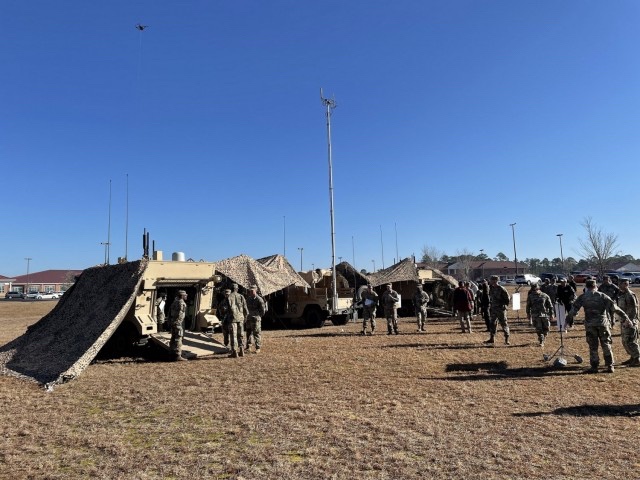
FORT CARSON, Colo. — 4th Infantry Division Soldiers just completed testing a new command post structure as part of the Army’s effort to modernize the division headquarters.

“Command Post Infrastructure Integration (CPI2) is the new command post for the division and it replaces the legacy tentage and all of the vehicles and large footprint that a division had before for their main command post,” said Maj. Jordan Funderburk, Plans Officer at the Ironhorse Division.

During the test, CPI2 systems are being evaluated on the time it takes for a division headquarters to emplace, displace, operate and move its command post to support unit missions.

The design of CPI2 enables a division headquarters to be scalable, modular, and agile while reducing the physical area required of tactical operations.

“The CPI2 system does drastically reduce the teardown of the equipment — the former being the large tent where everyone would congregate to one location,” said Maj. Christopher Sullivan, another 4th ID Plans Officer.

CPI2 equipment for a division headquarters come with two variants of workspace shelters, the Mission Command Platform (MCP) and the Command Post Support Vehicle (CPSV), mounted on the Light Medium Tactical Vehicle (LMTV).

The Ironhorse division headquarters conducted a series of tactical movements with the CPI2 equipment, requiring them to take the system out of operation, move to a new location, and re-establish operations.

“Getting these reps in [repetitions of setting up, tearing down, and moving] has helped us develop our tactics, techniques and procedures to make this setup faster and safer,” said Sgt. Maj. Michael Bass, Division Engineer Sergeant Major for the Ivy Division.

Besides tactical movements, the division used components of CPI2 such as the Secure Wireless Mesh Remote Endpoint (SWMRE) and millimeter waveform (mmW).

“From a communications standpoint, keeping the servers and the Command Post Support Vehicle (CPSV) in a warm start means that we can have the network up as soon as we drop the trailer,” said Cpl. Jonathan Knowles, a 4th ID communications and information technology Soldier.

“These new shelters definitely help enhance my job,” added Knowles. “(CPI2) gives me the power to focus on and isolate an issue to a single thing, which in turn helps the user, get back to work in the fight. It enables me to get in and out really quickly.”

By CPT Demetrius L. Spencer, Test Officer, Mission Command Test Directorate, U.S. Army Operational Test Command

Marksmanship Training Center Increases Lethality, One Round at a Time

Friday, December 17th, 2021

FORT CHAFFEE, Ark. — A rifle is fired, the cracking sound of the gunfire splits the quiet, sending a round-down range at more than twice the speed of sound. Smoke from the muzzle hangs in the air for a moment, long after the round has reached its target, 600 yards away.

“Hit,” said Sgt. Tristian Ivkov, an infantryman turned sniper with 1st Battalion, 157th Infantry Regiment, Colorado Army National Guard, as he stared through his rifle scope. “Right on the X.”

Ivkov was talking to his spotter, Spc. Max Miller, also a Colorado Army Guard member, during one of the many shooting events at the 51st Winston P. Wilson and 31st Armed Forces Skill at Arms Meeting Sniper Rifle Matches at the Fort Chaffee Joint Maneuver Training Center Dec. 4-9. The pair won the WPW sniper match last year and were invited to compete as part of the All-Guard shooting team this year.

These matches are hosted annually by the National Guard Marksmanship Training Center of the Arkansas National Guard. This is the Super Bowl of National Guard shooting events, Ivkov said.

“I am impressed by the professionalism and knowledge that the cadre of instructors has here in Arkansas,” said Ivkov. “They have some of the best instructors this community has to offer. This would be impossible to replicate at the home station.”

The Winston P. Wilson matches include small arms, machine gun and sniper championships. Army and Air National Guard personnel from across the country are eligible to compete. The Armed Forces Skill at Arms Meeting is open to all U.S. military branches and international shooters. This year’s competition featured shooters from Denmark, the Netherlands, active component Army and Marine Corps and Special Forces teams.

The Winston P. Wilson and Armed Forces Skill at Arms Meeting sniper competition consisted of 33 two-person teams comprising of a shooter and spotter. The shooter’s primary focus is hitting the target, while the spotter relays data such as wind speed and direction, humidity and bullet trajectory, to the shooter.

The teams participated in 20 events that tested their ability to precisely engage long-range targets, as well as closer targets with different weapons systems. Snipers are also tested on their ability to conceal while stalking a target. This competition is the ultimate validation test of a sniper’s ability to shoot, move and communicate in a stressful environment, said Ivkov.

This year, the winners of the Winston P. Wilson match were Staff Sgt. Caleb Ash and Sgt. Ryan Marsh, with 1st Battalion, 635th Armored Regiment, Kansas Army National Guard. Staff Sgts. Demetrios Iannios and Eric Vargas, 223rd Regiment (Regional Training Institute), California Army National Guard, claimed the top spot in the Armed Forces Skill at Arms Meeting.

The NGMTC hosts the sniper competition at Fort Chaffee due to the range capacity, said Army Maj. Megan Thomas, the Marksmanship Training Center’s chief of operations., She added that this is the National Guard’s premier sniper range because of the capacity ability for long-range rifle fire.

“Increasing lethality is our main goal here,” said she said. “You want to be able to trust the person to your left and right that they can pull the trigger and render a target incapacitated if needed.”

Headquartered at Camp Joseph T. Robinson Maneuver Training Center, Arkansas, the 233rd Regional Training Institute and NGMTC administers National Guard Bureau training and competitive event initiatives.

In addition to shooting competitions, the NGMTC is also an official Army schoolhouse for squad-designated marksman, small arms and sniper courses. The school is facilitated by the Arkansas National Guard but is open to Soldiers in any Army component. This is the graduate school for many Soldiers to learn and expand on their tactical shooting skills.  Soldiers leave certified with additional skill identifiers that designate them as marksmanship experts.

It’s all part of the NGMTC’s mission to provide marksmanship and sustainment training to Soldiers from across the country, said Thomas said.

“We’re spreading a wealth of knowledge,” said Thomas. “And [competitions] are a force multiplier. You bring one soldier here, and they can go back to their unit and assist with ranges, qualifications and [preliminary marksmanship instruction] to lead training on a range.”

Guard Soldiers typically must compete in their states’ Adjutant General Marksmanship Match to validate qualify certify their readiness to compete in the Winston P. Wilson and Armed Forces Skill at Arms Meeting competitions.

However, it’s not only about winning but learning from counterparts, said Sgt. Howard Hall, an infantryman with 1st Battalion, 185th Infantry Regiment (Stryker), California Army National Guard.

“Competitions like these really hone people’s skills to a higher level,” said Hall. “They continue to push us to strive to not just be complacent with the title of sniper but to really get out there and continue to earn it every day.

“This is where all the information exchange and networking happens. For that alone, it’s fantastic.”

By SFC Zach Sheely, National Guard Bureau

1st Special Forces Command Releases New Vision Statement

Wednesday, December 15th, 2021

The Premier Partnered Irregular Warfare Force:

24,000 Strong

7 Special Forces Groups

2 Psychological Operations Group’s

1 Civil Affairs Brigade

1 Special Operations Sustainment Brigade

United under a single patch,

Focused on a single purpose.

US Army and Air Force Fire Support Specialists Form a ‘COLT’ at Combined Resolve XVI

Wednesday, December 15th, 2021

HOHENFELS, Germany — A two-person team of Airmen is dropped off by a Bradley Fighting Vehicle at the forward line of troops. They move down the line of cavalry scouts until they meet another small team, this one made up of U.S. Army artillerymen, who are dismounted from their own Bradley and are outfitting their rucksacks for an extended patrol. They are preparing to scout enemy positions, checking their radios and packing binoculars for a long patrol behind enemy lines.

The teams are part of the force-on-force exercise portion of Combined Resolve XVI, which includes approximately 4,600 armed forces service members from Bulgaria, Georgia, Greece, Italy, Lithuania, Poland, Serbia, Slovakia, Slovenia, Ukraine, United Kingdom and the United States. The operations are being conducted by integrated battalions with multinational units operating under a unified command and control element, allowing the U.S., its allies and partners to experience invaluable training alongside each other.

“Today we are going out as a COLT (Combat Observation Lasing Team),” said Senior Airmen Fernando Marquez, a Joint Terminal Attack Controller with 4th Air Support Operations Group. “A COLT team is basically the eyes on the ground when our sensor assets, which typically allows us to see far, cannot do the job. We have to push behind enemy lines, or in as far as possible with the enemy, so we can provide real targeting data for the brigade and division fires assets.”

The goal of COLT teams is to identify enemy targets, and, if possible, the teams will use laser targeting systems to mark targets for precision guided munitions. Joint teams of Fire Support Teams, known as FiSTers, and JTACs are best suited for providing COLT support to an Army brigade deployed in a combat scenario.

“Our mission is a list of high-value enemy targets,” said Sgt. Devon Eaker, a Joint Fire Support Specialist with 1st Battalion, 5th Field Artillery Regiment “Hamilton’s Own,” 1st Armored Brigade Combat Team, 1st Infantry Division. “I think I’m lucky to have the six guys total that we have right here. I’ve worked with these two JTACs before, and I’ve worked with the other three FiSTers a lot, and I can’t think of a better group of dudes to send forward to do this.”

FiSTers are the 1-5FA Headquarters and Headquarters Battery fire support officers, noncommissioned officers and enlisted joint fire support specialists responsible for identifying indirect fire, or fires, missions on the Combined Resolve XVI notional battlefield. FiST teams are attached to all of the multinational maneuver units operating during CBR XVI. This is an opportunity for these multinational units to experience the capability of the U.S. to provide close air support in joint operations.

“My fire support NCOs are organic to the field artillery battalion but are tasked out to each maneuver element,” said 1st Sgt. Michael York of HHB. “They are combat multipliers, and they enable the maneuver units to perform their mission by providing them with fires. So, if there is ever artillery, mortars or attack aviation getting called in, there is a fire supporter attached to that asset.”

Air Force JTACs direct the actions of aircraft while engaged in close air support. They can call in close air support from F-22s, A-10s, F-35s, or anything that the U.S. Air Force can provide air-to-ground operations.

“We’re fighting this new fight,” Marquez said. “We’re getting out of the COIN [counterinsurgency] mentality and moving into this new LSCO [large scale combat operations] fight. So, we are trying to shape the way we fight this new battle.”

Despite the proliferation of unmanned aerial vehicles in combat operations, both the Army and the Air Force continue to train and develop ground-force fire support teams. The force-on-force exercise held during Combined Resolve XVI at the Joint Multinational Training Center in Germany provides an excellent training opportunity for COLT.

“We’re essentially deep strike and reconnaissance,” Eaker said. “We get out there, forward of the FLOT, as close to the enemy as we can, see what’s coming and pitch it backwards. And if we can, we’ll kill what’s out there. We have access to aircraft via JTACs, fixed and rotary wing. We are in range of all artillery that the brigade has now through 1-5FA. With those combined, there’s not much out there that we can’t kill.”

The modern battlefield is shaped by UAVs directing cameras toward the enemy to gather intelligence. As the fight turns from terrorism to an enemy with more sophisticated electronic equipment and air defense, the potential disruption of UAV imaging is a very real threat. Well trained COLT teams ensure that U.S. Forces maintain the ability to penetrate enemy formations, identify threats and deliver fires munitions onto those threats, helping to maintain overwhelming firepower which is critical to victory on the LSCO battlefield.

To learn more about exercise Combined Resolve, follow: www.dvidshub.net/feature/CombinedResolve

By SSG George Davis

Spirit of Innovation: EagleWerx Celebrates Opening with Dedication Ceremony at Fort Campbell

Friday, December 10th, 2021

The 101st Airborne Division (Air Assault) has been a leader in Army innovation for decades, and the Spec. 4 Peter M. Guenette EagleWerx Applied Tactical Innovation Center promises to play a major role in future warfighter transformation.

Soldiers, Families and community members toured the facility firsthand Dec. 7 during a ribbon cutting and dedication ceremony at 89 Screaming Eagle Blvd., where they learned about EagleWerx’s capabilities and bottom-up approach to innovation.

“We all know that transformation starts with the people who are executing, and the Soldiers are the ones closest to the problem,” said Capt. Lauren Hansen-Armendariz, deputy innovation officer, 101st Abn. Div. “They understand it the best, and that’s exactly why EagleWerx exists – to be able to give Soldiers what they need so they can make improvements.”

EagleWerx gives Soldiers direct access to a wide range of capabilities including entry-level artificial intelligence, robotics equipment, 3D printing, engineering support and educational workshops to solve problems. Its employees can also connect Soldiers with collaborative partners such as Vanderbilt University, Middle Tennessee State University and U.S. Army Combat Capabilities Development Command, or CCDC.

Major General JP McGee, commanding general, 101st Airborne Division (Air Assault) and Fort Campbell, said EagleWerx is an important step forward for the installation because it empowers Soldiers to adapt and excel in future conflicts.

“Innovation is not about a technology,” McGee said. “It is about a spirit within our Soldiers and leaders, and it needs to be established and fostered before a crisis, before we are at war. A site like this named after one of our heroes, Peter Guenette, represents our tangible investment into establishing innovation as an enduring part of the culture of the 101st.”

Guenette served with 506th Infantry Regiment, 101st Airborne Division (Airmobile), during the Vietnam War and received a posthumous Medal of Honor citation for his efforts on the battlefield. During a firefight in the Quan Tan Uyen Province May 18, 1968, he smothered the blast from a hand grenade with his body to protect his fellow Soldiers, saving at least three others at the cost of his own life.

The installation later dedicated the Guenette Arts and Crafts Center to his memory in 1975, and the building retained his name after it was re-established into EagleWerx.

“It evolved into something pretty awesome,” said Michael Guenette, Spec. 4 Guenette’s brother. “It was awesome before as an arts and crafts center, and as the war in the Middle East started it was good for helping Soldiers who had PTSD work on projects. And now this is a great evolution. My brother was a science guy, he really was, so I think it’s a great thing. Keeping his name on the building is important, and this base honors heroes like Peter.”

Guenette was among several guests at the facility’s ribbon cutting and dedication given a guided tour, where Soldiers from across the installation highlighted partnerships and projects being developed through EagleWerx.

Chief Warrant Officer 3 Ron Billingslea, 101st Division Sustainment Brigade, said EagleWerx will allow the unit to push its additive and subtractive manufacturing capabilities to the next level.

“Additive manufacturing, in layman’s terms, is the ability to create parts, one-off pieces or test molds so we can test or figure out a problem and create a solution without having to expend a lot of materiel,” Billingslea said. “Right now, we’re looking at problems that we’re tracking across the board, like long lead times on parts for vehicles that are down or one-off pieces that will get everyday use from Soldiers.”

The Lifeliners use 3D printing capabilities and computer aided design, or CAD, files to produce those parts that can be used to repair broken equipment on the battlefield quickly instead of waiting for third parties to deliver materiel. CAD files for specific parts can also be uploaded into a database and shared across the Army, Marine Corps, Navy and Air Force.

“We’re going to partner up with EagleWerx to be able to build products we can prototype here,” Billingslea said. “When we send a CAD file back to the forward line of troops, they can run that program to make sure it’s optimal to what we need in the field. In doing that, we build a network and create a partnership with EagleWerx as a hub for forces across the U.S. platform.”

In addition, Billingslea is planning to facilitate classes at EagleWerx to teach Soldiers and local students the basics of CAD, additive and subtractive manufacturing. Soldiers can use that instruction to gain a better understanding on how those capabilities can help them, while students can position themselves for success in the military or a trade.

Educational programming is a major component of EagleWerx, and the facility has already hosted a number of classes since its soft opening in August.

“I took part in a design thinking workshop on suicide prevention,” said Spc. Seth Johnson, 1st Battalion, 327th Infantry Regiment, 1st Brigade Combat Team, 101st Abn. Div. “The solution we came up with is currently in the process of being implemented in the division, and it’s sort of like an Eagle Day 2.0 where one day out of every month you do cohesion building exercises among your squad. We reiterated the importance of that, how it affects people and how they feel about it when it’s done regularly.”

Approximately 30 Soldiers from across the installation participated in the workshop and formed two teams to pursue different solutions. Johnson said he appreciates the chance to get involved and looks forward to seeing what future workshops can develop.

“It makes you feel like you have an impact on the Army and the ability to solve problems that affect people at your level,” he said. “I think EagleWerx is going to produce great things and given the opportunity I’d be happy to come back and work on more projects.”

Other classes hosted at EagleWerx are made possible through support from community and Army partners. Bull Holland, Advancing Concepts Office Operations, CCDC Army Research Laboratory, recently led three teams of Soldiers through the H4X Lean Acquisition Innovation Course, a five-week graduate-level course, using EagleWerx as a venue.

“What we’ve done for these Soldiers is put together a class that teaches the same lean innovation methods that we teach in American Psychological Association [APA] schools and other graduate programs around the country,” Holland said, adding he has taught the same course at North Carolina State University. “Instead of us trying to find the right place to engage Soldiers in each different brigade, EagleWerx centralizes Soldiers from across the division into one spot and gives people like myself a place to plug in.”

Soldiers who completed the course at EagleWerx used entrepreneurial skills to develop requirements for new “see through wall” capabilities, electromagnetic sensors and air assault planning based on problem statements provided to each group.

“Our problem statement was that as technology progresses, our electronic footprint keeps increasing through emissions of energy and it’s something potential adversaries could exploit and use against us,” said Staff Sgt. Patrick Frisbie, electronic warfare noncommissioned officer in charge, 1st BCT. “That’s something that we want to develop tactics, techniques and procedures to mitigate.”

As an electronic warfare NCOIC, Frisbie is familiar with that problem and has practical experience with looking for electromagnetic signals to trace enemies. He and his classmates used that experience to identify cost-effective technologies the division could eventually use to reduce energy emissions down to the company level.

“Soldiers all have their own particular insights and they know the problems they face the best,” he said. “This gives them a space to come down if they have an idea. Even if it’s a simple modification to a piece of equipment that already exists, they have professionals here that can put them in touch and make things happen.”

Ultimately, EagleWerx is intended to help Soldiers find the resources to solve problems at any scale and build a culture of innovation across the division.

“Innovation does not start with me,” McGee said. “It is not a top-down driven endeavor; it starts with our people closest to the challenge – our Soldiers who are at the tip of the spear. Our vision is that all Screaming Eagle Soldiers are empowered to inform, accelerate and integrate innovative solutions and models in order to prepare the 101st for the future fight.”

Story by Ethan Steinquest 

Fort Campbell Public Affairs Office