Aquaterro

Archive for the ‘Army’ Category

US Army Soldiers Experience The Great Escape Tour

Thursday, July 22nd, 2021

?AGAN, POLAND — U.S. Army Soldiers with the 1st Armored Brigade Combat Team, 1st Cavalry Division participated in a guided tour at the Great Escape museum in ?agan, Poland, July 5, 2021.

The Great Escape was a massive escape attempt from Stalag Luft III, a prisoner of war (POW) camp in ?agan, Poland, controlled by Nazi Germany during WWII.

The Troopers walked approximately three miles through the woods to get the chance to learn about an essential piece of military history. Upon arrival, the Troopers were provided with a guided tour from the curator around the remains of Stalag Luft III.

The curator began the tour by leading the troopers to the memorial near the entrance of the museum. He explained the history behind the monument and the dedication to the Soviet prisoners that perished at Stalag Luft III. Outside, Troopers were able to see a replica of an old wooden watchtower and an exit to one of the three underground tunnels.

Once inside, the Troopers saw a miniature model of the camp and where the three tunnels — known as Tom, Dick, and Harry — were dug. This miniature model gave the Troopers a visual of the camp’s diversity. The museum displayed multiple flight suits from different countries.

The curator explained all the planning that went into the escape attempt and mentioned a few facts that aren’t commonly known. The camp was nearly impossible to escape from because of the elevated prisoner housing, loose, collapsible soil, and seismograph microphones in the ground around the perimeter of the camp. The prisoners had to be extremely cautious while preparing to escape under the guards’ watch.

The Troopers were able to explore a barracks replica outside the museum that would have housed prisoners of war. To their surprise, the living conditions in the barracks were much better than expected. There’s a common misconception that Stalag Luft III had living conditions similar to those of a concentration camp.

Although it was a prison camp, the Germans had to follow the rules set by the Geneva Convention according to the curator of the museum, so there was a standard of living that the prison had to uphold.

Staff Sgt. Noah Hill, a brigade religious affairs noncommissioned officer with 1st Armored Brigade Combat Team, 1st Cavalry Division, set up the guided tour. He said he enjoys seeing the Troopers get off base and learn more about the Polish culture near their area of operation.

“We went through our training rotation,” Hill said. “However, I also wanted them to be able to talk about the good that’s in Poland and build that trust with the Polish people who we’re working with.”

Troopers of 1st Cavalry have had the opportunity to partake in a few military history tours like this one. They have also toured Auschwitz concentration camp and been given a Polish military history presentation to understand Poland’s culture better. The 1st ABCT is currently undergoing redeployment operations before heading back to its home station in Ft. Hood, Texas.

By PFC Michael Baumberger

New Material Could Mean Lightweight Armor, Protective Coatings

Wednesday, July 21st, 2021

RESEARCH TRIANGLE PARK, N.C. — Army-funded research identified a new material that may lead to lightweight armor, protective coatings, blast shields and other impact-resistant structures.

Researchers at the U.S. Army’s Institute for Soldier Nanotechnologies at the Massachusetts Institute of TechnologyCaltech and ETH Zürich found that materials formed from precisely patterned nanoscale trusses are tougher than Kevlar and steel.

In experiments, the ultralight structures, called nanoarchitectured materials, absorbed the impact of microscopic projectiles accelerated to supersonic speeds.

“Increasing protection while simultaneously decreasing the weight that soldiers carry is an overreaching theme in our research,” said Dr. James Burgess, ISN program manager for the U.S. Army Combat Capabilities Development Command, known as DEVCOM, Army Research Laboratory. “This project is a really good example of such efforts where projectile energy absorption is nanostructured mechanism based.”

The research, published in Nature Materials, found that the material prevented the projectiles from tearing through it.

“The same amount of mass of our material would be much more efficient at stopping a projectile than the same amount of mass of Kevlar,” said Dr. Carlos Portela, assistant professor of mechanical engineering at MIT, the study’s lead author.

The researchers calculate that the new material absorbs impacts more efficiently than steel, Kevlar, aluminum and other impact-resistant materials of comparable weight.

“The knowledge from this work…could provide design principles for ultra-lightweight impact resistant materials [for use in] efficient armor materials, protective coatings, and blast-resistant shields desirable in defense and space applications,” said co-author Dr. Julia R. Greer, a professor of materials science, mechanics, and medical engineering at Caltech, whose lab fabricated the material.

Nanoarchitected materials are known to feature impressive properties like exceptional lightness and resilience; however, until now, the potential for additional applications has largely been untested.

“We only know about its response in a slow-deformation regime, whereas a lot of their practical use is hypothesized to be in real-world applications where nothing deforms slowly,” Portela said.

To help fill this vital knowledge gap, the research team set out to study nanoarchitected materials undergoing fast deformation, such as that caused by high-velocity impacts. At Caltech, researchers first fabricated a repeating pattern known as a tetrakaidecahedron—a lattice configuration composed of microscopic struts—using two-photo lithography, a technique that uses a high-powered laser to solidify microscopic structures in photosensitive resin.

To test the tetrakaidecahedron’s resilience to extreme, rapid deformation, the team performed experiments at MIT using the ISN-developed laser-induced particle impact array. This device aims an ultrafast laser through a glass slide.. As the laser passes through the slide, it generates a plasma, an immediate expansion of gas that launches the particles toward the target.

By adjusting the laser’s power to control the speed of the microparticle projectiles, the researchers tested microparticle velocities within the supersonic range.

“Some experiments achieved twice the speed of sound, easily,” Portela said.

Using a high-speed camera, the researchers captured videos of the microparticles impacting the nanoarchitected material. They had fabricated material of two different densities. A comparison of the two materials’ impact response, found the denser one to be more resilient, and microparticles tended to embed in the material rather than tear through it.

To get a closer look, the researchers carefully sliced through the embedded microparticles and nanarchitectured target. They found that the struts below the embedded particle had crumpled and compacted in response to the impact, but the surrounding struts remained intact.

“We show the material can absorb a lot of energy because of this shock compaction mechanism of struts at the nanoscale, versus something that’s fully dense and monolithic, not nanoarchitected,” Portela said.

Going forward, Portela plans to explore various nanostructured configurations other than carbon, and ways to scale up the production of these nanostructures, all with the goal of designing tougher, lighter materials.

“Nanoarchitected materials truly are promising as impact-mitigating materials,” Portela said. “There’s a lot we don’t know about them yet, and we’re starting this path to answering these questions and opening the door to their widespread applications.”

The U.S. Army established the MIT Institute for Nanotechnologies in 2002 as an interdisciplinary research center to dramatically improve the protection, survivability and mission capabilities of the Soldier and of Soldier-supporting platforms and systems.

In addition to Army funding through the institute, the U.S. Office of Naval Research and the Vannevar Bush Faculty Fellowship supported the research.

By U.S. Army DEVCOM Army Research Laboratory Public Affairs

Soldiers, Marines Test New Chemical, Biological Systems at Dugway APG

Saturday, July 17th, 2021

DUGWAY PROVING GROUND, Utah — Soldiers from Fort Drum and Joint Base Lewis-McChord teamed with Marines from Camp Pendleton to test new tactical biological detection and chemical contamination indicator systems here.

Soldiers with the 59th Hazard Response Company and 13th Combat Sustainment Support Battalion along with Marines from the 3rd Marine Air Wing went hands-on with the Joint Biological Tactical Detection System (JBTDS) and the Contamination Indication Disclosure Assurance System (CIDAS), which indicates on chemical agent contaminants so decontamination can take place.

“These two operational tests have given my company the opportunity to focus on our critical war-time collective tasks of site assessment and decontamination and refine our tactics, techniques, and procedures,” said Capt. Ryan Oatman, company commander of 59th Chemical, Biological, Radiological and Nuclear (CBRN) Hazard Response Company.

“The training benefit while conducting these operational tests to my unit’s operational readiness makes this tasking to support new materiel development a win-win.”

According to Test Officer Mr. Josh Smith of the U.S. Army Operational Test Command’s Maneuver Support and Sustainment Test Directorate, test data collected will be used to inform senior Army and Joint Service leaders on how effective, suitable, and reliable the JBTDS and CIDAS systems will be during real-world operations.
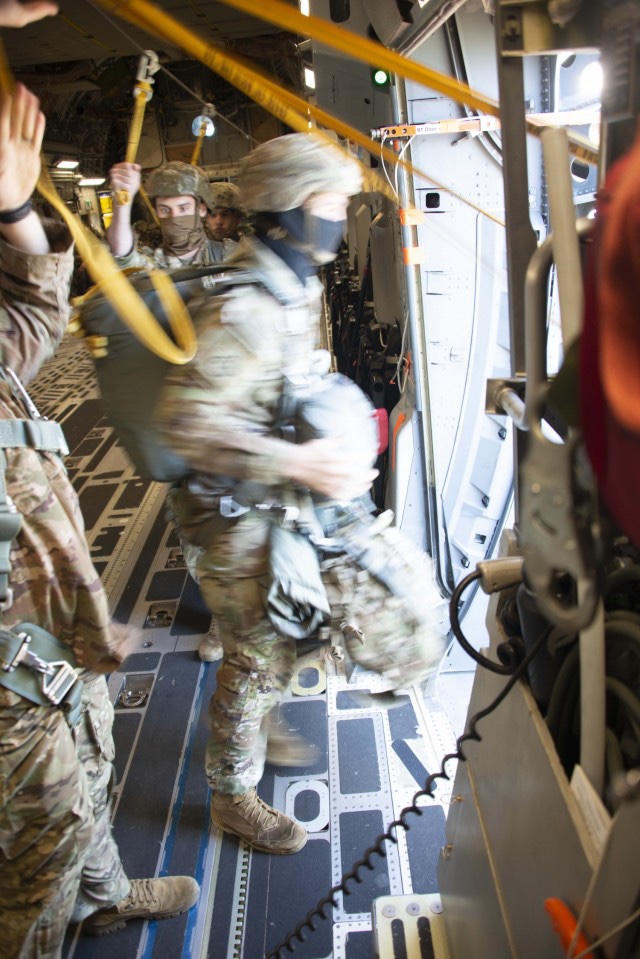
“Working with a test unit that is excited about and embraces the opportunity to train its Soldiers while providing valuable feedback on potentially new CBRN materiel solutions with considerations for its employment makes the hard work of operational testing worth it,” Smith said.

Smith explained the units will have employed the JBTDS and CIDAS systems during replicated security and sustainment operations through multiple days of tough, realistic training in the harsh Dugway Proving Ground environment.

“Since operational testing is about Soldiers and unit missions,” he said, “this test event is about making sure the systems developed are — and remain effective — in a Soldier’s hands and suitable for the environments in which Soldiers and units train and fight.”

By Mr. Edward M. Jagodzinski, Test Officer, Maneuver Support and Sustainment Test Directorate, U.S. Army Operational Test Command

Army Gunsmoke Satellites Successfully Deploy from Mojave Desert, International Space Station

Friday, July 16th, 2021

REDSTONE ARSENAL, Ala. – The U.S. Army Space and Missile Defense Command delivers Army space assets on orbit by any means necessary to test new capabilities for the warfighter.

The command’s first and third Gunsmoke-J satellites, a joint capability technology demonstration by the USASMDC Technical Center and Assured Position Navigation and Timing/Space Cross Functional Team, were placed into orbit, June 30, by two very different paths.

The first CubeSat was deployed from the Cygnus cargo vessel S.S. Katherine Johnson as a secondary mission shortly after it undocked from the International Space Station.

“We were very lucky to have this unique opportunity to place our satellite into orbit, and we extend our gratitude to those involved for making this a reality,” said Rebecca Nagurney, Gunsmoke deputy program manager. “What this group and our Gunsmoke-J team has accomplished over the past few months is amazing and is a testament to what true teamwork can achieve.”

The third CubeSat was air-launched into orbit by a 747 carrier aircraft from Mojave Air and Space Port in Mojave, California. It was flown out to a launch site over the Pacific Ocean, about 50 miles south of the Channel Islands. After a smooth release from the aircraft, the LauncherOne rocket ignited and propelled itself toward space, ultimately deploying its payload into an orbit approximately 500 km above the Earth’s surface.

“This deployment and same day launch of two separate Gunsmoke-J satellites is a major step toward demonstrating what we believe will be enabling tactical warfighter capability,” said Wheeler “Chip” Hardy, division chief, USASMDC Technical Center Space Directorate’s Space Applications Division. “We are excited to be at this point after five years of development. This is the culmination of a lot of hard work by a lot of people to get to this point. We look forward to the verifying demonstrations and a possible future transition of the technology to the tactical forces.”

The Gunsmoke-J science and technology effort will provide new and advanced capabilities to tactical warfighters in a satellite about the size of a loaf of bread. Its experiments will show how its sensors can provide critical data and information key in multi-domain operations. The effort will also help inform future acquisition decisions.

“We are very excited because now we can begin our checkout and mission operations as our work is part of a science and technology demonstration effort,” Nagurney said. “If the Gunsmoke experiments are successful, then this work could lead to future systems, which would enhance long-range precision fires in support of the warfighter.”

Gunsmoke and potential follow-on small satellite systems are designed to provide information or sufficient data relative to tactical decision-making that is delivered in a timely manner.

“The team has worked extremely hard on this effort so it was thrilling to watch a successful launch,” Nagurney said. “It is very rewarding to work on a program like Gunsmoke where our work is going to impact future technology and Army acquisition decisions to help support the warfighter.”

By Jason Cutshaw (USASMDC)

US Army Test Facility Recreates Space on Earth

Thursday, July 15th, 2021

REDSTONE ARSENAL, Ala. — Just exactly how cold is it in space?

The unofficial answer: really cold. The official answer: typically -460 degrees Fahrenheit. So how exactly would you operate a space-based sensor, which needs to detect and track very faint infrared signatures when operating in the cold vacuum of space?

That is where the U.S. Army Combat Capabilities Development Command Aviation & Missile Center’s space-based sensor test facility comes into play. Its two independent space chambers, which operate under the center’s Software, Simulation, Systems Engineering and Integration Directorate, utilize cryogenic refrigeration systems to achieve the required low temperature and pressure environment. The sensor under test is installed within the space chamber, allowing it to observe a multi-spectral target generation source, with all other elements within the chamber conditioned to space-like temperatures and pressures.

“This is the closest you get to a flight test without actually being in space,” said Space Chamber team member David Riesland.

But how exactly would a sensor’s projection system survive and operate within the chamber’s lower temperature/pressure environment? A high-fidelity scene generation system provides radiometrically precise dynamic scenes to the projectors, depicting the threat engagement from the perspective of the sensor field of view. The system presents a TV-like image to the sensor under test, which changes based upon the sensor viewpoint within the simulated battlespace. This allows evaluation of the optical, photon collection, and image processing functions of the sensor under test.

Just because the facility is only two years old doesn’t mean the team gets to rest on its laurels. “We are constantly trying to keep up with the sensors,” said Space Chamber’s Daniel Saylor.

These types of chambers are very rare, which is why it is highly unusual that another space chamber exists down the road at Air Force facilities on Arnold Engineering Development Center in Tullahoma, Tennessee. But there are significant differences.

AvMC’s chambers were specifically designed for Missile Defense Agency testing, including features to extend the operational duration of test events with reduced operational costs. Their state-of-the-art technology allows AvMC’s chambers to heat and cool faster than previous capability increments. They are more limber and can operate for months at a time to allow extended duration testing for large-scale scenario studies.

Just how long of an extended duration?

“We haven’t found the limit yet,” Riesland said.

By Katie Davis Skelley, DEVCOM Aviation & Missile Center Public Affairs

PROOF Research Awarded Contract for Future Weapon Systems Development

Tuesday, July 13th, 2021

PROOF Research®’s latest contract award builds on their small caliber barrel technology already in service with U.S. Military Forces.

Columbia Falls, Mont. (July 2021) – PROOF Research®, has been awarded a $12.7 million contract for the development and delivery of prototype advanced composite medium caliber barrels and components for next generation weapon systems. PROOF Research is the leading manufacturer of advanced high-temperature composite aerospace/defense materials and components, cut-rifled steel and carbon-fiber composite precision rifle barrels, and custom rifle systems that deliver extreme accuracy and enhanced performance with up to a 50% weight reduction.

The program builds on PROOF Research’s successful small caliber barrel technology already in service with U.S. military forces, and will enable medium caliber weapons with increased performance that provide overmatch capability on tomorrow’s battlefield. “This project demonstrates the scalability and performance advantages of PROOF’s technology in any weapon system,” stated PROOF Research CEO, Larry Murphy. John Clements, PROOF Research VP of Business Development and Military Programs, underscores the importance of the program to defense, “It is a progression of our commercial and military small caliber products that will generate a tactical advantage in larger weapons. We are extremely excited about this opportunity to improve the tools available to our Warfighters.”

“PROOF’s composite materials technology is unique in that it opens up the weapon design space to enable performance advantages that cannot be achieved with traditional materials and techniques. We design and build medium caliber weapon system barrels and components with characteristics previously not attainable,” said PROOF Research Advanced Composites Division General Manager and project Principal Investigator, David Curliss, PhD.

This effort is sponsored by the U.S. Government under Other Transaction number W15QKN-09-9-1001/W15QKN-12-9-0001/W15QKN-14-9-1001 between the National Armaments Consortium and the Government. The views and conclusions contained herein are those of the authors and should not be interpreted as necessarily representing the official policies or endorsements, either expressed or implied, of the U.S. Government.

Army Launches IVAS Integration Into Aircraft

Monday, July 12th, 2021

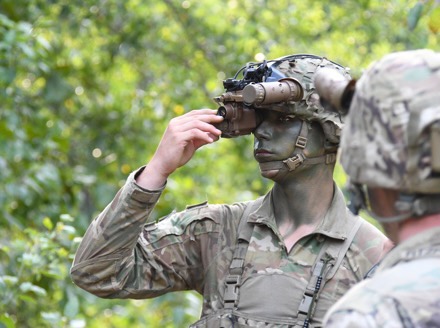
ABERDEEN PROVING GROUND, Md. — Army researchers are expanding the reach of the high-tech Integrated Visual Augmentation System (IVAS) to deliver capabilities to Soldiers onboard aircraft.

IVAS integrates next-generation situational awareness tools and high-resolution simulations to enable Soldier sensing, decision making, target acquisition and target engagement. The device provides Soldiers with a single platform to fight, rehearse and train.

During the research and testing phases, the Army initially focused on bringing the technology to dismounted Soldiers. During the next step, scientists and engineers developed a capability for Soldiers to maintain situational awareness using IVAS during transport in ground combat vehicles such as the Bradley and Stryker.

Now, Army Futures Command (AFC) and Project Manager IVAS are testing the system to deliver the technology for aircrews and paratroopers in Black Hawk and Chinook helicopters.

“The Army is investing in resources to broaden the emerging capabilities of IVAS to improve effectiveness and safety of airborne Soldiers en route to their mission,” said Dr. Navin Mathur, IVAS platform integration project engineer with the Command, Control, Communications, Computers, Cyber, Intelligence, Surveillance and Reconnaissance (C5ISR) Center — a component of AFC’s Combat Capabilities Development Command (DEVCOM).

The first aircraft integration operational test with paratroopers using IVAS occurred in May at Experimentation Demonstration Gateway Event (EDGE) 21 — a precursor to Project Convergence 21 — with the 82nd Airborne Division aboard two Black Hawks. The same Soldiers finished testing IVAS weeks earlier during Soldier Touch Point 4 at Fort Bragg and incorporated what they learned in preparation for EDGE 21.

They received real-time video feeds to their IVAS headsets, from a camera mounted to the bottom of helicopters, while flying to the objective site. By pushing a button on the headset, they could toggle among the screens, making the images larger or smaller. Two squad leaders in separate Black Hawks also coordinated a mid-flight change of mission plans using the system.

Research is now focused on providing video feeds from Air-Launched Effects (ALE), small unmanned aerial vehicles released in flight from helicopters, to paratroopers and aircrew wearing IVAS. Soldiers could also use the headsets to control ALE instead of carrying a tablet.

“During the development phases for these current and future ground and air platforms, we’re focused foremost on the putting together the user experience,” Mathur said. “The team is getting their feedback during exercises like EDGE and making quick upgrades. We’re continually refining designs to meet their needs.”

By Dan Lafontaine, DEVCOM C5ISR Center Public Affairs

USAMTEAC Test Rapid Opioid Countermeasure System at Camp Bullis

Friday, July 2nd, 2021

JOINT BASE SAN ANTONIO, TX – The U.S. Army Medical Test and Evaluation Activity (USAMTEAC) conducted a customer test for the Rapid Opioid Countermeasure System (ROCS) auto-injector at the Deployable Medical System Equipment for Training (DMSET) site in Camp Bullis, TX. USAMTEAC, formally called the Army Medical Department Board (USAMEDDBD), is part of the U.S. Army Medical Center of Excellence (MEDCoE), and provides independent operational testing and evaluation of medical and medical-related materiel and information technology products in support of the Army`s Department of Defense acquisition processes.

The ROCS test was requested by the product manager at the Joint Program Executive Office for Chemical Biological Defense (JPEO–CBD), Medical Countermeasures Systems (MCS) to assess the functionality and usability of the ROCS auto-injector within the operational environment. Soldiers who are the typical users of the ROCS served as test players for the event. The ROCS auto-injector report is relevant and provides JPEO–CBD MCS a report and data for their evaluation and possible future fielding throughout the Army.

Army test players participated in self-aid and buddy-aid scenarios using the ROCS, a single-use auto-injector pre-filled with 10 mg of Naloxone. The ROCS auto-injector provides the capability to deliver an intramuscular injection with a 22-gauge needle and be used in a suspected opioid environment with Soldiers wearing Mission Oriented Protective Posture (MOPP) Level 4 protective gear. During the test at Camp Bullis, test players also donned MOPP Level 4 gear in a simulated field environment.

“With the humanitarian missions we’re supporting our Soldiers may walk into a hot spot and unknowingly get exposed. The ROCS auto-injector will help if they are experiencing symptoms of opioid exposure with better medical care for the front line troops,” said Charles Lohsandt, one of the USAMTEAC Test Officers. “It’s a very small single-use cartridge that can easily fit in a gas mask carrier or inside one of the protective suit pockets, for example.”

Col. Mark Plooster, Executive Director, USAMTEAC, discussed the collaboration with other organizations in conducting this test. “What we do is bring in a capability developer from CDID (Army Futures Command Capability Development Integration Directorate), people from the FFID (Field Force Integration Directorate), the MRDC (U.S. Army Medical Research and Development Command), and Weapons of Mass Destruction – Civil Support Teams to bring in the whole team to make sure that everybody who has a piece of the pie is involved,” said Plooster. “At the end of the day the real customer is the Soldier on the battlefield. We try to make this test as realistic as we can using Soldiers in the actual unit that will be using the equipment.”




“The test players are the most important and valuable part of the test,” said Col. Roberto Marin, Chief, Materiel Test and Evaluation Branch, USAMTEAC. “Although we have the capability developers, the material developers, and us, the USAMTEAC test team, as the lead test agency, test players, also known as the end users, they provide us with honest feedback that is required to provide better medical care for the warfighter, the ultimate customer.” Said Marin. “Test player data feedback includes an after action review detailing the ROCS auto-injector strengths and weaknesses, a survey, and recommendations. We analyze all the data points and send a report to the material developer for higher level decision authority.”

To learn more about the USAMTEAC mission, visit their website at medcoe.army.mil/usamteac.

By Jose E. Rodriguez, MEDCoE Public Affairs