Wilcox Ind RAID Xe

Archive for the ‘Contracts’ Category

NSW Seeks Rugged/Civilian Clothing

Monday, September 12th, 2016

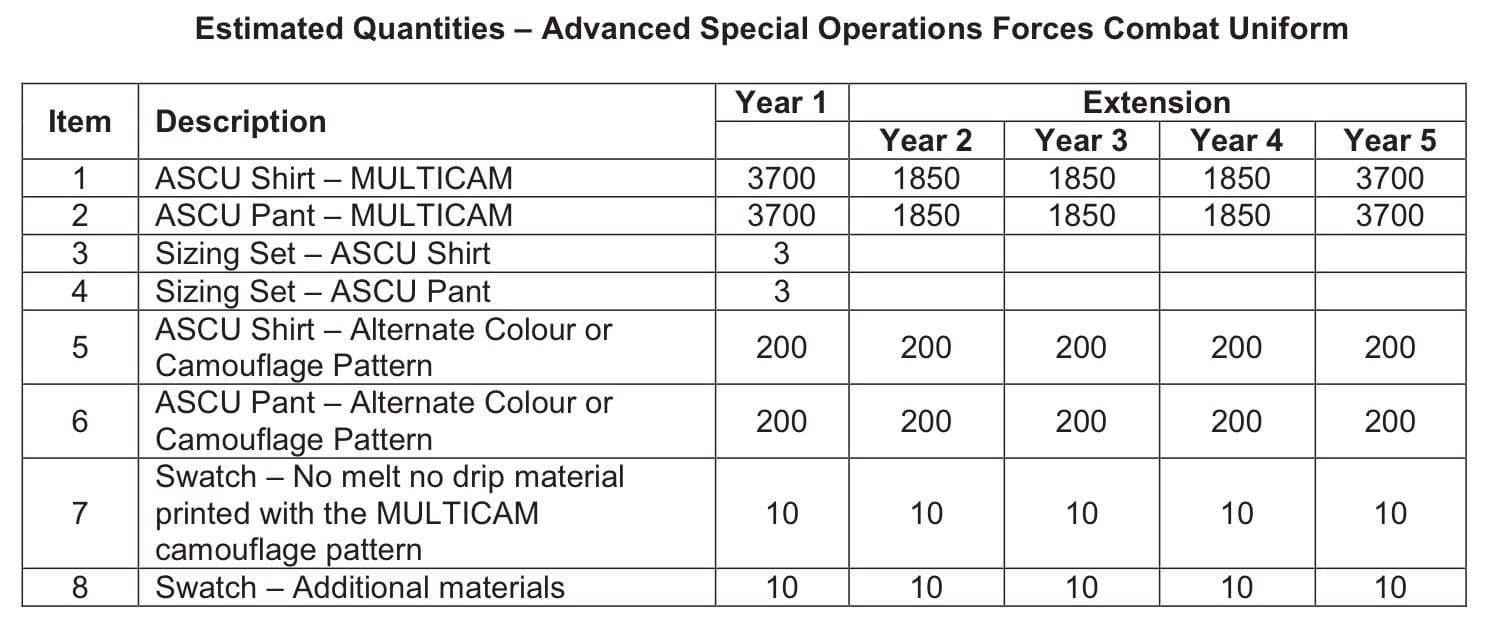
Naval Special Warfare Command (NSW) recently released a Request for Information (RFI) to industry. They are conducting market research to identify, as potential sources, companies who may possess the expertise, capabilities, and experience to explore industry’s ability to provide NSW with civilian/rugged clothing. They are particularly interested in small businesses providing feedback.

This RFI is interesting for several reasons. First off, we are seeing a formal inquiry from a SOF component for civilian outdoor clothing. Personnel have been wearing such items operationally for quite awhile, but this indicates making them an issue item. In many instances, civilian clothing is procured by the individual, either with personal funds or with a civilian clothing allowance, when authorized. Although some civilian clothing has been directly issued by units in the past, due to the restrictions of the Berry Act, it is quite difficult to do legally. However, one way is for a unit to buy the non-Berry items while deployed overseas and for the expressed use of overseas only.

The Berry Act may well be an issue for this potential program. As you can see, all of the example types of clothing they are seeking, are foreign sourced. Unless the program remains extremely small, and below Berry’s low threshold, it will be the driving factor for cost as well as performance. But the planning numbers belie such an argument. Conversely, the numbers aren’t very high either, at least from standpoint of the brands they call out. So making the business case is likely difficult for many brands to stand up US manufacturing. Granted, there is clothing made here in the US, but they differ from those in the chart below.

I’d really like to see additional Made in USA outdoor clothing options. Hopefully, NSW will find what they are looking for.

Interested parties should visit www.fbo.gov

6 Important Things You Need to Know About DLA’s TLS Contracts in 2016

Monday, September 5th, 2016

Unfortunately, there are still a lot of people who are reluctant to use the Defense Logistics Agency’s Tailored Logistics Support program to satisfy their requirements. Oftentimes, it is misunderstanding more than anything. When a unit purchases from TLS they are buying from DLA just like with requisitioning an NSN item, but the requirement is being fulfilled via a standing contract with one of six commercial vendors. While the needs are fulfilled by commercial vendors, it is a fully vetted government program put into place by DLA in order to reduce the strain on the standard stock system. DLA’s TLS supplements items with existing National Stock Numbers and allows authorized users to purchase low demand items along with the latest versions of gear.

I recommend that agencies and units consider the use of TLS, particularly when they have a laundry list of items to buy or know exactly the item they require. TLS offers the purchaser simplicity as well as control over what they buy. Additionally, with End of Fiscal Year right around the corner, TLS is a great way to obligate funds to satisfy requirements rather than spending them on a six month supply of toilet tissue. But, if you’re going to use TLS for EOY, you can’t wait. There have been some program changes this year which you need to know about. ADS Inc posted this article to their blog, summarizing these updates to TLS, which we asked to share. While we really appreciate ADS sharing this, we’d like to point out that the information pertains to the DLA TLS program as a whole, no matter which TLS vendor might fulfill your requirment.

ADS Inc. is a proud multiple award recipient of the Defense Logistics Agency’s (DLA) Special Operations Equipment (SOE) and the Fire & Emergency Services Equipment (FESE) contracts as part of the Tailored Logistics Support Program (TLSP). As an incumbent Prime Vendor, ADS has proven itself successful in fulfilling customer equipment and incidental service needs and requirements since its first prime vendor contract awarded back in 2001 and its first TLS award acceptance in 2005.

ADS’s experienced contracting team, expansive customer-focused sales task force and its positive relationships with over 3,000 partner suppliers contributes to its ability to exceed the TLS program’s primary goals of reducing costs, ensuring product of choice, improving logistics response time and increased customer support. In this blog, we are going to highlight 6 important things you need to know about leveraging DLA’s TLS contracts in 2016. Be informed with ADS!

1. The deadline for submitting End of Year (EOY) orders through DLA’s TLSP Contracts have been moved up two weeks!

It’s all too common for government entities to reach a “use it or lose it” period towards the end of the fiscal year. This is a pertinent time for buyers to determine any outstanding requirements and submit them to their contracting office for approval.

Did you know the TLSP contract submission deadlines are set almost two weeks earlier than they were last year?
This means NOW is the time to start gathering any last minute purchasing requirements. See Diagram A – TLSP Procurement Vehicles for additional information regarding order processing as it pertains to the FESE and SOE programs.

Note: All TLS orders must be submitted to DLA by September 9, 2016 at 11:59 p.m. Any orders with Fiscal Year (FY) 16 funds submitted past that timeframe will be returned to the submitter. Any orders received after that timeframe will be processed as FY17 funds.

2. The process for ordering through FESE and SOE TLS has changed as recent as May 31st, 2016.

As defense budgets shrink and a larger emphasis is put on improving the ordering process, the FESE and SOE TLSP contracts have adapted to continue to provide users with a simple, efficient procurement vehicle. The changes adopted this year give customers greater visibility on orders, more accurate pricing information and valid obligation/transfer of funding directly with DoD Finance personnel.

Changes to the SOE TLS Program (Effective November 2015) & FESE TLS Program (Effective May 31, 2016) Due to a mandate to conform to Audit Readiness requirements, several changes have been made to the SOE & FESE ordering process that the customer may or may not be informed of.

Most recent changes under the DLA Troop Support – Construction and Equipment Program:

For more information on how these changes affect the ordering process flow please download the flowchart provided by DLA.

1. Customer must now register a designated Finance Office Point of Contact (FOPOC) with their account and submit their information. Here are instructions on how to complete the designation form provided by DLA.
2. Once the customer’s FOPOC is registered, orders can be submitted for equipment, supplies and/or services under the current Order Request Spreadsheet. Once DLA approves the items for scope the request will be solicited amongst the qualified TLSP vendors.
3. DLA will email the Price Acknowledgement Spreadsheet to BOTH the Ordering Activity as well as the FOPOC.
4. Once the order is approved by the FOPOC and the Ordering Activity, the customer submits required funding information via the FOPOC Review Spreadsheet to DLA.
5. Upon award, DLA will send a second notification to the FOPOC and the Ordering Activity letting them know the order is awaiting obligation in the system.
6. Once the KO obligates the order, a third email will be sent to the FOPOC and the Ordering Activity with final order line item details.
7. A final email will be sent from DLA to the customer and will include a request to post receipt of the order in DoD EMALL.

3. It’s easier than ever to register with DLA.

To have access to a wide variety of Commercial Off-The-Shelf (COTS) equipment, incidental services and training through the SOE &FESE TLS Programs, qualifying customers must be authorized DOD, Federal or other DLA approved, federally-funded agencies. For more information on how to register, if you haven’t already, contact the following contracting offices:

DUNS: 027079776

FESE
Registration: Email | FESECustomerRegistration@dla.mil
Ordering: Email | FESOrders@dla.mil
Questions: Email | FESECustomerInfo@dla.mil

SOE
Registration: Email | SOECustomerRegistration@dla.mil
Ordering: Email | SOEOrders@dla.mil
Questions: Email | SOECustomerInfo@dla.mil

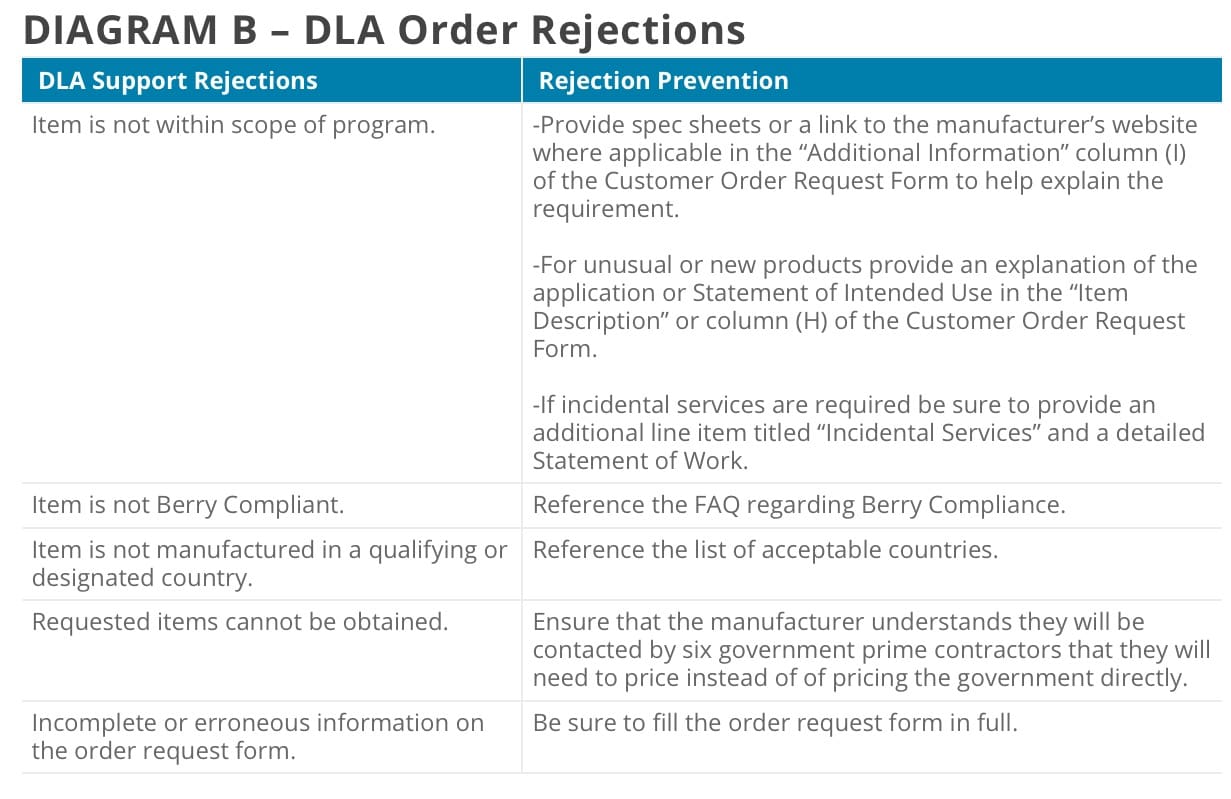
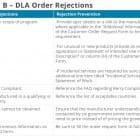
4. Every request is approved on a case-by-case basis. Increase your chances of a quick, smooth approval process with these tips:

There are several reasons why DLA would not award or approve product requests. It’s important to keep in mind that DLA may not always know of the product (if it’s new technology for example) and may not always know the relevant application and how it pertains to your mission and the contract scope.

5. You can buy incidental services through TLS if they’re ancillary and purchased with a product.

According to Bloomberg Government, the government’s top four spending categories are services-related.

When it comes to the purchase of incidental services through the FESE and SOE TLS Program contracts, they are typically requested as an additional line item on the Customer Order Request Form and are ancillary to a product being requested. Incidental service requests should also ensure proper functional capability and safety of the accompanying product(s). Consistent with product requests, DLA will approve incidental service requests on a case-by-case basis. 
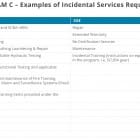

See Diagram C – EXAMPLES OF INCIDENTAL SERVICE REQUESTS for examples of these requests for both FESE and SOE programs. For additional instruction, visit the DLA SOE TLS Customer Guidelines and DLA FESE TLS Customer Guidelines or contact your respective TSLP Contract Manager.

6. ADS can…

Help you tackle road blocks early on.

Help you select equipment that fits your needs and requirements.

Provide procurement options through both of our FES and SOE TLS contracts.

Keep you updated on shipping information when your order is complete.

HOW TO ORDER:

1. Send RFQ to ADS

Request a quote from your ADS Account Manager. They will help you identify the best procurement options for your requirements – GSA, TLS, Open Market, etc.

2. ADS Provides Quote

Our knowledgeable ADS Account Managers can help you select equipment to satisfy your requirements, determine procurement options, as well as verify part numbers, lead times, pricing (including freight), and country of origin.

3. Register for the Program

If you determine that the TLS Program is best for your requirement, register for the corresponding TLS Program with DLA Troop Support.

Instructions for Customer/FOPOC Registration:
FESE | SOE

4. Submit Your Order

Email your completed order request to DLA Troop Support. They will act as your contracting office.
Contact Info: SOE TLS Orders: SOEorders@dla.mil
Contact Info: FESE TLS Orders: FESorders@dla.mil

5. You’re All Set!

DLA Troop Support will compete the requirement amongst the participating TLS vendors and provide best pricing for all items requested.

Once approved, DLA Troop Support will contact you and your FOPOC for funding information.

Once that is processed, an award will be made!

To learn more, visit adsinc.com/6-important-things-need-know-dlas-tls-contracts-2016.

USASOC Seeks Folding Kayaks

Wednesday, August 17th, 2016

It’s good to see that the traditional ways are still in fashion.

The U.S. Army Special Operations Command (USASOC) has a Brand Name or Equal requirement for manufacturer; Long Haul Folding Kayaks. In particular, they are seeking 10 of the Mark-II Commando Double Kayak.


Stats:
1.90 lbs / 41 kg
2.length 204″ / 518 cm
3.beam 36″ / 91 cm
4.depth 18″ / 46 cm
5.capacity: capable of supporting 900 lbs / 408 kg
6.pack size 3 bags

Includes:
-Complete Rudder Assembly
-Expedition Tuckunder Spraycover
-Classic Bags
-Longren Packing Sleeve
-2 Comfort Seats
-Footbrace
-Black Frame with Touch Codes

Program Manager Soldier Clothing and Individual Equipment Issues RFI To Industry For Army Modular Tactical Holster In Support Of XM17 Modular Handgun System

Wednesday, August 17th, 2016

This is a great piece of news. The Product Manager for Soldier Clothing and Individual Equipment (PdM SCIE) has identified a need for a new modular and tailorable holster system in support of the Product Manager for Individual Weapons (PdM IW) Modular Handgun System (MHS) XM17 program.

While the pistol is PdM IW’s bailiwick, it’s PdM SCIE’s responsibility to maintain, develop, and improve Soldier clothing and individual equipment to include holsters as the life cycle manager of these items. They’ve fielded holsters in the past.  For example, in 2013 they began fielding the Blackhawk SERPA and a G-Code holster for the M9 Handgun.  

However, along with the pistol it will support, this requirement is new and has us excited.  To begin with, it shows that the XM17 is alive and kicking and far enough along to give accessories like holsters a serious look.  What’s more, it’s good to see PdM SPIE working with PdM IW to field a holistic solution which crosses commodities between the two teams.  The XM17 solicitation did call for holsters, but as we’ll show below, the holster concepts weren’t nearly as ambitious as the requirement for the pistol.  

In the solicitation for the Modular Handgun System, the offerer’s were required to provide Holster Sleeves to fit the Blackhawk SERPA Improved Modular Tactical Holster.

The offerors were also required to provide compact holsters, which were essential Safariland ALS holsters.   

In both cases, the holsters are well established legacy systems, in wide use. Whether you like them or not, they are industry standard holsters. But if the Army is to get a new pistol, why not see what industry is capable of and field a new holster as well?

That’s the point of this call to industry requesting formation on what they are capable of regarding holsters. Specifically, they are asking a lot and hopedully, industry will step up to the plate. Here is a sampling of what they are seeking; the entire list can be found at www.fbo.gov.

Key Performance Parameters

KPP 1 – Interoperability
The AMTH will carry a M17 pistol (T) and will be interoperable with any other MHS variants (i.e. Compact, etc.) (T). The AMTH must accept the M17 with suppressor kit, without actual suppressor in place (T), or with suppressor in place (O).The AMTH will accommodate future handguns used by Soldiers by providing an interchangeable holster sleeve variant (T), with one holster system (O).

Rationale: Compact variant users may need to carry their handguns in an overt/tactical method in the course of their duties and it would be necessary for the full size holster to accommodate the compact variant. In the event a new handgun is needed, the existing holster will need to holster or adapt to holster the new weapon to ensure Soldiers have a holster system available for use. The MHS suppressor kit may include a longer threaded barrel and higher than normal sights. The holster must accept the weapon configured for suppressed use, while accepting a fully suppressed MHS is an objective. Other methods of carrying fully suppressed pistols exist that may be more operationally suitable to the user.

KPP 2 – Modularity of Mounting Positions
The AMTH must be modular and provide three (3) mounting options, 1) mounting on equipment using standard Pouch Attachment Ladder System (PALS) webbing; 2) on a belt; 3) and a drop leg configuration (T=O). In any of the configurations the MHS Tactical Holster must be adjustable to accommodate a vertical or cross drawing of the handgun (T=O).

Rationale: The MHS must have a holster associated that allows the user to wear the system securely on their person and allows them to do all combat/battlefield required tasks. Users have a need for a holster to allow them to securely carry and quickly employ the MHS. Users currently have the modular capability to transfer the holster from chest (MOLLE) to hip to thigh carry in seconds without removing the weapon from the holster sleeve. Users require this capability in the AMTH, for example, when transitioning from riding in a vehicle to dismount and individual movement to key leader engagement. Users of the MHS will need to use one or both hands to conduct battlefield tasks while still maintaining a tactical advantage. Therefore, Users of the MHS will need to have the ability to draw the weapon effectively with one hand quickly and efficiently.


KPP 3 – Retention
The AMTH must provide retention upon holstering without the activation or manipulation of first level retention devices to secure the handgun when Soldiers are training and conducting combat operations (T). The AMTH will have to carry the pistol in a manner that conforms to the shape of the handgun and ensure the handgun is securely held within the holster (T). The AMTH must provide redundant systems to ensure the handgun is secure (O) and prevents someone other than the Soldier from drawing the handgun (O). The AMTH must provide one level of retention (T), two levels of retention (O). No retention buttons, switches, levers, etc. will use the Soldier’s trigger finger to release the handgun (T=O). None of the retention systems will cause damage to the pistol (T=O).

Rationale: Soldiers require the ability to draw handguns from holsters and re-holster with one hand reliably when transitioning from another weapon system, or when presented with a lethal force engagement with little or no warning when only armed with a handgun. This requires that Soldiers be capable of drawing the weapon quickly with one fluid motion, attain a proper firing grip from the holster, engage enemy targets, holster the weapon and potentially repeat the process during the same engagement or in successive engagements. Through all of this, Soldiers require the ability to continue to conduct other tasks with the non-dominant/non-firing hand and maintain situational awareness of their battle space. Therefore, Soldiers must be able to conduct draw and re-holster with one hand and without looking or glancing away from their near-target environment.

KPP 4 – Ergonomics
AMTH must be manufactured in variants for right and left hand dominant personnel (T) or have one variant which allows for ambidextrous access of the weapon without an increase to the size of the holster (O). The AMTH must allow the Soldier to draw and re-holster the weapon continually with one hand (T=O).

Rationale: Users need to be capable of carrying/accessing the holster on the dominant side. Objective ambidexterity in the holster permits logistical streamlining, but not at the expense of ergonomics or increased bulk/snagging hazard. Many users of the MHS need to use one or both hands while maintaining a tactical advantage. Being able to draw and re-holster with one hand and without taking eyes off the target area allows the user to maintain situational awareness and tactical advantage.

Key System Attributes

KSA 1 – Construction Materials
The AMTH must be constructed of materials that are non-magnetic, non-corrosive, block absorption of blood-borne pathogens or other biological fluids, fungus resistant and fire resistant (T=O). The AMTH shall not be degraded by CBRN decontamination materials; insect repellant; sea water; and commonly used petroleum, oil, and lubricants (POL) (T=O). The materials of the AMTH that contact the handgun will not mar the manufacturer-applied finish of the weapon (T). The color of the AMTH will be Tan 499 (T), Operational Camouflage Pattern (O). The external surfaces of the AMTH must be dull, non-reflective, and must not contribute to visual (T) or infrared signatures (O). The AMTH must not have visible logos or distinctive commercial markings when worn by the Soldier (T=O).

Rationale: The holster is not considered CBRN mission critical but is a durable item, as such, it needs to be capable of surviving CBRN training regimen and commonly used POL and insect repellants. The weapon finish prevents corrosion and maintains a level of operational security through camouflage. It is expected and acceptable that the holster may affect user-applied paints and camouflage that are less resilient than the factory-applied finish. The holster should not damage the finish and induce increased maintenance or corrosion of the weapon. Tan 499 is an approved Tank and Automotive Command (TACOM) color via Memorandum for Program Manger Soldier Weapons, Small Arms Weapons Neutral (Non-Black) Color, dated 31 January 2014.

KSA 2 – Configuration/Reconfiguration
Initial configuration and adjustment of the mounting system for the AMTH will be conducted at the operator level and will be accomplished without the use of special tools (T=O). Once set to the Soldier’s preferences, the AMTH must allow for placement between any of the three modular mounting systems without the need for tools in no more than 20 seconds (T=O).

Rationale: Initial configuration and/or reconfiguration is a task that would be conducted in a maintenance-type environment and not under fire. Soldiers do not have access to special tools and introducing special tools is not desired. The Soldier does have a common tool (multi-tool) that has narrow and wide blade flat screw driver tips and a #2 Phillips screw driver tip. Transition from one modular placement platform to another needs to be conducted in a combat environment (e.g., exiting or entering vehicles, drop zones or landing zones, etc.) and the Soldier should be able to do so without the use of tools in an expeditious manner.

KSA 3 – Airborne/Air Assault
The AMTH will include a retention system that can be configured in preparation of operations such as military free fall, static line parachute, air assault/fast roping, SPIES/FRIES, combat diver, patrol boat operations, hovercraft operations, rappelling, mountaineering, jungle penetrations, All Terrain Vehicle Operations, swimming, etc. which is installed before the operation and removed when extra retention is no longer required (T); is part of the holsters retention system (O). When conducting these dynamic movements, the Soldier will require multiple steps to draw the handgun (e.g., installing and removing bungee straps, manipulating locking levers, etc.) (T), be able to draw and holster the handgun continually with one hand (e.g., having additional steps with collocated levers, etc.) (O).

Rationale: Soldiers occasionally are required to conduct highly dynamic mission-critical tasks that may exceed the limitations of standard holster retention devices. If the standard retention device is not sufficiently robust to maintain security of the weapon, another form of retention is needed to ensure the weapon is secure. These operations are pre-planned thoroughly and configuration would not be necessary on short order or under fire. The need to present the weapon for use during these situations is real; therefore, Soldiers would still need to be able to do so in a timely manner and potentially with only the firing hand, and then re-holster and secure the weapon to continue the dynamic event.

KSA 4 – Law Enforcement Configuration
The AMTH must provide a Law Enforcement configuration (T). The AMTH Law Enforcement configuration will have additional mounting platforms and/or parts that can be added to the AMTH to meet the Law Enforcement Configuration or be a variant that attaches to the AMTH platforms (T), be the same as the AMTH with no additional parts (O). The Law Enforcement configuration will consist of a holster sleeve and a mounting system that is compatible with existing Military Police Law Enforcement Ensemble Kit (LEEK) belt dimensions (T). All components of the Law Enforcement Configuration will be black in color (T=O). The Law Enforcement Configuration will have a mounting platform that is user adjustable for height, adjustable to below/above the belt wear, and capable of being angled to slant holster away from the user’s hips (T) by providing an additional belt mounting system to the AMTH that provides the required adjustability (O).

Rationale: Military Police conducting Law Enforcement Operations have special capability needs. It is logistically prudent to ensure the Law Enforcement configuration is compatible with the AMTH. LEEK belt and accessory dimensions and characteristics will need to be compatible with AMTH LE configurations.

KSA 5 – Target Acquisition
The AMTH must have a variant capable of holstering the XM17 with target acquisition enablers (lights, lasers, pointers) mounted on the forward rail of the handgun, which does not extend forward of the muzzle or below the lowest portion of the trigger guard, and is not more than 1.5 inches wide (T). The AMTH must be capable of holstering the XM17 with target acquisition enablers (lights, lasers, pointers) mounted on the forward rail of the handgun, which does not extend forward of the muzzle or below the lowest portion of the trigger guard, and is not more than 1.5 inches wide (O). The AMTH must be capable of holstering the XM17 with target engagement enabler (mini red dot sight, RMR, etc.) mounted on the top of the handgun slide (O).

Rationale: Soldiers that require target acquisition enablers need to be capable of employing those enablers straight from the holster. When using night optical devices, it is imperative that the weapon be equipped with target acquisition enablers to be able to engage threats with any degree of accuracy. Installing the enabler after drawing the handgun and then removing the enabler prior to re-holstering is not acceptable in any situation. Installing the enabler on a loaded handgun while under fire is unsafe. Enabler fit is based on the required capabilities of the XM17 enabler SEP effort. Intent of the threshold is to have an AMTH variant for enabled pistols. Intent of the objective is to have a single AMTH that accepts both enabled and non-enabled pistols. It is possible that the XM17 will be capable of accepting mini red dot sights (MRDS). There are also other efforts that are reviewing the viability of MRDS for pistols. It is reasonable and prudent to expect some users will have a need to holster the XM17 with MRDS capabilities mounted on the weapon.

KSA 6 – Cost
The Tactical Holster system with holster sleeve and three mounting positions will cost less than $100 (T), $70 (O). The Law Enforcement configuration will cost less than $50 (T), $20 (O) for the law enforcement adapter.

Interested parties have 45 days to submit in response to this Request for Information. Full details can be found at www.fbo.gov

Breaking – USSOCOM Cancels Suppressor Upper Receiver Group Solicitation

Monday, August 15th, 2016

In a special notice issued just minutes ago, United States Special Operations Command has canceled the Suppressor Upper Receiver Group solicitation.

The Suppressor Upper Receiver Group solicitation is cancelled.

United States Special Operations Command plans to analyze the results of the testing and post a new solicitation to industry in the future.

The message was simple and straight forward, yet doesn’t explain why. Many in industry have been very critcal of the ambitious program due to its requirements to keep the weapon cool enough to handle in spite of high operating temperatures. 

Considering the solicitation closed just a month ago, this move seems quite sudden. It sounds like none of the candidates met the program’s goals and SOCOM is going to circle back around.

Congratulations To Berry Aviation

Friday, August 12th, 2016


We know a lot of hard work went into that contract.

USSOCOM Plans Technical Experimentation Night Vision/Electro Optics and Advanced Sniper Rifle Military Utility Assessment

Wednesday, August 10th, 2016

USSOCOM has released an RFI for candidate technologies for the upcoming Technical Experimentation Night Vision/Electro Optics and Advanced Sniper Rifle (ASR) Military Utility Assessment (MUA) which will take place 14-18 November at Camp Blanding, Florida.

In particular, they are interested in technology readiness levels 3-6 and the intent of this event is to highlight technologies that support night vision/electro optics systems and advanced sniper rifle systems.

Technology areas to explore during the event include the following:
1. True Color Night Vision. Presentation of visible spectrum light (approximately
400nm to 750nm – flexible) that aids in target discrimination, mobility, combat identification, identify friend or foe, or situational awareness via a natural appearing manner. The need is from clear sky no moon (approximately 0.001 lux) to daylight conditions. Day only solutions will not be considered. A capability that allows true color at higher illumination and switch or transition to black and white at the lowest illumination (.001 lux) is of interest. Factors of consideration include resolution, sensitivity, latency, size, weight, power, dynamic range, and bits of color at low light. Both analog and digital solutions are of interest.
1.1. True Color Night Vision for man portable applications. This includes night vision goggles, rifle scopes, and binoculars. Retrofits to existing kit are considered as well as original full up solutions. For man portable applications; size, weight, and power have a priority. For head borne applications latency is of particular concern – though not so much a concern for rifle scopes or binoculars.
1.2. True Color Night Vision solutions for ground mobility visual augmentation systems that are compatible with integration into electro-optic / infrared turrets. The technology should also be applicable to fixed wing / rotary wing / maritime applications which would also use the electro-optic / infrared turret. For the platform based solutions size, weight, and power needs are not as stringent though integration is inherently important.
2. Undetectable day/night aiming for either assaulters, snipers: beyond iron sight or etched reticle.
2.1. Passive aiming methods that provide a cursor for point of aim / point of impact of the assaulter rifle shots (typically 5.56mm or 7.62mm) is sought. The cursor should ideally be viewable by other team members. Ranges include close quarters combat up to 500 meters.
2.2. Ability to actively call in and direct close air support through visual cue, illuminate, mark, and/or aim for assaulters, snipers, or JTACS without detection by opposing force.
3. Group I, II, III, Unmanned Aerial System Intelligence Surveillance Reconnaissance (ISR)
3.1. Team based situational awareness. Technologies that can provide small teams or maneuver elements with real-time Visible National Imagery Interpretability Rating Scale (VNIIRS) 9 or better streaming video, Ground Moving Target Indicator and Radio Frequency (RF) environment characterization capabilities. The technology should be audibly and visually undetectable to the greatest extent possible.
3.2. Force protection for any maneuver element. Technologies that can automatically follow (digital tether) a maneuver element. The solution should provide real-time streaming video to multiple concurrent users. Solution should provide VNIIRS 9 or better video quality in real time. The ability to detect and display Identify Friend or Foe markers would be beneficial.
3.3. Overhead persistent surveillance. Technologies that can be programmed to orbit or perch and stare at an area or object of interest. Technology should be visually and acoustically undetectable by persons or systems resident at an observed area or object of interest, while providing users VNIIRS 9 or better video quality in real time.
4. Tactical Surveillance Equipment (TSE).
4.1 TSE internet protocol (IP) compatible prototypes that can demonstrate or
explore session announcement protocol for broadcasting multicast session information. 4.4.2. TSE prototypes or software that can execute compression of imagery and
video with loss that does not result in undue noise or artifacts. This is for low-bandwidth applications, e.g. situations where frame rate times resolution times bit depth bit depth is 2 megabytes or less. Ultimately a lossless imagery appearance while with loss compression is utilized.
4.3. Technology advancements in detection, recognition, and identification (DRI) for TSE that significantly exceeds current state of the art.
4.4. Modular turbulence mitigation software/hardware for TSE that can either be used to retrofit existing equipment or be a new solution.
4.5. Software application or an “app” that can calculate necessary information for performing TSE tasks such as facial recognition, DRI, personal identification, ground sample distance, ground resolution distance, pixels between eyes of a person.
5. Cursor on Target (CoT) Integrated Heads Up Display (HUD). Systems producing CoT data are becoming more widely employed to provide battlespace situational awareness (SA) data. Joint Terminal Attack Controllers view this SA data to aid in accomplishing their mission. CoT integrated HUD systems which display friendly and enemy positions as well as aircraft positions, call signs, and altitudes as icons on the HUD are sought.
Submissions should consider a CoT HUD that:
– Integrates into current eye protection equipment or Ballistic Clear Glasses with Fusion/Panoramic night vision goggles (NVG).
– Integrates with current PLI data sources (i.e. Android and/or CoT Radios).
– Incorporates an intuitive user friendly interface.
– Displays compass direction, distance, and current grid.
– Rapidly enables/disables HUD overlay in case of close quarters combat situations.
– Can be powered off of other equipment with minimal cabling.
– Has wired information assurance or is wireless with information assurance.
6. Target Engagement
6.1. Positive identification of a person of interest (POI) as subject / not subject
at and beyond maximum effective range of sniper rifle calibers such as .338 Lapua Magnum, or .50. Size, weight, power, probability of false alarm and probability of false rejection are of specific concern.
6.2. Multispectral optics and fusion of various bands in an intuitive and value added manner. Information overload is a concern while information loss can be a concern – a balance is sought. Fusion of all optics bands is ideal, fusion of both reflective and emissive bands is a minimum. Algorithm are sought that would allow for operation on both man portable systems as well as UAS or manned platforms.
7. Advanced Sniper Rifle (ASR) Military Utility Assessment (MUA). This MUA will serve as a market survey for crafting requirements of the future ASR program. Technologies of interest include.
7.1. Commercial Off the Shelf (COTS) bolt action rifle with switch caliber capability (3 calibers). Able to fire 7.62mm NATO, .300, and .338 caliber ammunition.
7.2. Candidate weapons systems must include suppressor technology that can be used for all 3 calibers, whether integrated or detachable.

For full details on how to nominate a texhnology, visit https://www.fbo.gov/index?s=opportunity&mode=form&id=7580f2c57048e540f9f4ea42fadec8f1&tab=core&_cview=0

USSOCOM Awards Contract To Gentex For Advancement Of Headborne Systems Technologies

Monday, August 1st, 2016

It appears that USSOCOM has issued multiple contracts in response to their Broad Agency Announcement issued earlier this year to refine requirements for the next generation SOF helmet. The latest award is to Gentex, and we assume, much of the work to be accomplished by their Ops-Core business unit. The BAA can be seen below.

Revision

Click to view .pdf

Ops-Core FAST helmets have been SOCOM issue for many years and the fruits of this contract will be used by Natick to help  refine requirements for the next generation SOF helmet.  


Contract Award Dollar Amount: $370,365.51 Plus Option CLINs valued at $464,607.00.

The announcement is found at www.FBO.gov as long as they keep it there. Earlier award announcements to others have been deleted.