SIG SAUER - Never Settle

Archive for the ‘Contracts’ Category

Rheinmetall Receives First Order for a Modular Camp Under the German Armed Forces Contractor Augmentation Program II – Static Accommodation in Lithuania

Thursday, August 27th, 2026

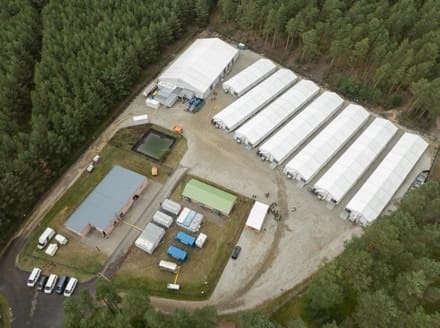
Rheinmetall has received an initial call-off from the Federal Office of Bundeswehr Infrastructure, Environmental Protection and Services (BAIUDBw) under the German Armed Forces Contractor Augmentation Program II – Static Accommodation (G-CAP II SU). In Lithuania, the group will now, as the main contractor, build a modular camp for up to 2,000 soldiers, which is due to become operational from mid-August 2027. Following commissioning, Rheinmetall will be responsible for facility management, including laundry, as well as catering. The order value for the construction of the modular facility amounts to €250 million, while the subsequent operation is valued at €40 million annually. The order was booked in Q3/2026.

The G-CAP II SU programme provides static accommodation for soldiers during deployment and standby commitments in the context of international crisis management and national and collective defence, irrespective of the climatic, geographical and geological conditions in the country of deployment. Pre-planned modular infrastructure covered by the framework agreement, from manufacture through transport, construction and operation to dismantling, forms the core of G-CAP II SU. Since these steps are standardised and can be called off from a single contractor, the entire process is accelerated. In this case, the contract was used to support the Bundeswehr in fulfilling its mission in Lithuania.

The G-CAP II SU project, initiated by BAIUDBw, aims to enable private-sector service providers to provide static accommodation during deployment. By enabling the private sector to establish such infrastructure, the Bundeswehr can conserve its own resources and keep them available for high-threat situations.

Rheinmetall is responsible for the planning, manufacturing and delivery of camps worldwide – by sea, land or air as required – as well as their construction, multi-year autonomous operation and subsequent dismantling. 

Saab Signs Long-Term Agreement for Camouflage Systems with the Netherlands

Thursday, August 27th, 2026

Saab has signed a long-term agreement with the Netherlands Ministry of Defence for the Barracuda Mobile Camouflage System. Saab has also received a first order within the agreement, with deliveries in the coming years.

The agreement, which runs over multiple years, enables the Netherlands to place orders and equip their vehicles with Saab’s Barracuda Mobile Camouflage System. 

“We are proud to support the Royal Netherlands Army with our advanced multispectral camouflage solutions, helping to protect its vehicle fleet from detection across the modern sensor spectrum, strengthening survivability and mobility on the battlefield,” says Henning Robach, head of Saab’s business unit Barracuda.

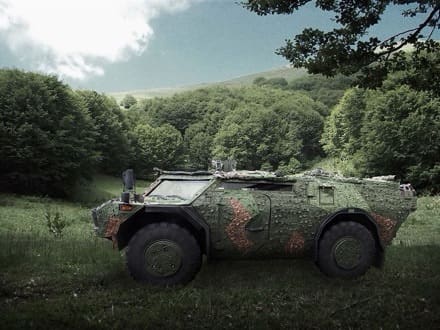
The initial order is for the Royal Netherlands Army’s existing Fennek and Panzerhaubitz vehicles. The agreement also includes options to equip additional vehicle types in the future. 

Saab’s Barracuda Mobile Camouflage System is tailor-made for a perfect fit for any vehicle, with woodland, urban or arctic camouflage patterns and can be deployed in any environment. 

AV Receives $51 Million US Army Order for Switchblade 600 Loitering Munitions

Wednesday, August 26th, 2026

Award under Lethal Unmanned Systems IDIQ reflects growing demand for AV’s next-generation, long-range precision loitering munitions and proven Switchblade 600 performance. 

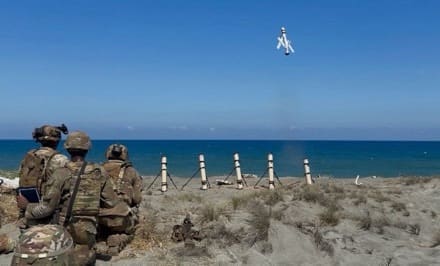
ARLINGTON, Va., August 26, 2026 – AeroVironment, Inc. (“AV”) (NASDAQ: AVAV), a global leader in defense technology, autonomous systems and precision strike solutions, today announced receipt of a $51 million delivery order from the United States Army for additional Switchblade® 600 Block 2 loitering munition systems. The order also includes Switchblade 600 Block 1 systems in support of a Foreign Military Sale to a key United States ally. 

The order was awarded under the Army’s existing five-year, $990 million Indefinite Delivery, Indefinite Quantity (IDIQ) contract for Lethal Unmanned Systems (LUS), originally issued in August 2024.  

This latest award represents a follow-on procurement to the Army’s initial order for the next-generation Switchblade product line and underscores the strong, sustained demand for AV’s battle-proven long-range, precision loitering munitions. 

“Continued investment by the U.S. Army in Switchblade 600 Block 2 reflects both the growing demand for long-range, precision loitering munitions and the proven reliability of the Switchblade family in demanding operational environments,” said Brian Young, Senior Vice President of Loitering Munitions at AV. “Building on the success of Switchblade 600 Block 1, Block 2 continues to deliver the meaningful upgrades in autonomy, resilience, and lethality tailored to the Army’s needs in contested, multi-domain operations.” 

This order also reflects AV’s expanding production capacity and performance on prior Switchblade 600 deliveries.  

“This new delivery order under the LUS IDIQ further validates Switchblade 600 Block 2 as a next-generation, scalable fires solution for the Army,” said Young. “As we expand our manufacturing capacity and accelerate delivery timelines, we’re ensuring that U.S. soldiers have reliable, combat-proven loitering munitions that deliver precision effects at range while keeping them out of harm’s way.” 

Since 2025, Switchblade 600 has been fielded across more than 20 brigade combat teams while hundreds of U.S. soldiers have been trained on the system’s operation and employment. 

Switchblade 600 Block 2 is designed for multi-domain operations and ruggedized for maritime and highly contested environments. Developed in collaboration with United States Special Operations Command (SOCOM), the system incorporates upgraded avionics and advanced automatic target recognition including SPOTR AiTR, to enable faster detection, identification, and engagement of threats.  

Integrated resilient communications, including Silvus MANET radios, support distributed operations and extended handoff ranges, while improved navigation and mission resilience allow effective employment in GPS-challenged environments. These enhancements provide commanders with increased reach, flexibility, and confidence against armored and other high-value targets. 

Kongsberg to Deliver Remote Weapon Systems to Canada

Monday, August 24th, 2026

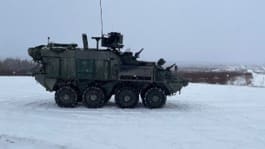
KONGSBERG, NORWAY – Aug. 20, 2026 – Kongsberg has signed a contract with General Dynamics Land Systems–Canada (‘GDLS-Canada’) valued at NOK 1.1 billion for the delivery of Protector RS4 Remote Weapon Systems. These systems will be integrated onto the Canadian Army’s Armoured Combat Support Vehicle (ACSV). 

The contract represents a continuation of the established partnership between Kongsberg and GDLS-Canada. This order is a follow-on procurement of RS4 systems for the ACSV program, building on previous deliveries to the same platform.

“This contract confirms our customer’s confidence in the Protector systems and further strengthens our long-term partnership with GDLS-Canada. We are proud that the RS4 continues to be selected as a key capability for the Canadian Armed Forces’ modern vehicle fleet,” said Kjetil Reiten Myhra, Executive Vice President, Kongsberg and President of the Defence Systems division.

Kongsberg has previously delivered RS4 systems to GDLS-Canada for integration on ACSV vehicles. The new deliveries will further enhance and expand the operational capabilities of the Canadian Army.

The RS4 is part of Kongsberg’s Protector family of Remote Weapon Systems, providing high levels of protection, flexibility, and situational awareness for vehicle crews.

The Protector RS4 is an advanced Remote Weapon System designed to enhance survivability, precision, and operational flexibility for modern military vehicles. The system is in service with defence customers worldwide and can be integrated onto a wide range of vehicle platforms.

US Marine Corps Awards Accrete Sole-Source Contract for Argus for Cognitive Advantage

Saturday, August 22nd, 2026

NEW YORK, Aug. 21, 2026 — Accrete, the cognitive infrastructure company building Knowledge Engines for autonomous work, today announced that it has been awarded a sole-source contract by the U.S. Marine Corps to deliver Argus for Cognitive Advantage.

The award was made on a sole-source basis. Under the award, Accrete will license its Expert AI Agents to the U.S. Marine Corps to help achieve cognitive advantage, enabling more informed, confident decisions.

Adversaries increasingly compete below the threshold of armed conflict, using coordinated narratives, synthetic media, and inauthentic amplification to shape perceptions faster than human analysts can track. Rather than treating open-source data as a search problem, Argus for Cognitive Advantage tracks, analyzes, and visualizes narrative development across the complete information environment — OSINT, open web, social media, broadcast media, messaging platforms, and foreign-language outlets. Accrete’s Knowledge Engine platform, which powers the Expert AI Agent Argus for Cognitive Advantage, converts the institutional knowledge of experienced practitioners into expert AI agents that surface the most relevant, use-case-specific signals across every accessible network. This significantly reduces analytic time and produces the detailed reporting required for timely decision-making.

In a world driven by visual media, rapid analysis is paramount — and this is where Argus for Cognitive Advantage’s video vision stands out. It reduces hours of video content to analysis in minutes, transcribing and translating speech, detecting objects and scene content, and inferring location cues — turning clips that once had to be watched end to end into searchable, attributable evidence, including video posted in languages the analyst does not read.

Additional product capabilities include:

Narrative intelligence. Narrative engines, stance detection, and predictive simulation track how conversations evolve and resonate.

Audience simulation. The Audience Simulation Agent segments an audience and simulates how each segment will react to a message before it is released, compressing a weeks-long analytic task into a single workflow.

Measures of effectiveness. Automated assessments quantify mission outcomes.

Global reach. Real-time translation and transcription across 243 languages, spanning sources including Facebook, Instagram, TikTok, X, YouTube, Reddit, Telegram, Weibo, and VKontakte.

Argus Chat. Analysts query the data in plain language.

Trusted AI by design. Every inference is traceable to its source, within auditable, accreditation-ready boundaries.

“Cognitive advantage is a warfighting requirement, not a support function, and this award reflects the Marine Corps’ clear recognition of that,” said Bill Wall, CEO of Accrete AI Government. “Furthermore, this sole-source award demonstrates the trust Accrete has built across the Department of War services. Accrete is proud to expand its reach within the Department of War by supporting the U.S. Marine Corps.”

Accrete first deployed Argus with the Department of War in 2022, followed by a multi-million dollar U.S. Army contract in 2024 to advance the capability for Army information operations. Argus for Cognitive Advantage was selected for a 2025 AFWERX STRATFI award to transition its technology from prototype to operational use.

“Knowledge Engines are dynamic context recorders, and the advantage begins the moment an organization presses record. The most valuable context in any institution is the know-how trapped in the heads of its best people. Organizations that never capture it are ceding compounding advantage to adversaries and competitors that do. Argus for Cognitive Advantage is one of the most sophisticated applications of the Knowledge Engine platform, and Accrete is proud to extend it to the Marine Corps as it counters adversaries operating against the United States every day through digital channels,” said Prashant Bhuyan, Founder, CEO, and Chairman of Accrete, Inc.


Denmark Selects Terma to Deliver Nationwide Counter-Drone Defense System

Thursday, August 20th, 2026

Terma will deliver a sovereign, integrated counter-drone defense system that connects existing and future sensors into one shared drone situational picture. With AI-supported processing of sensor data, the system will give the Danish Armed Forces and other authorities a stronger foundation to detect, understand and act on drone threats in real time.



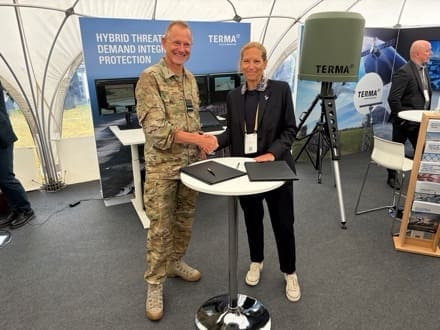
Per Pugholm Olsen, Head of DALO (Left) and Terma CEO Henriette Hallberg (Right)

Lystrup, Denmark – 19 August 2026 – The Danish Ministry of Defence Acquisition and Logistics Organisation (DALO) has entered into an agreement with Terma for the delivery of a new, integrated command-and-control system for counter-drone defense. The system will create a shared drone situational picture for the Danish Armed Forces and other authorities.

“I am pleased to sign this agreement, which will strengthen Denmark’s ability to maintain an up-to date drone situational picture. This new agreement with Terma is an important cornerstone in the ongoing effort to build a strong counter-drone capability, both within the Danish Armed Forces and Danish industry,” says Lieutenant General Per Pugholm Olsen, Chief of DALO.

From individual sensors to a shared drone situational picture

Denmark already operates sensors across the Armed Forces, civilian authorities and critical infrastructure, but today the information remains in separate systems and at different locations. The solution is built on Terma Helion, Terma’s sovereign multi-domain data backbone. Helion connects existing and future sensors and brings their data together into one shared drone situational picture. The platform integrates distributed systems and transforms large volumes of data into information that supports tactical decision-making at both local and central levels.

“In a security environment where drones represent a persistent and growing threat, the ability to detect, classify and act on threats across domains is fundamental to national security,” says Henriette H. Thygesen, CEO of Terma. “The ability to connect sensors, process data and turn information into timely decision support is essential to effective counter-drone defense. By creating a shared drone situational picture, we give the Danish Armed Forces and other authorities a strong foundation to act faster and with greater confidence. We are proud of the trust Denmark has placed in Terma. It confirms our ability to deliver mission-critical defense solutions that strengthen security in Denmark and across Europe.”

The solution also integrates OSL Technology’s FACE® platform for command and control and data fusion. OSL Technology became part of Terma in 2025. FACE brings together and processes data from Terma’s radar and surveillance technologies as well as third-party sensors and countermeasures. AI supports the processing, classification and prioritization of sensor data, enabling operators to rapidly identify and act on relevant incidents.

The solution builds on OSL Technology’s operational experience from complex civilian and military environments. Since 2019, OSL has been the prime contractor and system integrator for Heathrow Airport’s counter-drone system and also delivers counter-drone systems to the Ørland and Evenes air bases under a multi-year framework agreement with the Norwegian Defence Materiel Agency (FMA). Combined with Terma’s radar, surveillance and multi-domain capabilities, this creates a market-leading, open and modular counter-drone solution.

National control and flexibility for future threats

The solution will ensure national control over operational sensor data while enabling technologies from multiple suppliers to be integrated. It will be delivered in cooperation with other Danish industry partners and draw on expertise from across the Danish defense industry.

The scalable architecture allows sensors, sites, countermeasures and other capabilities to be continuously added over time. The solution can therefore support the management of drone incidents at military installations, airports, ports, energy facilities, government buildings and other critical infrastructure.

Facts

Together, the technologies enable authorities to:

  • Detect, classify and track drone activity
  • Fuse and prioritize sensor data using AI
  • Maintain a shared drone situational picture
  • Coordinate decisions and actions at Danish Armed Forces locations
  • Integrate new sensors and countermeasures as threats evolve

Hanwha Wins US Army Mobile Tactical Cannon Contract

Thursday, August 20th, 2026

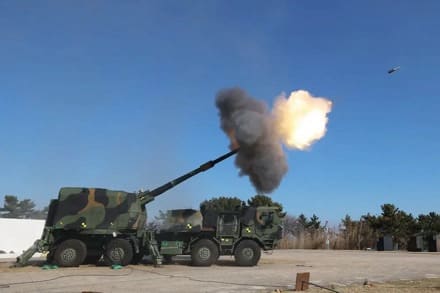
Hanwha Defense USA (HDUSA) announced that it has won a contract from the U.S. Army to deliver prototype K9 Mobile Howitzers (K9MH) for the Army’s new Mobile Tactical Cannon (MTC) program. The agreement provides for the accelerated delivery of six prototype MTC systems, with an option for an additional 12. This award marks HDUSA’s first major contract with the U.S. Army. 

HDUSA will provide a technically superior and rapidly fieldable 155 mm artillery system that supports the U.S. Army’s modernization and long-range precision fires objectives. With more than 2,500 K9 Howitzers already fielded globally, Hanwha is uniquely positioned to partner with the U.S. Department of War (DoW) to establish high-volume industrial capacity centered around the company’s wartime production ethos.

Hanwha’s phased-in localization strategy with domestic production and support means America’s defense industrial base will benefit from advanced manufacturing techniques, demonstrated technology, and good jobs. HDUSA is establishing a Phase I site in Opelika, Alabama, that will serve as the U.S. integration and test facility for Hanwha’s family of K9 Mobile Howitzers. HDUSA signed a three-year lease as part of the company’s strategic commitment to invest in the U.S. artillery system supply chain, enhance America’s combat vehicle industrial base, and serve as a long-term artillery modernization partner to the U.S. Army.

“We’re honored that the U.S. Army has selected Hanwha’s K9 Mobile Howitzer to fulfill its Mobile Tactical Cannon requirement. The K9MH is the total artillery solution and will be the centerpiece of Army Fires’ transformation into a more modern, more lethal force,” said Mike Smith, Hanwha Defense USA COO and President of Land Systems. “The U.S. Army’s selection is a testament to our track record of delivering devastating capability at speed, at scale, on cost, and onshore. As the wheeled variant of the K9, the K9MH provides an expansion path towards a tracked capability with designed-in margin for the future fight. And with such a capability, that fight will not be a fair one.”

Compatible with the Army’s full suite of munitions, the K9MH’s selection means the U.S. has now joined nearly a dozen allies who share a global industrial network and supply chain.

“Hanwha’s global supply chain and local production experience in Australia, Egypt, Poland, and Romania demonstrate a proven commitment to local execution we’re excited to bring to the U.S.,” said Michael Coulter, Hanwha Defense USA CEO. “Localization is central to Hanwha’s global business model, leveraging our global leading industrial technology and process in Korea to create sovereign industrial strength in the U.S., whether it be in shipbuilding, munitions, or combat vehicles.”

“This award reflects Hanwha’s enduring commitment to the United States and to strengthening the U.S. defense industrial base,” said Hanwha Group Chief Strategy Officer Alex Wong. “We are not simply delivering a system — we are building an American manufacturing enterprise, transferring technology, and creating a lasting foundation for broad industrial collaboration. Hanwha is invested in America for the long term.”

“We’re focused on creating a U.S.-anchored K9 Mobile Howitzer manufacturing network — with Opelika, Alabama, as the current Phase I launch point — that can deliver advanced Mobile Tactical Cannons at the speed and scale the U.S. Army needs,” said Jason Pak, Hanwha Defense USA Head of Land Systems-Artillery.

HDUSA will continue to evaluate future phases and locations as the company expands its U.S. artillery systems footprint and production capacity. The company is committed to engaging with suppliers and developing the workforce of the future necessary for long-term sustainment and technology insertion activities.

At a time when the U.S. is placing renewed focus on strengthening America’s defense industrial base, HDUSA believes its combination of mature capability and industrial commitment offers both near-term relevance and long-term value.

Bundeswehr Orders Further Mobile Rescue Stations from Rheinmetall – Order Worth Over € 500 Million

Tuesday, August 18th, 2026

Rheinmetall will supply further mobile rescue stations to the Bundeswehr. As an extension of a previous order, the armed forces are set to receive a total of 149 additional protected and unprotected systems, with a gross value of over €500 million. This call-off under a framework contract awarded at the end of 2024 is the largest order to date that the contractor, Rheinmetall Project Solutions GmbH, has ever received. Production of the rescue stations is due to begin in the first quarter of 2027.
With the order booked in July 2026, the total number of rescue stations rises to 165 systems, with a gross value of over € 600 million. In December 2024, the Federal Office of Bundeswehr Equipment, Information Technology and In-Service Support (BAAINBw) had commissioned Rheinmetall to supply up to 137 rescue stations to the Bundeswehr. At that time, ten ballistically protected and six unprotected systems were ordered. 

Call-offs for further armoured and unarmoured systems are included as an option in the contract. Training for the relevant personnel will also be provided.

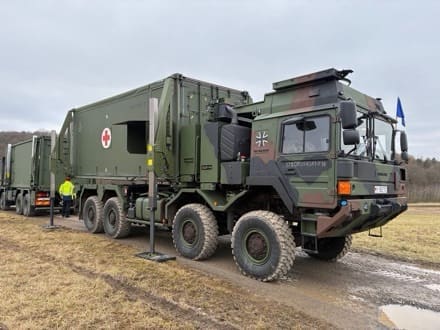
The rescue stations are part of the Modular Medical Facilities system. Within the Bundeswehr’s medical service, these highly mobile rescue stations ensure that the troops receive initial emergency medical care. If required, four soldiers can set up and dismantle the systems within a very short time. This incorporates a lesson learnt from the war in the Ukraine, namely that highly mobile systems are necessary for medical support.

Each rescue station comprises two containers that can be operated together or separately. Each container is fitted with a generator and air conditioning, and can operate independently for several days. Should one generator fail, the entire system can continue to operate using the generator from a single container.

The system features a fully equipped emergency treatment station, as well as four additional treatment stations. All the medical equipment is mounted on Airliner rails and can be configured according to the user’s requirements.

The system can be transported using different carrier vehicles used by the Bundeswehr. It can be set up at a longitudinal and transverse inclination. A custom lifting system was developed for this purpose, as no off-the-shelf system could meet the specified requirements.

The Bundeswehr is procuring both protected and unprotected versions of the system. This involves the refurbishment of an existing system. However, the new rescue station replaces a complex tent structure with a highly modular 3:1 container manufactured by Rheinmetall Mobile Systeme GmbH. The new system can be transported and set up in more challenging terrain.