XC3 Weaponlight

Archive for the ‘EW’ Category

AV Selected for $499M AFRL Contract to Advance Electromagnetic Spectrum Survivable Materials, Awarded $246M in Task Orders

Friday, October 3rd, 2025

ARLINGTON, Va., October 1, 2025 – AeroVironment, Inc. (“AV”) (NASDAQ: AVAV), a leading provider of advanced research and development innovation for national security missions and warfighter protection, has been selected for a 10-year single-award, indefinite-delivery/indefinite-quantity (IDIQ) contract valued at $499 million by the U.S. Air Force Research Laboratory (AFRL) for the High-Performance Electromagnetic Spectrum Survivable Materials Advancement (HELMSSMAN) program. Work completed under the program will mature material technology development and deploy protective solutions to the frontlines, guarding warfighters against exposure to harmful electromagnetic radiation.

“As technologies advance and battlespace tactics evolve, AV is helping warfighters stay ahead of emerging threats,” said Wahid Nawabi, AV Chief Executive Officer. “Whether through our autonomous systems, our layered counter-drone technologies, our advancements in satellite communication and space domain awareness, or–like HELMSSMAN–our advanced research and development, we are taking on the most critical challenges and rapidly transitioning innovation from the lab to the frontlines.”

AV has been awarded two initial task orders for this contract valued at $246 million:

Under the “Advanced Development of Vision Protection Materials” task order, valued at $98M, AV will develop a suite of viable electromagnetic spectrum (EMS) protection capabilities that do not increase operational risk or degrade mission performance. The team will research the interaction of EMS elements with materials, systems, and personnel to develop future-proofed vision protection systems for our warfighters.

Under the “Advanced Development of Materials for EMS Resilience” task order, valued at $148M, AV will conduct research on the impacts of EMS sources on U.S materials, components, and systems and provide mitigation options to the warfighter to ensure effective kill chain execution in complex environments. The team will develop test infrastructure and modeling methods to accelerate the fielding of measures validated in realistic environments for warfighter protection.

With these task orders, AV will research, develop, test, evaluate, prototype, demonstrate, and transition technologies to advance the development of vision protection materials and materials for electromagnetic spectrum (EMS) resilience. Work is planned to begin this month.

Leveraging its multi-domain, multi-mission expertise and past performance delivering innovative R&D material solutions to AFRL, AV will advance electronic protection materials through directed energy solutions, test range experience, modeling, and simulation (M&S) capabilities, and space technology transitions. The company has previously supported AFRL through the development of laser-hardened materials and techniques and electronic, photonic, electro-optical, and quantum materials for Intelligence, surveillance, and reconnaissance (ISR) and electronic warfare (EW) missions.

“We have demonstrated unique strengths in managing and executing strategic research programs,” said Dr. John Hogan, Vice President of Advanced Research and Development at AV. “This contract complements and continues our research and development work in material development with AFRL. We are honored to be a trusted partner in this effort.”

The Advanced R&D team at AV, located in Dayton, OH, is dedicated to developing hardened, smart materials that dynamically adapt properties to protect warfighters, their sensors, and their assets, like ground vehicles, aircraft, and structures. With expertise in thermal, optical, and electronic systems, the team identifies challenges and vulnerabilities across various domains and develops material solutions to counteract threats.

25th Infantry Division Leads the Way in Army Modernization with xTechPacific 2025

Thursday, September 25th, 2025

SCHOFIELD BARRACKS, Hawaii – From September 9–18, 2025, the 25th Infantry Division transformed its training areas into a living laboratory for the U.S. Army’s modernization efforts, hosting the xTechPacific 2025 competition.

The event, which brought ten innovative small businesses to Oahu, gave Army and joint leaders a rare chance to see emerging capabilities tested in realistic operational settings. Soldiers of the 25th Infantry Division and partner units integrated new technologies into live experimentation across Schofield Barracks and Joint Base Pearl Harbor-Hickam, culminating in Distinguished Visitors Day on September 18.

For the 25th Infantry Division, xTechPacific was more than just a showcase of new tools. It was a powerful demonstration of the Army’s Transformation in Contact initiative, which ensures emerging technologies are tested, refined, and employed by operational forces at the point of need.

Transforming in Contact

The Army’s Transformation in Contact initiative is designed to shorten the gap between laboratory innovation and battlefield application. Instead of waiting for long acquisition cycles to deliver fully mature systems, the initiative prioritizes getting promising prototypes into the hands of Soldiers early — allowing them to shape how technology evolves.

As one of the Army’s forward-deployed divisions in the Indo-Pacific, the 25th Infantry Division is uniquely suited for this mission. Its training environments mirror the diverse challenges of the theater: dense jungle terrain, mountainous regions, urban spaces, and maritime surroundings. By hosting xTechPacific 2025, the Division positioned itself as the Army’s bridge between innovators and operational demands.

“The 25th Infantry Division is leading the Army in continuous transformation, and we welcome every opportunity to partner with industry,” said U.S. Army Maj. Gen. James Bartholomees, commanding general of the 25th Infantry Division and U.S. Army Hawaii. “This division was the first in contact on the day of Pearl Harbor, and we have remained in contact ever since—that’s why innovation is so critical. Innovation today directly impacts our readiness against both current and future threats in the most dynamic theater in the world.”

Confronting the Hidden Threat: UXO and IED Detection

Few threats create more danger for ground forces than buried explosives and unexploded ordnance (UXO). In the Indo-Pacific, where soils vary from volcanic rock to dense clay, detecting these hazards is particularly challenging.

At Schofield Barracks’ South Range, innovators worked side-by-side with Soldiers to test advanced detection technologies. Some systems used drone-mounted magnetometers to map anomalies hidden underground. Others combined ground-penetrating radar with thermal imaging to distinguish between clutter and dangerous ordnance.

Soldiers provided critical feedback on ease of use, portability, and performance under stress. For the Division, these tests were not abstract — they reflected real threats encountered during operations.

“The work being done here in the Indo-Pacific is decisive for giving our troops an advantage in protection and capability,” said U.S. Army Lt. Gen Joel B. Vowell, deputy commanding general of U.S. Army Pacific Command. “When Soldiers, industry, and academia come together in real-world experimentation, the results can be transformational.”

The UXO experimentation underscored Transformation in Contact’s central idea: Soldiers must shape the development of tools that will one day protect them on patrol or in combat. By hosting these trials, the 25th Infantry Division directly influenced how the Army will confront the IED and UXO challenge in the years ahead.

Dominating the Spectrum: Electronic Warfare

Electronic warfare (EW) is one of the most contested domains in modern conflict, and the Indo-Pacific presents unique challenges across vast distances and crowded airwaves. For the 25th Infantry Division, ensuring its formations can fight through interference, jamming, and deception is essential.

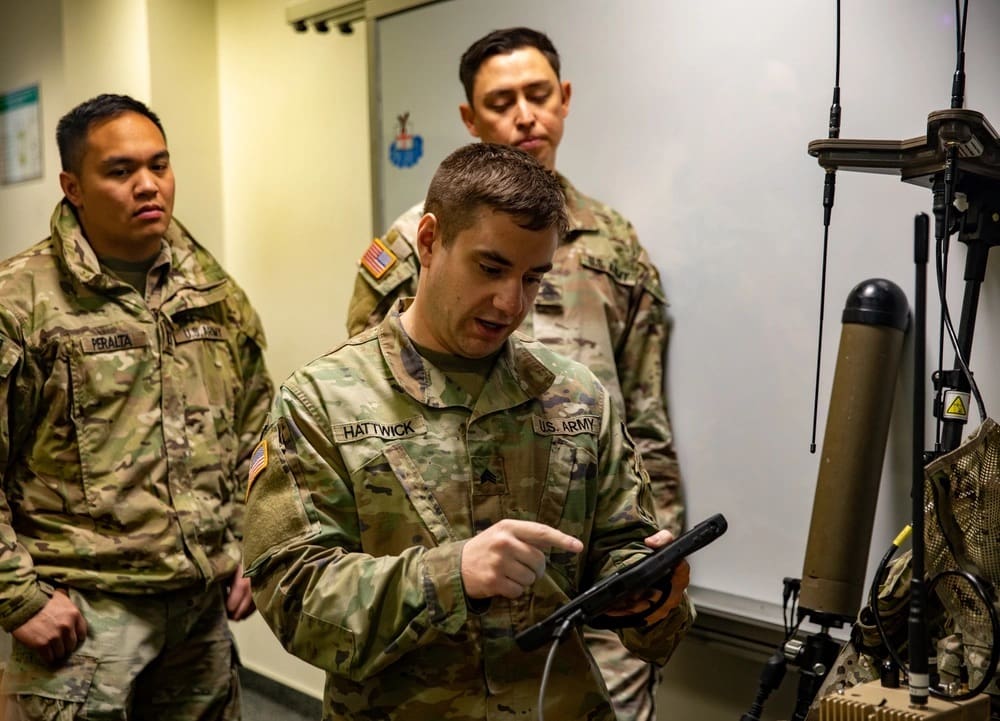
At South Range, Soldiers tested portable spectrum-awareness systems designed to detect and classify enemy signals. These devices, many of them compact enough to fit in a rucksack, used artificial intelligence and advanced processing to rapidly identify emitters across multiple frequencies.

During live scenarios, Soldiers moved through training lanes where they were challenged to detect and respond to simulated electromagnetic threats. Some systems automatically geolocated emitters, allowing units to pinpoint hostile sources. Others provided simplified user interfaces to reduce the cognitive load on Soldiers in fast-moving situations.

“For the first time, Soldier experimentation was incorporated directly into this competition, shaping how technology meets mission needs,” said Jessica Stillman, the U.S. Army xTech program manager. “These innovators received direct feedback from Soldiers and scientists to refine their solutions and ensure operational relevance. This competition embodies how the Army is transforming—incorporating Soldier experimentation into innovation from concept to capability.”

For the Army, xTechPacific’s EW demonstrations showed how Soldier feedback can make advanced technologies more practical for the field. For the 25th Infantry Division, the event reinforced its role as a leader in shaping the Army’s ability to dominate the spectrum in contested environments.

Securing the Seas: Watercraft Defense and Logistics

Operating in the Indo-Pacific means operating across the world’s largest maritime theater. For the Army, this requires not only defending watercraft from threats but also sustaining forces across distributed islands and austere shorelines.

At Ford Island Waterway and later at Schofield Barracks, the 25th Infantry Division helped evaluate technologies designed to meet these challenges head-on.

Autonomous surface vessels demonstrated their ability to provide layered defense for logistics convoys, escorting larger craft while detecting and neutralizing potential threats. Other systems focused on logistics, showcasing modular platforms that could be assembled in shallow waters to support distributed operations.

Soldiers tested these systems in scenarios simulating contested maritime environments, providing input on maneuverability, reliability, and adaptability to real-world missions.

“I’ve seen firsthand how Soldiers, warrant officers, and industry working together can develop life-saving solutions in combat,” said Vowell. “We don’t have the luxury of mass; instead, we must innovate asymmetrically to offset our adversaries’ advantages.”

The Division’s role in hosting these demonstrations highlighted how Transformation in Contact extends beyond the battlefield ashore. By testing technologies in Hawaii’s waterways, the 25th Infantry Division reinforced its readiness to operate in a truly joint, multi-domain environment.

Distinguished Visitors Day: Showcasing Innovation

On September 18, senior Army and joint leaders gathered at Schofield Barracks for Distinguished Visitors Day, the capstone event of xTechPacific 2025.

Guests observed live technology demonstrations in the morning before transitioning to Schofield’s Sgt. Smith Theater for a watercraft expo and the award ceremony. There, the Army recognized three winning innovators, each earning prize funding and the opportunity to pursue further development under the Army’s Small Business Innovation Research program.

“The ideas and technologies you bring will help our reconnaissance companies deploy, fight, and win in multi-domain operations” said Bartholomees.

For leaders, the day was about more than recognizing innovation — it was about seeing firsthand how the Army is accelerating modernization by placing Soldiers at the center of experimentation.

A Division at the Forefront

The xTechPacific 2025 competition reaffirmed the 25th Infantry Division’s position as one of the Army’s leading formations in modernization. By hosting live experimentation in Hawaii, the Division not only validated promising technologies but also demonstrated how the Army is operationalizing its Transformation in Contact initiative.

“Innovation today directly impacts our readiness against both current and future threats in the most dynamic theater in the world,” said Bartholomees.

As the Army looks to the future, the 25th Infantry Division’s role will remain vital. Positioned at the center of the Indo-Pacific, the Division will continue to connect innovators with operational realities, ensuring Soldiers remain ready, lethal, and adaptive in the face of evolving threats.

The Division’s leadership in this effort is not new. Over the past several years, the 25th Infantry Division has been at the cutting edge of transformation by fielding and refining some of the Army’s newest capabilities. The High Mobility Artillery Rocket System (HIMARS) has already proven its value in Pacific-focused training exercises, providing long-range precision fires that extend the Division’s reach across the region’s vast maritime and island geography. By incorporating HIMARS into distributed operations, the Division has shown how precision fires can deter aggression and provide critical options to commanders.

The Division has also embraced the Infantry Squad Vehicle (ISV), a lightweight, highly mobile platform that increases the agility of small units in jungle and mountainous terrain. Soldiers have employed ISVs in rigorous training scenarios across Hawaii, demonstrating how these vehicles enhance maneuverability, reduce fatigue, and enable faster movement in terrain that would otherwise slow infantry forces.

Beyond new equipment, the Division has restructured its formations to better align with the demands of multi-domain operations. Adjustments in task organization, command relationships, and sustainment practices reflect lessons learned through repeated experimentation. These changes allow the Division to operate more effectively as part of joint and coalition task forces, ensuring its units are ready to fight and sustain operations across dispersed island chains.

By combining these advancements with its role as host of xTechPacific, the 25th Infantry Division continues to demonstrate how Transformation in Contact is more than a concept — it is a daily practice. Positioned at the center of the Indo-Pacific, the Division will remain the Army’s proving ground for innovation, ensuring Soldiers stay ready, lethal, and adaptive in the face of evolving threats.

“The technologies showcased [at xTechPacific] will not only serve the Army, but also benefit society,” said Bartholomees. “Their dual-use applications, ranging from disaster response to infrastructure security, demonstrate how military innovation drives national progress and resilience.”

Story by SSG Alvin Conley 

25th Infantry Division

RTX’s Collins Aerospace Awarded NATO Contract for Electromagnetic Warfare Command and Control System

Thursday, September 18th, 2025

Software solution to provide common operating picture of electronic warfare threats

ARLINGTON, Va., Sept. 16, 2025 — Collins Aerospace, an RTX (NYSE: RTX) business, has been awarded a contract by the NATO Communications and Information Agency (NCIA) to provide its Electronic Warfare Planning and Battle Management (EWPBM) solution to NATO. This integrated software tool is designed to plan, direct, coordinate, synchronize, and assess electromagnetic warfare activities.

The EWPBM solution will deliver a Recognized Electromagnetic Picture, combining data from operations, intelligence systems, and other sources, as well as an Electronic Order of Battle, detailing the location and function of electronic devices. This comprehensive overview will enhance the understanding of both friendly and enemy electromagnetic warfare capabilities.

“We’re equipping commanders with a critical tool to visualize electronic warfare threats and automate the use of jammers and sensors,” said Ryan Bunge, vice president and general manager for Command, Control, Communications, Computers, Intelligence & Autonomy at Collins Aerospace. “This system will enhance joint operations’ effectiveness, interoperability, scalability, and resilience.”

EWPBM advances traditional battle management by incorporating situational awareness of the electromagnetic environment, aiding commanders in navigating complex multi-domain warfare. The software solution creates an electromagnetic operating picture, manages electronic warfare tactics, processes data for action plans, and monitors sensors and jammers.

Collins Aerospace will collaborate closely with NATO to rigorously test, validate, and integrate the system, significantly boosting NATO’s electromagnetic warfare capabilities and contributing to the collective defense and security of member nations.

Experimenting with Technology: Soldiers and Innovators Strengthen National Defense

Thursday, September 18th, 2025

Schofield Barracks, HAWAII – Soldiers from the 25th Infantry Division are testing innovative electromagnetic support systems to strengthen the Army’s ability to adapt and operate in the Pacific Theater. Partnering with industry experts through the Army’s X-Tech program, Tropic Lightning Soldiers are experimenting with emerging technology that promises to enhance battlefield awareness, reduce risks to troops, and advance multi-domain operations.

Staff Sgt. Clark J. Tequin, an electromagnetic warfare specialist assigned to the Multifunctional Reconnaissance Company, 2nd Brigade, 25th Infantry Division, emphasized the importance of this technology for future operations.

“The Army functions in multi-domain operations, and this is part of the cyberspace and electromagnetic spectrum,” Tequin said. “This allows us to fight in multiple domains throughout the battlefield. As we move forward in the Pacific, we need these types of technologies to help troops understand and have better situational awareness of the overall battlefield.”

This focus on adaptability demonstrates how the division is preparing for the challenges of modern warfare in a dynamic environment.

The tested system enables Soldiers to detect enemy activity without direct contact—giving commanders an edge in planning and protecting their forces.

“Systems like this allow us to create a baseline on the spectrum and understand what type of signatures might be out on the battlefield—what our enemies are using and how we can exploit those signatures,” Tequin explained. “For example, if our opponents use radios, we might be able to detect those specific radios and exploit their communication and other equipment.”

By developing the ability to see, sense and exploit adversary activity, the division strengthens its Lethality across multiple domains.

Working with industry partners is a key element of the division’s modernization efforts.

“It’s a good way forward as 25th Infantry Division continues to experiment with different technologies and really push the envelope on adapting to modern warfare,” Tequin said. “This is part of that multi-domain operation.”

This partnership reflects how we connect, communicate, and integrate partners as members of one team, showcasing how Soldiers and civilians can collaborate to develop solutions that directly enhance the warfighter.

That collaboration highlighted by Jessica Stillman, an X-Tech program manager, who explained the value of putting technology directly into Soldiers’ hands during first stages of development.

“It means that we are getting technology into the hands of the Soldiers early on and giving companies an opportunity to get feedback on the technology they’re developing,” Stillman said. “That way, they can iterate on it and ensure that it’s ready for field testing and ready for when it’s needed.”

Stillman noted that events like this bring both Soldiers and technical experts together, providing balanced insight.

“It brings together not only Soldiers, but also the technologists to really look at how the technology performs,” Stillman said. “It’s valuable to see what it looks like when the Soldier is using it in the field, and what it looks like from a technical or scientific perspective to ensure that the technology is actually going to work.”


Stillman’s comments reinforce the division’s value in partnerships —bridging industry and military expertise to accelerate innovation.

Sgt. Brock A. Gossling added that adaptability remains at the core of these efforts.

“Testing capabilities like this reflect that mindset because systems like these have to be adaptable and go after whatever the 25th Infantry Division has in front of them,” Gossling said. “We have to be able to use these systems and go after any targets in any area.”

Beyond adaptability, one of the fundamentals focuses on protecting Soldiers while accomplishing the mission. Gossling explained how electronic support systems enhance safety.

“Electronic support systems like these are important because they provide commanders with early warning and threat detection, so they have a better understanding of their awareness,” he said. “It also allows commanders to understand their income levels and limit the signature they output.”

This speaks directly to managing risk, ensuring that commanders can make informed decisions while minimizing risks to their troops, people, and mission.

Stillman emphasized that this is just the beginning of the Army’s partnership with X-Tech.

“This is the first experimentation that X-Tech is doing—not the last,” she said. “We have several more coming up, and Army senior leaders continue to ask how we can rapidly identify technology and get it into the hands of Soldiers. That is exactly what we will be doing in the months ahead.”

Tropic Lightning Soldiers are testing new electromagnetic support systems to sharpen Lightning Discipline and keep the division lethal and ready. By working with industry partners, leaders show Initiative and Agility to adapt faster than adversaries in the Pacific. And by connecting Soldiers with civilian experts, the division Strengthens Soldiers and Community, ensuring trust and readiness remain at the core.

Off to the Races: DRBE Develops World’s Largest Real-Time EW Test Range

Tuesday, August 26th, 2025

Digital RF Battlespace Emulator enables new levels of realism, scale, and complexity


Artist’s concept: Notional rendering of a warfighter leveraging the DRBE system in an electronic warfare test scenario. Source: DARPA | Colie Wertz

The U.S. Department of Defense faces an increasingly complex electromagnetic environment, in which rapid advances in radar and electronic warfare (EW) demand new tools for development, testing, and training. DARPA’s Digital RF Battlespace Emulator (DRBE) program took up this challenge, resulting in the world’s largest high-fidelity, real-time virtual radio frequency (RF) test range – enabling previously unachievable scale and realism in the emulation of EW scenarios.

Unlike traditional modeling, simulation, and open-air testing approaches, the DRBE system allows for the complex interaction of synthetic RF entities simultaneously, all within a fully software-defined environment. This offers a powerful new tool for testing AI-enabled EW capabilities and accelerating the development of next-generation RF systems. 

“DRBE is a leap forward in how we can prepare and equip RF systems against sophisticated adversaries,” said Anna Tauke-Pedretti, Ph.D., DRBE program manager in DARPA’s Microsystems Technology Office. “DRBE is not only setting a new benchmark for real-time simulation but is also accelerating our ability to develop and refine advanced electronic warfare capabilities that keep pace with emerging threats.”’

At the heart of DRBE is a real-time high-performance wafer-scale computing architecture, or “Real-Time HPC,” powered by the world’s largest processor. This compute system delivers massive throughput with ultra-low latency, a critical requirement for simulating complex RF engagements with the timing precision needed for modern EW tactics.

The first DRBE system will transition to a U.S. Navy lab in late 2025, where it will be integrated into the Department of Defense’s testing and evaluation infrastructure.

“DRBE is a catalyst, redefining the scale at which we can develop EW payloads and address complex challenges. It empowers our lab to craft solutions with unprecedented sophistication, significantly boosting our confidence in the effectiveness and reliability of our products,” said Jenifer Koch, chief technologist, Aircraft and Spectrum Integration Environments, U.S. Navy.

Expanding DRBE’s range

Building on this momentum, DARPA is now seeking to expand DRBE’s architecture to further boost performance and data flow. This next phase of development will integrate cutting-edge optical interconnects into the DRBE system, drastically increasing bandwidth and enabling scalable connections between hundreds of wafer-scale computers.

These enhancements will unlock the potential for even larger-scale RF scenarios, while also opening pathways for DRBE’s architecture to support additional mission domains, including battlespace autonomy, materials science, and digital twins.

“DRBE isn’t just a test tool; it has the potential to be a strategic enabler for next-generation defense technologies,” said Tauke-Pedretti. “By pushing the boundaries of real-time emulation and compute, we’re laying the groundwork for smarter, faster, and more resilient EW systems.”

Transformation in Contact Units Test Spectrum Situational Awareness System

Friday, August 22nd, 2025

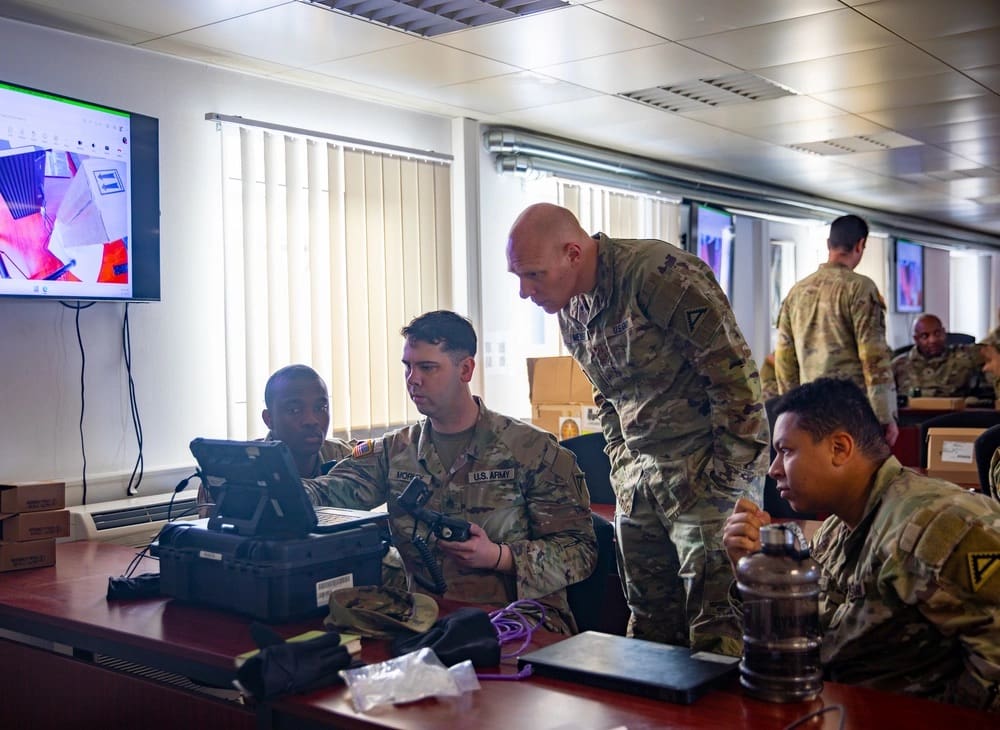
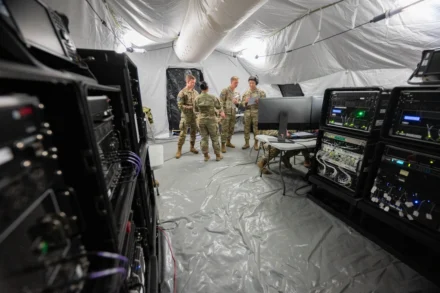
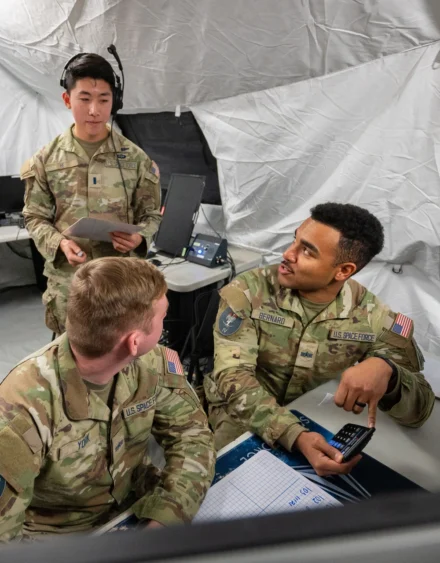
Joint Base McGuire-Dix-Lakehurst, NJ — Soldiers with the 25th Infantry Division, 101st Airborne Division, 11th Airborne Division and Special Operations Command received first touch and training on the Army’s newest addition to its Electromagnetic Warfare toolkit, Spectrum Situational Awareness System (S2AS).

The three-week User Assessment consisted of a week’s worth of training on S2AS and the Electronic Warfare Planning and Management Tool-X.

“This developmental test simulates a brigade headquarters with two dislocated companies testing out the S2AS system,” Maj. Megan Bridges, Assistant Project Manager for S2AS said. “We want to ensure the system is able to sense, detect and report emitter information.

S2AS is an electromagnetic spectrum situational awareness system that provides commanders with real-time electromagnetic spectrum (EMS) Situational Awareness to support EMS related-decisions making.

“When we incorporate missions control measures on the battlefield to ensure that the enemy can’t see us, we need to minimize who can use specific frequencies, systems, and at what power levels and bandwidth are they using to make sure we’re minimizing the enemy’s ability to see our blue force signature, whether on an installation or on a battlefield,” Master Sgt. Mike Powell, 3rd Infantry Division explained.

Understanding, and ultimately controlling, the electromagnetic spectrum on the battlefield is crucial to the Army.

“The Army has been pressing very hard on what it means to own the EMS,” Col. Leslie Gorman, Army Capabilities Manger for Electromagnetic Warfare said. “You have to understand the EMS as maneuver space and, understanding what our emissions look like on the battlefield, what the adversaries looks like on the battlefield, the countermeasures that are need to be put in place.”

S2AS is specifically designed to provide that visibility and the visualization for Soldiers and for the commanders in order to make more informed decisions.

“The Army needs an organic electromagnetic warfare sensing capability, which the system provides,” Bridges said. “It also increases the Cyber Electromagnetic Activities cell planning bandwidth, another important function S2AS brings to the table.”

“S2AS, being the Army program of record for the spectrum manager, gives us the ability to define the electromagnetic operating environment,” Powell said. “With the system, spectrum managers can identify signals on the battlefield, on a FOB, or on an installation, detect and analyze the signals and then provide that information back to commanders.”

The S2AS capabilities were effectively demonstrated during this test event. As more feedback from Soldiers becomes available through future TIC 2.0 experimentation events, the Army can ensure continuous refinement of the system to enhance its capabilities.

S2AS is slated for fielding to TIC 2.0 units in FY26.

Full Video – www.dvidshub.net/video/973339/spectrum-situational-awareness-system-s2as-news-video

By Shawn Nesaw, PEO IEW&S Strategic Communications

Northern Strike Brings Electromagnetic Warfare to the Front Lines

Saturday, August 16th, 2025

CAMP GRAYLING, Mich.—In modern warfare, battles are not only fought with rifles, tanks and artillery. Some of the most decisive victories are won across the electromagnetic spectrum.

At Northern Strike, the National Guard’s premier readiness exercise held this month at Michigan’s National All-Domain Warfighting Center, Soldiers trained in a high-intensity environment that pushed the limits of electromagnetic warfare, or EW. It tested their skills in realistic combat scenarios.

In classrooms, electromagnetic warfare specialists often train to disrupt, or “jam,” enemy communications, intercept signals and scan for threats. Jamming works by overpowering or confusing an enemy’s radio or data transmissions, preventing them from communicating or coordinating effectively.

Last year at Northern Strike, the 37th Infantry Brigade Combat Team, or IBCT, launched a pilot program that sent a mobile EW team into the field to disrupt the communication systems of units in training.

This year, the EW teams were embedded in infantry squads to create a more realistic, complex environment for Soldiers.

“This is a rare training opportunity in the National Guard and in the Army as a whole,” said Spc. Robert Bowley, an Electromagnetic Warfare specialist in the 37th IBCT from Columbus, Ohio. “To train with the equipment, you need the funding, and Northern Strike allows for that.”

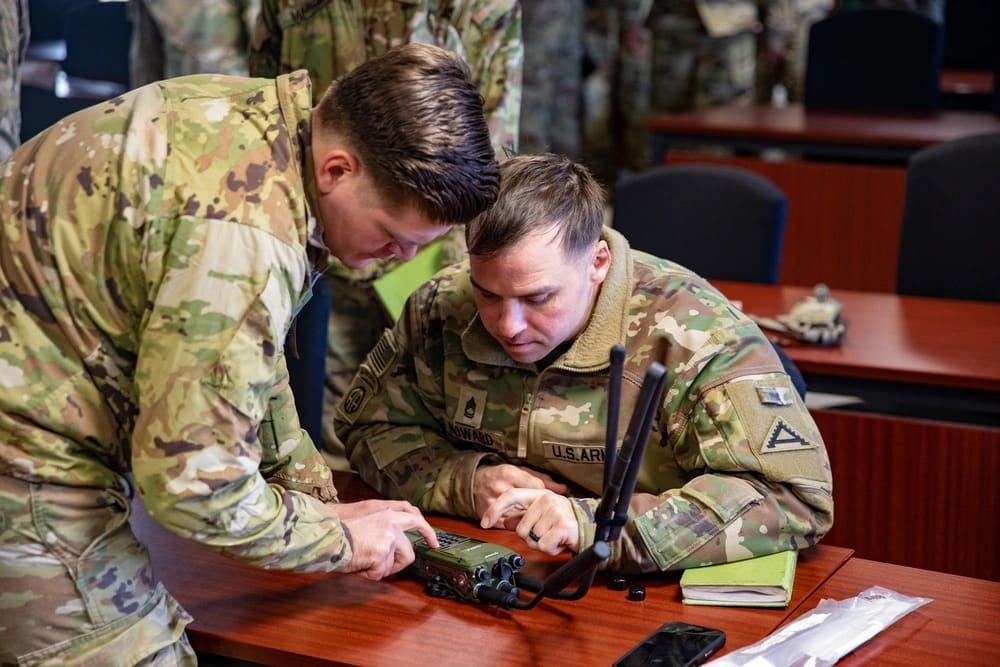
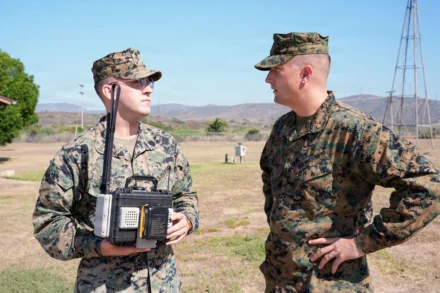
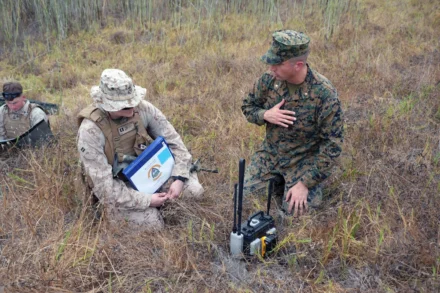
Bowley was equipped with the Beast+ system, a handheld multi-channel receiver and transmitter designed for Army EW operations. The system scans the electromagnetic spectrum to detect enemy signals, identify spoofing or jamming threats and enhance battlefield awareness.

“The antenna gives you a general direction and signal strength. I can see anything on the [radio frequency] spectrum,” Bowley said. “We also have a power amplifier that lets us jam communication systems.”

Bowley, who also participated in the exercise in 2024, said he acted as “an early warning system. I will be giving the direction of the opposing force and jamming their comms.”

The mission brought together electromagnetic service members from the 37th IBCT, the Royal Irish Regiment and the Latvian National Armed Forces. The teams combined their expertise by embedding an electromagnetic specialist with the Irish regiment and managing signal towers with the Latvian forces to carry out a complex, coordinated operation.

“In my job, you are on the front lines. We are not cyber on computers, we are in the field,” Bowley said.

At 1800 hours, Browley and seven infantry soldiers from the 2nd Battalion, Royal Irish Regiment, British Army, stepped off to the Combined Arms Collective Training Facility, which simulates fighting in urban terrain. Once they arrived, the squad cleared the building and Bowley looked for the best place to set up the Beast+.

“Ideally, it would be on top of a roof,” he said. “But they have drone capabilities, so this [his location] was the next best thing. In the best case scenario you want to be high up and have nothing around you.”

While the Royal Irish Regiment placed obstacles around the building, Bowley found a dark corner with windows on both sides.

“We will be defending from up here. With this spot, I have a window on both sides and am able to get the antenna outside. The main thing that is important is what is being said over the radio. When I see something on my screen, I will know the direction they’re coming from,” Bowley said.

Bowley knew the long night ahead would test his focus. He monitored the electromagnetic spectrum for hours, watching for the slightest signal of an attack and standing ready to jam enemy communications.

“I brought a lot of caffeine,” he said, laughing. “We have the go-ahead to jam whatever. Usually, you have to really go through hoops. The problem with jamming is that it is risky. Turning off comms can do a lot. The things that I will be looking at jamming are important. Like when they call up nine-lines, or before an assault.”

Bowley’s squad was on defense, which required members to stay alert the entire time. At 2200 hours, they experienced probing from a platoon-sized element testing their defenses. A drone tagged four simulated casualties.

At 0300 hours, shouts echoed as infantry teams moved in to assault the objective. With their communications jammed, the attackers yelled to coordinate.

“They realized we were jamming them and immediately got off their comms,” Bowley said.

Moments later, the opposing force stormed into the room and took down the defending squad in the exercise.

Master Sgt. Jason Ross, the electromagnetic spectrum operations noncommissioned officer for the Army National Guard Information Advantage Division, said the exercise was a reminder of why electromagnetic warfare must be integrated into training.

“Communications systems have changed rapidly in recent years and now evolve almost monthly,” Ross said. “The threat has grown significantly. Thinking outside the box is critical, but it’s not always an easy discussion to have.”

This scenario was unique because the communications cell was on the red team, creating an unpredictable training environment.

“It is hard to duplicate what we are doing at Northern Strike. The approval for this type of training is tricky. The support that Michigan has given to this exercise is amazing,” Gilly said. “The reality is when we train on a rifle range, a Soldier knows what to expect. That is not the case with electromagnetic warfare.”

Maj. Tucker Palmatier, a cyber electromagnetic warfare officer and Cyber Electromagnetic Activities officer in charge of the 37th Infantry Brigade Combat Team, said training in electromagnetic warfare is challenging because of federal restrictions.

“The FCC [Federal Communications Commission] law on jamming dates back to 1934, which makes it difficult to realistically train for today’s technology-driven battlefield,” Palmatier said.“Our challenge is maximizing training opportunities without breaking laws or regulations so Soldiers know exactly what to expect when it matters most.”

Despite those hurdles, Palmatier said the operation was a success.

“Our enemy was not anticipating electromagnetic warfare. We were able to degrade their communications, which left them unable to coordinate their attack, allowing a smaller force to successfully defend the position,” he said.

By 2LT Paige Bodine, Michigan National Guard

Pacific Defense Launches SABER, a Multi-Function Electronic Warfare Product Family for Multi-Domain Missions

Tuesday, August 12th, 2025

SABER’s tactical edge-based AI/ML capabilities enhance system performance, reduce operator burden, and counter emerging threats—all built on a MOSA framework

EL SEGUNDO, Calif.– Pacific Defense, the leader in C5ISR Modular Open Suite of Standards (CMOSS) products and integrated mission systems, announces the launch of its SABER Multi-Function (MF) Electronic Warfare and Signals Intelligence (EW/SIGINT) product family. The first offering in the line is the EWS1090VP — a 9-slot 3U OpenVPX™ system that seamlessly integrates counter-UAS, counter-communications, counter-IED, and counter-radar electronic support capabilities.

Designed for rapid capability insertion and adaptation, SABER addresses the complexity of today’s electronic battlefield, where adversaries continuously adapt, and traditional countermeasures struggle to keep pace. With its wideband processing capabilities, SABER empowers operators to conduct comprehensive, full-spectrum surveys of the electromagnetic environment. Warfighters can pinpoint signals of interest in real-time, while advanced direction-finding and geolocation maintain persistent tracking of threat emitters. SABER also delivers electronic countermeasures through multiple low-latency active and reactive electronic attack (EA) modes, effectively neutralizing threats while enhancing situational awareness and force protection.

MOSA Standards Revolutionize Life-Cycle Management

Aligned with CMOSS and The Open Group’s Sensor Open Systems Architecture™, SOSA™, technical standards, SABER is a Modular Open Systems Approach (MOSA) solution that leverages Commercial Off-the-Shelf (COTS) components—such as antennas and amplifiers—to reduce delivery timelines, lower costs, and enable rapid integration of multi-vendor technologies.

By adhering to SOSA and the CMOSS Modular Open Radio Frequency Architecture (MORA), SABER provides open interfaces for radio frequency (RF) systems. This ensures the platform remains adaptable and capable of addressing frequency-agile threats in congested electromagnetic environments. SABER can be quickly upgraded with any MORA-compliant third-party software application or software-defined radio (SDR), allowing operators to stay ahead of emerging threats. These accelerated upgrade cycles and cost efficiencies ensure warfighters are equipped with the most advanced RF systems available—from trusted, government-approved partners.

SABER Enhances Operator Effectiveness

SABER’s software enables versatile orchestration, from interactive control to fully automated, remote managed operations. Through a unified user-friendly interface, warfighters can seamlessly monitor system hardware, operate battle management tools, integrate third-party applications, and deliver decisive effects across the electromagnetic spectrum.

Integrated advanced artificial intelligence and machine learning (AI/ML) algorithms enhance SABER’s ability to detect RF patterns of life and identify anomalous behaviors. This maximizes accuracy while reducing operator workload and increasing overall mission efficiency.

“SABER’s tactical edge-based AI/ML capabilities enhance system performance, reduce operator burden, and counter emerging threats—all built on a MOSA framework,” said Frank Pietryka, VP of EW, SIGINT, and Autonomy at Pacific Defense. “Warfighters gain theater-level EMS superiority today, with the flexibility to upgrade emergent capabilities tomorrow. The modular design behind SABER’s multifunctionality allows us to continuously innovate and stay ahead of rapidly evolving EW threats.”

For more information, please visit: SABER.