Phantom Lights

Archive for the ‘EW’ Category

Modernizing Air Force TACP Ground Evaluations

Tuesday, March 17th, 2026

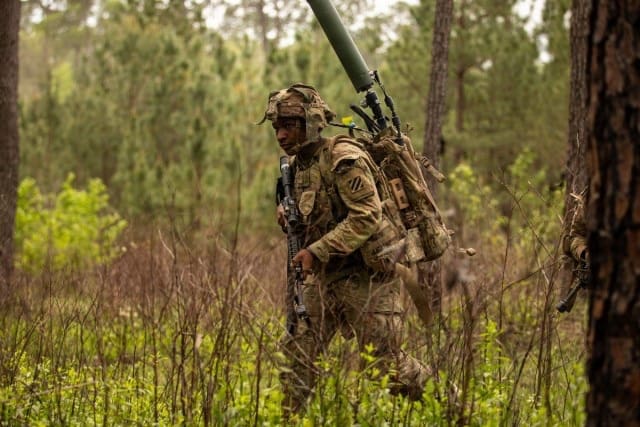
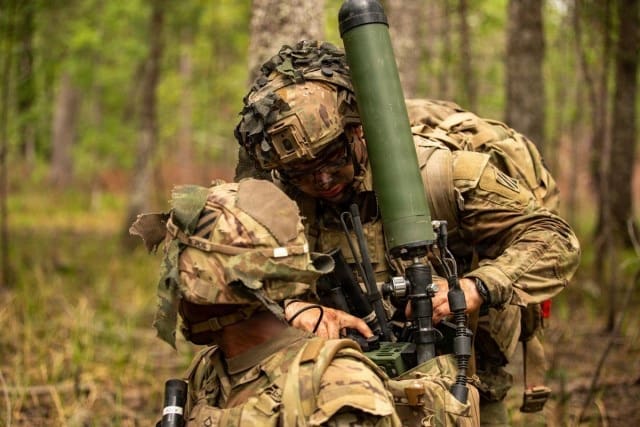
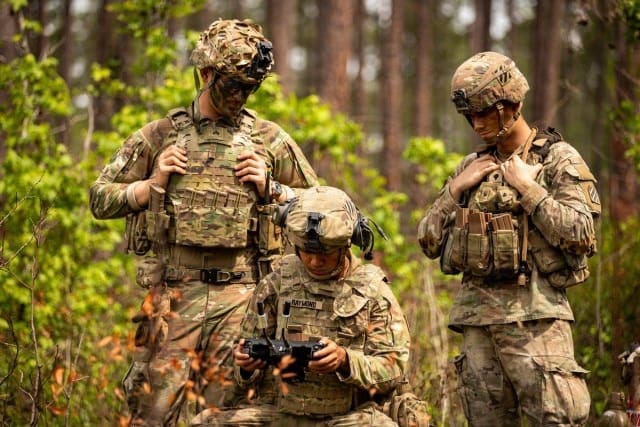
FORT CAMPBELL, Ky. — Air Force tactical air control party (TACP) operators from the 19th Air Support Operations Squadron underwent a comprehensive mission evaluation in January, utilizing advanced electronic warfare and autonomous drone technology to validate new ground combat standards.

The evaluation, which became a requirement for Air Force Special Warfare TACP units roughly two years ago, ensures operators maintain combat mission readiness through a full mission profile. The rigorous assessment covers every phase of a deployment, including preparation, infiltration, action on objectives, exfiltration, and a final mission debrief. Special Operations Warfare Ground Evaluations are conducted every 24 months to validate the unit’s combat mission readiness and ability to operate in in contested environments.

The evaluation began in a classroom setting where the team received a warning order detailing the mission. Lt. Col. Craig Lowrey, the 19th ASOS director of operations, served as the team leader during the exercise. He said the initial phase required the team to analyze the overarching mission set and discuss the scheme of maneuver while identifying the expectations for both friendly and enemy forces.

Once the planning phase concluded and a written portion was completed, the team moved to the field for a target acquisition mission. Evaluators provided only a rough area of interest, forcing the team to rely on specialized equipment to pinpoint an enemy location on an airfield.

The insertion took place in total darkness, requiring every operator to utilize night vision goggles. 1st Lt. Michael Morin, a ground evaluator assigned to the 19th ASOS, said the lack of ambient light made the mission particularly difficult.

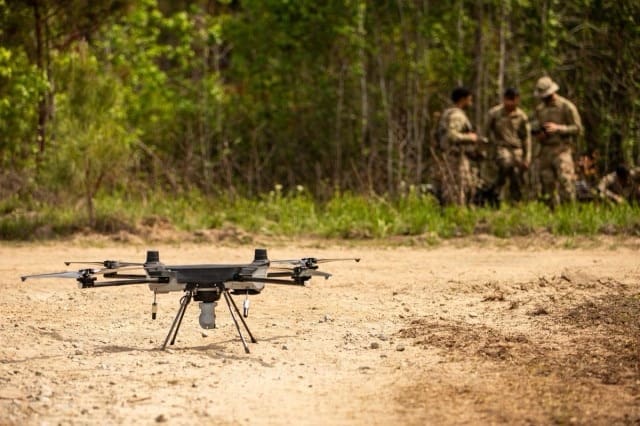
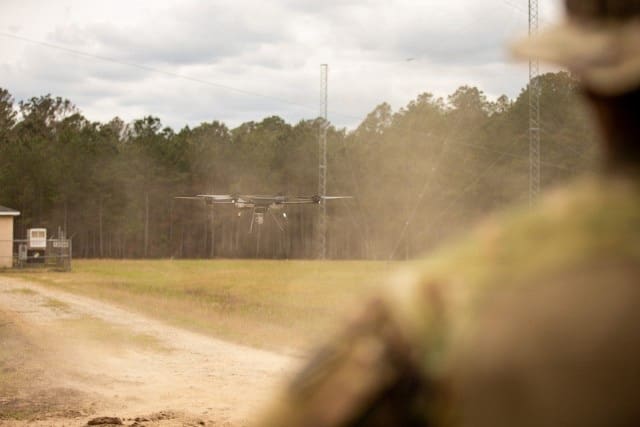
Upon reaching the vicinity of the objective rally point, the team secured the area. While the assistant team leader maintained security, the team launched a small Unmanned Aircraft Systems (sUAS) Skydio X2D drone. The sUAS was flown several hundred meters from the target area, obscured by the tree line, to get eyes on the objective.

The sUAS, which features 3D mapping and collision avoidance, allowed the team to navigate the forest and locate targets in a large open area. This provided the commander with a live video feed to refine the targeting data.

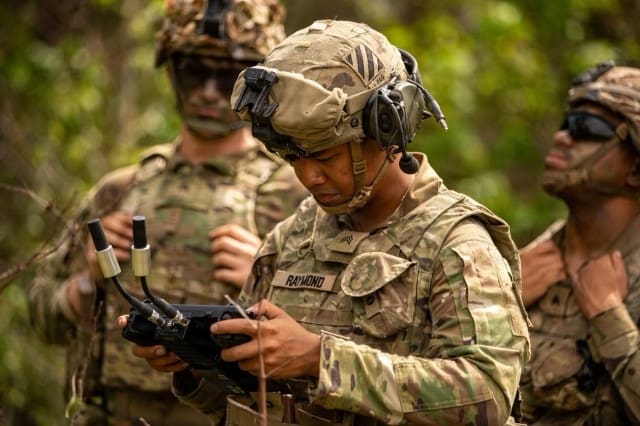
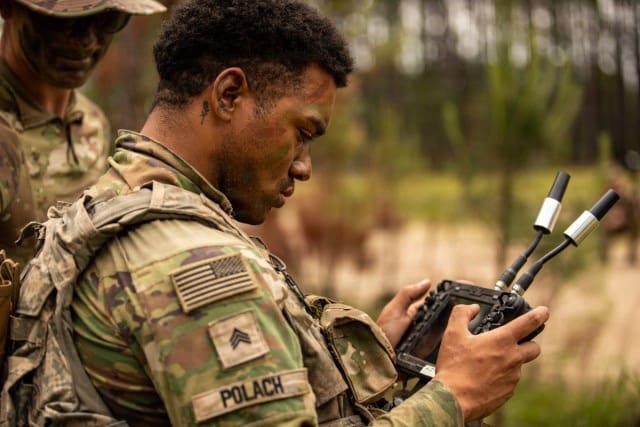
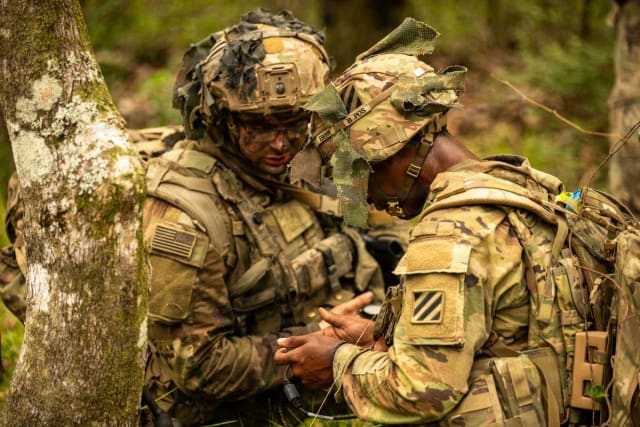
Simultaneously, the team utilized Electromagnetic Spectrum Operations (EMSO) using the Beast+ platform. This handheld device identifies and tracks adversary signals, such as radio or cellular communications.

“It can hear what kind of frequencies are being used,” Morin said. “It can help us pinpoint where radio traffic is coming from.”

By combining the signal data from the Beast+ with the visual data from the drone, the commander was able to determine the exact direction and location of the enemy.

Lowrey said the team made its way through multiple checkpoints before reaching the objective area. By using the technology to refine their targeting, they were able to send reconnaissance and surveillance teams forward to pinpoint high-priority targets. This allowed the team to successfully coordinate simulated airstrikes and artillery strikes.

The introduction of these ground evaluations reflects a shift in how the Air Force tests its special warfare operators. Morin noted that because these evaluations are relatively new, units are still refining the process to ensure operators are tested to the highest of their abilities.

The integration of low-profile, high-power technology like the Beast+ and Suas autonomous drones are essential for the TACP community as it prepares for near-peer conflicts where the electromagnetic spectrum is a primary battlefield.

By Jedhel Somera

Roke USA – Perceive MR Antenna

Wednesday, March 4th, 2026

Part of Chemring Group, Roke USA specializes in electronic warfare systems.

The Perceive Multi Role antenna features a small form factor head for Adaptive Digital Beamforming and Super Resolution Direction Finding (separate multiple signals on same channel) including azimuth and elevation outputs.

Compatible with PREFIX2 and VIPER software it offers 100MHz instantaneous bandwidth covering 2MHz to 6GHz.

Epirus, Digital Force Technologies Partner to Develop Non-Kinetic Counter UAS Kill Chain

Friday, February 27th, 2026

Los Angeles & San Diego, Calif—February 23, 2026Epirus and Digital Force Technologies (DFT) have partnered to deliver a fully integrated counter-UAS kill chain unifying the companies’ respective technologies for detection, tracking, identification, localization and non-kinetic, low collateral defeat of unmanned aerial systems (UAS) threats.

Under the agreement, Epirus will lead systems integration of DFT’s Seraphim command-and control and multi-modal sensor fusion software with Epirus’ Leonidas high-power microwave (HPM) platform for critical point defense.

Epirus’ Leonidas high-power microwave is a proven non-kinetic counter-UAS solution that  leverages electromagnetic interference to defeat swarming, AI-controlled and fiber-optic guided UAS that can evade legacy electronic warfare tactics. The Leonidas platform emits precise  electromagnetic interference to disable the critical electronics onboard a drone, neutralizing the  threat. Using software-based, operator-defined safe zones, Leonidas provides a scalable, high precision and low-collateral counter-UAS capability. The platform defeated a 49-drone swarm simultaneously with a targeted burst of electromagnetic interference at a 2025 live-fire demonstration.

DFT’s Seraphim software platform and counter-UAS Family of Systems deliver autonomous  tracking and identification of UAS threats in complex operational environments. Trusted to support  critical missions worldwide, Seraphim is built on a modular, scalable architecture that remains  sensor- and effector-agnostic, enabling rapid integration of best-in-class capabilities. Seraphim  combines sensing, decision support and effects coordination through a unified operational  interface. By fusing data in real-time and autonomously prioritizing threats, the platform enables  operators to move from detection to response with speed and precision.

“Leonidas was designed to maximize interoperability with partner technologies,” said Andy Lowery, Epirus CEO. “This collaboration marries our systems integration and swarm defeat  expertise with DFT’s edge processing and automation knowhow to deliver exactly what our  customers are asking for: a flexible, adaptable and fully integrated counter-UAS kill chain for critical point defense missions.”

“Integrating Seraphim with Epirus’ Leonidas high-power microwave platform extends AI-enabled  decision making through the defeat layer of the counter-UAS kill chain, delivering a turnkey detect to-defeat capability,” said Justin MacLaurin, Digital Force Technologies CEO. “This partnership  reflects a shared commitment to scalable, interoperable systems that give operators faster, more  effective solutions to defeat evolving drone threats.”

The companies will partner on U.S. government demonstration activities and are expected to  present their full counter-UAS kill chain solution later this year.

Eyes on the Horizon: Honing Counter Drone Skills in Eastern Europe

Friday, February 27th, 2026

Download the full document here: No. 26-1120, Eyes on the Horizon: Honing Counter Drone Skills in Eastern Europe (Feb 26) [PDF – 2.9 MB]

“In a situation where seconds determine survival, C-sUAS training isn’t just preparation, it’s a measurement of readiness. We must be ready to counter the evolving threat of unmanned systems…to dominate the skies.”

– 173rd IBCT (A) UAS subject matter expert.

Introduction

Observations from the Russia-Ukraine War have revealed emergent tactics, techniques, and procedures (TTPs) in the employment of small-unmanned aircraft systems (sUAS), which have proliferated across the battle space. Russian sUAS have become a significant and persistent factor in protection considerations for Eastern European nations, particularly bordering Ukraine. The rapid employment of sUAS compresses the decision-making cycle to mere seconds, rendering traditional centralized air defense approval processes ineffective at the tactical edge. Consequently, the training environment in future U.S. Army Europe and Africa exercises must replicate the compressed decision cycles and complex threat environments seen in Eastern Europe, ensuring tactical leaders have both the tools and the authority to act decisively.

Numerous drone incursions from the Russia-Ukraine War have spilled over into neighboring countries. These incursions have heightened concerns over unexploded ordnance (UXO), particularly in Moldova’s southern regions: Cahul, L?pu?na, and Tighina which are near the Ukraine border. UXO threats in these regions raise concerns about public safety and regional security. These challenges and concerns are not unique to Moldova but are prevalent across NATO’s Eastern Flank Deterrence Line, underscoring the need for enhanced counter small-unmanned aircraft systems (C-sUAS) capabilities and regional collaboration. This publication provides insights on how U.S. Army Europe and Africa (USAREUR-AF) units plan and execute C-sUAS training along with lessons learned from exercise Fire Shield ’25 executed in Moldova in August 2025.

Background

USAREUR-AF leadership plans to conduct C-sUAS activities in exercises to build readiness with subordinate units, integrate emergent technologies, and exchange best practices with Allies and partners. However, host nation legal frameworks governing radio frequency (RF) jamming often constrain full replication of real-world, non-kinetic defeat operations across many established training areas in Western Europe during peace time. Partner nations, like Moldova, that formerly belonged to the U.S.S.R., are optimum locations to conduct C-sUAS training because of drone incursion threats that bleed over from the Russia-Ukraine War. These threats have created a regulatory environment that allows C-sUAS equipment to operate and a host nation appetite for electronic warfare (EW) focused training. As a result, the 173rd Infantry Brigade Combat Team (Airborne) partnered with the 2nd Moldovan Brigade to conduct C-sUAS training as part of the Moldovan annual exercise Fire Shield ‘25 from 4-14 August 2025 at the Bulboaca Training Area in Moldova.

By CPT Madison Fuentes, CPT Saundra Johnson, Scott Safer, Samuel Flaming

Allen-Vanguard Breaks into South America with a Multi-Million Dollar Order for Their EQUINOX NG and SCORPION 2 ECM systems

Friday, February 6th, 2026

Allen-Vanguard, the global leader in providing customised solutions and enabling technology across the Cyber and Electromagnetic Activities (CEMA) domain, has recently received multi-million dollar orders for EQUINOX NG (their vehicle-based Electronic Countermeasure (ECM) system) and SCORPION 2 (their manportable ECM system). Due to the sensitivity of the purchasing nation’s operations, it is not possible to disclose specific customer details. However, this initial multi-million dollar order is a major capability uplift for the end user, will deliver enhanced protection to their personnel operating in high-risk Radio Controlled Improvised Explosive Device (RCIED) environments and help mitigate the threat posed by the increasing use of drones to deliver lethal effects.

Allen-Vanguard has over 20 years of expertise in providing customised ECM solutions for defeating Radio Frequency (RF) based terrorist and extremist threats. These threats include the continued global use of RCIEDs to target security forces and the increasing prevalence of drones or Unmanned Aerial Vehicles (UAV) being used for intelligence, surveillance, target acquisition and reconnaissance (ISTAR) or lethal means. Defence Forces, Public Safety & Security agencies around the world trust Allen-Vanguard’s capability solutions, because they are easy to use, robust, reliable and have been operationally proven on the battlefield and in the most challenging of peace-keeping missions protecting those who protect us.

Based on the current threat profile, the customer has purchased EQUINOX NG, a highly sophisticated vehicle-based ECM system. Its agile and flexible technical architecture has been developed around the leading global standards for Electronic Warfare (EW) hardware, ensuring compliance and easy integration with major programs for an enduring and ‘ever-greening’ capability. Coupled to a highly flexible and scalable physical format, allows it to be easily configured for a wide range of scenarios from armoured vehicle fits for operational theatres, VIP convoy protection or static vulnerable fixed site locations. The system can be configured with relative ease to address both the RCIED and drone threats alike. SCORPION 2, has all the same technical heritage and similar capabilities as EQUINOX, but has been specifically designed to be portable using a backpack for patrol-based operations. Clearly, it can also be fitted to vehicles or used at static locations, offering maximum flexibility.

The contract comes with a full support package, including training for users, technicians and mission fill development. This support includes the deployment of Field Service Representatives to ensure the development of indigenous ECM capability and reach back to the Threat Management Team.

This team of RF experts optimise algorithms specific to the end user’s needs to combat evolving threats specific to their region of operations. This comprehensive wrap-around support maximises the protection offered by the ECM systems, both from a physical capability perspective but also from the essential changes to tactics, techniques and procedures necessary to keep operators safe.

Bobby Strawbridge, President Allen-Vanguard, said: “This is an important milestone in Allen-Vanguard’s history, breaking into the South American market. We are operationally proven with NATO countries globally and have been trusted by peace-keeping forces in the MENA region for many years. Our systems are not only market leading in relation to their technology and capability but our support packages also ensure purchasing nations improve their wider ECM capability and remain updated with the latest algorithms and software to maintain their protection.”

CACI to Strengthen US Army Readiness and Spectrum Dominance with Next-Gen Electronic Warfare

Wednesday, January 28th, 2026

RESTON, Va.-CACI International Inc (NYSE: CACI) announced today that it has been awarded a five-year task order valued at up to $250 million to enhance spectrum dominance for the U.S. Army Capability Program Executive – Intelligence, Electronic Warfare & Sensors (CPE IEW&S).

“At CACI, we are making bold investments in battle-proven, software-defined EW solutions that allow us to stay one step ahead of the enemy and drive decisive action,” said John Mengucci, CACI President and Chief Executive Officer. “We empower warfighters to achieve and maintain spectrum dominance, especially when their lives are on the line in highly contested environments.”

CACI will leverage its intrinsic knowledge to provide comprehensive integration and sustainment of the technology to advance the Army’s multi-domain EW and spectrum dominance capabilities.

Safran Federal Systems Demonstrates Blacknaute Inertial Navigation System on US Army Black Hawk Following AUSA Debut

Thursday, January 22nd, 2026

ROCHESTER, NY – January 21, 2025

Safran Federal Systems, a trusted U.S. Department of Defense mission partner and leader in Assured Positioning, Navigation and Timing (A-PNT), announced the successful flight demonstration of its Blacknaute™ Inertial Navigation System (INS) aboard a U.S. Army UH-60 Black Hawk helicopter.

Purpose-built for multi-domain operations, Blacknaute™ delivers precise navigation in GPS-denied and electronic warfare-contested environments, fulfilling a critical need for resilient, open-architecture PNT capabilities across air, land, sea, space, and cyber domains.

The live flight test confirmed Blacknaute’s ability to maintain high-accuracy inertial performance without GNSS support, validating operational readiness just days after its U.S. debut at the 2025 Association of the United States Army (AUSA) Annual Meeting & Exposition in Washington, D.C.

“Our demonstration onboard the Army Black Hawk showcases the tactical readiness of Blacknaute™,”said Jon Leombrone, Executive Vice President of Navigation Systems at Safran Federal Systems. “The system maintained drift of less than 0.4 nautical miles per hour over several hours—proof of its SWaP-optimized, NAVWAR-resilient design engineered for rapid deployment across the Joint Force.”

Blacknaute™ combines multiple cutting-edge technologies in a rugged, lightweight system weighing less than 16 pounds. Key features include:

HRG Dual Core™ Technology: Safran’s patented hemispherical resonator gyro platform, fielded in more than 40,000 units and proven over 30 million operational hours across defense and aerospace applications.

M-Code Ready GNSS Receiver: Supports secure, multi-constellation satellite navigation using military-grade M-Code signals.

Ultra-Stable Atomic Clock: Provides highly precise timing with drift of less than one second every 30,000 years, ensuring reliable synchronization across mission systems.

Interference Detection and Mitigation (IDM): Built-in capabilities for detecting and mitigating GPS spoofing and jamming threats, enhancing survivability in electronic warfare environments.

Open Systems Architecture: Fully compliant with MIL-STD interfaces and TSO-C220 standards, enabling plug-and-play integration with modular open systems used across modern defense platforms.

Safran Federal Systems provides advanced, classified navigation and PNT solutions to Safran Defense & Space, Inc. (Safran DSI), accelerating innovation across multi-domain operations in support of U.S. defense programs.

For more information, visit us at BlackNaute | Air Navigation | Safran Federal Systems.

Year in Review: CECOM SEC Provides Solutions Through Modernization

Tuesday, January 20th, 2026

In 2025, the Communications-Electronics Command Software Engineering Center advanced the Army’s modernization portfolio through scalable software capabilities.

Given the Army’s adoption of continuous delivery and modern DevOps, transformation is the new normal for the Department of War support center headquartered in Aberdeen Proving Ground, Maryland.

DEVSECOPS AND CONTINUOUS DELIVERY

Powered by expertise in AI, DevSecOps, electromagnetic warfare, operational support, and software solutions, the Center concluded the year by advancing its core mission to deliver modular, transformative solutions that meet Soldiers’ evolving needs through enhanced cyber posture, scaled-up deployment cadence, modernized systems, and expanded field engagement. These competencies support enterprise DevSecOps efforts on behalf of the Enterprise Cloud Management Agency and the Chief Information Officer.

CECOM SEC’s extensive and continuous modernization posture kept the Army ahead of evolving threats without disrupting readiness. In step with its continuous software release cadence, the Center delivered 350 security updates in FY25, ensuring Soldiers have access to cutting-edge capabilities.

SOFTWARE MODERNIZATION AND CLOUD ENABLEMENT

FY25 saw the Center meet the Army’s need for cloud-based solutions. Cloud-enabled modular infrastructure allows the Army to deliver innovation rapidly so updates can be rolled out instantly across the force without delay.

“Software’s always changing, the environment’s always changing—so the requirements for systems are also changing with that, and we need to be able to adapt,” says Seiichi Sugawara, computer scientist for CECOM SEC.

The Center is propelled by the Army’s demand for innovation against the backdrop of an ever-changing battlefield.

“There’s a change in risk appetite. The Army is taking on more risk in order to release these next-generation systems faster,” Sugawara stated.

In FY25, CECOM SEC’s modernized cloud infrastructure met this speed of delivery with almost 600 software releases.

ZERO TRUST CYBERSECURITY

With the Army moving toward cloud-native solutions and continuous integration and continuous delivery, or CI/CD, there’s a growing requirement for a cyber posture that underpins modernized capabilities.

CECOM SEC advanced its cyber posture for the Army by working with the Army Materiel Command to support the DOW’s policy and procedure development for Zero Trust cybersecurity. In an escalating cyber threat environment, one of the Center’s goals is to educate the workforce on Zero Trust by partnering with Defense Acquisition University. The Center also partnered with U.S. Military Academy at West Point to analyze the feasibility of the SEC-developed mapping between Zero Trust and the DOW Risk Management Framework.

Continuous hardening of Army systems is required to ensure that readiness keeps pace with modernization across a more resilient foundation.

AI FLOW AND AI-ENABLED CAPABILITIES

FY25 was also CECOM SEC’s successful proof-of-concept year for AI Flow, an application built around AI agents, workflows, smart API’s, and custom AI applications. Designed to revolutionize workflows through cutting-edge AI technology, the application uses open AI structure to assist in a range of functions.

AI Flow currently handles 37 subscriptions with 500 agents across various organizations and averages 90 million tokens a month—and is growing, too. In FY25, the user base surged to 5,000.

The Center’s Army Reprogramming Analysis Team combined AI Flow with its Simulation Modeling Framework to create an AI-enabled code generator.

ELECTROMAGNETIC WARFARE AND THREAT ANALYSIS

That effort is part of the Army’s increased demand for threat analysis. FY25 saw continued field demand, upping the tempo of electromagnetic warfare support and driving the need for faster mission data updates. The Army Software Portal Electronic Notification System, managed by CECOM SEC, provided over 33,000 downloads for Soldiers requiring air and ground mission software support. The Center also analyzed 2,800 threats.

READINESS DATA AND DECISION SUPPORT

CECOM SEC’s mission focus in readiness continued to build rapport with Soldiers in the fight across the world. Its Data Analytics and Readiness Team developed a Power BI decision support tool that gives Army leadership real-time visuals of critical data such as budget allocations, acquisition milestones and equipment deployment timelines.

The Center’s usage of Low Code No Code technology is accelerating development and delivery of software to Soldiers.

Personnel from DART and CECOM SEC’s Technical Services Directorate also worked with the Army Audit Agency to develop tools for detecting fraudulent activities involving government-issued credit cards and the Defense Travel System. Out of 17 million Army vouchers, they were able to flag 240,000 for further review.

LOOKING AHEAD

The center’s deep commitment to meeting Soldiers’ needs is a testament to its continued pursuit of scalable software readiness.

While increased demands for AI, machine learning, and automation play out, the fact remains: CECOM SEC’s mission is to support people in the fight.

“Everything serves trust—and that trust is built on our technical competence and our work ethic, and the relationships that we can build based on that,” says John Fry, Field Support Branch Chief for CECOM SEC.

All these accomplishments reflect the greater transformation underway across the Army with CECOM SEC positioned squarely at the forefront of Army modernization in FY26.

“2025 was a strategic inflection point for the Center,” says Boomer Rizzo, Deputy Executive Director for CECOM SEC. “We’ve accelerated our shift from legacy software sustainment to agile software solutions. That shift fundamentally changes how we support Soldiers and partners moving forward in 2026.”

In alignment with the Army’s broader transformation efforts, effective January 20, 2026, CECOM SEC was redesignated as the CECOM Army Software & Innovation Center.

By Kevin Deegan