Aquaterro

Archive for the ‘Guest Post’ Category

US Air Force Bombers Conduct Training with Swedish Air Force

Monday, March 4th, 2024

Luleå, SWEDEN (AFNS) —  

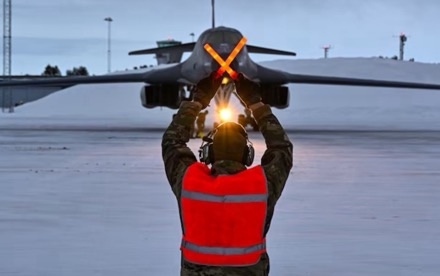
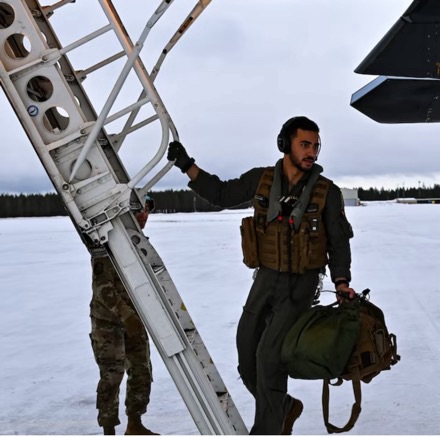
U.S. Air Force B-1B Lancers assigned to the 28th Bomb Wing at Ellsworth Air Force Base, South Dakota launched from their deployed location at Luleå-Kallax Air Base, Sweden, to train alongside Swedish air force aircraft Feb. 26.   

The mission, dubbed Vanguard Adler, was conducted as part of Bomber Task Force 24-2 and designed to integrate the U.S. bombers with Swedish JAS 39 Gripen fighters and joint terminal attack controllers operating in the Arctic and Baltic regions.   

The exercise included surface attack, air interdiction and close air support scenarios, all aimed at building partnerships and increasing readiness.  

“This timely opportunity for our crews to exercise our collective defense capabilities with our Swedish partners, soon to be NATO allies, in the Artic region is incredible,” said Lt. Col. Benjamin Jamison, 37th Bomb Squadron director of operations and BTF 24-2 lead. “It demonstrates our ironclad commitment to our partners and allies, demonstrates our expansive reach, and sends a strong deterrent message to potential adversaries.”   

The capability to generate sorties from locations like Luleå is a key focus area for U.S. Air Forces in Europe – Air Forces Africa. Through Vanguard Adler, BTF 24-2 sought to exercise the ability to quickly integrate forces and equipment at Allied and partner locations.  

All training objectives were met, according to officials.    

The U.S. routinely demonstrates its commitment to NATO allies and partners through BTF missions. Through these missions, USAFE-AFAFRICA enables dynamic force employment in the European theater, providing strategic predictability and assurance for Allies and partners while contributing to deterrence by introducing greater operational unpredictability for potential adversaries.   

Regular and routine deployments of U.S. strategic bombers also provide critical touch points to train and operate alongside our Allies and partners while bolstering a collective response to any global conflict.   

BTF 24-2 marks the first multi-day deployment of U.S. Air Force bomber aircraft to Sweden. 

By 1st Lt Cameron Silver

USAFE-AFAFRICA Public Affairs

Army Honors World War I Buffalo Soldiers with New Headstones

Sunday, March 3rd, 2024

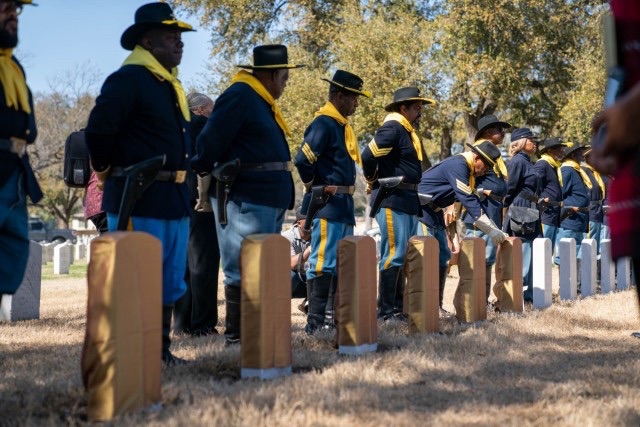
WASHINGTON — The Department of Veterans Affairs National Cemetery Administration dedicated new headstones for 17 World War I Black Soldiers of the 3rd Battalion, 24th Infantry Regiment, during a memorial ceremony Thursday, Feb. 22, 2024, at Fort Sam Houston National Cemetery in San Antonio, Texas.

Retired Lt. Col. Tanya Bradsher, VA deputy secretary and a fourth-generation veteran, said that two years ago to the day, they held a ceremony at the cemetery to unveil a marker to recognize the painful history, hoping to do more.

On Aug. 23, 1917, 156 Soldiers from the all-Black 24th Infantry Regiment were involved in what was known as the Houston Race Riots of 1917, also known as the Camp Logan Mutiny, in Houston, Texas. The incident occurred within a climate of overt hostility from members of the all-white Houston Police Department against civilians of the Black community and Soldiers. Of those found guilty, most were given prison sentences, and 19 were sentenced to death and executed. It was found that the courts martial of these Soldiers were hastily conducted and flawed with irregularities. The remains of 17 of the executed Soldiers were reburied at Fort Sam Houston National Cemetery in 1937 after removal from their original graves at Salado Creek.

The bodies of Cpl. Larnon Brown and Pvt. Joseph Smith, also executed, are buried elsewhere, having been reclaimed by family when they died.

The Army reviewed the cases of these Black Soldiers in 2023 and found their trials unfair, saying that “these Soldiers were wrongly treated because of their race and were not given fair trials.” Secretary of the Army Christine Wormuth set aside all convictions and directed the Soldiers’ records reflect honorable discharges.

“Today, the focus isn’t on that history; it is not on the marker, the trials or the Army decision,” Bradsher said. “The focus is on restoring the dignity, honor and respect to those 17 Soldiers and, by extension, to those two Soldiers who were executed and buried elsewhere, and to the 91 Soldiers sent to prison in those same trials.”

Retired Maj. Gen. Matt Quinn leads 155 VA national cemeteries and 122 VA grant-funded state and tribal veteran cemeteries in providing dignified burials in national shrines for veterans and eligible family members.

“As an Army veteran and Soldier for life, I’m especially honored to have been present when Army Secretary [Christine] Wormuth set aside the convictions of the 110 Black Soldiers of the 3rd Battalion,” he said. “Today, we right the wrongs of the past and honor the service of these Soldiers who served our country with honor,” he said. “Today, the VA will forever honor their service. This is a proud day for this Soldier, a veteran who would be proud to serve with them.”

These Soldiers were among those executed following the court martials of 110 Black Soldiers charged with murder and mutiny in the 1917 Houston Riots. Consistent with standard procedure of that time for Soldiers who were sentenced to death in a court martial, their graves were marked with headstones that listed only their names and year of death — as opposed to full honors.

Bradsher said equal justice belongs to all Soldiers.

“This day reflects the progress we have made as a nation since these men were first interred here a century ago,” she said. “Progress makes clear that all institutions must live up to the ideals and promise of our nation’s constitution.”

She said the headstones are more than physical markers. They are a symbol of promise and progress. They uphold the promise enshrined in the Constitution.
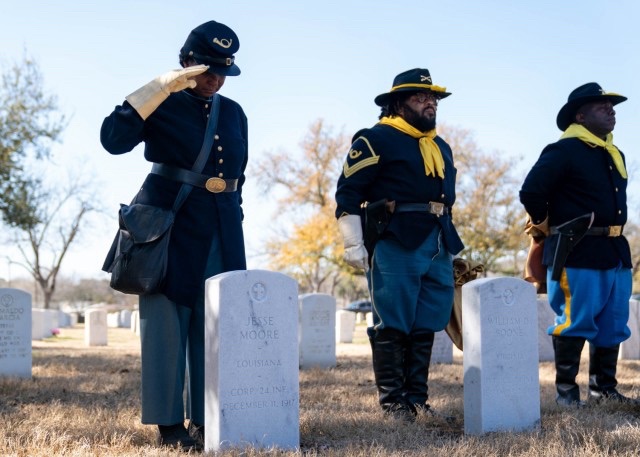
“All Americans have equal rights and equal worth. They represent the struggle and fight to keep the stories of these men alive,” she said. “These headstones now look like every other honorable veteran buried here. It represents the approval of a final resting place for these 17 Soldiers. They will be recognized and forever called veterans.”

She said their headstones will show their ranks, signifying their dedication, leadership and commitment to duty. They will also show their states of origin, reminding people that people who volunteer to serve come from states across the U.S, and their regiment, connecting them to servicemen and women with shared experiences across generations who safeguard the nation.

“These headstones will not erase history or right the wrongs of the past, but they will ensure future generations can understand that history and remember their names,” she said.

Yvette Bourcicot, Principal Deputy Assistant Secretary of the Army for Manpower and Reserve Affairs, said this event was meaningful to her as an Air Force veteran.

“These Soldiers are going to take their rightful place in history alongside African-Americans who have served this country honorably and deserve our respect,” she said. “We do ask for forgiveness for the injustice that was perpetrated on these Soldiers, and we’re doing everything we can to make this right. The Army is a learning institution, and we’re learning as we go. I’m appreciative to be here, representing what we’ve done.”

Bourcicot presented the descendants military service certifications with the upgraded honorable discharges and restored ranks. The corrected records are accessible to the public.

“While this can’t take away the generations of pain and trauma their loved ones endured, we hope these actions will serve as one more step down the path of restorative justice,” she said. “Their memory lives in every one of us and will inspire future servicemen and women to continue cultivating the Army and our sister services into a place where everyone who wants to serve can. We can’t erase the past, but we can learn from it and use it to guide our future.”
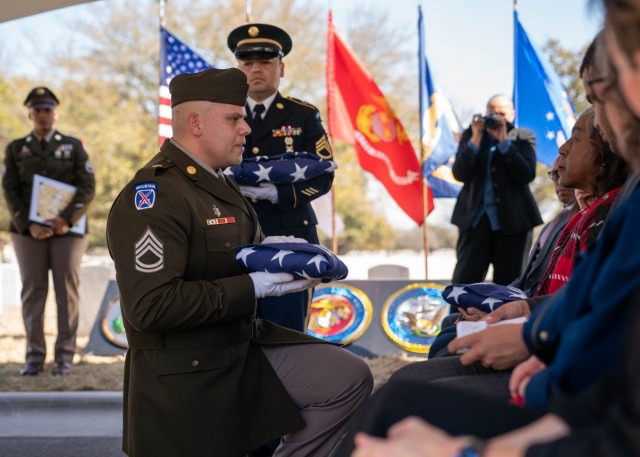
Jason Holt, a relative of Pfc. Thomas Hawkins, who was executed, acknowledged the painful history of the Houston Riot and praised federal officials like Bourcicot for taking steps to support the Soldiers decades after the event.

“It’s not easy for these folks here today to go back to their respective places of power and say they did something that involved racism,” Holt said. “To say that they did something to set aside convictions, to say they did something that was controversial. It’s not an easy job. I salute your courage.”

Holt was among three family members of Soldiers who received certificates in recognition of their relatives’ service.

The ceremony included a three-round volley, the playing of taps and presentation of colors, along with the unveiling of the headstones.

The Soldiers who received the honors were: Cpl. Charles Baltimore, Pfc. William Breckenridge, Pvt. Albert Wright, Pvt. James Divins, Pvt. James Robinson, Pvt. Thomas McDonald, Pvt. Babe Collier, Cpl. James Wheatley, Pvt. Frank Johnson, Sgt. William Nesbit, Pvt. Pat McWhorter, Pfc. Thomas Hawkins, Pvt. Risley Young, Pvt. Ira Davis, Pfc. Carlos Snodgrass, Pfc. William Boone and Cpl. Jesse Moore.

More than 180,000 service members, spouses and family members are buried in the cemetery at Fort Sam Houston.

By Shannon Collins

US Army Soldier Seeking Second Paralympic Berth

Saturday, March 2nd, 2024

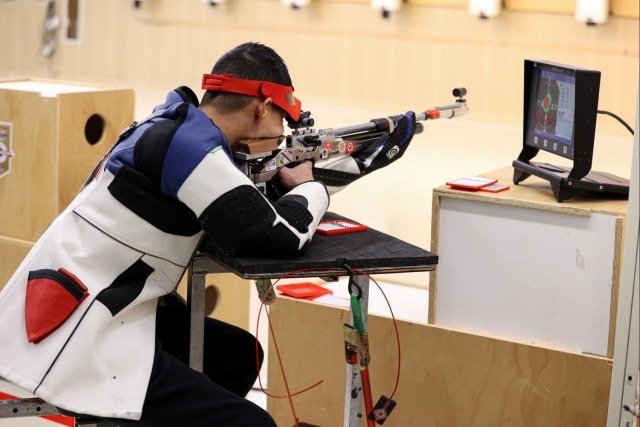
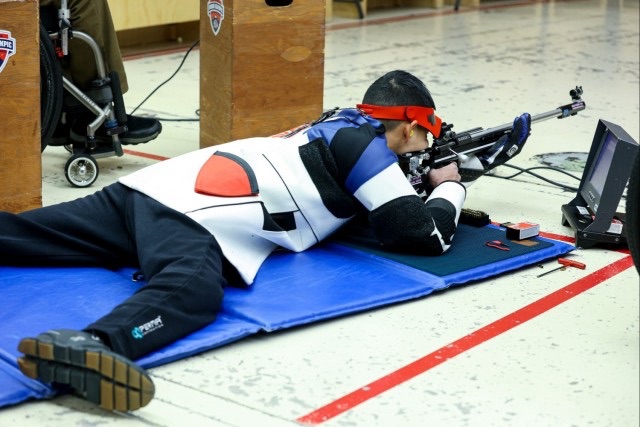
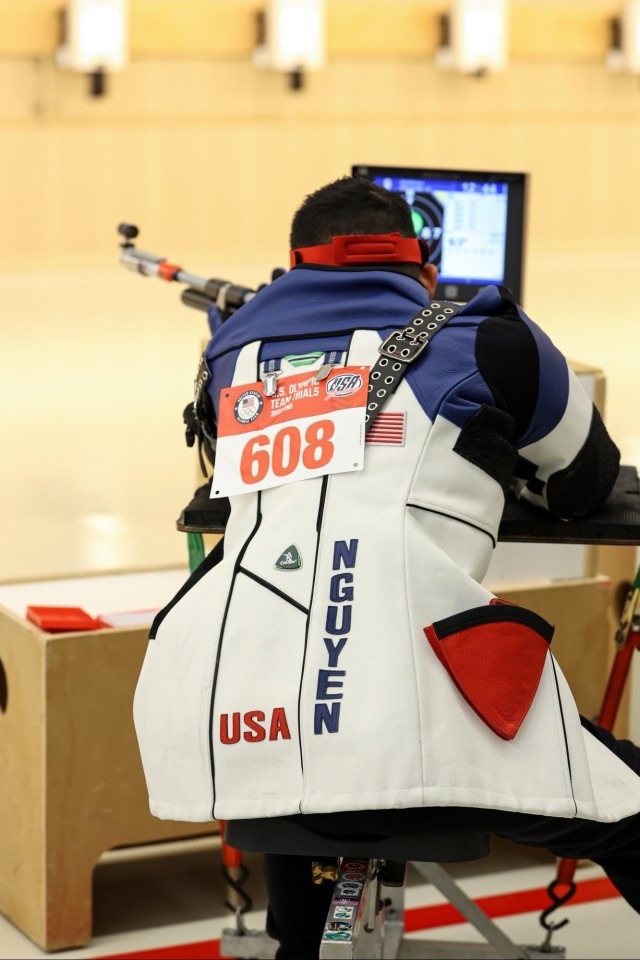
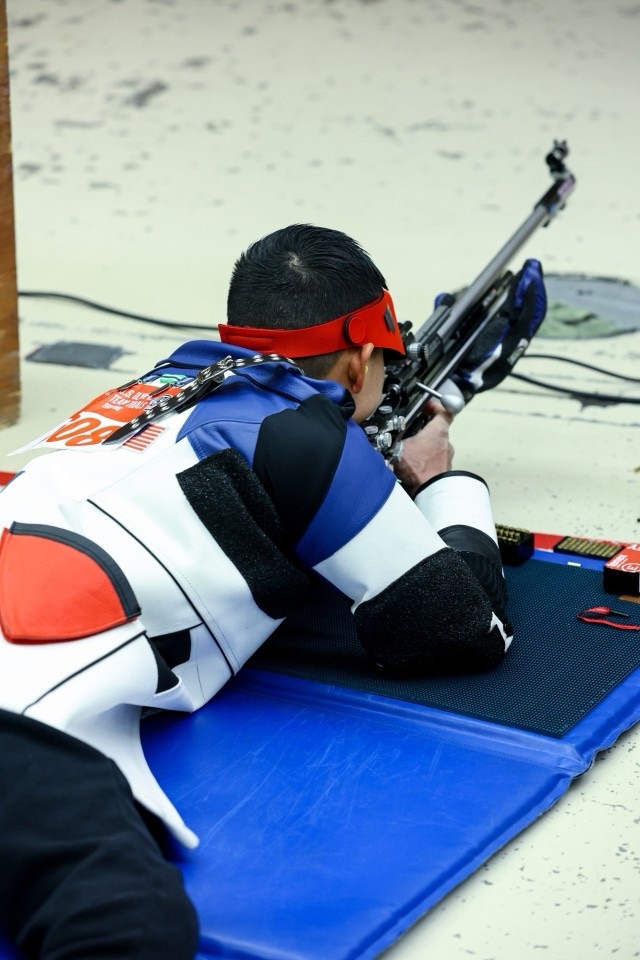
FORT MOORE, Ga. — U.S. Army Staff Sgt. Kevin Nguyen won the gold medal in both 10m Prone Air Rifle (R3) and 50m Prone Smallbore (R6) at USA Shooting’s Paralympic Trials – Part 2 in Colorado Springs, Colorado, February 2-10, 2024.

The recent wins in both disciplines puts the Purple Heart recipient in good standing over other top U.S. marksmen vying for a spot on Team USA’s Paralympic Rifle Team. In air rifle, Nguyen currently has a solid lead of two points while in smallbore his lead is an impressive seven points. To those not familiar with Paralympic shooting sports disciplines, a two or seven point spread may not seem like a lot. However, medals at the Olympic and Paralympic levels in the shooting sports are often determined by tenths or hundredths of points in scoring.

The Fort Moore Soldier said he is definitely happy with his strong performance, but the lead does not guarantee him a position on Team USA.

“It definitely takes a good bit of weight off my shoulders knowing that I have a comfortable lead over my fellow teammates and competitors, but that doesn’t mean I can become complacent,” said Nguyen who is a member of the U.S. Army World Class Athlete Program and attached to the U.S. Army Marksmanship Unit. “I will still go into Trials – Part 3 with the determination to compete at my highest and win.”

Like in the Olympics, each country is allowed a maximum of two athletes in each Paralympic event, if the country first wins the quota spots. Currently, the United States has only earned one quota spot for the 50m Smallbore (R6) event and has none in 10m Air Rifle (R3). However, the Para Shooting World Cup – India is coming up March 6-15, 2024, and USA Shooting is hoping to claim the remaining quota spot in smallbore and the outstanding two in 10m air rifle. That would open up four possible seats in those two shooting events.


The Paralympic Trials is not a new process to the Westminster, California native. He competed in the 2020 Paralympic Trials in Tokyo, where the Soldier said he gained some valuable experience that is helping him refocus his training.

“The biggest thing I want to focus on is match intensity. I know from my training and from the last few matches, that I can shoot the world class scores in matches. Now, it’s having to maintain composure and not get overly anxious like I did in Tokyo,” explained Nguyen.

“Tokyo, by far, was the most nerve-racking match I have ever competed in. I’m hoping, in France, I’m a little more composed and focused on my fundamentals.”

The significant performance at Paralympic Trials – Part 2 confirmed that Nguyen’s training plan is working. So as he prepares for the upcoming Para World Cup and Paralympic Trials – Part 3, the Soldier said he will continue working with his training plan that is showing results.

“I felt really good going into the match [Paralympic Trials – Part 2]. I’ve been working on my record days, focusing on shooting world class match scores on the spot. It felt really good to see that my training is mirroring my competition days.”

Training is not the only thing Nguyen has been working on though. He just became a new father, and he said he’s embracing every moment of this new experience.

“Being a father is such an awesome feeling, and I am enjoying every moment of it — even on days when I am not getting a whole lot of sleep. That’ just par for being a parent now, everybody goes through it.”

Becoming a father has not changed his perspective on his Paralympic goal, he just feels like he has added support now.

“I think having my family there with me at the Games will not only be a cool and fun experience, but it’s also a blessing. It’s like have your own cheerleading squad in the stands.”

As he aims to secure a position on Team USA’s Paralympic Rifle Team, for the second time, he said he has the same goal he had in Tokyo.

“I want to do better in France than I did in Tokyo; I’ve learn so much since then, and I am still fighting and wanting to bring home that Gold Medal for Team USA.”

By LTC Michelle Lunato

FirstSpear Friday Focus: FS Attends Enforce Tac & SICUR

Friday, March 1st, 2024

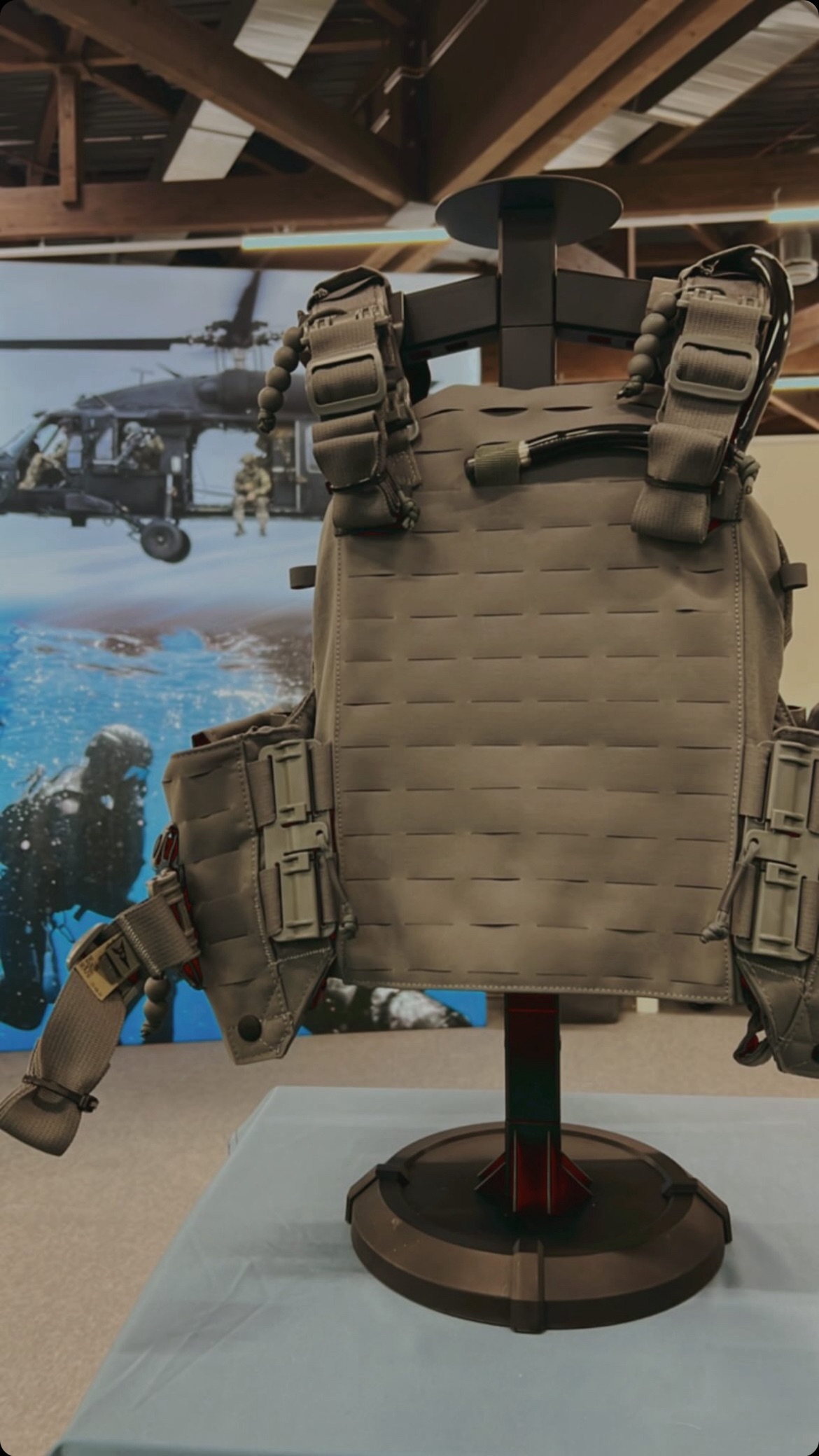
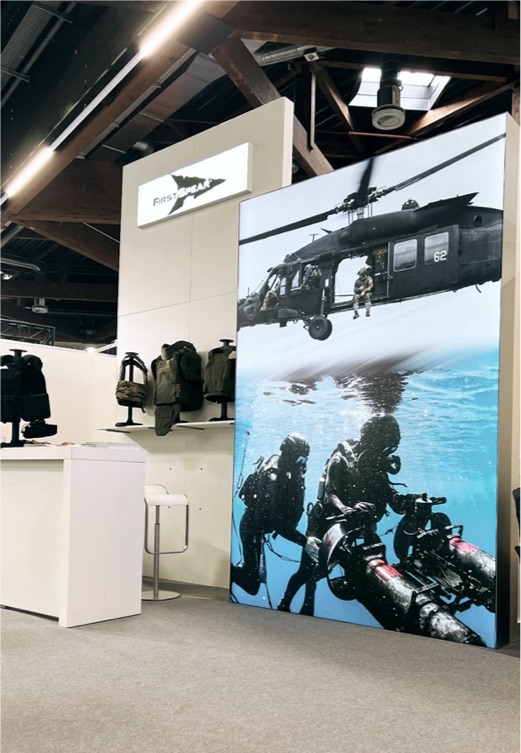
The FirstSpear team spent the week showcasing new technology & gear to end users at Enforce Tac in Nuremberg, Germany and SICUR in Madrid, Spain.

Continuing its attendance at Enforce Tac in its 11th year, FirstSpear continues to innovate and answer the call of those at the tip of the spear domestically and globally. With over 80 countries in attendance, this year also marked the 11th year of our attendance since the very beginning of the show.

The team also spent time in Madrid, Spain at SICUR leading international security event, that brings together public and private security companies. Continuing to support war fighters throughout the world.

For more information about FirstSpear, please visit www.first-spear.com.

Future Conflicts Demand Flexible and Mobile Command Posts

Friday, March 1st, 2024

SAVANNAH, Ga. — Army leaders understand that preparing for large scale combat operations will require commanders to lead on the move with the ability to disperse at a moment’s notice.

Leaders also understand that one size will not fit all for command posts under this new paradigm.

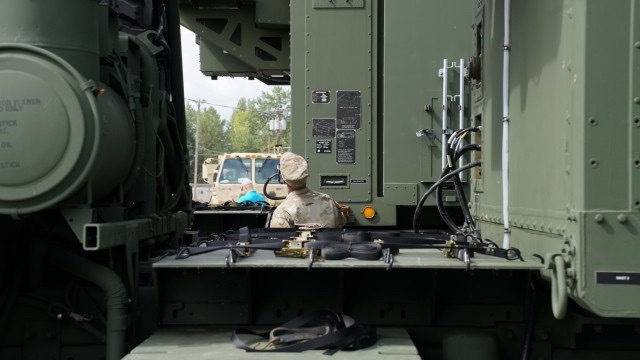
At the Army’s Network Technical Exchange Meeting (TEM) in December 2023 in Savannah, Georgia, a panel discussion on command post modernization unveiled plans for CPI2 Next, which is the latest in a series of efforts to modernize existing vehicle-based Command Post Integrated Infrastructure (CPI2) units and provide on-the-move command and control in anticipation of future combat scenarios.

The CPI2 program is integrating network and communications technologies into a variety of vehicle platforms, then fielding them incrementally to units for experimentation and feedback, which will inform future iterations.

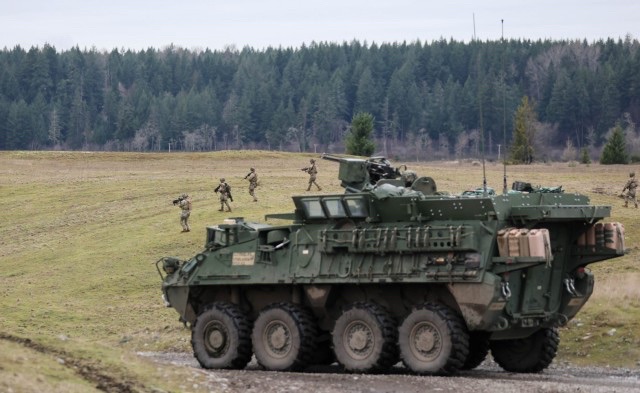
While current iterations of integrated command post platforms have proved useful in the field during unit experimentation, a Limited User Test (LUT) with the 1st Stryker Brigade Combat Team, 2nd Infantry Division (1-2) at Joint Base Lewis McChord, Washington, conducted this past summer indicated a need for a more adaptable, configurable command post with greater disbursement capability. From this feedback, project managers identified two primary concerns regarding the use of existing Command Post Support Vehicles: a lack of integrated power and insufficient wireless network configuration.

“We have to be able to disperse in a moment’s notice, and anything requiring cables or wires that connect to immobile objects will put Soldiers in harm’s way,” said Lt. Col. Herb Gamble, product manager for CPI2.

To address these concerns, panelists discussed solutions currently identified and solutions they will be seeking from industry partners to meet the Army’s goal for a modular, scalable and survivable command post to support Army of 2030.

Beginning in March, CPI2 program integration teams will begin installing generators onto 1-2 SBCT CPI2-equipped vehicle platforms. These power sources will replace the micro grid initially tested as part of the LUT, which still required the vehicles to be tethered to a power source.

“These generators will open up the option for more rapid displacement and emplacement of mobile command posts each time the tactical operations center jumps to another location within the operational environment,” Gamble said.

Sometime this summer, these power-integrated platforms will accompany the unit to their National Training Center rotation, prior to deploying.

“This will be the first time on-the-move command post capabilities will be part of a combined training center rotation,” Gamble said.

To address the wireless capabilities needed for on-the-move missions, the Army will generate a Request for Information to industry to enhance or replace the current onboard WiFi, which works well in line-of-sight situations but will require more robust capabilities to meet Army command post directive to rapidly move and halt in just minutes.

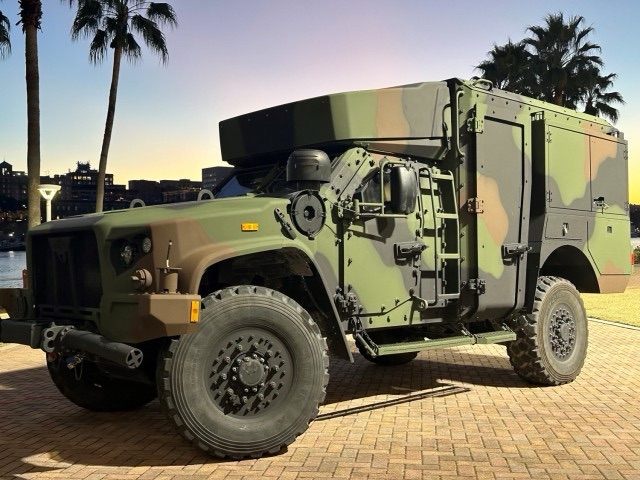
At the same time, the program continues to innovate, and is currently conducting a pilot that integrates command post capabilities into a Joint Light Tactical Vehicle — this time including the Advanced Field Artillery Tactical Data System to enhance fire support missions on the move.

“We conducted an exercise with the Army’s Test Command this past fall to determine the ability of forward observers to initiate a call for fires missions to the command post headquarters,” said Lt. Col. Jonathan Judy, product manager for Network Integration and Modernization. “In the lab we validated we can do digital calls for fire on a Secure But Unclassified – Encrypted network, then verified those results in the field using real Soldiers and equipment.”

As the program shifts to its next iteration, called CPI2 Next, it will focus on including more flexible integrated command post capabilities.

“Commanders want to be able to have the modularity and the ability to change and adapt based on their mission set,” Gamble said. “No command post will conduct operations the same way, because based on your mission set and where you’re located, you’re going to want customized command post capabilities.”

Providing units with modular A-kits for their vehicles and mission-tailored B-kits for the Soldiers themselves will allow for optimal functionality without sacrificing ability to disperse. These kits contain communications devices that will be swapped out according to mission objectives, making them ideal for widespread dispersal.

“All mobile command post development should incorporate both new and existing technologies, including improved on-the move and voice command capabilities, which allows project managers to update existing units without fully sunsetting their equipment, making it a favorable both practically and fiscally,” Judy said.

The Army will continue to seek innovative solutions to address these and other mobile and flexible command post requirements via requests for information this fiscal year, including the potential for interoperability with Mission Partner Environment services in anticipation of combat operations with allies and partners.

“Make sure you give us your biggest and brightest ideas,” Gamble said to industry TEM 11 attendees. “We owe it to our Soldiers in arms.”

By Mollie Ryan, PEO C3T Public Affairs

Navy Pins First Robotics Warfare Specialist

Thursday, February 29th, 2024

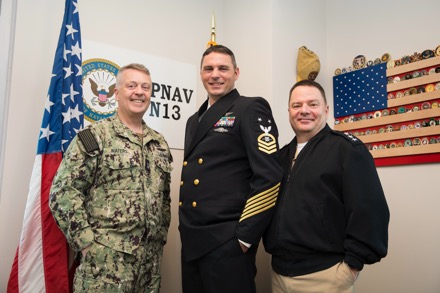
ARLINGTON, Va. — The Chief of Naval Personnel, Vice Adm. Rick Cheeseman, and the Navy’s Personnel Plans and Policy Division (N13) Director, Rear Adm. Jim Waters, pinned Master Chief Christopher Rambert as the Navy’s first Robotics Warfare Specialist during an office call at Naval Support Facility Arlington, Virginia, Feb. 27, 2024.


The rating insignia reveal followed the U.S. Navy’s announcement in NAVADMIN 036/24, establishing the branch’s enlisted career field for operators, maintainers, and managers of robotic and autonomous systems.

The establishment of the RW rating underpins the Chief of Naval Operations Adm. Lisa Franchetti’s plans for building and developing “a team who has the reps and sets in sensors, platform autonomy, and mission autonomy programs, and can provide input in machine-learning feedback processes,” a priority she discussed in her keynote address at the WEST 2024 naval conference.

Although Rambert is the first Sailor to don the new RW uniform rating badge, the development of the Navy robotics warfare community represents years of effort.

“It’s a proud moment to see all the hard work that’s gone into developing this badge, and just seeing it finally get codified and brought to life – to me, it signifies the hard work of the people around me,” Rambert said.

From research and analysis to organizing working groups and designating individual subject matter experts, Sailors and Navy civilian employees have been working behind the scenes on creating the Robotics Warfare Specialist career field for more than three years.

Its founding has distinguished the Navy as the first Department of Defense branch to establish a dedicated enlisted workforce specialized in unmanned and autonomous technology.

“The RW rating is a major milestone in our Navy’s relentless march to achieve a truly hybrid Fleet,” Cheeseman penned in NAVADMIN 036/24.

According to Rambert, the DoD’s hybrid force framework is a force multiplier, allowing Sailors to develop seasoned experience across the rating’s multiple domains – subsurface, surface, air, and ground platforms.

With a background as an aviation electrician’s mate, Rambert spoke to the tactical advantages that will come with the new rating’s initial cadre – and the growing opportunity for future RW Sailors.

“You get the opportunity to go to so many different places,” Rambert said. “If you look across the spectrum of the entire Navy, you’ve got Sailors that have the potential to really touch every single domain out there and that’s very rare.”

Rambert has served as the Navy’s sole Robotics Enlisted Community Manager at the Bureau of Naval Personnel since October 2023.

“It’s really an awesome feeling to be the first one to represent the rating,” Rambert said. “And to see this rating finally come to fruition, you can see the level of excitement, and passion from the other Sailors that are out there.”

Eligibility and Application

The initial selection of Sailors for RW conversions will consist primarily of active-duty Sailors currently holding robotics-related Navy Enlisted Classification (NEC) codes. Sailors currently or previously assigned to billets in unmanned vehicle divisions are primed for selection.

Active-duty E-4 to E-9 Sailors who meet the above criteria can apply by submitting a NAVPERS 1306/7 Electronic Personnel Action Request (EPAR) form to BUPERS-328 or BUPERS-352 (SELRES).

The Navy’s Fact Sheet focused on RW Conversion Opportunity provides further details on the specific NECs, ASVAB scores, and background requirements for applicants: www.mynavyhr.navy.mil/Portals/55

Rambert described the sought-after characteristics of RW candidates as being driven, adaptable, and motivated to become masters of the craft.

“They have to have [the] drive to want to be a part of something that might not be entirely defined by policy,” Rambert said. “They need to be passionate about what they do because what they’re learning now and the lessons learned that we take to the table later can have huge effects on the success of the rating as we progress into the future.”

Rating Symbol Design

Originally designed by Chief Aviation Electrician’s Mate McLean Monaghan, the RW rating symbol comprises an airplane propeller and lightning bolt crossed over a treaded wheel, all layered over a single wave. Each element represents a domain that U.S. Navy Robotics Warfare Specialists are expected to operate in to support the mission of the DoD:
· Airplane Propeller – Aerial Systems
· Lightning Bolt – The Electromagnetic Spectrum
· Treaded Wheel – Ground Systems
· Wave – Surface and Subsurface Systems

For information regarding the application process, visit the RW enlisted community management page on the MyNavy HR website at: www.mynavyhr.navy.mil/Career-Management/Community-Management/Enlisted/Robotics-Warfare

For more news from the Chief of Naval Personnel, follow MyNavy HR on Facebook, Instagram, X (Twitter), and YouTube, or visit www.navy.mil/cnp

Story by Petty Officer 1st Class Jeanette Mullinax 

Chief of Naval Personnel

Vertx Tactical Tuesday: New! Midlayer Hoody

Tuesday, February 27th, 2024

Vertx unveiled their all-new Crucible Midlayer Hoody in January. This hoody is expertly crafted with 60G PrimaLoft® Gold Active Vent insulation, ensuring optimal warmth without the risk of overheating thanks to its superior moisture management. The high-tenacity fabric promises maximum comfort and quiet movement, making it perfect for layering and easy to pack away when not in use. Equipped with a center front YKK Vislon zipper with interior wind guard, zippered hand pockets, and a fitted hood, convenience meets functionality in every detail.

Available in Tobacco and Black, head over to the website and check them out.

167th Communications Flight Redesignated as Squadron

Tuesday, February 27th, 2024

MARTINSBURG, W.Va. —  

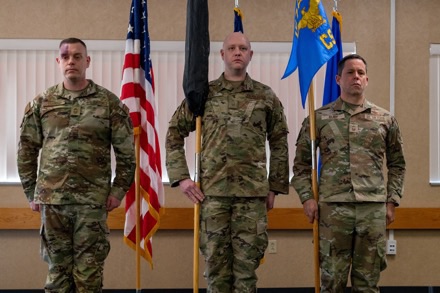
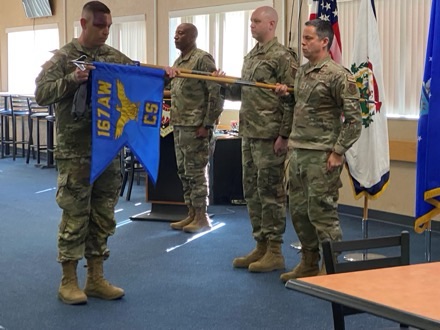
MARTINSBURG, W.Va. — A ceremony marking the redesignation of the 167th Communications Flight as a squadron was held at Shepherd Field, Martinsburg, W.Va., Feb. 3, 2024.

During the ceremony the 167th Communications Squadron guidon was revealed and the 167th Communications Flight guidon was furled for the final time.

Air National Guard units nationwide are redesignating their communications flights to communications squadrons due to the growing responsibilities and emerging mission-sets required of the communications career field.

There’s been many technological advances since the communications flight was established at the 167th nearly 60 years ago, explained Lt. Col. Donald Carpenter, 167th Communications Squadron commander.

“Now we’re on the cusp of a new technological era with artificial intelligence, machine learning and large language models,” said Carpenter. “A new season requires a new approach, and the Air Force sees that and is realigning the force to do that.”

The 167th Communications Squadron units enables the information technology infrastructure of the wing. They are responsible for the computer and networking hardware, printers, cell phones, handheld tablets, software deployment, software updates, communications security for the classified network, radio equipment, wireless networks, base fiber optic and copper infrastructure that connects the wing to the Department of Defense network.

As a squadron, the communications unit is postured to take on additional roles to protect cyberspace platforms and to meet expeditionary and mission generation support requirements.

Carpenter acknowledged that there will be challenges as the squadron adjusts to the new mission-sets but said they will get through it.

“We’ve been on a journey for three years to reshape the organization to what it is today,” he said. “We’ll continue to drive that needle forward to much greater success.”

By SMSgt Emily Beightol-Deyerle, 167th Airlift Wing