FirstSpear TV

Archive for the ‘Guest Post’ Category

Iowa National Guard Trains in Wyoming’s Higher Elevation

Wednesday, June 7th, 2023

CAMP GUERNSEY, Wyo. – Iowa National Guard infantry and aviation units traveled west by ground convoy and air to conduct annual training at the Camp Guernsey Joint Training Center in Wyoming at the end of May.

Wyoming’s elevation and expansive landscape offered a different training environment for the Midwest Soldiers.

“We’re spoiled in Iowa,” said Chief Warrant Officer 2 Ryan Hill, a training officer and UH-60 Black Hawk pilot with Company C, 2nd Battalion, 147th Assault Helicopter Battalion. The state sits about 1,100 feet above sea level. “We have power for days. Whereas [in Wyoming], you’re starting at about 5,000 feet, which is going to change aircraft performance. That’ll be good training for aircrew members when they go to high altitude.”

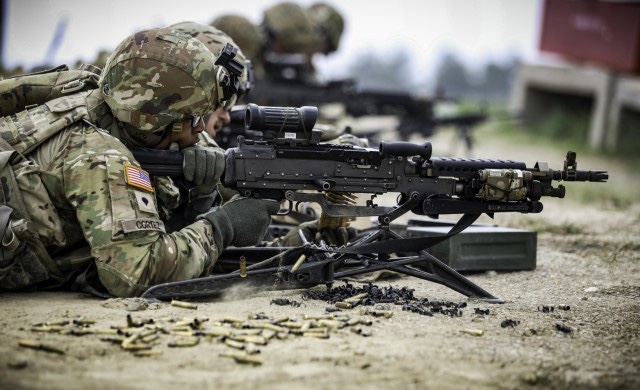
Several aircraft crew chiefs qualified on door gunnery skills, shooting an M240 machine gun out of the window of a Black Hawk as it flew over targets.

“My favorite part was definitely going up high and then seeing the tracers hit the little buildings and all the humvees,” said Spc. Julia Adkins, a Black Hawk mechanic with the 2-147th AHB. “It was a great experience because I’m brand new to flying.”

The 1st Battalion, 168th Infantry Regiment (“Lethal Battalion”), took advantage of the expansive weapon qualification ranges and rugged terrain to practice squad-level maneuvers. Soldiers spent several days in tents in the field.

“It’s just a massive training area,” said Capt. Jeremy White, executive officer with the 1-168th Infantry. “You can drive it for hours one side to the other. If you think you can put all your gear on and run around conducting operations like normal, you’re wrong. You can’t dodge higher elevation and this is a completely different terrain.”

White described it as collective training to test how well Soldiers move as a team toward objectives using communication and hand signals. Companies took turns rotating through physically taxing live-fire exercises, moving swiftly up and down steep slopes through tall grass and dodging environmental obstacles.

“We grow as a team as we’re out there,” said Spc. Valery Gonzalez, with the 1-168th Infantry. “We obviously have to trust each other so nobody gets hurt.”

In addition to completing unit-level tasks, the two infantry and aviation elements joined together to conduct realistic operational training. Ground force commanders with the 1-168th Infantry sent up orders to the 2-147th AHB, imitating what would happen if infantry Soldiers needed aircraft assistance in a real-world scenario – whether they needed people, supplies or equipment transported.

“One of the big takeaways for us is that we’re a customer-based service,” said Hill. “We have a lot of young aviators who have been focused on getting good at flying the aircraft. Now, they’re going to be able to execute planning processes, and they’ll have passengers that need things with real-life factors playing into it.”

The training is also valuable for Soldiers in the 1-168th Infantry. White said many Soldiers in the Iowa Guard train with real aircraft only a few times in their careers. The 2-147th AHB offered familiarization with aircraft safety procedures, air assault movements, supply drops and sling load operations.

The 1-168th Infantry trained on their new M3A1 Carl Gustaf Multi-roll, Anti-Armor, Anti-Personnel Weapons System (MAAWS). The recoilless rifle is capable of firing numerous types of rounds suited for targets that range from humvees to armored tanks. It can also illuminate the battlefield and provide smokescreens.

Staff Sgt. Chris Nieman, an infantryman assigned to Company A, said the weapon’s improved optics system eliminates much of the guesswork in aiming at targets.

“I really enjoy being in the field and training Soldiers,” said Nieman. “It’s loud, it blows up. Soldiers enjoy that. On a tactical level, it just increases our lethality. It’s a force multiplier on its own.”

Members of the 1-168th Infantry also broke in some new M110 A1 squad-designated marksman rifles with scopes, ambidextrous controls and suppressors. Even with all the new features, it wasn’t much heavier than the traditional M4 carbine rifle most Army Soldiers use.

“It’s a dream to shoot,” said Staff Sgt. Gabriel Morey, an infantryman with Company C. “I’ve seen nothing but smiles coming off of our range here at Camp Guernsey, so we have pretty positive rave reviews so far.”

By SSG Tawny Kruse, Joint Force Headquarters – Iowa National Guard

AFSOC Hosts Security Force Assistance Air Advisor Summit

Tuesday, June 6th, 2023

HURLBURT FIELD, Fla. —  

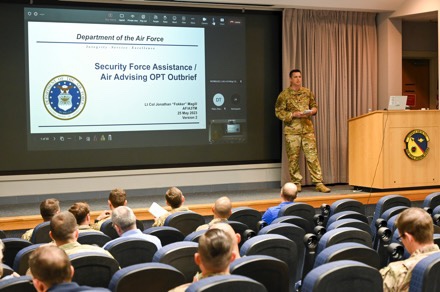
Hurlburt Field, Fla. –Key members from across the Security Force Assistance and Air Advisor enterprise gathered here for a summit, 23-25 May.

The purpose of the summit was to gather expertise to plan and propose a way forward for cross-functional, Air Force-wide Security Force Assistance capabilities that can support higher-level guidance and Combatant Commander objectives and campaign plans.

The conference kicked off with opening remarks from Maj. Gen. Albert G. Miller, Headquarters U.S. Air Force Director of Training and Readiness, and included Col. Jocelyn Schermerhorn, AFSOC Director of Operations, Dr. Sean McFate, a foreign policy expert with a focus on National Security Strategy, and Ms. Beth Grill, RAND Corporation national security policy analyst.

During her remarks, Schermerhorn emphasized the importance of foundationally getting the structure of Air Advisors across the formation right.

“The strategic environment we’re in today is much different than the place we’ve operated for the last 20 years,” said Schermerhorn. “We have an opportunity to make sure that we get this right as we develop a sustainable capability from the ground up. We’re looking to your expertise to ensure that we get there.”

The National Security Strategy and National Defense Strategy details the need to develop diplomacy with our partners and allies – an area that SOF forces are uniquely suited to support.

“If we get this right, we’ll have a more deliberate, requirement-focused enterprise that spans across our formation with a significant return on investment,” said Schermerhorn.

Speakers, panelists, and audience members hailed from a variety of areas, such as International Affairs at Headquarters U.S. Air Force, the U.S. Army Security Force Assistance Command, Air Force Materiel Command, 621st Air Mobility Advisory Group, 571st Mobility Support Advisory Squadron, 435th Contingency Response Support Squadron, 36th Tactical Advisory Squadron, and several others.

The summit concluded with an out brief that detailed findings and made recommendations on a way forward for senior leaders to consider as they’re making decisions.

“Based on the work that I saw this week and the feedback we got from our senior leaders during our out brief – I’m confident that we were able to work together to propose a way forward that accomplishes the mission,” said Col Magill, Headquarters Air Force, Mobility Air Forces Division, air advising cross-functional manager. “Ultimately, we’re bringing back some great proposals that should integrate partners by design, enabling day-zero interoperability and combined effects.”

By Ciara Travis

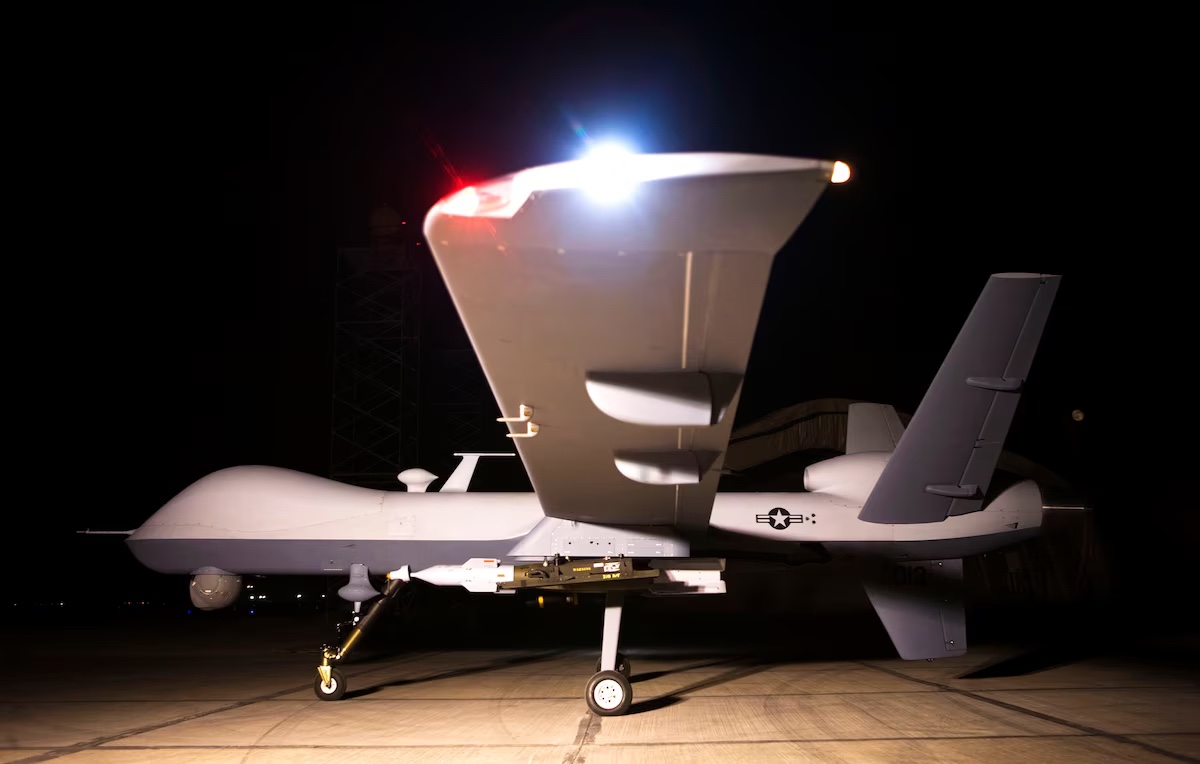
AATC Tests Enhanced Intelligence Gathering Capabilities with MQ-9 Reaper Upgrade

Monday, June 5th, 2023

EIELSON AIR FORCE BASE, Alaska (AFNS) —  

The Air National Guard-Air Force Reserve Command Test Center partnered with the 174th Attack Wing and 556th Test and Evaluation Squadron to test an upgraded satellite communications capability of the MQ-9 Reaper during exercise Northern Edge 2023 at Eielson Air Force Base.

Northern Edge 23 is a U.S. Indo-Pacific Command-sponsored, Headquarters Pacific Air Forces-led, multilateral, joint field training exercise at main operating bases Joint Base Elmendorf-Richardson and Eielson AFB.

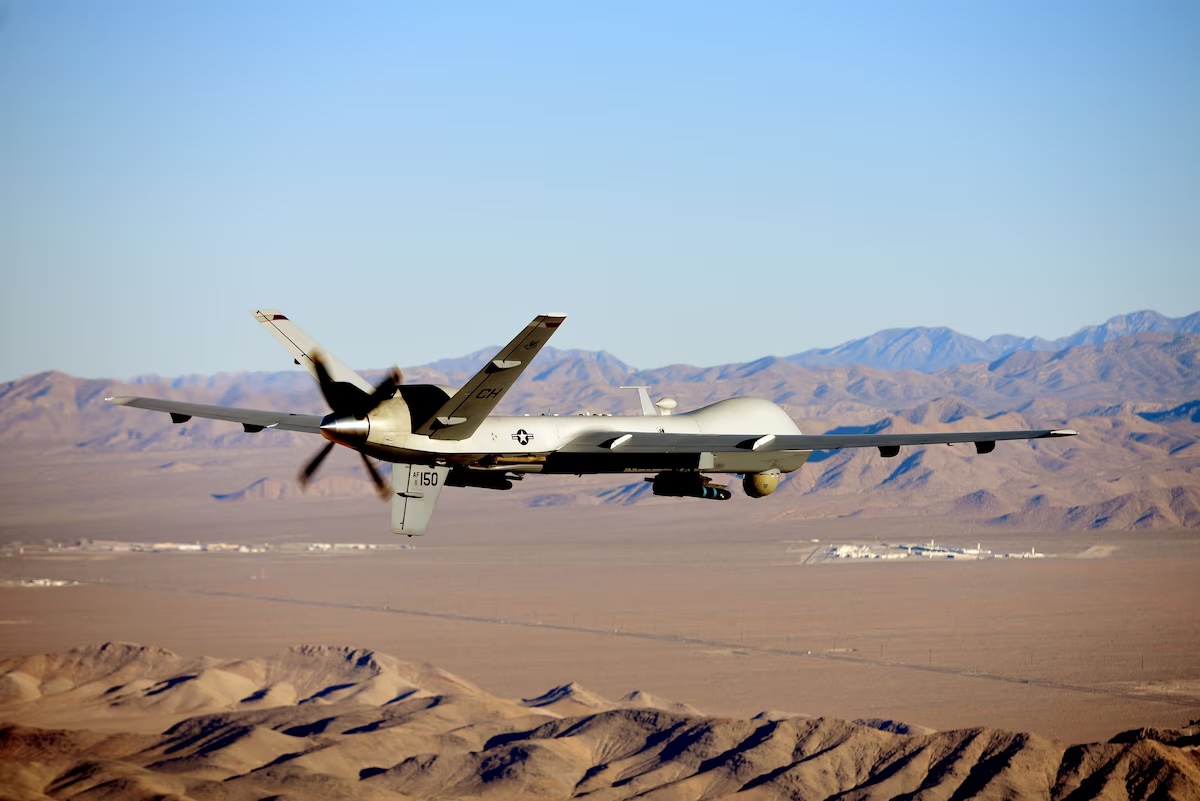
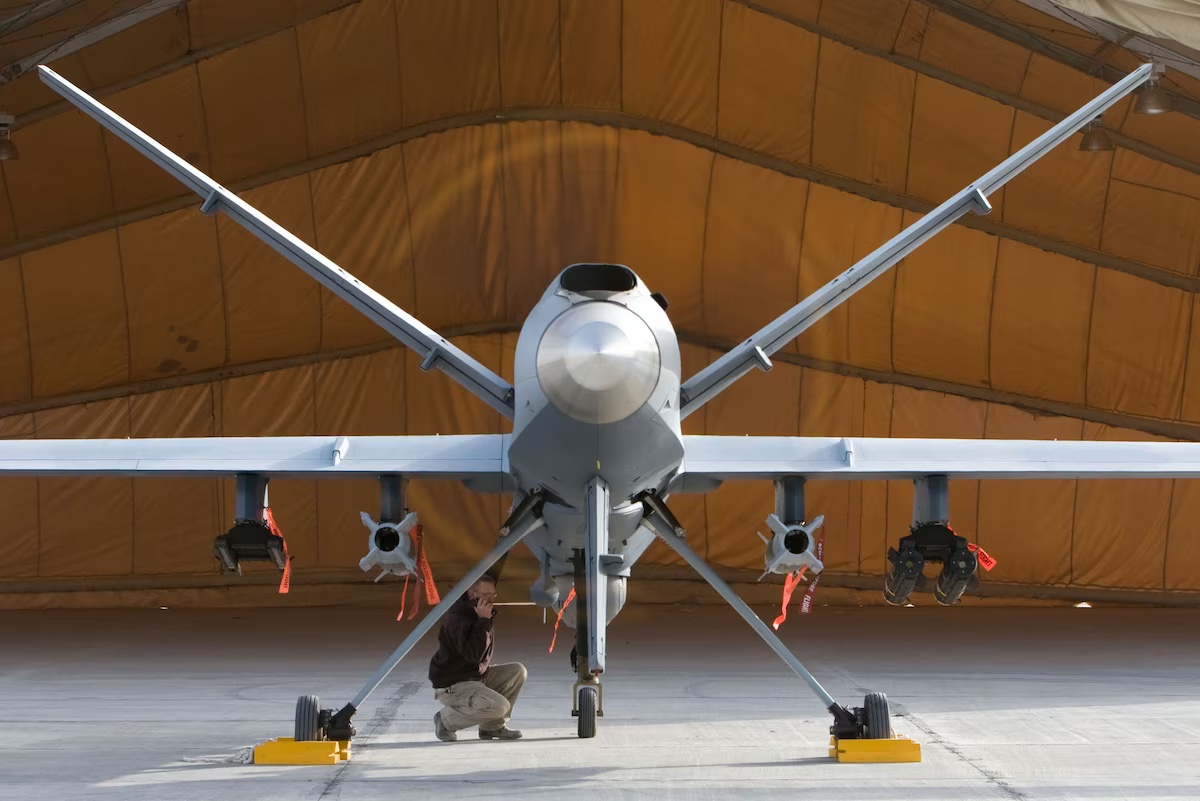
The MQ-9 is a remotely piloted aircraft primarily used for intelligence, surveillance and reconnaissance missions. Air National Guard pilots, using the SATCOM upgrade, can now fly ISR missions in real-time almost anywhere around the world from remote bases in the United States.

The MQ-9’s upgraded SATCOM system uses advanced satellite technology to transmit data and communications over long distances. It is capable of flying at high altitudes for extended periods and its sensors can provide real-time intelligence on adversary positions, movements and activities. The ANG plans to deploy the upgraded MQ-9 to support ongoing operations around the world, as well as for training exercises and other missions in support of U.S. national security objectives.

“The speed at which this modernization effort and test program has been accomplished highlights the Accelerate, Change, or Lose vision from General Brown,” said Maj. Ryan Nastase, Test Program manager.

“This SATCOM upgrade will allow pole-to-pole operations while increasing the amount of data or bandwidth the MQ-9 can transmit and receive by more than double and reducing the latency or time of transmission by a factor of 10.”

Maj Ryan Nastase, Test Program Manager

With the upgraded SATCOM capability, the MQ-9 can continue to modernize by integrating more advanced sensors that require increased bandwidth. The upgrade enhances the aircraft’s ability to provide real-time situational awareness to combatant commanders around the world.

“This upgrade is a game-changer for the MQ-9 and the Air National Guard,” said Lt. Col. Matthew Harris, Hancock Field ANG Base test pilot at Syracuse, New York. “We can better support our combatant commanders and provide critical intelligence in real-time.”

The SATCOM upgrade is one of many advancements being fielded on the MQ-9. The ANG and its partners are continually working to enhance the capabilities of these critical assets and provide combatant commanders with the best possible support.

by SSgt Van Whatcott, 162nd Wing Public Affairs

AFSOC’s Second Summit Tackles How to Instill Mission Command

Saturday, June 3rd, 2023

HURLBURT FIELD, Fla. —  

Air Force Special Operations Command’s second Mission Command Summit concluded its three-day event on May 18 with the goal to generate how to instill a culture of mission command across the formation.

During the first summit, the team developed the philosophy of mission command which empowers our commanders and subordinates to execute assigned missions using some or all of the seven joint functions. Those missions are assigned by commanders via mission-type orders that ultimately enable subordinates to operate competently and confidently.

This summit provided an opportunity to connect key stakeholders from DAF, joint and ally counterparts to have candid conversations about the vision for mission command in AFSOC’s new force presentation construct. 

“Our future operating environment looks very different than how we’ve fought over the last three decades and our adversaries have been paying attention to that,” said Lt. Gen. Tony Bauernfeind, AFSOC commander who provided opening remarks for the summit. “We’ve become on reliant on our global reach, active FOBs (forward operating bases) and centralized command/decentralized execution. For us to be successful, we need to shift our focus to the control piece, which is mission command.”

He expanded on the “how” and laid out the aspects that surround mission command: mutual trust built through exercises, ensuring clear commander’s intent, having an aggressive but disciplined mindset, a higher tolerance for risk and building competence.

“Developing mission command across our command will take more than writing doctrine or policy,” said Bauernfeind. “This is why we’ve established the headquarters A7 and are establishing the Air Commando Development Center this summer. This will allow us to focus that energy to synchronize and coordinate the training, education, exercising and experimentation that are required to develop the competence around mission command. And competence leads to the first aspect of mission command, mutual trust.”

This is yet another change AFSOC is tackling to prepare Air Commandos for the future operating environment. The command has been a pathfinder for the Air Force chief of staff, Gen. C.Q. Brown Jr.’s five drivers for change across the force: AF Force Generation, Agile Combat Employment, Multi-capable Airmen, wing A-staff implementation and now, mission command.

Moving forward, the 492 Special Operations Training Group and A7 are outlining actions and owners for the identified barriers to normalize mission command in AFSOC formations and updating the Mission Command Toolkit to rollout the next version at Commando Rally scheduled for June 2023.

“There’s no denying that this is a heavy developmental effort across the Air Force, but here in AFSOC, we’re up for the task,” said Bauernfeind.

By 2nd Lt Cassandra Saphore, AFSOC Public Affairs

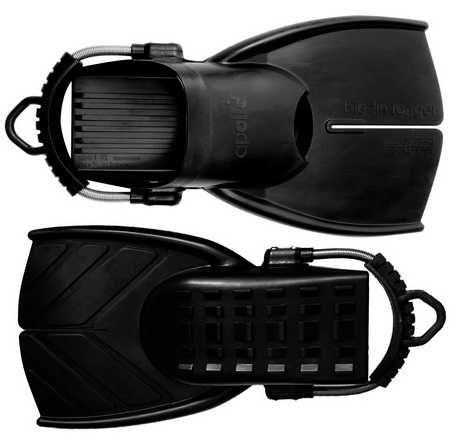
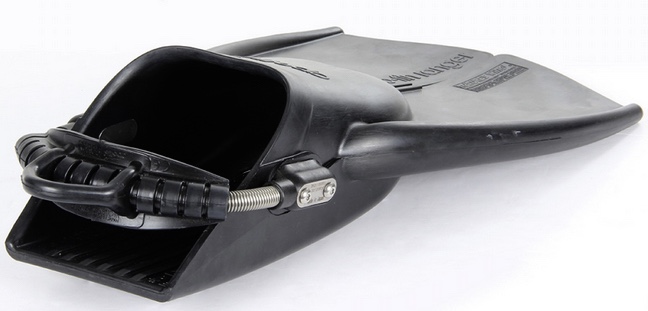
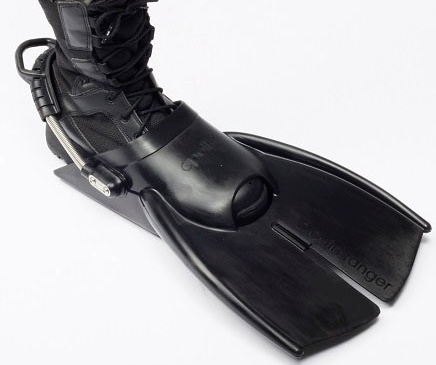
Apollo Ranger Bio-Fin – Stealth Black

Friday, June 2nd, 2023

For when you need more than one tactical fin option!

The Apollo Ranger Bio-Fin was engineered for a particular mission set. Designed to provide a tough, light & compact fin offering performance without compromise. It provides nearly all the benefits and 80% of the thrust of a full-sized Stealth Bio-Fin but without the length. It is now also available with stealth black stainless-steel spring.

Ideally suiting dives where a long fin is either undesirable or simply gets in the way of operations. Inclusive tactical divers wearing Patriot3 Jet Boots, DDV pilots, parachutists conducting water jumps, helicopter or ship SAR swimmers or divers, Police dive teams, standby divers and white water rescue teams to name a few.

• Fits both Amphibious boots and standard Military footwear.

• A tough Natural rubber blade provides exceptional manoeuvrability and explosive thrust.

• Propeller-fin technology – proven to reduce fatigue and maximise endurance.

• Secure stainless steel spring strap eliminate strap, lug or buckle breakage and are quick & easy to don and remove.

• Soft comfortable foot pocket with anti-slip high traction sole (easy to walk in).

• Negatively buoyant, if the operator is required to discard the fin it will sink to the bottom; so as not to alert others of the operator’s presence.

• The rubber’s flexibility still gives a powerful thrust, while reducing the risk of surface splashing. The comfortable foot pocket accommodates most military and amphibious footwear, for example jungle boots.

Uncompromisingly made of the best natural rubber and fittings in Japan.  

Stealth Black military only version is NSN’d for all size ranges. 

NSN # and Size options are available from www.apollomilitary.com/products/bio-fin-ranger-stealth-black-spring-strap 

FirstSpear Friday Focus – Summit Bag

Friday, June 2nd, 2023

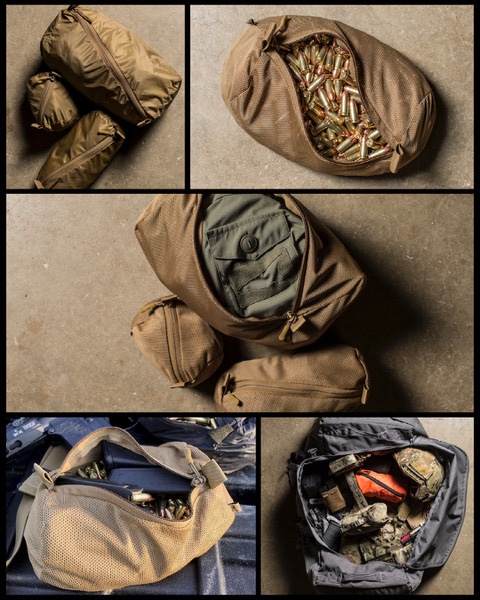
Our popular Summit Bag provides a great way to keep your gear organized inside larger packs or bags and works exceptionally well as a stuff sack for garments and gear. You can throw it under your seat or keep it in the trunk. This is an incredibly versatile organization tool used extensively by both military and civilians.

• Made in AMERICA

• Mesh, 70D ripstop, and High-Vis Orange Packcloth

• Zipper closure

• Available exclusively at FirstSpear

Small (1 Liter) – 4″ x 4″ x 4.5″
Medium (2 Liter) – 4″ x 4″ x 9″
Large (7 Liter) – 6″ x 6″ x 12″
XL (11 Liter) – 6″ x 10″ x 12″
2XL (56 Liter) – 12″ x 12″ x 24″

Check out FirstSpear to find American Made kit and accessories, Built For The X.

75th Innovation Command Brings Unique Skills to EDGE 23

Friday, June 2nd, 2023

The 75th Innovation Command (IC), based in Houston, Texas, employs reservist Soldiers who have been recruited from the civilian world because of their sought-after technical skills and expertise.

The 75th IC team also bring decades of combined military experience with countless deployments under their belts.

“We are here because we are engineers, we are scientists, we all have STEM degrees and backgrounds, so it’s easy for us to talk the talk with these developers and innovators,” explained Chief Warrant Officer 3 Steven Dixon, an innovation technician with the 75th IC.

“I can see where these technologies could be applied on the battlefield, because we have been there. All of us,” added Dixon, who has been deployed six times.

Lt. Col. Martin Plumlee, officer in charge for 75th IC from the Huntsville Innovation Detachment said, “That’s sort of the beauty and secret sauce of the 75th. We are looking for those people who have those unique skills and abilities who can help the Army when they are wearing this suit [Army uniform] and still help the Army when they are wearing a different suit.”

So, who better to provide Soldier feedback during the aviation-centric Experimentation Demonstration Gateway Event, better known as EDGE, that took place at Yuma Proving Ground (YPG) in late April through mid-May than the 75th IC?

The three-week event brought Army Futures Command’s Future Vertical Lift (FVL) Cross-Functional Team and industry and international partners to the Yuma desert to work through network connectivity, frequency communication and flying maneuvers. The event culminated with a live capabilities demonstration for senior leaders and members of Congress.

“Our job here is to integrate and to be embedded with FVL to support all levels of their mission,” Plumlee explained.

That meant boots on the ground at YPG for the duration of the exercise to assess the technology and provide feedback. The 75th IC Soldier feedback in some instances provided the missing link to get a system just right.

Capt. Eric McClure, an Innovation Officer with the 75th and UH-60 Blackhawk pilot by trade, said there were several moments with technology creators where the collaboration led them to think, “Oh, I never really thought about this” or “The feedback you just provided will help us go back and fix a software error or bug we saw, or potentially help improve a system to make it more user friendly.”

EDGE provided the unique ability to gather creators, engineers and software developers with Soldiers for their instant assessment and recommendations.

“Failure is a gift” is a term McClure said someone coined during EDGE. He went on to explain, “It’s a great learning moment, so they can take that back and improve their system. You can see there is care in the eyes of these industry partners to fix those problems, and some have been doing that rapidly on the fly. They have their engineers and their software coders on site. They experience a problem one day, they immediately go back and try to fix it.”

EDGE’s location in the hot Arizona desert made for a perfect training ground. Yuma Test Center at YPG provides unrestricted airspace to allow for air and ground testing.

“You can design something, but if you don’t know how it’s integrated, if the person who is putting in the equipment, or the crew members landing, don’t interact on true missions, or mock missions where they are actually flying the aircraft in the dust with sweaty hands using the equipment, it makes a huge difference,” explained Chief Warrant Officer 4 Gerrit Jenniskens, a tech scout with the 75th IC.

“You see where the failure points are here in a test experimental environment. So, when they get out in the desert or mountain or wherever they are going to be operational, those variable points are reduced. Let’s get it right in the experimental phase,” Jenniskens added.

And that’s ultimately the goal of EDGE — looking to see if the presented systems will be effective solutions and useful for the Army of the future.

“We want to win and bring all our men and women home,” remarked Plumlee.

By Ana Henderson

Revision I-Vis: Compelling Contrast and Color Accuracy [Updated]

Thursday, June 1st, 2023

Sometimes a capability or technology comes along that seems like it should be easy to explain, but really isn’t — at least not without providing an in-person, first-person experience. It was difficult before when comparing polarized vs non-polarized eye pro, and it’s more so the the case now with Revision Military’s “I-Vis” technology for shooting glasses. I-Vis glasses might look like just the latest tactical sunglasses du jour, but there’s a lot of high-tech stuff going on in those lenses. It’s a lens technology that provides significantly increased contrast without losing detail.

That’s a much bigger deal than you might think.

Higher contrast with detail retention is something that even the higher end eye-pro (including Revision’s own) has previously been unable to do. Increasing contrast (or polarizing) a lens has previously by necessity meant blocking some of the light allowed through a lens. This results in a degradation of Gamut Expansion, which is the number of colors an individual can see.

That is no longer the case.

I-Vis Lens Technology

David Reeder
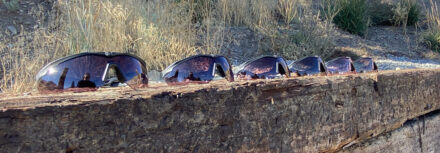
Revision I-Vis ballistic glasses

This article originally ran in October, 2022. It has been updated with additional information and imagery and republished.

We’ll have to get a little bit into color science to explain Gamut Expansion and how it affects your shooting and perception, but the BLUF is this:

It is now possible to injection mold a ballistic lens that delivers markedly (measurably) superior contrast without the previously-necessary reduction in detail.

As Revision explains it, I-Vis will “…expand chroma and enhance the number of colors the user can see.”

The tech is in the dye formulation process.

It is much easier to see it through the lenses than to grasp it based on a few hundred words, but here’s a basic rundown.

There are three types of vision: Photopic, Scotopic, and Mesoptic. Photopic (which uses cones) =color, daylight, and detail. Scotopic (which uses rods) = nighttime, black & white, lack of detail. Traditional tinted shooting lenses increase contrast by moving color reception from photopic toward scotopic, with a corresponding loss of detail.

Color Neutral Lens Tech

The first things to understand are, 1) light is information to the brain, and 2) contrast = differentiation.

I-Vis improves both of those things. It does so by increasing ocular resolution by an estimated 130% or more. It does this with just a marginal reduction in sharpness when compared to a good clear lens and without the significant degradation of true color caused by traditional tinted lenses. Although we haven’t (yet) seen independent testing to confirm that exact number, an initial field expedient trial by media members, some competitive shooters, and (unofficially) some specialized military personnel does seem to corroborate the claim. The eyes of every individual are different, but most people will see a marked difference in contrast and detail using I-Vis vs. traditional tinted contrast eye protection.

Traditional shooting/ballistic glasses typically use a monochromatic lens tint that enhances contrast, often significantly so. However, this reduces the Gamut of Expansion and color accuracy and also increases eye fatigue. To combat this, users engaging in “color critical” tasks use something like a basic smoke-tinted lens that offers no performance benefit other than light reduction.

Dr. Richard Colo, OD, explains in part:

In terms of performance, all shooting glasses have been predicated on what I like to call the wow factor. For decades, people selling glasses for shooting would increase contrast so that we wound having the tint of the month…increase contrast, increase contrast, increase contrast. That became a kind of benchmark in terms of how good a shooting glass lens was. The problem with that is, as you increase the contrast, you reduce the amount of light coming in. As you reduce the amount of light coming in, you’re shifting from photopic detail toward scotopic black and white.

I-Vis glasses are color neutral. This enhances color accuracy, reduces eye fatigue, increases depth perception, and provides greater visual detail.
Eyes make only two movements. One is a “smooth pursuit” movement. The other is “saccadic” movement. Smooth pursuit, which uses cones, is how we pull the trigger. Saccadic, which uses rods, is how we go from one spot to the other – and it’s a thousand times as fast as smooth pursuit. I-Vis lens technology improves contrast (i.e. differentiation) without negatively impacting either. This increases visual performance.

Filtering light

Let’s break it down substantially more Barney-style: I-Vis lenses add more colors to your crayon box.

With more crayons you can draw (i.e. see) with better resolution and depth perception. It’s not that the red object you see becomes “more redder”, it’s that it becomes more of that object’s actual, specific red hue. This effectively reveals things — admittedly sometimes smaller, seemingly inconsequential things — you would otherwise not have seen. Think digital photograph vs. posterized clip art, albeit not always as immediately drastic.

From a performance perspective, particularly in a tactical or other life-or-limb situation, little inconsequential details are often anything but.

Increased contrast without loss of detail allows for accurate recognition of colors. Accurate recognition of colors ensures depth performance and promotes visual comfort.

Image comparison courtesy of Revision Military.

Confident Perspective

In addition to the obvious benefit of improved perception, target acquisition, and the like, increased contrast without corresponding loss of detail improves confidence. Dr. Colo, who also has a degree in psychology, makes a particular point of this in the context of shotgun sports.

“Take for example an average individual in the field wearing a clear lens. That person is out shooting clays. The pupil constricts and depth of field increases. The constricted pupil restricts the blur circle at the back of the eye, increasing the depth of field, and everything is clear.  Going on down a few stations, though, now your pupil dilates. This puts a bit of a fuzzy edge around the target. It’s not the fuzzy edge that might be a problem problem, it’s the potential effect of that fuzzy edge on the shooter’s confidence-doubt that could become the problem.”

“Contrast sells glasses. Detail hits (or breaks) targets.” Dr. Richard Colo

This sort of increased confidence is obviously just as applicable (and potentially far more significant) to someone trying to pick up and identify a moving target through a scope, or notice minute changes in the soil that might indicate an IED, or the presence of a camouflaged threat.
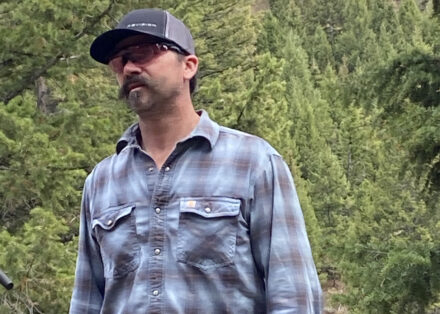
Sid Mitchell of Revision Military

Sid Mitchell of Revision Military (who wears prescription glasses) explaining how I-Vis works, and how it might work to make Rx versions of the lenses.

Environmentally Specific.

Well, ~ish.

There are six tints of I-Vis available, each developed after an extensive theater-specific study of potential AO color palettes using global data from the National Oceanic and Atmospheric Administration (NOAA).

This provides for five individual tints designed to increase contrast and elevate color recognition in the prevalent terrain of different geographic regions, plus a “general purpose” tint that functions extremely well across the board (if not to the extent of the more specialized lenses).

I-Vis Verso Lenses Eye Protection

It’s hard to adequately and accurately demonstrate how I-Vis impacts color perception, but here’s a crude attempt. This gif begins with Verso lenses in front of the camera, then shows what it looks like without them (and back).

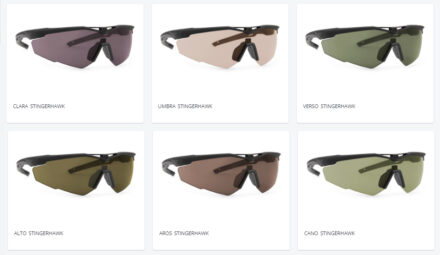
The I-Vis lens line includes:

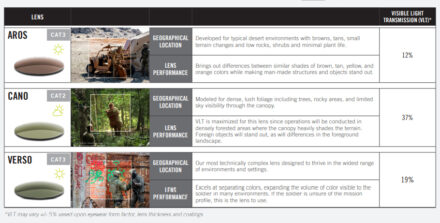
• Verso 

The most technically complex I-Vis lens, Verso designed for the widest range of environments and settings. This is the general purpose lens one would want if only able to buy one pair. (Visible Light Transmittance/VLT: 19%*)

• Aros

Aros is intended to enhance colors found in typical desert environments. It brings out differences between similar shades of brown, tan, yellow, and orange colors while making man-made structures and objects stand out. (VLT: 12%*)

• Cano

Cano was developed to provide color definition environments dominated by greens, browns, and grays (typified in lush foliage). Cano lenses maximize visual light transmission because they’re designed for densely forested areas with a canopy and shaded terrain. Man-made structures will stand out, as will differences (or changes) in the foreground landscape. (VLT: 37%*)

Revision I-Vis Cano lenses with and without.

This is a look at the same ravine as above, this time using Cano lenses. With, then without, then with again. Use of an animated gif on an electronic screen is necessarily crude – apologies for that.

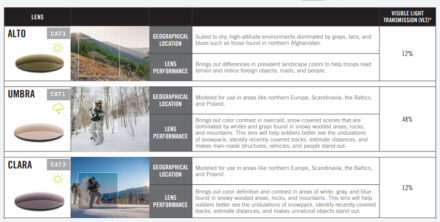
• Alto

Alto lenses are suited to dry, high-altitude environments dominated by grays, tans, and blues (such as the terrain found in northern Afghanistan).  (VLT: 12%*)
• Clara

Clara lenses were modeled for use in northern Europe, Scandinavia, and the Baltics, and Poland. They’re designed to bring out color definition and contrast in brightly lit areas of white, gray, and blue. Think snowy wooded areas, rocks, mountains, and areas with undulating snowpack. (VLT: 12%*)

• Umbra

Much like Clara, the Umbra dye formulation is intended to improve color contrast in overcast, snow-prominent areas dominated by whites and greys (snowy, rocky areas and mountains).  (VLT: 48%*)
Polarized vs non-polarized is no longer the main choice; now it's a matter of appropriately selecting the correct environmental lens from the Revision Eyewear i-Vis line.

Polarized vs non-polarized is no longer the main choice; now it’s a matter of appropriately selecting the correct environmental lens from the Revision Eyewear i-Vis line.

*VLT may vary +/- 5% based upon eyewear form factor, lens thickness and coatings.

Polarized vs Non-Polarized

To better grasp why i-Vis lens tech is significant, it might be helpful to understand just a little about how polarized vs non-polarized lenses work. Polarized sunglasses provide a sharper image than non-polarized sunglasses. A polarized lens seems to call out better detail than non-polarized lenses while simultaneously doing their main job – cutting the glare of bright light, increasing visual clarity, and reducing eye strain.

Reflected light (light waves bounced off a horizontal surface like water, sand, snow, and pavement) is often worse than bright sunlight, even when direct. That reflective surface glare is where you wring the most advantage from polarized glasses (whether corrective, ballistic, and/or safety glasses) vs. regular sunglasses.

Polarized lenses are great. Many people (myself included) prefer them to non-polarized ones, particularly when on the range, driving, or doing something else outdoors. Unfortunately, the anti-reflective coating used on a polarized sunglass lens to achieve glare mitigation does so by filtering out certain light waves. I won’t pretend to understand all the science, but as I understand it, that anti-glare lens coating is designed to block horizontal light (i.e., shimmer, dazzle, etc.) in particular.  In simplest terms, this means it acts like slats on a window blind, blocking out horizontal rays in particular.

Because some light is blocked, however, some information is lost. That’s why polarized shades aren’t always the best choice for wear on an overcast day, driving in potentially icy conditions, or just looking at digital screens (LCD screen, phone or tablet, etc.). A non-polarized lens doesn’t block glare as well but does a better job of allowing you to see your environment more how it really is. Non-polarized glasses can also provide UV protection, of course, and that’s all anyone needs many times.

Revision’s i-Vis glasses provide many of the advantages of polarized options, vis-a-vis horizontal light waves, contrast, etc., without the reduction of information that comes from polarized light. My Speed Demons (the metal frame i-Vis option) do a great job blocking reflection and providing contrast, but I don’t know how (or if) they protect UV light/UV rays. I’ll have to find that out.

I-Vis EyePro Features
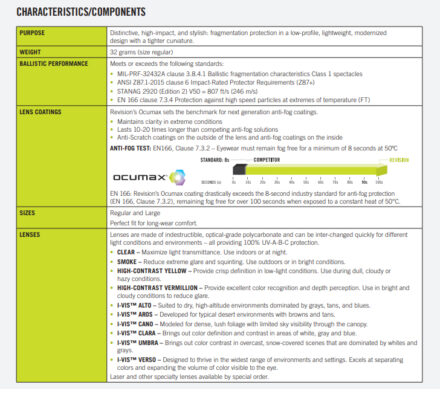
Prior to i-Vis, the most common eye pro comparisons boiled down to ballistic vs impact protective, and polarized vs non-polarized. This lens technology has greatly changed those limitations.

Prior to i-Vis, the most common eye pro comparisons boiled down to ballistic vs impact protective, and polarized vs non-polarized. This lens technology has greatly changed those limitations.

Options Available

Initial styles of I-Vis will include Stingerhawk spectacles and Snowhawk goggles. There will be other styles and models in the future however, all focusing on what Revision’s Sid Mitchell views as the necessary trifecta of modern eye protection: protection, performance, and style.*
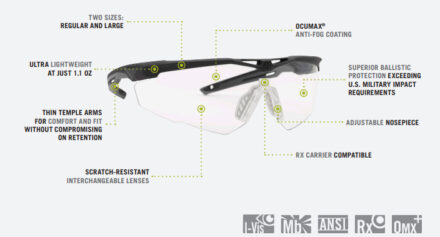
The Stingerhawk spectacle system will be available in I-Vis.
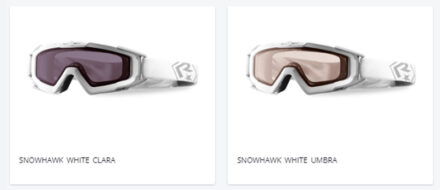
So will Snowhawk goggles.

*Style might seem trivial in the context of form vs. function, but it’s not. Not when style and aesthetics directly impact the use of eye pro off the battlefield – which it does. This was true before, when debating the relative merits of polarized vs non-polarized lenses, and it remains true now that i-Vis has entered the chat.

Learn more at RevisionMilitary.com.

DRW