TYR Tactical

Archive for the ‘Guest Post’ Category

Hurricane Hunters Testing New SATCOM Capabilities

Sunday, November 7th, 2021

KEESLER AIR FORCE BASE, Miss. (AFNS) —  

For the Air Force Reserve’s 53rd Weather Reconnaissance Squadron Hurricane Hunters, stationed at Keesler Air Force Base, the ability to transmit data in flight is tantamount to mission success.
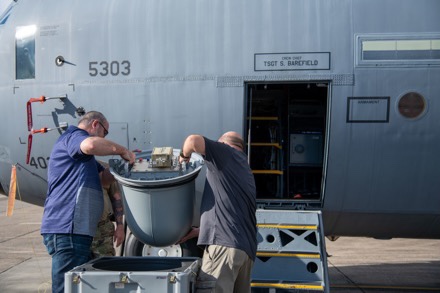
As one of their WC-130J Super Hercules powers through a hurricane, a loadmaster is in the back, preparing and launching dropsondes that collect atmospheric data.

The aerial reconnaissance weather officer sits adjacent, quality checking the figures from the dropsonde, as it plummets to the ocean’s surface, and from the stepped frequency microwave radiometer attached to the wing of the aircraft.

From there, all pertinent information that can help forecasters better predict the storm’s intensity and track is sent directly from the aircraft to the National Hurricane Center, Florida, or the Central Pacific Hurricane Center, Hawaii.

To accomplish all of this, the 53rd WRS’s 10 WC-130Js are equipped with satellite communications capabilities.

While for years the squadron’s 10 aircraft have been able to send the atmospheric data collected from the dropsondes and SFMRs, new technology is being tested that will allow more real-time information for the NHC concurrent with the National Hurricane Operations Plan’s requirements of radar reflectivity imagery and high density, three-dimensional Doppler radial velocities of the tropical cyclone core circulation.

Ed Bodony, Center Test Authority test director at Robins AFB, Georgia, and 1st Lt. Makiah Eustice, flight engineer for the CTA, made the trip to test a protocol satellite communications system that will allow those on the ground to see high-definition video of radar footage from flights as they fly through a storm.
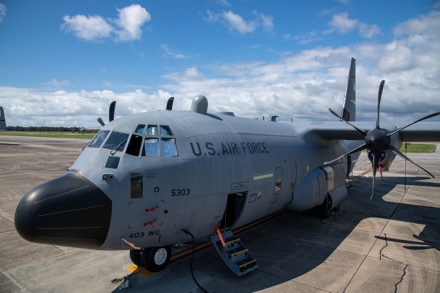
“With our current system, we’re able to send data we collect in intermittent bursts throughout the flight,” said Lt. Col. Tobi Baker, 53rd WRS ARWO. “This new SATCOM system will allow us to send data continuously, including sending video of the radar imagery we’re seeing on our screens on the aircraft to the people on the ground.”

For this initial testing portion, Bodony and Eustice as well as representatives from the companies behind the technology, first conducted a ground test.

“We tested for compatibility and functionality to make sure it’s not going to harm any other parts or functions of the airplane’s normal systems like taking off, cruising, and commanding,” Eustice said.

Eustice also said they tested to make sure the system could transmit data and be received on the ground.

The setup used for testing is called the C-130 X-Band Multi-Purpose Hatch System Solution SATCOM System and includes a hatch mounted satellite antenna, a portable base kit, and a laptop.

The 18-inch electronically steerable parabolic antenna, enclosed in what is called a radome, is inserted and protrudes from the escape hatch on the flight deck while connected to the base kit in the back of the aircraft, which consists of a power distribution unit, power supply, tactical switch, modem, and router.

“The equipment used for these tests is not exactly what the final product will be like,” Bodony said. “What we’re using for testing is what’s called a ‘roll on, roll off’ setup, because of the relative ease of putting it on and taking it off of the aircraft. If all goes well, and the 53rd (WRS) moves forward with this technology, a permanent design will be constructed and installed.”

Following the ground test, the crew took flight.
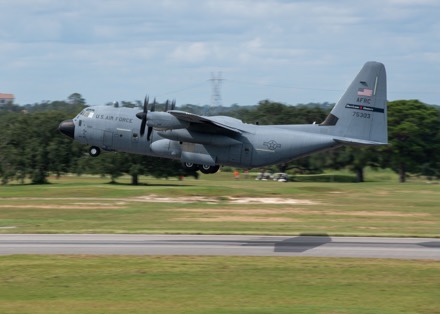
“Everything went well,” Bodony said. “This two-day process was just to qualify and confirm that the equipment works. Next is operational testing. A different crew of engineers will come in and they’ll test its capabilities in an actual storm environment.”

Of course, unlike other weapons systems and testing, it’s difficult to plan operational testing when it’s dependent on the weather, so the unit will have to wait for a storm to develop to complete the process.

“This has been in the works for a long time,” Baker said. “Right now, we’re able to send the radar imagery we compile from flights in a video file after the fact. That’s great for research purposes, but being able to send the video in real time will be beneficial for those people on the ground putting out the watches and warnings as it will give them a better idea of what’s going on in and around the eye or center of a storm.”

By SSgt Kristen Pittman, 403rd Wing Public Affairs
Special Warfare Training Wing: First USAF Organization to Host a Special Operations Forces Training “Shura”

Saturday, November 6th, 2021

Joint Base San Antonio – Chapman Training Annex, Texas —

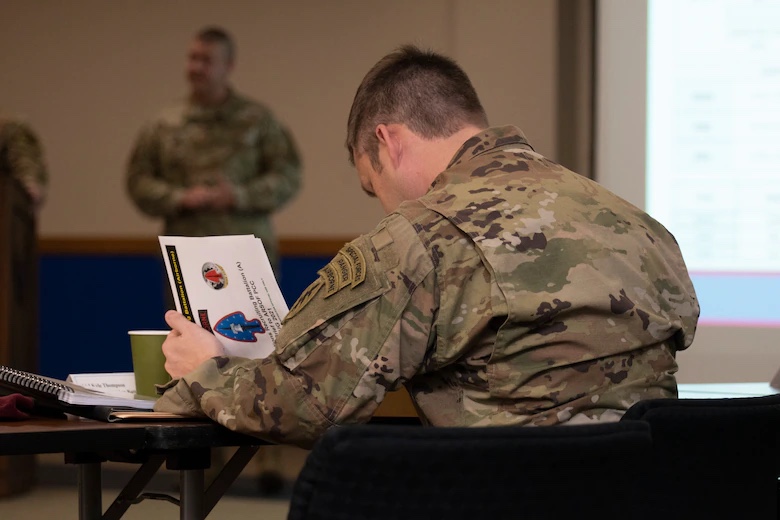
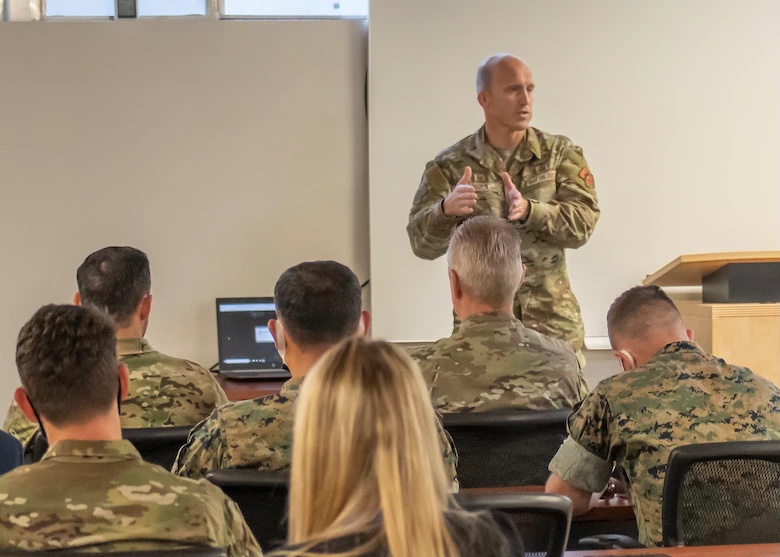
The Special Warfare Training Wing is the first U.S. Air Force organization to host a Special Operations Forces Training “Shura”, a gathering of senior leaders from SOF-generating commands under U.S. Special Operations Command and its allied counterparts around the world held Nov. 2-4, 2021 at Joint Base San Antonio-Lackland.

Over the years, senior leaders of SOF-generating commands have routinely held SOF Training “Shuras” to cross-pollinate best practices and to build lethal SOF warriors capable of solving the nation’s most complex problems in austere environments.

For the SWTW, hosting this iteration of the SOF Training “Shura” represents a natural evolution stemming from decades of its predecessor organizations training Special Warfare Airmen for service in special operations around the world, a critical mission set that has not stopped and is now more important than ever in the age of strategic competition.

“Our relationship with the special operations community is important for the SWTW,” said Col. Mason Dula, SWTW commander. “A third of our graduates are destined for service inside a USSOCOM component, and learning from our SOF-training counterparts helps reinforce the imperative that our Special Warfare graduates will be expected to seamlessly interoperate with joint special operations forces, the day they graduate from our pipelines.”

Members attending the SOF Training “Shura” discussed a wide variety of topics affecting the SOF world, including pre-accessions, recruiting and development, training pipeline standards and more, while reinforcing partnerships to ensure a unified approach towards the USSOCOM SOF Operating Concept 2030, aimed at preparing SOF operators for the future fight.

Two widely discussed topics included the various Assessment and Selection models that different SOF-generating commands utilize and the integration of human performance technology as SOF warriors of the future are built – both of which the SWTW has been accelerating change in since its inception in Oct. 2018.

In Jan. 2019, the SWTW instituted its very own 4-week Assessment and Selection (A&S) to carefully select potential Air Force SW operators based on character and attributes, replacing the previous Indoctrination course that focused primarily on physical attributes.

“Many people think that A&S is just about selection, when in reality, it promotes a learning culture,” said Col. Robert Taylor, Special Warfare Training Group commander. “A&S focuses our cadre, training, and operational forces as best we can on the core attributes of an individual.”

Interwoven in the A&S model of the SWTW and every other aspect of the wing’s imperative to build SW Airmen of the future is its Human Performance Support Group, the first of its kind in the USAF, which fuses cutting-edge science and technology into each step of the process as SW Airmen are built from the ground up at the SWTW.

“We instill human performance principles that SW Airmen can apply throughout the duration of their careers and beyond,” said Col. George Buse, Special Warfare Human Performance Support Group commander. “Our team helps set the foundation for building resilient warriors who are physically harder, mentally sharper, and spiritually stronger.”

At the end of the SOF Training “Shura”, all parties left with new knowledge that will go on to affect the kinetic battlespace of the future.

“Hosting the SOF Training ‘Shura’ is important for SW culture because we are a learning organization,” said Col. Dula. “Like the operational forces inside Air Force Special Operations Command, the SWTW has a responsibility to ensure that we understand and anticipate changes inside the joint SOF community and adjust our training pipelines accordingly to produce graduates ready to execute the nation’s special operations immediately upon arriving to operating forces.”

Members of the Special Warfare Training Wing provide initial training for all U.S. Air Force Special Warfare training AFSCs, to include, Combat Controllers, Pararescue, Special Reconnaissance, and Tactical Air Control Party Airmen.

To learn more about SW Airmen or other U.S. Air Force Special Warfare career opportunities, go to: https://www.airforce.com/careers/in-demand-careers/special-warfare.

By 1st Lieutenant Xiaofan Liu, Special Warfare Training Wing

Friday Focus: Happy Veterans Day Happy Birthday Marines

Friday, November 5th, 2021

Next week is a celebration and remembrance, in 96 hours we will have praised and celebrated one of the finest Military Branches in the world and we remember all veterans past and present.

Happiest of Birthdays to the United States Marines Corps and may you have many more years of service to our great nation. “Semper Fidelis.” To all that have served, we will continue to support you and your missions. From our FirstSpear family to yours, thank you for your honorable service and to those that continue to serve, you are admirable in your endeavor.

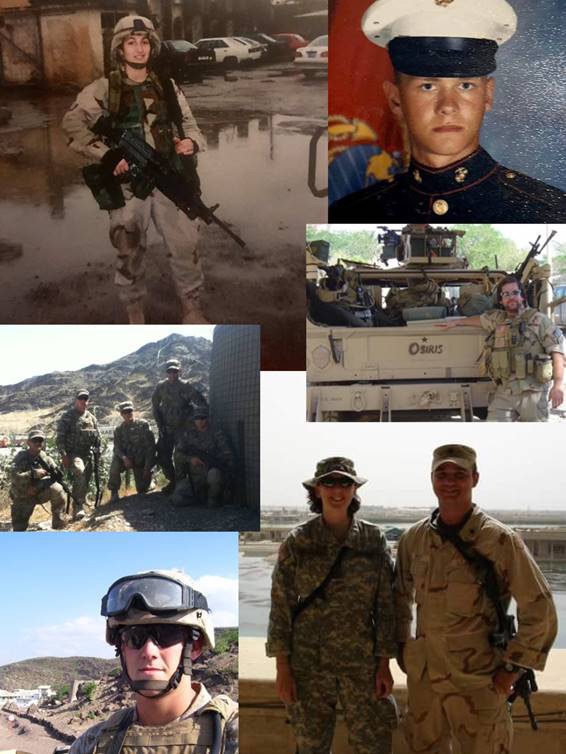
Here’s a collage of some familiar FirstSpear faces from far off places.

We employ veterans and encourage anyone looking to join the FirstSpear family to check out our job listings:www.ziprecruiter.com/c/FirstSpear/Jobs.

For more information about FirstSpear, check out www.first-spear.com.

Multi-Domain Warfare Students Observe real-time C2 of AFSOUTH Operations, Get a Taste of Multi-Domain Operational Planning

Thursday, November 4th, 2021

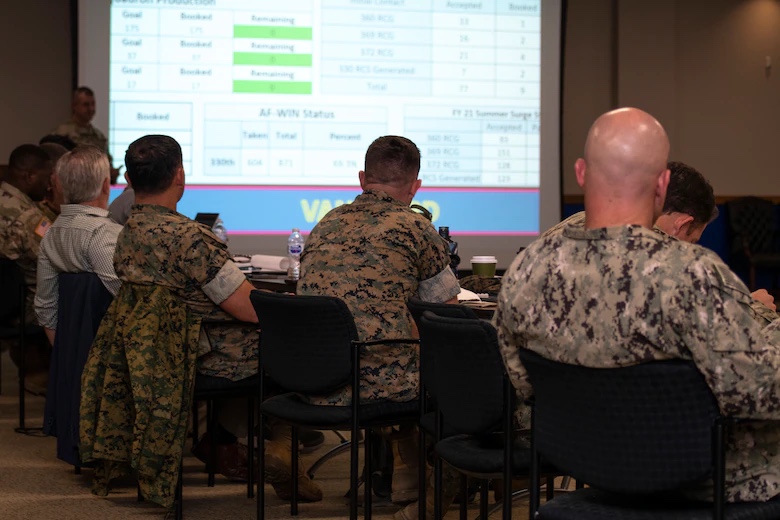
The Multi-Domain Warfare Officer Initial Skills Training class 21B visited the 612th Air Operations Center at Davis-Monthan Air Force Base, Arizona, to observe real-time operations, Sept. 27-28. 

The 612th AOC’s mission is to “plan, command, control, execute, and assess air, space, and information operations to meet Secretary of Defense, Chairman of the Joint Chiefs of Staff, and Commander, United States Southern Command’s taskings across the full spectrum of military operations.” 

Davis-Monthan AFB was the third of a four-leg trip for the Multi-Domain Warfare Officer, or 13O, students traveling to geographic and functional operations centers. The 13Os had just visited the Shadow Operations Center – Nellis, or ShOC-N, at Nellis AFB, Nevada, as well as the Combined Space Operations Center at Vandenberg Space Force Base, California.  Their next and final stop will be the 616th Operations Center at Joint Base San Antonio, Texas.

“When the class arrived, they received a brief about how 13Os have been used in AFSOUTH [Air Forces Southern] and some of the unique characteristics of the command and AOC,” according to Maj. Nathaniel “Crowbar” Butler, a 13O Class 20A graduate, assigned to the 612th AOC Strategy Division. “We then provided them with initial data and assumptions to begin planning for a strategic deterrence mission. We were able to provide real-world lines of effort, priorities, and constraints to shape their planning.”

The training exercise provided the students with real-world exercise planning experience using real-world products that were not derived in an academic environment.

Butler continued, “Their deliverable was a brief that demonstrated how they would employ a task force, with a synchronized IO [information operations] plan, to build partnership in our AOR [area of responsibility] and reinforce the message that the U.S. is the ‘Trusted Partner’ in South America.”

Both teams successfully met the air component’s intent and demonstrated an ability to use their training in a competition environment scenario.

“It’s just amazing to witness how far we’ve come as a brand new career field.  When I graduated as part of the very first 13O class, we were still an experiment in almost every sense of the word,” weighed in Lt. Col. Marcus “Troll” Bryan, 705th Training Squadron commander/leader of the 13O schoolhouse, Hurlburt Field, Florida.

Bryan continued, “The first 13O graduates didn’t know what to expect when we left the schoolhouse nest. In many instances, AOCs were a hodge-podge of various career fields where organizational culture was dependent on command climate.  Now we have 13O students visiting 13O graduates, executing real-world 13O planning events as part of their training, and most importantly building a culture of operational C2 expertise across the globe!”

Lt. Col. Benjamin “Dragon” Lee, 705th TRS director of operations and 13O graduate, seconded that view.  “By the time this class graduates, they’ll know where their first follow-on assignment will be, and most (if not all) of those assignments will be to Air Components like they saw on this TDY.  This world-wide 13O network and culture is one of many 13O career field milestones that will help the USAF lead the joint force in an era of strategic competition.”      

The demand signal from the air components for confident operational command and control experts capable of integrating multiple domains is stronger than ever. The 20-week AFSC [Air Force Specialty Code]-awarding course is the most rigorous operational-level planning course in the USAF, preparing 13Os to lead operational planning within the air component from day one.

To learn more about 13O training and the Multi-Domain Warfare Officer career field, visit the following websites:  intelshare.intelink.gov/sites/C2/13O/SitePages and www.milsuite.mil/book/groups/13O.

The 705th TRS reports to the 505th Test and Training Group and 505th Command and Control Wing, both are headquartered at Hurlburt Field, Florida. 

By Deb Henley, 505th Command and Control Wing, Public Affairs
Fibrotex – Camo Trio Operational View

Wednesday, November 3rd, 2021

Fibrotex’ Signature Management Systems are designed to be adaptable to the mission and the asset that needs to be concealed. The Fibrotex team is constantly adapting to the ever-changing battlefield requirements. The three elements of total force concealment are Mobile, Static, and dismounted troops signature management, they rely and depend on each other. Without all of them, our operational abilities are reduced and end-up placing our operators in harms way.


The Systems listed below are a few of the more popular solutions within the Fibrotex arsenal.

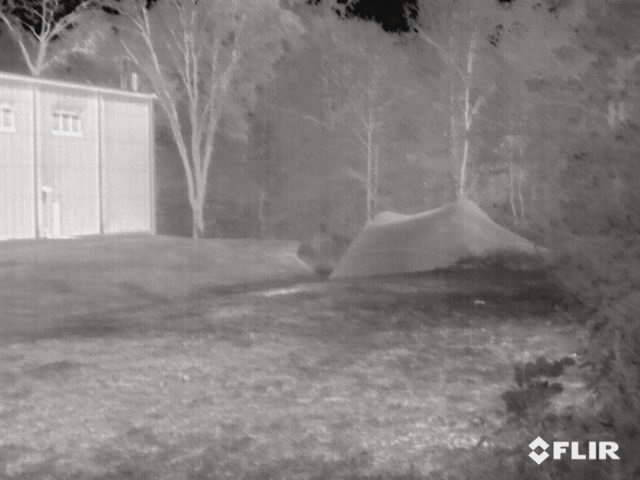
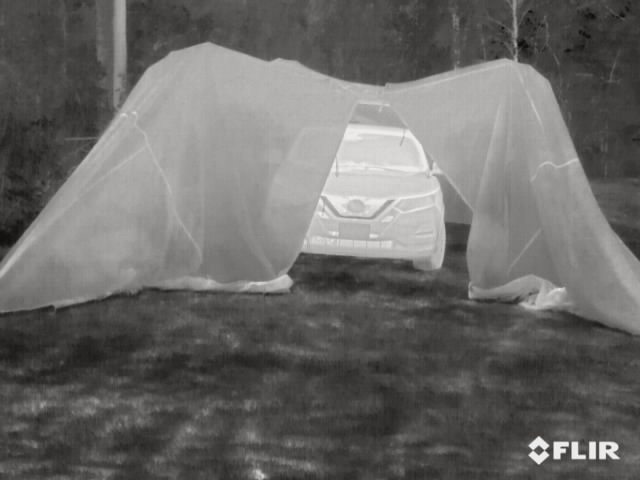
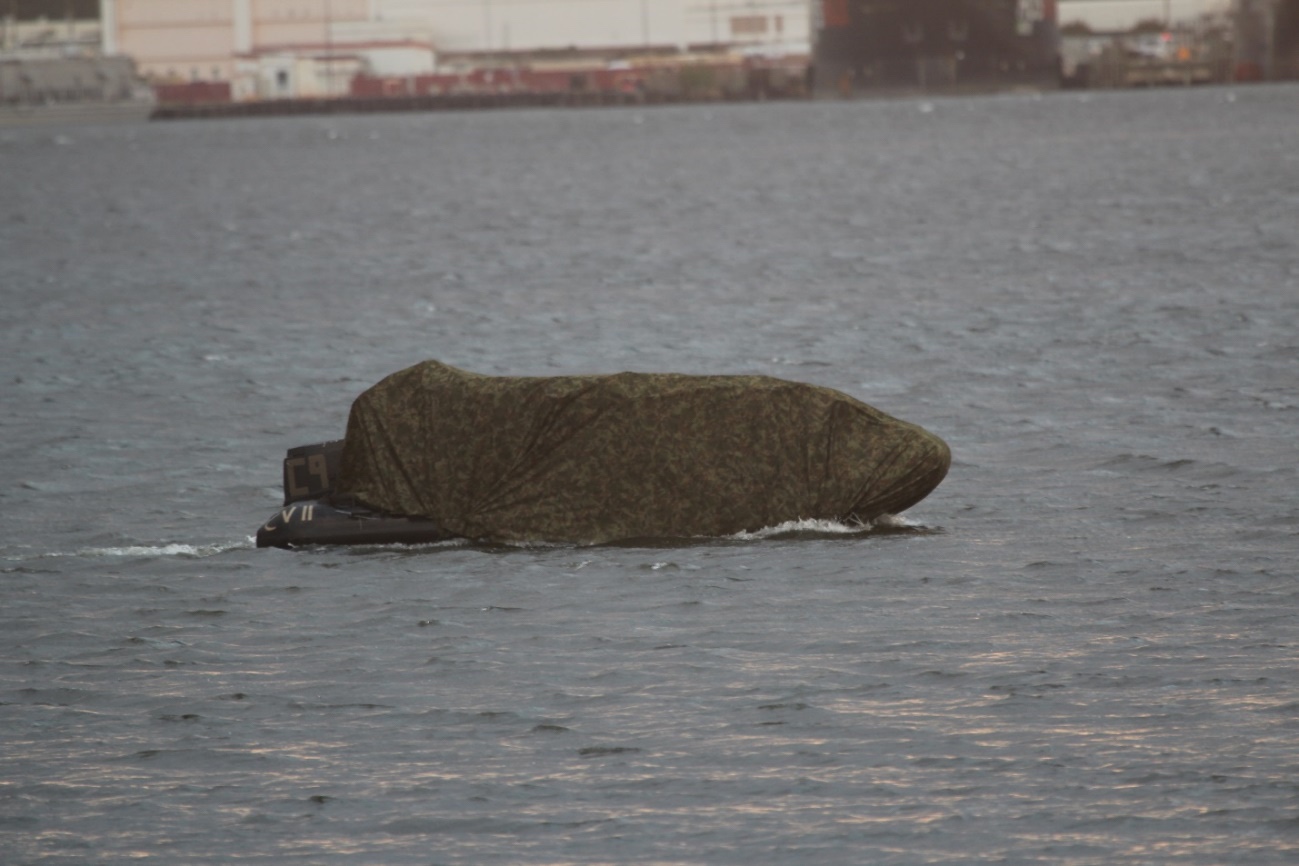
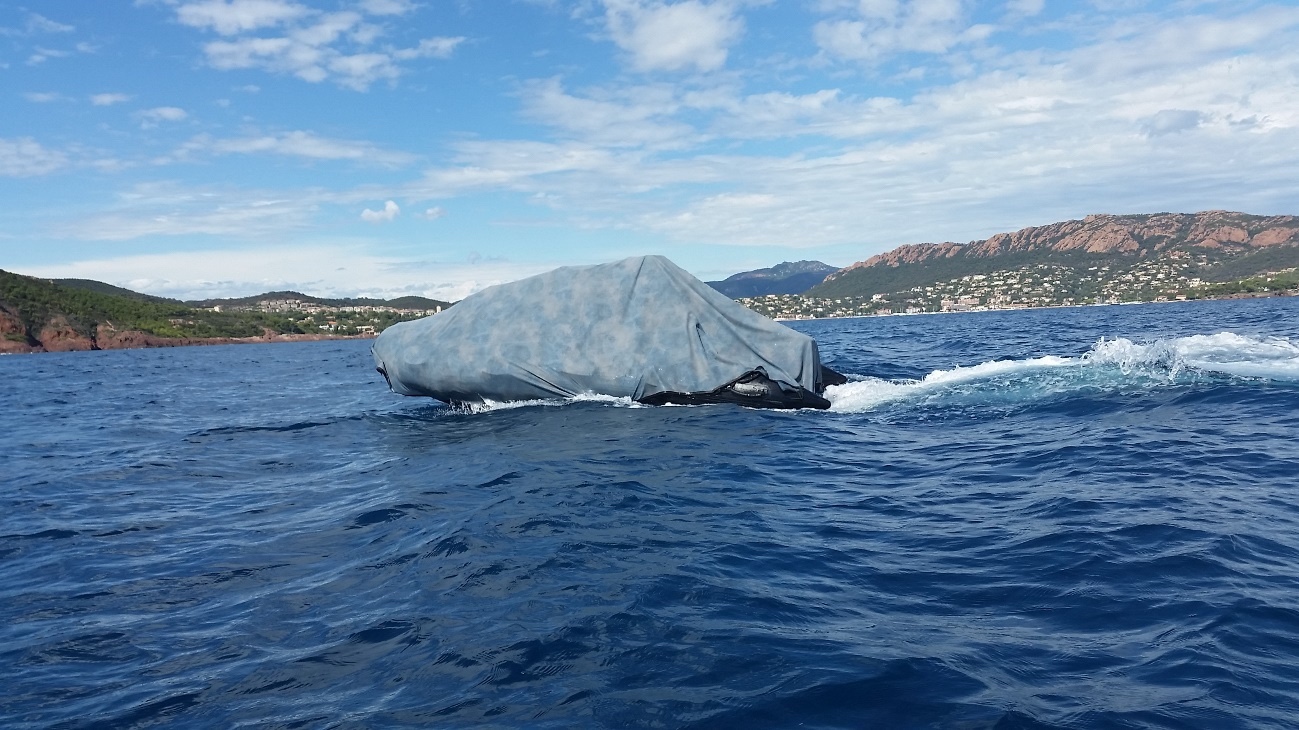
The Ultra-Lightweight Camouflage Net System (ULCANS). While already a program of records accessible to all US DOD branches, it is the workhorse of Fibrotex’ Signature Management systems. With the proper amount of Hex and diamonds linked together, you can cover any asset within the Military’s inventory. With the UV, VIS, NIR, SWIR, Thermal, and RADAR scattering capabilities. Our unique app, amongst other information and tactical guidelines, has a section that lists typical configurations (the App ULCNAS is available both on google play and on the Apple App store). This shows common military vehicles and other assets and the ULCANS sections required and in what order to properly conceal that asset. This is just one of several resources that can be found for the end-user.


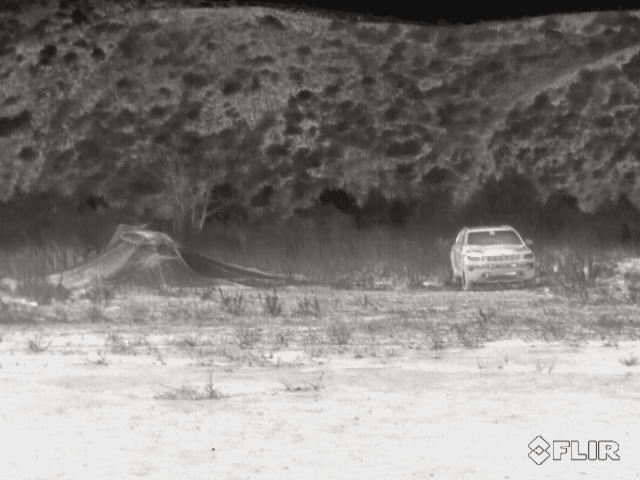
A hex and two diamonds set up covering a midsize SUV from 50 meters.


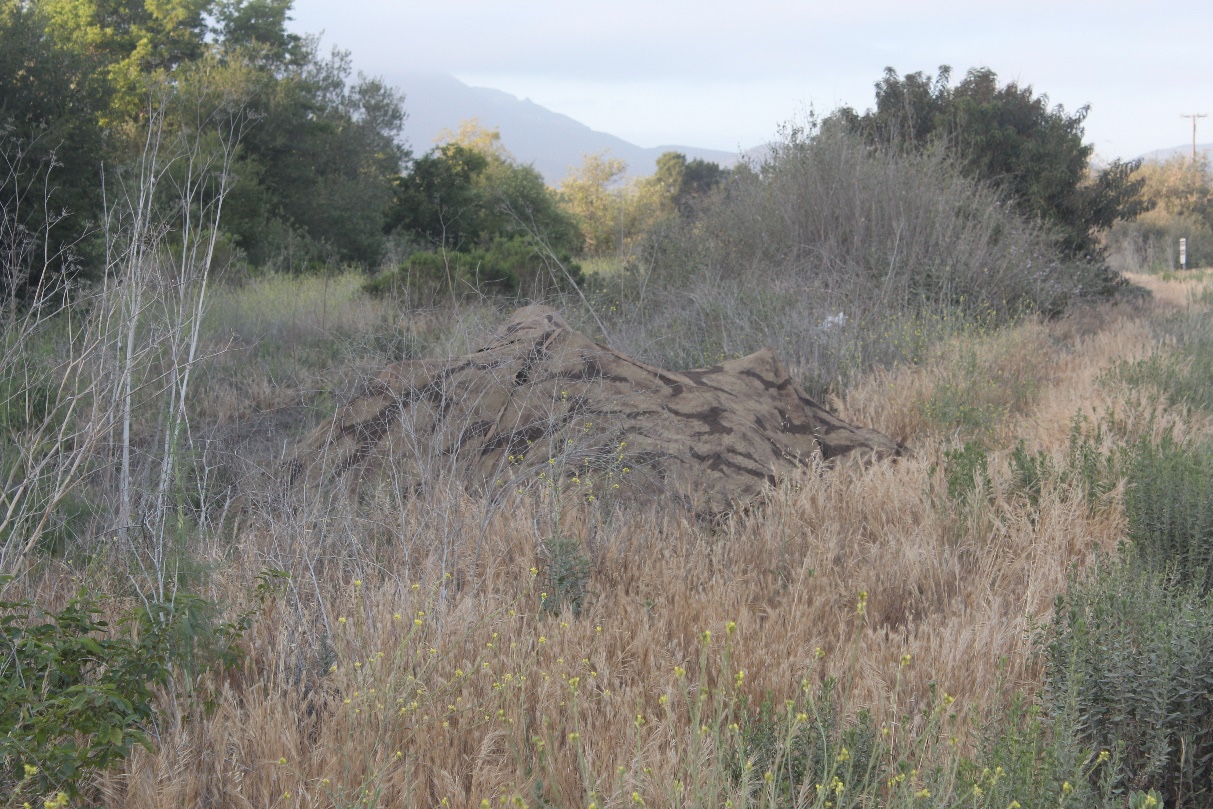
The front of this ULCANS is open to ensure the vehicle is prepped for a quick exfil from 10 meters.


An ULCANS used to hide the Radar signature of this Combat Rubber Raiding Craft.

The Sophia kit is the brainchild between French Commandos and our CEO, Eyal Malleron. It is the true and only DIY (do-it-yourself) kit in the field. 2.6 meters by 33 running meters of material rated for UV, VIS, NIR, SWIR, and thermal spectrums fitted into a kitbag with ruck straps, a hook-pile tape opening at the top, and snap links at the bottom. It is restricted only by the end-user’s creativity. The material has a crush factor making a 3-D effect without the extra weight or excessive snagging. Perfect for hiding unique items.



A series of Sophia sections attached to a US Marine UTV with three Marines inside in comparison with a Mid-size SUV at 50 meters.


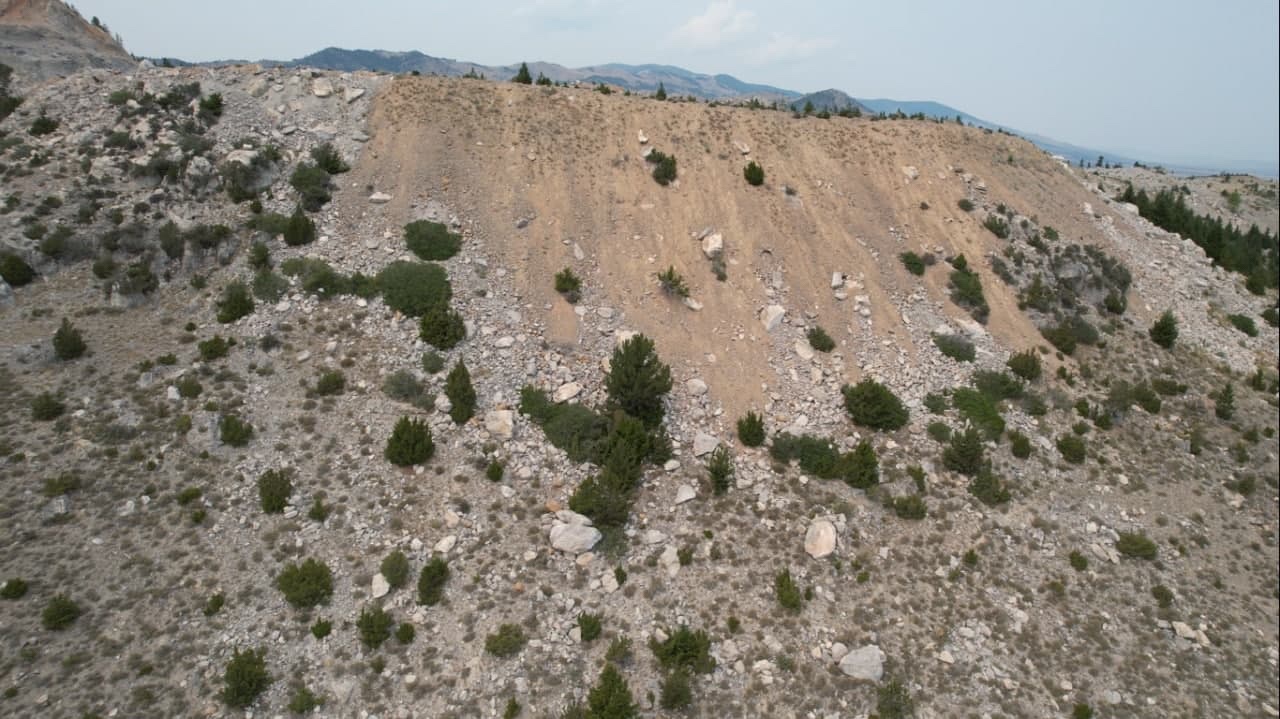
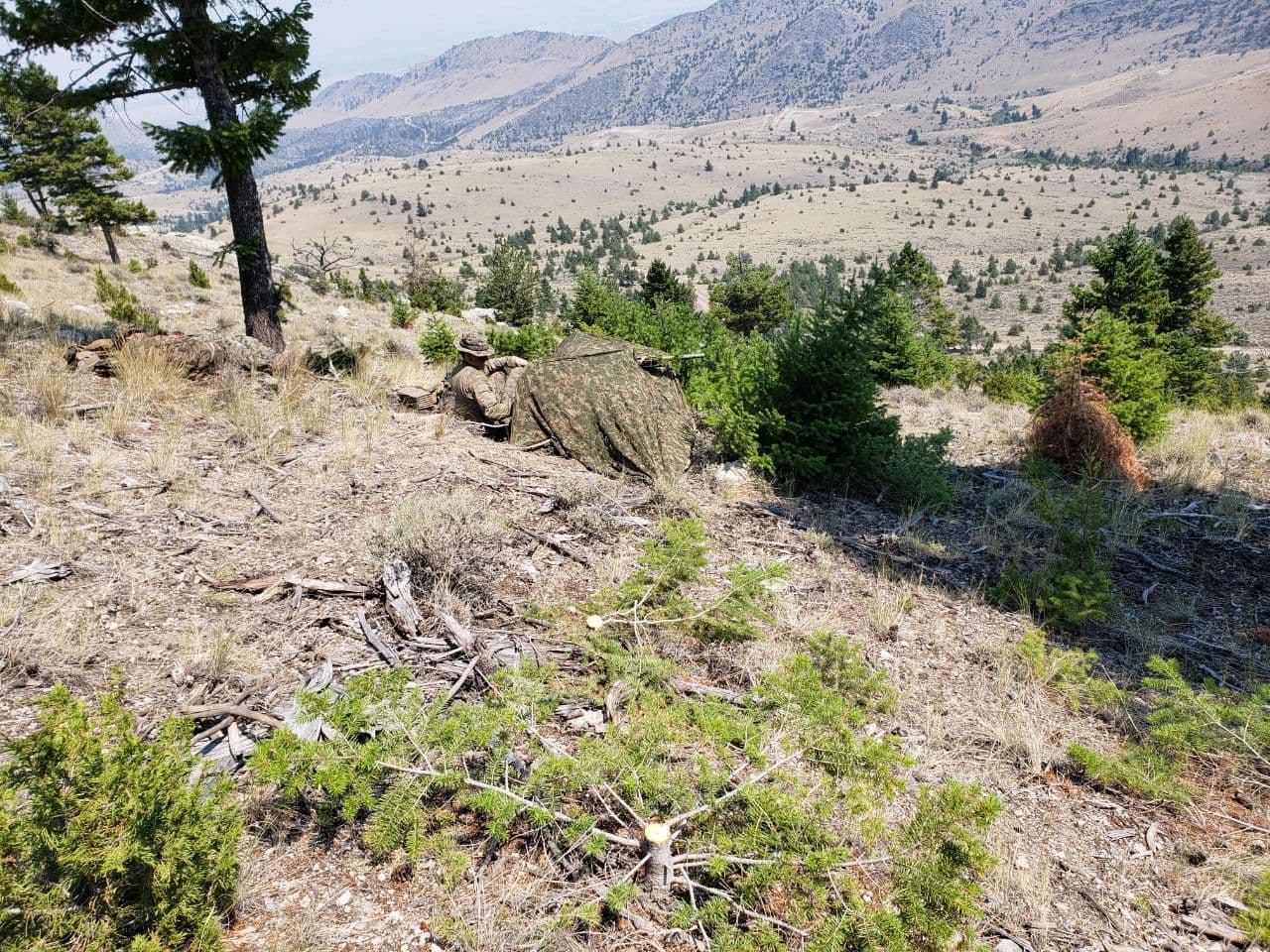
A still image from drone footage of a ridgeline in Montana. A Nine-man Recon team is concealed underneath a section of Sophia. The drone operator was unable to locate the team after a detailed search of the ridgeline.


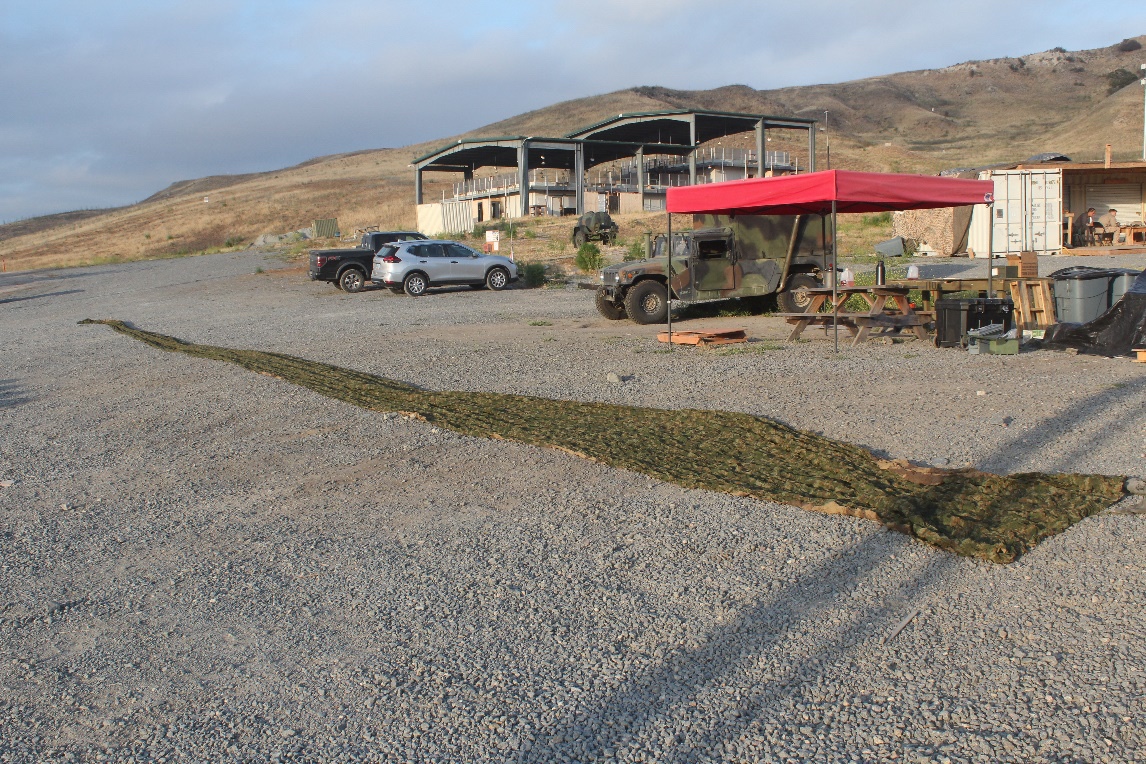
33 meters doesn’t sound like a lot of material until you see it stretched out in front of you.

The NOA is a favorite of the Fibrotex Signature Management Systems. Capabilities ranging from UV, Vis, NIR, SWIR, and thermal and 30% denser than the ULCANS material to cater to the dismounted troops. With the ability to be worn on the body and then linked together to be used as an OP Kit. It’s also strong enough of a material to be used as a pole-less litter in the event of a casualty. With multiple uses, it cuts down on the overall weight of the shooter’s kit.


Four NOAs linked together in an OP configuration with a US Marine Observing out of a loophole.


A Recon Marine wearing a NOA moving from a grey rocky environment to a green pine thicket.


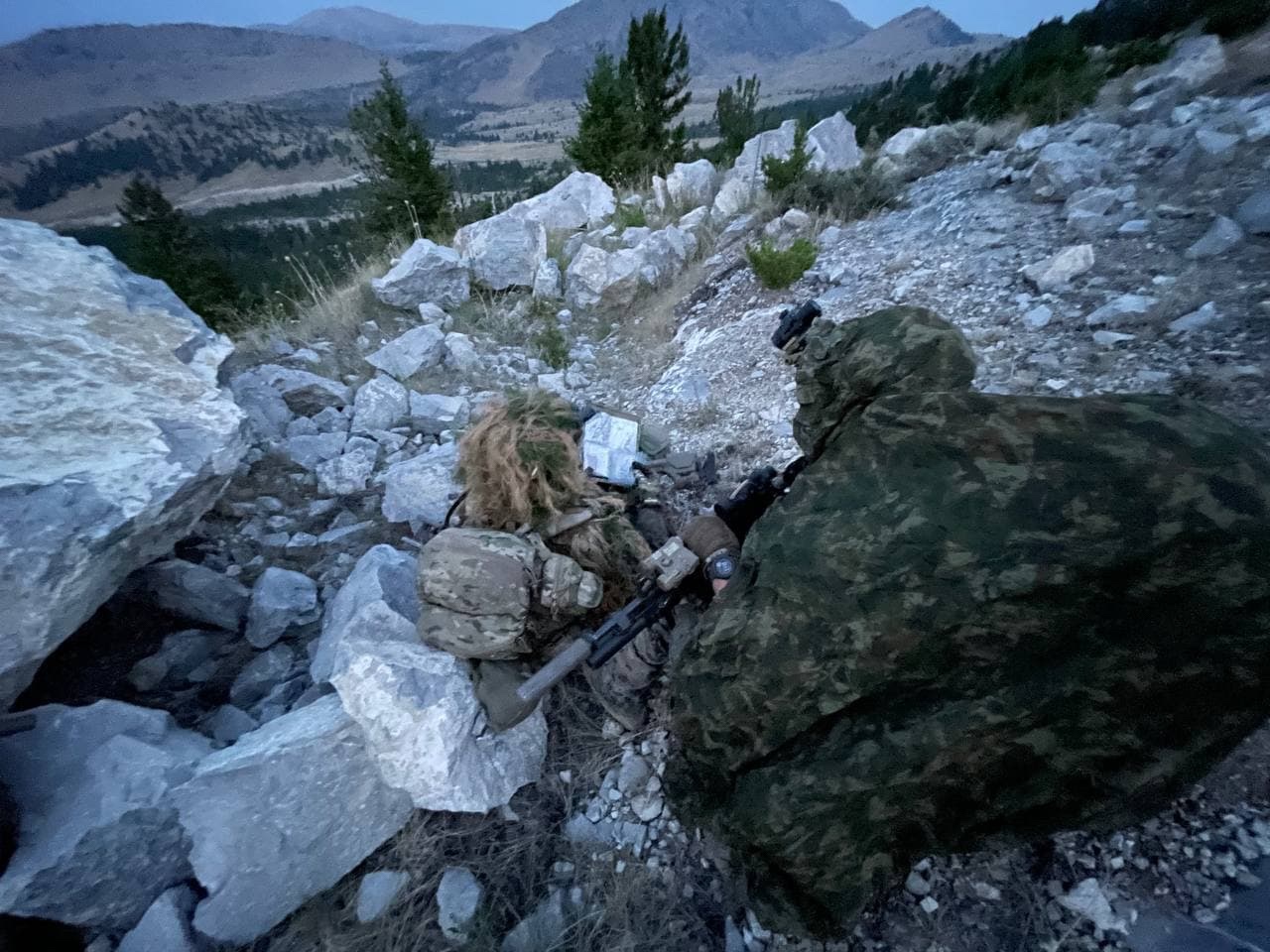
A Sniper team sets up a hasty final firing position using two NOAs linked together around the M110 SASS.


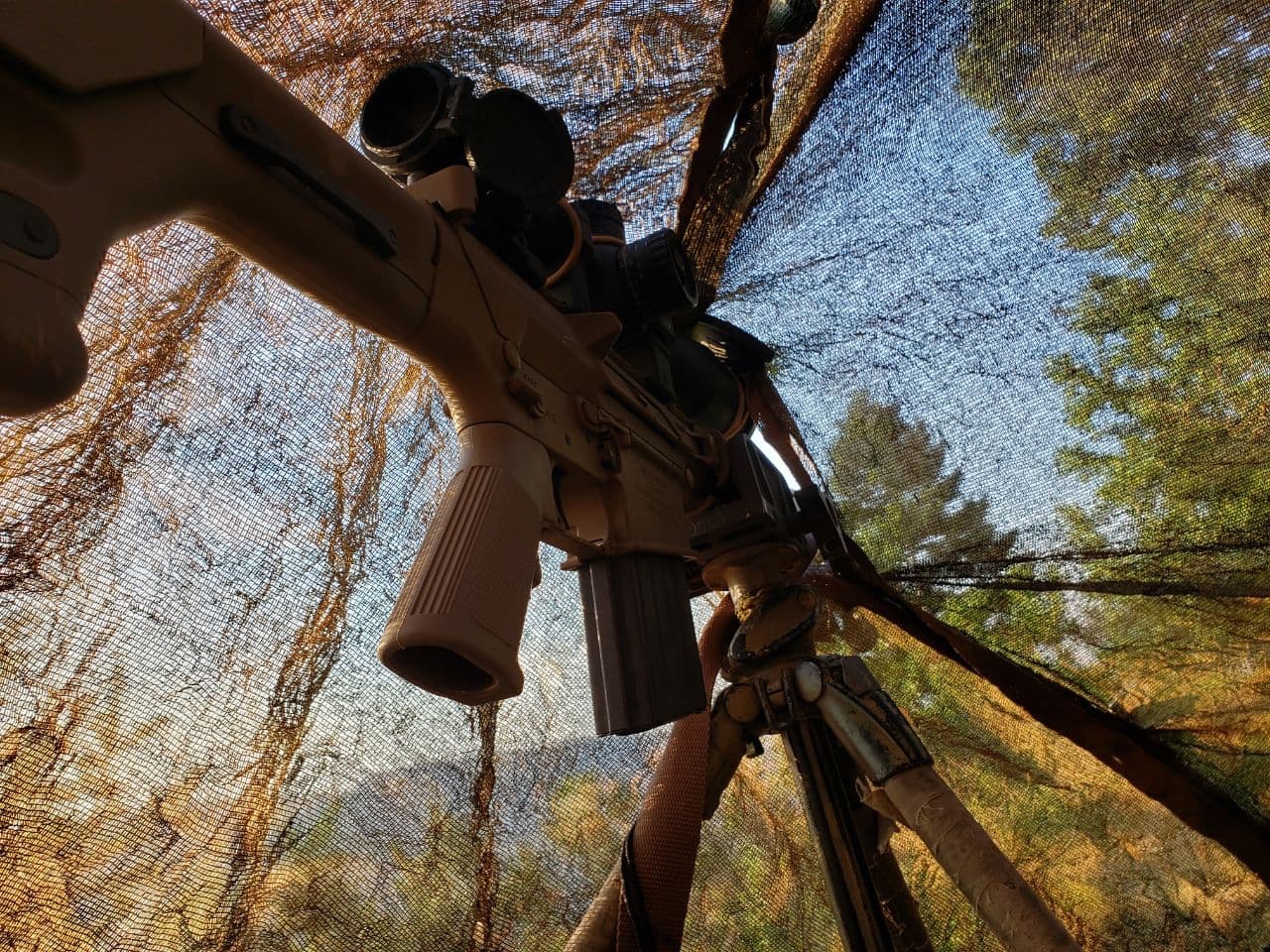
The same FFP from the inside of the system.

The Nightwalker is a niche signature management suit that focuses on the thermal spectrum. Best used for Long Offset leaders Recon, Y-Offset Raids, and amphibious insertions. The material is similar to a tracksuit and is extremely lightweight.

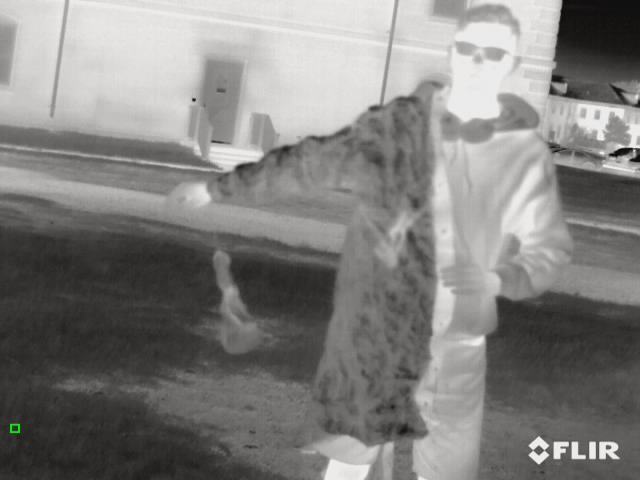
A US Marine demonstrates the thermal signature management capabilities of the Nightwalker at 10 meters.

The longer you work with these systems in the field the more uses and better techniques you can develop. Every repetition leads to a higher chance of mission success. Unseen, Unbeaten!

Follow us on our Website: www.fibrotexusa.com , Instagram and twitter (@fibrotexusa)

By Conner Rees. He is a signature management Field Representative with Fibrotex USA after having spent 9 years as A Reconnaissance Marine and Scout Sniper with 2D Reconnaissance Battalion.

This guest post was provided by FibroTex at the request of SSD after reviewing their technologies during AUSA 2021.

Utilizing Semi-Autonomous Resupply to Mitigate Risks to Soldiers on the Battlefield

Wednesday, November 3rd, 2021

YUMA PROVING GROUND, Ariz. — Situated in a broad swath of Arizona desert, Yuma Proving Ground offers the U.S. Army a prime location for testing — or “proving” — new capabilities.

It is a fitting home base for Project Convergence 2021, a modernization experiment organized by Army Futures Command’s Joint Modernization Command.

The event brings together members of the Joint Force to test and retest novel equipment and systems.

“It’s the initial steps of working out how our joint forces will need to operate in the future,” said Joseph Cruse, data collection and analysis execution lead for Project Convergence 2021.

Dotted throughout the dusty landscape at Yuma Proving Ground are high-tech, multi-phase exercises designed to validate the utility of first-of-their-kind tactical and operational scenarios, many of which are enabled by artificial intelligence.

One such scenario explores the Army’s ability to use joint sustainment semi-autonomous resupply mechanisms to improve logistical dexterity while mitigating additional exposure and risk to Soldiers.

“The goal is to ensure that we’re able to extend our reach, especially during MDO, which is multi-domain operations,” said Maj. Christopher Jones, the lead for semi-autonomous resupply testing at Project Convergence 2021.

“We can do that by applying semi-autonomous vehicles into our formations, to provide rest for Soldiers, to take the Soldiers off the ground and expedite those pushes that we need to get out to our Soldiers,” Jones said.

The semi-autonomous resupply process, as envisioned and executed, starts with a need on the battlefield — for food, supplies, ammunition or even replacement parts for heavy machinery.

The exercise at Yuma Proving Ground specified a need for a replacement part required by a tank operator in the field, setting into motion a number of steps to deliver the essential item.

Communicating with a base of operations, the tank operator described his location and the part needed, and personnel set to work quickly to obtain the part. Those responsible for doing so assumed a spare parts-limited environment, so a replacement was fabricated using a field-ready 3D printer capable of producing both plastic and metal objects.

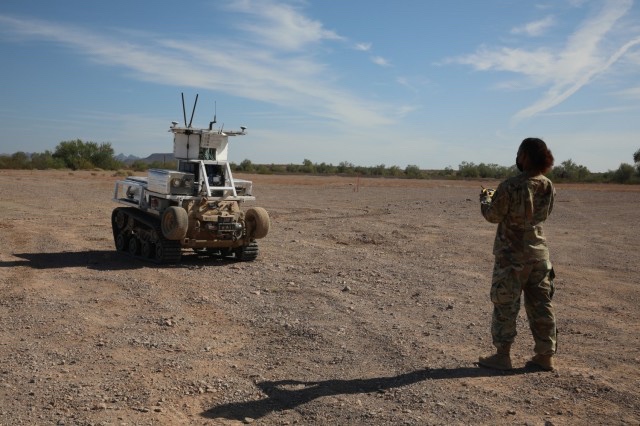
The Army then dispatched a small convoy of leader-follower tactical wheeled vehicles, which can be driven independently, remotely or be made to follow a vehicle, to deliver the part to an Expeditionary Modular Autonomous Vehicle (EMAV), a U.S. Marine Corps robotic vehicle, waiting at the (simulated) fighting edge.

Once the part was secured to the platform of the EMAV, Soldiers sent remote communications from a distance, signaling to the vehicle exactly where it should deliver the item. When it received the message, the previously still machine revved into gear, kicking tan dust onto its black tracks and road wheels as it accelerated up a hill and turned toward its destination.

According to Dr. David Stone, a senior robotic engineer with the Marine Corps Warfighting Lab, the EMAV is operational in all terrains, possessing the ability to not only travel through muddy fields but also to pull other vehicles out of the mud. Despite its relatively smaller size, “the thing’s basically a truck,” Stone said.

Stone elaborated that the EMAV, which is a diesel-electric hybrid, is “very robust. Its versatility and the modular aspect — being able to do different warfighting functions — is the real value of it.”

Originally designed to accompany dismounted Marines, the durable autonomous vehicle can also serve the needs of Joint Force missions, as evidenced by the exercise.

“Between the Army and Marine Corps, we are going after the same thing,” Stone said. “Anything we can do to leverage on another’s work helps us do more with the money we have.”

While an EMAV was used for the training exercise, the Army also intends to use its Robotic Combat Vehicle-Light to serve a similar purpose in future semi-autonomous resupply missions.

Following the arrival to its destination approximately two miles away, and the human-assisted replacement of the tank part in the exercise, the EMAV returned to its starting point, powering easily through gravel and dirt as it traveled among a group of heavy military trucks.

The scenario demonstrated how the U.S. military can integrate new field-deployable technologies with existing ones, offering additional options to commanders while decreasing the human footprint necessary to carry out logistical resupply missions.

“People who are supplying us with ammo, water, food, etcetera — anything that puts Soldiers at risk, the EMAV takes them out, and it saves lives,” said Pfc. Daniel Candales of 1-508 Parachute Infantry Regiment, 3rd Brigade, 82nd Airborne Division, who was trained on the various functions of the vehicle.

The Army is additionally working to develop complementary capabilities that would allow for autonomous loading of supplies and digital tracking of items and vehicles and testing prototypes for these systems at Project Convergence 2021.

Reducing the need for hands-on support will also enable Soldiers who would otherwise be assisting with resupply chains to tackle other priority tasks. In addition, augmenting methods for delivering necessary equipment and supplies over treacherous ground will bolster the Army’s ability to function effectively across multiple domains.

“Logistics is something we always have to improve upon,” said Command Sgt. Maj. Robin M. Bolmer of the Army’s Futures and Concepts Center, who observed the exercise. He explained that new technologies open up numerous possibilities for growth, but that “the need to sustain what we have is always going to be there.”

The Futures and Concepts Center developed the initial concepts for many of the technologies and systems being tested during Project Convergence 2021, and will assume responsibility for organizing Project Convergence 2022, which is slated to include the participation of U.K. and Australian forces.

Bolmer shared that he was observing this year’s activities with an eye toward continual modernization progress, keeping the question of “how do we build upon all the great work being done here?” always at the forefront of his mind.

By Maureena Thompson, Army Futures Command

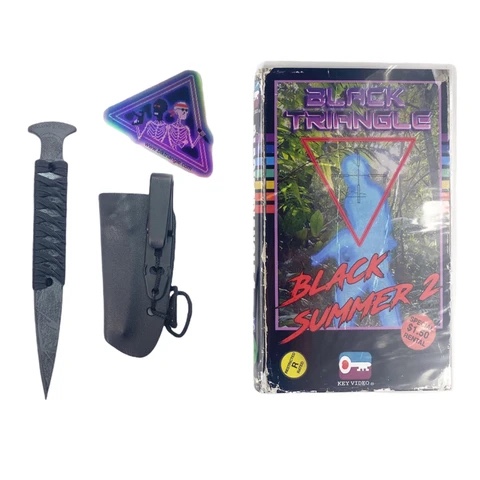
Black Triangle Announces the Midnight Creeper MK4

Tuesday, November 2nd, 2021

The Ultimate Non-Metallic Fighting Knife

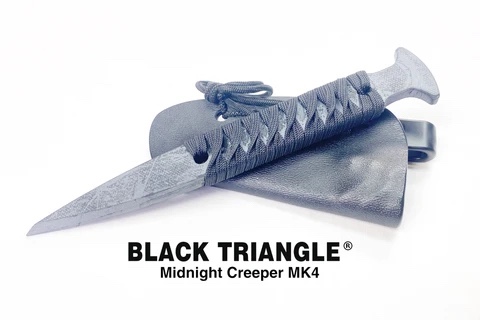
Available November 26th, the Midnight Creeper MK4 is a much-needed modification to our most popular G10 knife.

An index point is a touch-based feature that tells the user that they are grabbing the knife the same way every time. So, what would happen if we took the MK1 Mod2 and added an index point to it? That is the question asked by Johnny Primo of Courses of Action. Some students at recent Courses of Action combatives classes happened to also be Black Triangle end users. A common theme among them was the inability to get a consistent grip on the handle. This feedback was just the information we needed.

We kept the same overall length of the MK1 but gave the handle a tune-up. The symmetrical finger choils and flared pommel give the user a secure and ambidextrous grip.

The sheath is flipped so the bevels face the body when drawing the knife. It keeps the knot away from the skin, thus eliminating a hotspot. This is another common suggestion from end users.

The flipped sheath and clip position allows a right-handed user to carry the knife on the appendix support-side in conjunction with an AIWB firearm. For those carrying strong-side, the clip orientation allows for the knife to be slightly canted to the rear, giving the user more comfort when sitting.

The MK1M2 is not going away, however for those already carrying a MK1, the MK4 is definitely the next level up. 

These additions to an already trusted and proven product makes the MK4 the ultimate non-metallic fighting knife.

Fibrotex – Past, Present… Future!

Tuesday, November 2nd, 2021

This video will whet your appetite for a big report tomorrow on some very exciting signature management technologies from FibroTex.