FirstSpear

Archive for the ‘Guest Post’ Category

TYR Tuesday – IDTOUR VTS |Virtual Trade Show| Shield Spec Review

Tuesday, August 25th, 2020

Episode Nine of Innovate or Die® Tour Virtual Trade Show #IDTOURVTS is here!

Episode Nine:
IDTOUR VTS |Virtual Trade Show| Shield Spec Review

CQB Shield with Viewport Available Now:
www.tyrtactical.com/products/list/shield-systems/ballistic-shields-and-armor

New episode launching every Tuesday.

What is IDTOURVTS?
Our mission has always been about protecting those who run towards the threat. To that end, we created the Innovate or Die® Tour and Mobile Showroom. Over the past couple years it has allowed us to meet you face-to-face, gather your feedback and answer your questions.

Life has been put on hold for many people around the world, but you have not stopped risking your safety and health against all the threats we face today.

We can’t wait to meet you on the road again.

Thank you to the men and women of the armed forces, first responders and health care professionals who continue to put their lives on the line. You haven’t stopped working and neither will we.

Episode One:

IDTOUR VTS |Virtual Trade Show| PICO-DS & DSX Plate Carriers

Episode Two:

IDTOUR VTS |Virtual Trade Show| The Ultimate Range Bag

Episode Three:

IDTOUR VTS |Virtual Trade Show| Shield & Dolly System

Episode Four:

IDTOUR VTS |Virtual Trade Show| Huron™ Hot Weather Uniform

Episode Five:

IDTOUR VTS |Virtual Trade Show| PICO-MVW-DSX Plate Carrier System

Episode Six:

IDTOUR VTS |Virtual Trade Show| EPIC-DSX Plate Carrier System

Episode Seven:

IDTOUR VTS |Virtual Trade Show| Gunfighter Belts

Episode Eight:

IDTOUR VTS |Virtual Trade Show| Shield Camera System Preview

New Landmine Detection Method to Reduce False Alarm Rates

Tuesday, August 25th, 2020

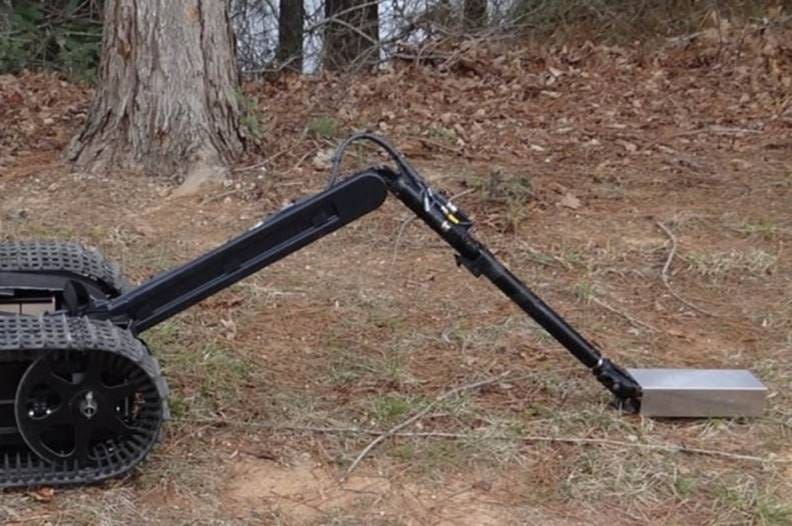
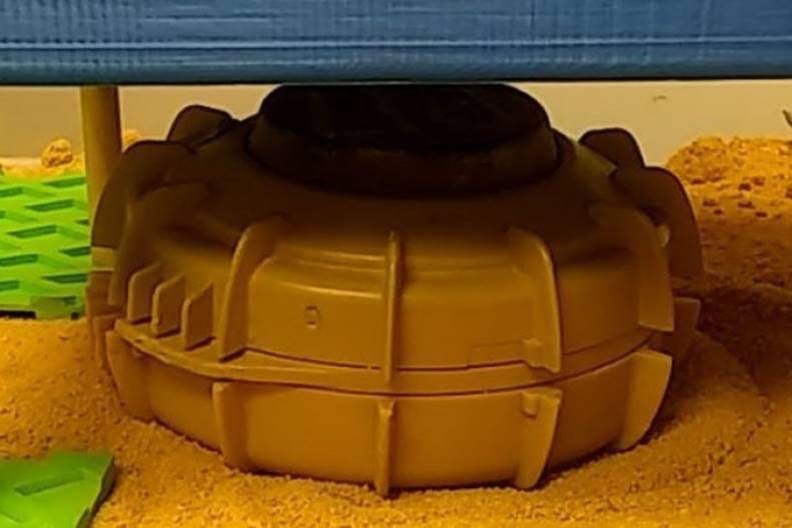
RESEARCH TRIANGLE PARK, N.C. — Landmines pose a serious threat in conflict areas, yet modern detection systems struggle to discriminate between explosives and clutter. A project funded by the Army developed a new method for landmine identification that will greatly reduce false alarm rates.

Fewer false alarms will significantly reduce the cost of humanitarian landmine clearance operations and provide greater road mobility by avoiding unnecessary route detours. With this new technology, landmines can be detected without digging.

Vadum, Inc.North Carolina State University, the Georgia Institute of Technology and the Army Research Office, an element of the U.S. Army Combat Capabilities Development Command’s Army Research Laboratory, collaborated to develop what’s known as the Vibration-ENhanced Underground Sensing system, or VENUS.

“New concepts are rare in the area of landmine detection,” said Dr. James Harvey, program manager, ARO. “This advance has the potential to be a game changer.”

The Night Vision and Electronic Sensors Directorate of the U.S. Army CCDC C5ISR Center supported the research as a part of an Army Small Business Technology Transfer award managed by ARO.

Most conventional landmine detectors are based on detecting the electromagnetic signature of the mine itself, which can easily be confused with other buried metal objects or wet or magnetic soil patches.

With this new technology, published in the proceedings of the 2020 SPIE Defense & Commercial Sensing Conference, the small metal parts inside the landmine are stimulated to vibrate using a pulsed magnetic field. Most other buried objects don’t respond to the magnetic pulse and those that do have very different vibrational characteristics. The vibrations are detected by a unique high dynamic range vibrometer that can distinguish closely-spaced low-frequency vibrations.

“This new capability resulted from combining exciting results from several previous ambitious research projects and is an outstanding example of the transition from university basic research to new military and commercial technology capabilities,” said Professor Michael Steer, a NC State research partner. “The mathematical algorithms behind the detection depend on understanding the details of the interaction of magnetic fields, radar pulses, and vibrating components within the landmine as well as with the properties of various soil and clutter objects. Advancing university physical models and analysis continue to support the improvement of the detection algorithms.”

The Army awarded the research team an additional two-year Phase II STTR contract to mature its unique technology.

As part of that award, the research team will work to miniature and ruggedize the detection device for reliable outdoor testing at an Army range. The researchers also will collect data from real landmines in a variety of soil conditions and demonstrate the performance of the technology in demanding and stressing field conditions.

“Because conventional metal detectors and ground penetrating radar rely on similar same fields, it should eventually be possible to upgrade conventional systems with VENUS technology to maximize detection capability,” said Dr. Josh Wetherington, principal Vadum researcher.

By U.S. Army CCDC Army Research Laboratory Public Affairs

MATBOCK Monday – GRAVEROBBER Sustainment and Gram

Monday, August 24th, 2020

Happy MATBOCK Monday!

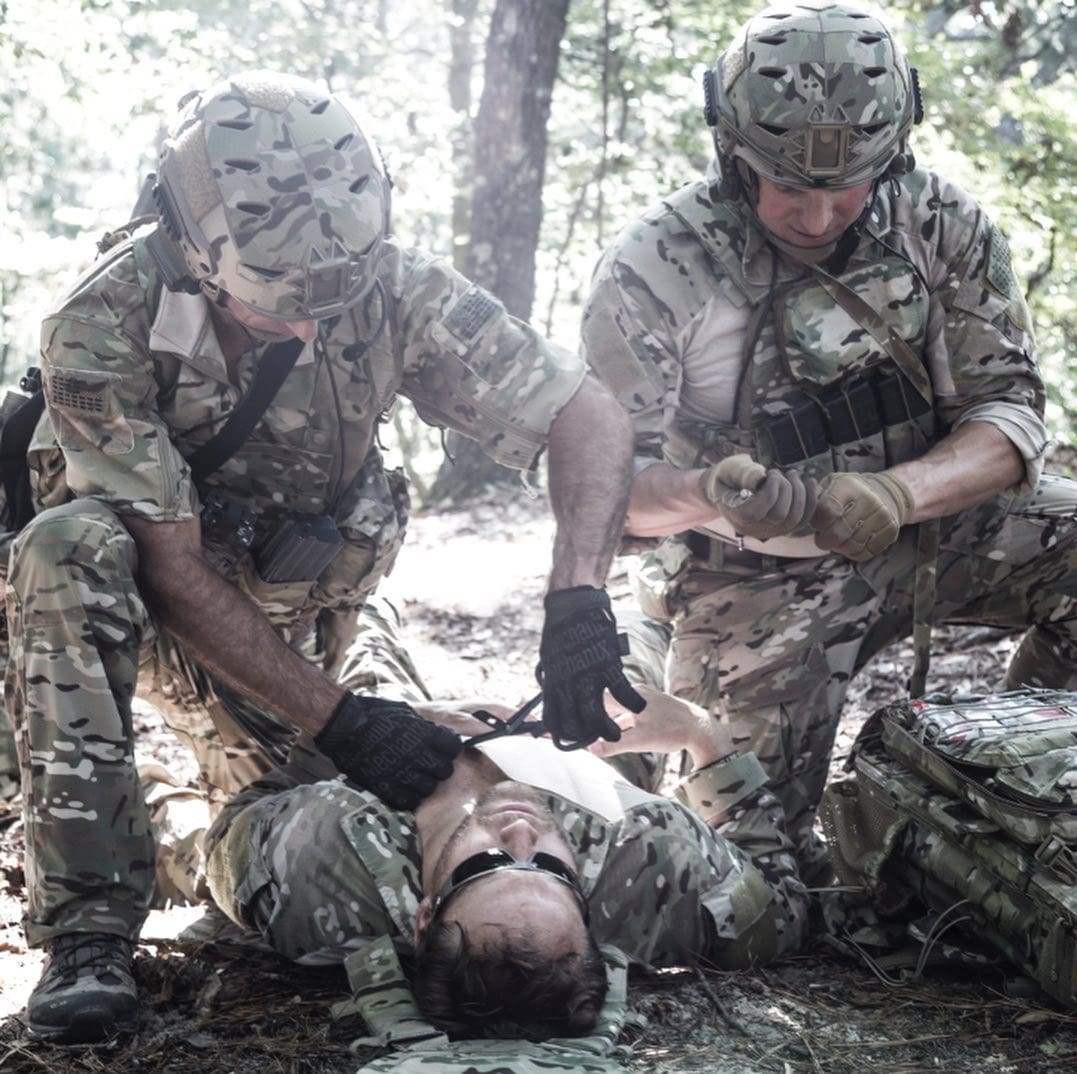
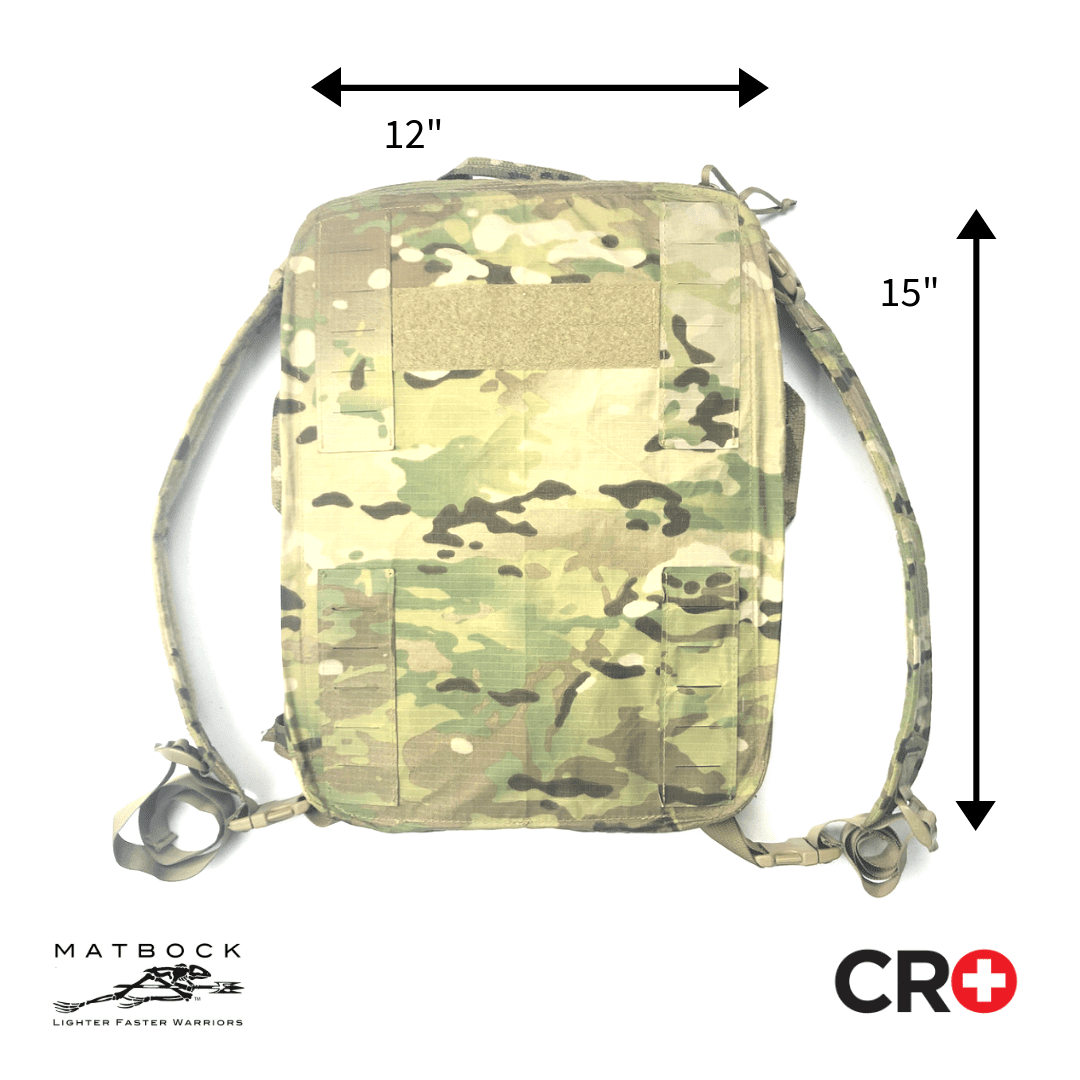
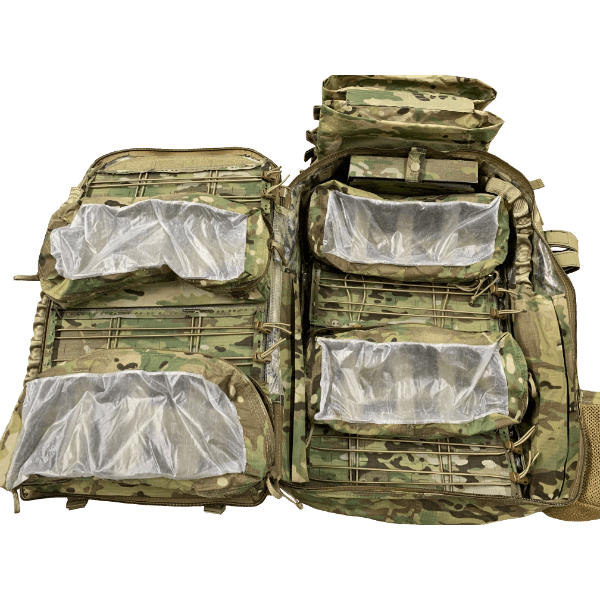
The Graverobber™ Assault Medic (GRAM) bag is the result of years of needed improvement in bags specifically designed for the team medic. CRO brings a multi-mission approach to the design with their well-thought-out adaptability, including a panel insert that converts to a skeleton med panel which can be clipped or slung using the thin padded shoulder straps. Remove to design a custom panel that is interchangeable for different packing requirements, or easily change bags with the versatility of a panel insert.

Lighter Faster Warriors, The MATBOCK ethos, is realized by the GRAM. MATBOCK Ghost® material is used throughout with Tegris reinforcements, giving the inside contents protection to allow for narcotics to be set up using a soft case.

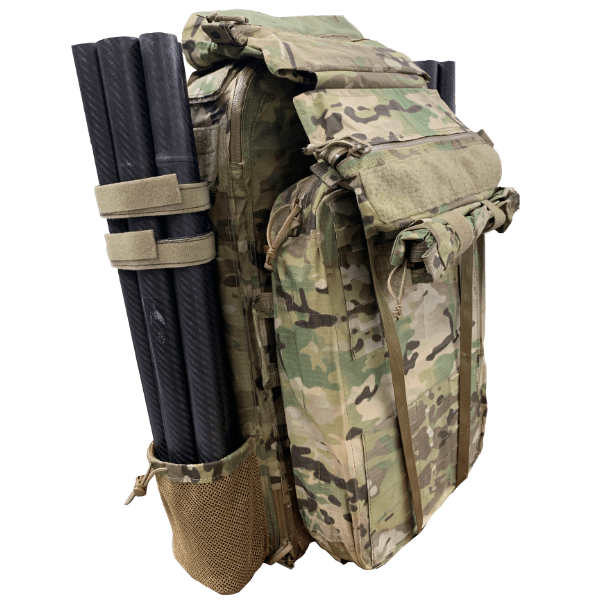
The GRAM is designed to be mounted to an ALICE frame, giving the medic a slim assault bag that can be configured in many ways to enhance medical load carriage. This jumpable, water resistant bag bridges the gap between assault bags and en-route care, due to its expandable design and ability to hang.

This versatile, meticulously designed med bag was created with everyday medic load carriage in mind.

www.matbock.com/collections/grave-robber/products/gram

The Graverobber™ Sustainment Kit is a joint CRO Medical and MATBOCK project to bring a prolonged field care pack to the operational medic. It features the Sustainment bag, 4 x sustainment pouches, 4 x sustainment panels, and the Graverobber™ Drug Box. All made from MATBOCK Ghost and Ghost Light materials.

www.matbock.com/collections/grave-robber/products/grave-robber-sustainment-kit

The Technical Mountain Ruck is a combination of the GRAVEROBBER Assault Medic (GRAM) Kit and the GRAVEROBBER Sustainment Kit. The GRAM easily zips to the outside of the sustainment bag to give the medic everything needed for both assault and prolonged medical operations. Made from MATBOCK’s Ghost and Ghost Light materials for superior water resistance, durability, strength and weight savings.

www.matbock.com/collections/grave-robber/products/grave-robber-technical-mountain-ruck

Don’t forget to tune in on Monday at 1:00 PM EST as we go live and show you what the GRAVEROBBER Sustainment and GRAM have to offer!

SBIR Grant Fast-Tracks 3D-Printed Runway Mat Development

Monday, August 24th, 2020

WEST LAFAYETTE, Ind. – A $1 million SBIR Phase II grant from the U.S. Air Force will help fast-track the development of a new innovative runway mat.

Pablo Zavattieri, the Jerry M. and Lynda T. Engelhardt Professor in civil engineering at Purdue University, is working with Indiana Technology and Manufacturing Companies (ITAMCO) to develop the new runway mat. The team uses metal 3D printing methods for its technology.

“The objective of the research is to develop a robust sheet or roll technology that serves as an alternative to the AM-2 mat for temporary or expeditionary flight operations,” Zavattieri said. “AM-2 matting has served the U.S. military well since the Vietnam War, but the materials and technology in the ITAMCO-led research project will offer many benefits over AM-2 matting.”

The proposed matting solution is composed of an upper surface that mates with a lower surface and contains a type of architectured material called Phase Transforming Cellular Material (PXCM) geometry to mitigate anticipated loading and shear stresses.

Zavattieri said a portable and lightweight airfield mat must be easy to install and store, yet capable of withstanding the stresses of repeated takeoffs and landings of aircraft.

“Products made with PXCM geometry have the ability to change from one stable configuration to another stable or metastable configuration and back again,” Zavattieri said. “This means the new runway mat could potentially heal itself, resulting in a much longer life span than a runway made with AM-2 matting. Another benefit is that debris on the runway will not hamper the runway’s performance with our technology.”

In Phase II, the team will move into the prototype and testing stage. The prototype’s ability to restore itself to its original contour and attain full operational capability 30 minutes after compaction and preparation of the final repair site will be tested.

SCUBAPRO Sunday – Binoculars for Use on the Water

Sunday, August 23rd, 2020

Binoculars are one of the most important things to have when you are on the water. It one of the only times you will truly be in the wide open for everyone to see you and if you can’t see them you are at a big disadvantage. When it comes to selecting a good pair of binoculars for use on the water or in the field, there are a lot of things to look for. Most of the time, if you are not a sniper, you really don’t understand or care what all this stuff means. But here are a few things you should know to help you choose the right ones for the job.

• 7 x 50’s and 8 x 32’s
• What about prisms
• Are coated optics important

Binoculars are described using two numbers, such as 7 x 50 or 8 x 25. The first number identifies the magnification or power. The second is the diameter of the objective lens (the lens at the front) in millimeters. Magnification power describes how much closer objects appear when you view them. In a 7 x 50 binocular, the image is magnified seven times. Increased magnification reduces the brightness of the image, so as magnification increases, binoculars require increasingly larger objective lenses to maintain brightness. The larger their size, the more light they can gather. 

Magnification: Many binoculars used on land have too much magnification for use on a non-stable platform. The more an image is magnified, the harder it is to keep an object in view, so 7x power is the practical magnification limit for small boats (under 50′). Image stabilizing binoculars allow comfortable viewing with much higher magnification, up to 18x power, because they automatically compensate for movement.

Waterproof construction: With the combination of water, salt, and changes in temperature, it will cause the interior lenses of a non–waterproof binoculars to fog. Waterproof construction, with the internal O-rings, sealed and filled or “charged” with dry nitrogen, combined with flotation in the strap, to help protects your binoculars if they are dropped overboard.
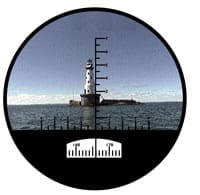
Rangefinders are handy for taking bearings or determining approximate height of or distance to an object.

Do you need a built-in compass or rangefinder reticule?

Bearing compasses: Built-in compasses, which appear superimposed near the image you see through the lens, lets you take bearings from an object that is very far away. They are highly recommended for marine use.

Rangefinder reticule: If you know the height of an object, such as a hill or navigation marker (often printed on charts and maps) and can measure the angle to its top using binoculars equipped with a rangefinder reticule, you can calculate your distance from that object.

Individual focus, center focus, or fixed focus?

Binoculars may have independent eyepiece focus to compensate for the differences between eyes and for different distances. In center-focus binoculars, one eyepiece adjusts to accommodate the difference between your eyes. A central focus knob then adjusts both sides simultaneously for distance.

Steiner Binoculars use a fixed-focus system, with a very deep depth of field, called Sport Auto-Focus. With Sports Auto-Focus, once you’ve adjusted your ocular settings for differences in your individual eyes, you won’t need to adjust the binocular again for varying distances. You’ll get a sharp, clear picture from 50′ to infinity. This set-it-and-forget-it system works well.

Relative brightness: How bright an image appears is a function of the quality of the optics and the ratio of the objective lens diameter divided by the magnification, squared (50 ÷ 7)2. So, 7 x 50 binoculars have a relative brightness of about 50, while 8 x 23 binoculars have a relative brightness of only 8.2. Objects will be visible in far less light with the 7 x 50 models.

Light transmission efficiency: Cheap glasses may allow only half the light entering the objective lenses to reach your eyes. Good quality glasses pass about 75% of the light. Truly exceptional binoculars, such as top models from Steiner and Fujifilm, pass more than 93% to 97% of light to your eyes, making all objects appear brighter. Quality optics also make the image sharper. Inexpensive glasses may produce astigmatic images that are fuzzy at the edges. Superior glasses are sharp from edge to edge and are less fatiguing to the eyes when used for extended periods.
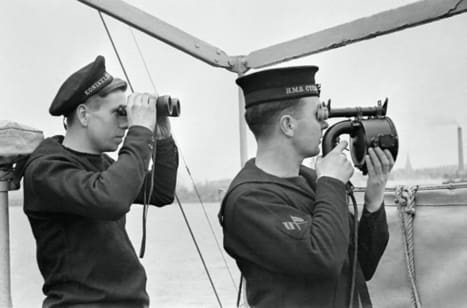
Lens coatings.  When light enters or leaves a piece of glass, about 5% is reflected back. With as many as 16 air/glass surfaces inside your binoculars, there could be a lot of internal light bouncing around, reducing the brightness, sharpness, and contrast of the image. Lenses are coated using one or more thin layers of chemicals (most commonly magnesium fluoride), reducing this internal reflection from 5% to 1% or less. But not all coatings are the same. If you look at the outside lens surfaces, quality lens coatings will appear as subtle tints of violet, blue, or green. Heavily colored lenses in cheap glasses actually reduce the amount of light transmitted. Also, better binoculars include more layers, with more complex chemical combinations, on more surfaces, to achieve light transmission efficiency.

• Coated: one or more surfaces coated with a single layer.

• Fully coated: all air-to-glass surfaces are coated with a single layer.

• Multi-coated: one or more surfaces coated with multiple layers.

• Fully multi-coated: all air-to-glass surfaces are coated with multiple layers.

Field of view The field of view describes the width of the image you see, measured in feet at the distance of 1000 yards. Binoculars offering 385′ field of view show the viewer a cone that is 385′ wide 1000 yards out. Higher-powered image-stabilized binoculars provide a narrower field of view (200–340′) than conventional units (up to 430′).
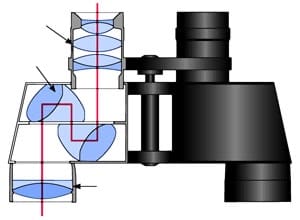
Prisms are used to invert and magnify an upside-down image, are either Porro (binoculars with a dog-leg shape) or roof prisms (with straight tube configuration that is easier to hold). There is some disagreement as to which is best, but it’s generally believed that Porro prisms yield superior optical performance. They transmit more light, resulting in brighter images, and provide better depth perception, because their objective lenses are farther apart. However, some roof prisms with phase shift coating provide excellent performance.

Image-stabilizing binoculars
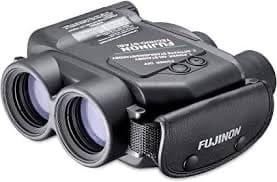
Image Stabilizing (I.S.) binoculars provide a steady image, even on a Zodiac that is not stable. The rolling, pitching and bouncing motion on a boat makes it hard to keep an image in focus using binoculars. I.S. binoculars automatically compensate for movement on a non-stable platform, like a boat, helo, or a side by side to deliver a stable image, even at high magnifications.

There are a few companies that make I.S bino’s, and they all basically work the same but, every company is a little different. Fujinon’s Techno–Stabi IS binoculars are built with dual piezo–motion sensors and gyro position sensors that are linked to direct drive motors for instant and continuous stabilization with low battery drain. The Techno–Stabi achieves a high degree of stabilization in all planes. Two direct-drive motors–one horizontal, one vertical–each controlled by its own piezo vibration sensor, instantly stabilize the image. Phase–coated roof prisms help provide clarity. Power consumption is minimal, and they are advertised as waterproof.
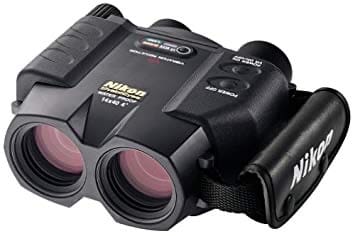
 

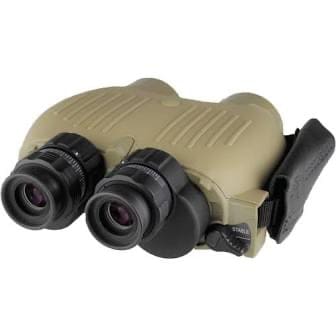
Nikon’s StabilEyes binoculars and Fraser Optics binoculars and monocular are built with a digitally stabilized gimbaled servo system to provide a view that is unaffected by handshake or vibration. The StabilEyes provide constant stabilization when activated, and Nikon’s original dual-mode system allows for use on land and sea by compensating for both roll and shake. The StabilEyes line is also completely waterproof and fog proof. The power consumption of the AA batteries is minimal in spite of the constant image stabilization functions.

Army Tests Versatile Unmanned Aircraft at Yuma Proving Ground

Sunday, August 23rd, 2020

YUMA PROVING GROUND, Ariz.– The United States military has used unmanned aerial systems (UAS) for decades, and increasingly counts on them to perform dangerous missions that save Soldiers’ lives.

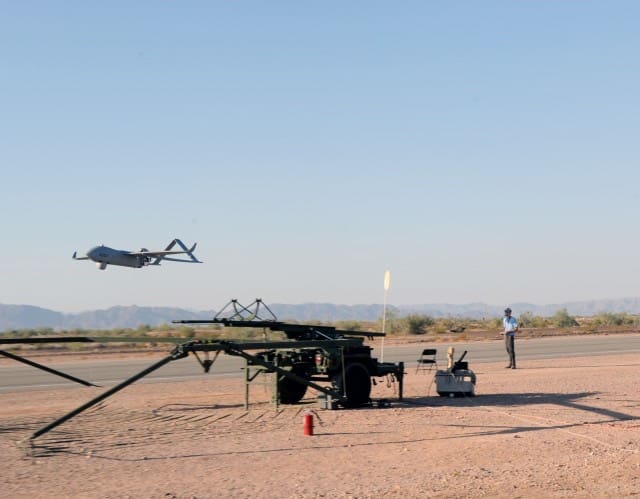
Among these flying wonders is the Aerosonde, a catapult-launched and net recovered aircraft used primarily for surveillance and reconnaissance.

Capable of 15 hours of flight time, the Aerosonde is highly portable and boasts outstanding optics at high altitudes. The system has undergone extensive testing at U.S. Army Yuma Proving Ground (YPG) for most of its existence.

“We test here whenever we have changes to the system,” said Kyle Petesch, Aerosonde site lead. “The YPG personnel are very attentive to what we ask for and easy to work with.”

“Aerosonde has been testing here for more than 12 years,” added Matthew O’Donald, test officer. “It’s a well-proven machine, and there have been numerous upgrades over the years.”

The sheer volume of commercial air traffic in the United States means that conducting developmental testing of even the smallest UAS in a safe, sustained manner within the national airspace is highly problematical. However, such constraints do not exist at YPG—the proving ground controls nearly 2,000 square miles of restricted airspace in addition to boasting clear, stable air and an extremely dry climate where inclement weather is a rarity.

“We have perfect flying weather, well over 300 clear days per year,” said O’Donald. “We have such a wide flight area of restricted airspace that’s perfect for customers to get what they need.”

“We like the nice, clear weather without a lot of clouds or rain delays, and definitely like the range space we can get here,” added Petesch. “The flat desert is good for emplacing ground stations and measuring farther distances without trees or line-of-sight issues.”

Aerosonde is typically deployed in a system with multiple aircraft and ground control stations, all of which can be accommodated in a realistic manner at YPG. The vast range and air space here means the testers can easily evaluate things like fuel consumption and the ability to smoothly hand-off control of the craft between controllers located in multiple ground control stations.

“We test not only to integrate products our customers want, but also to improve our own system’s reliability,” said James Ruthven, senior engineering support manger. “In the end, that helps our country’s mission overseas by having a quiet, reliable aircraft that provides good optics and other sensors.”

The Aerosonde is a relatively quiet aircraft, as is necessary for its surveillance mission.

“Our end user—a platoon out in the field—doesn’t want their targets to know they’re being watched,” said Ruthven. “Our engine and aircraft has to be quiet, so coming here affords us the opportunity to put people out in the desert and do acoustic measurements. We can tailor how we operate in the real world based on the findings we have here.”

The proving ground’s extensive experience with testing UAS and associated sensors is another attraction, as is the ability to control a large swath of the radio frequency (RF) spectrum. YPG has more than 500 permanent radio frequencies, and several thousand temporary ones in a given month.

“This is the easiest place for us to operate, and we get the most complete and comprehensive coverage in support of what we’re doing,” said Ruthven. “The heat and density altitudes that we find in this local environment are very similar to a lot of the places we’re operating in overseas.”

The Aerosonde will continue coming to YPG for testing well into the future, Ruthven added.

“We’re looking at our technology roadmap and trying to grow what our system can do for the customer to meet their needs for the next decade to come,” he said. “Utilizing the test ranges, frequencies, and facilities here is crucial to us getting to that point. The work we were able to do at YPG got us to this point.”

By Mark Schauer

Air Force Life Cycle Management Center Awards Skyborg Contract

Saturday, August 22nd, 2020

WRIGHT-PATTERSON AFB, Ohio (AFNS) —

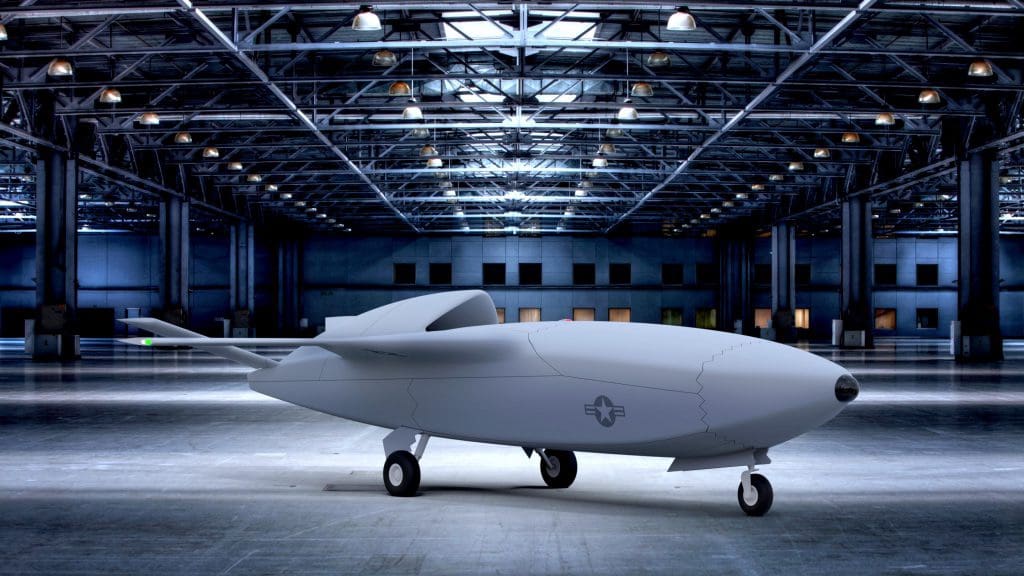
The Air Force Life Cycle Management Center has awarded multiple indefinite-delivery / indefinite-quantity (IDIQ) contracts to The Boeing Co., General Atomics Aeronautical Systems Inc., Kratos Unmanned Aerial Systems, Inc. and Northrop Grumman Systems Corp.

These initial awards will establish a vendor pool that will continue to compete for up to $400 million in subsequent delivery orders in support of the Skyborg Vanguard Program.

The aim of the Skyborg Vanguard program is to integrate autonomous attritable unmanned air vehicle technology with open missions systems to enable manned-unmanned teaming. This will provide a game-changing capability to the warfighter. The attritable UAV line of effort awarded by this contract will provide the foundation on which the Air Force can build an airborne autonomous “best of breed” system that adapts, orients and decides at machine speed for a wide variety of increasingly complex mission sets.

“Because autonomous systems can support missions that are too strenuous or dangerous for manned crews, Skyborg can increase capability significantly and be a force multiplier for the Air Force,” said Brig. Gen. Dale White, Fighters and Advanced Aircraft program executive officer, who, along with Brig. Gen. Heather Pringle, Air Force Research Laboratory commander, serves as the leadership for the Skyborg program. “We have the opportunity to transform our warfighting capabilities and change the way we fight and the way we employ air power.”

Skyborg is one of three Vanguard programs identified late last year as part of the Air Force Science and Technology 2030 initiative. These high priority Air Force capability development efforts come with an enterprise commitment to deliver game-changing capabilities to transform Air Force operations for the future force.

“Autonomy technologies in Skyborg’s portfolio will range from simple play-book algorithms to advanced team decision making and will include on-ramp opportunities for artificial intelligence technologies,” Pringle said. “This effort will provide a foundational government reference architecture for a family of layered, autonomous and open-architecture UAS.”

The Vanguards are also introducing a novel early partnership between AFLCMC and AFRL due to the need to quickly identify cutting-edge technology and transition directly into the hands of the warfighter.

“The greatest technological edge is for naught if the warfighter can’t use it on the battlefield. That makes the partnership between AFRL and AFLCMC so vital to this program. We can’t allow bureaucratic speed bumps to interfere with our mandate to deliver,” White said.

By Daryl Mayer, Air Force Life Cycle Management Center Public Affairs

SOLGW – What is the A5 System? And Why Do We Use It?

Friday, August 21st, 2020

Instead of finely tuning a rifle, we want to give it the widest operational envelop. The more finely tuned something is the more narrow that window. A fighting gun should be forgiving. Our goal is to incrementally improve the performance of this platform…and those incremental improvements added up absolutely make a difference.

www.solgw.com