Phantom Lights

Archive for the ‘Guest Post’ Category

Max Talk 32: Highlights from the Texas Class 2019

Monday, August 5th, 2019

This is the thirty-second installment of ‘Max Talk Monday’ which shares select episodes from a series of instructional videos. Max Velocity Tactical (MVT) has established a reputation on the leading edge of tactical live fire and force on force training. MVT is dedicated to developing and training tactical excellence at the individual and team level.

This week’s video is a compilation from the Texas Class 2019. This is an annual class open to all MVT alumni.

More of these instructional videos can be found by subscribing to the Max Velocity Tactical YouTube Channel.

Detailed explanations can be found in the MVT Tactical Manual: Small Unit Tactics.

Max is a tactical trainer and author, a lifelong professional soldier with extensive military experience. Both enlisted and commissioned (via the Royal Military Academy Sandhurst) into the elite Parachute Regiment, Max served in the British Army equivalent of US Special Operations Forces: The Parachute Regiment maintains a battalion (1 PARA) under Director Special Forces as part of the SFSG, with 2 and 3 PARA additionally serving in the UK’s elite Rapid Response Force. Max served on numerous operational tours (known as combat deployments in the US), and also served as a recruit instructor at the PARA Training Depot. Max spent a further five years working operationally as a paramilitary contractor in both Iraq and Afghanistan; the latter two years working for the British Government in Helmand Province.

Max has been running Max Velocity Tactical (MVT) since 2013. MVT has established a reputation on the leading edge of tactical live fire and force on force training, specializing in teaching Small Unit Tactics. MVT is dedicated to developing and training tactical excellence at the individual and team level. MVT operates the Velocity Training Center (VTC) tactical and leadership training facility near to Romney, West Virginia. MVT classes utilize professional combat marksmanship, tactical and leadership training, in order to develop situational awareness, teamwork, leadership, decision making and communication.

Website: Max Velocity Tactical

YouTube: Max Velocity Tactical

Excellence in Tactical Training.

Strikehold’s Leapfest Wrap-Up

Monday, August 5th, 2019

We are fortunate to share Strikehold.net’s coverage of Leapfest 2019, the annual military parachuting competition hosted by the Rhode Island National Guard.

Leapfest is the largest, longest standing, international static line parachute training event and competition. Conducted by the Rhode Island Army National Guard, the purpose of Leapfest is to promote international camaraderie and Esprit de Corps among Airborne Soldiers, while also showcasing the capabilities of the Rhode Island National Guard.

Paratroopers are specially selected, trained, and highly disciplined soldiers. They are able to rapidly deploy, land, and sustain a powerful combat force to achieve strategic objectives – such as seizing and holding key terrain or infrastructure. They can also be dropped behind enemy lines to conduct raids and other types of tactical interdiction missions. They are typically used as countries’ rapid deployment forces, with the ability to operate on any terrain in any environment with little warning.

Airborne forces can vary in size from an airborne company, a regimental combat team, or to an entire division or corps. To become a paratrooper, a soldier must go through rigorous physical and psychological training and conditioning in order to be ready to jump and fight without hesitation.

Leapfest is routinely attended by teams from across the Armed Forces of the United States (both Active and Reserve forces) as well as multiple international teams. Participants aim to land as close as possible to a marked, designated area within the landing zone. Upon landing and completing a PLF (parachute landing fall), participants are timed by qualified judges until they reach the designated area.

Each team consists of 5 participants: 4 jumpers and 1 alternate jumper. Each jumper must complete 2 jumps to be qualified for the individual award, and each team must complete 8 jumps in total to be qualified for the team award.

Jumpers exit from a CH-47 Chinook helicopter at an altitude of 1500 feet (457 meters) using an MC-6 static line, steerable, parabolic parachute. The MC-6 is the latest advanced-design steerable, round-canopy, parachute, and was developed through the Special Operations Forces Tactical Assault Parachute Systems (SOFTAPS) program. The MC-6 utilizes the same SF-10A canopy that has been in use with US Special Operations Forces for over 10 years. The MC-6 Maneuverable Troop Parachute System consists of the SF-10A Main Canopy, the T-11R Reserve, and the T-11 Harness.

This year there was a total of 35 teams from the US and 20 teams from 12 international Partner Nations. This year’s international teams hail from Canada, Chile, Czech Republic, Dominican Republic, Germany, Netherlands, Italy, Jordan, Mexico, Morocco, Qatar, South Africa, United Kingdom and New Zealand.

In addition to the competition, Leapfest also features a day of friendship jumps conducted by international Jump Masters, followed by a Wings Exchange Ceremony prior to the official Closing Ceremonies.

Further info about Leapfest can be found online and on Facebook.

To view all of the photos taken during the competition, visit strikehold.net/2019/08/04/leapfest-2019.

Thanks Lawrence!

Army Boosts Soldier Battery Power for Greater Lethality, Mobility

Sunday, August 4th, 2019

ABERDEEN PROVING GROUND, Md. — Army Futures Command, or AFC, is helping to increase Soldier lethality and survivability through the research and development of lighter batteries with more power and extended runtimes.

As the Army modernizes the current force and prepares for multi-domain operations, the quantity and capabilities of Soldier-wearable technologies are expected to increase significantly, as will the need for power and energy sources to operate them.

Engineers and scientists at AFC’s subordinate command — the Combat Capabilities Development Command, or CCDC — are making investments to ensure future power and energy needs are met by exploring improvements in silicon anode technologies to support lightweight battery prototype development.

“This chemistry translates to double the performance and duration of currently fielded batteries for dismounted Soldiers,” said Christopher Hurley, a lead electronics engineer in the Command, Power and Integration Directorate, or CP&ID, of CCDC’s center for Command, Control, Communications, Computers, Cyber, Intelligence, Surveillance and Reconnaissance — or C5ISR.

“The capabilities of these materials have been proven at the cell level to substantially increase energy capacity. We’re aiming to integrate those cells into smaller, lighter power sources for Soldiers,” Hurley said. “Our goal is to make Soldiers more agile and lethal while increasing their survivability.”

Soldiers currently carry an average of 20.8 pounds of batteries for a 72-hour mission. With the Army focused on modernization and the need to add new capabilities that require greater power, the battery weight will continue to increase and have a detrimental effect on Soldiers’ performance during missions, Hurley said.

“The C5ISR Center is helping the Army get ahead of this problem by working on advanced materials like silicon anode,” said Hurley, who noted that incorporating silicon-based anodes into Army batteries will cut their battery weight in half.

The C5ISR Center is incorporating component-level R&D of advanced battery technologies into the Army’s Conformal Wearable Battery, or CWB, which is a thin, flexible, lightweight battery that can be worn on a Soldier’s vest to power electronics. Early prototypes of the updated silicon anode CWB delivered the same amount of energy with a 29 percent reduction in volume and weight.

The military partners with the commercial power sector to ensure manufacturers can design and produce batteries that meet Warfighters’ future needs. However, the needs of civilian consumers and Warfighters are different, said Dr. Ashley Ruth, a CP&ID chemical engineer.

The Army cannot rely on the commercial sector alone to meet its power demands because of Soldiers’ requirements, such as the need to operate at extreme temperatures and withstand the rigors of combat conditions. For this reason, the electrochemical composition in battery components required for the military and consumer sector is different.

“An increase in silicon content can greatly help achieve the high energy needs of the Soldier; however, a great deal of research is required to ensure a suitable product. These changes often require entirely new materials development, manufacturing processes and raw materials supply chains,” Ruth said.

“Follow-on improvements at the component level have improved capacity by two-fold. Soldiers want a CWB that will meet the added power consumption needs of the Army’s future advanced electronics.”

As the Army’s primary integrator of C5ISR technologies and systems, the C5ISR Center is maturing and applying the technologies to support the power needs of the Army’s modernization priorities and to inform requirements for future networked Soldiers. This includes leading the development of the Power and Battery Integrated Requirements Strategy across AFC, said Beth Ferry, CP&I’s Power Division chief.

As one of the command’s highest priorities, this strategy will heavily emphasize power requirements, specifications and standards that will showcase the importance of power and energy across the modernization priorities and look to leverage cross-center efforts to work on common high-priority gaps.

Power Division researchers are integrating the silicon anode CWB with the Army’s Integrated Visual Augmentation System, or IVAS, a high-priority augmented reality system with next-generation capabilities for Solider planning and training. Because IVAS is a dismounted Soldier system that will require large amounts of power, the Army is in need of an improved power solution.

To gain Soldiers’ feedback on varying designs, the C5ISR Center team plans to take 200 silicon anode CWB prototypes to IVAS Soldier Touchpoint 3 Exercise in July 2020. This will be the first operational demonstration to showcase the silicon anode CWB.

The C5ISR Center is finalizing a cell-level design this year, safety testing this summer, and packaging and battery-level testing taking place from fall 2019 to spring 2020. Advances in chemistry research can be applied to all types of Army batteries, including the BB-2590, which is currently used in more than 80 pieces of Army equipment.

“A two-fold increase in capacity and runtime is achievable as a drop-in solution,” Ruth said. “Because of the widespread use of rechargeable batteries, silicon anode technology will become a significant power improvement for the Army.”

By Dan Lafontaine, CCDC C5ISR Center Public Affairs

SCUBAPRO Sunday – The USS Indianapolis

Sunday, August 4th, 2019

Like most people, I first heard of the Indy from the movie “Jaws” but didn’t really know what happened or if it was just made up for the movies. But it did happen, and it is one of the worst disasters in naval history. Like most of the times that something like this happens, it is from more than one bad thing that seems to build up. They where alone without escort, no one knew they were leaving or where they were going or when to expect them.

On the 15th of July 1945, the USS Indianapolis had departed Gaum on a top-secret mission to deliver the first atomic bomb (little boy) to a Naval base on the Pacific island of Tinian. It would be used on the 6th of August, 1945, to level Hiroshima. It departed Tinian on the 28th of July and headed towards, Leyte Gulf in the Philippines to meet the Task Force being formed, for the invasion of mainland Japan.

On the 29th of July, the Indianapolis was making about 17 knots, and then just after midnight, a Japanese torpedo hit her starboard bow, blowing almost 65 feet of the ship’s bow out of the water and igniting a tank of 3,500 gallons of aviation fuel. Then another torpedo struck closer to midship, hitting the fuel tanks and the powder magazines. This set off a chain reaction of explosions that effectively ripped the Indianapolis in two. Still traveling at 17 knots, the Indianapolis began taking on massive amounts of water; the ship sank in just 12 minutes. Of the 1,196 men aboard, 900 made it into the water alive.

No one knows what drew the sharks in, but it is thought that the sound of the explosion, the man in the water and yes, the blood in the water. The first night, the sharks focused on the floating dead. But the survivors’ struggles in the water only attracted more and more sharks. As the sun rose on the 30th of July, the survivors bobbed in the water, and a lot of the rafts were no were to be found. The living searched for the dead and appropriated their lifejackets for the survivors that didn’t have one. The survivors began forming into groups, some small, some over 300.  Soon the sharks turned their attentions toward the living, especially the injured and the bleeding, sailors tried to quarantine themselves away from anyone with an open wound, and when someone died, they would push the body away, hoping to sacrifice the corpse in return. Many survivors were paralyzed with fear, unable even to eat or drink from the meager rations they had salvaged from their ship. One group of survivors made the mistake of opening a can of Spam—but before they could taste it, the scent of the meat drew a swarm of sharks around them. They got rid of their meat rations rather than risk a second swarming.

The sharks fed for days, and with no sign of rescue for the men. Navy intelligence had intercepted a message from the Japanese submarine that it had torpedoed the Indianapolis. Describing how it had sunk an American battleship along the Indianapolis’ route, but the message was disregarded as a trick to lure American rescue boats into an ambush. The Indianapolis survivors learned that they had the best odds in a group, and ideally in the center of the group. The men on the outsides or, worse, alone, were the most susceptible to the sharks.

As the days passed, many survivors succumbed to heat and thirst or suffered hallucinations that compelled them to drink the seawater around them—causing them to die from salt poisoning. Those who so slaked their thirst would slip into madness, foaming at the mouth as their tongues and lips swelled.

Around 11:00 a.m. on their fourth day, a Navy plane flying overhead spotted the Indianapolis survivors and radioed for help. Within hours, another seaplane, manned by Lieutenant Adrian Marks, returned to the scene and dropped rafts and survival supplies. When LT Marks saw men being attacked by sharks, he disobeyed orders and landed in the infested waters, and then began helping the wounded and stragglers, who were at the greatest risk. Most of the survivors said that one of the scariest times was waiting to get out of the water. A little after midnight, the USS Doyle arrived on the scene and helped to pull the last survivors from the water. Of the original 1,196-man crew, around 900 made it to the water alive, of that only 317 remained. Estimates of the number who died from shark attacks range from a few dozen to almost 150.

In November of 1945, Captain McVay was court-martialed for “hazarded his ship by failing to zigzag and failure to order to abandon ship fast enough” at the time torpedoes struck. The commander Hashimoto ( CO of the sub that sank the Indy) testified at the trial that he would have been able to sink the Indianapolis whether it had been zigzagging or not, testimony which appeared to fall ao deaf ears and had no impact at all on the court-martial board which found McVay guilty anyway. Like always, the military did not take any of this into account.

• The captain was never told that Jap Subs had been seen in the area.

• The Indy was cruiser with no sonar, and it usually had a destroy with it for anti-sub. But they were told they didn’t need one and to go alone.

• The Indy sent out three SOS, and all three were received. One group thought it was fake, one of the admirals on duty was drunk, and the third that was received, the” O” was asleep and had ordered everyone not wake him up.

In 1968 he committed suicide suffering from health issues for years. In 2001 he would be cleared of all charges. But it was too little too late. Like always, the military blamed someone. Of the over 300 ships that were sunk, during WW2 he was the only CO to be court-martialed for it.

www.ussindianapolis.org

FirstSpear Friday Focus – Tactical Patrolling Harness NSNS

Friday, August 2nd, 2019

All new in the Non-Stocking Non-Standard section of the FirstSpear web store is the FirstSpear 6/12 Laser Cut, Tactical Patrolling harness. Classic patrolling harness design with modern construction techniques and materials including FirstSpear 6/12 and FirstSpear quick-relase Tubes technology. Large padded shoulder straps, drag handle and 6/12 back panel allow the user to mount 6/9, 6/12, and molle style pockets. Available in small/medium and large/ extra large. Limited colors and sizes available.

Non-Stocking Non-Standard items were built at the request of FirstSpear professional users and contract overruns. 100% 1st quality goods. Colors, sizes, and quantities are limited. When they are gone they are gone, No back-orders will be filled. No Returns No Exchanges.

www.first-spear.com

No More ‘Flight Suits,’ the Integrated Aircrew Ensemble Makes Debut

Thursday, August 1st, 2019

Representatives from Wright-Patterson Air Force Base, Ohio, visited Joint Base Pearl Harbor-Hickam July 8-12 to introduce fighter pilots and aircrew flight equipment professionals to some of the newest developments in flight-suit technology.

Team Hickam’s Hawaiian Raptors, comprised of members from the 199th and 19th Fighter Squadrons, have been selected to be the first aircraft operators to bring the gear, called the Integrated Aircrew Ensemble, into an operational capacity.

The visiting project managers from the Human Systems Program Office provided demonstrations, fittings and on-the-job training to F-22 Raptor pilots and the AFE Airmen who will maintain the state-of-the art ensemble.

“Being selected as the first unit, and also as the Air National Guard, over any other [major command] is definitely something to be proud of, said Senior Master Sgt. Michelle Davidson, 154th Operations Support Squadron AFE superintendent. “I think it says something about our work ethic and our integrity down here; that we’re willing to take on the challenge and be a part of this new process.”

Hawaii Air National Guard and Active Duty pilots were provided demonstrations and were individually measured for custom-fit equipment.

Unlike the currently used ‘legacy’ equipment, which had been piecemealed with additional support items over several decades, each component of the IAE has been designed to complement all other items. The IAE is built to support aircrew in all ejection-seat aircraft, to include fighters, trainers and bomb carriers. Its material has been influenced by recent advancements in sports technology to aid aviators who endure harsh flight conditions.

“It’s all strategically placed so items are not on top of each other; it minimizes the occurrence of friction, hotspots or wear-down on the system,” said Carl Medeiros, IAE program manager. “The material is also moisture-wicking, so it pulls moisture away from the body, removing and reducing thermal burden, while increasing mobility and comfort levels. When it all comes together, there’s a direct correlation and improvement to the physiological effects on the pilot.”

A combination of four layers can be used to support pilots in the face of natural elements and a wide range of mission sets. This includes a thermal undergarment for cold weather protection, a water-resistant environmental protection layer, a chemical/biological/radiological resistant layer and the coverall, which provides heat and flame protection.

While the new system will require additional familiarize training events for AFE Airmen, less man hours will be required to sustain and service the equipment. Developments, such as the new floatation device, make this possible, as it does not require sensitive munitions to activate and can be transported and handled without risks of explosive reactions.

According to Medeiros, the Hawaiian Raptors are projected to receive the IAE during the first half of 2020.

“Initially I think the buildup process is going to be quite tedious,” said Davidson. “It’s a big task to take on, but I think once the supplies are delivered and we’re all set up it’s going to be an amazing product for us to use.”

Story by SrA John Linzmeier 

154th Wing Public Affairs

202 MPH $205,000 APR RS7 The World’s Fastest Armored Car?

Tuesday, July 30th, 2019

Pete Blaber led company uses advanced polycarbonate composites and ballistic glass and “world class” security features to creat a B-4 level safe room.

AddArmor, known as much for the pedigree of its leadership as for designing what they call sophisticated mobile safe rooms, recently announced its latest creation: the “world’s fastest armored car.” It’s an Audi RS7 built with a polycarbonate weave they say is 10x stronger than ballistic steel.

The new 202 mph APR-tuned RS7 was designed and built to showcase new developments in lightweight combat-proven polycarbonate armor paneling. Armored vehicles have long been associated with lumbering, heavy duty trucks. This was apparently the impetus that pushed AddArmor design. As they describe it, they decided to showcase a truly modernized armored car that could put lie to such impressions – and by doing so to highlight just how far modern armor technology has evolved. The result is a car they claim can perform at speeds of more than 200mph sporting an armor material weighing 60% less than ballistic steel.

AddArmor President Jeff Engen explains.

“With the new AddArmor APR RS7, we wanted to demonstrate how today’s armoring technology allows drivers to pick from a wide range of cars not normally associated with armored vehicles. The total armoring weight of the AddArmor APR RS7 is no more than 200 pounds. That small amount of weight allows for exotic sports cars and even electric vehicles to be nicely armored without compromising their performance or range. The key difference is AddArmor uses a polycarbonate composite instead of heavy steel plating. The weave offers a much stronger, lighter package that simultaneously allows the car to be much faster.”

Speed and maneuverability is frequently a critical element of safety, so AddArmor worked to ensure the vehicle’s “lightweight comprehensive 360-degree protection” would function without compromising acceleration or braking. They combined this ballistic protection with horsepower. As a result, the RS7’s 4.0L twin-turbo engine is complemented an APR Stage II system. AddArmor advises us this “special performance package” will produce 760 horsepower/800 lb-ft of torque with a manufacturer-clocked 0 – 60 mph time of 2.9 seconds.

AddArmor upfitted European B4-level armoring to the RS7; this package combines front-seat 360-degree polycarbonate body panels and ballistic glass to limit weight and protect the primary the occupants. Their ballistic glass is comprised of a multi-layer mixture of polycarbonate and ballistic glass, providing a transparent layer of armor that can withstand prolonged attacks from blunt objects like bricks and bats. Ballistically, the B4 armor can stop a .44 Magnum round, allowing drivers and passengers to evade attack – more important to EP/PSD work than overlanding, but nice to have nonetheless!

Vehicle armor is ballistically rated, much as individual body armor is categorized in II, III, and similar levels by the NIJ. The actual terminology used my vary, for instance from the US State Department Armored Vehicle Program to others from half a dozen or more different countries.

As described by the AddArmor release, the APR RS7 features “Delta Force-tested security throughout.”

The description continues:

Hidden security countermeasures include a sonic sound cannon with a PA system and siren capable of 120 dB. Other security items include electric-shock door handles equivalent to a high-powered taser gun and pepper spray dispensers. For ramming, AddArmor installed a front barrier bumper that protects the car’s radiator while also allowing the automobile to comfortably drive through most ambush situations. The AddArmor APR RS7 also includes a specially developed rear blinding light system that uses aircraft landing technology to temporarily blind assailants. The new vehicle also features a custom smokescreen system. For added security, the AddArmor APR RS7 includes biometric gun racks hidden in the trunk that can accommodate assault rifles and handguns.

Another unique security measure included on the AddArmor APR RS7 is a special Global 911 concierge service. This satellite-activated 24/7 system monitors the vehicle’s occupants via their cell phones and an array of beacons. Any sign of trouble automatically sets off a siren in a command center staffed by highly trained security staff with military and first-responder backgrounds. The Global 911 concierge service assesses all security situations as they arise and dispatches solutions in the case of any emergency. These systems allow AddArmor to protect their clients anywhere around the globe.


For added security, the new AddArmor APR RS7 includes a multitude of other on-board tactical electronics. An overseas-compliant drone-denial frequency-jamming satellite communications system has been installed alongside active mine/explosion detection, as well as a state-of-the-art 360-degree night-vision camera system. In the case of any airborne attacks, the AddArmor APR RS7 has an overpressure gas detection unit with onboard gas masks and air tanks to supply filtered fresh breathing air.

The RS7 runs on high-performance 275/30ZR21 Pirelli P Zero Run Flat tires capable of driving 30 miles after sustaining multiple high-powered rifle shots.

The AddArmor APR RS7 demonstrates how AddArmor provides custom protection packages to meet clients’ needs for either new or existing vehicles. Security packages for executive, work, personal, and family vehicles are available starting at $28,000. The new AddArmor APR RS7 is available for $205,000.

AddArmor (which offers training as well) can be found online at AddArmor.com.

DR can be contacted on IG via @reederwrites.

NSWC Crane Hosts First United Kingdom Light Weapon Design Course for Expeditionary Professionals

Tuesday, July 30th, 2019

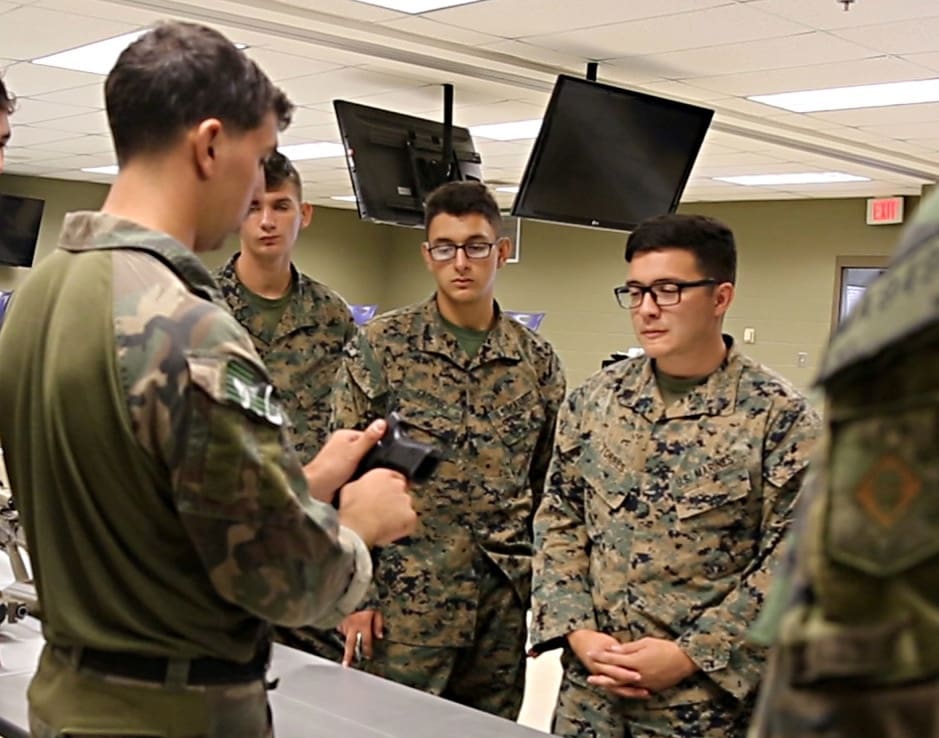
CRANE, Ind. – Naval Surface Warfare Center, Crane Division (NSWC Crane) hosted Expeditionary professionals for its first Light Weapon Design Course led by Cranfield University, a postgraduate university based in the United Kingdom that specializes in defense technology.

“This is the first time the Light Weapon Design has been brought to Crane,” says Adam Parsley, a Division Manager at NSWC Crane. “The Small Arms Weapon Systems Division was able to really enhance the learning experience for all the students with the access we have to weapons, ammunition, and the firing range.”

Parsley says the Light Weapon Design Course teaches the fundamentals of weapon operation and design.

“It focuses on the development of light weapons, or small arms, and their design and operation today,” says Parsley. “Through this course, our Expeditionary employees will better understand the reasoning behind design parameters – heat dissipation, durability, signature, recoil – and will have better concepts of how to design and test weapons.”

Chris Shaffer, an engineer at NSWC Crane, took part in Cranfield’s Light Weapon Design Course. Shaffer says these highly specialized courses from Cranfield help with workforce development.

“These courses offer Expeditionary professionals the opportunity to gain unique, hands-on experience,” says Shaffer. “They can take the engineering concepts, ideas, and skills they learned in undergrad and apply them to military devices. For these jobs in Expeditionary Warfare, the workforce needs specialized knowledge.”

Students from other commands traveled to NSWC Crane to participate in the course.

“The Light Weapon Design Course was fantastic,” says Erin Thompson, a Weapons Team Engineer at Marine Corps Systems Command. “I learned so much that will be directly applicable to my job and make me more effective for the Marine Corps. Chris Shaffer and the Crane team were great and the access we were afforded to the weapons was incredibly beneficial.”

“I thought the class was really well done,” says Elizabeth Palm, a Test Officer at US Army Cold Regions Test Center. “Adam and Chris did a great job coordinating with Cranfield to be able to offer so much hands-on time with a variety of weapons, especially the foreign ones. And of course any chance to get out on the range is always a good day!”

Cranfield University is in its second year of offering Masters of Science courses at Crane. The Light Weapon Design Course is the seventh Cranfield course since its inception.

“Cranfield offers courses in weaponry, munitions, sensors, and communications that most colleges and universities just don’t have,” says Parsley. “They also have packaged these courses in this condensed, one-week format that is optimal for the working professional who wants to pursue an advanced degree.”

NSWC Crane is a naval laboratory and a field activity of Naval Sea Systems Command (NAVSEA) with mission areas in Expeditionary Warfare, Strategic Missions and Electronic Warfare. The warfare center is responsible for multi-domain, multi- spectral, full life cycle support of technologies and systems enhancing capability to today’s Warfighter.

By NSWC Crane Corporate Communications