SIG SAUER - Never Settle

Archive for the ‘Guest Post’ Category

NY Army National Guard Runs Infantry Reclassification Training Course

Thursday, September 6th, 2018

CAMP SMITH, N.Y. — Ten Army National Guard Soldiers from the Northeast, who originally were not infantrymen, are now qualified to wear the sky blue cord and crossed rifles of the Infantry after completing a three-week reclassification course.

Conducted by the New York Army National Guard’s 106th Regiment Regional Training Institute, the three-week class is designed to turn Soldiers with a variety of other military occupational specialties into Infantry Soldiers.
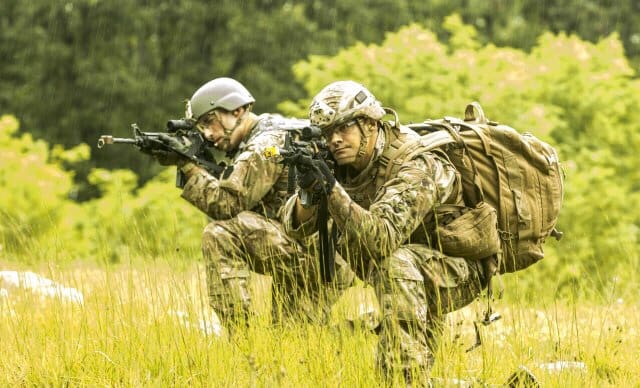
US Army Spc. Joshua Yajcaji a native of Brick, N.J., assigned to Company B, 1-114th Infantry Regiment, in a security position after dismounting a CH-47 Chinook helicopter from to Detachment 2, Company C, 3rd Battalion, 126th Aviation, at the start Infantry reclassification course 18-002 final field training exercise.

Course 18-002 began on Aug. 3, 2018, with 15 candidates and graduated 10 infantrymen on Aug. 17, 2018. Three of the graduates were New York Army National Guard members.

Starting October 2018, the 106th RTI will be one of only six locations where Soldiers can attend the reclassification and other Infantry courses.
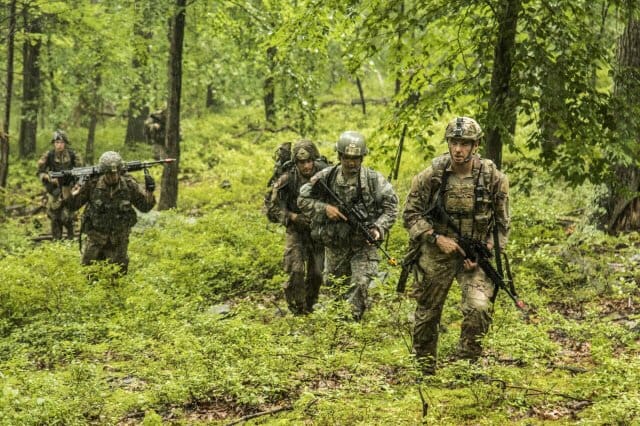
Army National Guard Soldiers from the Northeast Region at Infantry reclassification course 18-002 ruck march in the mountains.

“It takes a special person to want a chance to become an Infantry Soldier, to fight for your country and loved ones at home and asking nothing in return,” said Staff Sgt. John Dustman, the senior course instructor at the RTI and 25-year combat veteran.

“I don’t expect those who graduate this course to become experts on the Infantry, but I expect after what they go through they should have it inside to always try and push through at all times,” said Dustman.
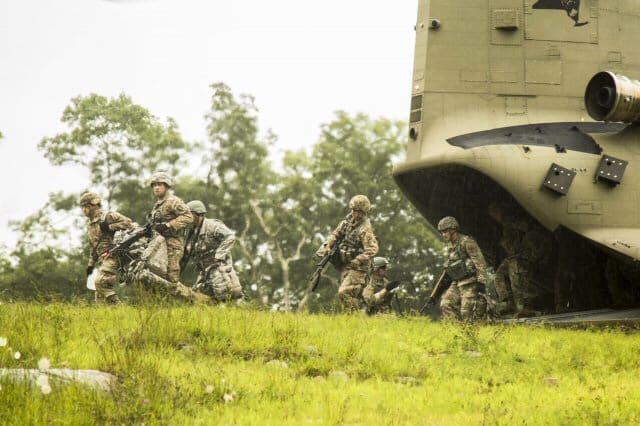
Army National Guard Soldiers from the Northeast Region at Infantry reclassification course 18-002 storm out of the belly of the CH-47 Chinook helicopter from Detachment 2, Company C, 3rd Battalion, 126th Aviation into positions during their final field training exercise.

The Infantry is an extremely physically demanding occupation and only accepts Soldiers into its reclassification course who request the change and are excelling in their military duties like the Army physical test, marksmanship, and driver’s qualifications.

Some Soldiers are drawn to the physically demanding portion of the job, like Spc. Michael Labonte, a motor vehicle operator assigned to Company C, 1st Battalion (Airborne), 143rd Infantry Regiment, Rhode Island Army National Guard.
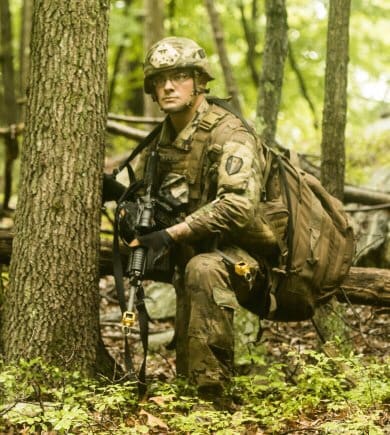
Spc. Michael Labonte a resident of Smithfield, R.I., assigned to Company C, 1st Battalion, 143rd Infantry Regiment, takes cover before a mock assault.

“I needed something that would let me be out in the field with my fellow Soldiers,” said Labonte, who is a resident of Smithfield, Rhode Island.

He decided to make the job switch because in his current role as a motor vehicle operator, he mostly did paperwork and inspections.

“The course is the most challenging thing I have done in my four years in the military,” said Labonte.
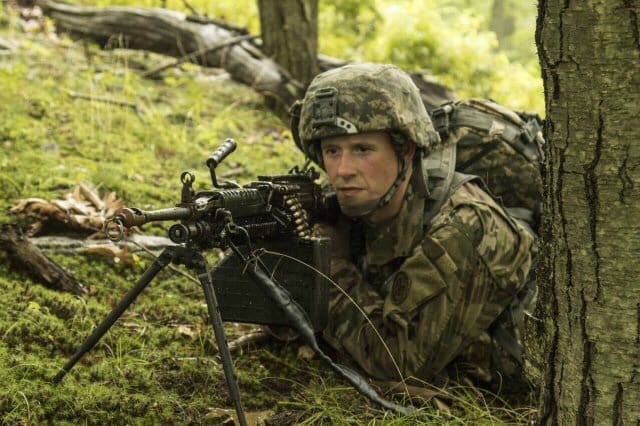
Spc. Brandon Weston, a resident of Buffalo, N.Y., assigned to B Company, 1st Battalion, 182nd Infantry Regiment, prepares to take aim with a Machine Gun, 7.62 mm, M240.

Soldiers also spend a large amount of time in a classroom setting to become knowledgeable on the duties they need to perform as modern-day Infantry Soldiers.

“There is a lot of good knowledge going around and a lot of good guys here,” said Spc. Michael A. Shriver, a prior-service Marine assigned to 2nd Battalion, 108th Infantry Regiment, New York Army National Guard.
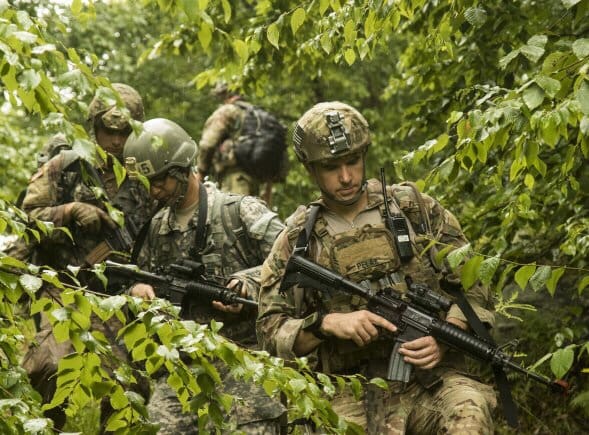
Army National Guard Soldiers from the Northeast Region at Infantry reclassification course 18-002 ruck march down a mountain.

Students learn to master some of the Infantry’s weapons systems like the Browning .50 Caliber Machine Gun and the M240 machine gun, while familiarizing themselves with other systems like the M320 grenade launcher and the M16 rifle with the M203 grenade launcher attachment.

They are also taught current scientific strategies on how to maintain a peak level of physical fitness that included safety considerations while working out, injury control, environmental considerations, and other techniques.
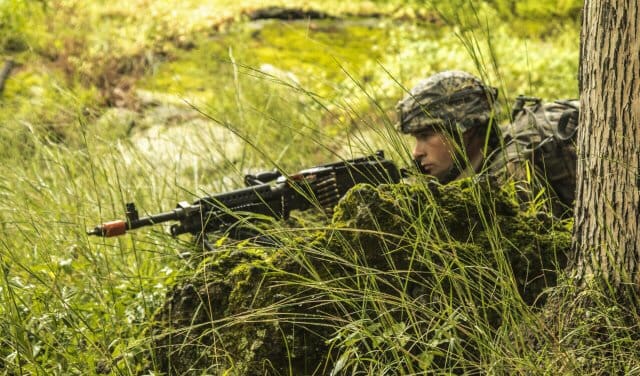
Spc. Zachary Pisani a native of Boston, Mass., assigned to Company C, 1st Battalion, 181st Infantry Regiment, takes aim while concealed behind a tree.

Fitness is a big concern for Infantry Soldiers since they train and operate with a high-level of physical activity.

“The ruck marches, loaded with at least 45 pounds of gear, and the Infantry 5-mile run were the most difficult part,” said Spc. Movado A. McKoy from Queens, a logistics specialist with 1st Battalion, 69th Infantry Regiment, New York Army National Guard.

What surprised McKoy was just how effective the instructions, tactics and procedures were at this level.

“The lessons we were taught trained us on how to tactically move in densely wooded areas,” said McKoy. “I want this occupation to prove to myself that I can do it.”
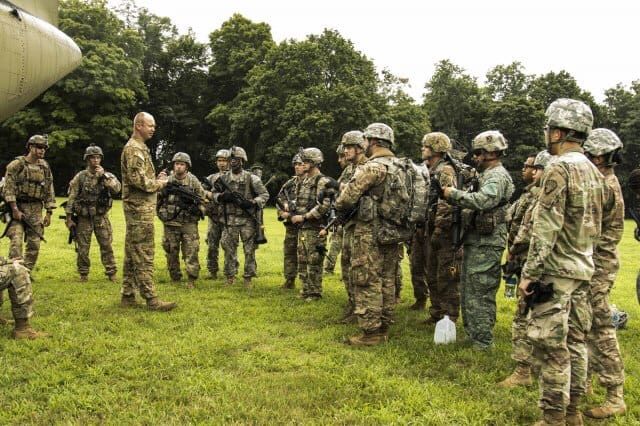
Army National Guard Soldiers from the Northeast Region at Infantry reclassification course 18-002, along with course support staff, receive a safety brief for the CH-47 Chinook helicopter before flying out for their final field training exercise.

Ten of the 15 Soldiers who started the course made it to the final task, a 48-hour-straight field training exercise, or FTX, in the mountains and woods at Camp Smith. That task was all that stood in their way to earn the sky blue U.S. Army Infantry colors and badge.

Camp Smith is a military installation of the New York Army National Guard in Cortlandt Manor, about 30 miles north of New York City. It consists of 1,900 acres with training assets and simulators.
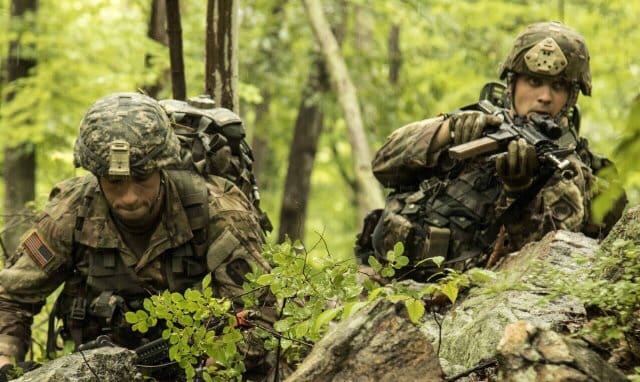
Spc. Brandon Weston assigned to B Company, 1st Battalion, 182nd Infantry Regiment U.S., and Army Spc. Brandon Weston to B Company, 1st Battalion, 182nd Infantry Regiment, scramble for positions during a mock assault.

During the FTX, students go out as a platoon and are led by two of the course instructors. They move tactically throughout the woods while going up against role-playing enemy combatants made up of their course instructors and handpicked Soldiers.

“The two-day FTX was designed to test all they had been training on, and what they will required to enter the Infantry,” said Staff Sgt. Morgen P. Sealy, the course manager and an Afghanistan combat veteran.

Sealy explained their biggest challenge is that a lot of the units do not prep their students for a condensed and intense course like this.”The best part of the course is seeing the progression in the students from day one till when we get to the field,” said Sealy.

“We want heart, willingness to learn, self-motivation, the desire and the determination to succeed,” Dustman said. “My personal expectation is that after this course they keep learning the craft even more.”

Story and photos: CPL Nnaemeka Onyeagwa, New York National Guard. Photos of Infantry reclassification course 18-002 final field training exercise were taken at Camp Smith Training Site, Cortlandt Manor, N.Y., Aug. 13, 2018.
SureFire Field Notes Ep 32 How to Enter Shooting Positions with Barry Dueck

Thursday, September 6th, 2018

SureFire Field Notes is a multi-segment informational video series with tips and techniques from subject matter experts of all backgrounds. In this episode, Barry Dueck discusses how to enter shooting positions for both competition and tactical shooters.

Barry Dueck is a former Marine, owner of Dueck Defense Inc, champion competitive shooter and VP of Suppressors and Weapons at SureFire LLC. Barry is also the architect of SureFire’s SOCOM suppressors, winner of the most rigorous and extensive suppressor evaluation in history. Barry’s knowledge comes from his military experience, expertise in the firearms industry as a designer, and also from being a 3-Gun Champion, IPSC Grandmaster and USA Team World Shoot gold medalist.

High Angle Solutions – Brigantes Presents – UK issue Bergan compared to Snigel Designs Rucksack

Wednesday, September 5th, 2018

All light role troops understand the pain and discomfort associated with carrying your own body weight on your back.  It is something that you just have to get used to.  However, with recent high injury rates from nerve damage due to carrying heavy loads we wanted to look at what we choose to carry on our backs.

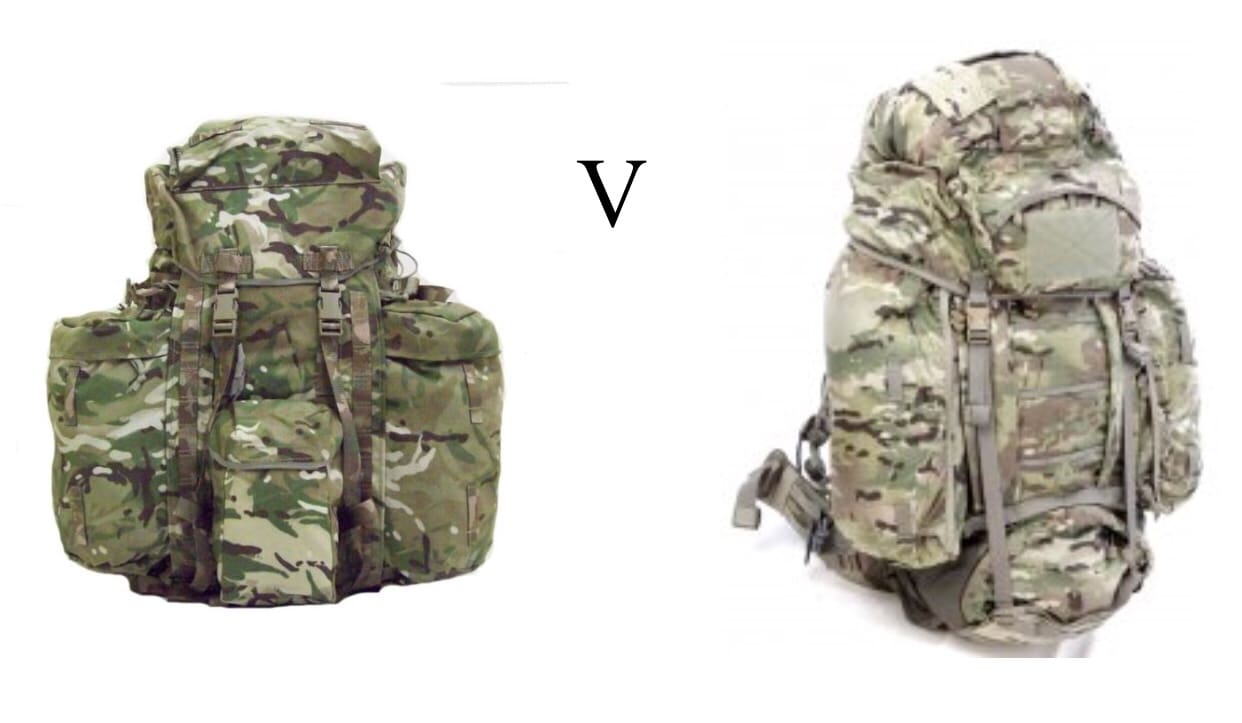
The UK issue Personal Load Carrying Equipment (PLCE) Bergan has been around for decades in various forms. Originally derived from the Berghaus Cyclops Roc it has moved further and further away from its high-quality ancestor.  The current version follows the same design format and uses 1000 denier MTP fabric.  The back system is simple, in the extreme, and has more in common with what you would find on a daysack not something that you would use to carry 100+lbs.  It is functional from the point of view of its pockets and layout and has become integrated into the way that the UK troops operate in the field.

The Snigel 90Ltr shows many similarities with its pocket structure and style.  Other than that they could not be further apart.  Now used by a number of specialist units the pack has a full modern back system that you would expect to see on the best civilian rucksacks.  The foam used in the shoulder straps is of the highest possible standard and addresses the nerve damage issue associated with the issue Bergan. This is also helped by a very substantial waist belt. The rucksack uses a 500 denier Multicam fabric which is lighter and more flexible than the 1000 denier but does not compromise on robustness.

If you are required to carry all your kit on your back, then it is absolutely paramount that the piece of equipment you use to hold it is comfortable and reliable.  The issue Bergan falls well short of what can now be achieved.  Time for a change we feel. What do you think?

For more information get in touch by email on international@brigantes.com or for UK customers warrior@brigantes.com.  

www.brigantes.com

SCUBAPRO Sunday – History of Combat Divers/Swimmers in the US

Sunday, September 2nd, 2018

The first mention of combat swimmers appears in the chronicles of the Greek historian Herodotus ca 450BC. The Persian king Xerxes used divers to retrieve goods off of sunken ships. They were also used for ship repair and reconnaissance of harbors and channels.

Almost every Navy throughout history has had some form of combat swimmers. They have been used to smuggle goods in during the siege of Syracuse during the Peloponnesian war. The Spartans and Athenians were one of the first to employ combat swimmers, but history usually credits Alexander the Great in his famous siege of Tyre (Lebanon) in 332 B.C. He used “demolition divers” to remove obstacles from the harbor. Aristotle reported that Alexander himself made several dives in a crude diving bell to observe the work in progress. They were also used to cut the anchor lines of Roman ships by the Byzantines in 320 BC. The Byzantines replaced the lines with their own and pulled the Roman boats into the harbor ending a 3-year siege. The Romans then replaced all their anchor line with steel chains.

The U.S. started using Combat swimmer at the birth of our country. They were used during the revolutionary war to set fires and sink British ships. They were also used in the Civil war by both sides for sabotages and scouting. The U.S. didn’t really use combat swimmers again until WW2. Although some Americans did service with specified dive units of our allies in WW1. Those men would go on to help set up the units we used in WW2.

The combat diving mission was the same in World War II as it had been in previous wars: to remove obstacles from enemy waters and to gather intelligence. The Navy’s Underwater Demolition Teams (UDT) were created from bomb disposal experts and SeaBees (combat engineers) teamed together in 1943 to devise methods for removing obstacles that the Germans were placing off the beaches of France.

There where more than one combat swimmer/diver unit for the U.S. Navy in WW2. To name a few where the Navy Scouts and Raiders unit, Underwater Demolition Units (UDT), Navy Combat Demolitions Units (NCDU) and the OSS Maritime Unit. The OSS MU was on the cutting edge for U.S. combat swimmer/ divers. They where the first to use the Lambertsen Rebreathing Unit (LARU), an early underwater breathing device. The Lambertsen unit permitted a swimmer to remain underwater for several hours and to approach targets undetected because the LARU did not emit telltale air bubbles. Dr. Christian J. Lambertsen, then a U.S. Army captain, developed the Lambertsen for the MU. They also developed or used several innovative devices, including an inflatable surfboard, a two-man kayak, and limpet mines that attached to the hull of a ship.

The first UDT combat mission, wherein the Pacific. It was a daylight reconnaissance and demolition project off the beaches of Saipan in June 1944. In March of the next year, preparing for the invasion of Okinawa, one underwater demolition team achieved the exceptional record of removing 1,200 underwater obstacles in two days, under heavy fire, without a single casualty.

Diving apparatus where not extensively used by the UDT during the war. No suitable equipment was readily available to them. UDT experimented with a modified Momsen lung and other types of breathing apparatus, but not until 1947 did the Navy’s acquisition of Aqua-Lung equipment give impetus to the diving aspect of UDT operations. The trail of bubbles from the open-circuit apparatus limited the type of mission in which it could be employed, but a unique SCUBA (self-contained underwater breathing apparatus) platoon of UDT members was formed to test the equipment and determine appropriate uses for it.

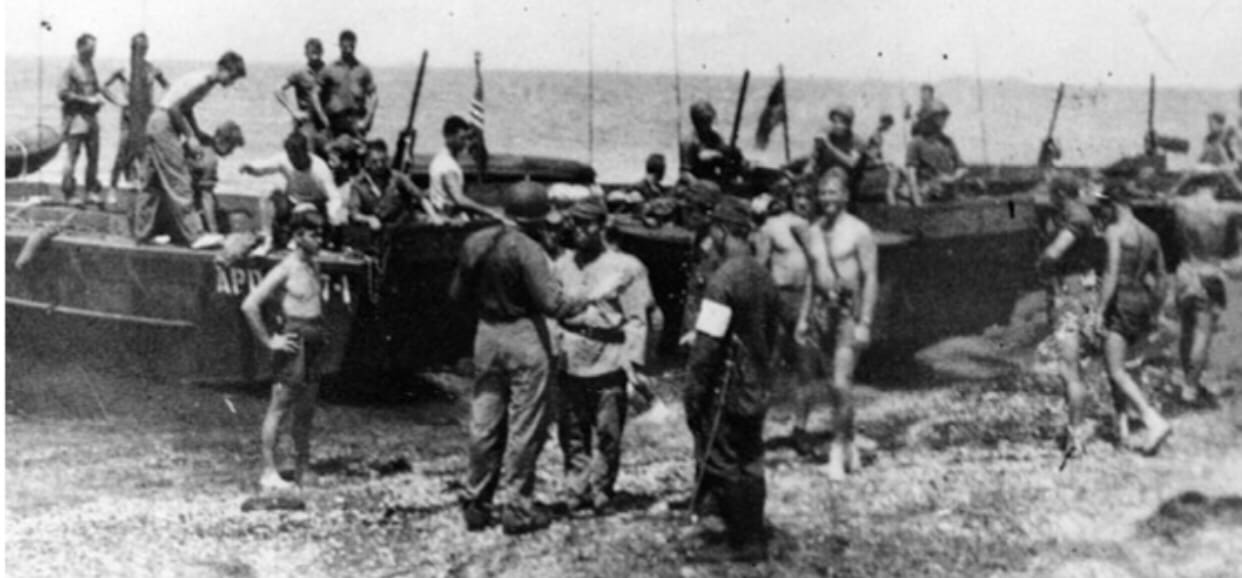
UDT-21 (now SEAL Team 4) is credited with accepting the first official surrender on mainland Japan of WW2. Here the Commanding Officer LTCmdr Clayton of UDT-21 receives the first sword surrendered to the U.S. on mainland Japan. When he returned to the ship, he was ordered to return it so they could surrender to General MacArthur (just one more thing in a long list, that makes him one of the worst generals in history.)

At the end of WW2, most of the special maritime units where dissolved, all except a hand full of UDT teams. In the Korean Conflict, the Frogman started to come out of the water more and more. They where assigned targets like destroying bridges and other direct action missions.

In 1962, President Kennedy established SEAL Teams ONE and TWO from the existing UDT Teams to develop the Navy’s Unconventional Warfare capability. The Navy SEAL Teams were designed as the maritime counterpart to the Army Special Forces “Green Berets” with their primary focus on Direct Action missions. They deployed immediately to Vietnam to operate in the deltas and thousands of rivers and canals in Vietnam and effectively disrupted the enemy’s maritime lines of communication.

The SEAL Teams’ mission was to conduct counter guerilla warfare and clandestine maritime operations. SEALs also advised and trained Vietnamese forces, such as the LDNN (Vietnamese SEALs). Later in the war, SEALs conducted nighttime Direct Action missions such as ambushes and raids to capture prisoners of high intelligence value.

The SEALs were so effective, that the enemy named them, “the men with the green faces.” At the height of the war, eight SEAL platoons were in Vietnam on a continuing rotational basis. The last SEAL platoon departed Vietnam in 1971, and the last SEAL advisor in 1973.

In 1983 all UDT teams where turned into SEAL teams (SEAL Team 4 and 5) and SEAL Delivery teams (SDV 1 and 2). All branches of service have Combat Swimmer/Divers. In the Army, Rangers and Special Forces (Green Berets) can go thru Army combat diver school in Key West. The Air Force has a combat diver course for all ParaRescue and Combat Controllers. As both groups get assigned to work with all branches of Special Forces, they have to know how to dive as well. The Marines also have a Combat dive course that Marine Raiders and Recon personal attend.

Explosive Ordnance Disposal units. All branches also have EOD units. They are as old as the combat swimmer unit and have always been a big part of every military operation. Draper Laurence Kauffman, the man credited with starting the UDT, and being the first U.S. frogman was first an EOD officer with the British at the start of WW2. One month before Pearl Harbor he returned to the U.S. and joined the Naval Reserve. EOD personnel are some of the smartest people on the battlefield today. They are right there in the fight with all Special Forces and conventional units.

The mission of the combat swimmer has not changed much since it started around 450 BC. Combat swimmers still conduct special reconnaissance missions of beaches and harbors. They can climb out of the water to destroy something or even grab someone off a beach. The only thing that has changed is the technology that is available to them, but the basic combat swimmer skills will always be the same. Just about every country in the world is accessible from the water so the need for a combat swimmer will never go away.

Unity Tactical FUSION Friday

Friday, August 31st, 2018

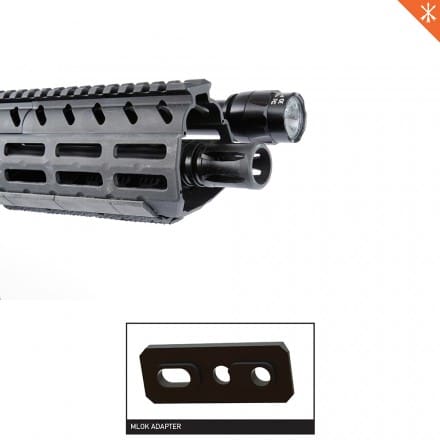
FUSION, by Unity Tactical, is a system of modular, multi-purpose components that provide end users unparalleled flexibility in mounting accessories to weapon platforms.  It offers complete control in attachment of lights, lasers, sights, and other equipment to achieve complete integration, optimal placement, lightest weight, and most economy of space.

FUSION Config 10A BreakOut

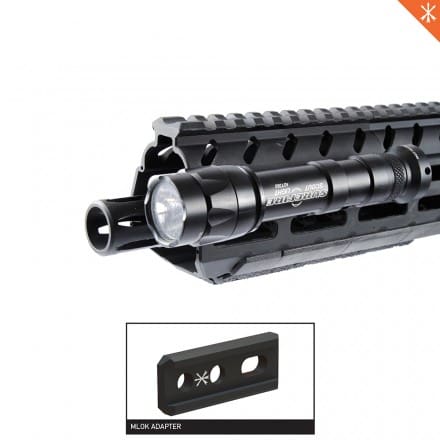
This FUSION configuration features the MLOK Compatible Adapter.  It is designed to place Surefire Scout and Streamlight Rail Mount lights (as well as FUSION accessories) as close to the rail as possible.  Rail estate is always at a premium, but we also want to make sure our gear is as low profile as possible.  The FUSION MLOK Compatible Adapter will give you the lowest profile stance and is particularly handy for PDW style weapons.  In order to achieve this super low profile, you must have access to the backside of the rail on the host firearm.  This is easily achieved by removing the rail, installing the accessory, and reinstalling the rail.

FUSION Config 10B BreakOut

FUSION components are machined from 6061-T6 aluminum and MILSPEC Type 3 anodized.  Designed and made in the US from US materials and good ole’ fashioned American innovation.  FUSION is the original and best modular accessory mounting system.  Make your gear work for you, not the other way around.

FUSION components are available from Unity Tactical and authorized dealers to build your perfect setup.

www.unitytactical.com

DHS Awards $199K to Protect The Force for Development of Energy Harvesting Fabric

Thursday, August 30th, 2018

WASHINGTON – The Department of Homeland Security (DHS) Science and Technology Directorate (S&T) has awarded $199,260 to Boston-based Protect the Force, Inc. for the development of photovoltaic (PV) energy harvesting fabrics. PV materials produce electricity through exposure to light. Energy harvesting fabrics produce and store electricity within a fabric weave to power portable devices.

Protect the Force received its award for its project titled “Photovoltaic (PV) Energy Harvesting Textiles for Homeland Security Ensembles” under S&T’s Silicon Valley Innovation Program (SVIP) Other Transaction Solicitation Energy Harvesting Fabrics – HSHQDC-17-R-00050. This is the first award under this solicitation.

Protect the Force will develop PV fiber that can be woven into a “power fabric” and integrated with first responder garments to provide a reliable, portable power source. The power fabric can be used to make first responder gear or placed as panels on protective clothing.

“Protect the Force’s proposed technology could change how first responders are able to perform during emergencies,” said Melissa Ho, SVIP Managing Director. “A wearable, portable power source could support safety equipment and communication tools; it has the potential to improve the work of first responders across the nation.”

The first phase will see Protect the Force fabricating and testing the PV fiber and weaving said fiber into a textile matrix.

Companies participating in the SVIP are eligible for up to $800,000 in non-dilutive funding over four phases to adapt commercial technologies for homeland security use cases.

For more information on current and future OTS solicitations, visit www.dhs.gov/science-and-technology/svip or contact dhs-silicon-valley@hq.dhs.gov.

Widget Wednesday: PTX SAT-P Android App

Wednesday, August 29th, 2018

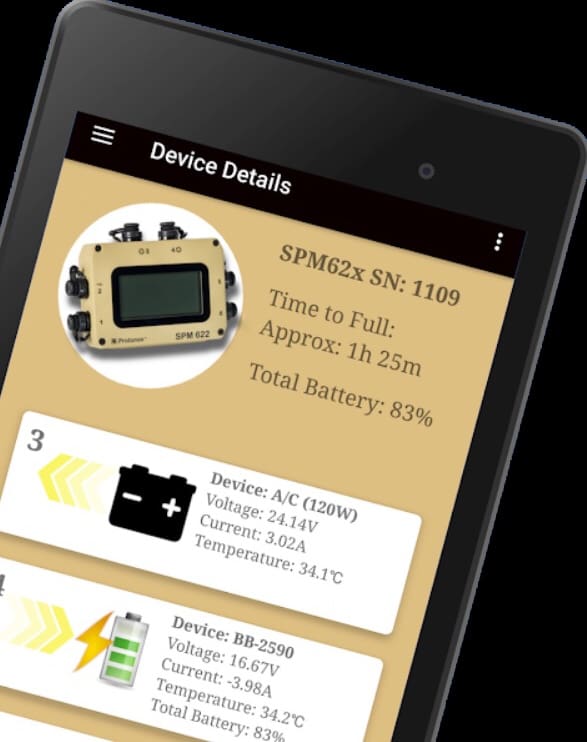
The latest Widget created by the Brainboxes at Protonex is the PTX Situational Awareness Tool for Power (PTX SAT-P). The SAT-P provides an all-in-one solution for managing your PTX SPM-622 Squad Power Manager from your Android phone or tablet.

The app allows users to easily monitor their energy usage in real time and to quickly see key information such as:
• What devices are connected and consuming power?
• What power source is connected and in use?
• How long will the battery last at present rate?

The app also allows users to monitor and update their Power Manager firmware version.

The PTX SAT-P App requires a phone or tablet that will accept an external keypad and is running Android 5.0 or higher, and is available on the Google Play Store at: play.google.com/store/apps/details

For more information about PTX power management systems from Protonex, visit: www.PTXnomad.com

Proliferation of Drones Posing Risk for US Military, Army Expert Says

Tuesday, August 28th, 2018

WASHINGTON — As of January 2018, over 1 million micro drones were registered with the Federal Aviation Administration, with about 878,000 of those registered to hobbyists, said Dr. Juanita Christensen.

These micro drones are proliferating in other nations as well, including areas in every combatant command where U.S. forces are stationed or operating, she added.

Christensen, executive director of the Aviation and Missile, Army Research, Development and Engineering Command, spoke at the Institute for Defense & Government Advancement-sponsored Counter-UAS Summit here, Aug. 23.

The growth of drone ownership poses challenges, she said, such as identifying the unmanned aerial system, determining whether or not the unmanned aerial system is friend or foe, and, if foe, employing the right countermeasures.

32B0FABF-845E-4E7A-BE39-42FDD18C7EB4
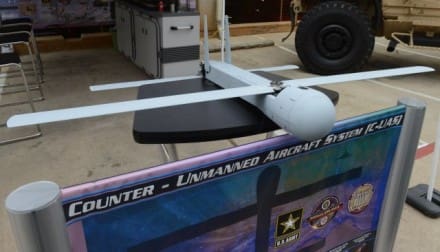
The U.S. Army is at the forefront of identifying and mitigating threats from unmanned aerial systems, including identifying the UAS, determining whether or not the unmanned aerial system is friend or foe, and, if foe, employing the right countermeasures. (Photo Credit: U.S. Army photo David Vergun)

UAS IDENTIFICATION CHALLENGE

It’s not just the sheer number of drones that is an issue, but also the the hundreds of UAS variants being produced worldwide, Christensen said.

Each of these variants comes in different weights, shapes, and sizes. Additionally, each has different operating characteristics such as speed, flight duration, maneuverability and payload capacity. These variations make tracking them difficult because it’s hard for radars and other surveillance systems to identify exactly what’s out there, she said.

Another reason why it’s hard to identify UASs, she said, is that many are very small and therefore have a minuscule radar signature. Additionally, some of these UAS fly very low to the ground, away from a radar’s line of sight. They also move relatively slowly, similar to the flight of a bird, and they produce very little acoustic, infrared, radio frequency, or electromagnetic signatures.

Current military radars and surveillance sensors may categorize class 1 and 2 UASs as “clutter,” and not identify them as UAS, she said, explaining that class 1 and 2 consist of micro and mini UAS, respectively. These are the UAS systems commercially available to anyone.

The second challenge is determining whether or not the UAS is being flown by a hobbyist or commercial entity for benign reasons, or by someone bent on causing harm, she said.

Any number of payloads can be placed on a UAS and they can also be used for surveillance, Christensen added, declining to get more specific for security reasons.

This identification problem is especially acute because operators often have to determine friend from foe and what action to take in just a matter of seconds.

UAS COUNTERMEASURES CHALLENGE

RDECOM has recognized the importance of countering UAS for some time now, Christensen said.

In January 2014, RDECOM stood up the Counter-UAS Community of Practice. That community coordinates counter-UAS research with all of the labs across the Army and the other services and looks for solutions from industry and academia, she said.

For example, the Army Research Laboratory, which falls under RDECOM, is working with the community to study how to defeat swarms of enemy UASs, she said. And, the Communications-Electronics Research, Development and Engineering Center, also in RDECOM, is testing electronic countermeasures.

The community also is working with industry and academia to open new lines of effort, such as applying machine learning and artificial intelligence that will enable faster processing of data so that countermeasures can be taken much more quickly and with greater accuracy, she said.

The community is focused on class 1, 2 and 3 UAS threats, she said, explaining that class 3 consists of low-end tactical UAS. The other classes, 4 and 5, are high-end tactical and strategic UASs, respectively, that fly high and for long durations and are in the Air Force’s area of responsibility.

There are many promising lines of effort to deter a threatening UAS, she said, such as kinetic; passive, such as shooting a missile at the UAS that contains a net that deploys to take it down intact; sensitive sensors that can detect the UAS’s signatures emitted; and various types of jamming devices.

Besides going after the UAS itself, there are other efforts underway to defeat the “kill chain aspect,” she said, meaning eliminating the enemy UAS operator and the network behind it.

By David Vergun, Army News Service