Aquaterro

Archive for the ‘International’ Category

The Future of Autonomous Fighters Is Coming To Rome

Saturday, November 8th, 2025

GA-ASI Brings Uncrewed Fighter Fleet into Focus at International Fighter Conference 2025

SAN DIEGO – 03 November 2025 – General Atomics Aeronautical Systems, Inc. (GA-ASI), the world leader in uncrewed aircraft systems, is excited to participate in the upcoming 25th anniversary of the International Fighter Conference as the event’s only Four-Star Lead Partner, reflecting the company’s global commitment to the future of autonomous fighter jets.

GA-ASI’s growing production fleet of unmanned combat jets – including the MQ-20Avenger®, XQ-67A Off-Board Sensing Station, and YFQ-42A Collaborative Combat Aircraft – is defining the global future of autonomous and semi-autonomous combat jets, leading the way in autonomy development, manned-unmanned teaming, and affordable, rapid delivery at scale. The company’s vision for its Gambit Series of modular, scalable, uncrewed fighters paves the way for U.S. forces, allies and partners to quickly evolve global air forces for the future fight.

Publicly promising to build and fly a production-representative uncrewed jet fighter for the U.S. Air Force by summer 2025, GA-ASI launched its YFQ-42A CCA in August, pioneering a new era for fighter jets. Flight operations continue today across the growing fleet, cementing GA-ASI’s continued dominance in UAS development and delivery while meeting anticipated timelines and remaining true to its word.

“The YFQ-42A is a revolutionary aircraft, and the fleet is in production and in the air today,” said David R. Alexander, president of GA-ASI. “This isn’t a ‘wait and see’ moment. We’re flying. We’re delivering. And we’re advancing this future of combat aviation, the same way we have for more than three decades.”

Since 1992, GA-ASI has delivered more than 1,300 combat aircraft to U.S. forces and international partners, surpassing more than 9 million total flight hours in 2025. The company’s Predator®, Reaper®, Gray Eagle®, SkyGuardian®and SeaGuardian® aircraft continue to set the standard for medium-altitude, long-endurance UAS performance.

The company’s MQ-20 Avenger, an internally funded uncrewed combat jet that achieved first flight in 2009, continues to serve as a test bed for advanced autonomy integration and demonstration, incorporating and flying the latest cutting-edge software from U.S. government sources, leading industry suppliers and GA-ASI’s own autonomy software development teams, often at company expense.

For International Fighter Conference, Nov. 4-6 in Rome, GA-ASI plans to offer attendees a chance to see the future for themselves, with a full-scale model display of the YFQ-42A CCA co-located inside the show venue and other announcements. For more information on IFC 2025, visit www.defenceiq.com/events-internationalfighter.

INVISIO Secures SEK 190 Million Order for Intercom and Dismounted Soldier Systems

Friday, November 7th, 2025

INVISIO has received a significant order from an existing European customer for its Intercom and Dismounted Soldier systems. Deliveries are set to commence immediately and are expected to be completed by Q1 2026.

The order, valued at SEK 190 million, includes systems designed to provide seamless communication capabilities for both mounted and dismounted users. The order reflects the growing demand for INVISIO’s advanced communication solutions, developed to enhance operational efficiency and increase safety in demanding environments.

Lars Højgård Hansen, INVISIO CEO, said:

“We are pleased to have received another significant order for our Intercom system and personal system. This once again re-affirms that our solutions meet the very high expectations of users operating under the most critical and challenging conditions.

We also take pride in being able to deliver such a large order within a short period of time, which is a unique capability in our industry. This shows that a well-balanced inventory, combined with close collaboration with customers, is a clear competitive advantage.”

Leonardo and Rheinmetall: First Contract to Supply Armoured Vehicles for the Italian Army

Thursday, November 6th, 2025

The temporary grouping of companies Leonardo and Rheinmentall, as part of the Leonardo Rheinmetall Military Vehicles Joint Venture (50% Leonardo and 50% Rheinmetall AG), was awarded the first supply contract for 21 vehicles “A2CS Combat” for the Italian Army. The delivery of the first vehicle is expected by the end of 2025.

David Hoeder, Executive Chairman of JV Leonardo Rheinmetall Military Vehicles: “This first joint order following the decision to establish a joint venture between Rheinmetall and Leonardo is an important milestone. It brings the two companies, as well as two of Europe’s largest countries closer together. Cooperation is not optional anymore – it is the very essence of our European strategic sovereignity.”

Laurent Sissmann, CEO of JV Leonardo Rheinmetall Military Vehicles, stated: “We are pleased to announce this first step of the industrial synergy between Leonardo and Rheinmetall. We will work side by side to provide cutting-edge armoured vehicles, able to operate in modern operational scenarios.”

Leonardo and Rheinmetall will supply 21 tracked armoured vehicles for the Italian Army, 5 of which are Rheinmetall’s Lynx KF-41 with the Lance turret followed by 16 newly configured vehicles equipped with the same chassis and Leonardo’s Hitfist 30mm turret. The agreement also includes upgrading the whole fleet to the latter configuration, as well as including an additional 30 optional vehicles, and training and simulation systems to better train crews. These are fully digitalized latest generation vehicles based on merger of the best technologies on the market and capable of acting interoperably in a multi-domain context.

The supply falls within the scope of the A2CS – Army Armoured Combat System programme, originally called AICS – Armoured Infantry Combat System, which involves the total acquisition of 1.050 armoured combat vehicles and which, together with the Main Battle Tank programme, will renew Italian Army’s heavy vehicles fleet.

Galvion and South 8 Technologies Sign Letter of Intent to Collaborate on Lithium-ion Battery Technology for Extreme Cold Environments

Thursday, November 6th, 2025

Galvion, a global leader in the design and manufacture of intelligent power and data management solutions, innovative head systems and integrated soldier systems, today announced it has signed a Letter of Intent (LOI) with South 8 Technologies, a San Diego–based innovator redefining lithium-ion battery performance with its patented LiGas® cell technology. The LOI represents a shared commitment between two innovative defense and energy organizations to push the boundaries of battery performance through focused research and product development.

Galvion and South 8 are dedicated to using advanced battery technology to further address the challenges faced by today’s warfighter. As modern military operations extend into increasingly harsh and unpredictable environments, particularly the Arctic and other cold-climate theaters, limitations in today’s energy solutions become clear. The LOI establishes the framework for cooperative innovation, knowledge exchange, and field-focused testing to accelerate customers’ operational readiness in sub-zero temperatures. The initial scope of the work is guided by the urgent needs of defense customers in the US and Northern Europe who demand improved battery performance in climates with extreme temperatures. By leveraging South 8’s LiGas cell technology and aligning R&D capabilities, the collaboration seeks to demonstrate next-generation battery systems capable of operating reliably in Arctic conditions, with sustained temperatures as low as -60 °C (-76°F).

Todd Stirtzinger, CEO of Galvion said: “We have spent over a decade driving innovations in power provision and management to provide solutions that can adapt to the ever-changing operational needs of the modern warfighter. Arctic readiness is a new reality and partnering with South 8 allows us to explore battery technology that is specifically engineered to cope better with the challenges of extreme cold environments.” He added: “We see a lot of opportunity in combining South 8’s LiGas cell technology with our field-proven SoloPack™ battery family so we can provide defense customers with energy solutions that further enhance resilience, reliability, and mission readiness in extreme environments.”

“At South 8, we are redefining what is possible for lithium-ion performance in the harshest environments. This LOI with Galvion represents an exciting step toward enabling reliable energy storage in extreme cold applications where conventional batteries struggle. By integrating our LiGas cells, customers like Galvion can deliver unmatched performance and resilience, supporting critical missions in the world’s most demanding conditions.” said Jungwoo Lee, CEO of South 8 Technologies.

Galvion and South 8 will explore opportunities for joint development and commercialization of battery solutions that take full advantage of the South 8 LiGas cells’ wide temperature discharging and recharging capabilities as well as improved safety characteristics.

Australia’s Best Take on Premier Patrolling Test

Thursday, November 6th, 2025

Soldiers from 1st Battalian, the Royal Australian Regiment (1RAR), achieved gold at this year’s Exercise Cambrian Patrol, proving why they are Australia’s best.

Wind howled through the Welsh hills as the Australian infantry section stepped off into darkness for the biggest challenge of their careers.

Ahead lay unforgiving terrain, freezing water crossings and a gauntlet of combat scenarios to test the limits of endurance, skill and teamwork.

Fresh from their Duke of Gloucester (DoG) Cup victory, the team had just over a week of rest before flying to London and travelling from there to Cardiff.

After a crash course in British Army doctrine and weapons, they began their patrol at 2am from Maindy Barracks into the soggy, undulating landscape of the Brecon Beacons.

‘The views were unreal. Not something you see in Aussie training areas.’

Section member Private Benjamin King said the nerves hit them as they drove to the assembly area.

“You get those butterflies, but once the patrol commander got the FRAGO [fragmentary order] and we cracked into the mud model, the nerves disappeared and we got on with the job,” he said.

After crossing a minefield and dealing with a chemical warfare attack, the team was notified of a vehicle that had struck a mine and required medical assistance. 

After an eight-kilometre march, they reached the accident that their section commander, Corporal Tiger Jefferys, said was the one they handled best.

“Some of the other British forces commented that our standard of battlefield casualty care was very impressive, which was good to hear and it’s good for Australia as well,” Corporal Jefferys said.

Between stands, the soldiers patrolled through breathtaking terrain and were able to enjoy the views thanks to clear weather – in contrast to the rain-soaked DoG Cup.

“We were lucky with the weather,” Private King said.

“The views were unreal. Not something you see in Aussie training areas. But it was still cheeky chats with your mates and keeping your game face on.”

The team next faced a military float crossing through an icy reservoir before harbouring up for the night. 

In the morning, the section met with indirect fire and a trench assault – the highlight of the patrol according to Private King.

“It was intense, with realistic enemy and a proper mock-up trench,” he said. 

“We got contacted early, had to fight our way in, clear through and capture a high-value target. It was something I hadn’t done before and it pushed us hard.”

‘They were all excellent. At no point did anyone lag behind or say that they needed a rest.’

After securing an enemy commander, the team stepped off on their final 10-kilometre stomp to the finish line, followed by a debrief.

The team took just more than 40 hours to complete the exercise and were happy to be off their feet after more than 60 kilometres of patrolling.

Exercise Cambrian Patrol has been held annually by the British Army since 1959. It is regarded as the world’s premier patrolling test. 

This year, 122 teams took part. To earn gold they had to score more than 75 per cent across the entire patrol.

According to Corporal Jefferys, the section was ecstatic after finding out they were one of the few teams to achieve the gold standard.

“It felt great, especially getting everyone over the line at the end. I’m really proud of the team to have achieved it,” Corporal Jefferys said.

“They were all excellent. At no point did anyone lag behind or say that they needed a rest. Everyone was fit, all over their drills and highly motivated.”

Private King said the patrol was a last hurrah for the section. Given they had been training together since their DoG Cup selection, their achievement was made even more meaningful.

“Once we found out, it was just pure elation. Like we’d finally done it. We’d got a gold at DoG Cup and then gold at Cambrian,” he said.

“It showed how capable an RAR section is on the world stage.”

By Corporal Michael Rogers

A4ESSOR and OCCAR Sign New Procurement Contract to Advance Development of Interoperable Tactical Communications

Tuesday, November 4th, 2025

Procurement contract to carry out the capability deployment of the ESSOR High Data Rate Waveform – EHDRWF.

Munich/Bonn, November 3, 2025 — a4ESSOR S.A.S (Alliance for ESSOR – European Secure Software Defined Radio), a multinational joint venture that develops secure software defined radio (SDR) technology, has signed a procurement contract with the intergovernmental Organisation for Joint Armament Cooperation (OCCAR) to carry out the capability deployment of the ESSOR High Data Rate Waveform – EHDRWF. The waveform can be ported to national software-defined radios; through this unique approach, any nation can use its own radio and be interoperable with other nations in their tactical communications. The contract for the so called ESSOR Development Stage #4 (ES4) is valued in excess of 47 million EUR.

The six nations involved and their respective industry leaders (Finland – Bittium, France – Thales, Germany –Rohde & Schwarz, Italy – Leonardo, Poland – Radmor, Spain – Indra) have then been working to add new features, such as electronic protection measures and support of modern cryptographic standards, leading to several successful interoperability demonstrations and qualification tests and to the adoption of ESSOR High Data Rate Waveform as NATO STANAG 5651 in 2023.

Under the new contract, a4ESSOR will design a common mission framework aimed at shared planning capability of network parameters of the EHDRWF. Once implemented in the command-and-control system of each nation, the mission framework will ensure high interoperability at operational level, allowing quick and accurate deployment of multinational EHDRWF networks.

a4ESSOR will conduct field tests of the EHDRWF on the various radio systems to assess the maturity, performance and reliability of the waveform in various scenarios, providing valuable feedback for future waveform enhancements. The field test will also include trials in different operational environments (urban, rural and hilly terrains), line-of-sight/non-line-of-sight and mobility scenarios, as well as analysis of waveform performances under potential interference conditions. Furthermore, the contract will define an ESSOR in-service support framework and will set up an ESSOR laboratory as the reference for interoperability validation.

Lino Laganà, President and General Manager of a4ESSOR, said “a4ESSOR has been active for over 16 years playing a crucial role to develop and test ESSOR capabilities and technologies to address multinational defence requirements as a valuable solution in addition to the existing legacy waveforms. The ESSOR HDRWF standard is capable to facilitate seamless communications across diverse radio platforms and nations, affirming its potential to enhance collaborative defence operations across Europe and NATO countries.”

“The mission framework will allow a quantum leap forward in terms of interoperability among armed forces from various countries, as it will define what’s needed to achieve interoperability in mission planning and management. We will work at defining the required solutions towards their integration onto command & control systems of the various countries. It’s an evolution enabler, from technical to operational interoperability.”

Lino Laganà continued “The project aligns with the European Union’s strategic objectives of strengthening defence cooperation, enhancing autonomy, and improving the efficiency of combined military missions. By equipping EU member states with secure, interoperable, and scalable communication solutions, the initiative strengthens Europe’s collective ability to respond to threats and ensures seamless coordination in operations.”

Contribution to European Energy and Fuel Security: Rheinmetall Cooperates with German Technology Champions to Build Production Facilities for CO?-Neutral Synthetic Fuel for Military Use

Tuesday, November 4th, 2025

In the future, Rheinmetall intends to enable armed forces to produce their own fuel locally and independently of global fossil fuel supply chains. To ensure the operational readiness and energy supply of military forces, Rheinmetall is now presenting a new strategic concept: the independent synthesis of e-fuels by European armies. The ‘Giga PtX’ project developed by Rheinmetall, in collaboration with partner companies, aims to establish a Europe-wide network of several hundred modular e-fuel production plants. Depending on the application profile, these plants will be capable of producing 5,000 to 7,000 tonnes of diesel, marine diesel, or kerosene per facility per year. With this concept, Rheinmetall is looking at strengthening the energy self-sufficiency and resilience of European armed forces in a sustainable manner, while also contributing to the stability of critical energy infrastructure.

Rheinmetall offers to act as general contractor and is responsible not only for system integration but also for the design, construction, maintenance and operation of the large-scale industrial facilities. The company thus offers its customers a holistic solution – from the engineering phase to long-term operation.

In order to be able to provide the plant technology immediately, a strong alliance of participating German industrial giants and leading cleantech companies has been formed. “We have exactly the partners we need. We are prepared and can start immediately. We are literally ready to go in order to strengthen fuel resilience in Germany and Europe in the long term”, says Birgit Görtler, Vice President Sales Hydrogen at Rheinmetall.

Sunfire, a leading global manufacturer of industrial electrolysers will be joining the consortium. The company’s pressurized alkaline electrolysers are intended to be an indispensable component of e-fuel production plants, ensuring the reliable supply of green hydrogen.

Sunfire’s portfolio also includes highly efficient SOEC technology. By utilising waste heat in the form of steam, the facility achieves a significantly higher conversion efficiency. This means that more hydrogen, and consequently more fuel, can be produced with the same amount of electricity. This technology is therefore ideal for use in e-fuel facilities.   

In addition to green hydrogen, carbon dioxide is required to produce synthetic fuels. This is why Greenlyte, a new energy player based in North Rhine-Westphalia, is also joining the consortium. Using its modular technology to produce green raw materials, Greenlyte can capture carbon directly

from the air, providing another key component for producing synthetic fuels at the Giga PtX facilities, alongside hydrogen. This feature enables the facilities to operate independently of existing infrastructure and with greater flexibility, thereby increasing location independence.

Alongside the new partners, Rheinmetall’s long-standing cooperation partner INERATEC from Karlsruhe also plays a central role in the consortium. This technology company is responsible for the heart of the facility: the Reverse Water Gas Shift (RWGS) and Fischer-Tropsch processes. These processes convert hydrogen and carbon dioxide into synthetic fuels. INERATEC recently demonstrated its leading expertise in the field of power-to-X technologies by commissioning Europe’s largest power-to-liquid facility in Frankfurt am Main. This facility produces up to 2,500 tonnes of sustainable fuel annually.

“War readiness requires a resilient energy infrastructure. Maintaining fossil fuel supply chains will be challenging for European countries in the event of a defence situation. With the Giga PtX facilities, Rheinmetall and its partners are sending a strong signal of industrial transformation, climate protection and security resilience in Europe”, said Armin Papperger, CEO of Rheinmetall AG.

The first facilities can be realised at short notice as soon as the political and regulatory framework conditions have been established.

New Partnership Between Milrem Robotics and Poland’s Military University of Technology Strengthens Defence Robotics R&D

Sunday, November 2nd, 2025

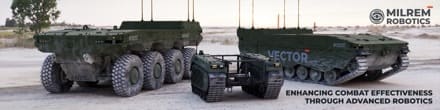
Milrem Robotics, the world’s leading robotics and autonomous systems developer, and Poland’s Military University of Technology (Wojskowa Akademia Techniczna—WAT) have signed a cooperation agreement to accelerate joint scientific research, innovation, and education in defence robotics.

The agreement was signed on October 29, 2025, by Brigadier General Prof. Przemys?aw Wachulak, PhD, DSc, Eng., the Commandant-Rector of the Military University of Technology, and Kuldar Väärsi, the Chief Executive Officer of Milrem Robotics.

This partnership fosters research and development synergy: together, Milrem Robotics and WAT will co-design and implement projects under European and international programmes, drive joint scientific publications and conference participation, and combine technological development with academia to accelerate innovation.

“We are delighted to collaborate with WAT to enhance Europe’s defence capabilities. This partnership reflects Milrem Robotics’ dedication to Poland’s vibrant innovation ecosystem. As a global leader in advanced technology, this agreement signifies an exciting milestone in our journey to engage with Poland’s dynamic industrial and technological landscape. Together, we will utilise agility, creativity, and innovative solutions to foster progress, demonstrating that European collaboration is essential to maintaining a competitive edge in the future,” said Kuldar Väärsi, CEO of Milrem Robotics.

“At the Military University of Technology, we understand the importance of rapidly implementing research results and delivering new technologies: military, dual-use and civilian,” said Brigadier General Professor Przemys?aw Wachulak, Commandant-Rector of WAT. “WAT’s cooperation with Milrem Robotics is another important step toward advancing unmanned ground vehicle technologies for the military, as well as new educational opportunities for the young ranks of soldiers and engineers building our future security,” he added.

“This agreement allows us to bring academia and robotics engineering closer together to create real impact,” said Marcin Sobieraj, Country Manager of Milrem Robotics Poland.

The cooperation further provides for mutual technical and scientific consulting, exchange of knowledge and experience, and coordination of research and development efforts. Educational integration is central: Milrem experts will engage in WAT’s workshops, courses, and events; students will gain from study visits, internships, and apprenticeships.

Milrem Robotics and the Military University of Technology commit to ongoing collaboration in science, education, and defence systems development, pushing advancements in unmanned systems and enhancing European resilience.