GORE-TEX Professional - AWICS

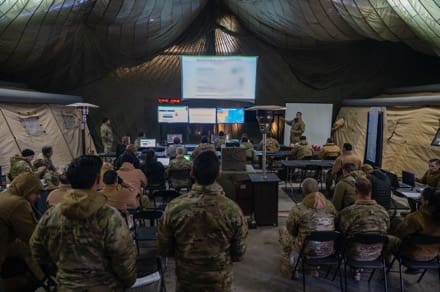
Inside 492nd SOW’s New Special Operations Advisor Teams

August 24th, 2025

DUKE FIELD, Fla. —  

While headlines often focus on major combat operations or high-visibility deployments, a quieter force is shaping the future of global security—Air Force Special Operations Command’s Special Operations Advisor Teams. Operating under the 492nd Special Operations Wing, these highly trained teams are experts in building partner capacity, fostering long-term relationships with regionally aligned partner nations within U.S. Southern Command, and amplifying power through security cooperation.
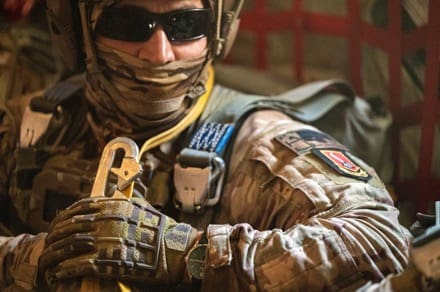
SOATs are composed of Air Commandos who combine tactical expertise with cultural understanding, language proficiency, and advisory skills. Their mission: to regionally synchronize, integrate, enable, and selectively employ Air Force Special Operations Forces capabilities in the SOUTHCOM area of responsibility to further national priorities and outpace strategic competitors through unparalleled multi-domain support to the joint force.

“Our SOATs advise, assist, and enable partner forces in achieving their own security objectives—thereby contributing to regional stability and strengthening partnerships that endure across generations,” said the squadron commander.
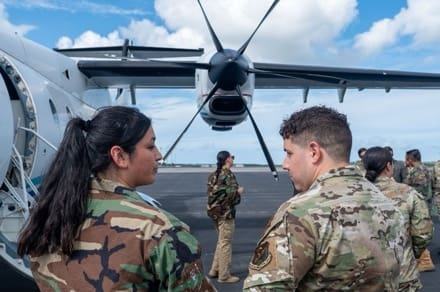
Members recently demonstrated their capabilities during SOUTHERN STAR  ‘25, a multinational special operations exercise that took place across Chile from May 26 to June 8, 2025. The exercise brought together forces from six nations and 10 observer countries, totaling more than 2,700 participants. Their shared mission was to enhance interoperability and strengthen global special operations partnerships through joint training from Antofagasta to Punta Arenas . The SOATs participation helped synchronize air-to-ground integration and improve interoperability between U.S. and Chilean units, further reinforcing mutual readiness.
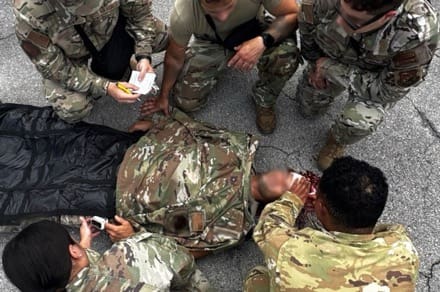
SOAT members must train regularly in tactical operations, communication protocols, physical fitness, and scenario-based exercises to assess readiness and ensure operational standards are met. To formally evaluate this proficiency, teams annually participate in a unit-led certification exercise designed to assess operational readiness, reinforce standards, and ensure all SOAT members meet mission-critical performance requirements.

“Our mission is to maintain the highest standards of training, proficiency, and operational precision within Special Operations Advisor Teams,” said the squadron operations officer. “This commitment ensures their capability to effectively advise, lead, and execute complex missions that advance national security objectives and uphold strategic interests in dynamic and challenging environments.” 

Beyond exercises, SOATs are on the front lines of generational partnership building; establishing trust and cooperation with foreign counterparts that span not just missions, but decades. This enduring engagement creates a network of allied capability that magnifies U.S. strategic reach while allowing partner nations to stand stronger on their own.
In a world of evolving threats and increasing geopolitical complexity, Special Operations Advisor Teams represent one of AFSOC’s most flexible and impactful tools. They are advisors, diplomats, and force multipliers setting the standard— El más dedicado gana. ..The most dedicated wins.

By TSgt Carly Feliciano, 492nd Special Operations Wing
Exhibitor Registration and Shooting Positions Now Available for Industry Day at the Range 2026

August 24th, 2025

BOULDER CITY, Nev. – August 20, 2025 – SHOT Show® Industry Day at the Range, the premier hands-on event held annually the day before SHOT Show®, has officially opened exhibitor registration for its 21st annual event, taking place January 19, 2026, at the Boulder Rifle and Pistol Club in Boulder City, Nevada. In addition to opening registration, a limited number of shooting positions are now available.


Industry Day provides exhibitors with a unique opportunity to launch new products, create content with top-tier media and influencers and connect directly with SHOT Show attendees in a dynamic, hands-on environment. The event continues to drive early engagement and momentum that carries into the show floor and beyond.

A select number of shooting positions are now available, including:

  • Exclusive Shooting Bay

  • 10×20 Shooting Area
  • Shared Bay
  • 10×10 Shooting Area
  • 10×10 Airgun

“Industry Day consistently gives companies the platform to generate buzz and build key relationships before SHOT Show even begins,” said Kelsey Puryear, Industry Day at the Range co-owner. “Shooting positions are limited, and we encourage interested exhibitors to secure their spot early for the industry’s most influential range event.”

Supported by the National Shooting Sports Foundation as title sponsor through 2028, Industry Day at the Range remains the only official range event associated with the SHOT Show. Exhibitor space is limited, and early registration is strongly encouraged.

New exhibitors can register online now to secure their space. Shooting Positions are also available online. For additional details and answers to frequently asked questions, please visit the event website.

For more information about the 2026 SHOT Show Industry Day at the Range visit ShotShowRangeDay.com

Savage Arms Announces A22 and B Series Timber Tactical

August 24th, 2025

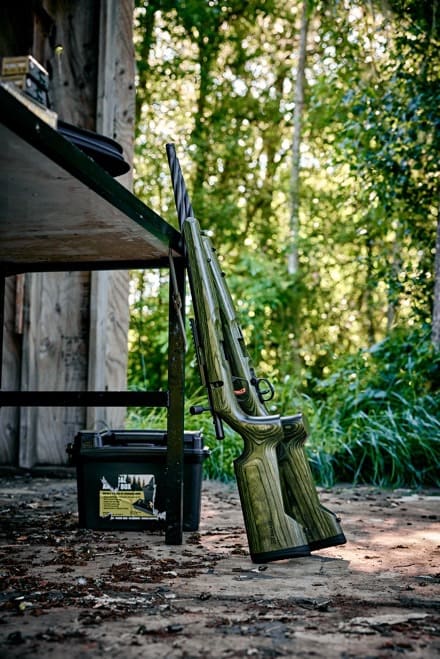
WESTFIELD, Massachusetts – August 22, 2025 – Savage Arms®, an iconic firearm manufacturer, is excited to unveil the A22 and B Series Timber Tactical, an exceptional addition to its lineup of precision-engineered rimfire rifles. These models masterfully combine classic design with modern innovation, built for shooters who value both high performance and refined craftsmanship. 

The A22 and B Series rifles feature a stunning OD Green Laminate stock, designed for unparalleled durability while maintaining a sophisticated appearance. The vertical grip enhances precision shooting, allowing for improved control and accuracy. Additionally, the rear hook provides an extra layer of stability, enabling shooters to manage the rifle effectively with their off hand. 

“Our new Timber Tactical rimfire rifles provide unparalleled accuracy and comfort,” said Brett McKenna, Rimfire Product Manager. “Whether you are a seasoned shooter or a newcomer, these rifles provide the precision engineering needed for consistent performance. As we lead Savage into the future, we’re proud to introduce products that honor our heritage while embracing innovation. These new rifles are a perfect example of the excellence in firearms craftsmanship that defines the Savage name.” 

Equipped with dual forward sling studs, these rifles are designed for versatility in the field. The 20 MOA picatinny rail installed on the A22 and B Series models allows for easy attachment of optics, ensuring that shooters can customize their setup to meet their specific needs. The A22 Model is available in .22 LR, while B Series models are chambered in .22 LR, .22 WMR and .17 HMR. The wide variety of chamberings ensures there are options for every shooter. 

The flush fit 10-round rotary magazine ensures smooth feeding, while the 18″ heavy profile barrel, featuring deep spiral fluting and a 1/2×28 threaded muzzle, guarantees consistent performance shot after shot. For those opting for the B Series models, the 1.5-pound Precision AccuTrigger offers an exceptional shooting experience, providing a crisp and clean trigger pull that enhances accuracy. 

SKU / Description / MSRP 

70251 / B Series Timber Tactical 22 LR / $599 

70551 / B Series Timber Tactical 22 WMR / $599 

70851 / B Series Timber Tactical 17 HMR / $599 

47258 / A22 Timber Tactical 22 LR / $599 

For more information about Savage Arms and its extensive line of leading firearms, visit savagearms.com

McAlester Army Ammunition Plant Provides Critical Munitions Loading Function

August 24th, 2025

MCALESTER, Okla. — Thanks to cutting-edge technology, the Multi-Purpose Load Facility, or MPLF, at the McAlester Army Ammunition Plant in Oklahoma is revolutionizing the way large-caliber munitions are loaded.

Jointly developed by the Army and Air Force, the $58 million facility streamlines multiple loading operations into a single, centralized location. This integration significantly boosts both worker safety and production efficiency.

The vision for MPLF began several years ago as MCAAP searched for a home for full-rate production of unique penetrator assets. An underutilized facility was identified, the Air Force provided funding, and the concept took root with a focus on flexibility and adaptivity.

MCAAP self-executed the project using advanced in-house engineers, a robust artisan workforce and a skilled procurement staff. The project began with a relatively small amount of facility modifications which led to the ability to implement new industrial processes through the installation of state-of-the-art explosive loading equipment.

“The MPLF stands as a testament to what happens when joint forces have a common goal in mind,” said Col. Curtis Perkins, MCAAP’s commander. “The future of defense is shaped every day at McAlester through relentless innovation, unwavering commitment, safety, and precision in execution.”

At the heart of the MPLF is a bladeless, resonance-based mixer capable of processing 55-gallon batches of energetic materials. This advanced system reduces mixing times from hours to mere minutes, resulting in significant increases in efficiency and substantial cost savings.

“What happens here inside the MPLF isn’t mixing,” Perkins said. “It’s the critical path where resources, speed, precision and purpose converge to drive the production mission forward.”

Designed to support precision near-net-shape manufacturing, the MPLF represents a major leap forward in energetic material production, with enhanced safety protocols embedded throughout its operations. It is designed with a focus on flexibility and enhanced quality throughput transitioning operations from World War II era facility constraints to a more modern work environment.

“The MPLF serves as a prime example of joint service collaboration with the common goal of providing increased readiness and lethality to the warfighter,” Perkins said. “This teaming concept has helped to modernize one of our nation’s most important insurance policies while highlighting the talent that exists in our organic workforce. It is a true OIB success story.”

By Matthew Wheaton, Joint Munitions Command, Public and Congressional Affairs

Hegseth Announces Establishment of Mexican Border Defense Medal

August 23rd, 2025

Effective immediately, the Mexican Border Defense Medal is established to recognize service members deployed to the U.S. international border with Mexico for Defense Department support to U.S. Customs and Border Protection, said Defense Secretary Pete Hegseth in an Aug. 13 memorandum.

Service members deployed in support of CBP previously were recognized with the Armed Forces Service Medal.

To receive the new award, service members must have been permanently assigned, attached or detailed to a unit that deployed to participate in a designated DOD military operation supporting CBP within the area of eligibility for 30 consecutive or nonconsecutive days, from Jan. 20 to a future termination date to be determined, Hegseth said.

The area of eligibility is U.S. land within 100 nautical miles from the international border with Mexico within Texas, including the city of San Antonio, as well as New Mexico, Arizona, California and the adjacent U.S. waters out to 24 nautical miles, he said.

Service members and veterans previously awarded the AFSM may apply for the new award in lieu of the AFSM previously awarded, the secretary said, adding no one can be awarded both medals for the same period of qualifying service.

“Securing the southern border, protecting the territorial integrity of the U.S. and defending our homeland are Department of Defense priorities,” said Anthony J. Tata, undersecretary of defense for personnel and readiness.

Tata underscored the timeliness and criticality of this award, adding, “The service members deployed to support this national security imperative deserve to be recognized for their bravery and contributions — and we look forward to pinning the Mexican Border Defense Medal on them soon.”

The U.S. Army Institute of Heraldry will expedite procurement of MBDMs made to DOD standards, and the Defense Logistics Agency will expedite the process for procuring and placing the MBDM in the supply system to ensure timely availability of the award for qualifying service members and veterans.

About the Medal

According to Institute of Heraldry, the MBDM is identical to the Mexican Border Service Medal, struck in 1918, for service in 1916 and 1917 in the Mexican state of Chihuahua and on the U.S. side in the vicinity of the New Mexico and Texas borders with Mexico.

The medals are bronze. On the front is a sheathed Roman sword hanging on a tablet, along with an inscription that reads “For Service on the Mexican Border.”

The sword symbolizes war or military strength and is sheathed to indicate service in the United States rather than in actual combat.

On the reverse side is the Coat of Arms of the United States above a scroll and surrounded by a wreath ending at the center with cross rifles in dexter, crossed sabers in sinister and crossed cannons in base.

The wreath represents achievement. The rifles, sabers and cannons represent the infantry, cavalry and artillery.

The ribbon’s field of green is symbolic of freedom, while the golden yellow color alludes to virtue. These colors represent civic virtue by serving the government in the pursuit of freedom.

The order of precedence for the MBDM will be before the AFSM and after the Korea Defense Service Medal.

By David Vergun, DOD News

Signal Corps Radio-Controlled Drones: Origins of the UAS Program

August 23rd, 2025

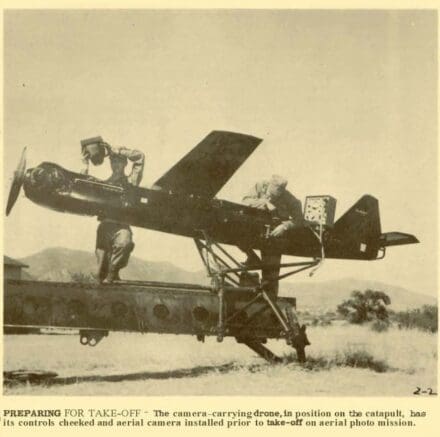
Unmanned Aircraft Systems (UAS) are a hallmark of the transforming mission of the U.S. Army Communications-Electronics Command as it embraces the principles behind Army Continuous Transformation. Modern UAS technology is touted as the future of the force, capable of performing a wide array of tasks while keeping Soldiers safe from harm. Although UAS use has been highlighted in recent news coverage of war-fighting efforts across the globe, the basis for current developments begins with the Signal Corps almost 70 years ago.

The CECOM Historical Archive collection documents the use of drone technology for surveillance throughout the late 1950s and early 1960s, a natural progression of the U.S. Army Signal Corps’ historic aviation and photography missions.

An article in the March-April 1956 edition of “Tec-Tac,” Technical and Tactical Training Aid Nonresident Conference Course, produced by The Signal School, Fort Monmouth, NJ, highlights the early development of drone technology for surveillance, written for the knowledge of Signal Soldiers.

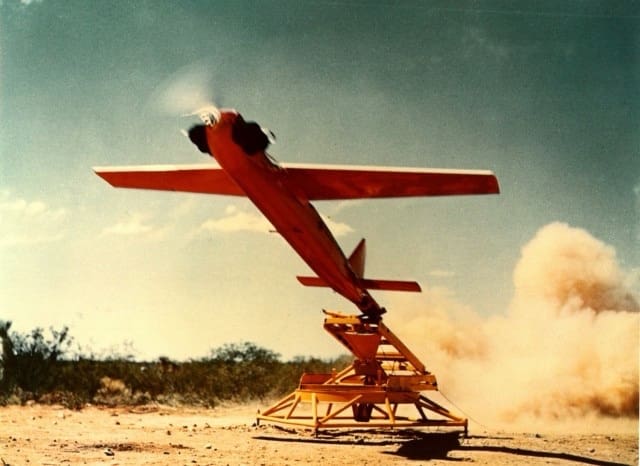
Development by the Signal Corps of a new camera-carrying drone will give the combat commander front-line aerial surveillance photographs in less than an hour and at no risk to personnel. The drone, a radio-controlled aerial target plane, was equipped at the Army Electronic Proving Ground (at Fort Huachuca, AZ) for its aerial surveillance mission. The drone can fly in excess of 200 miles an hour and climb at a rate of several thousand feet a minute. Although its take-off is jet-assisted, the drone operates on a gasoline motor-driven propeller while in the air. Equipped with still and motion picture cameras, the drone provides aerial photographic coverage at altitudes from a few hundred feet up to more than four miles.

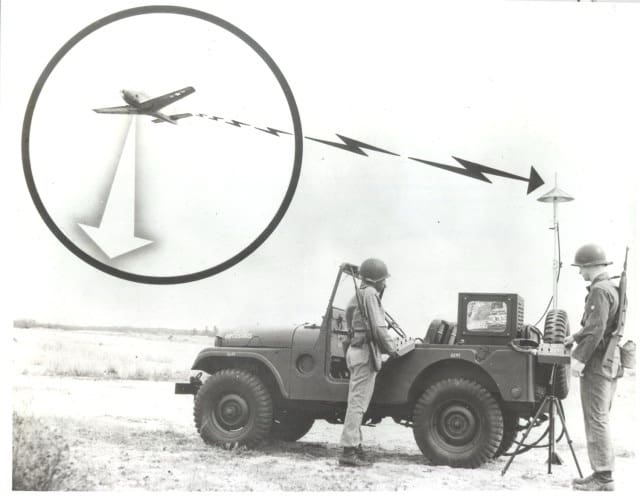
That same year, a captioned photograph depicted Soldiers operating radio remote controls that could pilot a television robot plane up to 40 miles away. The unmanned aircraft transmitted aerial views of distant sites, using lightweight television equipment developed at the Army’s Signal Corps Engineering Laboratories at Fort Monmouth. The airborne TV station weighed 135 pounds, less than a human pilot.

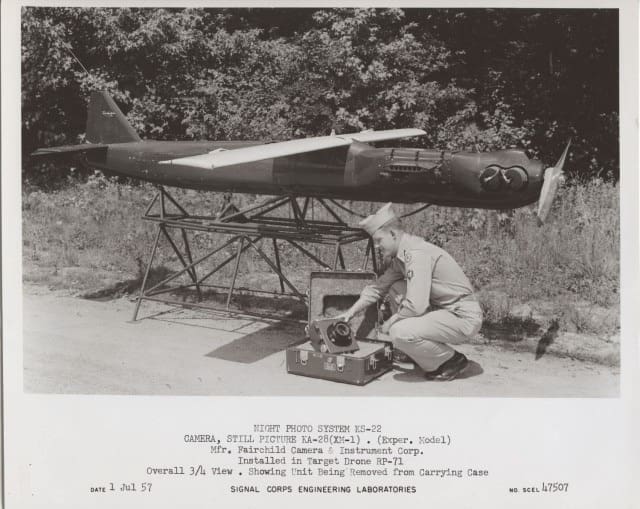
Development continued through the late 1950s and early 1960s, with the 1957 experiments of a Night Hawk drone, a nighttime photo system, and a still picture camera installed in Target Drone RP-71; the surveillance drone SD-2 of 1959 tested at Yuma Proving Ground, and the 1962 Infrared Surveillance System AN/UAS-4.

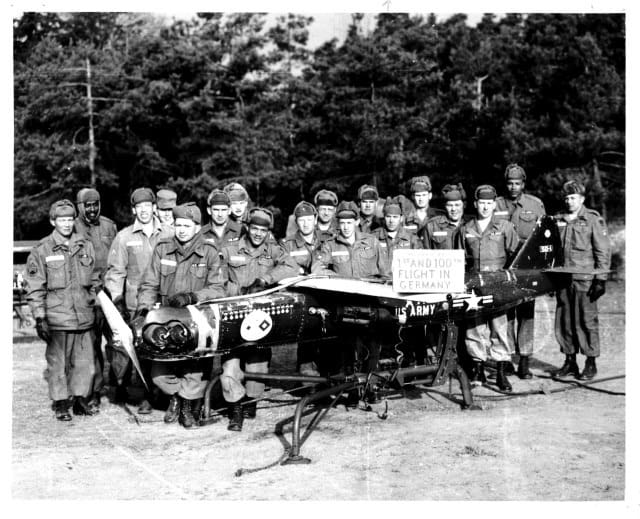
In Germany, a photograph taken in April 1960 documents the men of the Drone Section USA Surveillance Unit, Europe, lined up behind the SD-1 Surveillance Drone that flew the first and one hundredth Surveillance Drone flight in Europe as a demonstration for Secretary of Defense Thomas S. Gates, Jr. This was the next-to-last demonstration — the last one was for AUSA members.

In 1965, however, the Army Chief of Staff directed the Army Materiel Command that funds would not be expended on a complete drone system until formal requirements for drones were established, and a study was conducted regarding the need for drones, weighing the desired capabilities against the complexity of operations, maintenance, and training. As the U.S. began operations in Southeast Asia in the mid-1960s, the widespread testing and development of the technology vanished from the historical record, likely due to the densely forested landscape of Vietnam that limited the effectiveness of this type of developing surveillance technology. By 1966, many of the programs that were being developed and tested were declared obsolete, and the technologies and resources were reallocated to other areas across the U.S. Army Electronics Command, a CECOM predecessor.

Though sidelined in the 1960s due to mission needs and the changing face of warfare, the Signal Corps’ drone program laid the foundation for the autonomous systems and capabilities that continue to shape the future of military operations.

By Susan Thompson, CECOM Command Historian

Army Accelerates Long Range Reconnaissance UAS Capability

August 23rd, 2025

The Army recently awarded contracts to AeroVironment and Edge Autonomy to rapidly deliver initial Long-Range Reconnaissance (LRR) systems. The AeroVironment P550 and Edge Autonomy Stalker Block 35X are Group 2 UAS designed to provide Reconnaissance, Surveillance, and Target Acquisition (RSTA) organic to maneuver battalions. Capabilities include an open systems architecture, allowing quick integration of additional capabilities to meet ground commanders’ mission requirements, primarily at the Battalion level.

By working with multiple vendors, the Army continues to foster healthy, continued competition to ensure the Warfighter receives the best solutions quickly. The Army will use these initial LRR systems to establish operator training that remains Military Occupational Skill (MOS) agnostic, enabling any Soldier to operate the platforms and will begin fielding to operational units later this year as part of the Transformation in Contact 2.0 initiative.

The LRR program directly supports the Secretary of Defense’s July memorandum on “Unleashing U.S. Military Drone Dominance,” demonstrating the Army’s commitment to advancing drone technology and operational effectiveness.

A force-multiplier, LRR UAS will provide maneuver battalion commanders with increased RSTA capability organic to their formation. The Army anticipates additional LRR system selections in the future.

The Program Executive Office Aviation, through the Uncrewed Aircraft Systems (UAS) Project Office, equips Soldiers with cutting-edge tools to meet evolving mission demands and ensures the Army maintains tactical superiority on the battlefield.

Courtesy Story

Program Executive Office, Aviation

USSOCOM Selects LMT Defense for Medium Range Gas Gun – Assault Program

August 23rd, 2025

USSOCOM has announced Lewis Machine & Tool as the winner of the Medium Range Gas Gun – Assault OTA. MRGG-A is a carbine chambered in 6.5 CM and capable of semi and full auto fire. It is a companion weapon to the Sniper variant of MRGG, awarded to Geissele Automatics in 2023.

Lewis Machine & Tools Defense, Eldridge, Iowa, was awarded a 10-year indefinite-delivery/indefinite-quantity contract (H9240325DE003) with a maximum ceiling of $92,000,000 for medium range gas gun-assault kits, spare parts and accessories, new equipment training, and engineering change proposals. The work will be performed in Eldridge, Iowa, and the last day to order under the contract is Aug. 14, 2035. U.S. Special Operations Command, MacDill Air Force Base, Florida, is the contracting activity. (Awarded Aug. 20, 2025)