In the rigid world of military tradition, true innovators are rare. Even rarer are leaders who respect tradition yet willingly break with convention when the mission demands it. Lieutenant General William Pelham Yarborough was one of those men—a visionary whose creativity, intellectual curiosity, and willingness to challenge orthodoxy when circumstances required, helped define the identity of the U.S. Army’s Special Forces. Remembered today as the ‘Father of the Modern Green Berets,’ Yarborough’s legacy extends far beyond a title; it lives on in the culture, symbols, and mindset of America’s most unconventional soldiers.
A Mind Built for Innovation
Born in 1912 to a military family in Seattle and raised largely in Georgia, Yarborough entered the U.S. Military Academy at West Point during a period when doctrine and hierarchy ruled Army thinking. Commissioned in 1936 as an infantry officer, he began his career overseas in the Philippines. From the outset, his assignments revealed a pattern that would define his professional life: identify a difficult problem, ignore unnecessary convention, and design a practical solution.
That pattern became unmistakable after his transfer to Fort Benning in 1940. As a test officer with the 29th Infantry Regiment—and soon after as an acting captain commanding Company C, 501st Airborne Battalion—Yarborough found himself in the embryonic world of U.S. airborne forces. There, he applied both artistic sensibility and engineering logic to the challenges of a new form of warfare. He designed the Army’s metal parachutist qualification badge (which he later patented), the M42 “jump” uniform, specialized jump boots, and a range of air-droppable equipment containers. These were not cosmetic contributions; they were functional innovations that helped turn airborne theory into combat reality complete with an Esprit de corps.
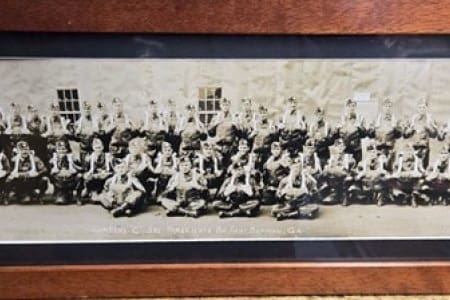
Unit photograph, Company C, 501st Airborne Battalion, Fort Benning, GA, 1940. Captain Yarborough (the Company Commander) is sitting in the front row, second from the right.Photo by Gary Wilkins, 1st SFC PAO.
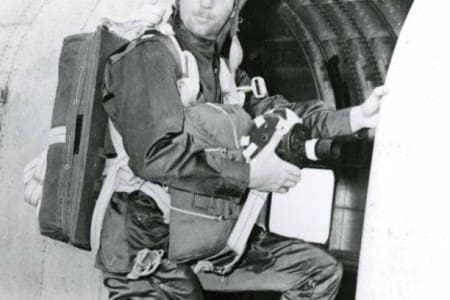
Capt. Yarborough boards a C-39 troop transport aircraft. Photo by The Army Historical Foundation.
Leadership Under Fire
During World War II, Yarborough’s unconventional mind was paired with combat leadership. In 1942. While serving in England as an airborne advisor for Operation Torch, he helped plan the first U.S. combat parachute operation, which landed American paratroopers (himself included) in French North Africa. The following year, as commander of the 509th Parachute Infantry Battalion at Anzio, he demonstrated that creativity did not come at the expense of discipline. Under fire, he demanded high standards, proving that unconventional thinking and strict professionalism were not mutually exclusive.
Diplomacy, Discipline, and the Cold War
After the war, Yarborough’s adaptability placed him in another complex environment: Allied-occupied Vienna. From 1945 through the mid-1950s, he served as Allied provost marshal, working daily with British, French, and Soviet forces. In this tense Cold War setting, he helped establish the famous four-power “International Patrol,” a mission that required restraint, cultural awareness, and constant negotiation—skills that later became hallmarks of Special Forces operations. His later assignment as deputy chief of the U.S. Military Advisory and Assistance Group in Cambodia further expanded his understanding of unconventional warfare and foreign internal defense.
The “International Patrol” later became informally known as “four men in a jeep,” a phrase that echoed the wartime Hollywood film Four Jills in a Jeep. One of the film’s stars, Martha Raye, would later become one of the most devoted and visible supporters of U.S. Army Special Forces. The connection is an interesting historical footnote: a reminder that Yarborough’s work in Vienna operated not only at the tactical and diplomatic level, but also within a broader cultural context that would later intersect with the Special Forces community in unexpected ways.
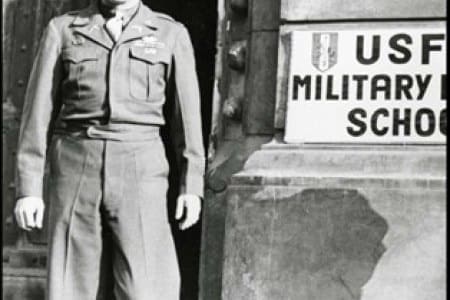
Colonel Yarborough serving as the Allied military Provost Martial in post-war occupied Vienna. Photo by The Army Historical Foundation
Forging the Green Beret Identity
Yarborough’s most enduring impact came in the early 1960s when he was appointed commander of the U.S. Army Special Warfare Center. At the time, Special Forces existed, but their identity—and institutional acceptance—remained fragile. Yarborough understood that elite units require both rigorous training and a unifying symbol. In 1961, he took a calculated risk by arranging for Special Forces soldiers to wear their green berets during a presidential review at Fort Bragg, despite the headgear lacking official authorization.
President John F. Kennedy, who himself held considerable interest in unconventional warfare, noticed immediately. When he asked Yarborough about the berets, the general seized the moment to explain. The result was a White House directive authorizing the green beret as the exclusive headgear of U.S. Army Special Forces. With that decision, Yarborough gave the force not just a uniform item, but an identity—one that signaled independence of thought, adaptability, and quiet professionalism.
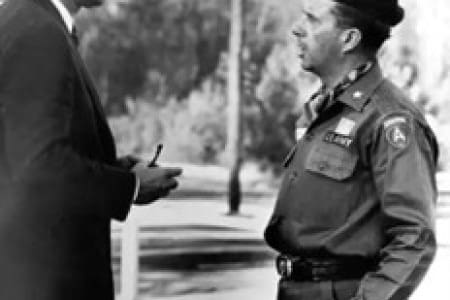
Brigadier General Yarborough, wearing his green beret, in a discussion with President Kennedy during the president’s inspection of Special Forces personnel while visiting Fort Bragg in 1961. Photo by The Army Historical Foundation
As SWC commander, he also reshaped training. He expanded the curriculum to include military assistance, unconventional warfare, counterterrorism, and mandatory foreign-language instruction. Just as important, he fostered an environment where intellectual curiosity and creative problem-solving were expected. His vision was clear: Special Forces needed to be thinkers as much as fighters.
Senior Command and Global Perspective
In the latter stages of his career, Yarborough served in some of the Army’s most demanding senior roles. He represented the United Nations Command as chief negotiator at Panmunjom, dealing directly with Chinese and North Korean counterparts. As a lieutenant general, he commanded I Corps in Korea and later served as chief of staff and deputy commander in chief of U.S. Army Pacific. Across these assignments, his unconventional mindset remained intact, even extending to personal gear—such as his modified Air Force N-3B parka, altered to meet his own practical standards rather than rigid regulation.
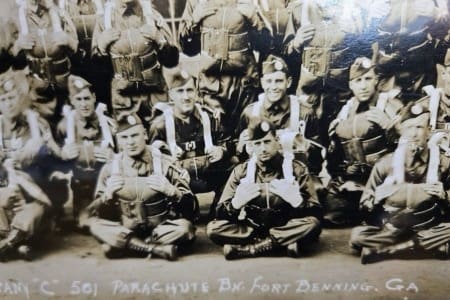
Close up view. Captain Yarborough first row, second from right, Photo by Gary Wilkins, 1st SFC PAO.
A Legacy Etched in Steel
Yarborough’s influence did not end with his retirement. Beginning in 2002, graduates of the Special Forces Qualification Course were awarded the serial-numbered “Yarborough Knife,” a tangible link between new Green Berets and the man who forged their professional identity. Though later cost constraints severely limited its distribution, the knife remains one of the most powerful symbols of excellence and heritage within the Special Forces community.
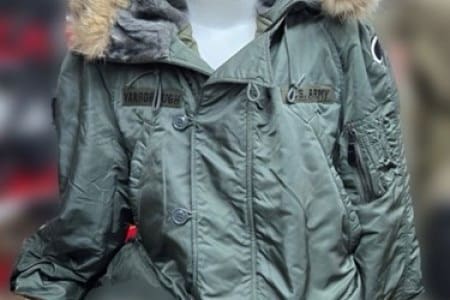
LTG Yarborough’s personal customized USAF N3B winter parka, worn during his command of I Corps in the Republic of Korea. Photo by Gary Wilkins, 1st SFC PAO.
By Mr. Gary Wilkins, 1st Special Forces Command
Lieutenant General William P. Yarborough did more than design equipment or authorize a beret. He shaped a culture. He believed in a “new breed of man”—one who could think independently, adapt quickly, and succeed in the world’s most ambiguous and dangerous environments. Today’s Green Berets, operating across cultures and conflicts, continue to embody that vision. In their mindset, methods, and symbols, the legacy of Yarborough’s unconventional genius endures.
By Mr. Gary Wilkins, 1st Special Forces Command