Spiritus Systems was on hand at DSEI and exhibiting the upcoming LV-120 armor carrier which will be available this fall.

Spiritus Systems was on hand at DSEI and exhibiting the upcoming LV-120 armor carrier which will be available this fall.

Platatc’s Desert Night Camouflage line as seen in this image captured during DSEI is definitely coming and it looks great!

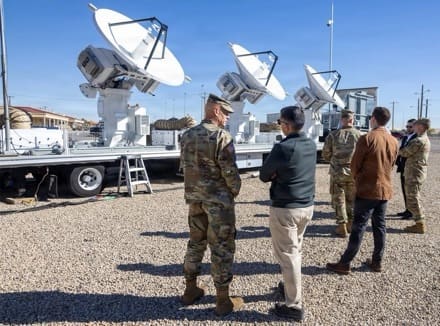
FORT SILL, Okla. — In the subtropical landscape of Fort Sill, those who are up early can often hear a constant buzzing coming from part of the installation. But it’s not their tinnitus acting up, or a swarm of killer bees. That low droning sound is likely coming from the Joint Counter-Small Unmanned Aircraft Systems University.
The school is the War Department’s only joint training center aimed at countering the growing number of aerial threats against U.S. troops and coalition forces. It teaches Soldiers, sailors, airmen and Marines how to operate drone equipment, plan counter-small UAS strategies and train others to defend their comrades from harm.

“Coming out of a long period of counterterrorism … we’ve really seen the proliferation of drones [that] we call small-UAS … at low altitudes that have speed and accuracy that we’ve never seen before,” explained Army Lt. Col. John Peterson, JCU director. “That alone has changed the landscape.”
The urgent need to understand how to counter these threats is obvious from the conflicts unfolding in Ukraine, the Middle East and the Indo-Pacific region. Enemy drone tactics, techniques and procedures change almost daily, JCU officials said, leaving experts to constantly search for ways to update their defenses.
“Just understanding how easily these drones can be converted for malicious intent — that was something that was very surprising [to] me,” said Marine Corps 1st Lt. Jacob Ceglenski, JCU student.
Joint Counter-small Unmanned Aircraft Systems (C-sUAS) University Director U.S. Army Lt. Col. John Peterson and JCU Student U.S. Marine Corps 1st Lt. Jacob Ceglenski speak about the JCU at Fort Sill, Oklahoma, Aug. 20-21, 2025. DoW video by U.S. Air Force Staff Sgt. Madelyn Keech.
However, air defense is nothing new to the U.S. military. American short-range air defense has been dominant for decades, so despite the new threats that are persistently cropping up, it’s nothing the U.S. can’t handle.
“For our [counter-small] UAS battle drills, they’re really not any different than anything our air defenders have already been doing,” said Army Sgt. 1st Class Alan Buhl, JCU instructor. “Everyone else is just now learning entry-level air defense doctrine.”
“[We are] making sure that we’re sustaining the training for joint partners,” Peterson said. “That they have the understanding and they’re comfortable using the equipment that they’re being provided.”


Courses Cover Operation, Planning and Protection
The JCU couples lessons learned in the field with intelligence assessments and other capabilities to give deploying service members the knowledge they need to mitigate ever-changing threats. About 30 experts run the school, which offers three courses that can last from one to three weeks.
The operator’s course goes in-depth to teach service members, most of whom are enlisted, how to use counter-small UAS equipment and understand the technicalities. The planner’s course teaches officers and staff how to place and employ those assets. Those students gain an understanding of U.S. systems and enemy tactics, then develop defensive plans to protect critical capabilities and assets. The installation protection course teaches post leaders how to sharpen their defenses, including how to tell the difference between potential threats and benign hobbyists’ drones.
Each course starts in a joint classroom environment where students from all career fields learn the basics: the types of aircraft they may see downrange, where they come from, how to identify them, and how to employ passive air defense measures, such as aircraft shelters, camouflage to hide assets and dispersion to spread them out.


“Looking up in the air — the third dimension — is not a requirement for most jobs in the military. But now everyone — the infantrymen, the artillerymen, the logistician — all have to look up,” explained Army Maj. Dennis “Chip” Stanford, JCU executive officer and a career air defender. “People [have to] adopt the mindset that everything is being observed from multiple angles, and it’s realistically a transparent battlespace.”
After a few days, the classes are split into service-specific tracks. At the JCU’s training range, they’re taught how to operate and maintain various systems and pieces of equipment, depending on what their service uses downrange.
Students also gain an understanding of 24 types of commercial off-the-shelf UASs. Many are known as “blue air” drones, which are used by DOW during operations. Others, known as “red air” aircraft, are used by countries perceived as our enemies.
Air Force Capt. Sarah Dahlke, assigned to Air Forces Central Command Force Protection at Al Udeid Air Base in Qatar, took the planner’s course in August. Approaching the UAS problem from the intel side, Dahlke often monitors aerial threats from a desk, so it’s good for her to see all the various aircraft up close.
“It looks a lot different when you’re out here on the ground, especially when you’re talking about visually identifying things,” she said. “Working in intel, you see all the red [adversary threats], but you don’t really get into the intricacies of the blue side. So, for me, that’s been the most valuable thing.”
All of the students know how important the curriculum is to the current global environment.
“We need to learn, and we need to be able to train people, as well as have knowledgeable planners,” said Army Chief Warrant Officer 2 Jilliene Huffman, air and missile defense systems tactician assigned to the 82nd Airborne Division. “[The 82nd] did just stand up the 3rd Battalion, 4th Air Defense Regiment. They’re going to be one of the first air battalions under a division that has actual counter-UAS systems … which is why it’s important that I came here.”
The Threat Detection Systems
When it comes to students in the operator’s course, there are 15 fixed-site systems they may learn, each of which identifies, tracks and mitigates drone threats using a combination of components.
One of the main fixed-site systems students train on is the Fixed-Site Low, Slow, Small Unmanned Aircraft Integrated Defeat System. It includes components to counter electromagnetic attacks, as well as ground-based radar and an electro-optical/infrared camera that can identify potential threats. The FS-LIDS can detect and even shoot down missiles, school officials said — a scenario students practice during simulations.

The simulations operate from trailers on the compound that mimic forward operating base command and control centers. Students learn the roles of each player in the room so they can understand the capabilities and limitations of every portion of the process, from the camera systems to the radar and the Forward Area Air Defense System.
“[FAADS] controls everything that’s supposed to happen … from shooting a rocket to electronic warfare,” explained Fred Hill, manager of the JCU operator’s course. “Everything the service member does — how he would do it downrange — he’s going to do it that exact way right here.”
While Army students heavily focus on FS-LIDS, the Navy and Air Force both use a fixed-site system known as a Counter-Remote Control Model Aircraft Integrated Air Defense Network. Other systems taught include the Negation of Improvised Non-State Joint Aerial system, used to counter small UASs; the Drone Restricted Access Using Known Electromagnetic Warfare system; and the Tactical Intelligence Targeting Access Node, a next-generation intelligence ground system.
The culmination of the classes is a joint exercise, during which all the students work together to counter a simulated threat.

JCU Staff: Going Above and Beyond
Before any students can be taught, the JCU staff has to get spun up on each piece of equipment, and commercial partners help with that. To repay the favor, instructors keep manufacturers in the loop on new technology they see on the battlefield so those drone builders can adapt, too.
Many of the staff go above and beyond their daily roles by doing all the flying, maintenance and aircraft development. For example, one staff member has created intricate manuals for each aircraft, while another works with 3D printers to create drones and replacement parts.


“The cost of [having] drones to shoot is unrealistic — at least $1,000 a pop. And when we’re talking 36 students a class, we can’t keep up with that cost,” explained JCU staff member Richard Stairs, who runs the compound’s 3D printing lab. “By using 3D printing, we minimalize that cost and basically cut it in half, based on what components we’re using.”
Peterson said it’s not a big team, but they are all passionate, adding, “The adaptation and innovation that they’ve been able to do on their own time … it’s remarkable what this team at the JCU is doing and will continue to do to help support the joint force.”
The JCU shares a lot of its products with DOW drone forces so they can develop their own capabilities in the future. The school also partners with federal agencies and academia and even trains foreign service members of partner militaries.
“Each country has a little bit of a different environment and theories behind [counter-small UAS strategy], so it helps give us a more well-rounded experience,” Peterson explained.

While drone warfare is perpetually changing, the school is determined to keep pace.
“We are constantly evolving — that’s with the new equipment, new threats and new student input that comes through,” said Jacob Cameron, JCU air boss. “No matter what the threat is, the JCU is adapting.”
The JCU, which became operational in 2023, falls under the Army’s 30th Air Defense Artillery Brigade. Fort Sill is home to the Army Field Artillery School, the Army Air Defense Artillery School, the 75th Fires Brigade and the 31st Air Defense Artillery Brigade, all of which have nurtured counter-small UAS strategies since the threat first surfaced.
By Katie Lange, Pentagon News
TAMPA, FL (September 22, 2025) – D&M Holding Company, Inc. (D&M), the global leader in delivering complete solutions for ammunition, primer, and propellant manufacturing facilities, and DEMCO Holding Company (DEMCO), a Saudi Arabian defense company, signed a strategic partnership agreement at the General Authority for Military Industries (GAMI) pavilion during the Defense and Security Equipment International (DSEI 2025) event in London. The agreement focuses on developing, constructing, and commissioning state-of-the-art propellant and primer manufacturing facilities in Saudi Arabia.

Under the agreement, D&M and DEMCO will collaborate to deliver single-base and double-base propellant factories as well as a modern primer manufacturing facility to support Saudi Arabia’s defense industrialization goals. The agreement combines DEMCO’s local market knowledge and regulatory expertise with D&M’s technical and project-delivery capabilities.
“We look forward to working closely with our partners to transfer expertise and build sustainable, locally operated facilities that meet Saudi Arabia’s strategic requirements,” said Dan Powers, President and CEO, D&M Holding Company.
The facilities will produce propellants and primers for small, medium, and large caliber ammunition.
About D&M Holding Company
D&M Holding Company, Inc. (D&M) is an ammunition and energetics engineering company headquartered in Tampa, Florida, with additional operations in Cabot, Arkansas. D&M specializes in the design and manufacture of ammunition and energetics equipment and turnkey factories for customers worldwide.
For more information visit D&M Holding Company.
BALTIMORE, MD — September 22, 2025 BlackSea Technologies (“BlackSea”), a leader in autonomous maritime systems, today announced the development of its new family of Modular Attack Surface Craft (MASC) unmanned surface vessels (USVs) designed to meet the U.S. Navy’s call for modular, multi-mission combatants. Submitted under Solicitation N00024-25-R-6314, BlackSea’s MASC solution delivers a mission-driven, production-ready platform to accelerate the Navy’s transition to a distributed and survivable future fleet.
In July 2025, the U.S. Navy issued a solicitation inviting industry to propose modular surface vessels capable of executing a broad range of missions including; anti-surface warfare, strike operations, electronic warfare, mine countermeasures, and logistics—through containerized, rapidly reconfigurable payloads. BlackSea’s proposed 66-foot aluminum catamaran was purpose-built to exceed these requirements.
Mission-Driven Design
Unlike retrofitted commercial hulls, BlackSea’s MASC USV was designed from the keel up to maximize payload access, capacity, and operational flexibility.
The BlackSea MASC vessel offers:

With twice the payload area and electrical power of similar-sized vessels, the platform supports seven mission profiles out of the box: Anti-Submarine Warfare (ASW), Anti-Surface Warfare (ASuW), Electronic Warfare/ISR, Logistics, Infrastructure Monitoring, Strike, and Mine Warfare (MCM/MIW).
“Our approach starts with the mission, not the platform,” said Todd Greene, Deputy Director of Advanced Technology at BlackSea. “We designed a flexible, modular combatant that can evolve with the Fleet and be built at scale today, not years from now.”
Production-Ready and Rapidly Scalable
Leveraging its proven Global Autonomous Reconnaissance Craft (GARC) production line, currently producing one craft per day at BlackSea’s Baltimore facility, the company is prepared to build and deliver the first fully integrated MASC prototype within six months.
The design shares 75% commonality with BlackSea’s fielded GARC systems, ensuring supply chain resilience and rapid integration of existing autonomy, command-and-control, and perception subsystems.
The hull form, derived from BlackSea’s operational GARC platform, uses slender twin aluminum hulls for low drag and high stability—enabling safe launch and recovery of containerized payloads. Marine-grade aluminum construction aligns with existing shipyard skillsets.
Powering the craft are dual Volvo Penta D8-IPS600 integrated propulsion units, eliminating shaft alignment during assembly and supported by a global logistics network. The open architecture is built natively on the Navy’s Unmanned Maritime Autonomy Architecture (UMAA), enabling plug-and-play autonomy integration and preventing vendor lock-in.
Enabling the Navy’s Future Fleet
The Navy’s MASC program consolidates the goals of its earlier Large and Medium USV initiatives, seeking modular, containerized surface combatants to distribute lethality across the Fleet. By combining proven autonomy systems, fielded production methods, and a design tailored to naval missions, BlackSea’s MASC USV offers the Navy a decisive advantage in speed to fleet, operational flexibility, and long-term scalability.
“Fleet modernization demands bold steps,” said Chris Devine, CEO of BlackSea. “With our MASC solution, the Navy can field a family of unmanned combatants that are mission-driven, production-ready, and built to scale.”
About BlackSea Technologies
BlackSea Technologies is a premier naval technology firm enabling new asymmetric strategies so U.S. Naval and military forces can prevail over the next several decades in multi-dimensional conflicts. We deliver innovative maritime systems and mission solutions to our nation’s warfighters from the ocean surface to the seabed.
For more information about BlackSea, please visit our web site and follow us on LinkedIn.
Company announces major U.S. expansion following closely on the heels of Australian and European expansion – a clear signal of DroneShield’s push to lead and reshape the global counter-drone landscape

Warrenton, Virginia – September 22, 2025 – DroneShield, a global leader in counter-uncrewed systems (CUxS) technology, today announces it is significantly expanding its research and development (R&D) operations in the United States.
This move emphasizes DroneShield’s commitment to expand its R&D and testing capabilities and will result in more than doubling its workforce in the U.S. Over 30% of the new roles will be dedicated to software development and further strengthening its artificial intelligence (AI) team and capabilities.
As part of this strategic investment, DroneShield will also double the square footage of its U.S. headquarters in Virginia, reinforcing its dedication to breakthrough technology and better positioning the team to meet rapidly growing global demand for advanced CUxS solutions.
This U.S. expansion follows the company’s recent announcement of its expansion of production facilities in Australia and new office established in the European Union. DroneShield’s global strategic investments are part of a concerted effort to broaden its international footprint and establish a stronger physical presence near customers in key markets.
“As we continue to scale our operations globally, this expansion in the U.S. plays a crucial role in enhancing our ability to innovate and deliver advanced solutions for the evolving defense industrial base right here in the U.S.,”said Matt McCrann, CEO of DroneShield LLC. “We’re investing in the future of defense, and our growing footprint and impact in the U.S. market directly supports that effort.”
The expanded U.S. facility will enable DroneShield to accelerate its product development cycles and better service its growing customer base. The addition of key personnel to the R&D team will help drive forward-thinking technological advancements and ensure the company remains responsive to the needs of its customers.
“We’re not just expanding our operations, we’re doubling down on our commitment to providing best-in-class counter-drone solutions,” said Tom Branstetter, Vice President of Sales and Business Development, DroneShield LLC. “This investment enables us to be more responsive to the growing needs of our U.S. customers across the various sectors we serve.”
Combined with expanded R&D and planned U.S. production initiatives, the robust growth positions DroneShield to support U.S. Department of Defense’s push for fast, risk-embracing acquisition of cutting-edge counter-drone solutions.
“Expanding our U.S. technology team strengthens our ability to support critical programs and deliver advanced solutions with greater speed and precision. This investment ensures end users benefit from responsive, real-time support and the depth of expertise required for mission success,” said DroneShield’s Chief Product and Technology Officer, Angus Bean.
This expansion supports DroneShield’s bold strategy for global growth. With a commitment to innovation and leadership in counter-UxS technology, DroneShield is positioning itself to meet the increasing global demand for advancing security solutions. These strategic moves ensure that the company remains at the forefront of the industry, ready to address the evolving challenges of an interconnected and rapidly changing world.

Sales Manager – Thril
Location: Pipersville, PA (Hybrid/Remote options available)
Reports To: Vice President
Department: Sales & Marketing
About THRIL
Founded in 2017, THRIL is an American firearms accessory company specializing in magazines and firearm accessories. Committed to accessible, high-quality products, THRIL serves OEM, commercial, and military markets, providing solutions that enhance firearm functionality and user experience.
Are you a driven and motived sales professional with experience in the firearms/defense industry?
We are a small but growing company seeking a dedicated and dynamic sales professional ready to take on the challenge of building and expanding our sales in both commercial and military/government markets.
Position Overview
The Sales Manager will develop and execute THRIL’s sales strategy, focusing on commercial and military/law enforcement accounts. This role requires a strategic thinker with deep firearms industry knowledge, exceptional relationship-building skills, and the ability to collaborate closely with marketing to drive revenue growth.
Sales Strategy Development: Create and implement strategies to increase revenue in commercial, military, and law enforcement markets.
Extensive Travel: Up to 100 days per year, including visits to distributors, dealers, supporting rep groups, and industry trade shows.
Account Management: Build and maintain strong relationships with key accounts, including commercial distributors, dealers, major retailers, and government/military clients.
New Business Development: Identify and pursue new business opportunities to expand THRIL’s presence in commercial and military/government markets.
Collaboration with Marketing: Align sales initiatives with branding, promotions, and product launches.
Market Analysis: Conduct market research to identify emerging trends, competitive activity, and opportunities for growth.
Sales Forecasting & Performance Metrics: Provide accurate sales forecasts and track progress against revenue goals and key performance indicators.
Team Leadership & Mentorship: Mentor and guide junior sales staff or supporting reps, fostering a high-performance sales culture.
Customer Feedback & Product Input: Relay customer feedback to engineering to guide future development and product enhancements.
Qualifications
Education: Bachelor’s degree in Business, Marketing, or related field.
Experience: Minimum of 5 in sales, with experience in the firearms or defense industry, including experience with military/government accounts.
Skills: Strong negotiation, communication, and interpersonal skills.
Knowledge: Deep understanding of the firearms industry distribution and dealer network, including commercial and military markets.
Compensation
Base Salary (Hybrid)
Benefits: 401(k) retirement plan, competitive insurance plan
Paid Time Off: 3 weeks
Please email your resume, along with a brief cover letter outlining your relevant experience, to KMcManus@Thrilusa.com

(McLean, VA — September, 2025) FN America, LLC, is pleased to announce that the company has been awarded an additional $6.9m in orders for M240 and M249 machine gun barrels spread across nine deliveries by the U.S. Department of Defense’s (DoD) Defense Logistics Agency (DLA) Land and Maritime.

“The contract to provide these barrels for M240 and M249 machine guns is a testament to our partnership with the U.S. DoD, which dates back nearly five decades,” said Mark Cherpes, President and CEO for FN America, LLC. “We are honored to support the U.S. military with the highest-quality cold hammer-forged barrels. The durability and accuracy of FN barrels provide our servicemen and women with the most effective and highest-performing products available.”
FN collaborates with and is a key partner of DLA Land and Maritime, a combat support agency within the U.S. DoD and one of the largest suppliers of spare parts that support land-based and maritime weapon systems. DLA Land and Maritime serves over 20,000 customers throughout all U.S. military branches, civil agencies and other DoD organizations, helping to sustain weapon systems in the field.
The M240 general purpose machine gun, derived from the FN MAG® 58, was adopted by the U.S. military in the late 1970s, and has been in continual service since being introduced. FN has created multiple variants of the M240, including the M240 coaxial, the M240B, M240L, M240D and M240H models. The FN® M249 has been a mainstay throughout the U.S. military since 1986 and is currently in service in more than 30 countries.

Throughout its history, FN has been one of the largest suppliers of small arms to the U.S. military and continues to develop innovative technology for the future. In addition to the M240 and its variants, the company currently holds contracts for the FN® M249 lightweight machine gun; the FN® MK 46, MK 48, MK 17 and MK 20 SSR for USSOCOM; and various other contracts.
For more information about FN’s military product line or current U.S. military contracts, please visit www.fnamerica.com.