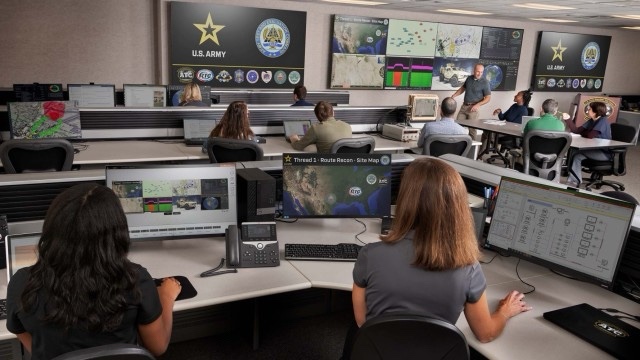
Robotics and in particular developing weapons for unmanned systems has become a focus of DoD. This poster was presented during NDIA’s recent Future Forces Capabilities Conference in Huntsville.

Contact info is on the poster for those interested.
Robotics and in particular developing weapons for unmanned systems has become a focus of DoD. This poster was presented during NDIA’s recent Future Forces Capabilities Conference in Huntsville.

Contact info is on the poster for those interested.
With Executive Order 14057 requiring the Department of Defense to transition its non-tactical vehicles to a 100% zero-emission vehicle (ZEV) fleet, including 100% of light-duty acquisitions by 2027 and 100% of medium- and heavy-duty acquisitions by 2035, there’s an increased interest in Commercial Off The Shelf electric vehicles.

Polaris will be showing their Polaris RANGER XP Kinetic All-Electric Utility Vehicle at AUSA in booth
The RANGER XP Kinetic is an electric version of the Polaris RANGERs already in the motor pool which are primarily used for off-road, on-base transportation, hauling and towing.
It offers 110 horsepower, 140lb-ft of torque and the ability to tow 2,500 pounds and haul 1,250 pounds with three drive modes, Eco+, Standard and Sport.

Offered in two models, the RANGER XP Kinetic’s drivetrain features fewer moving parts for lower maintenance costs and more uptime for increased productivity. Plus, the quiet electric powertrain means easier radio and face-to-face conversations as well as greater situational awareness. The RANGER XP Kinetic also boasts a rigid one-piece chassis, full-body skid plate and large front bumper to deliver maximum protection to the operator and vehicle. Ground clearance of 14 inches, 10 inches of suspension travel and 29-inch Pro Armor X-Terrain tires further increase durability of the RANGER XP Kinetic in even the roughest terrain.

RANGER XP Kinetic Premium – 14.9kWh battery (Li-Ion technology) delivering up to ~45-mile range
XP Kinetic Ultimate – 29.8kWh battery (Li-Ion technology) delivering up to ~80-mile range
RANGER XP Kinetic Features:
– All-electric powertrain gives customers a sustainable option for off-road work
– The RANGER XP Kinetic has the ability to decrease total cost of ownership, reduce CO2 emissions and operate quietly
– Polaris UTVs have been replacing full-size trucks and vans for decades
– A full-size EV averages $66,000
– A budget-friendly alternative to full-sized vehicles, Polaris UTVs are less expensive to purchase, operate and maintain.
– This all-new, all-electric RANGER XP Kinetic is a significant offering for our government customers that need to incorporate more electric vehicles into their fleet without sacrificing utility, performance or durability
– Meets mandates for customers with limitations on combustion fleet expansion
– Provides full accessories of gas-powered, e.g. winch, cabs, cargo, etc.
– Class-leading 110 horsepower
– 140lb-ft of torque
– 2,500 lbs towing
– 1,250 lbs payload in the rear cargo box – 25% more than any other side-by-side
– 14” ground clearance
See the Polaris RANGER XP Kinetic All-Electric Utility Vehicle in booth #2917.

Heading to AUSA? Join TenCate Protective Fabrics for Happy Hour at their booth (#2333) beginning at 3pm on Monday, October 9th for an afternoon of good drinks and great friends. During that time, TenCate Protective Fabrics will be giving out Free Anchor Lite T-Shirts (Booth #2333 *while supplies last).
Checkout TenCate Protective Fabrics at booth #2333 to see their full lineup of innovative fabrics designed to keep you comfortable and protected in the field and on the job.
The AUSA Annual Meeting & Exposition takes place in Washington, DC from 9-11 October, with this year’s motto set as “Be All You Can Be”. The American Rheinmetall family of companies along with key partners from Rheinmetall’s global enterprise will be on-site (booth #1603) showcasing some of their most recent activities, achievements and innovative solutions aimed at providing the U.S. Army with the critical, next-generation technologies it needs and deserves.
The “M109-52” Self Propelled Howitzer Prototype Featuring Rheinmetall’s L52 Howitzer Cannon System and Enhanced by Advanced Artillery Technologies

Rheinmetall’s world class, combat proven L52 155mm Cannon Armament integrated on the M109 Self-Propelled Howitzer System is the optimal solution for the Army’s requirement to upgrade the M109 fleet. The exceptional L52 armament currently in service in Ukraine and with eight global allied users delivers a significant increase in range, precision and lethality. Rheinmetall will further display its operationally proven suite of propellants and munitions on site at AUSA this year. These products and capabilities are closely aligned with the Army’s Long-Range Precision Fires modernization priorities. The Rheinmetall-BAE team will perform a series of live fire demonstrations of the upgraded M109-52 in 2023 and 2024. Rheinmetall will feature the systems solutions for platform, cannon, projectile and propellant technology across the artillery “eco-system” on its booth. A full-sized M109-52 prototype system will be featured on the BAE Systems booth (#925) for attendees to view throughout the show.
Autonomous Vehicle Capabilities – Unmanned and Unmatched

Rheinmetall’s PATH Autonomous Kit (A-Kit) is a navigation system that enables full autonomous movement of vehicles. It can be rapidly integrated on existing vehicles or the latest next-generation platforms. It is a core element of Rheinmetall’s exceptional Mission Master family of autonomous unmanned ground vehicles (UGV); combining advanced sensors, technology leading algorithms, and real-time data analysis to allow vehicle platforms to operate autonomously in a wide range of operating environments. Fielded and tested on a variety of platforms, the PATH A-Kit is a mature, proven technology that stands out from the competition. At AUSA, American Rheinmetall will demonstrate the system’s platform agnostic design through display on multiple different platforms. Rheinmetall’s PATH A-kit can also be seen on display at industry partner booths including Tomahawk Robotics (#4049) and L3Harris Technologies (#1725).
Additionally, Rheinmetall and partner blackned will be onsite to discuss the features and benefits of blackned’s TacticalCore solution when coupled with the Mission Master UGV, to augment domain awareness by delivering resilient communications across a disparate network of unmanned and autonomous platforms in a contested communications battlefield. Seamless. Networked. At the Edge.
The Skyranger 30mm c-UAS Turret with Airburst Munition on the M5 Ripsaw RCV

Skyranger is a highly mobile, lethal and precise air defense system, capable of engaging modern battlefield threats, particularly highly agile or swarming small unmanned aerial targets. The M5 Ripsaw, with active (3D AESA radar) and passive IR sensors along with the high rate-of-fire 30x173mm Revolver Cannon® KCE-ABM with ground-to-air missiles offers a superior, autonomous firepower solution for Soldier protection in the most austere operating environments. The modular system, shown with Rheinmetall’s Path A-Kit provides best-in-class air defense in line with the Army’s Air and Missile Defense modernization priority.
The HX3 CTT – The Next-Gen Tactical Truck that Delivers

Rheinmetall MAN’s new HX3 8×8 tactical truck with pallet load handling system is redesigned from the ground up for improved protection, increased mobility, greater comfort and easy integration of future applications for increased performance due to its open systems architecture. Using a derivative of the HX3, the HX3 CTT, Rheinmetall and its teammate GM Defense are executing an Army rapid prototyping award for the Common Tactical Truck (CTT) Program. Accordingly, Rheinmetall, as a leading global developer and producer of tactical trucks, will remain closely aligned with the Army’s Contested Logistics Cross Functional Team’s priorities. See the truck in person at the GM Defense booth (#661) as well as scale models on the Rheinmetall booth.
American Rheinmetall’s XM30 Offering
Appropriately cleared personnel can engage with Rheinmetall’s XM30 Team, led by American Rheinmetall Vehicles, regarding XM30 technologies and program performance. The Team is an elite U.S. defense industry group, including Textron Systems, Raytheon, L3Harris Technologies, Allison Transmission and Anduril Industries, that is participating in the XM30 program. The American Rheinmetall XM30 features a new, lethal, unmanned 50mm turret with 3GEN FLIR, a highly maneuverable and more compact chassis, advanced on-board protection systems integrating active protection and an open systems architecture ensuring overmatch today and tomorrow. An augmented reality technology demonstrator will be available to cleared DoD personnel at the Rheinmetall booth.
Altruity – Bringing Vision to Provisioning
Unveiled for the first time at this year’s AUSA Exhibition – Altruity is a revolutionary, real-time digital information ecosystem that brings sustainment to the forefront of the acquisition process to influence design utilizing the system’s authoritative source of truth. Building and transferring data at lightning speed, without error and synchronizing digital information between engineering, manufacturing, supply chain and logistics, Altruity provides more time to plan and execute successful fielding and lifecycle support. On-site demos are available upon request.
Airburst Lethality – Fight. Survive. Win.
Visitors will see a range of world-class, medium caliber airburst munitions, a field of technology in which Rheinmetall specializes. The airburst munitions produce lethal effects against personnel in open and defilade positions, defeat unarmored/lightly armored vehicles and provide layered c-UAS defense. Rheinmetall is also leveraging its extensive systems expertise to provide high performance programmers that increase first round hit probability for airburst systems. Also on display will be the 40mm Squad Support Weapon (SSW40), the world’s first automatic, magazine-loaded, shoulder-fire grenade launcher.
Electronic Mission Systems Including Unmatched EO/IR 360° Vehicle Situational Awareness Technologies
Rheinmetall’s U.S. electronics division, American Rheinmetall Systems, will display its broadened product portfolio. In addition to Soldier lethality systems such as laser aiming, pointing and illuminating devices and fire control systems, the company offers world-class vehicle electronic mission systems. On display at AUSA will be an interactive commander’s and gunner’s display of a TRL 9, fully integrated, modular and scalable combat vehicle system for EO/IR 360° Situational Awareness and Driver’s Vision Enhancement.
StrikeShield Active Protection System: Modular Protection with Lower Risk of Detection
Rheinmetall will demonstrate its expertise in vehicle survivability with an exhibit of StrikeShield – a hybrid active protection solution that combines active and passive protection to achieve optimal performance while minimizing the vehicle’s electronic signature, system weight and power consumption.
Rheinmetall welcomes visitors to AUSA booth #1603 to experience the Group’s offerings fitted for the Army’s future fighting force.
Quaze Technologies, a Canada-based innovative technology company and the creator of wide-surface wireless power transfer, is introducing their revolutionary autonomous wireless power transfer capabilities to the US defense sector at AUSA 23. Quaze will have a senior team on the ground at AUSA in Washington DC and can arrange meetings to demonstrate their ground-breaking technology, on request. Quaze are interested in reaching out to the research and development agencies across the US DoD as well as sparking interest in the wider US user community, regarding their unique wireless charging technology.

This US announcement follows on from DSEI in September where the Quaze concept demonstrator remote charging solution, named Drone Swarm Tactical OverWatch (DSTOW™), was featured as part of Rheinmentall’s innovation portfolio. The Quaze DSTOW was displayed on the Mission Master SP autonomous unmanned ground vehicle. It was active and wirelessly recharged 3 Parrot ANAFI USA drones.
The DSTOW addresses a critical need in the world of drone operations, enabling the continuous aerial support of tethered drones with the flexibility and freedom of untethered flights. With just one Quaze DSTOW, drones of any make or model can charge wirelessly and simultaneously, ensuring reliable charging even in the most hostile environments. This reduces the constraints associated with battery levels, connecting charging cables, or swapping batteries. It’s seamless, efficient, and paves the way for autonomous and uninterrupted drone missions. The DSTOW’s versatility extends across platforms and applications. Whether mounted on various vehicles or employed in static operations, such as mobile command centers, the DSTOW remains a dynamic solution. Its adaptable form factor accommodates UAVs of all sizes and seamlessly integrates onto diverse platforms, ensuring the readiness of drones for extended missions or remote swarm operations.
Quaze’s Surface Power Technology revolutionises the way devices are powered, enabling easy and reliable wireless charging for remote or autonomous devices on land, sea or air. Powered by magnetic resonance this technology offers a safe, secure and seamless solution to efficiently charge multiple devices with variable power demands across a wide platform surface area.
Quaze remote charging surfaces are scalable to suit various demands and the potential applications in defense are vast, by freeing technology from the constraints of cables and redefining how electronic systems access power. Quaze have designed and developed their solid state volumetric technology to be compliant with relevant Electromagnetic Interference (EMI) and Electromagnetic Compatibility (EMC) standards.
Xavier Bidaut, CEO at Quaze Technologies said. “We were overwhelmed by the amount of interest shown in our technology when we introduced our DSTOW to the European defense sector at DSEi. He added:
“Together with Rheinmetall we have already showcased one particular charging application. However, there are many more potential applications being developed and as interest grows across the defense environment, more and more applications are becoming apparent.”

WASHINGTON — As ground robotics and autonomy are expected to play a critical role in future warfare, four Army leaders will jump start AUSA with a Warriors Corner discussion on human-machine integration at 12:50 p.m. Monday, Oct. 9, 2023.
Michael Cadieux, director of U.S. Army DEVCOM Ground Vehicle Systems Center; along with Brig. Gen. Geoffrey Norman, director of the Next Generation Combat Vehicles Cross-Functional Team, shortened NGCV CFT; Maj. Gen. Curtis Buzzard, commanding general at Maneuver Center of Excellence; and Col. Shane Upton, director of the Contested Logistics CFT, will address formation-based concepts developed with human-machine integration advances. Brig. Gen. Stephanie Ahern, concepts director at Army Futures Command, will moderate the panel discussion.
The session will be livestreamed on DVIDSHub.net.
Transforming for the future fight requires engagement across the Army and joint force. Advances in ground robotics and autonomy and the effective fusion of robotic systems into formations will provide new capabilities to help the Army achieve goals for multi-domain operations.
The fusion of robotics in formations is already taking place on the ground at various Army training locations.
“Soldier Touchpoints help us to help define future tactics and techniques for fighting with these revolutionary systems while informing future required capabilities for the science and technology community to develop,” Cadieux said.
“Human-machine integration is all about bringing the right mix of robotic elements to our formations to enable a total formation that is more capable than the sum of either the human or robotic elements,” he said.
Robotic combat vehicles will provide formation leaders new options on both the offense and the defense. The NGCV CFT has been at the forefront of robotic combat vehicle development and the experimentation that refines those vehicles.
“We’re already seeing the first robotic capabilities that we’ll be fielding, and our teams for years have been experimenting with the best way to integrate them into formations,” Norman said.
“We’re not sure yet what the integrated formations will look like, but it could require warfighters to control multiple platforms simultaneously, or perhaps multiple warfighters working different parts of the same system, or the flexibility to move between these two paradigms as the mission requires,” Norman said.
Robotic combat vehicles can accomplish some of the more dangerous and mundane tasks, such as refueling and for port logistics, while freeing up Soldiers to do the tasks that call for more thinking.
“Human-machine integration is fundamental to sustaining the future joint force operating in a contested logistics environment,” Upton said.
The integration of robotics into manned formations will iterate between doctrinal and training insights informing what the robots need to do and insights from experiments with the robots informing how doctrine and training need to adapt.
The Army has created a ground vehicle autonomy strategy built on a foundation of modular open systems approach, or MOSA, which will enable common unmanned maneuver capabilities across the ground vehicle fleet.
“Building a MOSA based, common approach to ground autonomy software lets the Army collaborate with a wide range of industry-leading partners while controlling current and future costs,” Cadieux said.
Understanding formation-based concepts developed with Human-Machine Integration advances is a key priority to designing the Army of 2040.
“The technologies Army pursues in the ground vehicle space drive at both robotic capability growth and in strengthening the interface between the Warfighter and the robotic elements,” Cadieux said.
By Jerome Aliotta
Replacing TenCate Brand After 25 Years

With a New Name, a Contract for Its Latest Innovation, and an Enduring Commitment to Quality, Integris Composites Is Exhibiting at AUSA 2023, Booth 2153
Washington, Oct. 6, 2023 — The group that announced its game-changing Trauma Reduction Technology here last year is returning to AUSA 2023 with the announcement of its first military contract for ballistic plates using that technology, a new name for the company and a renewed commitment to quality and customer service.
“We will meet you at Booth 2153 as Integris Composites USA, Inc.,” said Andrew Bonham, president. Last month Integris became the new name for TenCate Advanced Armor. Integris is exhibiting at the Association of the United States Army 2023 Annual Meeting and Exposition, to be held at the Walter E. Washington Convention Center in Washington, D.C., Oct. 9–11.
“Visitors can examine our Cratus™ 3650 Wave ballistic plates, which incorporate the Trauma Reduction Technology we premiered at last year’s AUSA conference. This year we are demonstrating the plates and other innovative composite solutions,” Bonham said.
Deep Experience
“Best of all, you can meet our team and experience their unwavering commitment to customized ballistic, blast, spall and weight solutions that stretch the boundaries of existing products and standards,” said David Cordova, chief commercial officer.
“Our new name, Integris, embodies a quarter-century legacy of design, engineering and manufacturing armor for personal protection as well as land, air, and naval vehicle survivability.
“We’ll continue challenging current limits with fresh approaches — such as our composite optronics housings that protect the sensors inside as well as our advanced spall-liner solutions, notable for their lightness and significant cone-angle reductions,” added Cordova.
The global Integris Composites organization and Integris Composites USA, Inc. are headquartered in Tysons Corner, Va.
We would be remiss if we didn’t share the recently released Impact 4000 Ballistic Rail-Mounted Laser Rangefinder from Vortex Optics.

With a range of 5 yds – 4000 yds, it incorporates the GeoBallistics Solver with a full, up-to-date bullet library allowing you to use one of the ten preloaded profiles for popular cartridges or create custom profiles. You can interact with the software via an app for your end user device.

Calculations rely on data from the on-board compass and exposed temperature, pressure, and humidity sensors. GeoBallistics Solver will also connect with with popular weather devices or local weather stations.
The Impact 4000 weighs 16 oz and its dimensions are 4.6″ x 2.5″ x 3.2″.

In the Box:
• Impact 4000
• Bluetooth Remote
• Bluetooth Remote Mounting Kit
• Easy Zero Tool Kit
• SureFit Cover
• Lens Cloth
• Custom Tools
• CR123 Battery
• CR2032 Bluetooth Remote Battery
vortexoptics.com/vortex-impact-4000-ballistic-rail-mounted-laser-rangefinder