SIG SAUER - Never Settle

Shop Show 23 – The Micro Wing from Antimatter x Tactical Development

October 19th, 2023

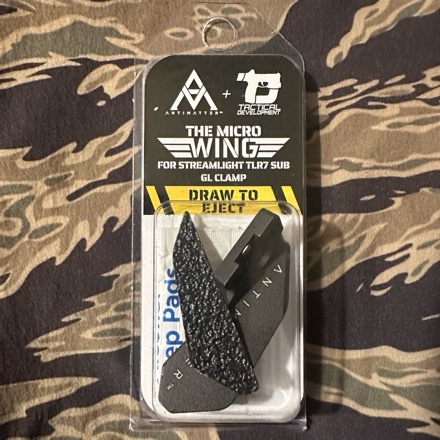
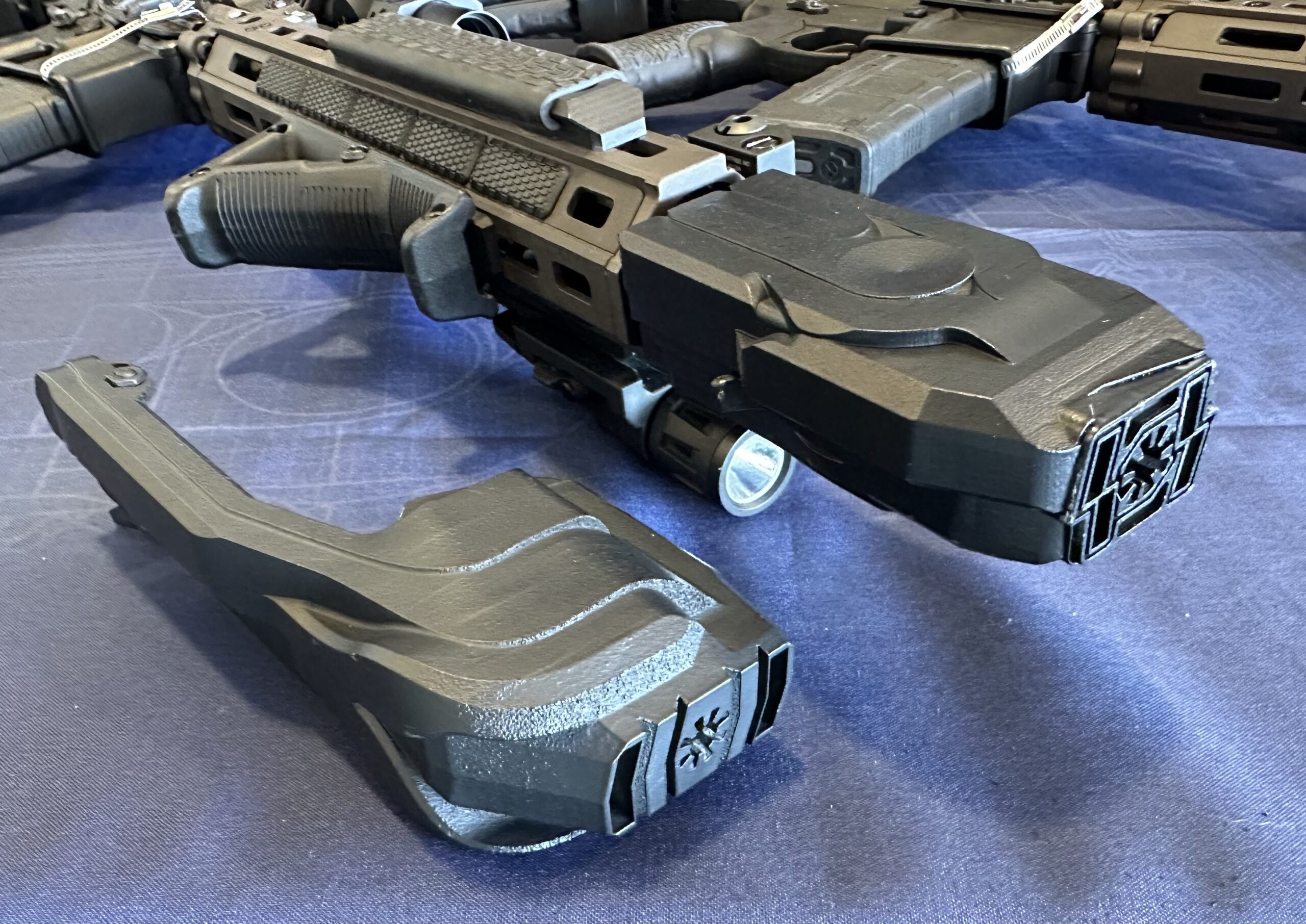
Antimatter Industries gave us a sneak peek of their collaboration with Tactical Development, The Micro Wing.

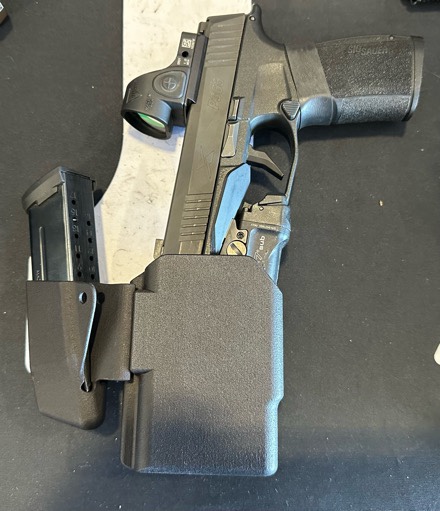
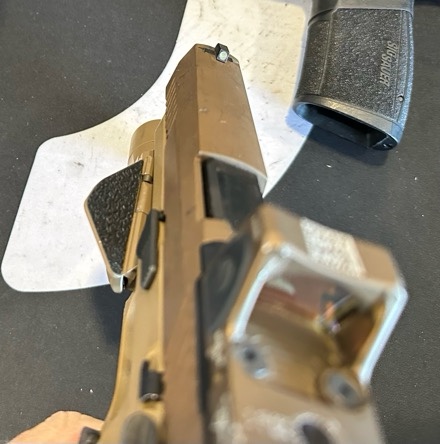
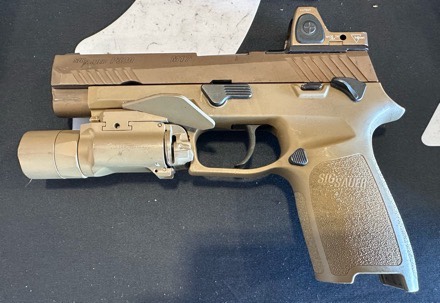
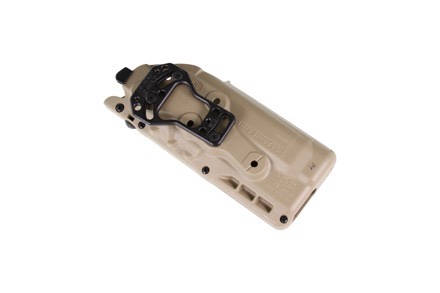
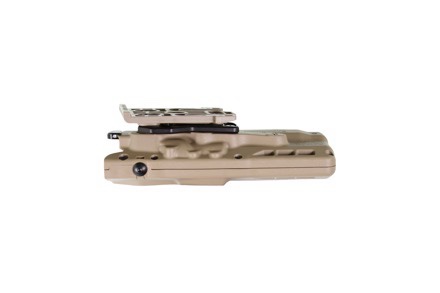
It was for those who use Safariland (and other) holsters but want a weakhand thumbrest for added control.

Simple to install, it folds out of the way when holstering your pistol, yet offers purchase for your thumb.

The hinged mount fits in between your pistol light and rail.

Coming soon from www.antimatterindustries.com.

American Rheinmetall Supports Successful Test of M109 Self-Propelled Howitzer Modified with Rheinmetall’s Combat-Tested 52-Caliber Cannon

October 19th, 2023

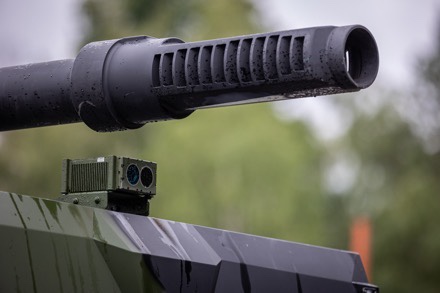
Rheinmetall and BAE Systems have successfully completed a live fire test of the M109 Self-Propelled Howitzer (SPH) modified with Rheinmetall’s L52 155mm, 52-caliber cannon. The M109-52 is a significant, low-risk, high-performance upgrade to the current 39-caliber cannon and provides additional range required in large-scale operations. The test, conducted at Camp Ripley, MN, proved the compatibility of the L52 cannon with the M109A7 platform during the live fire exercise. 


“Integrating Rheinmetall’s world-class, battle-tested L52 artillery cannon system into the M109 platform will return tactical fires overmatch to the U.S. Army in a capability assured, timely, low-risk manner,” said Joe Chan, VP of Business Development at American Rheinmetall Munition. 
Rheinmetall’s L52 artillery cannon system is currently the backbone of nine NATO and allied partner nations’ tactical artillery forces. By integrating this world class, combat proven system on the M109 platform, the US will achieve expanded interoperability on day one with battlefield partners. Notably, the cannon system has become a favorite for Ukraine due to its accuracy, range and durability in combat. 

The M109-52 offers a low-risk pathway to rapid development, putting this significantly improved capability in the hands of our warfighters quickly to ensure overmatch on the battlefield. By combining two mature systems, Rheinmetall and BAE Systems avoid many of the technical risks associated with similar lethality upgrade efforts. The criticality to deliver improved artillery capabilities is underscored by the ongoing conflict in Ukraine and is a key part of the Army’s number one modernization priority –  long-range precision fires. 

The team plans to conduct additional testing in 2024, which will highlight extended range across a variety of ammunition combinations. 

www.rheinmetall-us.com

GA-ASI Advances Aerial Recovery for SUAS and ALE

October 18th, 2023

SAN DIEGO – 10 October 2023 – General Atomics Aeronautical Systems, Inc. (GA-ASI) recently advanced its Aerial Recovery System for Small Unmanned Aircraft Systems/Air-Launched Effects (SUAS/ALE) by deploying and retracting a towline with a “smart end feature” from a GA-ASI MQ-20 Avenger® Unmanned Aircraft System in flight. The demonstration took place on Sept. 20, 2023, over Dugway Proving Ground, Utah.

During this demonstration, a hoist from Breeze-Eastern equipped with GA-ASI’s smart end feature was integrated into Avenger’s payload bay. While in flight, the towline was deployed away from Avenger to the optimal distance for aerial recovery. The smart end feature was able to wirelessly transmit its position back to Avenger, confirming its ability to transmit the data to a nearby SUAS/ALE for aerial recovery. The smart end feature’s “deployed” position correlated to GA-ASI’s multi-degree-of-freedom finite element catenary models, confirming its potential for SUAS/ALE aerial recovery.

“Integrating air-launched UAS from Group 5 unmanned aircraft is possible, in part, thanks to advances in relative navigation technology, complex towline analysis, and multi-aircraft control being pioneered by GA-ASI,” said Mike Atwood, Vice President of Advanced Programs at GA-ASI. “We are excited to see this technology enable long-range kill chains from today’s manned and unmanned systems supporting operations in highly contested environments.”

Beyond just captive carry back to base, the SUAS/ALE can be refueled, recharged, and/or rearmed and then redeployed. Redeployment can occur from the host aircraft, enabling SUAS/ALEs to conduct their own orbits from airborne launch and recovery positions. Aerial redeployment allows UAS like GA-ASI’s Avenger or MQ-9A Reaper to serve as mobile command centers for a network of SUAS/ALEs in a persistent, expansive grid for surveillance, electronic attack, enemy air defense suppression, communication pathways, or joint all-domain mobile command and control for days or weeks at a time.

Breeze-Eastern’s commercial-off-the-shelf helicopter rescue hoists, with performance capabilities that meet or exceed system requirements, provide a high Technology Readiness Level (TRL), and offer a low-risk solution to ensure SUAS/ALE aerial recovery. Throughout the hoist integration and flight testing, Breeze-Eastern provided technical and logistical support.

Ian Azeredo, Breeze-Eastern’s Chief Engineer, commented, “With this milestone demonstration, GA-ASI has once again awed the aerospace industry. The professionalism and surgical ingenuity shown in the integration phase by the Aerial Recovery team all but guarantee future program success.”

The novel aerial recovery concept utilizes a towline and smart end feature, which serves as a beacon and mechanical interface for aerial recovery. The SUAS/ALE calculates its precise position relative to the smart end feature for navigation into towline intercept, followed by a maneuver to capture the end feature. Once secure on the towline, the SUAS/ALE folds its wings and stops its engine to transition into a passively stable towed body. A podded hoist aboard the capital ship reels in the SUAS/ALE to a captive carriage state where the two platforms return to base together.

215 Gear – Negative CANT Adaptor

October 18th, 2023

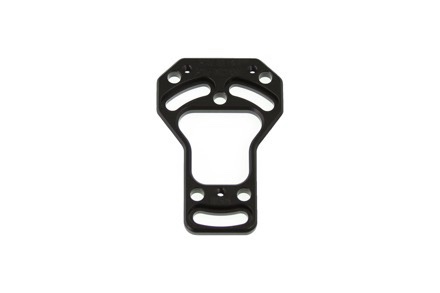
Designed to mount any Safariland™ holster or QLS plate, allowing for holster drop and CANT. By adding negative CANT into the pistol, it provides a streamlined draw of the pistol. To achieve a streamlined draw, CANT the pistol grip rearward, until your forearm and wrist, while in a straight line, naturally drop to your pistol grip. If you have to angle your wrist, you are reducing economy of motion and slowing you draw. The OEM Safariland™ QLS never achieves a neutral or zero, at best @5º positive CANT. Our system provides negative CANT and 1/2” drop, for both left and right handed shooters. Machined from U.S.A made solid billet aircraft grade Aluminum, not plastic.

Includes: 6061 Aluminum adaptor, three U.S.A. made #8-32×1/2” Adaptor Mounting screws.

Does not include: Installation tools or thread locker.

Made in the U.S.A/ Berry Compliant Made with 100% U.S.A 6061 Aircraft Grade Aluminum.

Anodized matte Black.

Product total weight: 1 1/8 oz. Product dimensions: 3.61”L x 2.38”W x 0.25”H

www.215gearstore.com/negativecantadapter

Shop Show 23 – Berry Compliant HK Hook from Ocean State Innovations

October 18th, 2023

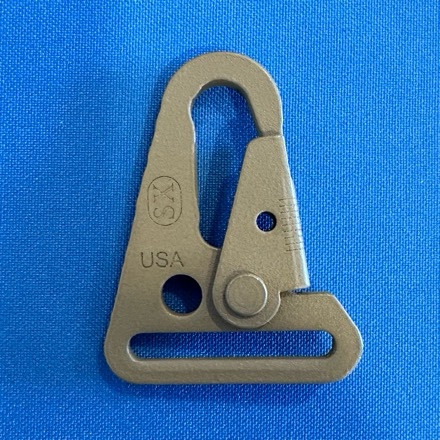
Here’s a sneak peek at an upcoming Berry Compliant HK Hook from Ocean State Innovations.

Coming very soon, look for it in Coyote and Black finishes.

osinnovate.com

Shop Show 23 – 5.56mm Evolys Machine Gun from FN

October 18th, 2023

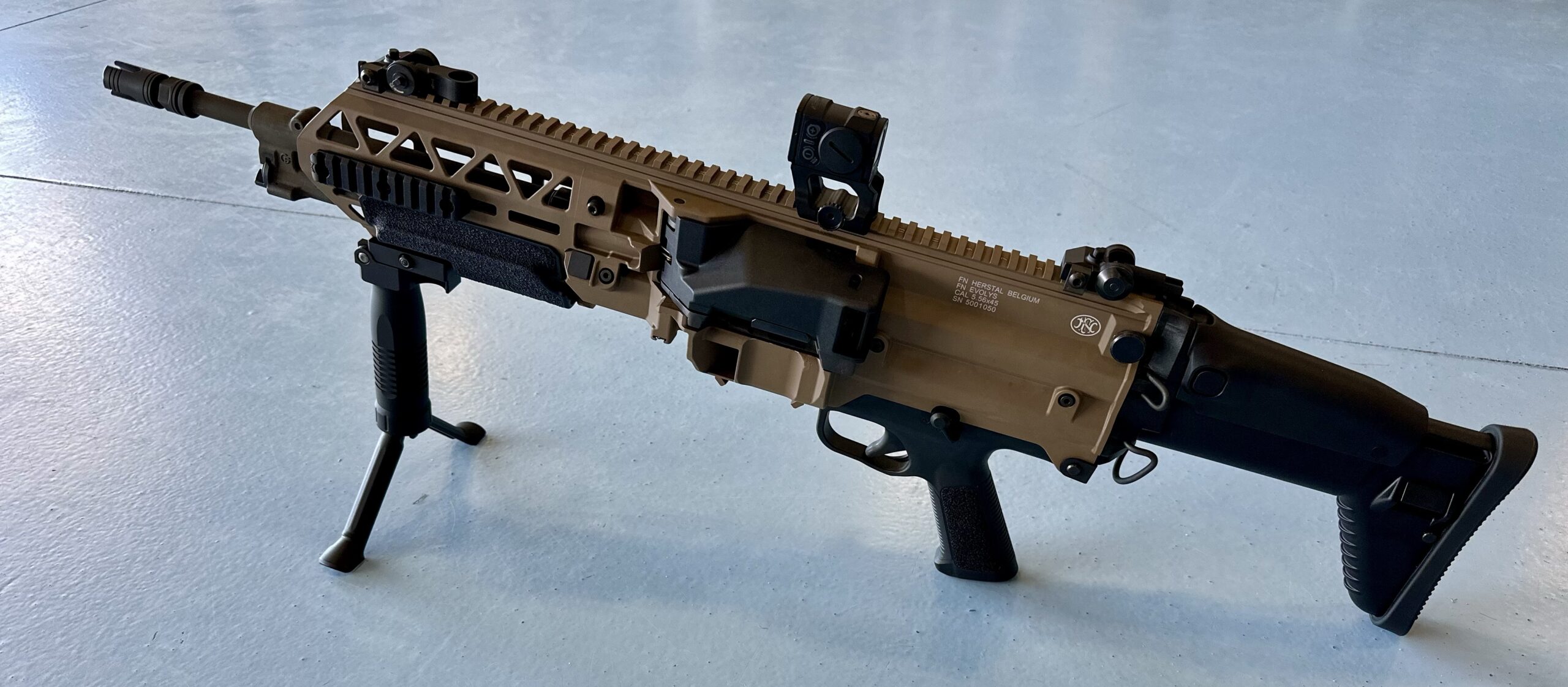
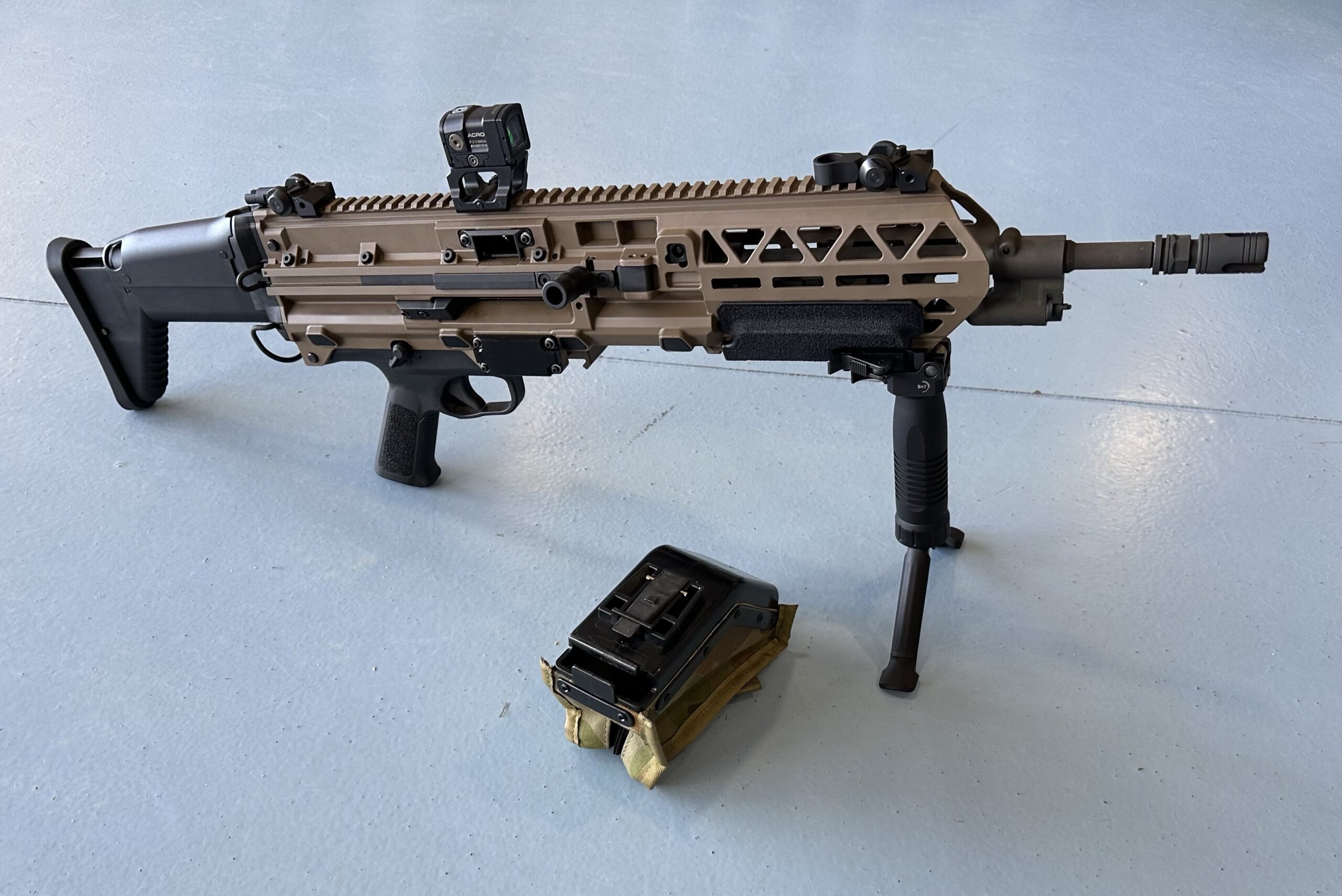
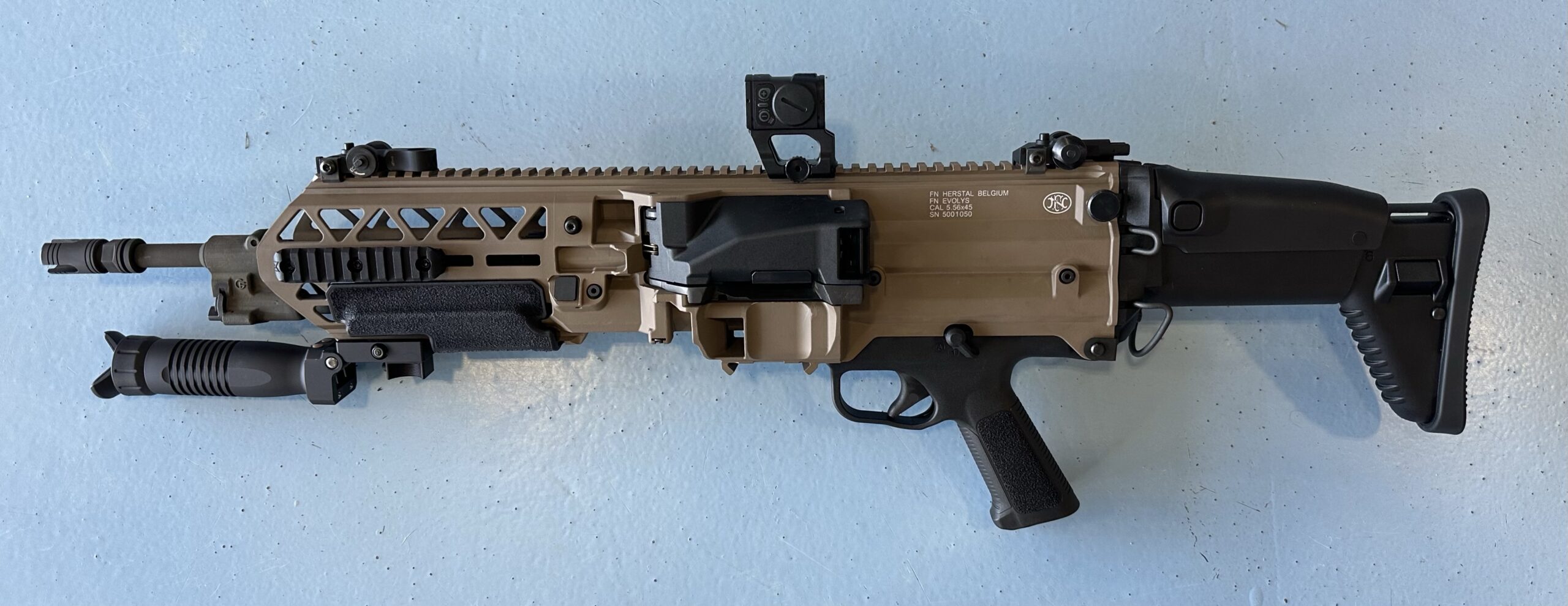
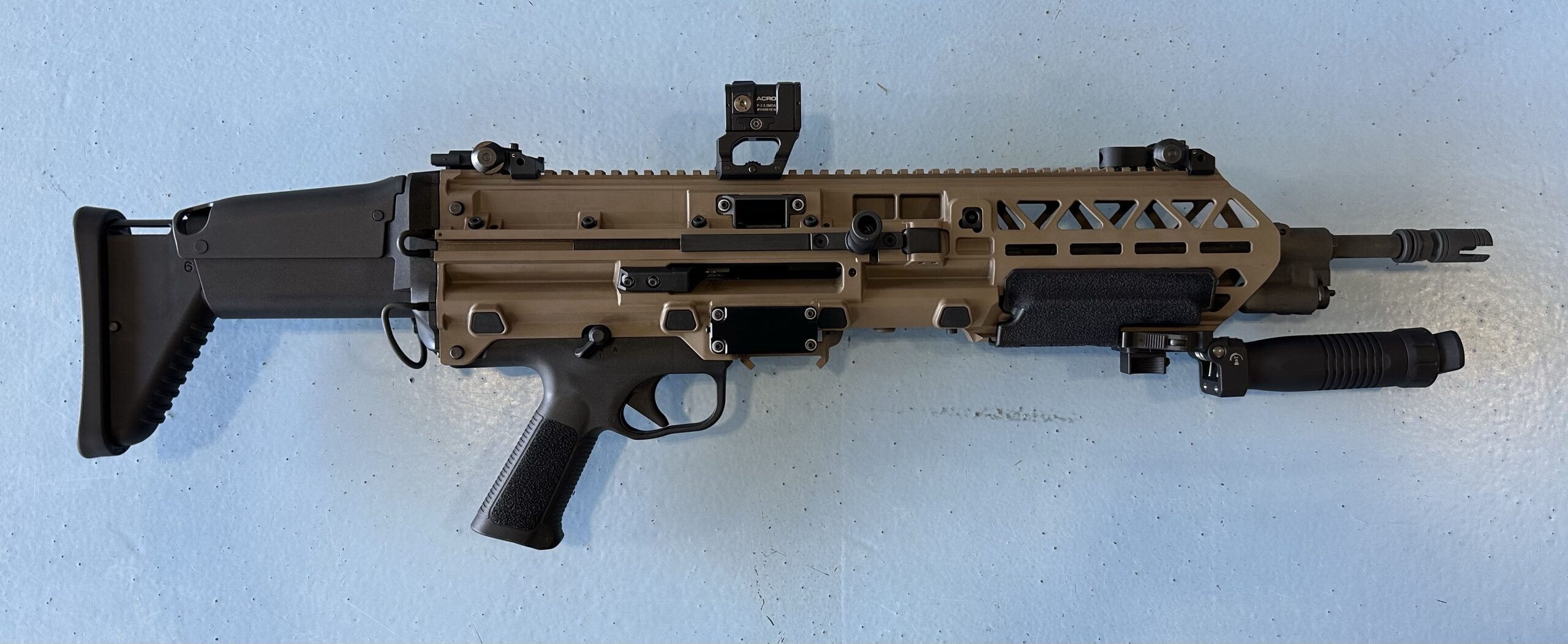
Launched in May of 2021, the Evolys machine gun from Fabrique National was originally available in 7.62 NATO and later introduced in .264. Now, they’ve added a 5.56mm model.

This belt-fed weighs 12 lbs and offers all of the features of its bigger brother like side loading. It’s also fully compatible with existing M249 and Mk46 ammo boxes.

What you see here is the Rest of World configuration with SCAR Stock and unique trigger pack. The US variant will offer alternate stocks and the same trigger pack from the LICC program. The optic and MagPod seen here were added only as examples of accessories which can be added to the gun.

The gun is in production and has been delivered to European customers for evaluation.

Shop Show 23 – Multi-Function Muzzle Device from Strategic Sciences

October 18th, 2023

Developed under a contract with the the Irregular Warfare Technology Support Directorate (IWTSD), this new suppressor technology from Strategic Sciences is unlike anything you’ve ever seen.

This two-piece design has been kept under wraps during development and is the brainchild of Russ Oliver who originally founded OSS Suppressors before moving on to Strategic Sciences. In addition to offering a unique form factor, the flow through suppressor design is 3D printed with the muzzle device attached over the barrel and the suppressor module latched into place in front of the muzzle device. (Yes, ATF is going to call both components suppressors, but this was developed for a military requirement, not commercial sale). Since the muzzle device fits over the barrel, it can’t be used with every rifle configuration.

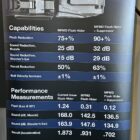
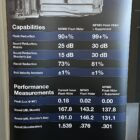
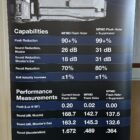
Word has it this technology works very well. It’s available in 5.56, 7.62 and .338 variants. Below you can see some basic, releasable data on each of the models developed so far with different weapons.

IWTSD is a government office, which is responsible for conducting research and development in support of U.S. and allied organizations involved in Irregular Warfare. Although this includes Special Operations Forces (SOF), there is a variety of other government agencies with IW responsibilities who share mutual needs within this realm. IWTSD works with academia and industry to develop new advanced capabilities. Originally known as the Combating Terrorism Technical Support Office (CTTSO), the name was changed to IWTSD, under the Assistant Secretary of Defense Special Operations / Low Intensity Conflict (ASD SO/LIC) in 2021.

Look for more information on this line of suppressors soon.

Forging the Future: How Advanced Manufacturing Is Revolutionizing Marine Corps Logistics

October 18th, 2023

Marine Corps Base Quantico, Va. —

As the United States Marine Corps continues to execute its strategic shift towards the Indo-Pacific, the importance of overcoming the logistical challenges of the modern battlefield has become increasingly evident. At the vanguard of this transformative landscape, Marine Corps Systems Command’s Advanced Manufacturing Systems team, or AMS team, is innovating to overcome the logistical challenges of the modern battlefield.

As stated in the Marine Corps’ Installations and Logistics guidance, to succeed on the modern battlefield, the Corps “will need a logistics enterprise fully integrated with the broader objectives of Force Design, capable of supporting multi-domain and distributed operations in contested environments.”

Keeping these insights in focus, the AMS team is leading the charge to field bleeding-edge solutions to ensure the warfighter has access to mission-critical equipment and replacement parts without having to rely on traditional supply lines or navigate the constraints of iron mountains.

According to Matt Audette, AMS program analyst, having the ability to essentially 3D print key components on the battlefield could stand to revolutionize how the Corps thinks about logistics.

“With its smaller footprint and easy-to-use technology, we can construct essential components right on the battlefield, making us nimbler and more responsive in any combat scenario.”

-Matt Audette, AMS program analyst

“In a nutshell, additive manufacturing is a game-changer for the Marine Corps. It allows us to repair equipment and innovate solutions right on the frontline,” said Audette. “With its smaller footprint and easy-to-use technology, we can construct essential components right on the battlefield, making us nimbler and more responsive in any combat scenario.”

When speaking to the AMS team, there appears to be a consensus that this innovative approach to manufacturing enables rapid delivery of mission-critical components to the front lines, with multiple subject matter experts underscoring the significance of augmenting the traditional supply chain.

“Parts break—that’s the reality of the battlefield,” said Robert Davies, AMS team lead. “You used to have two simple choices: bring the parts or order the parts. Our advanced manufacturing solutions rewrite that playbook. Now, we can actually manufacture essential components right in the combat zone. When something breaks, a call is made: ‘We need a component.’ No more ‘We forgot it’ or ‘It’ll take months to arrive.’ We contact our machinists and within a couple of hours, we’re making and sending parts back up to the frontline.”

While it might be tempting to view advanced manufacturing as a futuristic endeavor still on the horizon, recent successes suggest otherwise and Marines are now empowered to create stand-alone items such as hand tools, jigs, table models, training aids, and even vehicle parts.

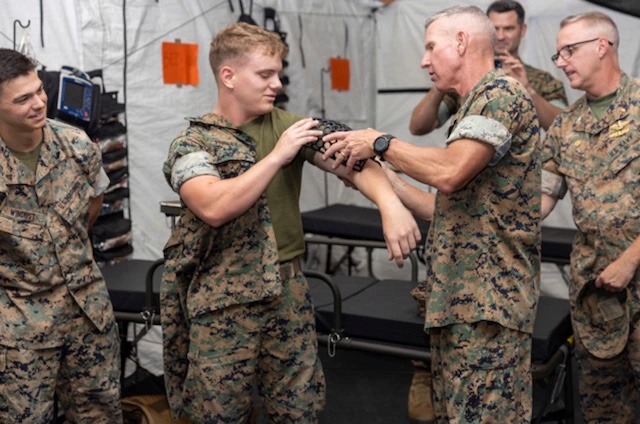
Just this past June, Navy and Marine engineers demonstrated the technology’s real-world potential by successfully 3D-printing a medical cast aboard a Marine Corps Osprey in mid-flight—demonstrating not only an increase in operational survivability but also an enhancement in battlefield lethality by minimizing downtime and accelerating troop readiness.

Similar successes to those achieved with the medical cast are seen in the creation of vehicle parts, with the Joint Light Tactical Vehicle serving as a prime example.

“We’re taking what our guiding documents say about modern day battlefield foraging and creating a real capability to do so with repair parts,” said Audette. “With our 3D printers and CNC mills, we can now craft these parts right where the fight is happening. What’s more, our allies possess the same industrial capabilities as we find here in the US. This also means that whether we’re in Darwin, the Philippines, or Japan, we can harness local expertise and resources to ensure our equipment remains mission-ready without relying on traditional supply chains.”

Dr. Kristin Holzworth, chief scientist on the AMS team, explains that this capability becomes increasingly vital as the Corps continues its strategic shift towards the Indo-Pacific.

“We have to do some very creative work to do additive manufacturing and 3D printing forward.”

-Gen., Eric M. Smith, Commandant of the Marine Corps

“Large-scale advanced manufacturing offers a solution to complement our limited assets. What makes it truly advantageous is its adaptability. Unlike traditional manufacturing, where we conform to one build, with 3D printing, we tailor each print to the specific mission’s requirements,” she noted.

Ultimately, advanced manufacturing technologies help advance Force Design’s transformative goal of creating, “Smaller but better-connected formations that organically possess a complete kill chain appropriate to echelon, and that can prevail in a contested operating environment.”

Citing “major end items” such as aircraft engines and propellers, Gen. Eric M. Smith, Commandant of the Marine Corps, recently told the Senate Armed Services Committee, “We have to do some very creative work to do additive manufacturing and 3D printing forward,” stressing the importance of taking pressure off of the lines that come from the United States through contested logistics areas.

After all, as he noted, “Every pound matters when you’re trying to move things across the expanse of the Pacific.”

As the Marine Corps continues its journey towards modernization under Force Design and the challenges posed by a pivot to the Pacific, feedback from Marines on the ground has been overwhelmingly positive. Notably, younger generations of Marines, who have grown up in a digital age, are embracing advanced manufacturing technologies with remarkable ease.

According to Audette, “The advantage of additive manufacturing is its accessibility and rapid training. Unlike traditional machining, which requires months of training and involves large equipment, additive manufacturing’s smaller machines have a lower learning curve. Many junior Marines already have experience with 3D printers, enabling us to quickly train them in a matter of days, enhancing readiness and problem-solving capabilities.”

This easy access to the capability aligns closely with the objectives of Talent Management, which urges the Corps to cultivate an adaptive, highly skilled force that can “solve problems faster and more creatively.”

“Advanced manufacturing isn’t about replacing traditional production lines; it’s about supplementing them.”

-Robert Davies, AMS team lead

But advanced manufacturing does much more than reduce iron mountains and streamline logistical demands; it also offers significant cost savings to the taxpayer.

“In traditional manufacturing, it takes time to scale production and achieve cost efficiency. With additive manufacturing, we reach optimal cost on day one, making it possible to produce low-volumes of parts efficiently” Audette explained.

It is important to understand, however, that this capability is not meant to replace industry partnerships; rather, it serves as a crucial alternative for the warfighter in the heat of battle who cannot afford to wait for traditional resupply channels to fill a request.

“Advanced manufacturing isn’t about replacing traditional production lines; it’s about supplementing them,” said Davies. “We’re not here to mass-produce hundreds of components in an hour—that’s for dedicated facilities. What we offer is the ability to produce a limited number of key components on-site when they’re urgently needed, all while respecting intellectual property laws. This shortens the supply chain and enables rapid response, whether that means getting Marines into the fight quicker or extracting them more safely.”


 The AMS team is not solely focused on monetary or cost savings; instead, the true triumphs are found in the logistical innovation and the time efficiencies that heighten combat readiness.

Ultimately, advanced manufacturing is a pivot point in military logistics, crystallizing the future of warfare into an immediate reality. By infusing cutting-edge technology into the very sinews of Marine Corps operations, the AMS team is not only revolutionizing logistics but also fundamentally altering how we conceive of readiness and adaptability on the 21st-century battlefield.


As the Marine Corps intensifies its focus on global littorals, particularly within the intricate geopolitics of the Indo-Pacific, advanced manufacturing emerges as a crucial enabler for sustaining combat effectiveness. This technological leap is more than a contingency; it’s a strategic imperative. By melding innovation with real-world application, the Corps isn’t just gearing up for future conflicts—they’re actively shaping the battlespace of tomorrow.

By Johannes Schmidt, MCSC Office of Public Affairs and Communication | Marine Corps Systems Command |

Editor’s note: Learn more about how the AMS team is redefining the Corps’ logistical capabilities on MARCORSYSCOM’s Equipping the Corps podcast, featuring Matt Audette, here: www.dvidshub.net/audio/73020/equipping-corps-s2-e11-advanced-manufacturing-systems-team-with-maj-matthew-audette