The UK-based company Arktis is introducing Wolf Grey and Ranger Green to their line later this year.

Seen here is the B474 Vulcan jacket which was introduced last year. Named after the famed V-series bomber, it features Primaloft insulation
The UK-based company Arktis is introducing Wolf Grey and Ranger Green to their line later this year.

Seen here is the B474 Vulcan jacket which was introduced last year. Named after the famed V-series bomber, it features Primaloft insulation
Denmark’s MLV Tactical gave us a sneak peek of their upcoming hot weather uniform.

The uniform is manufactured from a highly breathable and quick drying lightweight nylon.

The jacket incorporates a ventilation panel.

The trousers feature reinforced knees (which will be color matched to MultiCam during production) and insect netting at the bottom hem.


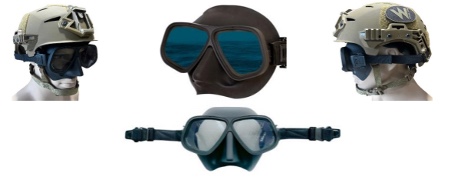
German company Hexonia was recently purchased by Norway-based NFM. They displayed quite a few technologies from both companies but what caught my eye was the new Trivium Head Protection System which was recently adopted by the German Bundeswehr’s Kommando Spezialkräfte (KSK). While Trivium is new, it finds its roots in the IdZ (Infanterist der Zukunft) helmet and is designed and manufactured in Germany.

The Trivium helmet system for the KSK comes in a hard case and includes nearly 20 components.

Ballistically the base helmet meets VPAM 3 25mm and boasts a V50 around 750 mps and will sustain 9mm on top with no deformation. The rifle appliqué dampens 7.63×39 mild steel core residual energy to 10 jule. Additionally, there are removable ballistic ear shields which are 50% lighter than precious versions and allow use of the side rails when attached.

The system includes two visors and a mandible.

The system includes both a ballistic helmet as well as a carbon bump helmet. Both helmets meet the EC mountaineering standard. The ballistic version is offered in Full Cut, Half Cut, High Cut and Super High Cut variants.

The suspension will look very familiar.


HAYMARKET, VA – March 7, 2023 – SK Guns®, the Nation’s only series driven, limited edition manufacturer of custom firearms, is proud to support Kids and Clays through their initiative, SK Gives Back®. Kids & Clays is dedicated to improving the lives of critically ill children and their families by partnering with Ronald McDonald House Charities (RMHC) Chapters to host sporting clays, skeet and trap fundraising events.
“Through our SK Gives Back initiative, we’re proud to continue our support of Kids & Clays and participating Ronald McDonald House Charities Chapters,” said Simon Khiabani, owner and founder of SK Guns. “Kids & Clays gives shooters the chance to come together, change lives and give a new generation of shooters the opportunity of a lifetime. We’re dedicated to enhancing awareness of their mission through support, donations and more.”
Since 1999, Kids & Clays has generated more than $20 million through hosting and promoting sporting clays, trap and skeet events. More importantly, participation in the events facilitated by Kids & Clays has raised awareness for RMHC Chapters among the hunting and shooting community, while assisting hundreds of thousands of families served by Ronald McDonald Houses each day.
The SK Gives Back initiative provides and enhances personal growth and development opportunities to organizations who are making an impact across the country. The initiative supports a wide array of causes as regular donors to foundations such as the NWTF, the DC Project, Kids and Clays and more. By regularly donating firearms to these amazing organizations, the program gives back to those in need on a local and national level.
To learn more about SK Gives Back, SK Guns® and new production offerings from SK Customs®, visit skguns.com.
Software-defined architecture, coupled with off-the-shelf hardware components, lets users surpass 500 simulated satellite signals

ROCHESTER, N.Y., March 7, 2023 – Orolia, a Safran Electronics & Defense company, announced today that Skydel, its flagship GNSS simulation engine software, can generate more than 500 signals from a single platform. By leveraging its software-defined architecture, Skydel’s potential can be massively scaled upwards when employing a robust set of hardware components. GNSS users, experts, and manufacturers, as well as those looking for an LEO-capable simulation system, can greatly benefit from this unmatched number of signals.
“GNSS chipset, cellular handset, and GNSS receiver manufacturers have been looking for a robust solution that can generate a very high capacity of signals — with all the constellations and multiple frequencies – from a single workstation. Skydel gives them that capability,” explained Pierre-Marie Le Veel, Orolia’s Simulation Product Director. “With the right hardware, Skydel is the first high-capacity GNSS simulator on the market that can also accurately generate advanced multi-path, jamming, spoofing, or the high number of signals and frequencies needed for a true LEO constellation simulation.”
Skydel contains a rich feature set that includes multi-constellation/multi-frequency signal generation, remote control from user-defined scripts, and integrated interference generation. However, one of Skydel’s greatest assets is its open, software-defined architecture. “Skydel’s software-defined GNSS simulation approach is just the tip of the iceberg,” added Le Veel. “With more and more customers simulating multi-path and jamming scenarios, and the need for more signals in more applications –even beyond traditional simulators – the need for high-capacity has never been greater. The Skydel engine opens the possibility for users to escalate to over 1000 signals and not be limited by hardware design.”
In addition to generating a high channel/satellite count, Skydel can also produce navwar signals without any additional hardware. Since 2015, Skydel software has been used to simulate GNSS signals for a wide range of applications and business segments including automotive, aerospace, space, telecommunications, and defense.
For more information, please visit any of the following links:
• Skydel GPU guide
• Bring Your Own Hardware Guides
• GNSS test plans
Horizon Laminate is a collaboration between British Tactical and Flimmuur Tactical. Patented, it’s seen here in the construction of British Tactical’s MagPI line of pouches.

They’ve managed to save weight by transitioning from a Kydex retention system to using Curv as a stiffener which facilitates retention. Curv is lighter and easier to cut meaning it can be scored and folded in order to created strong shapes.