TYR Tactical

Archive for August, 2026

Shell Shock Technologies Launches NAS3 Primed Cases in .308 and 5.56 NATO

Tuesday, August 4th, 2026

Factory-primed nickel alloy rifle cases bring Shell Tech’s lightweight, corrosion-resistant NAS3 platform to precision, hunting, and duty-grade custom rifle ammunition assembly.

Eubank, KY (August 2026)Shell Shock Technologies, LLC. (SST), a leading innovator in the ammunition industry, today announced the launch of NAS3™ Primed Cases in .308/7.62x51mm and 5.56 NATO/.223 Remington, expanding the company’s rifle case lineup with a factory-primed option built for shooters who assemble their own precision, hunting, and duty ammunition.

Like all NAS3 cases, the new primed rifle cases are constructed from SST’s proprietary nickel alloy body paired with a stainless-steel head, a two-piece design engineered to be up to 50 percent lighter than traditional brass while offering roughly twice the tensile strength and greater elasticity. The nickel alloy construction also delivers strong corrosion resistance and smooth, consistent feeding and extraction. By arriving factory-primed, the new cases eliminate a manual step in the case-preparation process, allowing shooters to move directly to charging and seating projectiles.

Built for the .308 Winchester and 7.62x51mm NATO platforms, the new NAS3 .308 Win./7.62x51mm Primed Cases are aimed at precision rifle competitors, hunters, and duty-focused shooters who demand consistency at distance. The cases’ uniform wall thickness and tight dimensional tolerances support tighter velocity spreads and more consistent accuracy at standard SAAMI pressures across a wide range of .308-class projectiles, from lightweight varmint loads to heavier hunting bullets. The reduced case weight is designed to translate into lighter loaded ammunition for hunters and long-range shooters carrying rounds afield or on the line. At the same time, the corrosion-resistant nickel-alloy construction is built to withstand high-round-count training and duty use.

Optimized for the 5.56 NATO and .223 Remington chamberings common to AR-15, M4, and similar modern sporting rifles, the new NAS³ 5.56 NATO/.223 Rem. Primed Cases are geared toward high-volume shooters, from competitive marksmen and varmint hunters running extended strings to law enforcement and military users training and qualifying at scale. The case design is built to maintain clean cycling and reliable extraction through rapid-fire strings, while its lighter weight reduces the overall load for shooters carrying large volumes of ammunition for training, qualification, or extended range sessions. The cases support a range of 5.56 projectile weights, from lightweight loads suited to high-volume training to heavier options for precision or specialized applications.

“Every case we bring to market starts with the same question: how do we take weight and inconsistency out of a shooter’s hands without asking them to compromise on performance?” said Peter Foss, Managing Partner and CEO of Shell Shock Technologies. “The .308 and 5.56 markets ask for different things — one rewards consistency at distance, the other rewards reliability at volume. Bringing the NAS³ platform to primed cases in both calibers lets us meet serious rifle shooters wherever they’re shooting, right out of the box.”

NAS3 .308/7.62x51mm Primed Cases and NAS35.56 NATO/.223 Rem. Primed Cases are available now through Shell Shock Technologies in pack sizes ranging from 250 to 5,000 rounds. Pricing for the .308 primed cases starts at $220 for a 250-count pack, with 5.56 primed cases starting at $135 for the same pack size. Both products are available now at www.shellshocktechnologies.com

KommandoStore – Eighty-Four Combat Gloves

Tuesday, August 4th, 2026

At last weekend’s GOALS convention in Des Moines I had the opportunity to check out KommandoStore’s upcoming Eighty-Four Combat Gloves.

Coming in September these gloves are constructed with FR fabric and goat skin. Seen above are prototypes. They will be offered in Coyote, a Battlefield 3 colorway consisting of Black and Sand, and Ranger Green.

Fort Rucker’s Unmanned Advanced Lethality Course Ramps Up Tactical Drone Training

Tuesday, August 4th, 2026

The Unmanned Advanced Lethality Course at Fort Rucker, Alabama, is pushing forward with a series of updates aimed at strengthening tactical proficiency and meeting student expectations, said Army Staff Sgt. Mario Rostran, the course’s noncommissioned officer in charge, and Army Chief Warrant Officer 3 Robert Gatta, the course manager.

Rostran said the leadership team is focused on refining instruction in response to student feedback to ensure the course delivers the advanced-level rigor it promises.

“We’re continuing to improve the course,” he said. “We’re taking comments as we go and making sure [that] we’re meeting the standards students expect. The goal is to make this the advanced course it claims to be.”

Working alongside the team, Gatta is helping expand hands-on training and strengthen tactical application throughout the program.

“The most significant update is increasing the amount of physical, kinetic engagements from five to 12,” he said. “We have been working to refine the overall course to run smoother and provide the most up-to-date data.”

To meet the demand for advanced instruction, the course is shifting to a more tactical framework. Gatta noted the class will complete a culminating exercise this week at the drone training facility in Daleville, Alabama, marking a new experience for the students.

“This exercise will demonstrate a more real-world tactical environment and incorporate a close-quarters battle level of training, whereas previous emphasis has been heavily placed on outdoor live flights,” he said. “Our current goal is to make the training more tactical in nature. I believe we have several solid plans to build on moving forward.”

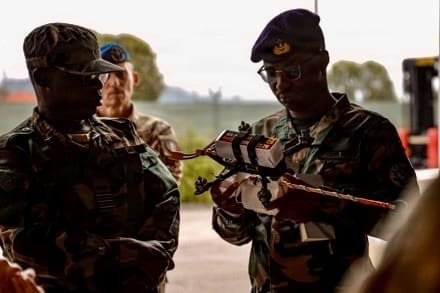
During this iteration of the course, students conducted live-engagement training using a purpose-built attributable system, the Shank 1.0, and C-4, a versatile plastic explosive. The event allowed students to apply lessons learned by flying the system, coordinating altitude and executing tactical employment against a designated target.

Army Sgt. 1st Class Riley Watts, assigned to Company A, 1st Battalion, 14th Aviation Regiment, spent months trying to enroll in the course. He said attending has given him a clearer view of how unmanned aircraft systems fit into the future of Army aviation.

“This is a great course to keep you relevant in today’s force,” Watts said. “Seeing how UAS is being implemented and utilized in today’s Army is eye-opening, and it shows you how important it is to understand these systems.”

Matthew Baldwin, a civil engineering major at the U.S. Military Academy, is attending to take tactical drone employment strategies back to the academy’s future applied systems and tactics team. His leaders pushed to send two cadets to the course to expand their understanding of drone employment and to share that knowledge when they return.

Baldwin, who hopes to commission into the air defense artillery branch, said the course offers a perspective that will be important to future Army operations.

“One of the big questions is how to counter drones effectively,” he said. “You’re talking about sending a very expensive rocket to take out a cheap drone. Understanding drones from the operator’s side, how they fly, what they look for, helps you understand how to counter them.”

Although he arrived with limited tactical flying experience, he said the hands-on instruction has significantly boosted his confidence.

“I didn’t know how to tactically fly. It’s a completely different flying style,” Baldwin said. “I feel better flying them, and now we’re trying to develop a training program to help build other pilots on our team.”


Beyond flying, Baldwin highlighted the value of the course’s mission-planning segments.

“I’ve really appreciated the planning side, [the military decision-making process], troop-leading procedures, what goes into reconnaissance,” he said. “I hadn’t learned a lot of that yet. Going into my [fundamentals of small-unit operations] class and eventually into the Army, my knowledge base is definitely better now.”

The Unmanned Advanced Lethality Course runs six times per fiscal year, providing recurring opportunities for soldiers seeking advanced UAS training. Upcoming course dates are Sept. 14-Oct. 2, and Nov. 2-20.

By Leslie Herlick, Aviation Center of Excellence

Quantum Systems Announces Major Upgrades to Its Long-Range Unmanned Aerial System RELIANT

Monday, August 3rd, 2026

Quantum Systems has upgraded its long-range Unmanned Aerial System (UAS) RELIANT. The latest generation offers increased payload capacity, broader mission flexibility, and software integration into the company’s MOSAIC UXS ecosystem. Designed around a fully European supply chain and minimal logistical footprint, Reliant will now compete for major global contracts.

Gilching, Germany, 27 July 2026 – Quantum Systems is announcing major upgrades to its long-range intelligence, surveillance and reconnaissance (ISR) system, Reliant. Following Quantum Systems’ policy of continuous development and R&D, the new features significantly expand Reliant’s mission flexibility while maintaining the ease of deployment and low logistical footprint that define Quantum Systems’ platforms.

The latest generation of Reliant features a hybrid-electric power unit and increases the system’s payload capacity to up to 9 kg, enabling a much broader range of missions. Depending on operational requirements, Reliant can now carry electro-optical sensors, laser-target designators, synthetic aperture radar (SAR), SIGINT and electronic warfare payloads, as well as SATCOM, relay and other mission-specific capabilities.

Despite its expanded capabilities, Reliant maintains its minimal logistical footprint with easy-packaging options and operations enablement for assembly by a two-person team and operations by a single operator. The hybrid-electric VTOL platform requires only a 10 × 10 metre launch and recovery area, making it independent of start- and recovery infrastructure and suitable for ship-based operations.

Beyond the platform itself, Reliant is fully integrated into the MOSAIC UXS software platform, making it interoperable with other unmanned systems in multi-domain operations. Together with operator workstations, training, sustainment and lifecycle support, Quantum Systems delivers a complete long-range unmanned capability rather than a standalone aircraft.

Reliant also completes Quantum Systems’ Family of Aerial Systems, complementing the short-range Twister and the mid-range Vector AI platforms. Quantum Systems UAS solutions are already in service with a range of NATO and allied armed forces, notably with the German Armed Forces and the Armed Forces of Ukraine.

Reliant is built around a secure European supply chain and supported by Quantum Systems’ growing industrial base, providing customers with a system without any Chinese components or ITAR restrictions.

“Reliant’s upgrades are the result of continuous feedback from military users and partners, and our answer to enhance long-range capabilities for NATO, Europe and our allies,” said Martin Karkour, Chief Revenue Officer at Quantum Systems. “We can now offer a truly unique capability, with a minimal logistical footprint, payload superpower and impressive range and endurance – completely built on a resilient supply chain. We are very proud of that.”

MAG Exchange – Two Months Out

Monday, August 3rd, 2026

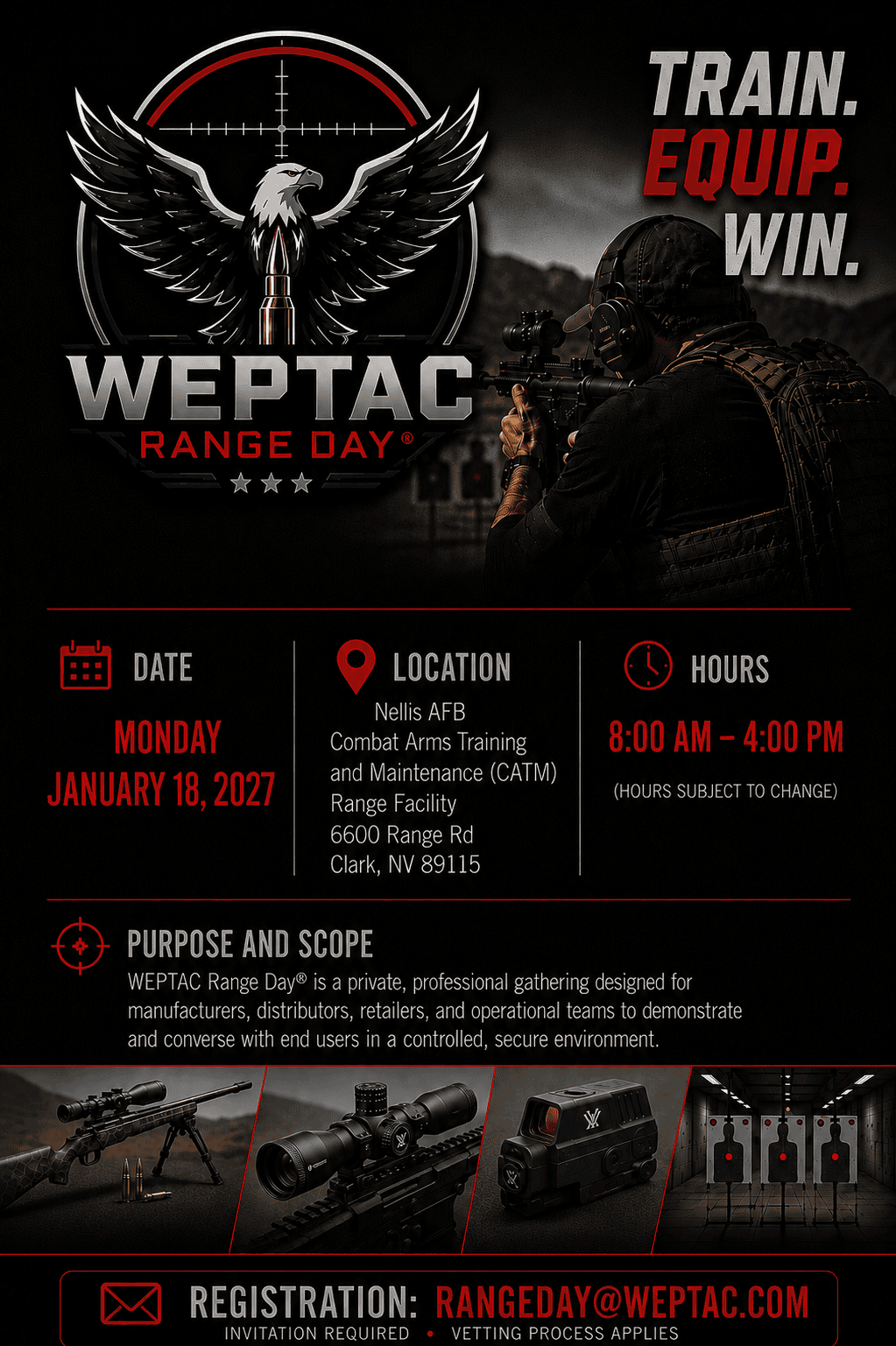
MAG Exchange is a private event held during evenings during the ARC WEPTAC which brings together industry leaders, innovaters, and professionals for an exclusive evening of networking, product showcases, and mission-focused solutions.

October 26-27 on Tucson, AZ.

Companies interested in exhibiting should contact PK at info@magexchangemil.com.

www.magexchangemil.com

Greenside Training Announces Gerald Hooee as New Instructor for CamoStalk360

Monday, August 3rd, 2026

Greenside Training LLC announces a new instructor for the first time in 15 years other than its founder Freddy Osuna. Greenside Training is proud to announce Mr. Gerald Hooee as our newest Premiere Instructor for CamoStalk360™. Gerald is also Handling curricullum design and research.

Welcome to the Team, Mr. Gerald Hooee.

A Marine Corps Scout Sniper, combat veteran, and seasoned sniper instructor, Gerald brings decades of experience developing professionals who must move unseen, observe with precision, and perform under pressure. Hailing from the Zuni Nation of New Mexico, he blends ancient Indigenous fieldcraft with modern human perception and performance science to create an unmatched learning experience.

In CamoStalk360™, you’ll learn that true camouflage isn’t about hiding—it’s about understanding how the human mind detects, processes, and overlooks information.

See. Move. Disappear. His first class August 30- Sept 1st, 2026 Avery Texas.

greensidetraining

EOTECH Supplies Electro-Optics to the US Army

Monday, August 3rd, 2026

Plymouth, MI (July 2026) – EOTECH, a division of American Holoptics and leader in advanced electro-optic sighting systems, today announced the recent sale of its OGL® (On-Gun Laser) systems, HWS® (Holographic Weapon Sights), and compatible magnifiers to the U.S. Army, totaling 14,000 units. The procurement was executed through multiple Transformation in Contact (TiC) buys to directly support the PAE Maneuver Ground portfolio’s surrogate optics project for M7, XM8 Carbine, and M250 Automatic Rifle.

This delivery provides critical day/night aiming, illumination, and engagement capabilities to Soldiers participating in the surrogate optics evaluation. The EOTECH systems include the rugged, combat-proven OGL for visible and infrared laser performance, industry-leading holographic sights for rapid target acquisition, and high-performance magnifiers—enabling enhanced lethality, improved positive identification, situational awareness, and operational flexibility in diverse and austere environments.

“EOTECH is proud to support the U.S. Army’s modernization efforts by delivering reliable, high-performance optics that meet the demanding requirements of today’s warfighters,” said Tod Litt; VP of Business Development-Intl/Govt for EOTECH. “These TiC acquisitions allow the Army to rapidly field advanced surrogate solutions, gather real-world Soldier feedback, and inform future requirements for a more sustainable and effective optics program across the force while replacing obsoleted systems currently being employed. We remain committed to American-made innovation that gives our Soldiers the decisive edge.”

The surrogate optics initiative for M7, XM8 Carbine, and M250 Automatic Rifle under PAE Maneuver Ground represents a key component of the Army’s accelerated acquisition strategy. By leveraging rapid procurement pathways like the TiC, the Army can efficiently evaluate technologies, mitigate risk, and accelerate the delivery of next-generation capabilities to maintain overmatch.

EOTECH’s holographic weapon sights and associated systems have a long history of trusted service with U.S. and allied forces. These latest deliveries underscore the company’s ongoing role in equipping America’s warfighters with cutting-edge tools designed for extreme durability, speed, and precision while proving that EOTECH’s capacity can scale quickly and efficiently to meet dynamic demand required of the U.S. Army.

BFG Monday: Your Gear Is Not a System Just Because It Fits on the Same Belt

Monday, August 3rd, 2026

By John Chapman
Executive Director, Task Force 70 Foundation

Photo courtesy of John Chapman
Ask most cops what makes a good loadout and they will start naming gear. A better belt. A lighter pouch. Whatever sling everybody is running this year.

Good equipment matters, but a collection of good equipment does not automatically create a good loadout. If the pieces were selected individually and never tested together, the setup can still fight the officer every time something needs to be reached, moved, or controlled. Load carriage has to work as a system.

A working loadout is not only lighter. It carries the weight deliberately, keeps critical equipment in a predictable location, controls anything that can move or snag, and accounts for ammunition and medical before the remaining space gets filled.

Most loadouts are not built that way. They grow one purchase at a time. A pouch is added because it solves one problem. A medical kit gets attached wherever space remains. A new sling goes on the rifle without anyone checking where the adjustment hardware or excess webbing sits against the rest of the equipment.

Eventually, everything technically fits, but nothing really works together.

The magazine pouch crowds the medical kit. The sling catches on a light, radio, or pouch. Equipment shifts when the officer runs or goes hands-on. Something that was easy to reach while standing becomes difficult to access from inside a patrol vehicle.

At that point, the officer is managing the equipment instead of using it.

Start With Four Requirements

A working loadout should address four things: carry, access, control, and sustainment.

Carry

Weight has to be distributed deliberately between the belt and carrier, kept close to the body, and evaluated over more than a few minutes on the range.

A setup that feels acceptable while standing at an equipment table may become a problem after hours of driving, walking, getting in and out of a vehicle, or moving through structures. Where the equipment sits matters as much as what the equipment weighs.

The goal is not to move every item off the belt or onto a carrier. It is to avoid concentrating weight unnecessarily in one area and creating pressure points that become harder to tolerate over a full shift.

Access

Critical equipment should be found through a repeatable movement, not a search.

If a magazine sits in a different location on every setup an officer trains or works in, the officer has to mentally correct for the difference. When equipment remains in a consistent location, the reach becomes more predictable.

Under pressure, an officer should not have to remember where something was placed on this particular belt or carrier. Consistent placement reduces unnecessary decisions and helps make equipment access more repeatable.

That does not mean every officer must have an identical loadout. Body type, assignment, agency policy, vehicle configuration, and mission requirements all matter. It means the location of essential equipment should be chosen intentionally and kept as consistent as those requirements allow.

Control

Anything that swings, shifts, or hangs loose becomes something else the officer has to manage.

That matters while running. It matters while climbing out of a vehicle. It especially matters during a hands-on encounter, when loose straps, exposed equipment, and poorly controlled pouches can snag, interfere with movement, or contribute to equipment loss.

A clean setup is not about appearance. It is about keeping equipment close to the body and limiting unnecessary movement.

This is where individual pieces have to be evaluated against their surroundings. A two-point sling such as the Vickers Sling™ can secure the rifle tightly against the body and adjust rapidly when it is time to present the weapon. That benefit is reduced if the sling’s routing or remaining webbing interferes with a radio, light, medical kit, or belt-mounted equipment.

The sling may work correctly by itself. The question is whether it still works correctly as part of the complete loadout.

Sustainment

Medical equipment and reloads should be accounted for before the remaining space is filled.

Those requirements take up space whether they are planned early or forced into the setup later. When they are added last, access is often compromised by whatever was already placed on the belt or carrier.

Medical equipment in particular cannot be treated as an accessory. The kit should remain secure during movement, accessible from a practical position, and recognizable to another officer who may need to deploy it.

A compact medical kit such as the Trauma Kit NOW!®  can help preserve limited space on an officer’s duty rig, but the size of the kit does not solve a poor mounting decision. The officer still has to test whether it can be reached from the intended position, accessed around body armor, and deployed while seated or working from an unfamiliar angle.

The right medical kit in the wrong place is still the wrong setup.

Build Around the Fixed Points

A practical way to configure a law-enforcement loadout is to begin with the items whose locations are primarily dictated by the job.

The holster, radio, less-lethal equipment, and agency-required items establish many of the fixed points. Medical and reloads should then receive deliberate space based on access rather than whatever room remains.

Once those fixed points are established, test how the complete system interacts:

• Can the officer enter and exit the vehicle without equipment catching on the seat, steering wheel, or door frame?

• Can magazines be accessed through the same basic movement used during training?

• Can the medical kit be reached without fighting another pouch?

• Can the rifle be secured close to the body without the sling interfering with belt- or carrier-mounted equipment?

• Does anything shift, flap, or come loose when the officer runs, climbs, kneels, or goes hands-on?

• Can another officer identify and access the medical equipment if the wearer cannot?

Those questions reveal more than standing in front of a mirror and deciding whether everything fits.

Weight Is Cumulative

There is rarely one piece of equipment responsible for all the unnecessary weight in a loadout. Weight accumulates through mounting hardware, extra webbing, overlapping materials, oversized pouches, and items carried because there happened to be space available.

That is why material and construction decisions matter across the entire system.

A lightweight platform such as the GRID® Belt helps reduce weight at the foundation of the setup. Helium Whisper® attachment systems can reduce pouch weight by up to 50 percent compared with legacy pouch designs while maintaining MOLLE and PALS compatibility. Across several pouches, those individual savings begin to add up.

Still, the lightest equipment available will not correct a poor layout.

A lightweight pouch mounted where it cannot be reached is not an improvement. A lightweight belt carrying too many unnecessary items remains overloaded. Weight reduction and thoughtful placement have to support each ot

Let the Instructors Find the Problems

Before committing an agency or team to a particular setup, put the complete system in front of the people who will train with it.

Firearms instructors may identify conflicts with the draw, reloads, or sling management. Medical instructors may see an access problem that was not apparent during the initial setup. Defensive-tactics instructors may find loose equipment or exposed straps that become a problem during physical contact.

Then test the loadout in the places where officers will actually use it.

Sit in the vehicle. Get out from both sides. Move through a doorway. Go to the ground. Access the radio. Transition the rifle. Reach the medical kit with either hand where practical. Have another officer locate it.

A catalog can explain what each product was designed to do. It cannot tell an agency whether every piece will work together on a specific officer, in a specific vehicle, under that agency’s policies and training.

That requires evaluation.

A working loadout should reduce the number of things an officer has to manage, not add to them. Build it deliberately, test it during movement, test it from the vehicle, and let the people who train with it find the conflicts.

That is the difference between owning equipment and running a system.

Build Your Loadout as a System

Explore Blue Force Gear® belts, slings, medical kits, and lightweight pouch solutions designed to work together.

Explore Load-Carriage Systems.

About the Author

John Chapman, known widely as “Chappy,” is a law-enforcement professional with more than 34 years of experience in operations, leadership, doctrinal development, applications engineering, and training.

A published author, he has spent more than 28 years developing and delivering patrol and tactical law-enforcement curricula. Through the Task Force 70 Foundation, John helps provide training, mentoring, and education to underserved rural and small-town law-enforcement officers and agencies across the United States.

Learn more about the Task Force 70 Foundation.

About Blue Force Gear

Blue Force Gear® is a leading innovator in lightweight tactical equipment, best known for producing some of the world’s most trusted weapon slings. The company continues to redefine load carriage with its Ten-Speed® multi-use pouches, MOLLEminus® platforms, and patented Helium Whisper® attachment system.

Driven by a commitment to performance and weight reduction, Blue Force Gear® engineers its products using proprietary ULTRACOMP® high-performance laminate materials, delivering durability without unnecessary bulk. This relentless focus on innovation, combined with precision manufacturing and attention to detail, has positioned the brand at the forefront of modern tactical gear.

Blue Force Gear® is a Great Place to Work® Certified company, reflecting its dedication not only to the warfighter, but to the people behind the mission.

For more information, visit www.blueforcegear.com.