Aquaterro

Archive for the ‘Army’ Category

FN Wins US Army Contract to Build M240 Machine Guns and Spare Receivers

Thursday, June 10th, 2021

(McLean, VA – June 10, 2021) FN America, LLC is pleased to announce that the company has been awarded a firm-fixed-price contract to supply the U.S. Army with M240 series machine gun variants and spare receivers. The contract, awarded through 2026, is multi-faceted and will support both the U.S. Army and other Department of Defense (DoD) programs.

“The U.S. Army contract for the M240 machine gun was the first military contract FN was awarded and the first to be produced from our production facility in South Carolina,” noted Mark Cherpes, President and CEO for FN America, LLC. “We’re incredibly honored to continue our relationship with the Army, supporting them with high quality and reliable weapon systems for our servicemen and women.”

The M240 general purpose machine gun, derived from the FN MAG 58, was adopted by the U.S. military in the late 1970s, and has been in continual service since being introduced. This contract provides a procurement vehicle for the US Army to purchase multiple variants of the M240 machine gun, including the M240 coaxial, the M240B, M240L, M240D and M240H models.

Throughout its history, FN has been one of the largest suppliers of small arms to the U.S. military and continues to develop innovative, future technology. In addition to the M240 and its variants, the company currently holds contracts for the FN M249 lightweight machine gun; the FN MK 46, MK 48, MK 17, and MK 20 SSR for USSOCOM, and various other contracts.

For more information about FN’s military product line or current U.S. military contracts, please visit www.fnamerica.com.

SIG SAUER Commemorates U.S. Army’s Birthday with Army Ranger Series Videos

Wednesday, June 9th, 2021

NEWINGTON, N.H., (June 9, 2021) – SIG SAUER, Inc. is proud to present a new four-part video series to commemorate the upcoming birthday of the U.S. Army on Monday, June 14th, and honor the prestigious U.S. Army Rangers with an inside look at the 2021 Best Ranger Competition.

“This year SIG SAUER was afforded the incredible opportunity to present custom M17 pistols as the official trophy pistols of the prestigious Best Ranger Competition,” said Jason St. John, Director, Government Products, SIG SAUER, Inc., and Sergeant First Class (Retired), U.S. Army Ranger. “Through this video series we recognize the U.S. Army and the incredible service and sacrifice of the entire U.S. Army Ranger regiment to our country.”

The SIG SAUER Best Ranger Video Series includes the following episodes:

Episode 1: Rangers Lead the Way: the already released video review of the history and foundation of the U.S. Army Rangers.

Episode 2: Honor: the newly released video reviews the inception of the famed Best Ranger Competition.

• Episode 3: 2021 Best Ranger Competition: an inside look at the grueling 3-day Best Ranger Competition to be released on the birthday of the U.S. Army, June 14th.

• Episode 4: Prestige: an interview with the 2021 Best Ranger Competition winners to be released on Friday, June 18th.

The U.S. Army Best Ranger Competition is a grueling competition that identifies the best, two-man U.S. Army Ranger team on a course that is designed to place extreme demand on each team’s physical, mental, technical and tactical skills and was held in Fort Benning, Georgia, April 16-18, 2021.

Learn more about the SIG Custom Works, U.S. Army Best Ranger Competition M17 Trophy Pistols.

Safran Optics 1 Delivers 4000th Laser Target Locator Module II to US Army

Tuesday, June 8th, 2021

Safran Optics 1 recently celebrated a milestone. They have delivered the 4,000th Laser Target Locator Module (LTLM) II to the US Army.

For more than a decade, LTLM has served the US Army as a laser targeting system to help dismounted Soldiers identify targets day and night in all battlefield and climate conditions. Initially, Optics 1 provided direct view optic and laser rangefinder components for BAE Systems’ device, but as it matured and transitioned to LTLM II, Optics 1 became the prime contractor winning a five-year IDIQ contract in 2016.

Based in New Hampshire, Optics 1 leverages an international supply chain with two other companies, Safran Electronics and Defense and Safran Vectronix. Camera cores and SOM boards originate in France and are shipped to Switzerland for initial assembly. Optics 1 then builds the final device to US Army specifications here in the US.

Optics 1 President and CEO, Joe Bogosian shared, “when talking about the 4,000th LTLM II, we must start with the end goal, and that is Optics 1’s support for the US Soldier in successfully conducting their mission and returning safely.”

They have consistently met the Army’s contractual needs for on-time and high-quality deliveries.

In fact, it’s involvement in this very program that allowed Optics 1 to grow their workforce and expand into other programs like the US Special Operations Command Enhanced Clip-on Thermal and SWIR Imager (ECOTI/ECOSI) programs, the Integrated Compact Ultralight Gun-mounted Rangefinder (ICUGR) for the US Marine Corps Squad Range Finder program, and the ECOTI for the USMC Squad Binocular Night Vision Goggle.

But they don’t sit on their laurels. During a recent visit I was shown a few new systems which will be released soon.

Army Leverages Virtual Reality to Understand Network Influence

Saturday, June 5th, 2021

RESEARCH TRIANGLE PARK, N.C. — Immersive virtual reality isn’t just for amusement parks, the U.S. Army is funding research that uses it to understand group dynamics.

The U.S. Army Combat Capabilities Development Command, known as DEVCOM, Army Research Laboratory funded scientists at Kent State University’s Electrophysiological Neuroscience Laboratory to create an immersive virtual reality lab that can be used in tandem with their other biophysiological technologies to advance an interdisciplinary understanding of group dynamics.

Immersive reality combines virtual reality with images, sounds, or other stimuli to provide an engrossing environment.

According to Dr. Bruce West, a senior Army scientist, the military is becoming increasingly reliant on small special operations teams, but little is known about how small groups function in these extreme environments. The research team uses cutting edge electrophysiological and physiological equipment to probe team functioning and decision-making under threat.

“In order to make valid and efficacious practical recommendations for small special operations teams in the modern global military context and other threat environments, Soldiers can benefit by training in immersive virtual environments to make them feel like they are really there,” said Dr. Lisa Troyer, program manager, social and behavioral sciences, ARL. “The immersive virtual reality system at Kent State University is developing more valid, impactful knowledge about how teams and individuals navigate dangerous environments.”

The lab includes cutting edge virtual reality headsets with three-dimensional eye tracking and omnidirectional treadmills, which can be integrated with EEG and other emerging biometric technologies.

“With this lab, ENLoK is generating path-breaking social science discoveries,” Troyer said. “The team’s efforts are leading the use of immersive virtual reality and capabilities to identify neurological signals of influencers in groups that can support Army missions by better understanding Army influence networks as well as adversarial groups.”

In earlier research, also funded by ARL and published in Social Psychology Quarterly, the Kent research team conducted a series of experiments manipulating status and used brain activity analyses to successfully identify neurological signals during social interaction that are unique to others’ perceptions of high status actors and their influence over group members.

“Understanding the consequences of status-based behavior in a variety of settings, including small team contexts, can help the Army prepare and train for modern military operations,” said Dr. Will Kalkhoff, ENLoK’s director and professor of Sociology at Kent State University. “The Army can also use the knowledge we are developing to better understand how influencers in allied groups support Army missions through their social networks or how adversarial groups mobilize.”

Now, the research team at Kent State is partnering with MILO, an Ann Arbor, Michigan-based component of Arotech’s Training and Simulation Division that provides immersive training solutions for military and law enforcement organizations around the world. The objective is to improve police and military readiness by integrating rigorous social science with emerging technologies already in use throughout the Department of Defense.



“Support and assisted facilitation of this kind of social research is exactly why we established the MILO Cognitive Division,” said Robert McCue, MILO’s general manager. “Our ultimate goal is to advance the scientific understanding of behavior and decision-making under threat and, in so doing, reduce danger to our servicemen and women and improve mission success by facilitating team functioning under threat.”

By U.S. Army DEVCOM Army Research Laboratory Public Affairs

Inventus Power Awarded Nine-year, $1.25 billion Contract to Supply Conformal Wearable Batteries to the U.S. Army

Thursday, June 3rd, 2021

Inventus Power, a global leader in the design and manufacture of advanced battery systems for military, medical, commercial, and industrial markets today announced it has been awarded a $1.25 billion contract to supply Conformal Wearable Batteries to the U.S. Army over a nine-year period.

The United States Department of Defense released this contract information on its website on May 12, 2021.

Inventus Power, the inventor and current producer of warfighter wearable power, has been working closely with the U.S. Army for over a decade. In 2010, Inventus Power invented the Conformal Wearable Battery (CWB) for the U.S. Army, and since then, has delivered over 100,000 CWBs for its Nett Warrior Program and Small Unit Power programs as the sole source supplier.

Inventus Power’s CWB 150 (14.8V; 152Wh) is a safe, flexible, and wearable power source designed to increase the mission effectiveness of the warfighter. It is the only fielded and proven battery that meets 100% of the U.S. Army’s requirements and exceeds the MIL-PRF-32383/4A specification in several areas critical to warfighter safety and mission accomplishment. Its anti-ballistic and antipropagation technologies make it one of the most advanced battery systems in the industry.

“We take pride in our long-standing partnership with the U.S. Army and our commitment to supply them with the most advanced centrally-powered source available – CWBs,” stated Mark Fiedler, Program Executive and Vice President of Government Programs and Support (GPS) at Inventus Power. “We are proud of this opportunity to continue to support our U.S. Military during its modernization effort. Our CWB is a proven product that meets the power, performance, and safety needs of today’s soldiers while reducing their overall weight burden.”

Technological advances have equipped today’s soldiers with more portable electrical systems than ever before. As their power needs continue to grow, future advancements in wearable power will need to offer higher energy density without increasing a soldier’s weight load or risk in battle.

“Inventus Power practices a process of continuous improvement for all our products and our CWB continues to evolve to meet the central power source requirements for warfighters,” stated Ilyas Ayub, Executive Vice President of Global Product Development at Inventus Power. “With our deep-rooted history of designing safe, innovative, and reliable power solutions for mission-critical applications, we are confident in our ability to design and develop more advanced, next-generation CWBs to meet the increasing energy needs of the modern soldier.”

www.inventuspower.com

Saab Unveils and Demonstrates New Guided Multipurpose Munition

Tuesday, June 1st, 2021

Saab, in cooperation with the U.S. Army and Raytheon Missiles & Defense, has successfully demonstrated the new Guided Multipurpose Munition (GMM). The GMM System Capability Demonstration was a joint activity between Saab and Raytheon Missiles & Defense, funded under a U.S. Government Rapid Innovation Funding (RIF) effort awarded by the U.S. Army. This three-year contract effort culminated in a live firing demonstration in November 2020. RIF efforts are intended to support the development of promising technologies that address military capability to fulfill an operational or national need.

On November 5 2020, at the Yuma Proving Ground, Arizona, Saab, in collaboration with the U.S. Army and Raytheon Missiles & Defense, fired Guided Multipurpose Munitions for the first time with live warheads. GMM was fired from both the Carl-Gustaf recoilless rifle and an adaption of an AT4 disposable launcher. The munitions were guided to their target using a semi-active laser guidance system and designator.

Through a series of live fire engagements, multiple targets were engaged and destroyed at ranges from 1550 to 2500 meters. The targets were triple brick wall, double-reinforced concrete wall, and an up-armored vehicle, demonstrating the devastating combination of a high-performance break-in charge, and a follow-through charge designed to ensure effects even in hardened targets. The increased range, in combination with a Confined Space capability, will offer troops greater tactical flexibility when selecting a firing position.   

GMM represents the next step in both the evolution of guided man-portable munitions and the Saab-Raytheon collaboration, and expands the shoulder-launched guided capability to the AT4. GMM also has the capability for future applications on remote weapons stations, manned and unmanned aerial and ground systems, and indirect fire.

“GMM marks the next step in the evolution of our shoulder-launched systems. It is the most advanced munition yet and will offer greater precision, outstanding performance with pin-point accuracy and multi-target capability,” says Görgen Johansson, head of Saab business area Dynamics.

“Raytheon and Saab have been working together on the GMM, and take pride in the fact that they can provide the Army with a standard guided munition they can fire from prolific soldier-borne launchers as well as weapons stations and unmanned vehicles. This universal munition will increase overall lethality and help prepare for every conceivable conflict on the spectrum,” says Tom Laliberty, vice president of Land Warfare & Air Defense, a Raytheon Missiles & Defense mission area.

The initial work on GMM began in 2017, which resulted in the concept of the Guided Carl-Gustaf Munition that was demonstrated in September 2019.

Saab’s Carl-Gustaf and AT4 weapon systems are used by the U.S. Armed Forces as well as the ground forces of more than 40 other countries.

Similarity of Legs, Wheels, Tracks Suggests Target for Energy-Efficient Robots

Saturday, May 29th, 2021

ABERDEEN PROVING GROUND, Md. – A new formula from Army scientists is leading to new insights on how to build an energy-efficient legged teammate for dismounted warfighters.

In a recent peer-reviewed PLOSE One paper, the U.S. Army Combat Capabilities Development Command, known as DEVCOM, Army Research Laboratory’s Drs. Alexander Kott, Sean Gart and Jason Pusey offer new insights on building autonomous military robotic legged platforms to operate as efficiently as any other ground mobile systems.

Its use could lead to potentially important changes to Army vehicle development. Scientists said they may not know exactly why legged, wheeled and tracked systems fit the same curve yet, but they are convinced their findings drive further inquiry.

“If vehicle developers find a certain design would require more power than is currently possible given a variety of real-world constraints, the new formula could point to specific needs for improved power transmission and generation, or to rethink the mass and speed requirements of the vehicle,” Gart said.

Inspired by a 1980s formula that shows relationships between the mass, speed and power expenditure of animals, the team developed a new formula that applied to a very broad range of legged, wheeled and tracked systems – such as motor vehicles and ground robots.

Although much of the data has been available for 30 years, this team believes they are the first to actually assemble it and study the relationships that emerge from this data. Their findings show that legged systems are as efficient as wheeled and tracked platforms.

“In the world of unmanned combat aerial vehicle and intelligent munitions, there is a growing role for dismounted infantry that can advance, often for multiple days, and attack in the most cluttered terrain such as mountains, dense forests and urban environments,” said Kott who serves as the laboratory’s chief scientist. “That’s because such terrain provides the greatest cover and concealment against the unmanned aerial vehicles. That, in turn, demands that dismounted infantry should be assisted by vehicles capable of moving easily in such a broken terrain. Legged vehicles – possibly autonomous–would be very helpful.”

One of the problems with legged robots, Kott said, is they seem to have poor energy efficiency, which limits teaming with Soldiers in austere battlefields.

“For the past 30 years, U.S. military scientists have addressed a number of challenges in developing autonomous vehicles,” said Kott. “Ground vehicles that maneuver on wheels or tracks, and air vehicles that resemble small airplanes which we call fixed wing and small helicopters, which are rotary wing, are now quieter and easier to integrate in troop formations. But for legged platforms, many hurdles remain elusive, and a huge one is making them energy efficient.”

Soldiers cannot afford to carry fuel or batteries for “energy-thirsty legged robots,” he said.

The paper explores whether artificial ground-mobile systems exhibit a consistent trend among mass, power, and speed.

As a starting point, the team investigated a scaling formula proposed in the 1980s for estimating the mechanical power expended by an animal of a given mass to move at a given speed, and compared this to a range of artificial mechanical systems varying in size, weight and power that are autonomous or driven by humans.

The team found the answer to their research question: a similar, consistent relationship does in fact apply also to ground-mobile systems including vehicles of different types over a broad range of their masses.

Kott said this relationship surprisingly turned out to be essentially the same for legged, wheeled and tracked systems. These findings suggest that human-made legged platforms should be as efficient as wheeled and tracked platforms, he said.

To conduct this study, the team collected diverse ground mobile system data from a literature review of previous studies and published data sets.

They studied wide ranges of sizes and morphologies within a data set that combined systems that included for example a 17th century British canon, the Ford Model T, the M1 Abrams tank and an ACELA train.

Gart said their research is relevant to designing ground mobile systems because it helps designers determine tradeoffs among power, speed and mass for future terrestrial robots for defense applications.

One Army goal is to develop new types of autonomous, or partly autonomous, ground vehicle to deliver supplies to Soldiers in challenging terrains, he said.

“To haul supplies, it must be able to carry a certain weight, or mass, at a certain time, or speed,” Gart said.

The formula can approximate the amount of power that vehicle will need, researchers said.

“The Army must develop feasible yet ambitious targets for tradeoffs among the power, speed, and mass of future terrestrial robots,” Kott said. “It is undesirable to base such targets on current experience, because military hardware is often developed and used for multiple years and even decades; therefore, the specifiers and designers of such hardware must base their targets–competitive yet achievable–on future technological opportunities not necessarily fully understood at the time of design.”

The formula developed in this paper gives such a target and could enable the Army to make predictions of future performance of ground platforms such as legged robots given design constraints like vehicle and motor weight and desired speed, he said.


Lightning Edge 21: 25th Infantry Division Exercises Multi-Domain Task Force Capabilities

Thursday, May 27th, 2021

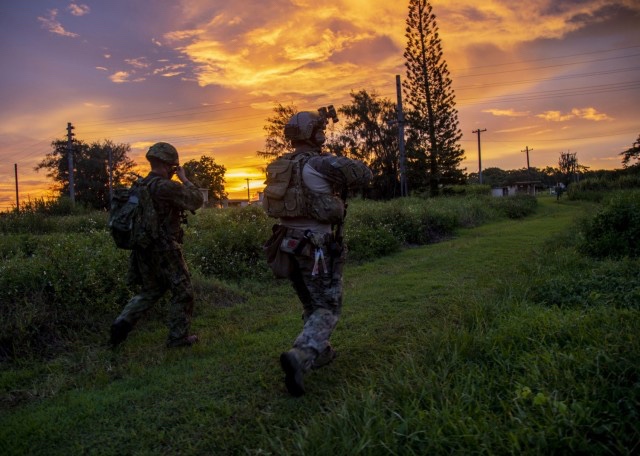
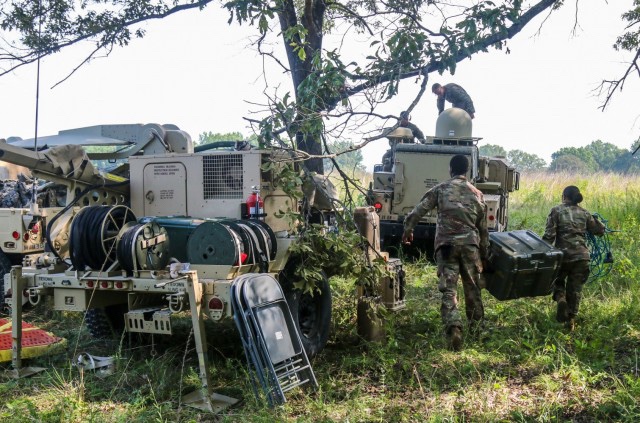
SCHOFIELD BARRACKS, Hawaii – Soldiers with the 25th Infantry Division conducted Exercise Lightning Forge 21 here from May 10 to 14 as part of a larger ongoing Army effort to modernize, test, and evaluate its Multi-Domain Task Force (MDTF).

These efforts focus entirely on defeating a competitor’s Anti-Access and Area Denial capabilities.

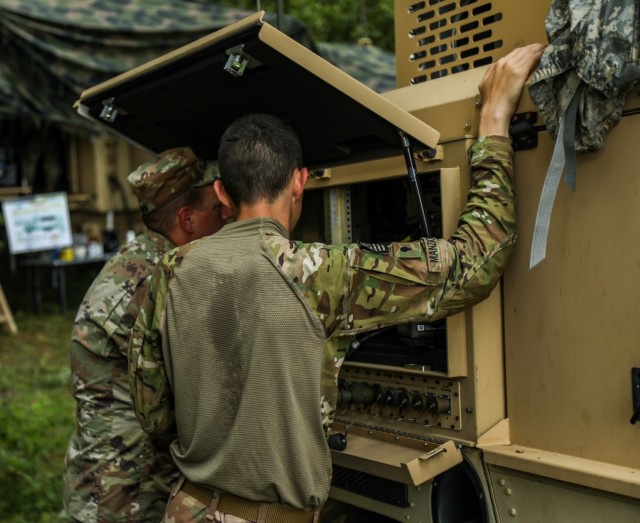
As part of these efforts, the 25th Inf. Div. conducted Multi-Domain Operations (MDO) targeting exercises, which allowed Soldiers to test systems and further develop concepts and methods for training and integrating Electronic Warfare and Signals Intelligence equipment as part of tactical operation.

Lightning Edge 21, in simultaneous conjunction with Exercise Northern Edge 21 in Alaska, validated over-the-horizon targeting integration between the 25th Inf. Div. and its higher headquarters, as well as the MDTF’s All Domain Operations Center (ADOC).

“The 25th Inf. Div. continues to play a significant role in the integration of these capabilities that support the MDTF,” said Maj. Peter Hwang, an officer assigned to the 25th Inf. Div. Intelligence section. “We understand that this integration of capabilities provides deterrence options for combatant commanders, which is why we train to achieve target refinement, handover, prosecution, and integration of MDO capabilities.”

Beyond the initial set-up and training that took place, the 25th Inf. Div. remotely connected to the MDTF through the ADOC at Joint Base Lewis-McChord (JBLM), Washington in order to enable a shared Common Operating Picture (COP), exchange over-the-horizon data, and to take action against simulated targets on Oahu.

“As America’s Pacific Division, we must train and be prepared to fight in a joint environment,” said Lt. Col. Michael Kotich, the 25th Inf. Div. chief intelligence officer.  “This requires synchronization, being embedded with other services, and, most importantly, integrating our own systems to allow us to see the COP in order to explore ways to deter competitors.”

“These are the sort of processes that we can only become experts at through multiple iterations of training exercises like Lightning Edge,” Kotich added.

The first MDTF originally had a field artillery brigade at its core that merged with an Intelligence, Information, Cyber, Electronic Warfare and Space, or I2CEWS, at JBLM.

A second MDTF is being planned for activation in Europe later this year.

These total force capabilities take into consideration the requirements that future battlefields may have.

“It is critical that we train accordingly and to do our best to integrate multi-disciplinary capabilities to achieve dominance across all domains,” said Hwang.

By MAJ Tania Donovan