FirstSpear

Archive for the ‘Army’ Category

Explosive Ordnance Disposal Techs Pioneer Innovative Method to Clear Stuck Artillery Round

Wednesday, March 20th, 2024

FORT SILL, Okla. – U.S. Army Explosive Ordnance Disposal technicians demonstrated flexibility, ingenuity and resourcefulness during a recent response to a lodged round in a M109A6 Paladin howitzer on Fort Sill, Oklahoma.

Army EOD Soldiers, from the 761st Ordnance Company (EOD) safely cleared the projectile that jammed during howitzer training.

Staff Sgt. Cody A. Dodd, an EOD team leader from the 761st EOD Company, coordinated with the Naval Explosive Ordnance Disposal Technology Division (NAVEODTECHDIV) to implement a new strategy to clear the lodged round.

The U.S. Navy is designated as the joint service Executive Agent for EOD Technology and Training. Part of the Naval Sea Systems Command, the Naval Explosive Disposal Technology Division is used by all EOD technicians for joint EOD requirements.

“This response was unique because it is rare to receive such an incident,” said Dodd. “Being at Fort Sill, home of the artillery, you would think this is a common occurrence. However, that is not the case. I’ve been stationed here for two years and this is the first incident like this.”

After the usual stuck round procedures were unsuccessful, Dodd and the field artillery battalion commander determined that the safest course of action was for the disposition of the gun barrel and ordnance inside.

Dodd led the team that disposed of the round while it was still lodged by moving the barrel to the demolition range and assisting in the download of the 4,500-pound tube. EOD team was able to safely destroy the stuck round and the Paladin will be operational again after repair parts are installed.

“This is important to the supporting artillery units because a stuck round causes the gun to be completely inoperable,” said Dodd, a native of Wellsburg, West Virginia, who has deployed to Afghanistan and Syria during his almost nine years in the Army. “It is our job to make all efforts to attempt to enable the gun to be at a firing status again.”

Dodd said the response will serve as a lesson learned for future joint service EOD operations involving stuck rounds.

“The highlight of this response would be the demolition procedure conducted on the gun tube and ordnance,” said Dodd. “With guidance from NAVEODTECHDIV, we were able to contribute to the overall EOD force for future incidents involving this ordnance.”

The Fort Sill, Oklahoma-based 761st EOD Company is part of the 79th EOD Battalion, 71st EOD Group and 20th Chemical, Biological, Radiological, Nuclear, Explosives (CBRNE) Command, the U.S. Department of Defense’s premier CBRNE formation.

From 19 bases in 16 states, Soldiers and Army civilians from 20th CBRNE Command take on the world’s most dangerous hazards in support of joint, interagency and multinational operations.

As the U.S. Army’s explosive experts, EOD technicians take on everything from hand grenades to nuclear weapons. After defeating more than 50,000 Improvised Explosive Devices in Iraq and Afghanistan, Army EOD techs are training to support ground maneuver forces during large-scale combat operations.

Army EOD technicians from the 761st EOD Company conduct target insertion, range clearance and fire break clearance missions for U.S. Army field artillery and air defense artillery units.

EOD technicians from the 761st EOD Company also enable military operations around the world and respond when military munitions are found on and off base in Oklahoma, Arkansas and across 60 counties in Texas.

Based on Fort Sill, Oklahoma, the 1-78th Field Artillery Battalion trains and educates Soldiers in fire support core competencies to support operational Army forces.

Lt. Col. Brian J. Dermody, the commander of the 1-78th Field Artillery Battalion, presented coins to the Soldiers involved in the response.

“Our fires mission is an absolutely critical part of the U.S. Army’s shift to preparing for large-scale combat operations against a near-peer adversary,” said Dermody, a native of West Chester, Pennsylvania, who has commanded the artillery battalion since July of 2023. “EOD technicians like Staff Sgt. Dodd take on the dangerous and demanding role of helping to keep us mission ready.”

By Walter T. Ham IV

1st Space Brigade’s Tactical Close Space Support is on the Move

Tuesday, March 19th, 2024

WHITE SANDS MISSILE RANGE, N.M. — Partnering with joint and coalition forces, U.S. Army Space and Missile Defense Command’s 1st Space Brigade continues to experiment with new tactical space control technology to support the warfighter in increasingly complex and contested environments.

Soldiers with the brigade’s 18th Space Company participated in experimentation at White Sands Missile Range during Project Convergence-Capstone 4 from mid-February into early March to advance the Army space, cyber and special operations forces “Triad’s” ability to conduct space operations at the tactical edge.

Project Capstone, an experiment hosted by U.S. Army Futures Command, saw warfighters from across the U.S. military and allied countries including the Five Eyes nations – United States, United Kingdom, Canada, Australia and New Zealand – as well as France and Japan, explore the future of warfighting communications, operations and maneuver.

As part of the first phase of PC-C4, these space Soldiers experimented with a small form factor system to determine if the kit fulfilled the Army’s current demand for a ruggedized, tactical space control system.

While the brigade’s current program of record is mobile, the Army is seeking technology that allows the capability to be hand-carried by the Soldiers themselves or transported by small tactical vehicles.

“Larger space capabilities cannot effectively integrate with more expeditionary units, such as SOF,” said Capt. Noah Siegel, Triad Experimentation Team platoon leader, 18th Space Company. “Shrinking our equipment and focusing on mobility allows our Soldiers to provide space support to units of all types at or beyond the tactical edge. For warfighters on the ground, this tactical space support enables the synchronization and convergence of joint and multidomain effects to enhance lethality.”

Amid the desert scrub and sand at the base of the Organ Mountains, the 1st Space Brigade Soldiers operated the small form factor from the back seat of the utility task vehicle – driven by soldiers with the British Army Special Operations Brigade – to demonstrate how space operations crews not only support American SOF partners but integrate with friendly coalition forces.

At the tactical level, Army space capabilities, such as the small form factor, would enhance ground maneuver formations’ ability to see, sense, stimulate, strike and assess across the spectrum. Special operations forces allow space Soldiers deeper physical access into austere operating environments.

“It was great to see the similarities and differences in how space, signal, cyber, as well as U.S., U.K., and Australian SOF partners operate,” said Sgt. Jon Rizzo, 18th Space Company. “We enjoyed working with these forces and exploring where and how we can fit in.”

Though the small form factor is not an Army program of record, experimentation initiatives such as PC-C4 allow the Army to assess the suitability of certain equipment to inform future programs of record.

Data and lessons learned from the brigade’s experimentation during PC-C4 was presented at Camp Pendleton, California, to Department of Defense senior leaders, allies and partners on March 4-5.

Story by Brooke Nevins 

U.S. Army Space and Missile Defense Command

75th Ranger Regiment Medics Prove They’re the ‘Best of the Best’

Saturday, March 16th, 2024

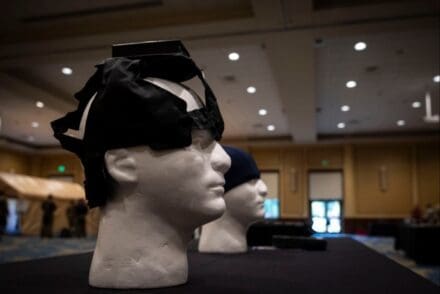
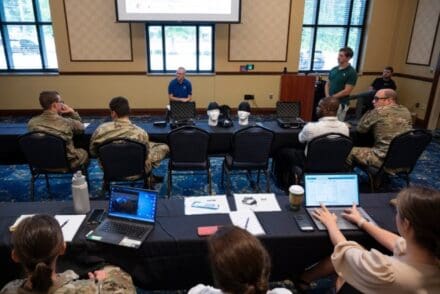
Fort Liberty, N.C. — The 2024 Command Sgt. Maj. Jack L. Clark, Jr. U.S. Army Best Medic Competition was held from March 4-8, at Fort Liberty. This year’s winners are Staff Sgt. Patrick Murphy, 75th Ranger Regiment, and Staff Sgt. Ryan Musso, 75th Ranger Regiment, both of Hunter Army Airfield.

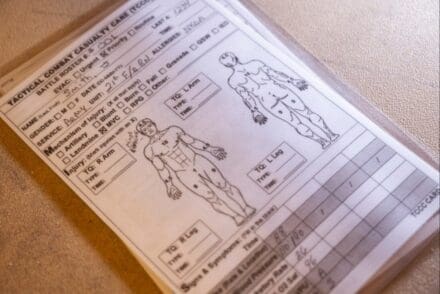
The Army Best Medic Competition is a two-Soldier team competition that physically and intellectually challenges the Army’s top medics in a three-day event that includes a realistic simulated operational environment. The competition pushes Soldiers to their limits to test their tactical and technical operational medicine capabilities — the skills required to bring the injured, ill or wounded warfighter home. More than 50 competitors squared off in teams of two for this year’s competition.

“This is about our Soldiers having combat ready care on the battlefield [in order] to be the most lethal force,” said Lt. Gen Mary K. Izaguirre, Surgeon General of the Army and commanding general of Army Medical Command, at the finish of the competition’s mystery event. “[Soldiers] are going to need everything we ask of you.”

The course tests medical skills and physical capabilities. However, the rigor prepares medics for combat deployments or any other demanding assignment the medics needs to do.

The competition is designed to simulate a realistic environment that includes emerging threats and to represent real-world combat conditions.”

“This competition makes me want to train harder,” said Musso. “To bring my [Soldiers] up to the level where we had to be over the last few days.” Musso said the hardest part was pushing himself farther than he had before.

The competition included events such as were foot marches, prolonged field care, weapons qualifications, day and night land navigation, knowledge test, and a mystery event and of a series of tasks the medics might face on the battlefield.

“Really glad to see all the hard work paid off,” said Murphy. “The hardest event for me was the dragging the Skedco for more than two miles.” (Editor’s note: A Skedco is a stretcher system used for transporting patients.)

Command Sgt. Maj. Timothy Sprunger said to the competitors at the conclusion of the final event, “We were here to find the best of the best. Congratulations.”

Army medics serve as the first line of care for injured, ill or wounded Soldiers and ensures medical readiness. They must be ready when called upon to deploy, fight and win in combat.

“They put it all out there,” said Sprunger. “They did a great job.”

The Command Sgt. Maj. Jack L. Clark, Jr. Army Best Medic Competition is dedicated to the 13th command sergeant major of the U.S. Army Medical Command. Clark was one of the most respected leaders and noncommissioned officers in the history of the command who understood the important role of medics in the Army and the trust Soldiers and leaders of units in combat must have in the Army Medical Department.

The competition is open to all active duty, Army National Guard and Army Reserve medical soldiers who have earned the competitive Combat Medical Badge or Expert Field Medical Badge.

Both Musso and Murphy agreed that future medics considering the competition should, “put themselves in really hard situations and force themselves to not quit.”

By Ronald Wolf

Army Enters into Development Phase of the Joint Targeting Fires Product

Monday, March 11th, 2024

ABERDEEN PROVING GROUND, Md. — The Army has officially started development of a new software that will automate the fires targeting process, giving commanders rapid data, situational awareness, and visualization to successfully deliver fires.

The software, known as Joint Targeting Integrated Command and Coordination Suite, or JTIC2S, will replace the Joint Automated Deep Operations Coordination System, JADOCS, and provide fires targeting capability and a joint fires targeting common operational pictures across forces.

Now in the engineering and manufacturing development phase, the Army will develop the software’s first iteration known as the minimum viable product, conduct testing in the field, incorporate Soldier feedback and then look to industry to further develop the software’s capabilities.

“Entering this phase of development is an exceptional achievement and a critical step to consolidating safety-critical fires software onto a single baseline,” said Col. Matthew Paul, project manager for Mission Command at Program Executive Office, Command, Control, Communications – Tactical, known as PEO C3T. “While JADOCS has served the Army well for more than 30 years, moving to JTIC2S will allow us to keep pace with the speed of technology, evolving Army priorities, and help us deliver a product that is effective for the warfighter.”

PEO C3T has determined the JTIC2S and the Advanced Field Artillery Tactical Data System Artillery Execution Suite and collective capabilities/development effort is considered a Fires Safety Critical Baseline. This capability will leverage a common back-end architecture, an open application programming interface and a common/intuitive role-based user interface shared by all fire support command and control and mission command systems using Tactical Assault Kit software.

As a software-only program, JTIC2S will link sensors to shooters without the need for specific hardware. It will provide rapid target engagement, near real-time access to friendly and enemy unit data, and be fully interoperable with Army, joint, intelligence community and coalition forces systems. Military service branches across echelons will utilize the functions within JTIC2S to support combined joint all-domain command and control and joint all-domain operations against a near-peer adversary.

Data, once tracked through Excel and PowerPoint files, will now be automated and displayed through 4D visualization to help commanders see themselves in time and space. The new system will utilize Tactical Assault Kit, a situational awareness web application that provides quick access to a common operating picture. JTIC2S will also be able to process varying data formats and leverage artificial intelligence and machine learning to aid commanders and forces in the decision-making process.

“Modernizing this software means the Army will be agile and responsive to the needs of the operational force,” said Lt. Col. Timothy Godwin, product manager for PEO C3T Fire Support Command and Control. “It will also be backwards compatible with JADOCS so that joint forces that continue to use JADOCS will still be able to communicate effectively. We know that theaters fight differently. Developing JTIC2S as a software only program will help us integrate into any network, and as technology enhances, we can make changes without a lot of time and money.”

The Army plans to use a multi-vendor approach for contracting and will be seeking various industry partners later in the fiscal year to help build this iterative software in addition to Advanced Field Artillery Tactical Data System Artillery Execution Suite and the Fires Safety Critical Baseline.

By Danielle Kress, PEO C3T Public Affairs

US Army Special Operations Museum Launches New Exhibit

Sunday, March 10th, 2024

WASHINGTON — On March 14th, 2024, the U.S. Army Special Operations Museum will launch an exciting new exhibit, “Opening the Vaults” at Fort Liberty, North Carolina, formerly Fort Bragg.

Opening The Vaults: Treasures of the Fort Liberty Museums is a temporary exhibit that will present rare and never-before-seen artifacts from the Fort Liberty Museums and historical holdings.

The exhibition is a collaborative effort with the John F. Kennedy Special Warfare Museum, 82d Airborne Division War Memorial Museum, U.S. Army Reserve Command History Office, and the 503d Military Police Battalion (Airborne).

ASOM, constructed in 2000, is the first U.S. Army Museum built outside the perimeters of an Army installation. Artifacts from the Fort Liberty Museum Enterprise as well as assets from the U.S. Army Center of Military History (John F. Kennedy Special Warfare Museum) will be housed together and accessible to the public, in the heart of downtown, Fayetteville, North Carolina.

Jim Bartlinski, Director of the Fort Liberty Museum Enterprise, said, “we thought that this would be a good opportunity not only to showcase rare artifacts, and never before seen artifacts, that we have here at ASOM, but also to give folks who necessarily don’t know about the museums on Fort Liberty the chance to see what those museums offer.”

This exhibition tells the story of the Army Reserve, Special Forces, and the 82d Airborne Division.  “So, it is a great collaborative effort for all of us.”

Historical panels were designed for each museum’s section by the John F. Kennedy Special Warfare Museum. The 503d Military Police Battalion, the only airborne military police battalion in the U.S. Army provided uniformed mannequins to “guard” the vault, while drawing in visitors to the exhibit.

The exhibit will also feature a “Seek and Learn” activity geared towards interacting with children to learn about the history of the U.S. Army, developed by ASOM’s Volunteer Coordinator, Laura Monk.

ASOM Curator, Jimmie Hallis, said, “The exhibit is a first of its kind at the Fort Liberty Army Museum Enterprise.”

“Everyone (involved in the exhibition) jumped right on board with it. Up until the artifact installation dates, I really didn’t even know what the other museums would bring. The selection of artifacts run the history realm, from the Civil War to the Global War on Terror, there is something for everyone to see,” Hallis said.

To see the exhibit, visit the U.S. Army Special Operations Museum web page for location and operating hours. Go to: history.army.mil and click on the Museums tab.

Story by CPT Janeen R. Phelps

Photos by James Bartlinski

School’s in Session: Report to the Tower

Sunday, March 10th, 2024

With harnesses on their hips, hardhats on their heads and rope in their hands, soldiers participating in air assault school rappelled off towers at Camp Buehring, Kuwait.

During air assault school, soldiers train on rotary wing aircraft, aircraft safety, aeromedical evacuation procedures, pathfinder operations, principles and techniques of combat assaults, rappelling techniques and sling-load operations. These trainings prepare soldiers to make use of their helicopter skills in combat.

Courtesy DoD News Service

Photos by Army SGT Vincent Levelev

BAE Systems Has Delivered a First-In-Its-Kind Armored Multi-Purpose Vehicle (AMPV) Turreted Mortar Prototype to the US Army

Friday, March 8th, 2024

The prototype showcases a newly designed top plate system—the External Mission Equipment Package (ExMEP)—that allows for the easy installation of a variety of turrets. This vehicle prototype is also outfitted with the Patria NEMO remote-controlled 120mm turreted mortar system.

The result of a rapid collaborative technology investment effort involving the U.S. Army, BAE Systems, and KONGSBERG/Patria, the prototype demonstrates potential variant growth for the highly adaptable AMPV family of vehicles. By using a fielded and fully-qualified asset like the AMPV chassis, it gives the Army options to field combat capabilities—such as the Patria NEMO—to Soldiers who need them at a much faster pace and reduced cost.

“Handing this remarkable capability over to the Army for evaluation is an important step in creating broader multi-purpose options for Soldiers to maintain combat overmatch on the battlefield,” said Bill Sheehy, BAE Systems AMPV program director. “The AMPV Turreted Mortar prototype was born from a capability discussion we had with the Army in 2022—the same year ExMEP was conceptualized with industry partners, and we look forward to its evaluation. The collaborative, future-driven approach to develop it will benefit the warfighter, and that is what the AMPV program is all about.”

The AMPV Turreted Mortar prototype that leverages BAE Systems’ ExMEP to rapidly integrate the NEMO 120mm mortar system is an indirect and direct fire support platform that can be used in multi-mission scenarios. The system enables Multiple Rounds Simultaneous Impact fire missions where up to five mortar rounds can hit targets simultaneously in less than four seconds while the vehicle is stationary or on the move.

The AMPV Mortar Carrier variant, which is one of the five variants currently in production with the Army, is comprised of the legacy 120mm mortar system. This new AMPV Turreted Mortar prototype offers a significant enhancement that would not only allow for increased capabilities and force protection, but also keep Soldiers completely under the armor protection provided by the vehicle.

Over the next several months, the Army will run the AMPV Turreted Mortar prototype through rigorous field evaluations to mark its capabilities against what Soldiers would require in the battlefield.

This is the second turreted AMPV prototype in the last three months that BAE Systems has showcased, the other being a Counter-Unmanned Aircraft System (C-UAS) capability, that utilizes the ExMEP top plate. As the future of battle evolves, the purpose-built framework of the AMPV platform exemplifies endless opportunities for seamless capability integration for the Army’s Armored Brigade Combat Team.

Soldiers Prepare for Combat Operations in the Arctic

Friday, March 8th, 2024

WASHINGTON — Braving subzero temperatures, about 9,000 Soldiers clad in white camouflage gathered in Alaska for a joint, multinational exercise.

Soldiers engaged in 40 training events over two weeks to prepare for combat operations in the northernmost region on Earth. During the largest multinational training exercise in the Arctic to date, called Joint Pacific Multinational Readiness Center 24-02, the Army simulated large-scale training operations in cold weather conditions for the first time. They tested next-generation weapons and operated cold weather, all-terrain vehicles or CATV, snow mobiles to traverse the terrain.

“What we’ve learned in this exercise is you’ve got to be ready for the full spectrum,” said Maj. Gen. Brian Eifler, 11th Airborne Division commander.

Five countries participated in training from Feb. 8 to Feb. 22 including a Canadian battalion and elements from Mongolia, Australia, Finland and Sweden. Exercises which align with the Army’s Arctic Strategy, stretched from Anchorage in the south to Utqiagvik, Alaska, the northernmost city in the U.S.

Climate change has made the Arctic more navigable, and as part of the Army’s Arctic Strategy, service must be ready to deter and defend against potential adversaries in the region, Eifler said. The guidance details how the service will train, organize and equip forces and partner nations.

The Army deployed an entire division during one joint exercise, which had U.S. Soldiers playing roles on both sides. Two battalions simulated enemy forces, equipped with artillery and rockets, Eifler said.

During that exercise, U.S. Soldiers learned to fight without air superiority and support. The friendly forces embarked on a 150-mile simulated, deep attack to train Army pilots to weave in and out of air defenses.

Soldiers, Airmen and Marines took part in a joint multi-battalion, joint force entry exercise into the Donnelly Training Center drop zone, north of Fort Greely. Soldiers also faced the challenge of disguising equipment in a snowy environment.

“In this battlefield, it’s very hard to be camouflaged like we used to,” Eifler said. “In some spectrums, you’re observed, whether it’s electronics, whether it’s physical, informational … across the cyber space … so we had to create windows to do a deep attack.”

Finally, troops engaged in an air assault simulation with American and Canadian Chinook helicopters, UH-60 Black Hawks and two battalions.

“That distance and scope and scale hasn’t been done before,” he said.

Soldiers also tested how the Next Generation Squad Weapon, the XM7 rifle, fared in frigid conditions and found parts of the weapon caused frostbite. Soldiers also had to adjust their survival measures. In addition to carrying more water, troops melted ice blocks and purified snow to help themselves hydrate.

“In this environment, if you stop, you freeze, and you get hypothermia,” Eifler said. “But at the same time you’re sweating, and you need more water. So that really challenged our sustainment.”

“All Soldiers require grit,” he added. “But Arctic grit … is a little bit more.”

They also had to keep electronic and digital equipment, including monitors and keyboards at a consistent temperature while sometimes operating them amid hurricane-strength winds.

Eifler said the 11th Airborne’s reactivation in 2022 gave Soldiers of that unit a greater purpose and reinvigorated Soldiers assigned to the unit. The Army also reassigned the 4th Infantry Brigade Combat Team and 1st Stryker Brigade Combat Team under the 11th Airborne.

“The forces up here had no real unity, purpose and identity,” Eifler said. “Being aligned as a division now — as warfighting capable force has increased readiness in the Indo-Pacific and for the Arctic. The [realignment] was extremely strategic. When you don’t have an identity, it’s really tough, no matter what line of work you’re in. And that was transformational up here.”

Eifler said that Soldiers who took part in the exercise can earn an Arctic skill identifier certifying that they served in a cold weather environment. Some troops even requested extensions to continue serving in the remote location.

In the past the Army has faced challenges with Soldiers experiencing depression and feelings of isolation. Eifler said that more new recruits have requested assignments in Alaska.

“Having that mentality and having that mindset that winter’s here and summer is short, and winter’s coming tomorrow; having that attitude has really changed the culture up here,” he added. “And we’re actually retaining people that have that expertise.”

Soldiers have also leaned on the Alaskan Inuit population who have taught Soldiers how to survive in Arctic conditions. For example, Soldiers learned to use ice drills to stake tents on the frozen tundra. Soldiers flew 500 miles north to Utqiagvik to perform a rapid infiltration test of the M142 High Mobility Artillery Rocket System or HIMARS. They tested HIMARS on a C-130 in -20 degree weather.

Pilots had to take extra steps to start Apache engines in cold weather conditions. They tackled a wide range of temperature changes from wind chills 40 degrees below to temperatures 40 degrees above. They studied the differences between light snow, heavier snow and wet snowfall, Eifler said.

“The temperature wasn’t consistent, which made it just a great testing environment to go full gamut on everything we needed to do,” Eifler said. “And then it really tested the grit of the Soldiers.”

The Soldiers treaded into new territory during the exercises. Eifler said that warrant officer pilots submitted white papers for Army manuals on how to operate Apaches in extreme cold. About 18 multinational observers took part including representatives from France, Japan, Nepal and Chile.

Next month, during Exercise Arctic Shock in Bardufoss, Norway, Army paratroopers will fly over the North Pole and perform an air entry operation. About 150 Soldiers from the 11th Airborne and 100 members of the Norwegian Army will take part in the exercise from March 18 to March 22.

“We’ll continue to push ourselves up here,” Eifler said. “And increase the scale and scope of these exercises. Because we’ve got to be better; we’ve got to be challenged. And we’ve got to help the Army resource us and structure us properly so we can meet those threats tomorrow.”

By Joe Lacdan, Army News Service