TYR Tactical

Archive for the ‘Contracts’ Category

Danish Armed Forces Selects SIG P320 X-Carry

Thursday, April 12th, 2018

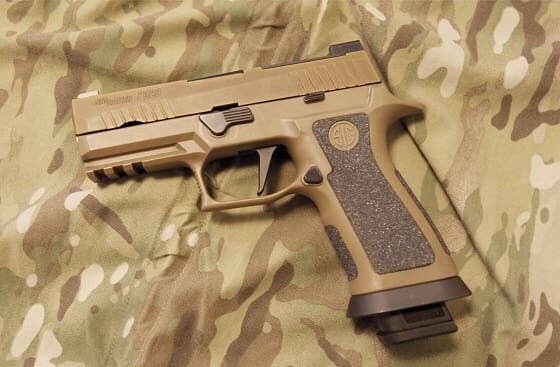
This is something we haven’t discussed. Late last year, the Danish Armed Forces adopted the SIG P320 X-Carry based on a tender overseen by the Ministry of Defense’s Food and Purchasing Board (FMI). The pistols are supplied by local vendor, CT Solution Aps.

According to the Danish Army, a total of four guns were tested and they were subjected to “all conceivable conditions” by users of the Special Operations, Military Police, Air Force and Army. The P320 was the best candidate in the four-week trial period. The test program was prepared by Hærens Kamp- og Ildstøttecenter (HKIC) in cooperation with FMI. of malfunction test, accuracy test, shooting in the dark and field field. The gun was also tested by experts from Direct Shooting Weapons (DSV) at HKIC. made drop test, penetration test and precision test.

The P320 will be supplied in two versions, a standard and a concealed carry version. These will replace all pistols in the Armed Forces, such as the M / 49 which would only carry 8 rounds compated to the 21 rounds of the P320.

Fielding has begun and the new pistol is expected to be full fielded to all units by the end of 2019 with new equipmemt training to be completed by the Commonwealth Defense Command (VFK).

This video from the Danish Defense’s YouTube Channel depicts the testing.

Thanks Keld!

Applied Fiber Concepts and Propper International Awarded New US Navy Body Armor Contract

Tuesday, April 10th, 2018

St. Charles, MO – Applied Fiber Concepts, Inc. and Propper International have been awarded a contract to manufacture the new Naval Security Forces Vest (NSFV) for the United States Navy.

The NSFV, which was awarded through a solicitation from the Naval Surface Warfare Center Panama City Division (NSWC PCD) for a new ballistic vest designed to protect sailors, consists of a base vest and modular components for tailoring protection levels to defeat multiple ballistic and fragmentation hazards while performing security and Anti-Terrorism/Force Protection (AT/FP) duties.

“We’re proud to partner with Applied Fiber Concepts, one of the industry’s most innovative ballistic protection providers,” said Anderson Ward, Senior VP, Global Supply Chain Operations for Propper. “The sailors who wear this armor can perform their missions with confidence.”

Michael Haynes, VP of Business Development for Applied Fiber Concepts, echoed that sentiment. “Providing advanced ballistic protection that can be configured to best fit the mission will allow the brave men and women responsible for keeping us safe to focus on their jobs and feel confident that they are protected.”

Applied Fiber Concepts will produce all the Level IIIA ballistic inserts, yoke, and collar assemblies and Propper will manufacture the outer carriers for the one-year contract that has an option for up to four additional years. All the ballistic material included in the NSFV is fully NIJ-certified and tested to perform up to NIJ 0101.06 standards, the highest standard for ballistic protection. Total contract production is projected to reach over 51,000 units.

Applied Ballistics Wins Military Contract to Advance Extreme Long-Range Sniper Capability

Thursday, March 29th, 2018

Applied Ballistics Wins Military R&D Contract
Precision Shooting Tech Company Funded to Advance Extreme Long-Range Sniper Capability

Cedar Springs, MI: Applied Ballistics LLC, a Michigan-based tech company focused on advancing the state of the art in long range rifle shooting, has been awarded a $1.3M contract by the Combating Terrorism Technical Support Office (CTTSO) to execute Phase 1 of the Extreme Sniper Strike Operations (ESSO) project.

Phase 1 of the ESSO project is focused on advancing the predictive capabilities of modern ballistic solvers by performing Doppler radar measurement and modeling of current service rounds at Extreme Long Range (ELR) as a function of gyroscopic stability, and refining the models of secondary ballistic effects such as spin rate decay and spin drift at ELR. Phase 1 will conclude with the ballistic modeling enhancements being integrated into the existing Applied Ballistics ecosystem of electronic devices which are currently deployed by numerous US and allied armed forces around the world. Phase 1 is scheduled for completion in late 2018.

Phase 2 of the ESSO project is a potential follow on (2019) that focuses on the development and fielding of an advanced ELR sniper rifle system designed to drastically increase first round hit probability at ELR on man sized targets. The Applied Ballistics Weapons Division is currently conducting research and development on weapons platforms, as well as new cartridge and bullet options, that will maximize ELR ballistic performance from lightweight, practical, magazine fed systems.

Bryan Litz, owner of Applied Ballistics LLC, said: “Our team of Aerospace, Mechanical, Electrical and Computer Science Engineers and Technicians will apply our combined experience including years of testing and competing in ELR Shooting to the successful completion of the ESSO program objectives. This means extending the maximum effective range of US and allied snipers, achieving decisive overmatch on the battlefield. I can’t imagine a better application of Applied Ballistics’ collective efforts.”

appliedballisticsllc.com

Ballard Subsidiary Protonex Receives $1.9M Follow-On U.S. Army Power Manager Order

Tuesday, March 27th, 2018

VANCOUVER, B.C., CANADA and SOUTHBOROUGH, MA, USA – Ballard Power Systems (NASDAQ: BLDP; TSX: BLDP) today announced that the Company’s subsidiary, Protonex, has received a $1.9 million follow-on purchase order for the supply of SPM-622 Squad Power Manager Kits to support U.S. Army Security Force Assistance Brigades (SFAB).


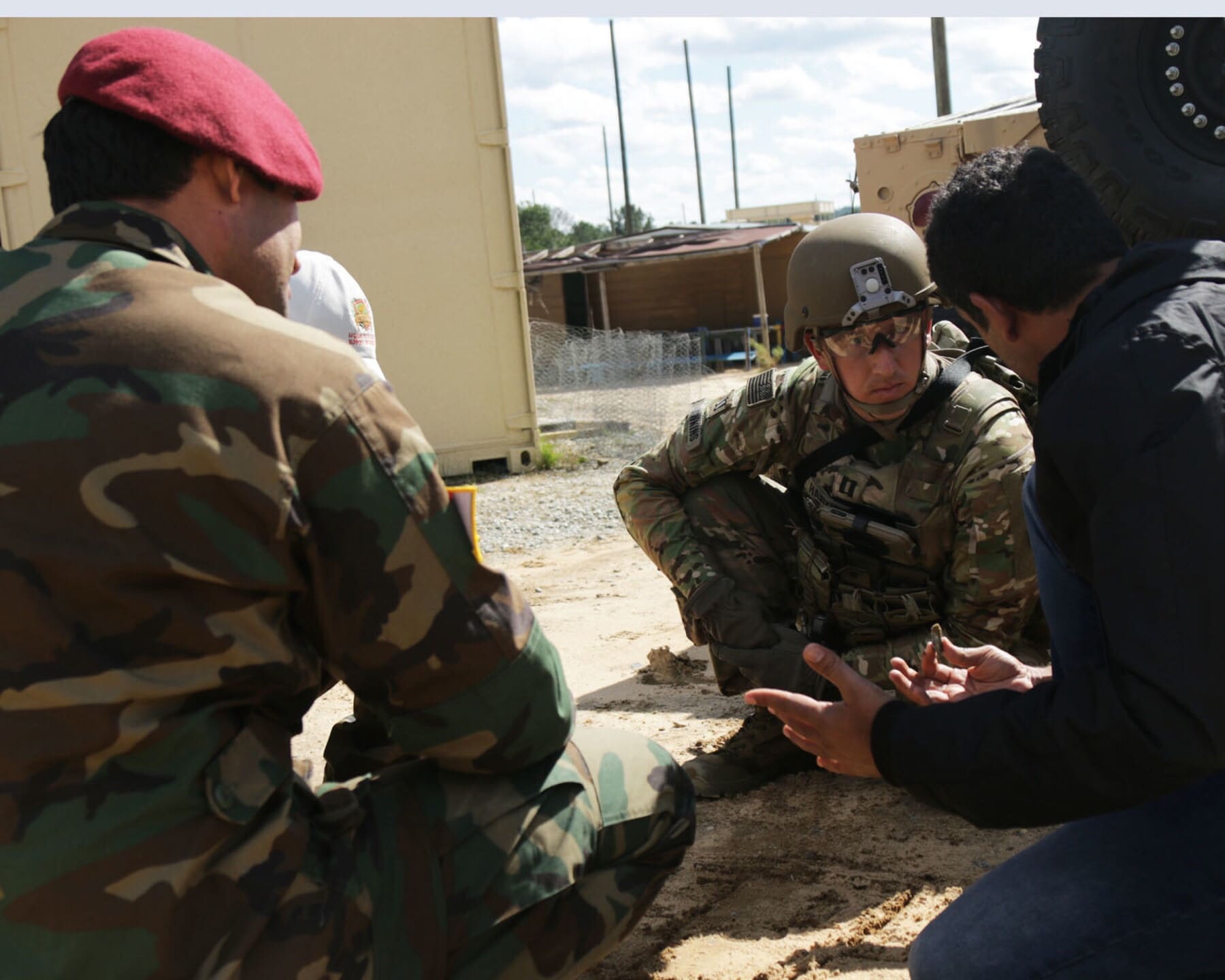
Capt. Christopher Hawkins, of the 1st Security Force Assistance Brigade, and an interpreter speak with local national soldiers to gain information about a village during training Oct. 23 at Fort Benning, Ga. (Spc. Noelle E. Wiehe/Army)

“This follow-on order through the Program Executive Office (PEO) – Soldier supports the mission of the U.S. Army’s Security Force Assistance Brigades,” said Ray Summers, Protonex Director of Military Sales. “The SFAB’s work is critical in supporting partner training in austere environments and the U.S. Army’s focus on these field forces is contributing to the growing demand for power management solutions.”

The SPM-622 Squad Power Manager is a tough and compact device which weighs less than a pound and enables military units to optimize power for multiple electronic devices, including portable radios, GPS systems, medical instruments, Explosive Ordinance Demolition equipment as well as tablet and laptop computers.

The SPM-622 can draw power from any source – including battery, solar, vehicle, AC, or scavenged energy sources – to run equipment or recharge batteries. It delivers deployment-proven benefits to military forces that include:
• Dependable power for more than 100 electronic devices currently used by troops;
• Lightened load for troops in the field by reducing their battery burden;
• Reduction in battery logistical support requirements; and
• Increased energy flexibility for troops operating in austere environments.

The SPM-622 Squad Power Manager system is developed and is produced by Protonex at the company’s facility in Southborough, Massachusetts. To date more than 5,000 units have been deployed by the United States and NATO Partner Nations.

www.ptxnomad.com

US Army Awards Norotos $35 Mil Contract For Night Vision Mounts

Tuesday, March 27th, 2018

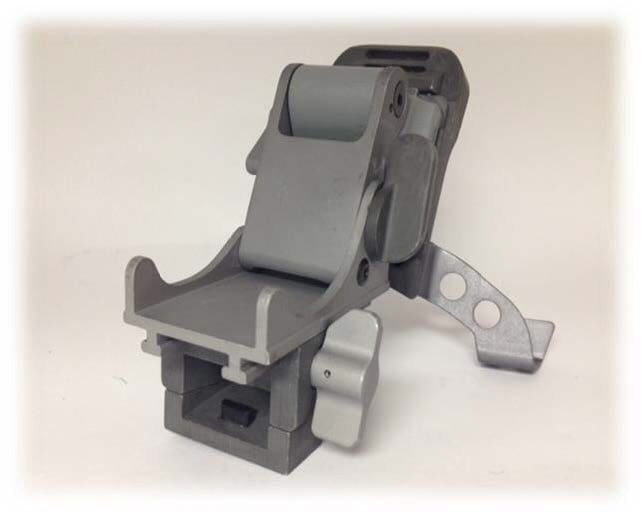
The US Army recently announced a $35 million contract for the Norotos RHNO II – Helmet Mount configured either for MICH/ACH helmet, or PASGT helmet, as follows:

PN 1955010-1 RHNO II Helmet Mount Assembly, PASGT

PN 1955010-2 RHNO II ACH Helmet Mount Assembly, MICH

Norotos Inc.,* Santa Ana, California, has been awarded a maximum $35,625,106 firm-fixed-price, indefinite-delivery/indefinite-quantity contract for helmet mounts for night vision systems. This was a competitive acquisition with two responses received. This is a five-year contract with no option periods. Location of performance is California, with a March 23, 2023, performance completion date. Using military service is Army. Type of appropriation is fiscal 2018 through 2023 Army working capital funds. The contracting activity is the Defense Logistics Agency Land and Maritime, Aberdeen Proving Ground, Maryland (SPRBL1-18-D-0010).

www.norotos.com

Federal Receives Five-Year Duty Ammunition Contract from Norway, Sweden and Denmark

Sunday, March 18th, 2018

ANOKA, Minnesota – March 15, 2018 – Federal Premium is proud to have secured a significant ammunition contract with the Swedish Police Authority, Danish National Police and Norwegian Police. These forces have committed to a five-year contract beginning in 2018 for the delivery of 223 Rem./5.56x45mm Tactical Bonded and 308 Win. Tactical Bonded Tip ammunition for use in all duty rifles.

“Police in Norway, Sweden and Denmark will now be relying on Federal Premium in their duty rifles to keep their residents safe and protected,” said Federal Premium President Jason Vanderbrink. “We’re extremely proud of this important contract. Our Tactical Bonded ammunition was chosen for its reliability, accuracy, terminal performance and ability to defeat barriers.”

Designed to penetrate the toughest barriers while maintaining terminal performance, both rounds have quickly become the choice for some of the most intense duty situations. The 308 Win. load in particular achieves accuracy and terminal performance unmatched by other ammunition.

Federal Premium is a brand of Vista Outdoor Inc., an outdoor sports and recreation company. For more information on Federal Premium, go to www.federalpremium.com.

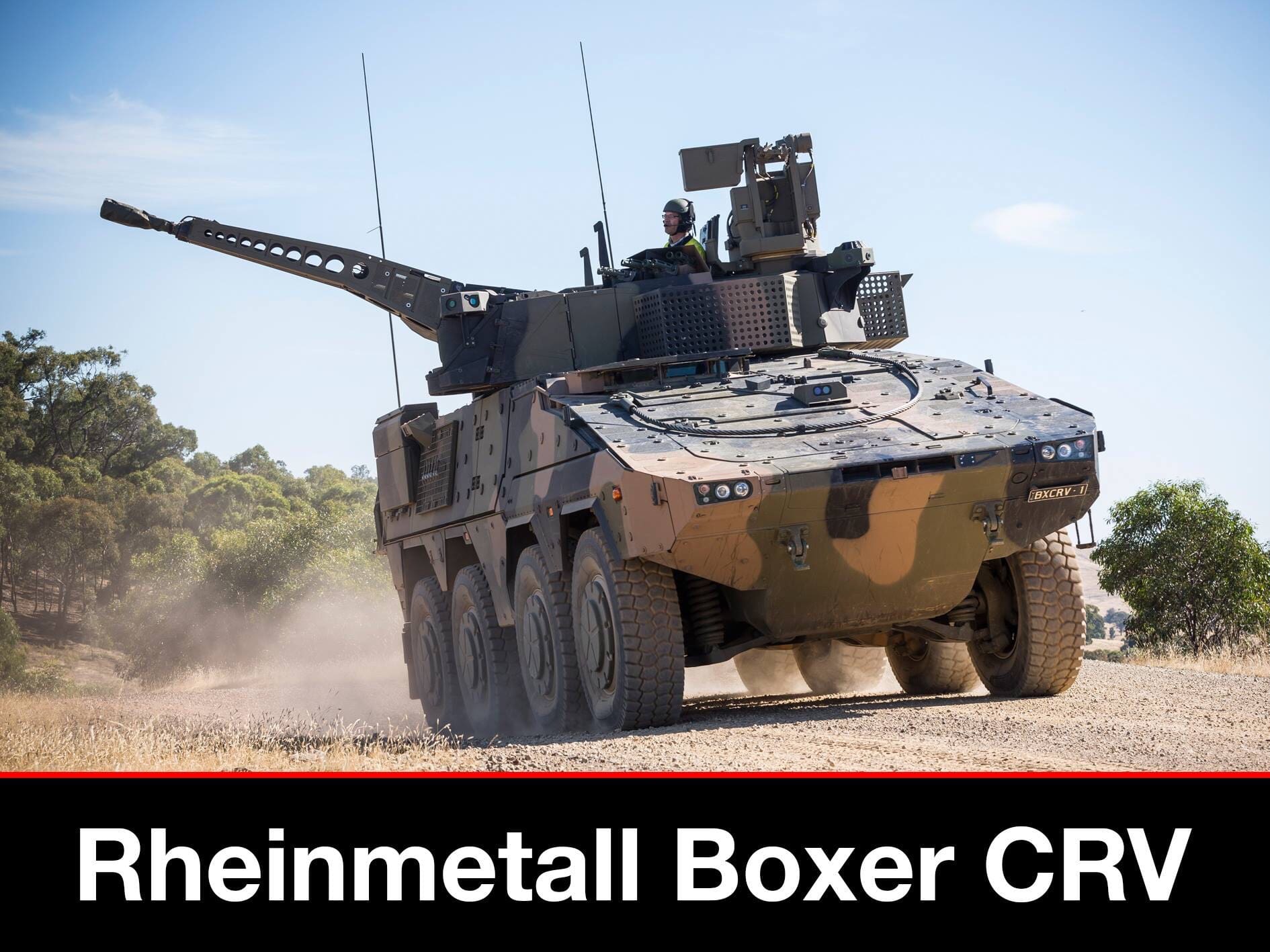
Australian Army – LAND 400 Phase 2 Announcement: Rheinmetall has been selected to deliver Australia’s new Combat Reconnaissance Vehicle, the Boxer CRV

Thursday, March 15th, 2018


Following a rigorous testing process, Rheinmetall’s Boxer CRV was assessed as the most capable vehicle for the Australian Army. The vehicle will enhance the safety, security and protection of our troops, and will replace the ageing Australian Light Armoured Vehicle (ASLAV).

The vehicles will be equipped with high levels of protection; firepower and mobility provided by the vehicles will be used for operations, varying from peacekeeping to close combat. They will able be used at facilities in Puckapunyal, Bandiana, Adelaide, Townsville and Enoggera.

The Boxer will be manufactured in South East Queensland and use over 24 manufacturers located across Australia.

Photo: LTCOL McKendry

US Army Issues Next Generation Squad Automatic Rifle Prototype Opportunity Notice

Wednesday, March 14th, 2018

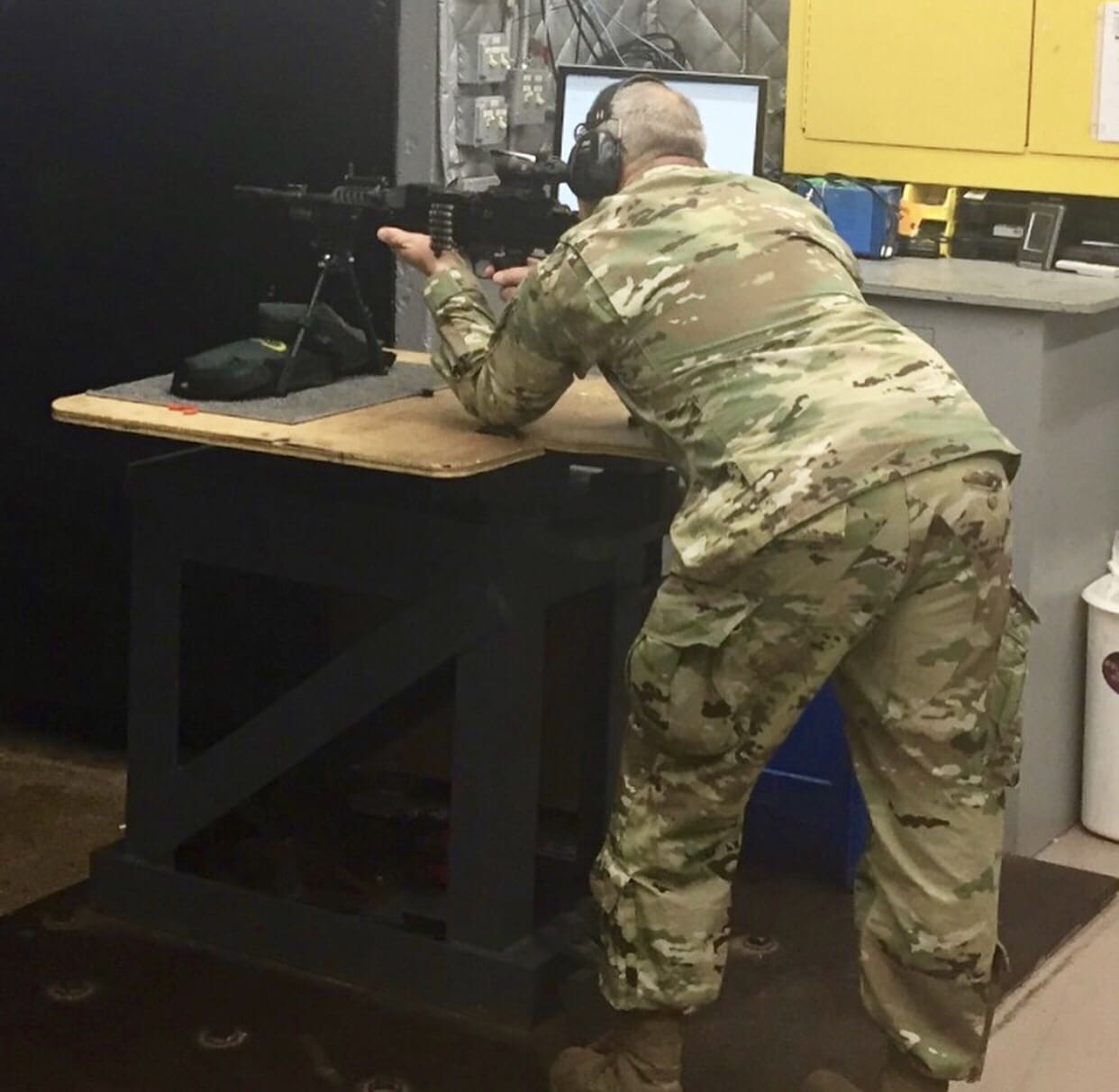
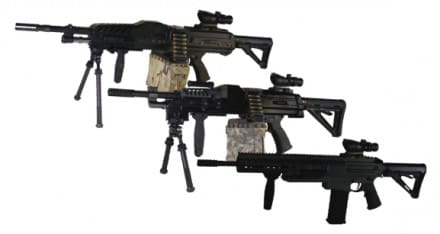
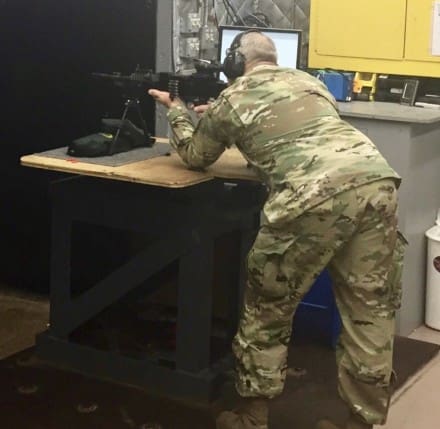
The U.S. Army Contracting Command – New Jersey (ACC-NJ), on behalf of Project Manager Soldier Weapons, is seeking proposals in regards to a Prototype Opportunity Notice (PON) for Next Generation Squad Automatic Rifle (NGSAR). The NGSAR is the first variant of the Next Generation Squad Weapons. The NGSAR will address operational needs identified in various capability based assessments and numerous after action reports. The NGSAR is the planned replacement for the M249 Squad Automatic Weapon (SAW) in Brigade Combat Teams (BCT). It will combine the firepower and range of a machine gun with the precision and ergonomics of a rifle, yielding capability improvements in accuracy, range, and lethality. The weapon will be lightweight and fire lightweight ammunition, improving Soldier mobility, survivability, and firing accuracy. Soldiers will employ the NGSAR against close and extended range targets in all terrains and conditions. The NGSAR support concept will be consistent and comparable to the M249 SAW involving the Army two-level field and sustainment maintenance system.
7944C214-1C76-4A39-9C3D-033DD4DB8E5E

Significance
NSGAR promises to be the most significant change to small arms technology since the 1960s. In one program, they hope to replace both the M4 carbine and M249 SAW. Hopefully, this won’t prove to be another Individual Carbine program where industry spends millions of Dollars and offers significant improvement, but institutional momentum gets in the way of progress. Fortunately, the Chief of Staff of the Army supports this initiative, but the program schedule will take it out long past his tenure. Hopefully, it will remain an Army priority.

Acquisition Methodology
The US government is trying to speed up the way it procures material for the Department of Defense. This program’s means of acquisition is a lot more like how the military procured the Joint Light Tactical Vehicle than how they purchased Modular Handgun System.

The Army’s schedule for NSGAR is also very aggressive. Lots of time and money has been spent on the Lightweight Small Arms Technology development effort which has been used to inform this effort. It’s gotten them this far, but the fact that they are moving forward with NSGAR tells me that at least someone realizes it’s still not yet ready for prime time. That means we are going to see a lot of new ideas with NSGAR.
0C7B66A1-5528-424F-BAC0-B9D2A7D7F387

Deliverables
The purpose of this PON is to award up to five Prototype OTAs with the goal of developing, within 12 months, a system demonstrator representative to include a functional prototype weapon, 2,000 rounds ammunition(s), fire control (day and night), bipod, suppressor, enablers (optional), spare part(s) to support firing 2,000 rounds, special tools, and operator manuals capable of firing and demonstrating the proposed capabilities to meet the lethality requirements. The goal is to develop system demonstrator representative of a Technology Readiness Level (TRL) 6 and Manufacturing Readiness Level (MRL) 6.

A system Demonstrator refers to a functional prototype weapon, 2,000 rounds ammunition(s), fire control (day and night), bipod, suppressor, enablers (optional), spare part(s) to support firing 2,000 rounds, special tools, and operator manuals capable of firing and demonstrating the proposed capabilities to meet the lethality requirements.

Follow-On
Following these efforts, a full and open competitive PON for a follow-on system integration prototype project may be announced. Participation in this system demonstrator PON is not required for participation in the follow-on system integration prototype project.

This Future Follow-On System Integration Prototype Project may be initiated with a new competitive PON requiring a system demonstrator (minimum TRL 6, MRL 6) bid sample and proposal. The combined evaluation of bid sample test results and proposal may result in the award of up to three independent OTAs. The OTAs may include decision points (e.g. Critical Design Review (CDR), Test Readiness Review (TRR), Product Qualification Test (PQT), and other critical tests) to continue or discontinue the OTA throughout the acquisition cycle. The system integration prototype project may include a full system integration, ensure a producible product that is safe, interoperable, affordable and sustainable through modeling, simulation, user evaluation and testing with a goal of delivering production representative systems achieving a TRL 8 and MRL 8. OTA deliverables may include 350+ weapons with fire control and other enablers, over 1,500,000 rounds of ammunition, spares, special tools, and manuals. Successful completion of the system integration prototype project may qualify Awardees for continuation into a follow-on production and deployment (P&D) effort without further competition.

Although the government states that a vendor need not participate in this go around to bid on the next, past experience has shown that participants in the initial effort glean a great deal of feedback, giving them an obvious advantage.

After that, the government may pursue a Future Follow-On P&D Effort(s), awarding up to two independent follow-on production OTAs or up to two independent Federal Acquisition Regulation (FAR) based contracts with a period of performance up to ten years. The P&D effort may include low rate initial production, operational test and evaluation, full rate production, fielding, and sustainment capability. Deliverables may include over 15,000 weapons with fire control and other enablers, over 30,000,000 rounds of ammunition with planned transition to Government run production (pending intellectual property if required), spares, special tool, manuals, and depot support.

Industry Challenges
Teams must be formed which include Weapon, Ammunition, and Electronics manufacturers. Due to the fast pace of this program, if they aren’t already working together on a strategy, both they and the government will miss out. Additionally, as I’ve critiqued in the past, the insistence on classifying program data has served as a bar to entry for many potential solution providers who cannot access program data.

To participate, offerors must meet at least one of the following conditions:
(A) There is at least one nontraditional defense contractor or nonprofit research institution participating to a significant extent in the prototype project.
(B) All significant participants in the transaction other than the Federal Government are small businesses or nontraditional defense contractors.
(C) At least one third of the total cost of the prototype project is to be paid out of funds provided by sources other than other than the Federal Government.

That means, all of the large, traditional defense contractors who were anticipate will be paying quite a bit out-of-pocket to participate.

Weapon
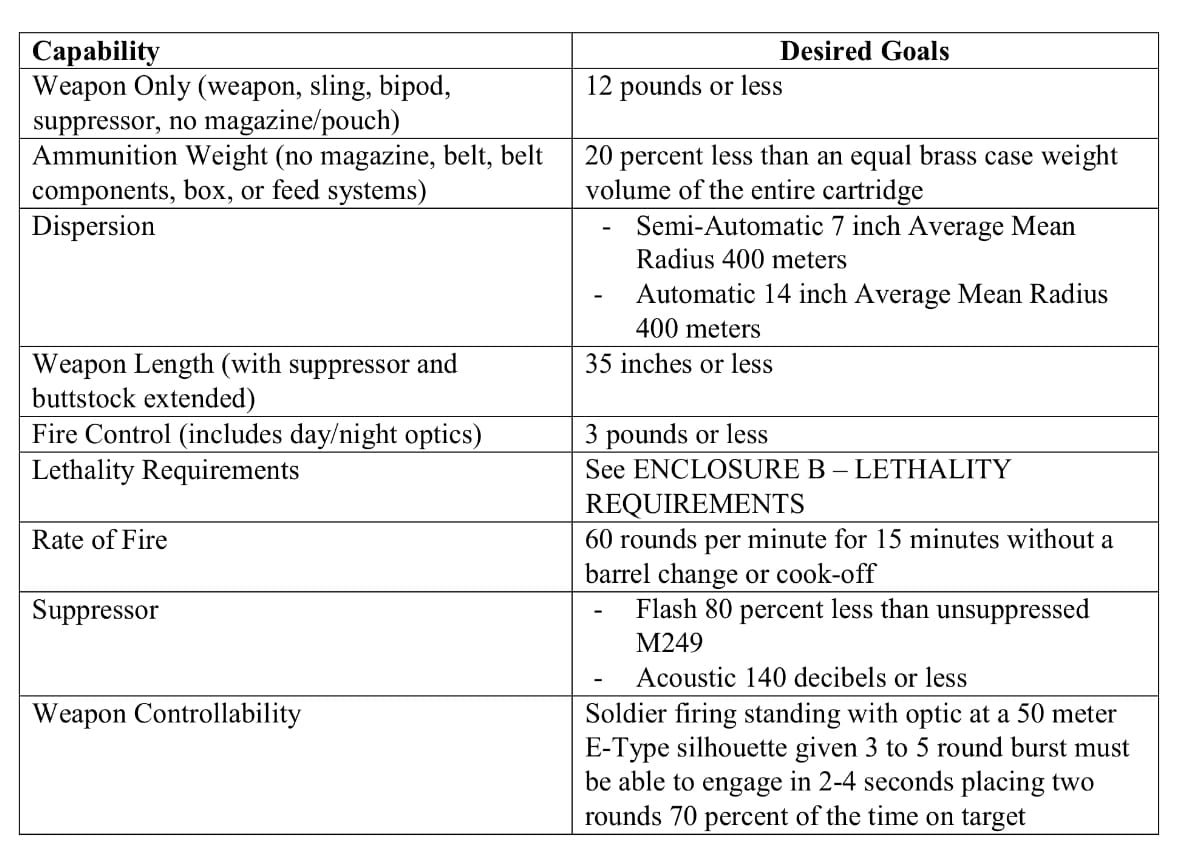
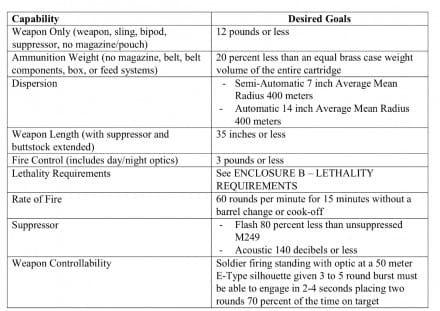
NSGAR prototype candidates should be 35” overall length including a suppressor which must offer 140 dB performance. NSGAR will feature Safe, Semi-Automatic and Automatic modes, with 400m dispersion.

Although the desired rate of fire is 60 rpm, this initial go around is to define trade space. That rate of fire is going to be a challenge with a box fed weapon, although rumor has it the government prefers a magazine over beltfed.
EB45272F-0354-4F02-95EA-159BBD12E582

Ammunition
The ammunition must be “20% less than an equal brass case weight volume of the entire cartridge.”

Fire Control
Fire control is a critical component of this program. It’s inclusion alone will keep many firearms manufacturers from participating due to the costs and unique technical expertise required to produce these components. Likewise, Electronics manufacturers will lack the know how to produce firearms.


The system demonstrator is encouraged to include additional capabilities such as: advanced fire control (direct view optic with variable magnification, laser range finder, ballistic calculator, environmental data, disturbed reticle, etc.), powered/intelligent rail (including data transfer), ammunition capacity (belt or box fed), and other enablers which enhance military utility.

Submissions
Offerors have until April 9th to make their submission. PON proposals will be evaluated on Concept, Feasibility and Price with all three

having equal weight.

Read all of the details here.

www.fbo.gov

Some of this information is derived from the NSGAR Industry Comments.