Troop Performance

Archive for the ‘Contracts’ Category

Modular Handgun System – Things Aren’t As Bad As The DOT&E Report Implies

Friday, February 2nd, 2018

A recently issued report from the Department Of Defense’s Director, Operational Test and Evaluation Office (DOT&E), on the Modular Handgun System has been picked up by bloggers and the headlines have been sensational. They’re being shared online at face value, with few people taking time to read the source document. You can read the whole thing here, and I encourage you to do so, but I’ll use extracts throughout this article.

img_5740.jpg

I’ve spent the past few days going back and forth with DOT&E and PEO Soldier, who manages the program, to clarify information in the report.

From the received responses, apparently the situation is not as dire as the authors of other stories would like their audience to believe.

Background

Each year, the Department Of Defense Operational Test and Evaluation Office (DOT&E) submits an annual report of test and evaluation activities to Congress.

The 2017 report was published on 26 January, 2018 and includes details on numerous test activities in support of Army procurement, including those of the joint Modular Handgun System. MHS consists of militarized versions of a standard (M17) and compact (M18) pistol, manufactured by SIG SAUER and based on their commercial P320 9mm model. the weapon has a common trigger pack and swappable frames to make the switch from M17 to M18.

img_5739.jpg

The weapon was selected for procurement just a year ago on January 19, 2017. Since then, it has served as a model for fast track acquisition reform.

The procurement announcement was met with displeasure from fans of fellow contender GLOCK who pointed to G19 use by USSOCOM as ample reason to broaden its issues within DoD. The SIG contract award was formally protested by GLOCK, but their effort was not sustained by the Government Accountability Office.

Drop Misfires Background

In August of last year, a blogger demonstrated that the commercially available SIG P320, which the MHS is derived from, would unintentionally discharge if dropped at a certain angle. Almost immediately, the internet began to call into question the safety of the Army’s version of the handgun. SIG analyzed the problem and quickly issued an interesting fix for their commercial gun; a new trigger pack based on the MHS trigger. SIG stated that the Army’s handgun already had a different, lighter trigger than the civilian model and had not demonstrated the same issue. SIG offered a voluntary upgrade to the new trigger for P320 users.

In November, I attended a media round table hosted by PEO Soldier to provide an update on fielding of MHS. One of the topics was unintentional misfires caused by dropping. LTC Steven Power, Product Manager Individual Weapons, Project Manager Soldier Weapons, assured everyone that MHS has not experienced such a failure.

Naturally, when I ran across this statement in the DOT&E report, I wanted clarification, because it went against everything I’d been told.

“During drop testing in which an empty primed cartridge was inserted, the striker struck the primer causing a discharge. SIG SAUER implemented an Engineering Change Proposal (ECP) to correct this deficiency by implementing lightweight components in the trigger group mechanism. This fix may have contributed to the splintering of two triggers during the IOT&E”

DOT&E Report

DoD Drop Testing

Before I get into what I learned about this statement I need to explain how DoD conducts drop testing. The procedure is contained in 4-10 of Test Operations Procedure 03-2-504A “Safety Evaluation of Small Arms and Medium Caliber Weapons” . The actual test is called the 1.5 m (5 foot) drop test which requires that a firearm loaded with a primed, empty, cartridge case be dropped from the height of 1.5 m unto a clean, dry, and level concrete surface at six different angles. The goal is to see if the firearm discharges or if the drop affects the function of the weapon.

img_5738.jpg

SIG SAUER’s Position

Since I had discussed the drop misfire issue with SIG in the past, I thought I should check with them. They responded by telling me that it was DoD’s report and they’d be the best place to seek out my answers.

Requesting Clarification From DOT&E

Initially, I contacted DOT&E with a list of technical questions. In particular, I wanted to know when and how they identified this malfunction. After some deliberation, DOT&E spokesperson, LTC Michelle L Baldanza offered this statement regarding the technical questions I had posed, “I will have to let the report stand for itself. You are welcome to contact the Army about this.”

What she was telling me was that the information had originated with the Army and all they had done, was collate it into their report. I’d need to go to PEO Soldier for the answers I was seeking.

PEO Soldier Responds

I approached PEO Soldier about this statement, asking how and when it had occurred. They did not provide details on any test failures but rather provided the statement below, which seems to refute the DOT&E report.

When tested in accordance with the TOP 03-2-504A, the weapon passed in all drop orientations.

PEO Soldier

Even then, despite several requests, they refused to provide a date when the 1.5 m TOP drop test protocol was accomplished. It should have initially been accomplished during source selection, while the Army evaluated the vendors’ candidate pistols and I was able to verify this information from other Army sources who were not authorized to speak publicly about the topic.

Splintered Triggers

The DOT&E report mentioned two “splintered” triggers. Of course, this became a central theme to call the program into question. I asked about the issue. The triggers still worked. PEO Soldier related that they “did not remain smooth and comfortable to fire,” saying it was an isolated issue, and not the result of a design flaw or on-going manufacturing problem. To put it into perspective, they’ve only encountered this issue in two pistols, out of approximately 10,000 purchased to date. It’s so rare, it shouldn’t have found its way into a report intended to discuss major issues.

img_5719.jpg

Ammunition / Reliability Issues

MHS includes four 9mm cartridges, manufactured by Winchester, but there are two primary rounds. The XM1153 Jacketed Hollow Point (referenced above) also referred to as a “special purpose”‘and the XM1152 Ball.

Additionally, there are two reliability factors, Mean Rounds Between Failure and Mean Rounds Between Stoppage. Both MRBF and MRBS were measured during Product Verification Testing as well as Initial Operational Test & Evaluation.

MHS was tested for MRBF and MRBS in both M17 and M18 configurations with JHP as well as Ball ammunition.

According to the DOT&E report, the MRBF reliability requirement for MHS is 5,000 MRBF for a 98 percent probability of completing a 96-hour mission without a failure. The MRBS reliability requirement is 2,000 MRBS for a 95 percent probability of completing a 96-hour mission without a stoppage.

During PVT which is an early test, the XM17 and XM18, with special purpose munition, met its requirement for both MRBF and MRBS:

– The XM17 demonstrated 8,929 MRBF (99 percent probability)
– The XM18 demonstrated 8,333 MRBF (99 percent probability)
– The XM17 demonstrated 1,923 MRBS (95 percent probability)
– The XM18 demonstrated 2,155 MRBS (96 percent probability)

During PVT, the XM17 with ball ammunition met its requirement for MRBF but not its requirement for MRBS. The XM18 with ball ammunition did not meet its MRBF or MRBS requirement.

– The XM17 demonstrated 6,944 MRBF (99 percent probability)
– The XM18 demonstrated 3,906 MRBF (98 percent probability)
– The XM17 demonstrated 343 MRBS (75 percent probability)
– The XM18 demonstrated 197 MRBS (61 percent probability)

Obviously, there’s a difference in how reliable the weapon is, based on the ammo used, and pistol configuration. Consequently, the Army decided to investigate the Ball ammo issues and moved to the next phase of testing solely with the JHP cartridge, which they consider is their “go-to-war” ammunition.

During IOT&E, 60 of 120 stoppages for the XM17 and 63 of 85 stoppages for the XM18 were failure of the slide lock to the rear at the last round. At least some of these stoppages were the result of poor grip. Additionally, 60% of these stoppages (75 of 123) were experienced by just eight shooters out of the 132 who participated in the IOT&E. Based on information from the Army Marksmanship Unit which is cited in the DOT&E report, it appears that the majority of those stoppages were caused by shooters disengaging the slide catch with their thumbs.

Once the Army understood it’s a software and not a hardware problem, they began to modify Marksmanship Training to ensure that Soldiers do not unintentionally engage the slide catch lever when firing the MHS. It’s a simpler solution than redesigning weapon parts.

In fact, the MRBS demonstrated during IOT&E is significantly increased if this stoppage is eliminated:

– The XM17 demonstrated 708 MRBS (87 percent probability).

– The XM18 demonstrated 950 MRBS (90 percent probability).

The weapon is capable of meeting the standard, given the right shooters.

Although they have a Conditional Material Release for both types of ammo and have been firing them since November, PEO reminded me that MHS meets, or exceeds, all operational requirements, including MRBS, with the XM1153 jacketed hollow point ammunition for which it is optimized.

While I take issue with how some things are presented, overall, the Army agrees with the findings in the report.

“The DOT&E report accurately conveys the test results.  It is normal and expected during testing to find opportunities to improve a system.  The testing determined that the MHS had a lower Mean Rounds Between Stoppage (MRBS) with ball ammunition than it has with the “go-to-war” jacketed hollow point round for which the system is optimized.  In July 2017, the Army formed a Tiger Team to perform a detailed root cause analysis of the ball ammunition issues.   Their analysis has resulted in a number of modifications expected to enhance MHS performance and reliability with ball ammunition.”

PEO Soldier

Much has been made on other websites about the pistol’s performance with the XM1152 Ball ammunition. Which, by the way, is a new cartridge, unique to this weapon. The truth is, it is safe to operate with both.

However, this isn’t good enough for the Army as they continue to consider performance improvements. PEO Soldier spokeswoman Ms Dawson explained, “It is simply not meeting its reliability requirements with the ball ammunition and has experienced stoppages and issues with “double ejections”.  Double ejections? I’m intrigued.

Double Ejections

Aside from the drop testing issue, I had hoped to get to the heart of “double ejections”. It’s referenced early in the DOT&E report.

“Both the XM17 and XM18 pistols experienced double-ejections where an unspent ball round was ejected along with a spent round.”

DOT&E Report

Until this week, I’d never heard the term used. PEO Soldier echoed the DOT&E definition.

“A double ejection is when a live unfired round is ejected along with the casing from the round that was just fired.”

PEO Soldier

Semi-Auto pistol’s don’t work that way, it’s a physical impossibility. So, I asked both DOT&E and PEO Soldier to further describe the malfunction in case it has a more commonly used name. Neither organization would. And yet, they’ve used it; over and over. PEO Soldier even set up a Tiger Team to get to the root cause of it. Reporters have parroted it as it were a common term. I even approached several individuals with extensive experience in Army pistol marksmanship and they were also unfamiliar with the term. Since nobody knows what it is, I’m not sure how they’re going to fix it. But whatever it is, the weapon is performing while using the JHP ammo.

In Summary

What we’ve learned:
-MHS is safe and passes drop standards
-MHS is reliable
-The trigger works
-Stoppages can be mitigated with training
-It introduces a jacketed hollow point ammunition capability
-The Army is working to improve its performance with Ball ammunition
-No one knows what a “double ejection” is except PEO Soldier, and they’re not telling

But this is the most important at part of this whole story. The Army is very confidant in MHS. In fact, PEO Soldier spokeswoman, Ms Debi Dawson released this statement:

Testing was conducted with warfighters from all Services, and their feedback about the MHS has been overwhelmingly positive.  The MHS meets, or exceeds, all safety and operational requirements with XM1153 jacketed hollow point ammunition for which it is optimized. The test results published in the Director of Operational Testing and Evaluation (DOT&E) report are being used to make the MHS even better.

PEO Soldier

Unfortunately, there are some pieces of data in the report which seem to be given greater importance than they should be, once put into perspective. In another case, testing which is claimed to have taken place hasn’t been accounted for, and refuted in other statements.

Greater care should be taken when providing input to these annual reports. They are used by Congress to monitor key programs. Additionally, the data has been used to undermine confidence in a program that is doing very well, as new unit after new unit is equipped with this improved capability.

Conclusion 

There’s a reason DoD tests. Every program finds unanticipated issues which must be fixed in order to field the piece of equipment across the force. Some come up years after a system enters service. If you read through the entire 2017 DOT&E Annual Report, you’ll find issues of every type, arising for every program showcased in the document. While much has been made online about MHS, when you break it down, it’s not as bad as it’s been made out to be, if you know what questions to ask.

Polaris Government and Defense Announces Recent Contracts with Latvia and Turkmenistan

Thursday, January 25th, 2018

Polaris® Government and Defense Signs a Two-Year Agreement with Latvia


Minneapolis, January 24, 2018 –  Latvian National Armed Forces has entered a two-year agreement with Polaris Government and Defense for vehicles via the U.S. government’s foreign military sales program. The approximately US$500 thousand contract is for undisclosed quantities of the Polaris MRZR® 2 side-by-side vehicles, SPORTSMAN® 6×6 and MV850™ all-terrain vehicles. The contract also includes spare parts for the vehicles, as well as operator and maintenance training, which will be conducted in country by Polaris.

“Latvia’s contract for MRZR 2 and ATVs will greatly enhance the mobility of their fleet in the Baltics, positively impacting their tactical advantage and support efforts to reinforce Latvia borders,” stated Doug Malikowski, director of international business development, Polaris Government and Defense.

Over the years, Latvia has strengthened security on the border due to increased regional disputes. The Polaris ultralight and all-terrain vehicles will be used primarily for border security. Polaris military vehicles provide off-road mobility for expeditionary forces in the U.S. and more than 25 allied countries to meet current and future mission demands and threats. Polaris service ranges throughout the world, creating a high degree of interoperability and commonality among U.S. and allied forces, such as Latvia.

Polaris vehicles ensure flexibility and modularity to support the various ranging uses including: border patrol, rapid personnel deployment, command and control, casualty and evacuation and supply transport missions. The vehicles are proven, reliable, and easily maintained through the Polaris global network.

Turkmenistan Special Operation Forces Equipped with Polaris Vehicles


Minneapolis, January 24, 2018 – The Turkmenistan Special Operation Forces has awarded a multimillion-dollar contract to Polaris Government and Defense for military and commercial vehicles. The Polaris vehicles provide mobility options to their combat commanders to pose multiple dilemmas to the enemy.

“Polaris is looking forward to supporting the Government of Turkmenistan and their defense forces as they update their ground vehicle fleet with Polaris lightweight tactical vehicles,” said Doug Malikowski, director of international business development. “The vehicles we provide are highly transportable, off-road capable and are relied on for helping Special Forces navigate restrictive and complex environments.”

Polaris was also honored to have had its vehicles featured in the Turkmenistan Independence Day parade. Polaris Government and Defense has other military customers in Central Asia including Afghanistan, Tajikistan, Philippines, and Malaysia.

With seating for up to nine, DAGOR™ comprises the optimal balance of rapid air transportability, payload capacity and advanced mobility. DAGOR gives an advantage back to dismounted warfighters, allowing formations to move faster, carry more and significantly reduce combat fatigue. And its weight and size allow it to be internally transportable on a variety of in-service aircraft, including CH-47 and C-130.

The Polaris MRZR® platform is flexible and modular to support uses ranging from rapid personnel deployment, to command and control, casualty evacuation to supply transport missions. MRZRs have redefined ultralight, off-road mobility for military vehicles and are mission critical for expeditionary forces in the U.S. and allied countries.

The MV850™ is loaded with features which make it as comfortable as it is powerful. Operators experience less fatigue because the MV850 provides the smoothest, most responsive power steering available in an all-terrain vehicle, variable assist for easier steering and active descent control and engine breaking system work together to monitor and control descent and deceleration. A powerful engine, two fuel tanks and 270 kg (600 lbs) of total rack capacity make it optimal for long distances.

Polaris vehicles are proven, affordable, reliable and easily maintained throughout the lifecycle with a commercial supply chain and the Polaris global network. to meet current and future mission demands and threats. And because the vehicles are in service throughout the world, there is a high degree of interoperability and commonality among U.S. and allied forces.

INVISIO Awarded Danish Defense Contract

Saturday, January 20th, 2018

INVISIO has signed a framework agreement with the Danish Defence Acquisition and Logistics Organization (DALO), to supply communication systems to the Danish Army. The agreement is for five years with options for another two years.

Collaboration with DALO and the Danish Army on a larger scale, began in 2012 when INVISIO’s communications system was integrated with the army’s new tactical radio to increase the safety and operational effectiveness of soldiers, and to reduce the risk of hearing damage.

”The Danish Army is a very important customer for us and our cooperation goes back many years. DALO places high demands on effective solutions that are integrated with the soldier’s other equipment, contributing to our continuous innovation work. For us, the contract is a clear sign of the continued confidence that the Danish Ministry of Defense has in us and our solutions”, said Lars Højgård Hansen, CEO of INVISIO.

With INVISIO’s communication system the users get a market leading hearing protection and can communicate and maintain a state of the art situational awareness in tough environments. The systems consist of headsets and control units connected to an external team radio or a vehicle’s intercom system, for example.

French GIGN Selects MAWL From BE Meyers & Co

Monday, January 8th, 2018

B.E. Meyers & Co., Inc. is pleased to announce that the MAWL-DA has been selected by the French National Gendarmerie’s elite police tactical unit, the GIGN, as their official individual NIR/VIS weapon laser and illuminator. The GIGN is currently upgrading legacy systems, and has begun to integrate new technologies with the unit’s available weapons platforms.

IMG_5964

After evaluating various laser aiming and illumination systems through rigorous testing, and in real-world scenarios, the MAWL-DA was proven to be the superior solution, and was selected for formal procurement and deployment within the unit. In addition to the MAWL-DA’s selection by the GIGN, other units in France, and other European SOF units have adopted it for use in their respective operations.

The GIGN is the elite Police Tactical Unit of the French National Gendarmerie. Its missions include counter-terrorism, hostage rescue, surveillance of national threats, protection of government officials, and targeting organized crime. It is renowned for its selection and implementation of innovative technology and tactics, using a comprehensive suite of both small arms solutions, and weapon enabling systems. The unit’s selection of the MAWL-DA as a tool for mission success is notable in light of the GIGN’s pedigree, and reputation as a premiere SOF unit. B.E. Meyers & Co. looks forward to the MAWL-DA’s service with the GIGN as NIR/VIS pointing and illumination system which will assist in the unit’s response to both domestic and international threats.

The MAWL-DA (Modular Advanced Weapon Laser – Direct Action) is a high-power infrared and visible green aiming and illumination laser for individual carbines. Offering improved ergonomics, interface, and performance, the MAWL-DA has been designed from the ground up around the needs of the modern night fighter.

Engineered to address the shortcomings of common laser devices in use with both military and law enforcement, the MAWL® incorporates cutting edge VCSEL technology which eliminates the current problem of inconsistent and granular, speckled illumination. This unparalleled beam quality is leveraged with multiple modes of divergence and power, based on the ideal settings for any operational environment: Close Range, Mid Range, or Long Range.

www.bemeyers.com

Orion UAS Contracted by US Air Force

Thursday, January 4th, 2018

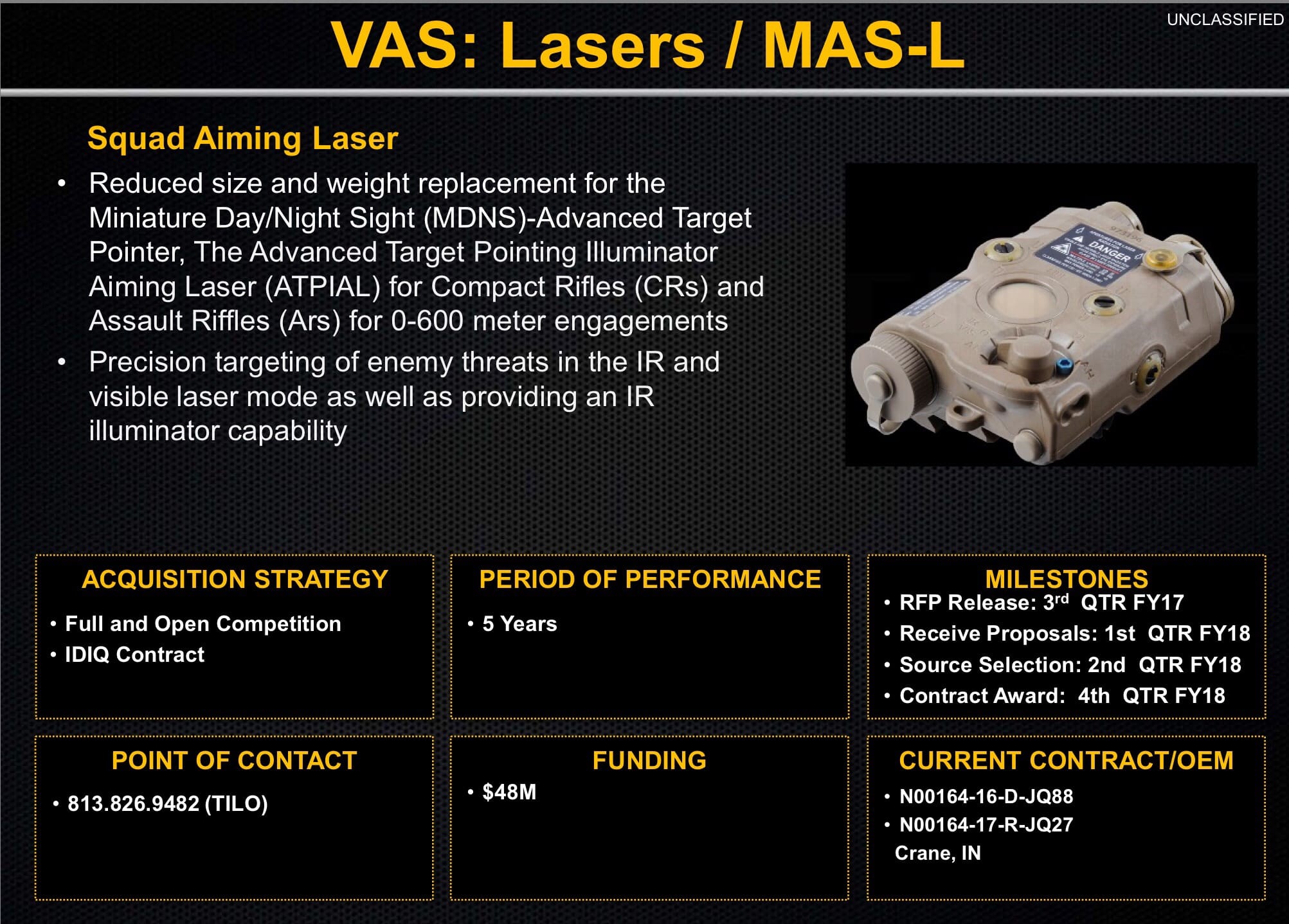
Manassas, VA, January 3, 2018 – The U.S. Air Force has awarded a new $48 million contract to Aurora Flight Sciences for the continued development of the Orion Unmanned Aircraft System (UAS).

Orion is a twin-engine high performance UAS that can stay aloft over 100 hours at a time with payloads in excess of 1,000 pounds. Development of the Orion started in 2006 and its first flight was in August 2013. In December 2014, the Orion established the current UAS world endurance record with an 80-hour, 2-minute and 52-second flight.

The new contract funds the development of a certified version of Orion that will be suitable for deployment anywhere in the world. The work will be performed in Columbus, Mississippi, and Manassas, Virginia.

www.aurora.aero

US Army Unveils Soldier Borne Sensors Procurement Strategy

Tuesday, January 2nd, 2018

In a recent update to the Request for Information issued late last year to industry, the Army has unveiled its procurement strategy for Soldier Borne Sensors. SBS are quiet, lightweight, commercial off the shelf nano unmanned aerial systems, to be deployed at the Soldier level. The US Army has taken cues from Black Hornet, a system in use with the British Army for the past couple of years.


A proposed nano UAS that the Army wants to develop and field will be about the size of a Black Hornet, but will be a completely different UAS system, having no relationship to the Black Hornet. No vendor has yet been chosen and as such, no prototype photos are readily available. Nina Langli, shown here, holds a PD-100 Black Hornet unmanned aerial surveillance aircraft near its two charging stations at the National Defense Industrial Association Special Operations exhibit, Jan. 28, 2015. Langli works at the Norwegian Embassy in Washington, D.C. (Photo Credit: David Vergun)

They have invited industry, academia, individuals, and labs to participate in a face to face Industry Day and to as well as a second User Assessment. This User Assessment will be used to determine the best performing solution currently available within program cost constraints. The SBS program affordability cap constrains the average unit price over the first 2,423 systems procured to $14,997.00 or less. Product Manager Soldier Maneuver Sensors (PdM SMS) intends to purchase up to 200 systems based on the User Assessment results through the Defense Logistics Agency (DLA) Tailored Logistics Support (TLS) Contracts in the third Quarter of Fiscal Year 2018 (3QFY18). Participation in the user assessment is mandatory to be considered for the FY18 purchase. Assessment activities will be conducted at Fort Belvoir, VA; Aberdeen Proving Ground (APG), MD; and Fort AP Hill, VA from January 18th through March 2nd 2018.

The assessment will be kicked-off with a live Industry Day and 1-on-1 sessions at Fort Belvoir, VA on January 16th and 17th 2018. The purpose of the 1-on-1 sessions, which will be held on January 16th, is for vendors to deliver hardware for the User Assessment, provide instruction on basic operation of their hardware, and describe their hardware – all items delivered with a complete system, vendor part number for the complete system, all user-replaceable spare parts, and vendor part numbers for all spare parts. PdM SMS will use the part number data to request quotes from all participating vendors through the DLA TLS program. Vendors intending to participate in the User Assessment shall request a 1-on-1 session and bring five (5) complete systems of their solution for assessment to the 1-on-1. Vendors may also provide spare parts they believe may be necessary to sustain the five (5) systems over the course of five (5) weeks of assessment. The assessment will include at least sixteen (16) cumulative hours of flight.

The purpose of the Industry Day, which will be held on January 17th, is for PdM SMS to provide updated program information including acquisition strategy, schedule, and a detailed description of the User Assessment.

Participation in the User Assessment requires vendor attendance at four (4) events:
• Industry Day. The vendor must schedule a 1-on-1session on January 16th 2017 and attend the group session on January 17th 2017.
• Imagery collection for camera assessment. The Advanced Sensor Evaluation Facility on Fort Belvoir, VA will collect imagery from all systems under assessment on January 18th, 19th, and 22nd 2017. Vendor assistance is required for up to four (4) hours to ensure adequate imagery is collected. The timing of each vendor’s support will be scheduled to minimize total vendor support time and travel.
• Acoustic data collection. Acoustic data will be collected from each system under evaluation in anechoic chambers at APG, MD on January 18th, 19th, and 22nd 2017. The intent is to mount the air vehicles in a stationary position and command the motors to simulate various flight conditions. Vendor assistance is required for up to four (4) hours to command the motors during collection. The timing of each vendor’s support will be scheduled to minimize total vendor support time and travel.
• Soldier training. Soldier test participants will be trained at Fort AP Hill, VA on February 19th and 20th 2017. Vendor attendance is required for two (2) days to conduct the training.

All parties interested in the Industry Day and/or User Assessment have until 15:30 Eastern Standard Time (EST), 08 January 2018 to submit. Visit www.fbo.gov for full details.

USSOCOM Awards Revision Contract To Develop Advanced Technology Demonstration Helmet

Friday, December 29th, 2017

Even as USSOCOM continues to evaluate industry proposals for their next Family of Tactical Headborne Systems, the command’s Science & Technology arm awarded an 18-month, $1,813,065 contract to develop Advanced Technology Demonstration Helmet. The award is based upon USSOCOM-BAAST-2015 Appendix J, Amendment 14 published on April 20, 2017 under the BAA’s area of interest, Topic 4.4 Optical Electronics. In July 2016, Revision was awarded a similar contract for the advancement of headborne systems technologies.

IMG_4680

During AUSA, Revision previewed their Sensys technology which serves as a platform to integrate new helmet and body worn technologies such as augmented reality and conformal power sources.

INVISIO to equip US Army’s new Security Force Assistance Brigades with communication and hearing protection systems

Friday, December 29th, 2017

Stockholm, December 28, 2017

INVISIO has received an order concerning deliveries to the US Army’s new specialized unit Security Force Assistance Brigades (SFAB). The order is valued SEK 10 million and connects to the previous order of SEK 20 million announced on December 4, 2017, amounting to a total order value of about SEK 30 million. Deliveries will take place during the first half of 2018.

The order includes communications system with control units and headsets for use with a radio. By ensuring a good hearing protection while the wearer can communicate and maintain situational awareness, the INVISIO systems address the Army’s modernization initiatives and provides Soldiers with the tactical advantage necessary to achieve mission success.

“We are proud to deliver our advanced communication systems to new units within the US Armed Forces. INVISIO’s systems are world leading in its segment and with this order we are strengthening our position further,” said Lars Højgård Hansen, CEO of INVISIO.

The Security Force Assistance Brigades are specialized units whose core mission is to conduct advise-and-assist operations with allied and partner nations. Soldiers in SFABs are highly trained and will help brigade combat teams build readiness by freeing them from advisory missions.