GORE-TEX Professional

Archive for the ‘Contracts’ Category

INVISIO receives a SEK 30 million order from partner MCL to support the British hearing protection program THPS

Saturday, June 3rd, 2017

INVISIO (IVSO) has received an order from partner MCL to provide hearing protection and communication systems for the British Tactical Hearing Protection System program (THPS). The order value amounts to approximately SEK 30 million and deliveries are planned for the second half of 2017.

The order for the INVISIO system is part of a contract awarded to Marlborough Communications Ltd (MCL) by the UK Ministry of Defence (MoD) in 2015 covering the delivery of systems to the British Army, the Royal Navy, the Royal Air Force and the Army Reserve. THPS, Tactical Hearing Protection Systems, is the modernization program for hearing protection and communications systems of the UK Ministry of Defence.

The 2015 contract is for four years with options for a further three years and comprises INVISIO’S hearing protection and communications system INVISIO S10. The solution provides the user with the ability to communicate and collaborate effectively in noisy environments, providing first rate hearing protection and situational awareness to personnel on operations, whilst offering more comfort.

INVISIO has previously supplied the THPS program with equipment corresponding to sales of approximately SEK 150 million.

www.invisio.com

USSOCOM Alerts Industry To Aviation Body Armor Vest Requirement

Friday, June 2nd, 2017

Natick released a Sources Sought Notice to industry for a new Aviation Body Armor Best to support SOF aviation customers.

KEY PERFORMANCE PARAMETERS (KPPs)
1. Must be capable of supporting the following items:
a. Spear Cut Level 5 Stand-alone, Swimmer Cut Front, Back, and Side Plates
b. Under-Arm Flotation System Modular Water Wing Design
c. SEA LV2 (Emergency Breathing Device)
d. M-4 Magazines (Qty: 3 with the ability to increase to a quantity of 6)
e. M-9 Magazines (Qty: 2 with the ability to increase to a quantity of 3)
f. CAT Tourniquet
g. Individual Medical Aircrew Kit (5.5″L x 5.5″W x 3.25″D)
h. Individual Survival Aircrew Module (5.5″L x 5.5″W x 3″D)
i. Universal radio pouch capable of holding the CSEL or 148 series Radio with Thales GPS
Side Mate Module Assembly
j. IZLID
k. Modular holster for M-9 Beretta capable of being mounted and reconfigured between the vest and belt, and capable of being mounted vertically, horizontally, or angled on the vest.
2. Must be interoperable with Swimmer Cut Generation V SPEAR Body Armor Plates
3. Must have an integrated extraction / retention system consisting of:
a. Belt shall be capable of being used independently as a method of extraction and retention
b. Chest connection point shall be capable of being used independently for retention. It shall be capable of being used for extraction in conjunction with the belt while maintaining the chest connection point as the single point of attachment to the hoist line.
This system should be capable of being used as a single point for both retention and extraction.
c. Capable of supporting a 400lb load for rescue hoisting from both belt and chest connection points and provides retention through a chest connection point compatible with lanyard part numbers AMTC-S1379 (7′) & AMTC-S1380 (12′) & 001-HSLSOCOM.
d. The belt must be rated in accordance to meet NFPA 1983-2012 – 3000lbs for 1.5min.
The criteria for the static pull test of the belt is a minimum break strength of 3000 lbs in an upright and inverted position. Pull Test (two iterations): Horizontal & head-down with a max buckles slippage of 25 mm (1 in.). The criteria for the static pull test of the chest connection is a minimum break strength of 3,000 lbs. for 1.5 minutes in horizontal, vertical, and angular directions.
e. Any harness worn with the belt must not diminish the pull strength in any way.
4. Must be available in Multicam and be capable of being printed in other patterns. ABAV must meet minimal requirements for not creating Visual and Near IR (VIS/NIR) offenders. If nonprinted materials are used, they must be in Tan #499 and meet VIS/NIR Tan #499 compliance.
5. ABAV must be flame resistant, no melt /no drip, and be self-extinguishing. The items shall be tested in both the warp and fill directions. The average melt / drip that occurs after removal of the source flame shall be less than 1 droplet. The average after flame in each direction (warp and fill) shall be no longer than 3.0 seconds, the average afterglow in each direction shall be no longer than 2.0 seconds, and the average char length in each direction shall be no longer than 4.5 inches for samples prior to laundering (0 washes) and after laundering (5 washes). Laundering shall be conducted according to AATCC Method 135, and the vertical flame testing shall be conducted according to ASTM D 6413
6. Environmental conditions cannot degrade the ABAV to the extent they cannot be used for its intended mission (e.g. buckles and fasteners must operate in extreme cold and hot conditions and be resistant to sand and debris).
7. Must withstand the effects of full climatic range of operations ranging from -50F to 130F.
8. Must withstand storage temperatures ranging from -50F to 185F.
9. Must be resistant to rot, mildew, DEET, Petroleum, Oil and Lubricants (POL), chlorine, UV light, and salt water.
10. Shall have a shelf life of not less than five years in a sealed package.
11. The ABAV must be easily usable and adjustable while wearing a wet suit, exposure suit, and/or cold weather gloves to the maximum extent practicable.
12. Must be backward compatible with all currently issued SPEAR Load Carriage items.
13. Shall provide adequate amount of surface area for carrying mission essential equipment tailored to duty position (e.g. rifleman, medic, engineer, etc). The ABAV shall be compatible with existing
USSOCOM equipment when minimally or fully loaded in accordance with operational practices.
Existing USSOCOM equipment includes Military Free Fall (MFF) equipment, fast rope and static line parachute equipment, combat swimming equipment, backpacks, equipment belts, and NBC gear (MOPP 4).
14. Shall have a handle capable of dragging or supporting 400 lbs. during dynamic motion in combat.
15. Fine adjustments to fit shall be easily made while in minimally and maximally loaded configurations. This includes the need for fine adjustments of any straps, harnesses, cummerbunds, or any other type of adjustment system while wearing the entire ensemble without removing it.
16. Provide equal weight distribution, be configurable for additional load carriage, and provide shoulder-hip distribution capabilities. These capabilities shall not interfere with any others, and should only add additional capability without detrimental aspects.

KEY SYSTEM ATTRIBUTES (KSAs)
1. Must be easily and quickly releasable when unloaded or fully loaded in all combat environments, including submerged / maritime environments where crashed aircraft is possible.
2. All aspects of the design and integration of the ABAV and its Accessories shall be simple, easy, and intuitive to use. The ABAV must be easily setup prior to use, and easily adjustable during use.
3. The holster must be capable of being transitioned from mounting on the vest in a horizontal, angled, or vertical configuration, to mounting on a belt.
4. Materials and designs of the ABAV must provide maximal comfort, full range of dynamic anatomical motion, and maximal agility during movement in all environments.
5. The ABAV shall minimize water retention, maximize drainage, and minimize drying time.
6. When fully loaded, the ABAV must allow the operator to bring and maintain all weapons to a good firing position or adjust firing position. These weapons include M-9, M-4, and crew served weapons.
7. Must not hinder or significantly interfere with the operator entering or exiting SOF ground vehicles, aviation platforms, movement through hatches or doorways, and must maximize comfort while riding on SOF/Service aviation platforms.
8. The Accessories should be simple to use, minimize bulk, retain necessary equipment, and allow easy access for removal and replacement of equipment into the pocket or pouch.
9. All Accessories should firmly attach to the ABAV in a way that minimizes relative motion between equipment-filled pockets and the ABAV. Fastening mechanisms shall be simple, easy to use, and durable for all operational environments.
10. Shall be capable of fitting the 5th to 95th percentile chest size (33″ circumference, 16″ torso length to 49″ circumference, 24 ¼” torso length
11. ABAV and Accessories must be able to integrate with a low profile, modular floatation system that has an easily installable bladder capable of providing no less than 70 lb. of positive buoyancy when inflated on the surface with 40 lbs. at 1 ATM. Modular flotation sub-components shall not reduce or will only minimally reduce the area available for Accessory attachment. Bladders and floatation capability must be easily removable.
12. ABAV and accessories must have durability and abrasion resistance during extended land operations.

Responses are due, NLT 7 June 2017. Visit www.fbo.gov for full details.

US Army Announces Industry Day For Next Generation Squad Automatic Rifle

Friday, June 2nd, 2017

The PM Soldier Weapons has announced a classified (yes, classified) Industry Day at Ft Benning on 25-27 July 2017 for the Next Generation Squad Automatic Rifle (NGSAR) which a single incremental program to replace the M249 Squad Automatic Weapon (SAW) in Brigade Combat Teams (BCT) and select support units during the next decade. Remember, NGSAR is one of the Army’s budget priorities.
IMG_2148

It will combine the firepower and range of a machine gun with the precision and ergonomics of a carbine, yielding capability improvements in accuracy, range, and lethality. The weapon will be lightweight and fire lightweight ammunition with improved lethality. The NGSAR will help to reduce the heavy load that burdens Soldiers and that has a significant negative impact on their mobility, survivability, and firing accuracy. Soldiers will employ the NGSAR against close and extended range targets in all terrains and conditions. The NGSAR will be compatible with and dependent on legacy optics and night vision devices to meet required capabilities. It will also be compatible with the Small Arms Fire Control system currently in development and possess back-up sights. It is anticipated the NGSAR support concept will be consistent with (comparable to) that of the predecessor M249 SAW involving the Army two level field and sustainment maintenance system. The NGSAR will achieve overmatch by killing stationary, and suppressing moving, threats out to 600 meters (T), and suppressing all threats to a range of 1200 meters (O).

Loads of technical data and requirements follow.

Mandatory Key Performance Parameters (KPP) described below identify the mandatory system capabilities for the NGSAR. These KPPs are essential to the development and improvement of an effective military capability that will make a significant contribution to the characteristics of the future joint force.

KPP 1 System Survivability:
The NGSAR is a mission critical system that must be survivable to chemical, biological, radiological, nuclear (CBRN) exposure to include effects of electromagnetic pulse and cyber-attacks. The NGSAR must be operational after exposure to chemical, biological, radiological, and cyber-attack (T). The NGSAR must be operational after exposure to chemical, biological, radiological, nuclear, cyber threats and electromagnetic pulse (O).

KPP 2 Operator System Training:
Soldiers will be trained to comply with the accuracy requirements in this document under simulated combat stressful conditions. Training on the system will be standards-based, leveraging technology in system design to minimize the training time and resources needed for operators/maintainers to achieve system competency. The following criteria will help to ensure system trainability:
1. TASK STEPS: 85% (T) to 95% (O) of tasks to operate and maintain the system will require less than 10 steps (including sub steps).
2. JOB/MEMORY AIDS: 85% (T) to 95% (O) of tasks that require 10 or more steps (including sub steps) will have job/memory aids that provide written procedures or diagrams to enable operators to perform the tasks without the need for extensive memorization.
3. MEMORIZATION: No more than 8 (T) and preferably 3 or less (O) discrete facts, terms names, rules, or ideas will be required to be memorized on any system task.
4. Instrumentable Multiple Integrated Laser Engagement System (I-MILES) Small Arms Transmitter (SAT) Tactical Engagement System (TES) Small Arms Transmitter (SAT). The NGSAR sight system must not interfere with the design, installation, or operation of the current I-MILES SAT and future Army-Tactical Engagement Simulation System (A-TESS) SATs when installed for Live Force-on-Force training.

KPP 3 Accuracy:
The NGSAR will have the capability to provide the P(i) metrics on the target sets located in the classified annex. This will require accurate P(h) along with ammunition capability.

KPP 4 System Weight:
The NGSAR combat configured weapon including sling, bipod and sound suppressor will weigh no more than 12 pounds (T) 8 pounds (O). This does not include ammunition or magazine.

KPP 5 Ammunition Weight:
The NGSAR ammunition will weigh 20 percent less than tactical brass equivalent caliber ammunition (T) 50% (O). Note the NGSAR ammunition could be a caliber not currently in use by the US Army. In that case the equivalent weights will be calculated through interpolation by the USG.

Key System Attributes (KSAs) described below are considered essential to achieving a balanced solution/approach to a system, but not critical enough to be designated a KPP.

KSA 1 Sustainment:
1. Operational Availability (AO): The NGSAR at the system level will be no less than 94.2% (T), 95.1% (O) measured over an extended period of operations consistent with (and indicative of) the annual wartime system usage cycle.
2. Reliability: The NGSAR will be functional in all operational environments (hot, basic, cold, severe, extreme sand/dust). Reliability of the NGSAR, measured at the system level (functions of weapon plus ammunition addressed collectively as an integrated capability) during equipment operation in accordance with wartime usage.
2.1 Class I (Immediately Operator Clearable) Failures: The NGSAR will demonstrate 94.5% (T), 99.3% (O) probability of successfully completing a day of wartime operations (daily average of 450 rounds fired per weapon) without incurring more than one immediately operator clearable (Class I) EFF as defined in the NGSAR Reliability FDSC (EFFs of Class I severity are clearable in 10 seconds or less).
2.2 Class II (Operator Clearable) Failures: The NGSAR will demonstrate not less than 90.1% (T), 99.2% (O) reliability of successfully completing each individual wartime mission specified in the OMS/MP (most demanding mission involves 293 rounds fired per weapon) without incurring a Class II operator clearable EFF (which requires more than 10 seconds to clear).
2.3 Class III (Non-Operator Clearable) Failures: The NGSAR will demonstrate not less than 90.6% (T), 92.0% (O) reliability of successfully completing the 72-hour wartime scenario specified in the OMS/MP (1,349 rounds fired per weapon) without incurring a non-operator clearable (Class III) EFF.
2.4 Barrel Life: The NGSAR will have a barrel life capable of meeting KPP accuracy/dispersion requirements with no more than a 10% degradation for 10,000 (T) and no degradation for 20,000 rounds (O).

KSA 2 Total Ownership Cost (Weapon Only):
Intentionally left blank.

KSA 3 Size:
NGSAR will have a maximum length of 38 inches and no longer than 35 inches with the buttstock in the stowed configuration (T); 35 inches maximum length and no longer than 32 inches with the buttstock stowed (O).

KSA 4 Rate of Fire:
NGSAR shall be capable of a rate of fire of 60 rounds per minute for 16 minutes and 40 seconds without a barrel change or risk of cook-off. Cyclic 200 rounds without cook off (T). NGSAR will be capable of 108 rounds per minute sustained for 9 minutes and 16 seconds without barrel change or risk of cook off. Cyclic 300 rounds without cook off (O).

KSA 5 Controllability:
NGSAR shall enable the Soldier to maintain a clear sight picture during automatic fire engagement of moving targets from the prone position with bipod (T). NGSAR will allow the Soldier to maintain a clear sight picture during engagement of moving targets from the kneeling position (O). Low recoil will allow the Soldier to better control the weapon and remain on target improving probability of hit. Recoil energy limitations will be in accordance with Test Operations Procedure 3-2-045 and Table 1 of TOP 03-2-826A.

KSA 6 Firing Modes:
NGSAR will have the capability to fire in automatic and semi-automatic modes (T). NGSAR will be capable of firing two rounds with one trigger pull with both rounds impacting the target within 1 inch at 100 meters in automatic or semi-automatic modes (O).

KSA 7 Weapon Signatures:
1. Suppressed sound signature at the shooter’s ear will be less than the suppressed M249 (T). The NGSAR will be unable to localize by sound beyond 300m (O). Localize is defined as the detection and subsequent identification of the weapon system, to include the type of weapon, and its location to the degree that an enemy could return effective fire on it. Improved suppression is for combat ammunition only and will not interfere with Training Aids, Devices, Simulators, and Simulations (TADSS.)
2. Suppressed flash signature will be less than the M249 (T). The NGSAR will be unable to be localized by flash out to 300m (O). First round flash will not be greater than the flash from subsequent rounds. Improved suppression is for combat ammunition only and will not interfere with TADSS.
3. The NGSAR thermal signature will be equal to or less than the M249 (T). NGSAR will possess advanced signature management capability to reduce thermal signature (O).
4. The NGSAR suppressed will produce less toxic gasses than the M249 unsuppressed firing M855A1 ball ammunition. The NGSAR suppressed will produce less toxic gases at the shooter than the M249 unsuppressed firing M855A1 ball ammunition (O).

KSA 8 NGSAR Ammunition:
1. NGSAR Combat Ammunition: NGSAR combat ammunition must provide the probability of incapacitation as listed in the NGSAR CDD classified annex. There must be a Tracer and Ball variant; the Tracer ammunition must provide a visual signature observable by the shooter with unaided vision during both daylight and night conditions (30-degree oblique from either side of the weapon) out to 600 meters (T). The ammunition must provide a visual signature observable by the shooter with unaided vision during both daylight and night conditions (30-degree oblique from either side of the weapon) out to 1200 meters (O).
2. Live Fire Training Ammunition: NGSAR live fire training ammunition must be accurate enough to hit single “E Type” silhouettes at 600 meters with 50% probability of hit (Ph) using conventional weapons zeroing techniques, with a maximum range that does not exceed 2400m. The ammunition must provide a visual signature with unaided vision during both daylight and night conditions to 600 meters. The objective version of this round possesses sufficient accuracy to be used for qualification on reduced range scenarios. Normal weapon wear and tear caused by the live fire training ammunition shall be equivalent to or less than the legacy M855 cartridge. Penetration performance of the M855 at 600 meters and the associated testing procedure was quantified for industry in MIL-C-63989. The penetration performance sought is worse performance than the M855 against AISI steel targets at all ranges over 5 meters. The objective live fire training cartridge penetration performance shall be less than the legacy M855 cartridge at all distances over five meters. This shall be demonstrated using the maximum thickness of AISI 1010 steel plate that the legacy M855 is expected to reliably perforate (V50; zero obliquity) at five meters. No perforation of that target is what is sought. For safety purposes, plate thickness may be extrapolated by suitable precision penetration experiments done at greater distances.
3. Force-on-Force Training Ammunition: NGSAR force-on-force training ammunition shall replicate the flash and noise of NGSAR combat ammunition. The NGSAR will possess a feature (such as a training bolt) that precludes the use of combat ammunition. The ammunition will have distinct, identifiable markings to enable identification under both normal and reduced visibility conditions. The operator will not be required to bore sight or zero the weapon to effectively use the force-on-force training ammunition. Any projectile fired must be accurate to hit single “E Type” silhouettes at 30 meters with 50% probability of hit using conventional weapons zeroing techniques. Any projectile shall be made in at least three colors that will wash off with the use of water. The ammunition shall not contain heavy metals, volatile, or ozone depleting chemicals and shall be non-toxic to allow for firing indoor without creating a toxicity problem. The use of this ammunition shall in no way degrade the weapon’s current performance (when the weapon is reconfigured for combat/service ammunition) or degrade the useful life of these weapons. The operator and other soldiers must be able to visually identify that force-on-force training ammunition is loaded into the weapon from a distance of 5 meters under daylight conditions (T). Force-on Force training ammunition must not penetrate human skin clothed in the standard Army issue uniform nor fracture or break the standard Sun, Wind, Dust (SWD) Goggle lens (LEXAN 1.52mm thick) when fired at a distance of 1.0 meter (39.3in) from the muzzle of the weapon. Force-on Force training ammunition must not penetrate human skin nor fracture or break the standard Sun, Wind, Dust (SWD) Goggle lens (LEXAN 1.52mm thick) when fired at a distance of 0 meters from the muzzle of the weapon (O).
4. Blank Training Ammunition: The NGSAR blank ammo will be utilized for force-on-force skill development and will have distinct identifiable markings to enable identification under both normal and reduced visibility conditions. The use of NGSAR blank ammo shall not degrade the weapon’s current performance (when the weapon is reconfigured for combat/service ammunition) or degrade the useful life of these weapons. The NGSAR blank ammo, when fired at one meter will not penetrate human skin clothed in the standard Army issue uniform. NGSAR blank ammo must fully complement all current and planned TADSS devices relying on blank ammunition for force-on-force training devices (i.e. I-MILES) (T). The NGSAR blank ammo, when fired at zero meters, must not penetrate human skin clothed in standard Army issue uniform (O).
5. Drill Ammunition: NGSAR drill ammunition must facilitate the performance of weapon operator tasks similar to live ammunition to include chambering weapons, clearing weapons, weapon maintenance tasks (including verification of proper weapon setup after maintenance procedures) and ammunition familiarity without risk of activating energetic materials. It must be standardized and easily discernible from other types of ammunition by Soldiers under training representative conditions (T=O).

KSA 9 Mobility:
Soldier mobility has a direct correlation to combat effectiveness. The lightweight NGSAR and ammunition with improved ergonomic features will not result in a reduction in Soldier mobility, agility, responsiveness, as measured by time to complete an Army obstacle course, such as the LEAP-A course, relative to the current baseline system with a combat load of ammunition (T). Soldiers carrying the NGSAR with a combat load of ammunition shall demonstrate a 10% improvement in Soldier mobility as measured by time to complete an Army obstacle course, relative to performance with the baseline system (O).

Additional Performance Attributes (APA) listed below are performance attributes of a system not important enough to be considered a Key Performance Parameter (KPP) or Key System Attribute (KSA), but still appropriate to include. Details to be provided during Industry Day.

APA 1 Integration
APA 2 Protective Materials
APA 3 Shot Counter
APA 4 Operational Controls
APA 5 Back-Up Sight
APA 6 Field Stripping and Tools
APA 7 Compatibility with Personal Protection Equipment
APA 8 Visual Signature
APA 9 Sling
APA 10 ID Markings
APA 11 Cleaning Kit
APA 12 Blank Firing Adaptor (BFA).
APA 13 Data Transfer (Intelligent Rail)
APA 14 – Weapon System Maintenance Ratio (MR)
APA 15 – Mean Time to Repair (MTTR)
APA 16 – Special Tools

It’s unfortunate that the Army has chosen to conduct this program at the classified level as they will preclude the vast majority of the industrial base. Few actual firearms manufacturers have facility clearances, let alone employees with active DoD security clearances. Let’s hope they sort this out.

For full details on the industry day event, visit www.fbo.gov.

Program Manager Individual Weapons Issues Request For Information To Industry For 7.62mm Interim Combat Service Rifle

Friday, June 2nd, 2017

For the last couple of months we’ve been talking about the US Army’s 7.62 rifle requirements.

For quite awhile it looked like they were going to leverage the M110A1 Compact Semi Automatic Sniper System program by purchasing additional Heckler & Koch G28s like they are doing for the Squad Designated Marksman Rifle’s directed requirement for 6069 rifles. Unfortunately, the CSASS weapon would need some changes for the ICSR role. For instance, it’s semi automatic and we understand that was a major sticking point. Consequently, they’ve released a Market Survey to industry in order to identify companies capable of producing a rifle which meets their requirements.

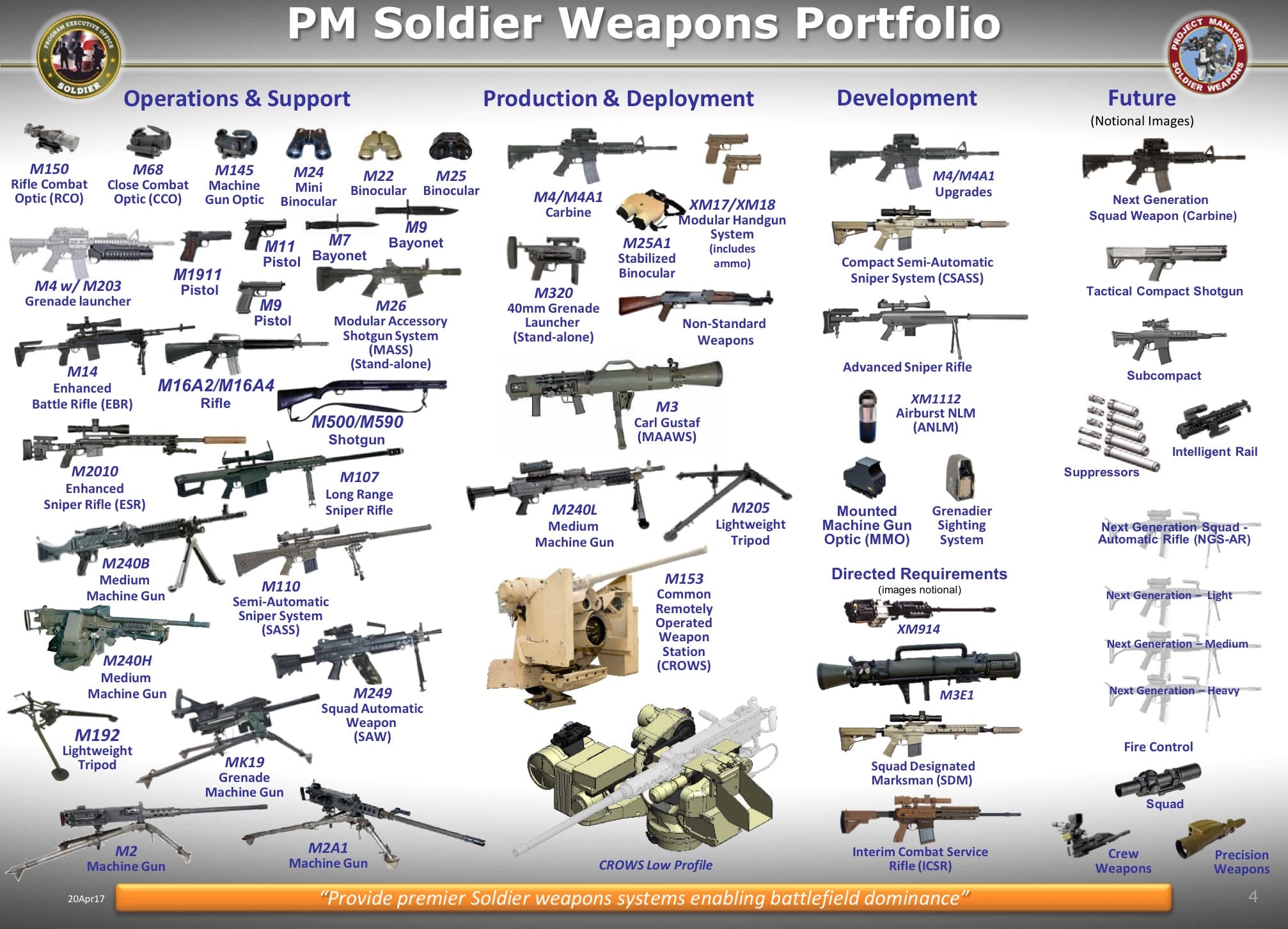
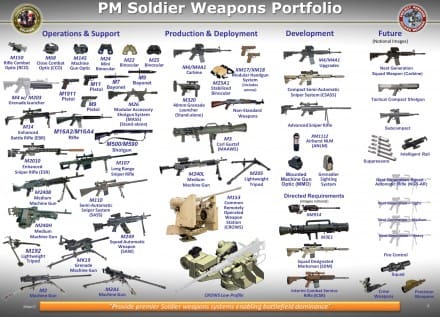
This slide was briefed by PM Soldier Weapons at the recent NDIA Armaments Conference and shows the ICSR as a directed requirement and has been in development for awhile.

IMG_2148

Desired Attributes of Interim Combat Service Rifle:
• The rifle must be a Commercial Off The Shelf (COTS) system readily available for purchase today. Modified or customized systems are not being considered.
• Caliber: 7.62x51mm
• Available barrel lengths, to include 16 and 20 inch barrels, without muzzle device attached.
• Muzzle device capable of or adaptable to auxiliary devices for:
— Compensation of muzzle climb
— Flash suppression
— Sound Suppression
• Fire Control: Safe, Semi-automatic, and fully automatic capable.
• All controls (e.g. selector, charging handle) are ambidextrous and operable by left and right handed users
• Capable of mounting a 1.25 inch wide military sling
• Capable of accepting or mounting the following accessories.
— Forward grip/bi-pod for the weapon
— variable power optic
• Detachable magazine with a minimum capacity of 20 rounds
• Folding or collapsing buttstock adjustable to change the overall length of the weapon
• Foldable backup iron sights calibrated/adjustable to a maximum of 600 meters range
• Weight less than 12lb unloaded and without optic
• Extended Forward Rail

This requirement was initially driven by a need to defeat a threat at 600m, but Army Chief of Staff GEN Mark Milley’s recent testimony to the Senate Armed Services Committee indicates that the proliferation of inexpensive armor which defeats out 5.56mm ammunition by our adversaries to be the current culprit. GEN Milley testified that the Army had developed a 7.62 round which will defeat that body armor. The ICSR is intended to fire that cartridge.

While the RFI mentions the production 10,000 rifles, remember, that’s a nice round number and not indicative of the actual requirement. Basis of Issue has been tossed around, ranging from four per squad to pure fleet fielding for IBCTs.

Naturally, this move to a full and open competition also means that the ICSR may not be the same rifle already selected for use as CSASS and SDMR. From a logistics standpoint this seems unwise to have two different (three if you count the legacy M110s) 7.62mm rifles in service at the same time with few, if any, compatible parts.

We’ve already discussed how the basic load goes from 210 rounds for 5.56mm to 104 rounds for 7.62. Now, consider a 12 lbs rifle with additional optic and other accessories, further driving the weight up. In addition to the load bearing burden, there is another issue at hand which must be considered. Not only is the rifle and ammunition heavier, it’s also more arduous to shoot, and that’s just on semi. The Soldier must hold the weapon on target and deal with the increased recoil impulse. Anyone who shoots both 7.62 and 5.56 regularly will tell you that they just don’t shoot as much 7.62 at a time as they do 5.56. When we add full automatic fire into the equation, we begin to enter relatively unknown  territory. Even when the US Army last issued a 7.62 rifle, the M14, only one Soldier per squad had a full automatic rifle (M14E2) which was configured slightly differently than the semi auto M14 carried by his squad mates. Go back further to the days of the M1 Garand and its .30-06 M1 cartridge and you find a completely different weapon for full auto fire, the M1918 Browning Automatic Rifle.


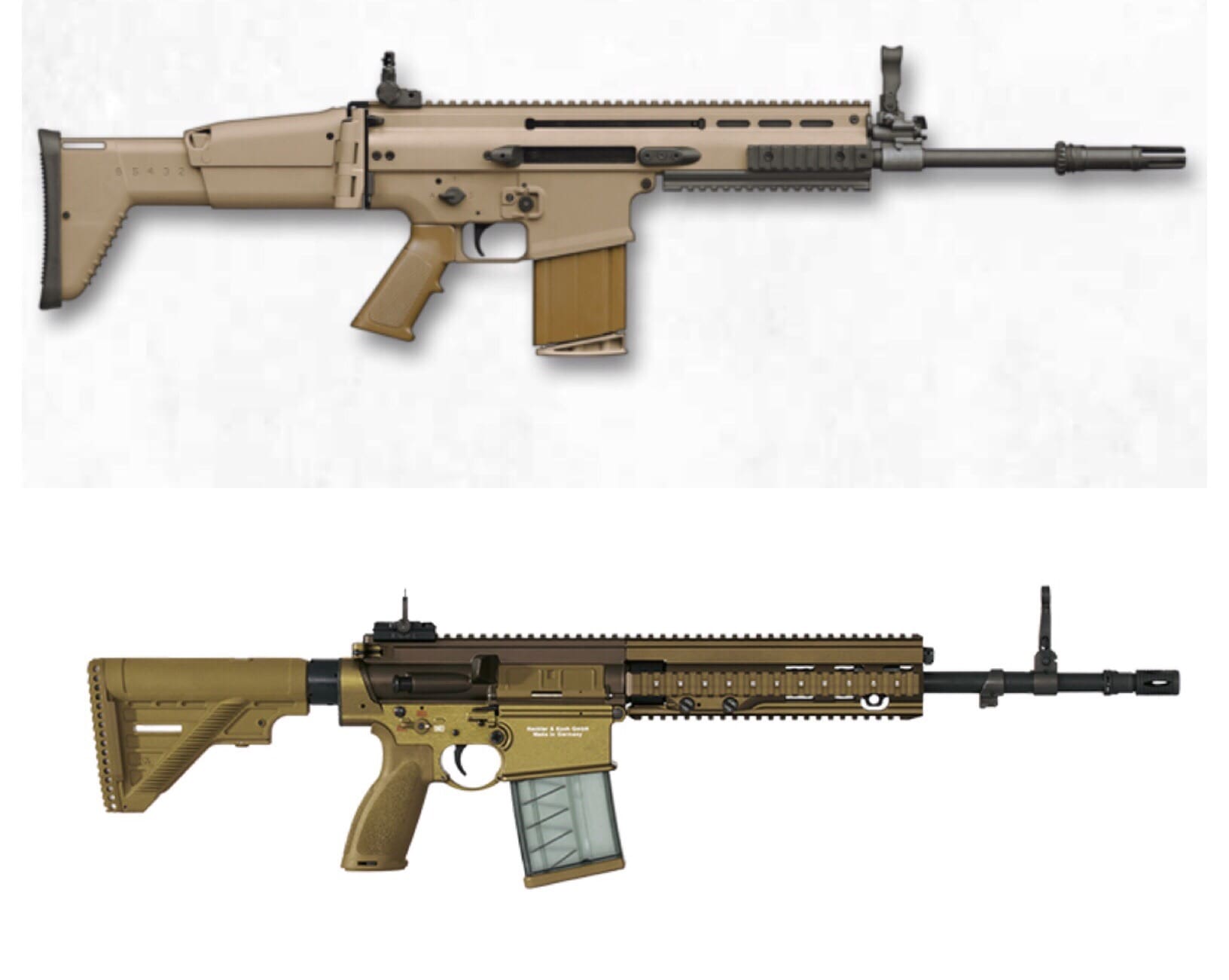
However, finding a COTS, fully automatic 7.62 rifle will be a challenge. Aside from FN’s Mk17 SCAR Heavy and HK417, there aren’t many others. We suspect the Army will end up looking at a bunch of AR10esque “COTS” guns which coincidentally have just recently been modified to fire full auto. They’ll be reliable guns in semi auto fire, but unproven for long-term full auto use.

Granted, it’s easier to get to an intermediate cartridge (6.5mm family) with a 7.62 platform, if that’s the actual, ultimate goal. The impending release of the Small Arms Caliber Study and USASOC’s current evaluation of 6.5 rounds will certainly inform such a move, but it’s still years off.

Based in these factors, there are many who would understandably prefer to just wait it out for the development of an intermediate cartridge and build a gun around that.

 However, as we recently wrote, the US military currently finds itself at the nexus of a US small arms renassiance. Requirements exist. Solutions, although not perfect, exist. And most of all, political will exists to resource the acquisitions. Rarely do we find ourselves in this position, so we must capitalize on the opportunity. Hopefully, the Army fully considers the full impact of fielding this weapon and make wise choices.

To read the full Sources Sought Notice, visit www.fbo.gov.

USSOCOM Issues Pre-Solicitation for SPEAR Family of Tactical Headborne Systems Coxswain Helmet

Wednesday, May 24th, 2017

The United States Special Operations Command (USSOCOM) recently issued a pre-solicitation notice to industry pursuant to their requirement for a multi-year contract to procure Special Operations Forces Personal Equipment Advanced Requirements (SPEAR) Family of Tactical Headborne Systems (FTHS)-Coxswain Helmet System. The Coxswain Helmet system is the most interesting helmet system from a technical standpoint and more closely resembles the recent Next Generation Helmet work done for SOF by Ops-Core and Revision.  Although Ops-Core is keeping their’s under wraps, Revision recently released their candidate commercially, as the Batlskin Caiman Head System.


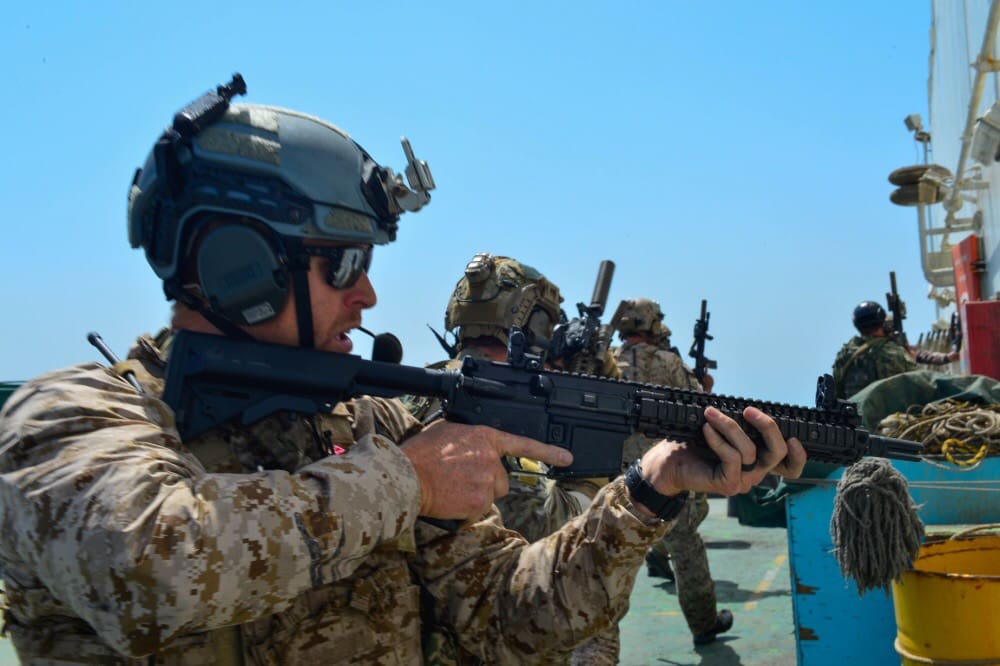
DoD Photo by MSG Timothy Lawn.

The coxswain helmet will consist of a non-ballistic helmet system with modular accessories which will consist of a visor, ballistic mandible, non-ballistic (i.e. impact) mandible, and two piece ballistic appliqué. Additionally, the helmets require a variety of VAS Shrouds, Helmet Covers, Accessory Rails, Pads, Exterior Velcro sets, and Peltor Adapters.

The helmets will be offered in five sizes in Tan, Neutral Grey, AOR 1, AOR 2 and MultiCam.

The government intends to award a five-year Indefinite Delivery Indefinite Quantity (IDIQ) Firm Fixed Price (FFP) production contract for a fully developed item to the offeror with the best value to the Government. They are looking for Commercial-Off-The-Shelf items. The actual solicitation should be issued in June and the minimum contract value will be $150K and the maximum contract value will be $95M.

Because of the scalability of the Coxswain Helmet I wonder how long it will be before other SOF personnel want it instead of the standard SOCOM helmet already in solicitation.  

For full details, visit www.fbo.gov.

US Army and 3M Provide Hearing Protection for Soldiers

Sunday, May 21st, 2017

Army’s PEO Soldier Orders 3M™ Personal Safety Division™ Tactical Communication and Protective Systems

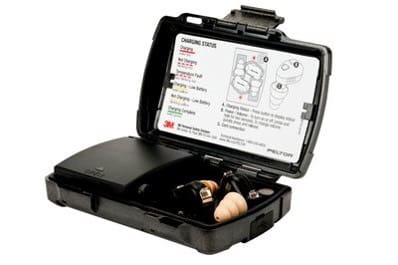
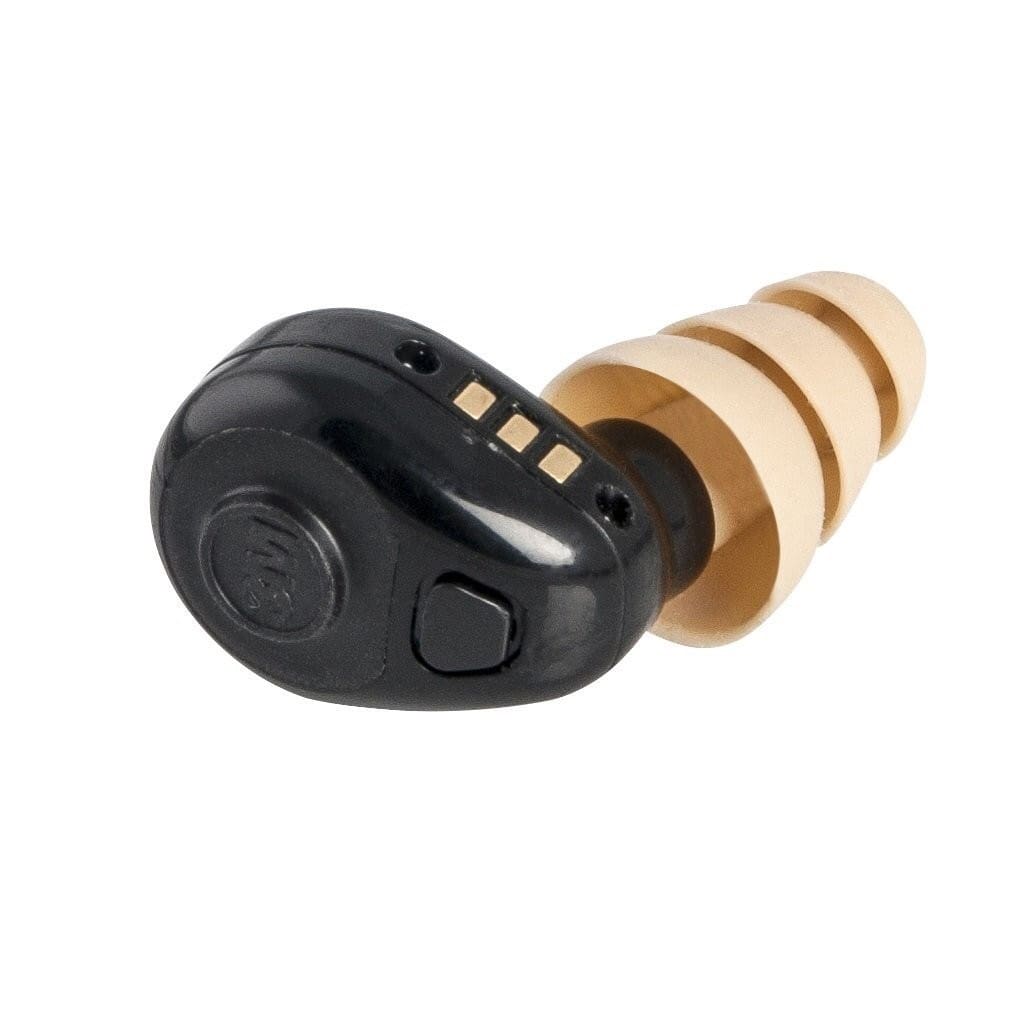
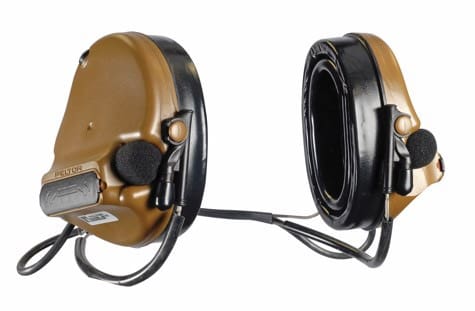
ST. PAUL, Minn. The U.S. Army has accepted two 3M™ products to equip soldiers with hearing protection and auditory situational awareness. The 3M Personal Safety Division has received initial orders for more than 6,500 devices that include 3M™ PELTOR™ TEP-100 Tactical Earplug Kits and 3M™ PELTOR™ COMTAC™ III ACH Communications headsets, plus spare parts and accessories totaling more than $1.6 million. Deployment of these Tactical Communications and Protective Systems (TCAPS) is managed by PEO Soldier.

“3M supports PEO Soldier’s objective to maintain hearing protection and prevent hearing loss. These products will help soldiers be more effective in combat, and will help allow them to return home with their hearing intact,” said Shawn Gregg, U.S. Business Director, 3M Personal Safety Division.

“Our history with U.S. Special Forces, collaboration with the U.S. Army, and relationships with U.S. Military Audiologists all helped contribute to the hearing solutions we have been asked to supply,” said Doug Moses, U.S. Product Marketer for Protective Communications at 3M Personal Safety Division.

The patented 3M PELTOR TEP-100 earplugs were introduced to the market in 2014 when demand for ruggedized, stand-alone electronic “in-the-ear” hearing protection devices surfaced. 3M’s research and development team responded by designing and developing a low-cost, easy-to-use, system that could be utilized in a wide range of applications, and in remote locations. A key application was for military service members and tactical law enforcement teams requiring auditory situational awareness, as well as hearing protectors to protect against the effects of hazardous noise.

The 3M PELTOR COMTAC III ACH was originally introduced to U.S. Military forces and law enforcement tactical teams in the early 2000s. The COMTAC Headset was the first tactical communications headset to offer an environmental listening function, sometimes referred to as “Talk-Through,” which enhances the ability to locate and identify opposing forces, by allowing safe audio sounds through. The headset reduces harmful noises, which promotes increased mission effectiveness, safety and survivability. The headset utilizes a proprietary digital audio circuit to sense noise levels above the desired threshold and compress them to a safe decibel level. Additionally, weak sounds can be amplified to an audible level, to better serve team members with existing hearing loss. Now in its fourth generation, over 600,000 systems have been delivered to military forces worldwide.

3M PELTOR COMTAC Headsets and Tactical Earplugs are commercially available and sold through the 3M distribution network. For more information, please visit 3m.com/tacticalppe.

3M is a global leader in hearing conservation, specializing in hearing protection devices, communication solutions in high noise environments, detection products such as noise dosimeters, fit validation systems and seen as an education authority throughout the world. To learn more about 3M hearing protection, please visit: www.3m.com/hearingprotection. To speak to a 3M specialist about a particular safety issue or training need, please call 800-243-4630.

Total Game Changer – USSOCOM & USMC Take First Steps Toward Adopting a .338NM Lightweight Medium Machine Gun

Monday, May 15th, 2017

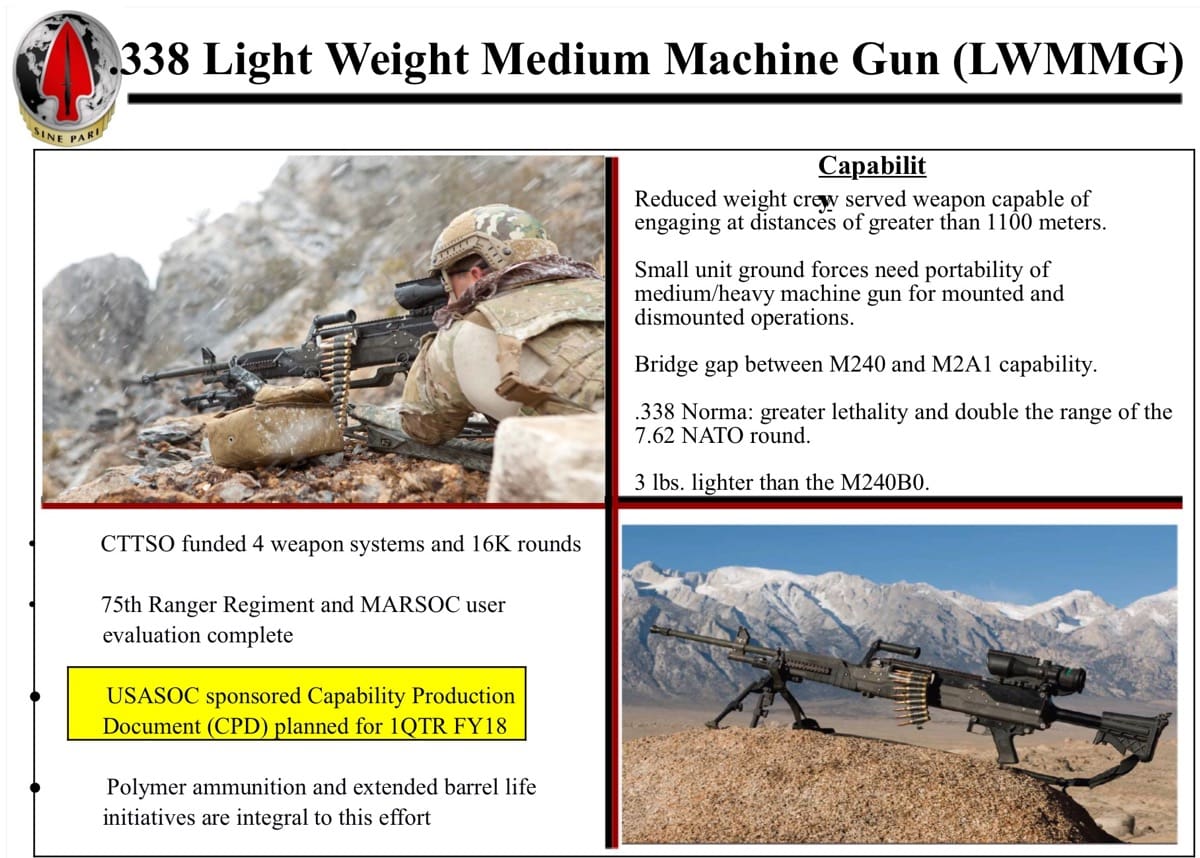
In a move that will turn the term “Overmatch” on its ear, the United States Special Operations Command, in conjunction with the United States Marine Corps has issued a sources sought notice for 5,000 Lightweight Medium Machine Guns in .338 Norma Magnum. The Russian PKM is a primary concern for dismounted infantry and the LWMMG doubles the 1000m effective range of the PKM.

Specifically, they are seeking producers who can provide:
-complete machinegun system to include weapon, suppressed barrel, and tripod
-any tools needed to conduct basic maintenance

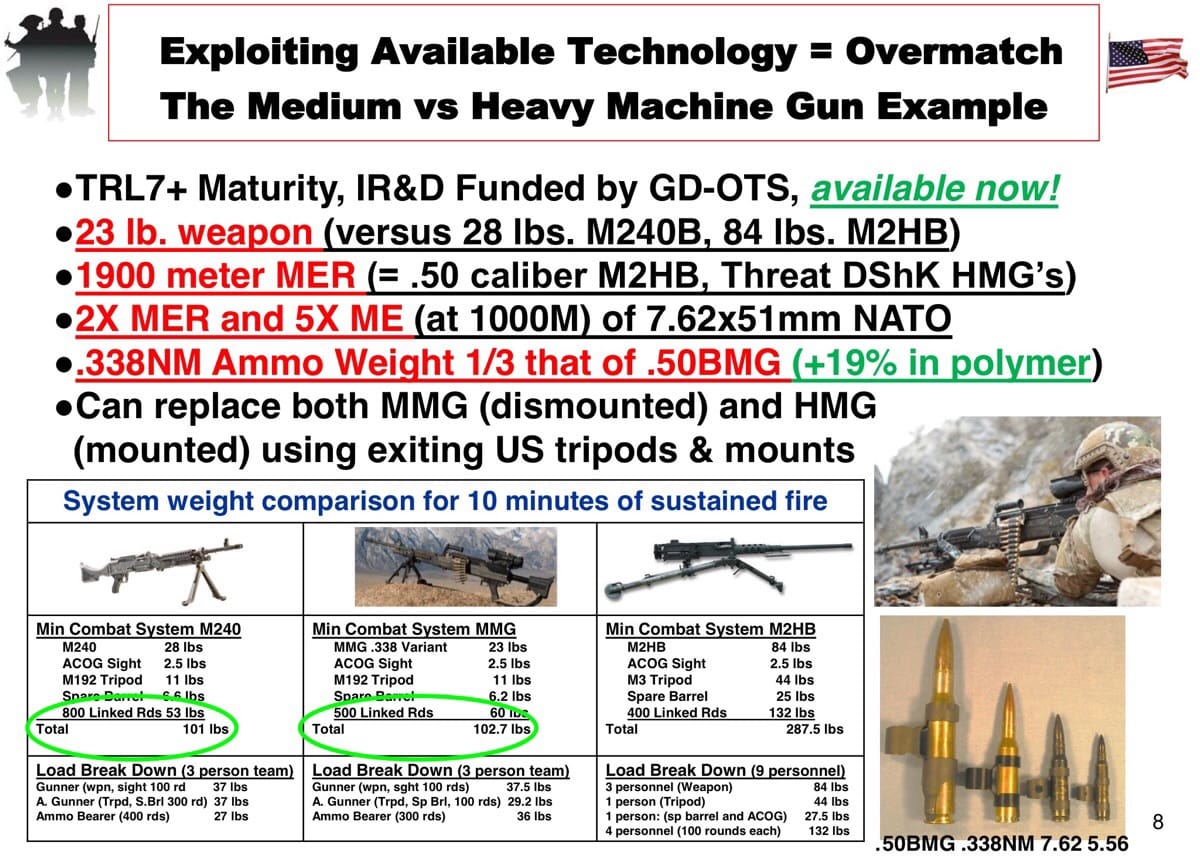
In short, the capability will provide a machine gun which is lighter than the current 7.62mm M240, yet offers nearly the reach of the .50 M2. However, unlike the M2, this new capability will offer pinpoint accuracy at those ranges. What’s more, with the introduction of polymer cased ammo, the weight of ammunition comes much closer to 7.62 than .50.

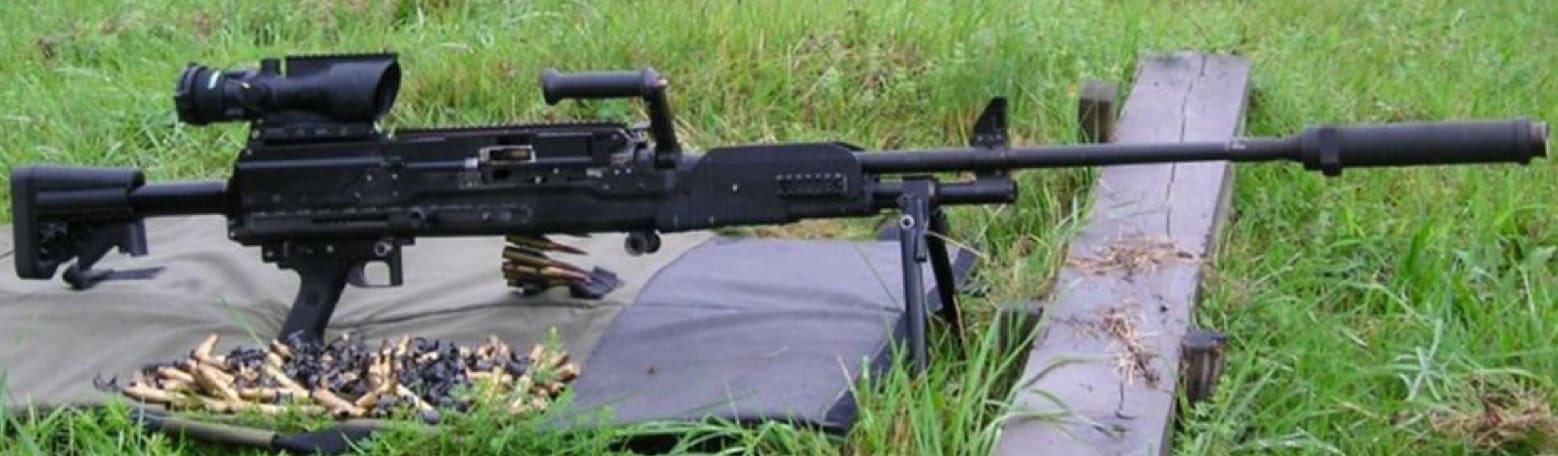
LWMMG specifics: The LWMMG should fire the belted .338NM round of ammunition with a polymer case. The LWMMG should weigh less than 24 pounds unloaded with a barrel length of 24in. The LWMMG should have a rate of fire of between 500-600 rounds per minute. Weapon shall be compatible with current rail mounted aiming systems with the ability to incorporate more advanced fire control technology. The system should include both a suppressed barrel and an unsuppressed barrel that can be rapidly changed. The LWMMG should include a tripod that is lightweight and provides the stability and accuracy required to engage targets at extreme ranges. The LWMMG should be able to mount in current machinegun mounts designed for the M240B/C. The weapon should have sufficient accuracy to engage area targets and vehicles at 2,000m.

At the recent NDIA Armaments Symposium, USASOC DCS G8, COL Samuel Ashley briefed this capability. The capability has been sufficiently demonstrated to move to procurement. However, COL Ashley related that this new capability will require new ootics amd target acquisition solutions.

To be sure, adopting a new cartridge is an expensive endeavor, but in this case, the new capability more than outweighs the cost. Additionally, SOCOM plans to introduce the caliber to its upcoming multi-caliber Advanced Sniper Rifle, along with a legacy 7.62 NATO and .300NM round.

One interesting point in the RFI is the mention of two types of barrels. One is a standard barrel and the other is suppressed. Notice they didn’t ask for a suppressor, but rather a suppressed barrel. As GD has demonstrated the weapon in use with a detachable suppressor in the past, this indicates they must have developed an integrally suppressed barrel. The amount of Interal Reasearch and Development Dollars GD has put into this weapon is impressive.

IMG_0535

This 2016 chart from a Jim Schatz briefing to industry depicts the weights of the M240, LWMMG and M2. In addition to weapon upgrades, Polycase technology is going to further lighten that load, or better yet, increase the amount of ammunition a machine gunner can carry.

We recently mentioned General Dynamics Ordnance and Tactical Systems’, Commercial Off The Shelf solution which this requirement is based on and is available right now, but I would not be surprised to see other vendors offer up solutions as well. I’ll keep my eyes peeled during this week’s SOFIC to see what turns up.

Some readers will get wrapped around the axel over the 5,000 number of systems in the RFI; but don’t. It’s a nice round number the government is using to measure industry’s capacity to produce the weapon. By no means is it a basis of issue plan based number.

In my opinion, adoption of this capability is the single greatest small arms capability enhancement to the US military in the last century. It offers the ability to deliver accurate sustained fire at ranges out to 2000m in a package which can be employed by one operator. MARSOC has been following the weapon’s development, but good on the Marine Corps writ large in seeing the value of this proposition. Hopefully, the US Army, a service very concerned about threat overmatch, will move this capability from a Future to Near-Term priority. However, based on recent directed requirement from the 4-Star level, I would not be surprised to see this happen as SOCOM’s program reaches maturity. This will not only enhance the Army’s capabilities but also help control ammunition costs.

For those interested in full details, visit www.fbo.gov.

SOFWERX Seeks Teams To Develop A K9 O2 Mask For HAHO Jumps

Monday, May 8th, 2017

Jump The Dog: Canine Oxygen Mask for High Altitude High Opening (HAHO)

IMG_1542

OpenWERX provides the general public with monthly opportunities to collaborate on innovative approaches relevant to SOCOM and other federal government agencies.

Prizes: First place: $6,000 – Second place: $4,000 – Third place: $2,000

OpenWERX Challenge-Jump the Dog

Open the description PDF here.

Here are some measurements that can be used as a guide to help develop the proper sizes for the masks:

– The average for a standard Belgian malinois is a nose length of approximately 4? with a circumference of approximately 10?.

– Variations in sizes should be able to accommodate nose lengths from 3? up to 5?, and circumferences of 8? up to 13?.

It might also be useful to do an Internet search for “how measure for a muzzle”, and other information about what will be comfortable for a dog (i.e. how much extra space to provide for the dog so as not to force their mouth completely shut). This site is an example.

Each team will create a video (10 minutes or less) presenting their concept to SOFWERX. The video will be viewed by the judging panel prior to the event. The teams will attend the OpenWERX event 1 June virtually or in person to answer questions by the judging panel.

June 1 Schedule
5:30-5:55 PM Networking (At SOFWERX)
5:55-6:05 PM Introductions
6:05-6:10 PM Air Bud Q&A
6:15-6:20 PM Summit Oxygen USA Q&A
6:20-6:25 PM Canine Performance Sciences Q&A
6:25-6:30 PM DKE Labs Q&A
6:30-6:35 PM Hack Tampa Q&A
6:35-6:40 PM Whiz-bang Q&A
6:40-6:45 PM Tampa Deep Sea Xplorers Q&A
6:45-6:50 PM The Shade Tree Mechanics Q&A
6:50-7:00 PM Tampa Technik Q&A
7:00-7:05 PM Birch Bunch
7:05-7:10 PM Break
7:10-7:15 PM Rossini Design Group Q&A
7:15-7:20 PM Frontier Labs Q&A
7:20-7:25 PM O.T.H.ER Team Q&A
7:25-7:30 PM Mako Design Q&A
7:30-7:35 PM Tampa Deep Sea Xplorers – Team Red Q&A
7:35-7:40 PM (MooLabs) Q&A
7:40-7:45 PM Lockheed Martin Aeronautics Co. Q&A
7:45-7:50 PM Quiet Professionals Q&A
7:50-7:55 PM IAG HAHO Dog Q&A
7:55-8:30 PM Judging
8:30 PM Prizes Awarded
9:00-9:15 PM Next Challenge Announced