FirstSpear TV

Archive for the ‘Guest Post’ Category

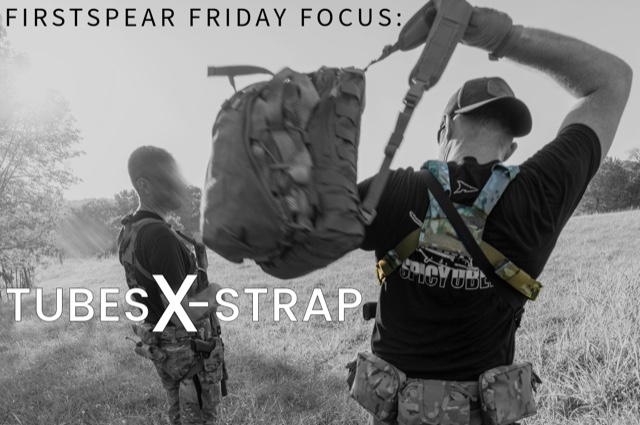
FirstSpear Friday Focus: Tubes X-Strap

Friday, September 22nd, 2023

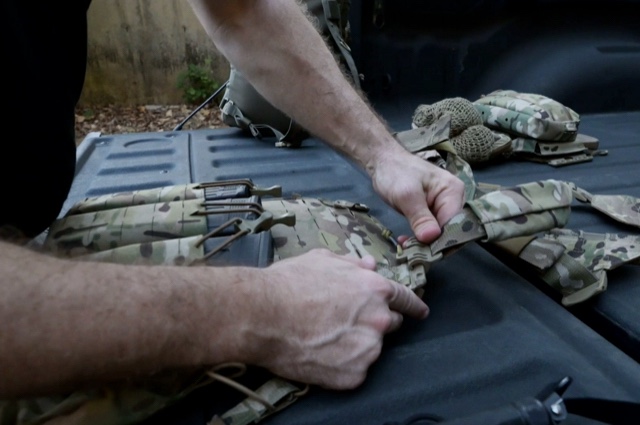
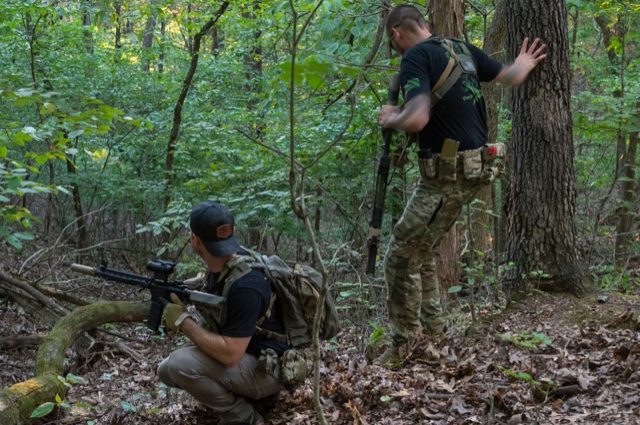
Designed to work with either the FS AAC family of plate carriers or Strandhogg, the Tubes X-Strap harness quickly Tubes into place and allows you to work with the front of your plate carrier in place without a back panel or cummerbund.

The X-Strap system can adjust to fit over the top of a Soft Armor Carrier or Cold Weather Clothing, elastic to allow flexibility and comfort in the field and the back panel provides attachment FS Cell Tags and morale patches.

Visit FirstSpear to find American Made kit and accessories, Built For The X.

SecAF Announces Air Task Force Model

Friday, September 22nd, 2023

ARLINGTON, Va. (AFNS) —  

Secretary of the Air Force Frank Kendall announced the Air Task Force as the next step in the Air Force’s Force Generation model during the Air and Space Forces Association’s 2023 Air, Space and Cyber Conference, Sept. 11 in National Harbor, Maryland.

“Major initiatives in the U.S. Air Force and Space Force, such as Air Force Force Generation in the Air Force and the evolving allocations of responsibility across Space Force field commands are moves in the right direction,” Kendall said. “On Friday, I approved the Air Force creation of three Air Task Forces to serve as pilots in order to experiment with ways to more effectively provide deployable, integrated units — two for U.S. Central Command and one for U.S. Indo-Pacific Command … they are a major step in the right direction, and we will learn from this experience.”

As part of an ongoing effort to build high-end readiness for the future, the Air Force continues to evolve the way it presents its forces through the AFFORGEN model.

What Airmen need to know about the Air Task Force
– The ATF provides the Air Force with a definable unit of action at a sustainable pace for employing and posturing forces.

– The first ATFs will enter the AFFORGEN cycle in Summer 2024 and will deploy beginning in fiscal year 2026.

– These Airmen which form the ATFs will team, train and deploy together through the AFFORGEN cycle.

– As ATFs are built, Airmen will be sourced from across the Air Force. Further details will be available in the coming months.

In addition to a disciplined force generation model, the Air Force is refining Agile Combat Employment tactics, Multi-Capable Airmen training, A-Staff constructs, and implementing a Mission Command approach to command and control.

Air Task Force construct
The ATF will consist of a Command Element with an attached expeditionary A-Staff; an Expeditionary Air Base Squadron to provide Base Operating Support; and Mission Generation Force Elements with attached Mission Sustainment Teams to facilitate Agile Combat Employment.

– The Command Element will be the ATF’s dedicated leadership team throughout the entire AFFORGEN cycle, focused on building, training, certifying and deploying a cohesive unit postured for success across the spectrum of conflict. The Command Element will consist of the commander, deputy commander, a senior enlisted leader and an expeditionary A-Staff.

– The ATF commander will be a colonel; the ATF deputy commander will be a lieutenant colonel who has successfully completed at least one squadron command assignment; and the senior enlisted leader will be a command chief master sergeant.

– The A-Staff will assist the ATF commander by providing staff support in interacting with higher headquarters and fulfilling the commander’s responsibility to provide resourcing, policy, oversight and guidance.

“Concepts like Multi-Capable Airmen and Agile Combat Employment are aligned with meeting the pacing challenge,” Kendall said.

The ATF model represents the next step in adopting a more modular organization of teams, which generate through the AFFORGEN cycle together and then deploy as a unit to maximize effectiveness.

Secretary of the Air Force Public Affairs

Texas National Guard, Chile Partner for Cyber Training

Thursday, September 21st, 2023

AUSTIN, Texas – The Texas National Guard and the Chilean Army conducted a joint cybersecurity exercise in Santiago, Chile, Aug. 28-30, as part of the State Partnership Program.

Col. Christopher Howell, chief of the Cyber Operations Branch, Joint Force Headquarters, Texas Military Department, said exchanging knowledge is a valuable tool to improve cybersecurity in both countries.

“We want them [Chile] to further understand how Chile’s cyber operations and organizational capabilities employ tactical responses at a military level. Also, we discussed the communications within their country,” Howell said.

As cyber threats become more common, supporting both countries’ relationships and strengthening the bonds between the military and their civilian counterparts is crucial, Howell said.

First Lt. Jose Pantoja with the Chilean Navy said these long-term partnerships are critical for international security.

“I think keeping this relationship between Chile and Texas is fundamental to develop our capacities and our apprenticeships to improve our defenses,” said Pantoja. “With this experience, the Texas National Guard shares with us their knowledge and training for maintaining our systems. We are also learning how they coordinate with their citizens.”

The exercise included a simulated cyber attack on a Chilean government website. Partners from both countries worked together to overcome challenges and address vulnerabilities.

Sgt. Maj. Darla Wright, senior noncommissioned officer for the Cyber Operations Branch, Texas Military Department, said building junior Soldiers’ knowledge benefits the military and the individuals.

“We wanted to share the different aspects that have been key to retain and recruit cyber personnel within the organization, and that is making every person understand their contribution and their effort is recognized, and this will create growth within the cyber-intelligence field now and for the future,” Wright said.

The Texas National Guard leaders also discussed the importance of rewarding hard work, developing individuals’ skills, and allowing each member the opportunity to advance within the Chilean Army.

“Often, the best recruiter is the person who is already doing that job. They have those skill sets, so the different things that we can help is to interview the talent within and train Soldiers to become instructors,“ Wright said.

The Texas National Guard and the Chilean Army have been partners under the Department of Defense National Guard Bureau State Partnership Program since 2008. They will continue to work together to share information, develop personnel, and respond to cyber threats and guidance for the future.

The 30-year-old SPP program has grown to include 88 partnerships with 100 nations.

By Sarah Snedden, Texas Military Department

Army Announces Terrestrial Layer System – Brigade Combat Team (TLS BCT) Manpack Prototype OTA Agreement

Wednesday, September 20th, 2023

ABERDEEN PROVING GROUND, MD – After more than six months of competitive white papers and technical evaluations for the Terrestrial Layer System – Brigade Combat Team (TLS BCT) Manpack, the U.S. Army entered into an Other Transaction Authority (OTA) agreement through the Consortium for Command, Control, and Communications in Cyberspace (C5) with Mastodon Design, LLC to support Phase 1 – Prototype Build and Demonstration. The agreement totals $1,521,490 for a 9-month Period of Performance.

The TLS BCT Manpack system will be a tailorable, modular, terrestrial capability that allows the integration of Signals Intelligence and Electromagnetic Warfare collection, processing, exploitation, reporting, and effects capabilities for SIGINT Collection Team and Electromagnetic Warfare Team elements. TLS BCT Manpack will provide the Brigade Combat Team commander a tactical advantage with agility and improved intelligence, surveillance, reconnaissance, and targeting in Multi-Domain Operations.

“The TLS BCT Manpack compliments the TLS BCT and TLS Echelons Above Brigade (TLS EAB) family of systems with a shared and open systems approach that creates the flexibility and efficiencies needed against a highly adaptive threat,” said Kenneth Strayer, Project Manager, Electronic Warfare and Cyber (PM EW&C). PM EW&C plans to transition the TLS BCT Manpack from prototyping to production in FY2024.

215 Gear – Sniper Attachment Platform

Tuesday, September 19th, 2023

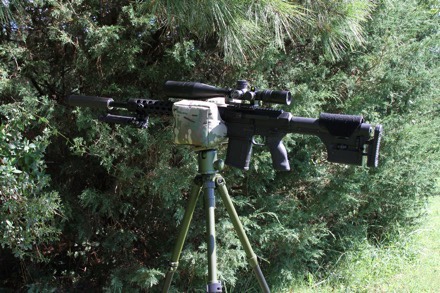
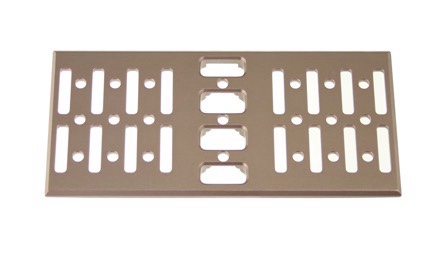
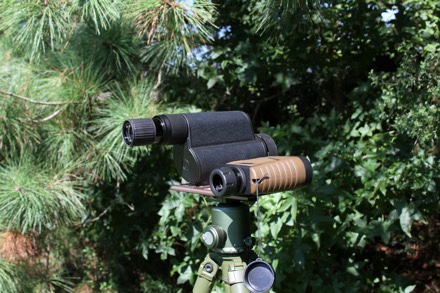
Designed as an ecosystem for the Sniper or Observer, providing versatility in mounting and configuration options. As your needs change, the system will provide mounting solutions to ensure your application end state is met. Machined with a monolithic, full width Arca Swiss rail for mounting to a RRS tripod head.

Additionally, 21 mounting holes are added for our 1/4-20 Optic Mounting Screws; with 16 M-LOK compatible channels. These channels are for mounting M-LOK compatible accessories, such as Picatinny mounting rails and specialty accessories. You can configure from a Shooting Bag platform to mounting optics, laser range finders or lasers in minutes. We are expanding accessories for this platform, based on current and future mission requirements.

Includes: 6061 Aluminum Adaptor Plate

Does not include: Installation tools or 1/4-20×3/8” screws.

Additional accessories for purchase:

1/4-20×3/8”screws for mounting your item to the Sniper Attachment Plate.

Made in the U.S.A with 100% U.S.A 6061 Aircraft Grade Aluminum.

Anodized matte FDE or Black.

Product total weight: 5 7/8 oz.

Product dimensions: 8.5”L x 4”W x 0.5”H

www.215gearstore.com/sniperattachmentplatform

D-Cell Redesignated 24th Rapid Deployment Squadron

Tuesday, September 19th, 2023

MACDILL AIR FORCE BASE, Fla. —  

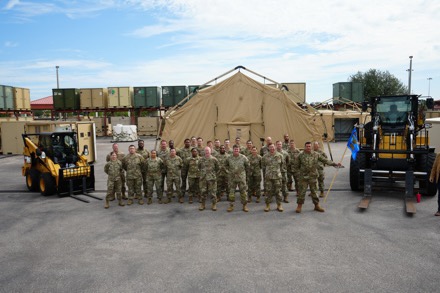
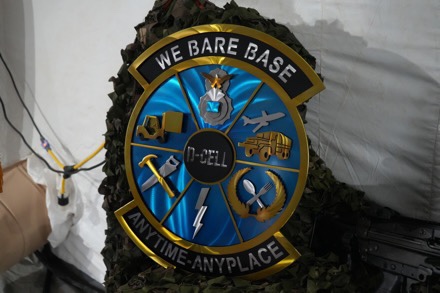
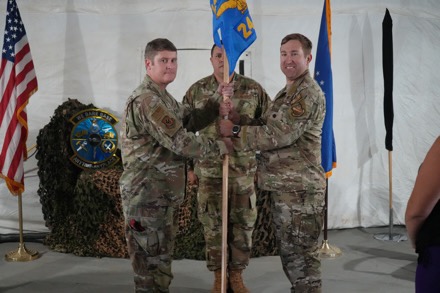
The 24th Special Operations Wing redesignated Detachment 1, also known as Deployment Cell or “D-Cell,” to the Rapid Deployment Squadron during a ceremony at MacDill Air Force Base, Fla., Sept. 6, 2023.

A geographically separated unit from the 24 SOW at Hurlburt Field, Fla., the Rapid Deployment Squadron consists of members across 15 career fields, forming four agile teams. These teams of multi-capable Airmen are trained in 49 cross-functional tasks including survival, evasion, resistance and escape training, advanced shooting and advanced combat casualty care.

The primary role of the RDS is to “bare base,” which is to rapidly turn austere locations into fully functional bases.

Col. Daniel Magruder, Jr., presided over the ceremony and gave opening remarks.

“Over 60 years ago, General Curtis Lemay established a unit that supported deployment operations,” said Magruder. “While your customer has changed over the years from U.S. Strike Command, which doesn’t exist anymore, your dedication to mission accomplishment hasn’t wavered.

The ceremony included the inactivation of Det-1, along with the activation of the 24th RDS and assumption of command.

“I’m encouraged that every member of your unit’s long blue line knows exactly where the unit came from,” said Magruder. “You know what it provides to our nation and the joint force, and where it’s going as it’s redesignated the 24th Rapid Deployment Squadron.”

In the last 54 years, both D-Cell and Det-1 have served under three different commands with its members participating in over 30 operations and four wars.

After accepting the guideon, Lt. Col. Michael Biederman, Commander, 24th RDS, expressed his excitement for the future.

“We have gained clarity on how AFSOC sees us and have rekindled our relationships with our partners to forge ahead in what we do best establishing bare bases and providing specialized engineering, logistics, services and security expertise in supporting the tip of the spear,” said Biederman. “In our uncertain geopolitical future I am certain the 24th Rapid Deployment Squadron will carry on DCELLs historic namesake to the far reaches of the globe.”

By Capt Savannah Stephens, 24th Special Operations Wing

Army Leaders Gather at Fort Moore’s Maneuver Warfighter Conference

Monday, September 18th, 2023

Fort Moore, Ga. – Top Army leadership from the Pentagon and major commands gathered here Sept. 12-14 for the Maneuver Center of Excellence’s Maneuver Warfighter Conference. The annual event, hosted by Maj. Gen. Curtis Buzzard, MCoE commanding general and Fort Moore’s senior commander, focused on the way forward for large scale combat operations, including presentations on maneuver modernization, multi-domain operations, robotics, electronic warfare, and data literacy as well as holistic health and fitness.

“For three days, we get to hear from the leaders of our Army. We get to focus on driving change and meet the challenges of Army 2030, shape the Army of 2040, and build a common visualization of where we’re going,” Buzzard said, emphasizing the importance of the MWFC.

Buzzard also mentioned the Army pivot to large scale combat operations, combined arms in a multi-domain environment, transparent battlefields, and the proliferation of unmanned systems as topics to be covered and discussed.

“We are at the epicenter of the changing character and immutable nature of war at the Maneuver Center of Excellence. This is exactly what we do: we focus on building the foundation and delivering trained and combat ready Soldiers and leaders to the operational force while also developing and integrating the doctrine and capabilities for the future,” Buzzard said.

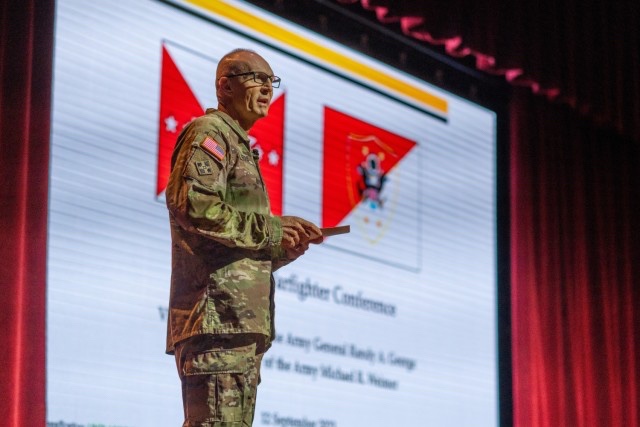
Senior leader presenters attending the event included Gen. Randy A. George, U.S. Army acting Army Chief of Staff; Sergeant Major of the Army, Sgt. Maj. Michael R. Weimer; the U.S. Army Forces Command command team, Gen. Andrew P. Poppas and Command Sgt. Major TJ Holland; the U.S. Army Training and Doctrine Command command team, Gen. Gary Brito and Command Sgt. Major Daniel T. Hendrex; U.S. Army Pacific commanding general, Gen. Charles A. Flynn, and the U.S. Army Futures Command command team, Gen. James E. Rainey and Command Sgt. Maj. Brian A. Hesler; among others.
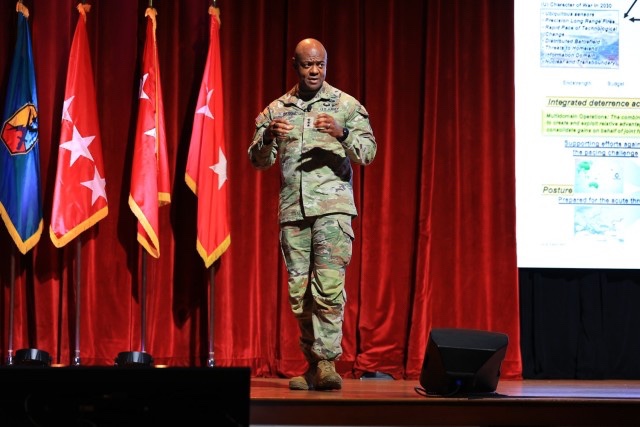
Special guest speakers included author and strategist Peter Singer and Mike “Coach K” Krzyzewski.

Realizing the Strategic Vision

“I want to talk to you a little bit about where the Army’s going,” said Gen. Randy George, acting Chief of Staff of the Army.

“We’re going to talk about our four focus areas,” the general stated, noting his newly refined focus areas of warfighting, continuous transformation, strengthening the profession, and delivering ready combat formations which were published only a week prior. “Our Army exists to fight and win wars; that’s why our number one focus area has to be warfighting – and be laser-focused on that.”

The general expanded that thought. “I expect you to focus on what makes you more lethal and cohesive,” he said, adding that anything “not contributing to lethality and cohesiveness” would have to be reviewed for possible removal.

“We going to have to change how we’re organized,” George continued, stating that he asked commanders at the four-star level to review their structure and adjust based on capability and environmental advances.

“We are going to change how we train,” he said, noting the current multi-domain environment. “We’re going to have to adjust going forward. We’re going to have to do things more rapidly.”
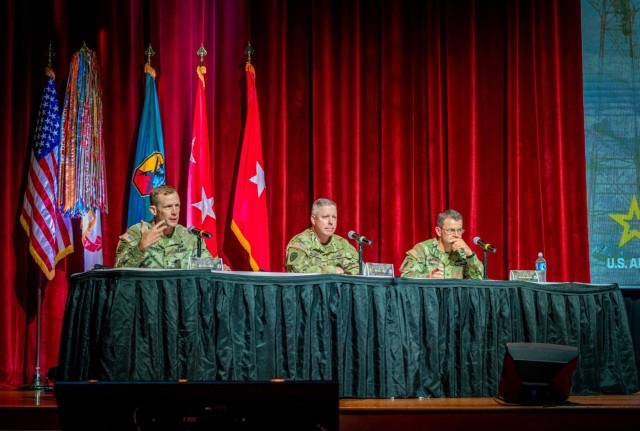
The best ideas, he added, most often were “bottom up”, originating in the field and the operational environment. “I ask you to think that, to write about it, to pass them up and to make sure we’re seeing them.”

“We’ve got some work to do,” said Michael Weimer, the recently sworn-in Sergeant Major of the Army. “We’ve got to transform how we develop our non-commissioned officers; we have to transform how we train; we have to transform how we manage our time, and I do believe that, at echelon, the non-commissioned officer has a key role to play in every one of those things.”

Achieve Army 2030

Gen. James E. Rainey presented remarks on the future of war from his perspective as head of U.S. Army Futures Command.

“There are three big things that are not going to change.” Rainey said, describing the first enduring element of the future of war as its definition: a contest of wills, the second as the immutable decisiveness of the land domain, and the third as the Army’s commitment to its values.

Regarding the last point, Rainey stated, “I believe the United States is going to continue to abide by the law of armed conflict, and that matters because that’s what separates us from the people we fight.”
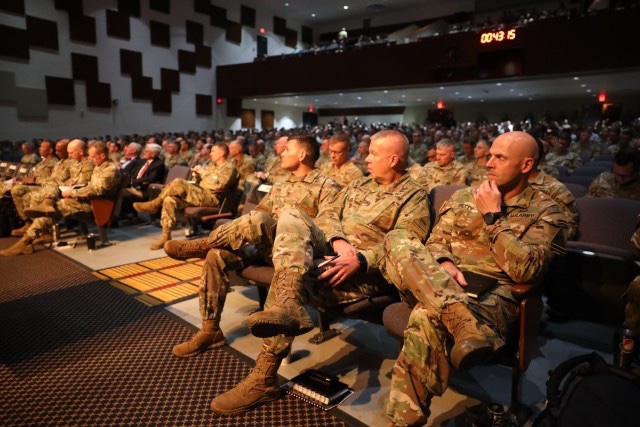
“What is going to change?” he asked. “We’re going to have to learn how to fight under constant observation and in constant contact in one form or another. That’s game changing. If I was a commander right now, I’d make sure I was putting more into counter-C5ISR (command, control, communication, cyber, intelligence, surveillance, and reconnaissance) than my own C5ISR.”

“Technology,” he stated, “indisputably favors the defense.” While defensive postures are getting stronger, he said, offensive warfighting is only getting harder and “more costly.”

Rainey also discussed the operational relationship between fires and maneuver.

“I think fires is going to bump up above maneuver again. We’ve gotten into thinking that fires is something to condition maneuver. I think the future is going to be about maneuvering to position fires. That’s a big, fundamental change.”

Rainey addressed other key issues facing the future Army, beginning with what he considers the impossibility of avoiding combat in urban areas.

“We’re kidding ourselves if we think we’re going to avoid fighting in cities. We’re not going to be able to avoid it.”

Shifting his comments to technology, he notably stated that, “If there’s one thing that you recall from today, this is it: technology is increasing the punishment of unskilled commanders and untrained units. If you’re not good, if you’re not prepared, you are going to pay for it at an unprecedented level.”

His remarks were echoed by Brig. Gen. Brian Vile, commanding general of the U.S. Army Cyber Center of Excellence at Fort Gordon, Ga., in a later panel discussion.
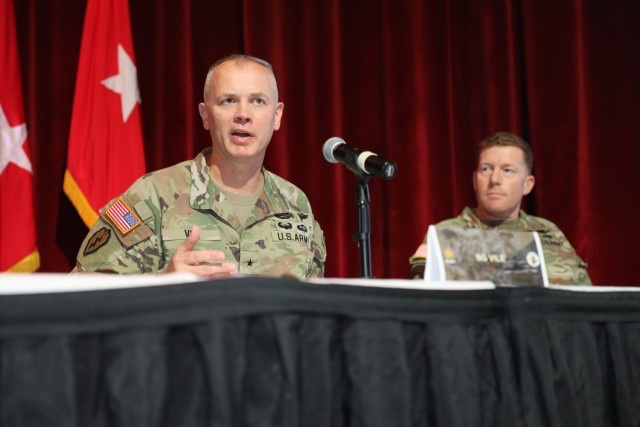
“It really boils down to two things,” Vile said. “First, we enable and defend friendly use of cyberspace and the electro-magnetic spectrum – EMS. The second thing we do is we deny our adversaries the use of cyberspace and EMS. If we’re successful, you’re going to fight like it’s 2030 and the adversary is going to fight like it’s 1914. We’re going to force them back to carrier pigeons. We’re going to force them back to runner-on-foot. We’re going to force them back to dumb weapons.”

Look Beyond 2030

The future is going to be about artificial intelligence, but in a very different way from how it’s been discussed so far, said Peter W. Singer, New York Times best-selling author and strategist for the New America Foundation. The age-old question of, “What if machines became intelligent?” is being addressed now, he said.

“It’s happening now, in our lifetime, and you are tasked to lead through this challenge,” Singer stated. “We’re only at the start of this journey. There’s no other area that is seeing as much change, as much investment, as much activity as this space.”

Artificial intelligence, Singer said, involves every country, every industry and will create opportunities everywhere.

“The editor of Wired magazine put it this way, ‘I think the recipe for the next ten-thousand start-ups is to take something that already exists and add AI to it.’”

Singer added that AI should be applied to the U.S. military today regarding maintenance, military medicine, acquisitions, intelligence analysis, and battle maneuver – nearly every aspect of what the Army does.

The three-day event concluded with remarks by coach Mike Krzyzewski, a graduate of the U.S. Military Academy at West Point and former Duke University and U.S. Olympics basketball coach.
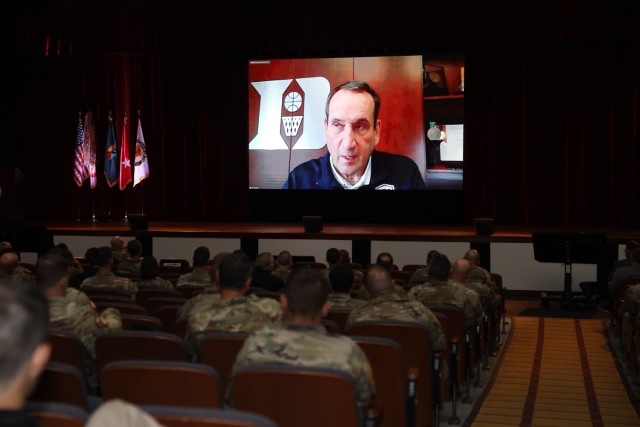
“I’m retired from coaching now, but I’m not retired from being a leader. I’ve been a leader my whole life. It’s the best profession in the world. It changes daily and you have to stay on top of things, and it really transcends every profession on this planet. If you do not have good leadership, you’re going to fail.”

“You are (leading),” the coach told the audience virtually from his office in North Carolina, “because you represent the best team on this planet – the United States Army. To be leaders on the best team in the world is such an honor and a huge commitment.”

“To me, leadership simply is having a group of people that you have the honor to lead, to use their talents to the highest level – not to put a ceiling on their talents – and coordinate them in the accomplishment of a mission.”

By Randy Tisor, Fort Moore Public Affairs Office

Air Force, Army Battle Labs Work with DARPA on ASTARTE, New C2 Capability

Sunday, September 17th, 2023

NELLIS AIR FORCE BASE, Nev. (AFNS) —  

The 805th Combat Training Squadron’s Shadow Operations Center-Nellis, also known as the U.S. Air Force’s Advanced Battle Management System Battle Lab, recently experimented with joint partners that helped evolve a new joint airspace management and joint fires capability at Nellis Air Force Base. Working with the U.S. Army’s Mission Command Battle Lab and Defense Advanced Research Projects Agency, the ShOC-N hosted and collaborated on a joint experiment of the Air Space Total Awareness for Rapid Tactical Execution, or ASTARTE, system, an advanced warfighting innovation project.



As the Air Force’s premier command and control battle lab, the ShOC-N supports the development, advancement and maturation of key technologies and capabilities designed to compress the kill chain for joint and coalition warfighters.

ASTARTE is a DARPA program, with Army and Air Force sponsorship, designed to enable efficient and effective airspace operations and de-confliction in a highly congested battlespace. ASTARTE automates the ability to provide a real-time common operational picture of airspace in and above an Army division to reduce the time required to execute time-sensitive joint fires. Raytheon Corporation developed the artificial intelligence-enabled software to support airspace synchronization and tactical decision-making with a modular approach to allow ASTARTE functionality to seamlessly plug into existing Army and Air Force command and control systems.

“The ASTARTE program highlights the opportunity offor integration at ShOC-N. Software developers from Raytheon, DARPA, and the C2 operators successfully worked through automation to and from fielded systems from Solipsys, Lockheed Martin, and others to show what’s possible when you bring motivated partners together,” said Lt. Col. John Ohlund, 805th CTS commander.

Army and Air Force warfighters simulated a division-level Joint Air Ground Integration Center, or JAGIC, to evaluate the ASTARTE software in an air-ground conflict using both live data from the Air Force’s Red Flag exercise and simulated data produced by the ShOC-N. In addition to Army role players, Air Force air battle managers acted as an Air Force tactical C2 node, in this case, a Control and Reporting Center, assessing ASTARTE information sharing needed to enhance real-time battle management decision-making.

Joint warfighters ran ASTARTE through various combat scenarios and JAGIC battle drills to evaluate the program’s ability to make sense of multiple data streams to create a unified common operational picture and to make tactical recommendations for enhancing joint fires. Additionally, this event provided a critical opportunity to assess the system as a decision aid to augment or potentially replace legacy C2 systems. Recent ASTARTE system enhancements included improvements to the user interface and role player training, placing a greater emphasis on “transparency” of the processes by which the system generates potential courses of action.

“In comparison to previous test events, we observed significantly reduced reliance on legacy C2 systems while using the ASTARTE software, and the role players reported a greater understanding of how the ASTARTE system executes tasks,” said Dr. Mary Schurgot, ASTARTE program manager in DARPA’s Strategic Technology Office.

The 805th CTS and additional program stakeholders successfully evaluated ASTARTE software, identified operational considerations and future improvements, and facilitated a strategy to transition the DARPA program to the Army and Air Force.

“For the Air Force, this was all about contributing to the continued evolution of future warfighter capabilities – and it’s really great to see the invaluable role the 805th CTS plays in facilitating the ABMS Battle Lab work with joint partners to bring DoD innovation efforts to Soldiers and Airmen in the field, furthering our mission to shape multi-domain command and control moving forward,” said Col. Michael Lake, 505th Command and Control Wing deputy commander, Hurlburt Field, Florida.

By 505th Command and Control Wing Public Affairs