XC3 Weaponlight

Archive for the ‘Guest Post’ Category

Zeroing: Basic Truths

Saturday, January 22nd, 2022

ZEROING IS NOT TRAINING

Zeroing your weapon simply calibrates your sight so that the bullet flight intersects with your line of sight at a specific distance. Zeroing has nothing to do with “Train as you fight.” Zeroing is just a Pre-Combat Check; it’s maintenance…”PMCS,” if you will. Just the same as a wheel alignment is to your tactical vehicle.

“Zeroing is not a training exercise, nor is it a combat skills event. Zeroing is a maintenance procedure that is accomplished to place the weapon in operation, based on the Soldier’s skill, capabilities, tactical scenario, aiming device, and ammunition.”

[Ref: TC 3-22.9, Appendix E Introduction]

YOU DO NOT HAVE A 25 METER ZERO

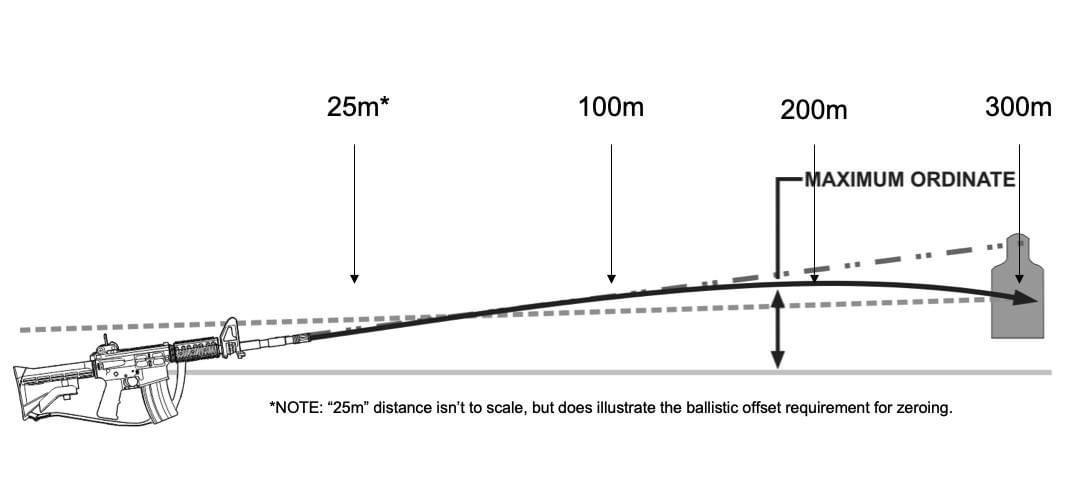
You have a 300m zero, conducted at 25m. In order for the bullet to strike where the Soldier is aiming at 300m, the bullet will cross the Soldier’s line of sight twice: once at 30m and again at 300m. The Army does not have 30m live fire shooting ranges, but it does have 25m ranges. So, what’s the work around? At 25m, the bullet is still below the line of sight (LOS), so we adjust the bullet’s point of impact (POI) to strike 1.5 MOA below the point of aim (POA). This is called a “ballistic offset.”

The same concept applies to Marines. The Marine Corps does not have a 36 yard zero. The Marines have a 300 yard zero, with a “Pre-Zero” conducted at 36 yards.

SIGHTS ARE ZEROED TO THE WEAPON, NOT TO THE PERSON SHOOTING THE RIFLE

Either the sight is matched to the bullet trajectory, or it isn’t. The person pulling the trigger can’t magically alter the exterior ballistics of the bullet. We demonstrate this reality at our Trainer courses by having cadre use someone else’s rifle with a known good zero to consistently engage targets at 300m.

[Ref: “Effects of Sight Type, Zero Methodology, and Target Distance on Shooting Performance Measures While Controlling for Ammunition Velocity and Individual Experience,” para 9(3), US Army Research Lab report ARL-TR-8594, Dec 2018.]

ZERO WITHOUT COMBAT GEAR

TC 3-20.40 removes combat gear as a condition for zeroing, recognizing that what the Soldier wears has nothing to do with the flight of the bullet, and may interfere with a solid, comfortable and unhindered shooting position needed to calibrate the weapon sight.

[Ref TC 3-20.40, Table E-14 “Conditions” vs Table E-48 “Conditions”]

“A common misconception is that wearing combat gear will cause the zero to change. Adding combat gear to the Soldier’s body does not cause the sights or the reticle to move. The straight line between the center of the rear sight aperture and the tip of the front sight post either intersects with the trajectory at the desired point, or it does not. Soldiers should be aware of their own performance, to include a tendency to pull their shots in a certain direction, across various positions, and with or without combat gear. A shift in point of impact in one shooting position may not correspond to a shift in the point of impact from a different shooting position.” [Ref: TC 3-22.9, para E-14 Note.]

REMOVING SIGHTS WON’T LOSE THE ZERO

“Removing and reinstalling the CCO or RCO will not lose the sight zero. Soldiers must record the sight serial number and the rail slot it was mounted in to retain the zero, however.” [Ref: TC3-22.9, para 3-26.].

We demonstrate this capability at our Unit Marksmanship Trainer Courses by swapping CCOs and RCOs multiple times onto an M4A1 and consistently engage 300m targets.

ETA: Luke Wright makes a great point in his comment to this post. When given the opportunity, always reconfirm your zero after reinstalling your sights. Rails/mounts may become out of spec over time and adherence to sight mounting procedures becomes critical. Depending on the precision required for distances and sizes of target engagements, the “acceptable” return-to-zero capability becomes a little squishy.

When zeroing, the following progression takes place, with a caveat*.

MECHANICAL ZERO

Sight windage and elevation knobs are centered within their ranges of adjustment in order to offer a reasonable chance of hitting the A8 25m zero target.

According to the M4A1 military specification (MIL-C-71186), mechanical zeroing will only get rounds somewhere in a 22”x16” box around your 100y aiming point. At 25m, that’s a 6”x4” impact zone. This clearly isn’t a valid zero, BUT it will get the Soldier on the A8 25m zero target.

10M LASER BORE-LIGHTING

Sight windage and elevation setting that accounts for the bullet’s trajectory at 10m that approximates a 300m zero to offer a better chance of hitting near the point of aim on 25m A8 zero target.

Laser bore-lighting is not an effective zero. For the CCO, a 10m bore-light only gives the Soldier about a 50% probability of hit at 200m. For night aiming lasers, a bore-lighting only gives the Soldier a 50% probability of hit at 150m. This, too, is clearly not a valid zero, BUT it will get a Soldier on the A8 25m zero target:

“The purpose of the bore-light is to get ‘bullets on paper’ during live-fire zeroing. Bore-lighting is not the same as zeroing the weapon.”

[Data and quote from “Training Lessons Learned on Sights and Devices in the Land Warrior Weapon Subsystem,” Army Research Institute, November 1999]

*CAVEAT – MECHANICAL ZERO & 10M LASER BORE-LIGHTING:

Unless a weapon was re-barreled or a new weapon sight was issued, the mechanical zero and laser bore-lighting should be bypassed. There’s no reason why the weapon sight setting would have changed since the last time it was zeroed at true distance during your last range event.

Since neither a mechanical zero nor a laser bore-lighting accurately applies a weapon zero, conducting those steps again will simply undo the previously validated weapon zero.

“25M ZERO”

First, you do not have a 25m zero. You have a 300m zero. In fact, the Army does not conduct a “25m Group & Zero Event.” The Army conducts “Table 4 – Basic.” “Zeroing” at 25m is applying a windage and elevation sight setting that approximates the trajectory of a 300m zero to maximize the chances of hitting the point of aim on a 300m target. Sometimes called a “near-o,” since it’s not truly a zeroed weapon, just “nearly,” and the Army uses a 25m range to get close to the first crossing (the “near” side) of the bullet with the shooter’s line of sight.

Soldiers must not rely on a 25m “zero.” Small errors at 25m create big errors at 300m. For example, a ½” sight error at 25m will cause approx. 6” error at 300m, which is more than halfway to missing your target (the E-type silhouette width is 19.5”).

CONFIRMATION OF ZERO AT TRUE DISTANCE

Small inaccurate sight settings that go unnoticed at 25m are fully expressed at farther distances. Confirmation of zero at 300m will expose those inaccurate sight settings and allow the shooter to obtain a proper and true zero.

While a 25m range is utilized to apply sight settings for a 300m zero, weapon sights are still not considered zeroed. Confirmation at true distance must take place.

Confirmation can be accomplished in any of the following ways, arranged in order of preference from most- to least-preferred.

Location of Misses and Hits (LOMAH) has acoustic sensors and digital plots of exact bullet impacts, giving Soldiers precise feedback to apply a true zero. It’s fast and it’s easy. Unfortunately, the Army doesn’t equip every firing lane or range with LOMAH. Not yet, anyway.

Known Distance (KD) range, with “spotters” inserted into each bullet hole on the paper target so Soldiers can adjust their sights to hit exactly where they’re aiming. Most Army training installation don’t have a KD range, though, so this isn’t a universal option. When available, though, this is preferred over the next option.

Automated Range Facility (ARF)/Modified Range Facility (MRF) with targets set to “hit-bob” mode react when a bullet strikes anywhere on the 300m E-type silhouette (19.5” x 40”). This method DOES NOT allow the shooter to apply a precise sight setting since no precise feedback is given. A strike anywhere on the target will register as a hit. Did you hit the target in the shoulder? Maybe the hip? Nobody knows. This does satisfy the Army requirement to confirm a true distance zero, however.

Bottom line: mechanical zeroing and laser bore-lighting help to get rounds on paper at 25m, which helps to get rounds reasonably well on target at 300m, which finally allows the shooter to get a true zero.

This is the first of a series of posts about the zeroing process. A recent post revealed a surprising amount of misinformation and mythology about zeroing in the Army, so we’re tackling the issue block by block. We’ll break down concepts and application for the entire process in future posts.

By SSG Ian Tashima, CAARNG Asst State Marksmanship Coordinator
FirstSpear Friday Focus: Strandhogg V3

Friday, January 21st, 2022

New for 2022! Strandhogg V3 features a new integral zipper admin pocket, top loop placard on front and back. It also features an instant adjust back panel. This carrier can be used with a variety of cummerbunds.

For more information, check out first-spear.com/platforms.

Next Day Armor: NIJ Certified Body Armor – Without the Wait

Thursday, January 20th, 2022

Next Day Armor, the only authorized internet distributor of Leading Technology Composites (LTC), is one of the few companies that has NIJ Certified Level IV body armor in stock and ready to ship for next-day delivery. Founded on the principle that your next day matters, NDA has created a streamlined procurement process that cuts out the middle-man and focuses on shipping your body armor so you can receive it as soon as the next day. Offering proven performance, accelerated acquisition, and cutting-edge quality – Next Day Armor is the best choice for anyone wanting high-quality body armor without waiting 8-10 weeks to get it.



High-Quality Armor at Affordable Prices

Next Day Armor’s hard armor plates are manufactured by LTC, the world’s most respected body armor manufacturer offering NIJ certified products. The NIJ (National Institute of Justice) is the only nationally recognized standard capable of qualifying armor for law enforcement and the military. Their rigorous ballistic and environmental testing protocols are implemented to ensure that only the highest quality armor receives a stamp of approval. LTC’s hard armor plates are certified and ready to be worn with the confidence of the NIJ’s standard.

The NDA Difference

Next Day Armor’s cutting-edge quality and next day delivery capabilities are unparalleled when compared to competitors. LTC body armor holds the highest standard for quality armor and is trusted by career professionals in the most dangerous fields, including military, police, and special missions units. Made of a ceramic/aramid or ceramic composite, LTC solves two of the biggest problems with body armor – weight and durability. This blend of materials creates a lightweight plate that is easy and comfortable to wear, while ensuring you are personally protected at all times.

Because Next Day Armor is the only authorized internet distributor of LTC, all of its products are manufactured and shipped within the United States of America, enabling NDA to get body armor into your hands within 24 hours. With shipping delays and supply chain issues bogging down body armor and personal protection companies, Next Day Armor provides superior service by offering next-day delivery.



Where Can I Get Next Day Armor?

If you’re interested in next-level personal protection body armor, head over to Next Day Armor’s website, www.nextdayarmor.com/shop/. Or, if you have any questions, reach out to NDA at sales@nextdayarmor.com. Next Day Armor staff are trained experts in the personal protection industry and will be glad to help.

TacMed Tuesday – The Tourniquet Task Trainer Arm

Tuesday, January 18th, 2022

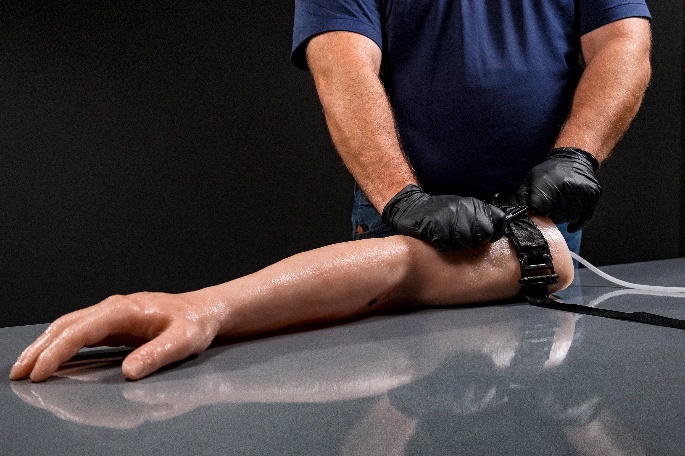
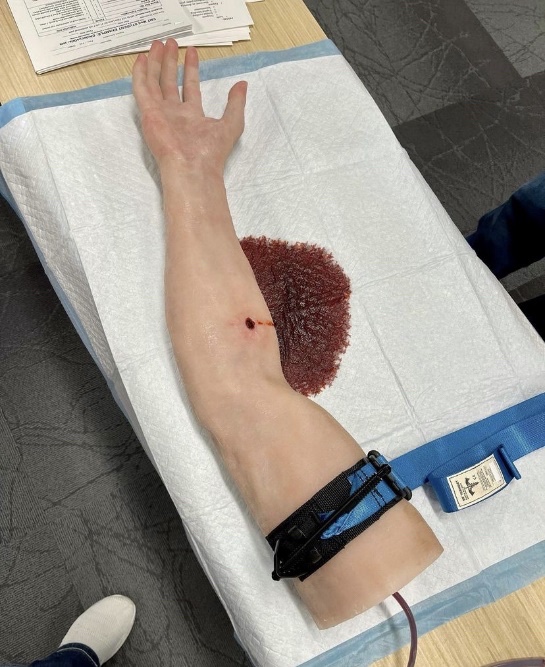
The Tourniquet Task Trainer Arm is a rugged, hyper-realistic hemorrhage control training solution designed for teaching proper tourniquet application both in the classroom and in field scenarios. Its unmatched lifelike design looks identical to human tissue, and the arm is durable with self-healing properties to withstand repeated use.

Its features include:

1. Lifelike Detail

From a distance and close-up, the hyper-realistic arm looks exactly like a real human extremity – from its skin texture to the lines in the palm to how the structure reacts during tourniquet application.

2. Full Arm Design

The full-length arm trainer is modeled off a 6’2” male for optimal hands-on training to develop muscle memory.

3. Integrated Wound

The gunshot entry wound site can bleed using the integrated vessel system for increased realism and demonstrating proper tourniquet application to stem severe bleeding in upper extremities.

4. Self-Healing Skin

In addition to its high-strength materials, the device’s skin features self-healing properties to increase the product’s life for repeated use by trainees in numerous courses.

If you are interested in learning more about this training tool and how you can improve your tourniquet application skills with it, go to tacmedsolutions.com/products/tourniquet-task-trainer-arm

AFCLC Launches New Introduction to China, Russia Courses with Certificates on Culture Guide App

Monday, January 17th, 2022

MAXWELL AIR FORCE BASE, Ala. (AFNS) —  

The Air Force Culture and Language Center recently added Introduction to China, Introduction to Russia Culture courses, and a video library to its newly updated, free Culture Guide mobile app. The addition of the courses moves lock-step with Air Force Chief of Staff Gen. CQ Brown Jr.’s strategic initiative, Accelerate Change or Lose, outlining four Action Orders and focusing on people, decision-making, competition, and adapting to change.

Airmen and Guardians will receive a Certificate of Completion ready to upload to their training record for credit when completing a course.

During his speech at the 6th Annual Air University Language, Regional Expertise and Culture Symposium in October, and later quoted in Air Force Magazine, Secretary of the Air Force Frank Kendall highlighted the importance of understanding Chinese culture for integrated deterrence.

“Collectively, we Americans lack an adequate understanding of Chinese culture,” Kendall said. “We run a significant risk of misinterpretation and missed signals when we project our own perspectives upon Chinese actions and communications.”

In less than 60 minutes, each course gives service members the baseline general attributes of the cultures of the nation’s strategic competitors. An outline of the courses includes:

Introduction to China: The new China Culture course consists of two informative segments. Part 1 introduces the concept of culture, social behaviors, and how they define a culture’s native belief system. In Part 2, the user engages the 12 Domains of Culture concerning China, the nation’s history, religion, socio-political relations, and more.

Introduction to Russia: The new Russia Culture course consists of two intricate parts and takes about 40 minutes. The first half introduces conceptions and philosophies related to culture in general. Then, in Part 2, the course introduces Russia as a nation, its multifaceted history, and explores the socio-political climate that encompasses the federation in the 21st century.

The new video library includes education content for integrated deterrence organically produced and curated by AFCLC. Currently, the library consists of Introduction to the Air Force Culture and Language Center, Korean Peninsula History, and Quadrilateral Initiative.

“The concept of official education delivered through a mobile app completely untethered from government IT systems has never been done before,” said Howard Ward, AFCLC director. “At Air War College and Air University, we take pride in being the Air Force’s global classroom. The way to accelerate learning is through mobile devices, where learning can occur anytime, anywhere, and through delivery methods familiar to Airmen, Guardians, Total Force, and members of other services. To accelerate change in learning at enterprise scale, the path to an Airman or Guardian’s mind begins in their pocket.”

AFCLC’s Culture Guide app is available to all military service members and civilians through the App Store and Google Play and it is safe for Department of Defense mobile devices. More than 20,000 individuals are already utilizing the app, and for those individuals, an automatic update to Version 2.0 is now available.

By Mikala McCurry and Lori Quiller, Air Force Culture and Language Center Outreach Team

SCUBAPRO Sunday – Australian Z and M Special Units WWII

Sunday, January 16th, 2022

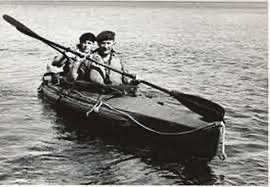
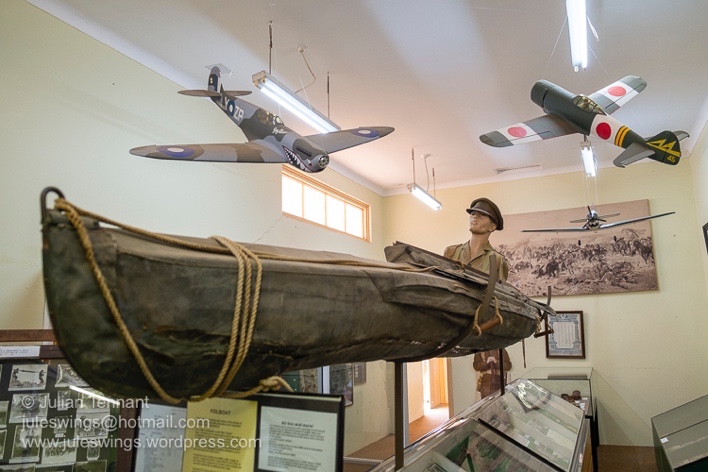
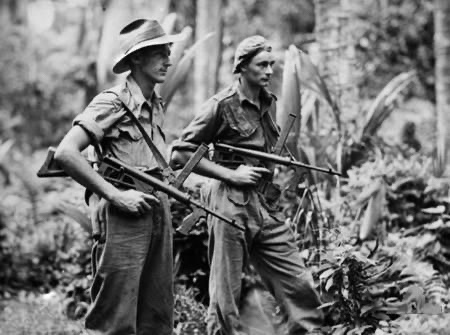
Growing up the movie “Attack Force Z” one of my favorite movies and still is. I have always wanted to an old school WW2 operation doing an insert by Klepper kayaks and blow-up a ship in a harbor or a bridge. You know like Cockleshell heroes or Attack Force Z  

SOE-Australia (SOA) was a WWII Special Forces and covert operations organization operating in the Pacific theater behind Japanese lines. It was made up of men and women from Australian, British, New Zealand, Canadian, South African, Indonesian, Timorese and Malay. SOA fought a secret, undercover war against the Japanese occupying force on the islands north of Australia. With the success of the British SOE unit in the European theater, Winston Churchill ordered that a similar unit be formed in the pacific. SOA was made up from many different units like the Royal Australian Navy’s  Coastwatcher’s, a propaganda unit the Far Eastern Liaison Office (FELO), the Secret Intelligence Service (SIS/SIA), a Dutch East Indies intelligence unit (NEFIS), the United States’ Philippine Regional Section (PRS, operating in the southern Philippines) and an Australian/British Special Operations group, which was to carry out missions behind enemy lines. The SOA took part in hundreds of covert operations against the Japanese and were directly responsible for eliminating thousands of enemy troops and sinking tons of ships and supplies, they paid a high price with more than eighty SOA commandos losing their lives. To maintain security, the SOA was given a cover name – Inter-Allied Services Department (IASD, mostly referred to as the ISD). It had British SOE agents that had escaped Singapore and the Dutch East Indies before it fell to the Japanese. That helped get it up and running.

SOA operators could operate in parties as small as two men, ISD Operatives faced overwhelming odds against a barbaric and increasingly desperate enemy. They conducted similar operations as many other SF groups in WWII. From Jedburgh’s type of missions (training indigenous guerrilla forces) to conduct direct action missions and raiding targets of opportunity. They also performed special reconnaissance missions close to enemy forces behind the lines.

The ISD men kept quiet about their exploits for over 50 years, and even today, the full story has never really been made public. The whole story of ISD operations during WWII is one that has been largely overlooked and misunderstood for the past 75 years. One of the main reasons for this is the misunderstanding that ISD was named Z or M Special Unit. The Z and M just referred to their administrative arm of the units. Z Special Unit was also used for requisitioning stores and transport through Australian Army channels. There are cases where Colonels were removed from transport aircraft to make room for ISD Corporals. Such was the administrative power of the Z Special Unit. So, this is how it was broken down, for Australian Army personnel and civilians assigned to ISD, and later to SRD, and as such, Z Special Unit appears on the service records of every Australian soldier who was assigned to either of those organizations. Another reason for some of the confusion is that in early 1943 the SOA was giving a new code name the Services Reconnaissance Department (SRD), and the term SOA was only to be used at the highest level. Z Special Unit does not appear on the service records of RAAF, RAN or British, NZ, Canadian, or South African personnel assigned to ISD or SRD since they weren’t enlisted in the Australian Army. However, Z Special Unit or Z Force became a common term in the post-war years, even among SRD Veterans. Although it is historically inaccurate to refer to the Special Operations as Z Special Unit. So, where do M Special units fit in? During the war an Allied Special Forces Reconnaissance Team under the command of the Services Reconnaissance Department (SRD.) It was the successor of the Coastwatcher’s unit. Raised in Queensland, Australia, in 1943, the unit operated behind enemy lines for long periods in the Pacific theatre, collecting intelligence such as enemy troop movements and shipping details. It was disbanded at the end of the war in 1945.  

Unlike its sister unit, M Special Unit wasn’t as well known for direct action missions. Z Special Unit was comprised of about 81 members and generally inserted via small boat, submarine, or airplane and conducted quick hit and run missions. They would also conduct intelligence-gathering operations. M Special Unit, on the other hand, operated behind enemy lines for extended periods and did long-range intelligence collection; as such, they tried to go undetected and, as such rarely engage the enemy.  

Also, all personal assigned to ISD were still listed as attached to the parent unit they came from. The reason for this was to help maintain secrecy. It was also used as a way to hide the funding for the ISD. As one of the best ways to keep something secret is never to show that money is going to them. The units never had an official insignia. You will often see a Z of M with a dagger through it. This was not made until 1970 and unfortunately, is mistaken for the units WWII symbol. 

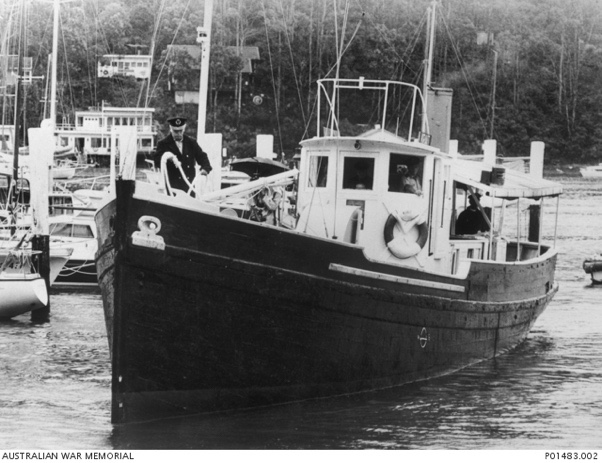
One of ISD/SRD’s most famous Operations was called Jaywick. They used a 68-ton wooden ship. British authorities had seized the Kofuku Maru in Singapore following Japan’s entry into the war. In 1943 she was renamed Krait and assigned to the SRD. The objective of Operation Jaywick was for SRD members to attack Japanese shipping in Singapore. SRD commandos paddled into Singapore harbor in kayaks and attached limpet mines to Japanese enemy shipping. The stealthy raiders sank seven ships and about 39,000 tons of supplies and equipment before escaping home to Australia. By the time they returned nearly seven weeks later, the crew of 14 had carried out one of the most successful clandestine raids in Australian history. Throughout the war, the 70-foot wooden-hulled boat involved in the Jaywick raid, MV Krait, sank more shipping than any other ship in the Australian navy.  

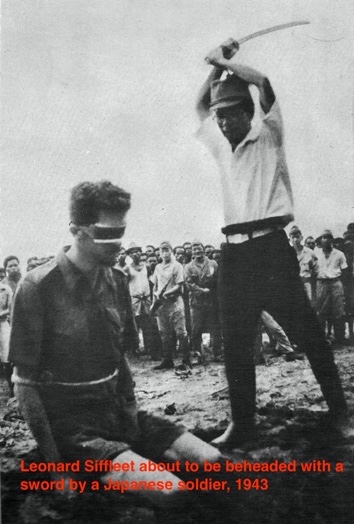
In a subsequent mission to Jaywick called Operation Rimau, the raiding party was detected by the enemy, hunted down and executed. Seventeen of SRD members lie in graves at Kranji War Cemetery in Singapore. In Operation Copper, eight men landed on an island off New Guinea to disable enemy guns before the Allied landing. Discovered by the Japanese, three commandos were captured, tortured, and executed. Four others escaped and fled out to sea, but only one made it home.

No matter what their name was or what they are called now, the units of WWII are the forefathers of today’s Special Forces in Australian and New Zealand and helped end the war.

www.australiansas.com/Establis%20SF

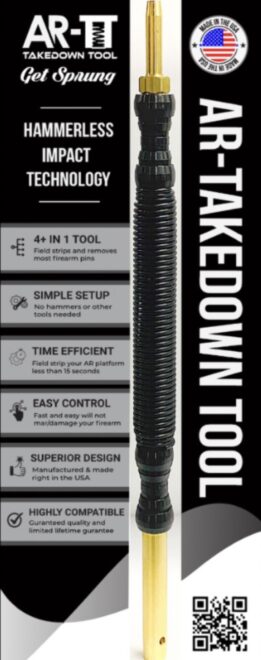
The AR-Takedown Tool

Saturday, January 15th, 2022

The all NEW AR-Takedown Tool is being released at Shot Show! 34.99 with free shipping! 100% USA made.

www.artakedowntool.com

MOSA Expedites Army Modernization Efforts at Aviation, Missile Center

Saturday, January 15th, 2022

REDSTONE ARSENAL, Ala. — It’s more than just a buzzword — it’s the way of the future for Army aviation.

MOSA — modular open systems architecture (or approach) — has become a popular term in recent years in the defense community, but it’s something the U.S. Army Combat Capabilities Development Command Aviation & Missile Center’s Joint Technology Center/System Integration Laboratory has worked on for years. That expertise and baseline is helping the DEVCOM Aviation & Missile Center adapt technologies quickly, efficiently and at a lower cost to support Army modernization efforts.

“While it’s a new term today, for us it’s business as usual,” said Joe Reis, Multiple Unified Simulation Environment lead for the JSIL. “We’ve been striving for the last 10 years to try to break our software down into components so it can be reused. Wherever possible, we started adopting all these different standard protocols with the vision of being able to reuse those components and being able to integrate with more than just ourselves. With that we’re able to stretch into areas we never have before.”

At DEVCOM AvMC, the MOSA success story starts with MUSE — the Multiple Unified Simulation Environment — a command and staff trainer. Originally created to provide Intelligence, Surveillance and Reconnaissance simulation capabilities, today the government-developed and sustained MUSE software baseline is being used in a variety of systems, including advanced teaming, part of AvMC’s support to the Future Vertical Lift Cross-Functional Team. The JSIL works primarily with unmanned aircraft systems, to include Shadow, Gray Eagle, Reaper and Global Hawk.

“The MUSE baseline was the foundational software that we began with for the Advanced Teaming effort,” said JSIL Software Lead James Bowman III. “We’ve been modifying and enhancing the MUSE baseline for over 20 years, by incorporating customer capability requests, keeping pace with industry standards and maintaining an accreditation (Authority to Operate — ATO). It would not have been possible for the Army to constitute the capabilities inherent in MUSE in time to meet the needs of Army Futures Command.”

“We’ve leaped into this research and development field instead of just being a trainer, because of being able to break these components down,” Reis added.

For the AvMC team, that is the whole point of MOSA — delivering solutions expeditiously to the Army and the Warfighter.

“MOSA is taking a modular approach, and for us, that’s just not theoretical,” Bowman said. “Software modularity allows the teams to share components across our enterprise, thereby negating duplicative efforts. It is paramount that the government continue to address intelligent software design, since it is our responsibility to provide quality solutions to and for the Warfighter that are concurrently cost-optimal for the government.

“We work to ensure that there is an intentionality to identifying common capabilities, already resident in MUSE, in order to exploit for utilization in our UAS Trainer solutions. Obviously, if not properly implemented, there can be challenges with code synchronization. JSIL addresses this by adhering to industry standard software processes and by utilizing Azure DevOps to ensure solution integrity. Consequently, stove-pipe solutions are a thing of the past. Once a bug is fixed in a component, all software that utilizes that component inherits the benefits of the fix.”

Another MOSA success story is the JSIL’s support to the Synthetic Training Environment Cross-Functional Team. The Reconfigurable Virtual Collective Trainer-Air uses the MUSE baseline foundationally, merged with work the JSIL did for the Air Force, to create a UAS software baseline for the RVCT-A.

“We would not have been able to support the high op-tempo of the RVCT-A effort had we not leveraged and utilized this MOSA construct,” Bowman said. “We continue to be energized about the possibilities of utilizing the MUSE and collective decades of UAS modeling and simulation domain knowledge to address current and emerging requirements.”

What’s next for MOSA at AvMC? The JSIL team will support swarming unmanned aircraft systems, part of the work being done with Advanced Teaming and Air Launched Effects. That effort includes incorporating an Army Game Studio Image Generator, which will reduce the money spent for commercial off the shelf rendering engine licenses and maintenance fees, a price tag that runs over $1 million alone for one UAS variant.

“If we can take that million-dollar expenditure and invest it in an existing GOTS image generator, that cost just goes away,” Bowman said. “MOSA is not just some buzzword, in our view, the implementation thereof provides tangible evidence of how we save the Army money, and how we get solutions to the soldier expeditiously, because we’re constantly building on a pre-existing, well-vetted, foundation.”

AvMC supports a variety of partners with MOSA, to include Program Executive Office Aviation; PEO Simulation, Training and Instrumentation; the Air Force Agency for Modeling and Simulation; PEO Intelligence Electronic Warfare & Sensors; and the FVL and Synthetic Training Environment CFTs.

“All of this work that we have done and are very proud of also has a global impact,” Bowman said. “We work with coalition partners, and because we adhere to these standards, when we show up to an exercise, not only are we operating our simulation, our coalition partners ask us at times to help them and we do that proudly. We’re U.S. citizens working with our coalition partners that are going to go to battle with us in the event that hostilities break out. We’re very proud to work with these standards to support not just the U.S., but its partners.”

By Amy Tolson, DEVCOM Aviation & Missile Center Public Affairs