Colt

Archive for the ‘Guest Post’ Category

Uniform Integrated Protective Ensemble Air 2 Piece Under Garment Completes Testing at Dyess AFB

Tuesday, June 29th, 2021

KIRTLAND AIR FORCE BASE, N.M. (AFNS) —

A joint military test team recently conducted ongoing developmental and operational testing of the Uniform Integrated Protective Ensemble Air 2 Piece Under Garment at Dyess Air Force Base, Texas.



UIPE Air 2PUG is a two-piece carbon-based protective undergarment designed to be worn underneath the CWU-27/P flight suit and is intended to provide chemical, biological, radiological and nuclear protection to aircrews in toxic environments.

The test team was made up of members from the Air Force Operational Test and Evaluation Center’s Detachment 2 and the 28th Test and Evaluation Squadron from Eglin AFB, Florida, the Navy’s Operational Test and Evaluation Force, and the Air Force Life Cycle Management Center’s Agile Combat Support Directorate Human Systems Division.

The new system is intended to offer better mobility, breathability, and a lower thermal burden on aircrews. UIPE Air 2PUG allows aircrews to stay in the suit longer and do their jobs with less heat burden or chances of heat casualties.

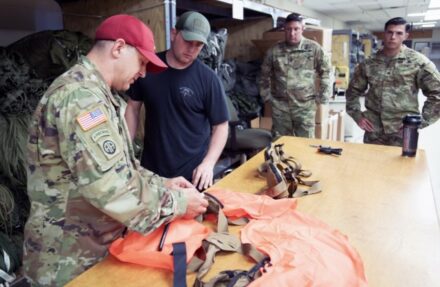
During this phase of testing, the UIPE Air 2PUG was tested on C-130J Super Hercules aircrews from the 39th and 40th Airlift Squadrons that are part of the 317th Airlift Wing at Dyess AFB. The aircrew simulated aircraft preflight checks and conducted a ground egress in order to field test the new UIPE Air 2PUG garment. The test event also focused upon the garment’s interoperability and compatibility with current equipment.

“The joint ground test provided critical feedback from the user to the engineering and testing team,” said Lt. Col. Brent Gaylord, 317th Operational Support Squadron commander. “The 317th Airlift Wing utilized a full aircrew complement to include female aircrew members representative of our diverse crew force and ensuring all ergonomic factors are considered. Updating decade’s old equipment is an exciting process to be a part of and is critical to maintaining our qualitative advantage over global competitors as we continually pursue full spectrum readiness.”

“This was the final ground compatibility test event,” said Tech. Sgt. Bryce Gardner, AFOTEC Det. 2 Aircrew Flight Equipment Program manager. “Previous test events were conducted with the KC-135 (Stratotanker) at McConnell AFB, Kansas; the HH-60 (Pave Hawk) at Nellis AFB, Nevada; and the F-15 (Eagle) at Eglin AFB. Multi-Service Operational Test and Evaluation will occur in the first quarter of fiscal year 2022.

“This test event went very well and the test team gathered all the required data because of the outstanding support received from the Dyess Aircrew Flight Equipment team and the participating C-130 aircrew,” Gardner said.

Once testing is completed and UIPE Air 2PUG is approved, it will be fielded to all Air Force, Navy, Marine Corps and Army aircrews across fixed wing, rotary wing, ejection seat and large frame aircrafts.

AFOTEC’s mission is to inform the warfighter and acquisition through operational tests. AFOTEC evaluates the capability of systems to meet warfighter needs by planning, executing, and reporting independent operational assessments, tests, and evaluations. From concept development to system fielding, AFOTEC evaluates a system’s overall operational mission capability under realistic conditions. AFOTEC’s mission requires lock-step efforts with acquisition partners focused on shortening the combat capability delivery timeline.

By Katherine C. Gandara, Public Affairs Advisor, Headquarters Air Force Operational Test and Evaluation Center

Alpha One Niner: A Brand You Should Know

Monday, June 28th, 2021

Just when you would think that the tactically-inspired realm of apparel and carry gear was saturated, an outfit comes around and kicks things up a notch. Alpha One Niner (A19er hereafter) is the brainchild of founder Helmie Ashiblie and leverages his experience in the shooting sports, grunt life, EDC product development and manufacturing disciplines. He has successfully merged this depth of knowledge with a creative energy that is hard to find these days and he’s been putting a shoulder to the wheel since day one.

Ashiblie pushing the limits during a recent match.
The first product under the A19er flag was the “Recon One” tablet caddy, an iPad sleeve/organizer that allows an aircraft passenger to affix it to the seatback pocket, allowing for easy access to the device and other small items like earbuds, notebooks and pens during long-haul flights. Helmie first pitched it on Kickstarter and A19er grew from there.

Years of international travel influenced A19er’s first products, as Helmie had already spent a ton of time globetrotting for SERT, the LE/Mil company he founded that delivers equipment and training solutions to a wide spectrum of paramilitary, law enforcement and special operations customers. Its signature product line is a series of soft-sided AR-pattern and SBR cases currently in use with units around the world.

A wide range of pouches, packs, Dopp kits and admin organizers followed the Recon One, utilizing excess production capacity at SE Asian facilities where SERT products are stitched up. It is at these locations and design studios that Ashiblie maintains trusted relationships and oversees high quality-control standards (once found only in the domain of USA-based manufacturers) for mission-essential gear.

Three core elements of Ashiblie’s past form the bridge to the company’s future. First, the brand takes its name from the call-sign he used while leading a reconnaissance platoon during compulsory national service with the Singaporean Army. I’ve shared lunch with Helmie and you can tell that those years in uniform made an indelible mark on his perspective. When I asked him to point to the signature philosophy that sets A19er apart from the competition, his reply was quick and to the point: “The dogged determination not to suck.” This mindset is in line with other veterans who founded the likes of Down Range Gear, Tactical Tailor, Mayflower Research & Consulting, PocketUp and GORUCK. They all grew their reputation through innovation and a commitment to their products and customers.

We talked about all things tactical during that lunch, and Helmie described the countless hours spent—even in the dead of night—answering texts, emails and voicemails from customers and colleagues.  He chuckled when I asked him how he juggles it all, then explained his fairly rudimentary thought process. He just wants to make sure he does everything to get it right.

The second element comes from a little-known part of Helmie’s past life as a model who worked with fashion houses in Milan and New York City. He took a deep interest in the behind-the-scenes work of product development and marketing, then used the knowledge to get SERT off of the ground after he left NYC and moved to Virginia in the aftermath of 9/11.  He is the first to admit that he is not a professional gear designer, but asserts that he knows a hell of a lot about finding the right resources to bring cost-effective products to market.

The final area that Ashiblie draws inspiration from is his participation in the IDPA and 2 and 3-gun shooting sports. His accrued experience influences several products that comprise A19er’s lineup and they all get the job done while looking good doing it.

The “Recon Nine Evade” eventually followed the Recon One and A19er broke into the mainstream as Helmie crowdsourced the feature set of this pack over at EDCForums.com, where he excelled at tapping into a potential customer base for inspiration. He solicited detailed input and commentary on the final design, with an eye towards maintaining transparency over the process.

Evade 1.5 in 420 denier Wolf Gray diamond ripstop nylon
When suggested changes to the basic design could be incorporated and they meshed with the realities of production restraints, Helmie did his best to follow through. When they were outside the realm of the possible, he let the forum members know.

“As long as you make that very clear from the get-go and simply DO NOT beat around the bush when it comes to what can or cannot be done, the guys are smart and reasonable enough to understand. If you decide to make a change and it’s not based on any of the revisions requested, get straight to the point and let everyone know why. You’d be surprised how accommodating and supporting others can be, and more importantly all parties walk away learning something from it.”

A year and dozens of prototypes later, the first commercial version of the Evade hit the streets and caused a stir. Because he is always on the path towards improvement, when comments started rolling in about the shoulder straps, main compartment volume or fabrics, Helmie listened carefully. The result was the Evade 2.0, a pack with larger volume and revisions to the carry system.

The final stop on the iteration train came about when members of various Facebook backpack groups began to get their hands on an earlier Evade, read a review, or watched a video of its features. These users and onlookers began to chime in and the 22 liter Evade 1.5 was developed as a slightly smaller pack that would make for a better EDC option. One gear reviewer spoke so highly of the final version that he felt the refinements left nothing else to critique; I wholeheartedly concur.

The Evade 1.5 is available in a “full” or “lite” version.  The “full” offers a dedicated laptop compartment while the latter version omits this feature. Both have a concealed/covert compartment between the main compartment and a user’s back, where a pistol can be secured on the full loop Velcro that lines the space. If a pistol is not holstered there, the compartment has enough room to secure an iPad, sensitive documents or other flat items like flex cuffs, evidence bags or laminated imagery.

A19er products provide superb organization
A full panel of MOLLE-compatible, laser-cut loop Velcro lines the main compartment, allowing a user to configure an array of pouches, organizers and holsters. It is this modularity that allows the Evade to fill a wide range of roles, for a broad spectrum of users, and at a respectable price that won’t crush a wallet. Its slick, inconspicuous exterior makes it as well-suited for special reconnaissance tasks as it would for range bag duty. The name is a perfect fit.

Nine different fabric weights, textures and colors are available, ensuring that there is an Evade 1.5 for practically anyone who needs modularity in their load carriage.  I spent a lot of time reading reviews on the Evade series, so when I required a new pack that wasn’t covered in PALS webbing, it was an easy choice. The packs are in heavy demand these days, so don’t be surprised if A19er is in the middle of a restock phase.

My Evade 1.5 has lived up to all of its advertised capabilities and you quickly get a sense of the deliberate thought put into its design. It follows in the footsteps of other classic tactically-themed packs, but stands on its own merits and has the potential to become as much an icon as the classic Eagle Industries A-III or Lightfighter RAID.

It has already won a user-nominated award for “Best Everyday Bag”, beating out contenders from heavyweights Triple Aught Design and Mystery Ranch. I’ve travelled across several continents with it and just when I’d given up on convincing my wife to ditch her bucket purse for air travel, she used an Evade on a return trip to the USA and is now hooked. If there was ever a strong endorsement, that’s it right there.

The latest A19er product to hit the scene is a pack that actually predates the Evade in terms of its development timeline.  The 25 liter “Pathfinder” utilizes the same harness system as the Evade 1.5 and is built to the same degree of durability, but can be best described as styled for the urban commute.

The A19er Pathfinder offers comparable organization capability to its smaller Evade cousin.
It is available with fewer fabric and color options, but the design still exhibits the clean lines you find in other A19er products. Dimension-Polyant X42 fabric forms the outer body and 210 denier ripstop nylon lines the interior compartments.

The padded laptop and tablet sleeves secure electronics while additional mesh compartments, admin organizers and water bottle pockets round out the feature list. It is definitely a stylish pack with a workhorse pedigree.

Got a lot of electronics and supporting cables? The Pathfinder can handle your carry requirement.

Alpha One Niner has been a personal project of Helmie Ashiblie since his first three-compartment caddy was used on a trans-Pacific flight.  His passion for producing hard-use gear has grown slowly but steadily, and if you operate in demanding environments downrange or around the corner, you should take a look at what the A19er brand has to offer.

Author Jon Custis is a veteran Marine infantryman who writes on a variety of tactical equipment, training, and leadership topics.

US and UK Communicators Conduct Electronic Warfare Training, Boost Interoperability

Monday, June 28th, 2021

(CUMBRIA, United Kingdom) — United Kingdom Signal Regiment and Special Operations Command, Europe (SOCEUR) Signal Detachment (SSD) conducted combined communications training at Royal Air Force Station Spadeadam April 19-22. Spadeadam is the only electronic warfare tactics facility in Europe where aircrews can practice maneuvers and tactics against a threats and targets that they face in contemporary warfare.

The exercise, designed to increase interoperability between the two NATO allies, facilitated mutual understanding of the combined tactical communication used by the U.K. and U.S.

“The training we conducted with the U.K. communicators was beneficial and realistic to battlefield operations as interoperability between allies is critical to the success of NATO missions,” said U.S. Army Sgt. Dayson Lindsay, a senior satellite communication system operator-maintainer.

Participants validated communication systems by troubleshooting software and hardware errors, implementing combined radio networks and training on international radio protocols to communicate effectively.

“Enabling an effective mission command requires combined communications in today’s complex military environment,” Sgt. Lindsay continued.

During the combined training event, the communicators explained and demonstrated each other’s communications equipment capabilities and functionality. This was followed by bridging solutions to facilitate secure communications between U.S. and U.K. radios.

“Working with the U.K. communicators has helped us improve communications interoperability by developing tactics and procedures that we can carry forward to future combined operations,” said U.S. Army Sgt. Andrew Reyes, a senior radio operator-maintainer from 112th Special Operations Signal Battalion (Airborne), assigned to SSD.

The SOCEUR communicators regularly conduct combined communications training throughout Europe to bridge partner radio systems between NATO allies and implement secure radio solutions for combat units.

SOCEUR employs Special Operations Forces across the United States European Command area of responsibility to enable deterrence, strengthen European security collective capabilities and interoperability, and counter transnational threats to protect U.S. personnel and interests.

By U.S. Special Operations Command Europe

SCUBAPRO Sunday – Hydro’s X BCD

Sunday, June 27th, 2021

The Hydro’s X is the first front-adjustable BCD to offer a fully injection molded Monprene® thermoplastic shoulders and back pad. This unique feature allows the shoulders to conform to your body like a tailored fit. Its flat-buckled quick-release integrated weight system and rear trim weight pockets work together to offer a more comfortable and balanced ride when diving. Add the full-sized backpack and stainless-steel Super Cinch tank band, and you also get excellent stability both on the surface and at depth. Two rear trim pouches help create a comfortable swimming position. The Hydro’s X has matched the patented injection-molded gel harness of the Hydro’s Pro but with a more traditional style wrap-around air cell with zippered cargo pockets on each side.

Again, like the SCUBAPRO Hydro’s Pro, this is a modular design, and several of its components are detachable and can be individually replaced, adding to the jacket’s longevity. The Monprene design makes it a lot easier to clean mud or any other contaminates off; it is also highly resistant to UV, chemicals, and abrasion, plus it doesn’t absorb water to help minimize drying time, making it ideal for Public Safety divers.

The weight pockets are molded to the outside of the pockets, making adding or removing weights a lot easier. The two big, zippered cargo pockets offer great gear-carrying capacity and are easily accessible even when the weight pouches are fully loaded. You can also add different accessories to the weight pockets, including your knife, lights, or our ninja pocket that rolls up out of the way when not in use.

Rotating quick-release shoulder buckles allow you to route your shoulder straps to optimize fit in any thickness of a wetsuit or drysuit. The bladder, made out of EndurTex high-tenacity nylon fabric, is extremely lightweight and durable while offering generous lift capacity, aided by lower back bellows. In the event of damage, several components on the Hydros X are detachable and easily replaceable. Two stainless steel D-rings provide clip-on points for additional gear. In addition, the Hydros X features a Multi-Mount Accessory Matrix with multiple D-Ring and mounting points that easily attach various dive accessories.

AFSOC at “Strategic Inflection Point”

Sunday, June 27th, 2021

U.S. Air Force Lt Gen Slife, commander of Air Force Special Operations Command, addressed the Global SOF Foundation’s 2021 virtual SOF Imperatives Forum to discuss the critical mission areas AFSOC will need to focus on to remain competitive in the future operating environment on June 6, 2021.

Slife was joined by LTG Francis Beadudette, commanding general of U.S. Army Special Operations Command.

Linda Robinson, Global SOF Advisor, moderated the conversation with the two current SOF component commanders and begin with each commanders’ view of the state of special operations today.

“When I think of where we are at in 2021, we are at a third post-Vietnam discontinuity, a point of time where the future is best understood as not a linear extension of the past, but rather as something requiring something different all together,” Slife began.

“We have to maintain the ability to respond to crisis on behalf of the nation on a short notice anywhere around the globe, maintain pressure on counter violent extremist organizations,” said Slife. “We have to be prepared for conflict with peer adversaries in contested environments, and we have to compete strategically with global competitors who challenge U.S. interests and our way of life.”

Operating in contested environments, Slife continued, may require changes in how AFSOC deploys its forces.

“To the extent that we can, we need to be independent of main operating bases such as large runways, large fixed facilities,” said Slife. “We need to get smaller, lighter, and more expeditionary to succeed.”

“It’s imperative to lower our signature,” he continued. “We have to be able to blend into the noise both physically and electronically around the globe, wherever we want to compete.”

In a fiscally-constrained environment, Robinson asked Slife what areas of AFSOC might still see growth.

“Going forward I think we need to talk about language,” said Slife. “We need to take a look at ourselves in AFSOC and decide to what degree do we need regionally specialized forces who have deepened understanding of regions and cultures and nations inside those regions.”

When asked what AFSOC needs from its sister services in terms of cyber, electronic and communication capabilities, Slife stated he is not interested in growing an organic capability.

“While AFSOC has a range of kinetic and non-kinetic capabilities…as an enabler, I don’t want to be a duplicator of what people are already doing for us at scale,” said Slife. “I’m focused on the things that no one else can do and I don’t think we are in a resourcing environment that permits duplication for stuff that goes on elsewhere.”

When asked, “How much air support is enough?” Slife described his perspective on balancing the variables of mission, resources, and risk.

“The answer is it’s never enough. As you talk to ground formations, clearly they’ll tell you they need more aviation, he said.” “But it’s not a question of do we need more or not, it’s a question of, ‘At what level of risk?’”

“AFSOC is resourcing aviation at an appropriate level of risk. For every dollar we put into growing our aviation capabilities, there’s an opportunity cost elsewhere,” he went on. “That’s why the armed overwatch program is so important to us, because it’s a very cost effective way of providing that air support to our ground teammates who are going to be prosecuting these C-VEO operations for years to come,” said Slife.

In Slife’s closing remarks, he reiterated the men and women in AFSOC are a competitive advantage and it is up to leadership to ensure they are preparing a formation that is prepared and ready for tomorrow.

“Our challenge in leadership is to ensure that those middle school kids today who will put an AFSOC patch on in 10 years know when they come to AFSOC, they’ll still be relevant.”

Story by 1st Lt Melissa Crisostomo, Air Force Special Operations Command Public Affairs

AFWERX Agility Prime Partners with Kitty Hawk in First Medevac Exercise with Electric Aircraft

Saturday, June 26th, 2021

WRIGHT-PATTERSON AIR FORCE BASE, Ohio (AFNS) —

AFWERX Agility Prime and new partner Kitty Hawk reached a milestone in May with their first operational exercise.

“This exercise produced important data that will bolster the program going forward,” said Lt. Col. Martin Salinas, the mission design team lead in the Air Force Operational Test and Evaluation Center.

The technology and companies in the AFWERX Agility Prime program continue to mature rapidly with a new partner Kitty Hawk joining the government/industry team. In the program’s first exercise, a diverse group of industry and government operators, engineers, and test professionals assessed the ability to do medical evacuation, personnel recovery, and logistics with Kitty Hawk’s Heaviside electric vertical takeoff and landing, or eVTOL, aircraft. The Kitty Hawk team also demonstrated Heaviside’s remote flying capabilities.

The multi-disciplinary team gathered a rich catalogue of data to inform dual-use utility at the prototype stage that will inform future developmental and fielding decisions. Besides assessing different loading scenarios, the team also observed demonstrations of remotely piloted and fully autonomous flights with Heaviside.

“The world is going to need new modes of transportation and Heaviside is one path to getting us there,” said Sebastian Thrun, Kitty Hawk CEO. “We are excited to be working with Agility Prime and look forward to our continued collaboration as we bring eVTOLs to more people.”

Founded in 2010 and based in California, Kitty Hawk, has developed numerous eVTOL vehicles including the Heaviside vehicle, named after the English engineer, Oliver Heaviside. Designed to be fast, small, quiet and green, the aircraft flies at up to 180 mph with a potential range of 100 miles plus reserves on a single charge, according to Kitty Hawk’s website. Heaviside takes off and lands in a 30×30 foot space, reaches sound levels of 38 dBA at 1,000 feet, is 100x quieter than a helicopter and requires less than half the energy per mile of a conventional electric car.

“The Agility Prime and Kitty Hawk teams facilitated the convergence of Air Force and Marine Corps testers and operators to engage with Heaviside, all while experimenting within the context of Personnel Recovery and logistics use-case scenarios,” Salinas said.

Salinas attributed the success of the California tests to the eagerness of those involved. “Pushing experimental tests in an operational context is challenging and exciting,” he said.

Col. Don Haley, Air Education and Training Command Detachment 62 commander, who leads a team in developing training syllabi for these new electric aircraft, noted, “this collaborative commercial/DoD use-case exploration revealed common attributes that serve both urban air mobility and search and rescue operations: High-reliability, responsive launch & recovery, minimal logistical footprint, accessibility for mobility-challenged, low acoustic signature, and high levels of autonomy.”

“We are pleased to welcome a new partner and happy about the progress in this first Agility Prime exercise,” said Col. Nathan Diller, AFWERX Director. “This is just the beginning of many examples that the team will be exploring in the coming months to partner with commercial companies in a way that accelerates maturity for commercialization, while providing the Department of the Air Force with decision-quality data for future force design.”

For more information, visit www.afresearchlab.com.

By Air Force Research Lab, AFWERX

SPARTANAT – Thermal Clip-On TigIR from Andres Industries

Friday, June 25th, 2021

Currently different NATO-partners are introducing the new Thermal Clip-On TigIR from Andres Industries to their armed forces. The special feature of the TigIR (pronounced tiger) is its particularly short design. This makes it the only thermal Clip-On to date that can also fit on the short optical mounts of machine guns. With a recognition range of 3km and weighing only 500g, it is also very light.

With a length of only 6cm, the TILO-6MA is to date the smallest thermal imaging goggles in the world with a resolution of 640 pixels. It is sea water resistant and is therefore also used by naval units. It can also be used, for example, in front of the ELCAN-Specter as a Clip-On Thermal.

The NSN, also known as the „supply number“ to NATO-members, is used in trade between NATO member states to correctly identify ordered equipment – even across language barriers. Specifically, the numbers are 5855-12-416-6304 for the TigIR-6M and 5855-12-416-6303 for the TILO-6MA. Civilian variants of both devices also exist and are already available in the US.

Links:

Andres: www.andres-industries-shop.de

TigIR: www.andres-industries-shop.de

spartanat: www.spartanat.com

FirstSpear Friday Focus: FS Proudly Supports the Tim Tebow Foundation’s Operator for a Day

Friday, June 25th, 2021

FirstSpear is proud to support the Tim Tebow Foundation in their “Operator For a Day” event that was hosted on June 19, 2021, in Perryville, Florida.

The Tim Tebow Foundation is committed to advancing the fight for the precious lives of those who have been trafficked or who are at risk of becoming victims to human trafficking. Directly and in partnership with other organizations in the US and abroad, the Foundation is actively fighting against human trafficking in three ways. First, they are proactive. They focus on the implementation of programs designed to preserve and strengthen families to reduce the risk of vulnerability. Secondly, they are reactive. The Foundation works in conjunction with rescue capable teams on the front lines where direct rescue of those who are enslaved occurs. Thirdly, they are committed to supporting survivors’ in recovery by providing them with the comprehensive care resources needed for healing to overcome the vicious trauma and abuse of human trafficking. 

In 2010, FirstSpear emerged from a bloodline of industry innovation. FirstSpear employs a methodology that integrates evolutionary design with advanced material components. An ambitious mandate demands branding that harnesses the company’s ethos, and “FirstSpear” is the translated namesake of the Primus Pilus, the Senior Centurion of a Roman Legion. FirstSpear dedicates our efforts to present-day Centurions, those willing to sacrifice to preserve our heritage and secure our future.

To learn how to get involved, check out www.timtebowfoundation.org.

For more information about FirstSpear, check out: www.first-spear.com