Rapid acquisition of electronic warfare capabilities served an urgent need, and in the process set an award-winning example of phased prototyping, experimentation and fielding with creative resourcing.
In March 2014, before the rest of the world could react, Russia invaded Crimea, then annexed the region, a peninsula at the southern end of Ukraine. Russia’s subsequent actions in Ukraine revealed electronic warfare (EW) capabilities that not only overwhelmed Ukraine but could rival those of the United States. The U.S. Army Europe (USAREUR) commanding general at the time, Lt. Gen. Ben Hodges, determined that electronic warfare was a critical strategic gap and pushed an operational needs statement to the Pentagon for quick action.
In response, the Army moved electronic warfare to the top of its list for rapid acquisition and endorsed a new approach—phased prototyping, experimentation and fielding—that would incorporate Soldier feedback throughout, infuse new technology as it became available and quickly deliver incremental upgrades to reduce operational risk while informing program-of-record (POR) capabilities currently under development but not yet ready for fielding. This strategy required a creative resourcing approach that combined existing funds, reprogramming actions and a new rapid prototyping program, and ultimately entailed more than 100 separate contract actions.
To formulate and execute the plan, the secretary and chief of staff of the Army tapped the then-newly formed Rapid Capabilities Office (now the Rapid Capabilities and Critical Technologies Office, or RCCTO) and the Project Manager for Electronic Warfare and Cyber (PM EW&C), part of the Program Executive Office for Intelligence, Electronic Warfare and Sensors (PEO IEW&S), to lead the execution of the project, working directly with operational units such as the 2nd Cavalry Regiment in Europe. Less than a year after the project’s approval, the Army fielded new electronic warfare prototypes to select units in Europe, giving Soldiers the ability to implement electronic protection for their own formations, detect and understand enemy activity in the electromagnetic spectrum, and disrupt adversaries through electronic attack effects.
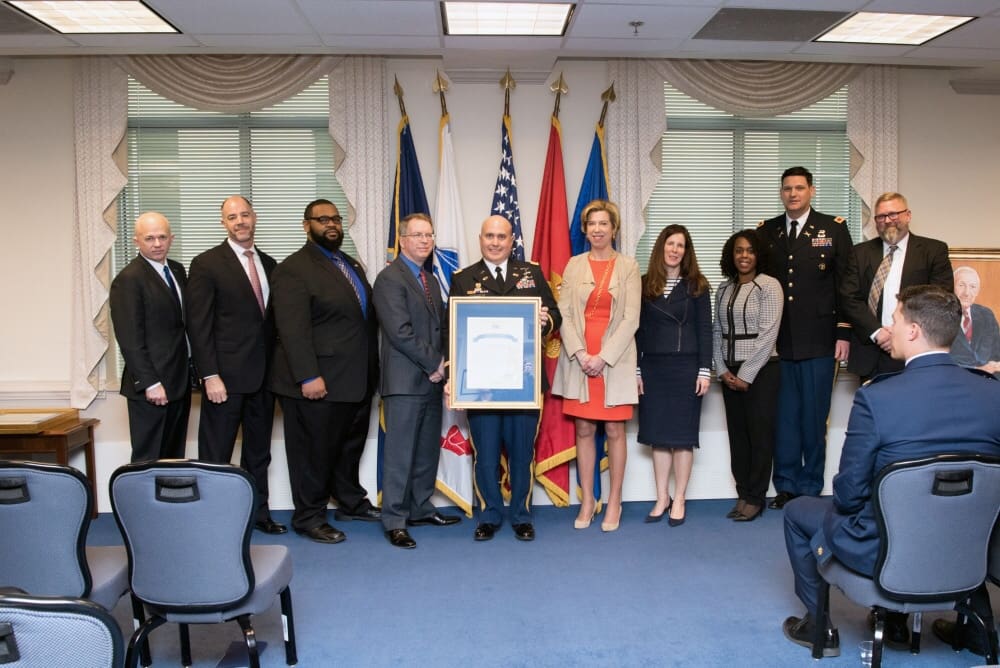
For their efforts in addressing this urgent operational need, the RCCTO and PM EW&C received the 2018 David Packard Excellence in Acquisition Award. The Packard is DOD’s most prestigious acquisition team award. It is given annually to a few select recipients across the armed services and defense agencies for significant contributions demonstrating exemplary innovation and best acquisition practices.
The award-winning effort required teamwork, innovation, a user-centric attitude and a willingness to accept that the prototypes being fielded were just that. They were not completely perfect solutions, but instead incremental advances, with the capability improving at each step as the effort progressed.
Below you’ll read about several of the key players who made the Army’s electronic warfare project a Packard Award-winning reality. However, they are only several of many. Scores of people within the organizations contributed to the success of the project, as did many other individuals and organizations across and outside DOD who were brought in to find new ways to successfully expedite the traditional acquisition process. From EW officers to Army headquarters staff, from cybersecurity experts within the Office of the Assistant Secretary of the Army for Acquisition, Logistics and Technology (ASA(ALT)) to the U.S. Army Test and Evaluation Command, from the Army’s Rapid Equipping Force to industry partners and many others, the achievements leading to the Packard were a team effort that reflects the best of what the Army can do when the stakes are high. Here is a look behind the curtain.
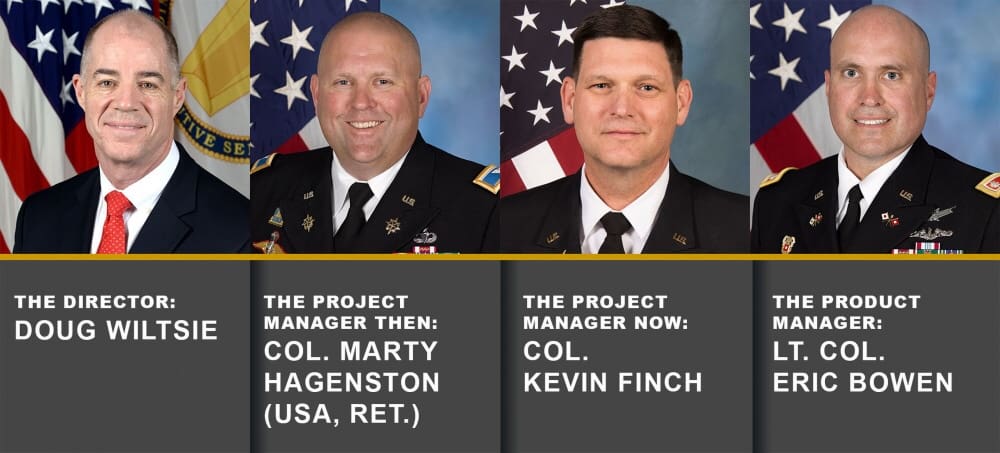
THE DIRECTOR: DOUG WILTSIE
“The big thing for us was speed. Where we had the opportunity to take risks, we did. It started with our board of directors [BOD], which at the time comprised the secretary of the Army, chief of staff of the Army and Army acquisition executive. We briefed the BOD, but there was no requirement to brief anyone else, due to the RCO’s unique charter. So the approval cycle was significantly shorter. The power of the BOD was it allowed us to bring in a broad end-to-end solution for the type of capability we needed to provide. And then, working with the unit, we developed what the specific requirements would be for mounted, dismounted, and planning and management systems. We developed an incremental strategy that increased the capability performance over time. We got prototypes into the hands of the users, who got to train on the equipment and give us continuous feedback on the performance and how to improve it. With this strategy, we fielded the first increment in one year, which was very impressive.”
The power of teamwork: “The user was actually in the lead of this project the entire time. From the delivery of the concept of operations to the performance of the system they wanted, the Soldiers and the EWOs [electronic warfare officers] in those brigades really helped shape how the system was going to operate. They were committed to the incremental strategy, where we put elementary pieces of equipment into their hands first, knowing that the capability was going to get better over time. PM EW&C was the other critical element to this project. The Rapid Capabilities Office had unique authorities but limited people to put on this project, so we partnered with PM EW&C to develop the solutions, prioritize the increments, develop the sustainment process, then together work on a funding strategy for every increment. It was a great partnership.”
Advice for rapid prototyping: “It starts with the user. The rapid approach is really a team sport, and the users are the critical piece on that team.”
THE PROJECT MANAGER THEN: COL. MARTY HAGENSTON (USA, RET.)
“Commanders are severely limited in what they can bring to the electromagnetic spectrum fight. These limitations and lack of options are driving the operational need for EW capabilities.” The operational needs statement (ONS) from U.S. Army Europe “became part of the larger materiel development strategy by design. It provided a mechanism from which to rapidly equip forward presence and rotational forces with initial capabilities, then iterate those based on direct user feedback.
“The ONS provided a superb venue for risk reduction for projected programs, some of which were years away from starting. Not only did the Army benefit from a materiel standpoint, but the effort also drove doctrine, training, organizational design, and tactics, techniques and procedures.” The entire spectrum of doctrine, organization, training, materiel, leadership and education, personnel, facilities and policy benefited, Hagenston said. Likewise, the ONS greatly benefited from programs of record that were underway. These included the Electronic Warfare Planning and Management Tool; Prophet Enhanced; Duke; and Versatile Radio Observation and Direction Modular Adaptive Transmitter, developed by the Intelligence and Information Warfare Directorate of what is now the U.S. Army Combat Capabilities Development Command’s C5ISR (Command, Control, Communications, Computers, Combat Systems, Intelligence, Surveillance and Reconnaissance) Center. “The team was able to leverage these programs, which helped our velocity by providing a critical foundation for the ONS.”
The key to success: “The real force behind the success of this effort was the teamwork, leadership support, stable resources and direct access to the customer. The approach itself was simple. First, we took what we had and adapted it to the operational problem. This served as Phase 1, or the minimum viable product. Once we deployed Phase 1, 12 months from receiving resources, we were able to take the direct user feedback and prototype something closer to what the units wanted. This served as Phase 2. Through all of the phases, the capabilities evolved based on direct user feedback. Our team carefully listened to the feedback and worked in those changes. In many cases it was done on the spot, while other changes were saved to the next logical insertion point.”
Advice for rapid prototyping: “First, get intimate with the operational problem. Second, get the minimum viable product out quickly and really listen to the direct user feedback. Finally, iterate as fast as possible based on the direct user feedback. Velocity is the real advantage.”
THE PROJECT MANAGER NOW: COL. KEVIN FINCH
“Rapid prototyping will have a very positive effect on the long-term POR. It also shows us the current state of industry. Specifically, in the EW specialty, rapid prototyping coupled with quick reaction capabilities [QRCs] has effectively informed the community on possible innovative solutions that help the U.S. pace the threat. The QRCs we are currently fielding to the force have enabled the program office to determine if innovative solutions are viable for long-term PORs. In FY20, PM EW&C will use the lessons learned from the QRC and rapid prototypes to inform the development of the long-term Terrestrial Layer System.”
What are the next steps for the effort? “The ONS for Europe maintains the ongoing effort until the POR comes on board. We have already provided an initial capability and are on schedule to provide a Phase 2 capability in FY19. This new capability will provide a significant improvement over Phase 1 while informing both the development of the POR and the Army’s decision-making on fielding quantities and timelines.
Also, with “The U.S. Army in Multi-Domain Operations, 2028” concept published, capabilities in the electromagnetic spectrum [EMS], cyber and space will become better integrated into operations. Niche systems will no longer operate in stovepipes, but will become integrated and synchronized with operations occurring in all the domains: land, air, sea, cyber and space. Systems such as the [Electronic Warfare Planning and Management Tool], which links and synchronizes the EMS to the tactical commander, will become increasingly important.”
Advice for rapid prototyping: “Implementing a rapid approach has to be a collaborative team process built on the adaptation of lessons learned and best practices. As PM EW&C moves into the second iteration of our rapid processes, hard timelines closely linked to the operational force’s needs will drive timely and responsive decision-making. Ultimately, the success of a rapid approach is highly dependent on buy-in from all the team members, including industry partners and external stakeholders.”
THE PRODUCT MANAGER: LT. COL. ERIC BOWEN
“This is the outcome of a Soldier-inclusive, Soldier-driven endeavor. Their feedback laid the blueprint that guided our multiphased approach, serving as our engine of innovation. We had continuous engagements with Soldiers who received the equipment, including from Stryker, armor and airborne infantry brigades. Although the initial phase repurposed existing equipment, the feedback identified additional enhancements needed, such as how information was presented to the operator, how it was reported to higher headquarters and how it should be installed in the vehicles for optimal use. This feedback also identified a need for additional vehicle platforms that would support light, expeditionary operations, as well as for sensors that Soldiers could easily carry and operate during dismounted operations. These capabilities, which we didn’t address initially, were prioritized for the follow-on delivery phases.”
The toughest challenge? “The ‘horizontal’ or system-of-systems integration and end-to-end engineering, because various sensors needed to function as a networked set. To make it all work, we needed to stitch together existing sensors that existed as both PORs and QRCs, in order to provide a common operating picture to our EW planning and management tool.”
Advice for rapid prototyping: “Keep priority on delivering the product on time. You are subject to the tyranny of time, and the solution delivered will not be perfect. It never will be. There are no more ‘drive-by fieldings,’ so forge a solid commitment with the user, who will shape development before delivery—and cultivate that relationship to fix, improve and maintain the equipment to ensure mission success. You are delivering more than just materiel; these capabilities will influence doctrine, change organizations and challenge policy to enable commanders and higher Army echelons to respond to rapidly evolving worldwide threats.”
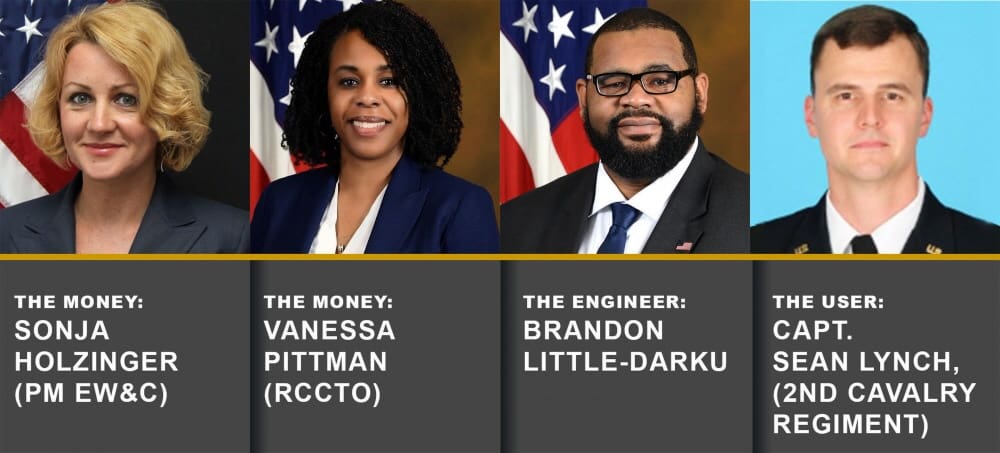
THE MONEY: SONJA HOLZINGER (PM EW&C)
“This rapid prototyping approach dictated an agile, adaptive business model. That meant the two business teams had to come together and determine how much the effort would cost, what type of funding was needed, what contract vehicles should be used and what resources were available.”
“Early on, as the acquisition strategy and technical requirements were being refined, we implemented a tailored work breakdown structure into all cost estimating efforts. This enabled the teams to accurately account for all costs associated with rapid prototyping and develop a cost estimate, which was later used as the basis for the spend plans. Throughout the whole process, strong collaboration and daily communication was the key. PM EW&C Business Management Division was heavily engaged in identifying what funds were needed and where they should be sent. The RCCTO Business Management Division was responsible for ensuring funds were provided on time and in the amount needed. The two teams worked as one toward accomplishing the same goal. The USAREUR ONS was executed almost 100 percent within the cost estimate, on time and without any unfunded requirements.”
What contracting mechanisms were used? “The business teams worked together to develop a funding strategy to ensure the effort was fully funded. Initially we reallocated existing funds for this effort. We also utilized mechanisms such as below-threshold and above-threshold reprogramming actions. We successfully applied for and received funding from the Office of the Secretary of Defense Rapid Prototyping Program. To meet a very tight timeline for delivery, we also worked closely with [the U.S.] Army Contracting Command, as well as the Navy and Air Force contracting commands, for select contracting actions.
“We coordinated execution of more than 100 contract actions, including contract modifications, task orders and delivery orders. In some instances, because of the urgency of the requirement and the government’s interest to start contract work early, we used un-definitized contract actions.”
Advice for rapid prototyping: “This is a great approach to quickly provide needed capabilities to our warfighters. Constant collaboration and communication with the project manager, contracting team, business team and all stakeholders involved in your program is a must. This allows you to identify and address any risks or issues early.”
THE ENGINEER: BRANDON LITTLE-DARKU
“As the project lead and lead systems engineer on EW for the RCCTO, I worked in close partnership with the PM EW&C team and my counterpart there, Lt. Col. Bowen, to develop and deliver this capability. Having a strategic focus and directing this capability not to the entire Army, but to brigade-and-below operations within the European theater, proved a key to our success. Focusing on the units aligned to USAREUR and understanding their concept of operations helped to scope not only the capabilities required of the various systems, but also how they needed to be integrated into the formations and the tactical mission command network. That, paired with early and continuous engagement with the brigade combat teams aligned to USAREUR, helped scope the effort and shape the overall phased approach for addressing the operational requirements.”
The toughest challenge? “Making sure we met all the requirements possible, which included establishing a networked EW capability that could interoperate with Army mission command systems, while also meeting our delivery timeline. The team included a great set of dedicated professionals within the RCCTO and the PM, and across our partners throughout the Army, that made this unprecedented effort a success.”
Advice for rapid prototyping: “Perfection is the enemy of ‘good enough’ when building your acquisition strategy and scoping out the phases of the capability. Time will always be one of the critical measures of success, and the burdens associated with the endless pursuit of perfection will always be a hindrance to getting the required capabilities to the end user. Working directly with the users early in the process, and then continuing to receive their input and operational feedback throughout the process, proved key to making sure we developed and delivered what they needed to meet their mission.”
THE USER: CAPT. SEAN LYNCH, (2ND CAVALRY REGIMENT)
“This equipment provides additional sensors that units can leverage to help build a common operating picture and drive the targeting process. It provides commanders with additional options to more effectively shape their areas of responsibility, while also addressing theaterwide challenges from near-peer competitors and NATO adversaries. These assets can be seamlessly integrated within a Stryker formation, require no reliance on joint air platforms, and can provide immediate direction finding or geolocating capability of enemy emitters to maneuver commanders at the lowest levels. The Army can continue to build on this momentum by solidifying what the primary mission or role of ground-based electronic warfare is and how the Army feels it should be equipped to accomplish it.”
How did partnering with the acquisition team early work for your unit? “Exceedingly well. Our team was fortunate to be able to participate in multiple Network Integration Evaluations, simulation exercises, and testing events both pre- and post-fielding. This gave our regimental planning team and tactical operators several instances to provide direct, candid feedback to the engineers, acquisition team and decision-makers involved in the project. We were able to see our ideas and feedback incorporated almost immediately, and knew with high confidence what we were receiving as the end user. This also served to get Soldier buy-in at the lowest levels, and they became more vested in providing comprehensive and meaningful feedback. It also removed a lot of unnecessary guesswork and ensured all parties had a shared understanding and shared expectations of the scope of the fielding.”
Advice for rapid prototyping: “Partner early and consistently with the acquisition team before, during and after equipment fielding. Know those aspects of the equipment that are more important to you and your Soldiers, and be prepared to communicate those requirements clearly. It’s also important to build a plan on how to go about stressing new systems, capturing relevant information, and how you envision the systems or equipment will be employed.”
For more information on the Army RCCTO, go to rapidcapabilitiesoffice.army.mil. For more information on PEO IEW&S and PM EW&C, go to peoiews.army.mil.
Story by Nancy Jones-Bonbrest, John Higgins and Claire Heininger – U.S. Army Acquisition Support Center
Photo by US Army SGT Amber I. Smith
NANCY JONES-BONBREST is a public communications specialist for RCCTO. She has written extensively about Army modernization and acquisition for several years, including multiple training and testing events. She holds a B.S. in journalism from the University of Maryland, College Park.
JOHN HIGGINS is a public affairs writer for PEO IEW&S. He is an Iraq War veteran and former public affairs Soldier. He holds a B.A. in film production from Towson University.
CLAIRE HEININGER is the public communications lead for RCCTO and has written extensively about Army acquisition topics. She holds a B.A. in American Studies from the University of Notre Dame and is a former politics and government reporter for The Star-Ledger, New Jersey’s largest newspaper. She is Level II certified in program management.
This article was originally published in the Spring issue of Army AL&T magazine.