XC3 Weaponlight

Archive for the ‘SOF’ Category

USSOCOM Issues 5-Year Science & Technology Broad Area Announcement

Thursday, May 7th, 2020

The United States Special Operations Command, Special Operations Forces Acquisition, Technology, and Logistics (SOF AT&L), Directorate of Science and Technology (S&T) has issued a new Broad Area Announcement to industry, communicating its investment strategy in FY21 and beyond which focuses on SOF modernization development efforts that include more encompassing, disruptive technology efforts that are larger in scope and meet the demands of the strategic vision and Future Operating Environment (FOE). USSOCOM will continue making some investments in Special Operations Forces (SOF) enhancements in the programs of record. USSOCOM employs capabilities in all domains: terrestrial, maritime, air, space, and cyber.

SOCOM desires advancements in technology across six capability focus areas which are directly aligned with the USSOCOM Capability Planning Guidance:

• Biotechnologies and Human Interface

• Hyper Enabled Operator

• Network and Data Management

• Next Generation Effects

• Next Generation Intelligence Surveillance and Reconnaissance

• Next Generation Mobility

They are interested in receiving white papers from all responsible sources in industry, academia, individuals, Federally Funded Research and Development Centers, National Laboratories, and Government laboratories capable of pursuing, developing and evolving disruptive capabilities that must be made available to the SOF Operator within the next five to seven years in order to achieve mission success in the Future Operating Environment (FOE). That environment will be austere, with SOF operating on their own, or with very little support.

That includes satellite denied/disrupted environments, under threat of targeting by high?end military capabilities, including Weapons of Mass Destruction, where the Cyber and Electronic Warfare domains are contested and increased scrutiny is routine. The Future Operating Environment (FOE) is a world of “Convergence”: the point where the gap between non-state and state actor capabilities diminishes and the threat to force and mission success increases significantly. Core SOF missions such as Direct Action, Counterterrorism, Security Force Assistance, Counter Proliferation of Weapons of Mass Destruction and more are not expected to change significantly; however, the operational environment in which these missions will be executed is changing in accordance with global themes and trends. SOF missions will not significantly change, but the environment in which they are conducted is, and will continue, to change significantly.

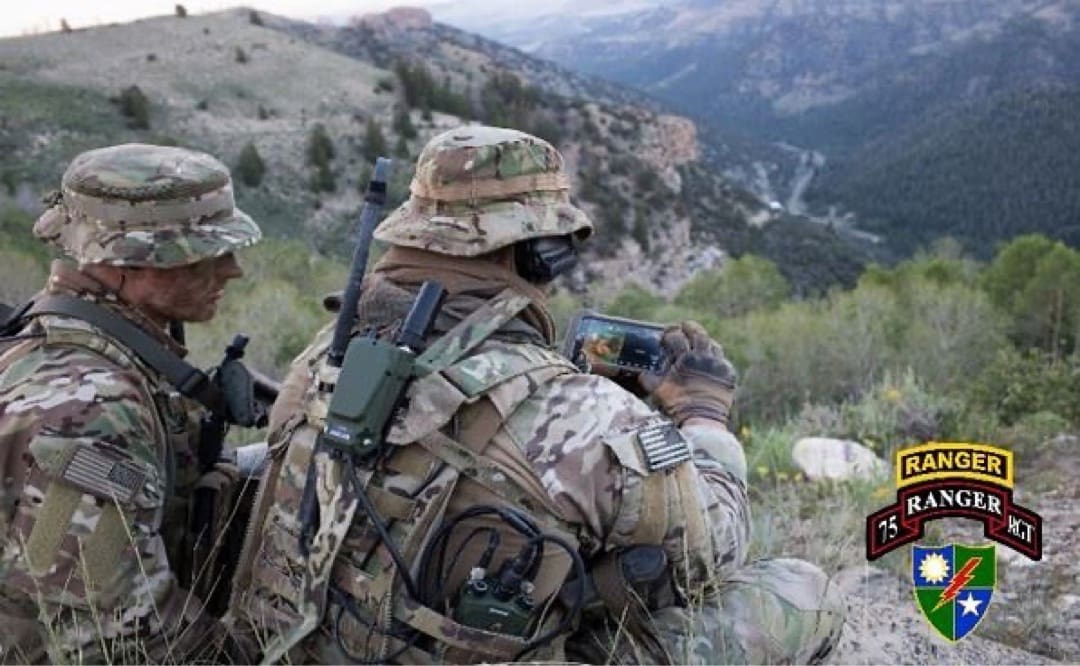
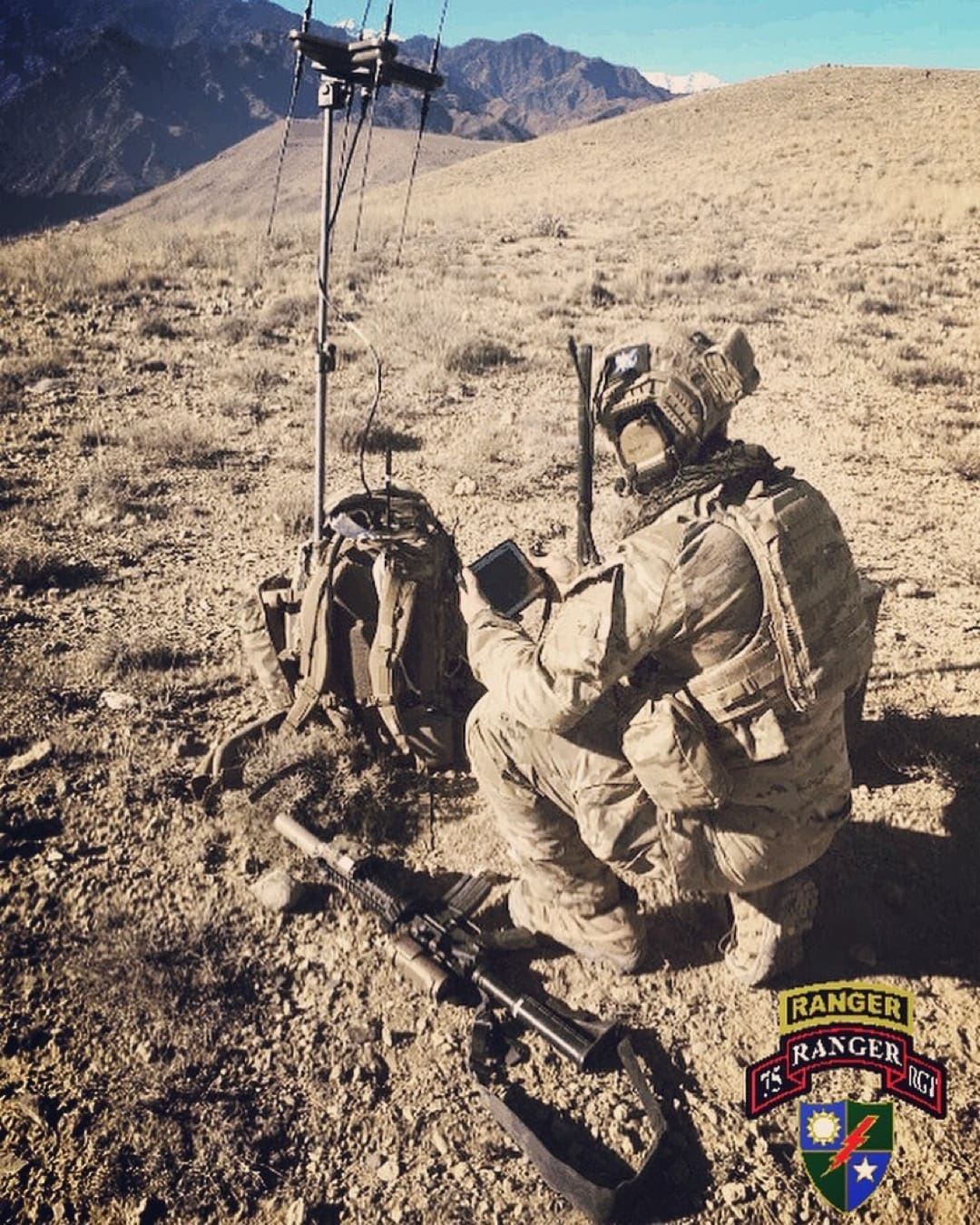
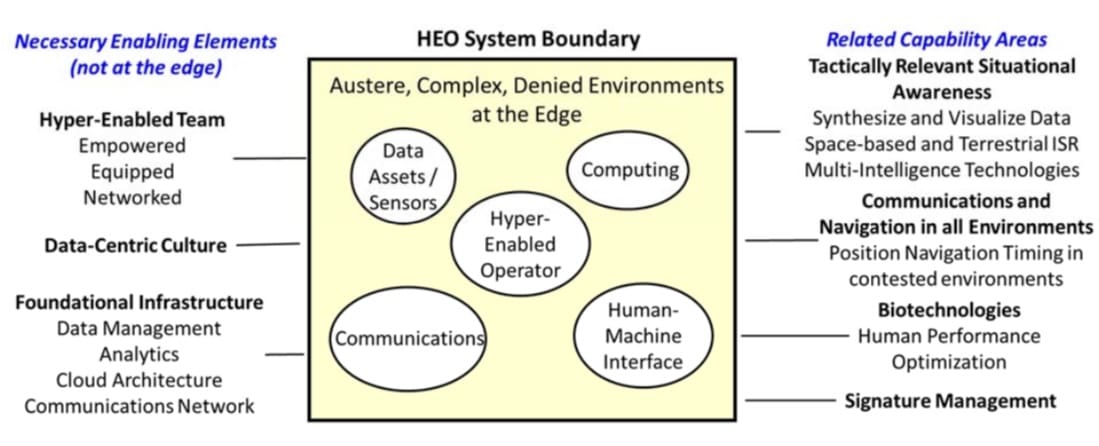
The SOF Operator remains the central focus of all efforts and is the subject of a dedicated program. In order to negotiate this environment, SOCOM envisions a Hyper Enabled Operator (HEO) who is a SOF professional empowered by technologies that accelerate tactical decision making by increasing situational awareness and reducing cognitive workload.

No single technology will independently make operators hyper enabled. Instead, operators will become hyper enabled through the integration of technologies. More specifically, the Hyper Enabled Operator will have technologies which permit the persistent, near?real?time collection of data; the rapid, automated distillation of those data into mission relevant information; the dissemination of that information to the personnel who require or can best use it; the presentation of that information in easily understandable formats and user?friendly modalities; the ability to use that information to select, direct, and implement tailorable, non? lethal and lethal effects to best meet mission objectives; all while maintaining freedom of movement and tactical invisibility. Thus, S&T seeks white papers in the areas of Next Generation Intelligence Surveillance and Reconnaissance, Networking and Data Management, Biotechnology and Human Interface, Next Generation Effects and Precision Strike, and Next Generation Mobility and Signature Management to build the Hyper Enabled Operator.

Offerors who wish to be considered for award in the fiscal years 2020 and 2021 must submit white papers on or before 21 May 2020, at 11:00 a.m. EDT,

This BAA will remain open for 5 years until 31 December 2025, unless superseded, amended, or cancelled.

Specific areas of focus are available at SAMS. Read it on beta.sams.gov…if you dare.

Ok, it’s a cheap shot, but SAMS is still a beta even though both industry and government rely on it for procurement notifications. That thing is a trainwreck.

US Air Force Creates New AFSC for Special Warfare Officers

Thursday, April 30th, 2020

ARLINGTON, Va. (AFNS) —

The Air Force consolidated and transitioned officers of Air Force Special Warfare to a new Air Force specialty code to increase resourcing, improve talent management and enhance deployment capabilities.

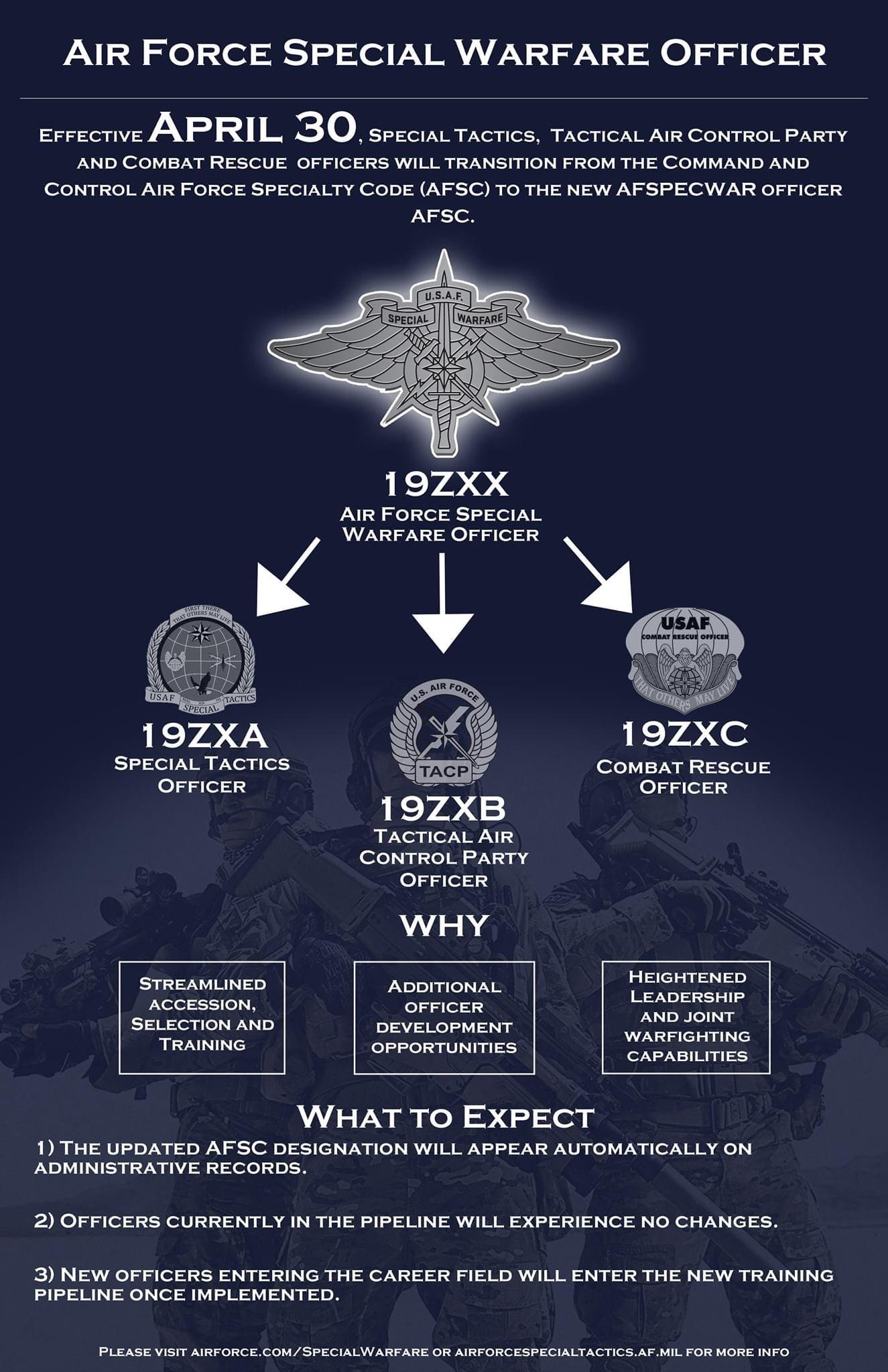
Effective April 30, special tactics, tactical air control party and combat rescue officers will transition from the command and control AFSC, 13XX, to the new AFSPECWAR officer AFSC, 19ZXX.

“The creation of a cadre of officers steeped in joint leadership and trained to lead the full spectrum of AFSPECWAR conventional and special operations missions will streamline accession, selection and common skills training,” said Col. Thomas Palenske, director of the AFSPECWAR directorate at the Pentagon. “These officers will share a common assessment and selection standard with a heightened benchmark for leadership capabilities to prepare them as next-generation leaders for the AFSPECWAR enterprise.”

The 19ZXX AFSC includes three shred-outs:

– Special tactics (19ZXA): Leads special operations forces conducting global access, precision strike and personnel recovery operations across all domains to support the joint force commander.

– Tactical air control party (19ZXB): Leads combat air forces and SOF conducting precision strike, the application and integration of joint fires and all-domain command and control operations to support the JFC.

– Combat rescue (19ZXC): Leads personnel recovery and SOF conducting personnel recovery operations to report, locate, support, recover and reintegrate isolated personnel across all domains to support the JFC.

All administrative systems such as MilPDS are expected to automatically update by May 1.

The transition to the new AFSC will be a direct conversion with no additional training required. While differences between special tactics, TACP and combat rescue officer training and development exist today, the development of a new 19Z assessment and selection process will create core standards for future special warfare officers.

“Upon the establishment of the 19Z officer training and developmental processes, every AFSPECWAR officer will exercise the unique competencies: ‘mission command’ culture, advanced combat skills, ground maneuver warfare expertise, air-mindedness and all-domain warfare capabilities,” said Col. Mark McGill, AFSPECWAR deputy director and officer career field manager. “They should see greater opportunities to serve in different positions across the Air Force and will serve the greater AFSPECWAR enterprise together.”

AFSPECWAR is the Air Force’s premier ground force that specializes in air, ground, space and cyber integration in hostile, denied or politically sensitive environments to achieve all-domain dominance. Officers in these career fields are charged with leading, organizing, training and equipping the special tactics teams, TACP and Guardian Angel weapon systems, which collectively execute global access, precision strike and personnel recovery operations.

The development and implementation of the new AFSC is a continuation of efforts to empower AFSPECWAR to be the elite and ready ground force the Air Force needs to dominate the air, space and cyber domains. In October 2019, enlisted members transitioned to new AFSCs that identify and categorize the AFSPECWAR operator, enabler and support specialties.

“The Department of the Air Force is modernizing to connect the joint force so we can more seamlessly integrate as a joint team,” Palenske said. “This transformation strengthens the connective tissue between AFSPECWAR Airmen enabling them to integrate the unique capabilities of the Air Force into an even more lethal, joint all-domain fighting force.”

Special Tactics Airmen Support Vital Training, Maintain Readiness Through COVID-19

Wednesday, April 29th, 2020

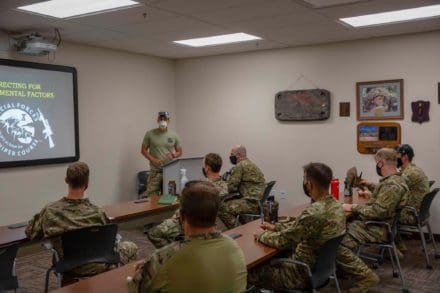
Special Tactics Airmen from the 23rd Special Tactics Squadron filled in to conduct interoperability training with the 14th Weapons Squadron assigned to the U.S. Air Force Weapons School detachment at Hurlburt Field, Florida for a Special Operations Force Exercise on April 22, 2020.

“The recent training event was done in conjunction with the 14th Weapons Squadron as part of their curriculum to produce Weapons Officers from various aircraft in [Air Force Special Operations Command].,” said Maj. Blake Jones, director of operations for the 23rd STS. “Their scenarios and full mission profiles necessitate the role of ground force as they train to conduct and support airfield seizures, non-combatant evacuations, hostage rescues and counter weapons of mass destruction operations. The 23rd STS picked up this great training opportunity after COVID-19 travel restrictions prevented other units from participating as planned.”

The exercise is a part of the 14th WPS’ demanding five and a half month syllabus exposing students to a wide range of joint special operations and combat air force capabilities. Being able to move forward with the training allowed the iteration of Weapons School students to stay on track with their training timeline.

“Our students require close interaction with skilled ground forces throughout their training to graduate them as the recognized experts in [Special Operations Forces] and [Combat Air Forces] integration,” said. Lt. Col. Jacob Duff, 14th WPS director of operations. “Our planned training partners, a different Special Tactics Squadron and multiple Army Special Forces units, were unable to travel to Hurlburt and the 23rd STS immediately stepped in to fill that gap. Without them, it would have been significantly more difficult to meet our training objectives and graduate the newest class of SOF Weapons Officers and enlisted Advanced Instructors.”

The SOFEX also provided a unique opportunity for local Special Tactics Airmen to conduct multifaceted training with a volume of aviation assets otherwise not easily replicated outside of a larger exercise. 

“Our recent participation allowed us to evaluate individual personnel and conduct training in mission planning, tilt-rotor assault, airfield seizure, landing zone establishment and control, terminal attack control, close quarters combat, personnel recovery and battlefield trauma care,” said Jones. “This was important because it gave many junior enlisted and junior officer [Special Tactics] personnel a crucial repetition mission planning with some of the best aviators in AFSOC as well as the opportunity to execute, work through contingencies and lead in a high-fidelity scenario.”

The units not only trained on the necessary skill sets needed to conduct a wide-range of special operations missions, increase lethality and maintain joint warfighting capabilities, but they were also tested on their ability to plan complex missions amidst COVID-19 preventative measures.

“The combat capabilities we are tasked to provide are not changing, but the constraints are different now so we must adapt,” said Jones. “We are adapting how we train, but also adapting how we resource and plan that training over teleconferences and web-based planning applications.”

In addition to reducing in-person mission planning, Special Tactics Squadrons have implemented several techniques to maintain readiness while keeping health of operators at the forefront, including sanitizing equipment, using face coverings when needed, conducting internal evaluations on prioritization of missions, staffing smaller training groups and taking advantage of local training opportunities.

“Stopping all training is not a feasible course of action because the second and third order effects months down the line are far too costly in terms of readiness,” said Jones. “Our squadron commits and deploys personnel operationally year-round, so we focused on ensuring we are still on track to field combat ready forces on time.” 

Special Tactics is U.S. Special Operations Command’s tactical air and ground integration force, and the Air Force’s special operations ground force, leading global access, precision strike, personnel recovery and battlefield surgery operations.

Story by 1st Lt. Alejandra Fontalvo, 24th Special Operations Wing Public Affairs

Photos by Staff Sgt. Rose Gudex

Operation Eagle Claw – 40 Years On

Friday, April 24th, 2020

Today marks the 40th anniversary of Operation Eagle Claw. In the early morning hours of 25 April, 1980 President Carter announced to a stunned world that the United States had undertaken an ambitious raid into Iran to liberate 52 American hostages held illegally at our Embassy compound in Tehran. The assault force can be seen here, loading C141s.

Unfortunately, Operation Eagle Claw was unsuccessful and we lost eight American servicemen in a horrible aircraft ground collision.

20120424-214950.jpg

However, their deaths were not in vain. The hostages were eventually repatriated and the accident was the watershed event that created, over the next several decades, the world’s preeminent Special Operations capability; USSOCOM and its components. Forty years later, we wouldn’t be where are without the determination of that fledgling task force. Join me in remembering those that had the guts to try.

“No Ordinary Dog” – The Tale of a K9 and his Handler in Naval Special Warfare

Tuesday, April 21st, 2020

“No Ordinary Dog” is the amazing story of a K9 and his Handler in who served in Naval Special Warfare.

Navy SEAL Will Chesney covers his military training and service with particular attention on his becoming a Naval Special Warfare K9 Handler beginning in 2008 after six years in the Teams. His new partner was named Cairo who did everything right alongside his human counterparts. Unfortunately, that included being shot on one operation.

Although Cairo looks like a house pet, this military working dog served on numerous raids and is famous for participating in Operation Neptune Spear at Chesney’s side. A lot has been written about Cairo’s role in the mission to kill bin Laden and a lot has been wrong. “No Ordinary Dog” sets the record straight.

After the raid, they both stayed with the Command, with Cairo serving as a backup dog and Chesney returning to his role as an Operator. Unfortunately, Chesney was injured in combat in 2013, suffering a brain injury and PTSD. Traditional medicine gave little relief to his list of ailments which included migraines, chronic pain, memory issues, and depression. Teaming back up with Cairo proved cathartic for Chesney as he began to heal himself and step up to help others.

About the Authors

During his service as a SEAL, Will Chesney was awarded the Silver Star and Purple Heart. Now he helps his fellow veterans who suffer from traumatic brain injuries.

Co-Author Joe Lauren an award-winning journalist and writer who helped Will Chesney tell the story. His books include the New York Times bestseller “As You Wish: Inconceivable Tales from the Making of the Princess Bride”.

Get your copy (ebook or hardbound) at www.amazon.com.

SOFWERX – Blast Exposure Monitoring System Assessment Event

Monday, April 13th, 2020

SOFWERX, in concert with USSOCOM PEO-SOF Warrior (PEO-SW), will host a Blast Exposure Monitoring (BEMO) System Assessment Event on 27 May 2020 to identify solutions to blast overpressure exposure recognition, which occurs with heavy weapon system use, breaching, and other dynamic training and operational environments.

Select individuals will be allotted a one-on-one session with USSOCOM to pitch, demonstrate, and/or discuss solutions.

Submission Deadline: 19 April 11:59 PM EST

To submit, visit events.sofwerx.org/bemo.

7th SFG(A) Conducts High Angle Rescue Training

Wednesday, April 8th, 2020

Members of 7th Special Forces Group (Airborne) conduct high angle rescue training on February 27, 2020, in Panama. The Soldiers were practicing how to tie knots and lift a litter up a cliff.

US Army photos by SGT Sean Hall and SPC Aaron Schaeper


NDIA, SOCOM Announce Virtual SOFIC

Tuesday, April 7th, 2020

NDIA, SOCOM to host virtual SOFIC in May

ARLINGTON, VA –The National Defense Industrial Association and U.S. Special Operations Command will host a virtual Special Operations Forces Industry Conference (vSOFIC) online, May 11-15, they announce today.

After canceling this year’s annual SOFIC event in Tampa, Florida, because of the COVID-19 pandemic, NDIA and SOCOM developed a new online platform to enable special operations professionals and industry partners to learn, network and collaborate on the initiatives and capabilities needed in the future.

“We understand the importance of the collaboration among industry, the government and academia to solve those most difficult challenges our warfighters face,” said Hawk Carlisle, NDIA’s president and CEO. “We look forward to bringing together, virtually, special operations throughout the country for this significant event that continues our collaboration with SOCOM.”

The virtual conference will include remarks, presentations and Q&A sessions with SOCOM leaders and acquisition, science, technology and logistics professionals. This year’s conference theme is “Expanding the Competitive Space.”

“During this time, having an opportunity to explain our capability needs and give industry leaders a chance to tell us what they have to offer may be more important than ever,” said SOCOM Acquisition Executive Jim Smith. “We’re especially excited that an online format will not only meet the needs of our current, valued industry partners but may also attract new teammates from the digital and cyber tech base.”

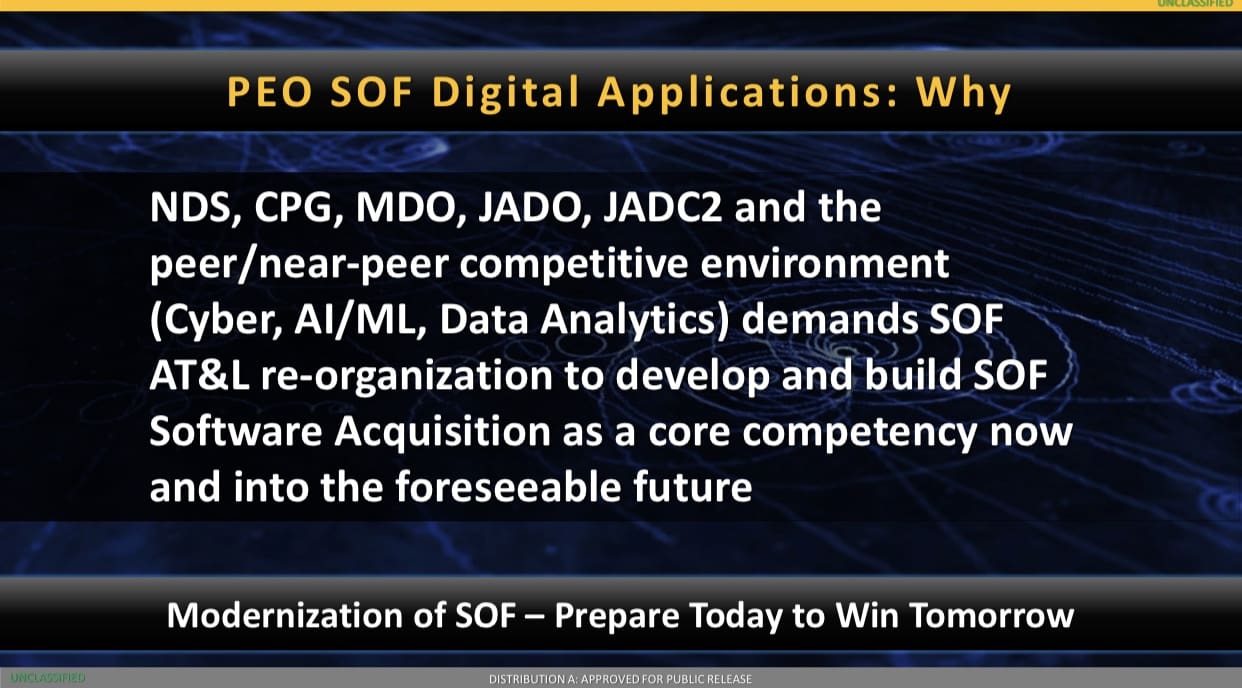
SOCOM has opportunities for industry innovation in many areas, including next-generation intelligence, surveillance and reconnaissance, next-generation mobility, precision fires and effects, hyper-enabling the operator, and biotechnologies. Additionally, innovation opportunities in data and networks exist for emerging requirements in software, artificial intelligence, machine learning and data analytics in web-based information operations, mission command systems and more.

SOCOM also has opportunities to collaborate in a new Digital Engineering Lab unveiled in September 2019. The lab facilitates development, testing and employment of new technical approaches to modernizing warfighting decision-making.

For additional information on the virtual conference and registration instructions, visit www.vSOFIC.org. Registration is required for all vSOFIC participants.