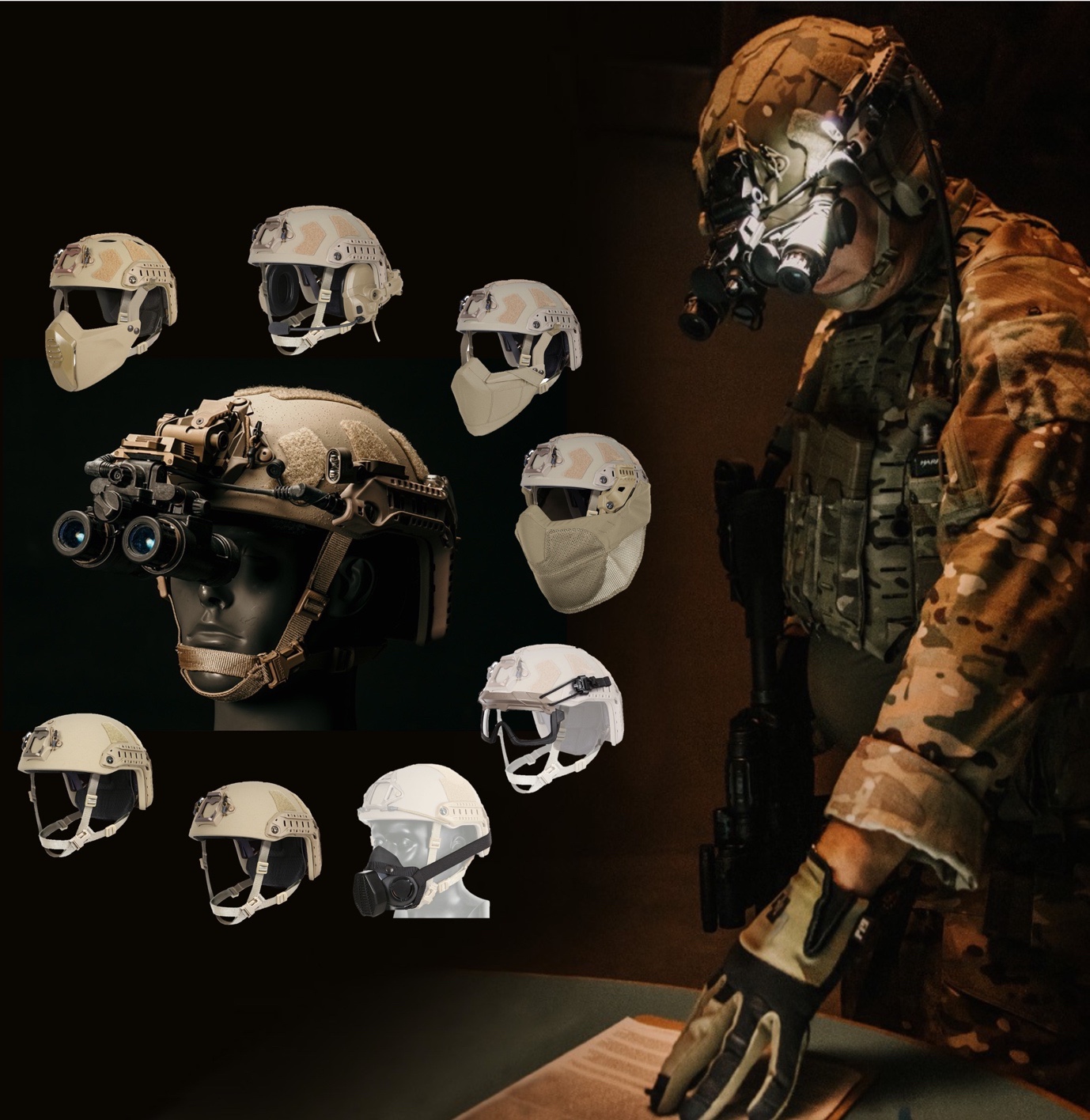
BOSS-Xe from Wilcox Industries

TNVC Launches SuperGain: Newest High Performance Unfilmed White Phosphor Image Intensifier Tubes Available Only at TNVC

August 29th, 2022

Redlands, California, August 25th, 2022—Over the years, TNVC has been fully committed to making the very best and very latest, MIL-SPEC, duty-ready night vision, thermal, and visual augmentation systems technology available to ALL customers, not just the privileged few. Continuing this trend, TNVC is extremely proud to announce the release of a brand-new product line: TNVC SuperGain Systems.

tnvc.com/supergain

The TNVC SuperGain family is based on the latest image intensifier tube technology from L3Harris, and is one of the most significant evolutions in Generation 3 night vision systems and performance since the introduction of Unfilmed technology and are available ONLY at TNVC as a new Premium Option for all TNVC customers.

Already in use with the United States military, including Special Operations Forces, these new SuperGain Unfilmed White Phosphor image intensifier tubes increase the Luminance Gain (Gain) specification for image intensifier tubes from the standard 40,000-80,000 fL/fc to between 100,000-120,000 fL/fc, greatly increasing the image intensifier’s ability to amplify and collect light, providing increased low light performance and extending operational envelope when compared to night vision systems utilizing conventional Unfilmed White Phosphor image intensifiers.

These new MIL-SPEC SuperGain image intensifiers will be available in all TNV-branded night vision systems, including the TNV/BNVG-M Artemis, TNV/DTNVS, TNV/RNVG, and TNV/PVS-14 as well as L3Harris-manufactured BNVD (PVS-31) and BNVD-1531 systems, all with an increased 2376+ Minimum Figure of Merit (FOM) specification. These new units will exist alongside current TNVC offerings, including those with standard Unfilmed and Filmed image intensifier tubes.

***SuperGain tubes are currently IN-STOCK for all TNV-systems. L3Harris systems will be available for Pre-Order***

SuperGain image intensifier tubes have undergone extensive testing both by the U.S. Army at Fort Belvoir and USSOCOM and Special Operations Forces organizations, and are currently being fielded and in-service around the world in the newest, most technologically advanced night vision systems in the force, including the AN/PSQ-42 ENVG-B Advanced Goggle as well as panoramic fusion goggles.

“From the end-user’s perspective, the SuperGain tubes will be noticeably brighter than standard Unfilmed White Phosphor tubes under most conditions and will provide more useable information in extreme darkness. However, I think the most significant difference that users in the field will see is the ability to see deeper into dark corners and underbrush, allowing them to detect potential threats beyond the range of typical image intensifiers. This can be a significant advantage in both urban areas / inside of structures as well as in more rural areas with vegetation and heavy canopy and subterranean operations” said Augee Kim, COO of TNVC.

While many consumers, both government and commercial have been focused on FOM (Signal to Noise Ration multiplied by Center Resolution expressed in lp/mm) as a metric for image intensifier performance and image quality, with manufacturers pushing the envelope of performance through improved methods and processes, Luminance Gain is typically set by the manufacturer.

Because Gain has typically been set by the manufacturers and is relatively stable, its importance to image intensifier performance has often been lesser discussed when talking about image intensifier performance, however Gain is one of the most critically important factors of image intensifier performance, with the “failure” implied in MTTF (“Mean Time to Failure”) of an image intensifier representing a roughly 50% loss of Gain.

“In the past there has been a concern that too much gain could lead to increased and undesirable noise in the image, which can be true with lower performance tubes” said Kim, “however as tube performance has continued to improve, with less noise overall, increasing the gain can increase the amount of useful information provided to the user,” said Kim.

In order to maximize the benefits of the increased Gain, these new SuperGain tubes from TNVC will also feature a minimum Figure of Merit (FOM) specification of 2376, the highest minimum performance specification currently available to the wide market, and with actual average tube performance exceeding that of current USSOCOM specifications.

Not only do SuperGain tubes provide improved light amplification and more information to the user, but effects can be felt on the user’s end as well—the overall brighter image allows the pupil to remain smaller, even in low light conditions where image intensifier tubes begin to dim, effectively improving the user’s vision and allowing them to take full advantage of the information provided by the SuperGain tube as well as reduce eye fatigue from long term use. Meanwhile, neither image intensifier life, nor reliability are affected, with SuperGain tubes being every bit as durable and reliable as typical Unfilmed White Phosphor image intensifier tubes.

“It sometimes amazes me how much analog image intensifier performance keeps progressing,” stated Kim. “In a world where digital technology is rapidly overtaking analog systems, analog image intensifiers are still the very best technology available for night vision and visual augmentation systems. It’s shocking both how much *and* how little Generation 3 image intensifiers have changed since their introduction in the late-1980s.”

“On the one hand, the same basic technological architecture of the Gen. 3 tube and photocathode remains—on the other, the level of performance offered by these tubes versus what was available thirty plus years ago is amazing. Tube performance from U.S. manufacturers has shot up across the board. L3Harris has been able to increase average FOM (figure of merit) performance alone by over 50% in the last six years. With the release of the SuperGain tubes, TNVC is able to offer the most advanced, most high performance, MIL-SPEC night vision systems currently available to our customers—BOTH government and commercial.”

TNVC MIL-SPEC SuperGain Systems will be available in all TNV-branded night vision systems, including the TNV/BNVG-M Artemis, TNV/DTNVS, TNV/RNVG, and TNV/PVS-14 as well as L3Harris-manufactured BNVD (PVS-31) and BNVD-1531 systems, all with an increased 2376+ Minimum Figure of Merit (FOM) specification. These new units will exist alongside current TNVC offerings, including those with standard Unfilmed and Filmed image intensifier tubes.

tnvc.com/supergain

***SuperGain tubes are currently IN-STOCK for all TNV-systems. L3Harris systems will be available for Pre-Order***

All TNV-Night Vision Systems are semi-custom built-to-order units, please allow approximately two weeks for order-processing and assembly. Existing order changes are on a first-come, first-served basis. Hand-select is available for TNV-systems.

MATBOCK Monday – New LOW VIS Medical Pouch &

August 29th, 2022

MATBOCK has two new exciting products we are launching. Our first product is the LOW-VIS Med pouch. It was designed to hold the Phokus Research Low Vis trauma kit, and safely secures your medical supplies until you need it. The ambidextrous two flaps on either side allow easy access in a rush with no complicated snaps, cables, or buttons making it easier to repack and close while on the small of your back. The back of the pouch is made from our laser-cut Ghost material and has cuts to allow both vertical or horizontal belt carry and is ideal for low-vis operations. We also have a MOLLE Tegris adapter that can be purchased separately if you would rather MOLLE the MED pouch to your gear. The medical pouch can also be directly mounted to the Soteria belt cage using the horizontal belt pass-throughs or by using the MOLLE Tegris adapter. At a mere 1.6oz it’s simple, multifunctional, and clean. Color choices: Black or MultiCam.




LOW VIS Med pouch MSRP $60

LOW VIS Med pouch with MOLLE Adapter MSRP $100

www.matbock.com/products/low-vis-trauma-kit-medical-pouch

Our next item is our Inner belt. Weighing in at just 4 ounces, the MATBOCK inner belt is the lightest and most stylish belt on the market. Made with our hydrophobic / high strength GHOST material and pile Velcro, it is used as the inner belt for both our Soteria and H.A.A.L.O belt systems. We also sell this as a stand alone belt for everyday use or during Low-VIS operations. Color choices: Black or MultiCam.

Features:
– The belt is lightweight and low profile for use daily as a regular belt.
– Made from hydrophobic and high strength Ghost material
– 100% Made in the USA


INNER Belt MSRP $56

www.matbock.com/products/inner-belt

Space Force – Orbital Warfare Mission

August 29th, 2022

The mission of Space Delta 9 – Orbital Warfare, headquartered at Schriever Space Force Base, Colorado, is to prepare, present, and project assigned and attached forces for the purpose of conducting protect and defend operations and providing national decision authorities with response options to deter and, when necessary, defeat orbital threats.

Seeking Copy of Lightfighter Manifesto

August 28th, 2022

I attempted to buy a copy of Volume One both times it was offered but was on travel each time and they were sold out before I could get a copy. I’d like to purchase a copy if anyone is done with theirs.

Email me here to discuss terms.

National Non-Profit Makes National Call to Stand Out and Wave Flags in Remembrance of 9/11 Anniversary

August 28th, 2022

On September 11th, and every Tuesday, nonprofit wants to honor the “Freeport Flag Ladies” and those affected by 9/11, by uniting in national flag waving

COLUMBIA FALLS, Maine – Aug. 25, 2022 – On Sunday, September 11, 2022, national nonprofit Wreaths Across America (WAA) is calling on all Americans to join them in waving the American flag in their own communities to commemorate the 21st anniversary of 9/11.

At 8:46 a.m., On Tuesday, September 11th, 2001, five hijackers took control of American Airlines Flight 11 and flew it into the heart of New York City and the northern facade of the World Trade Center’s North Tower (1 WTC).

At 9:03 a.m., five other hijackers flew United Airlines Flight 175 into the southern facade of the South Tower (2 WTC).

At 9:37 a.m., another five hijackers flew American Airlines flight 77 into the western facade of the Pentagon in Arlington County, Virginia.

At 10:03 a.m., four hijackers crashed United Airlines Flight 93 into a field in Stonycreek Township near Shanksville, Pennsylvania.

Members of the WAA family, including staff, volunteers, Gold Star and Blue Star Families, and veterans, will join to share in the patriotic act of waving the flag, and sharing the stories of those who raised their hand to serve following the events of that fateful day. The flag waving will start at 8:46 am ET, when on Tuesday, Sept. 11, 2001, five hijackers took control of American Airlines Flight 11 and flew it into the heart of New York City and the northern facade of the World Trade Center’s North Tower (1 WTC) and end at 10:03 am ET when four hijackers crashed United Airlines Flight 93 into a field in Stonycreek Township near Shanksville, Penn., on the same day.

You too can join by tuning in to the organization’s Official Facebook page, to share pictures and videos from your own community flag waving. Participants are encouraged to take video and pictures of their participation in the national flag waving and share them with WAA, their family, and their friends to help REMEMBER, HONOR and TEACH the generation born after 9/11, how hard times can strengthen us as a nation. Please use the hashtag #FlagsAcrosstheCountry and #AmericaStrong when posting on social media and tag the Wreaths Across America Official Facebook page.

WAA waves the American Flag every Tuesday morning between 9-10 a.m. ET and encourages the public to join them. Each week, messages of unity and remembrance are shared and the legacy of the “Freeport Flag Ladies” – who took to the Hill in Freeport on 9/11/01 following the events of that morning to hoist the flag and share a message of strength – lives on as it did each week for 18 years. After they retired on September 11, 2019, WAA took over the tradition and continues the weekly flag waving along US Route 1 in Jonesboro, Maine.

“Each Tuesday, we are joined by dozens of members of the local community and curious people stopping to be part of something meaningful,” said Karen Worcester, Executive Director, Wreaths Across America. “I hope people will join us this year, both on the anniversary of 9/11, as well as each Tuesday moving forward. This flag waving has taken on new meaning for us all and given a spark of hope for unity and patriotism during this difficult time in our country.”

Following the events of 9/11, three patriotic women (Elaine Greene, Joann Miller and Carmen Foote) were moved to find an old American flag they had stored at home and stand on a hill in Freeport, Maine, waving that flag to honor victims. These women became nationally known as “The Freeport Flag Ladies,” and proudly hoisted the Stars and Stripes every Tuesday morning for the following 18 years. After they retired on September 11, 2019, (their last 9/11 remembrance) the following Tuesday, September 17, 2019, Wreaths Across America took the helm and continued the weekly flag-waving tradition along US Route 1 in Jonesboro, Maine.

To learn more go to www.wreathsacrossamerica.org/pages/19520/News/804.

To watch the Facebook live event go to fb.me/e/2UPjaByZj.

SCUBAPRO Sunday – Low Volume Masks

August 28th, 2022

Why is low-volume important to Combat divers? For anyone who needs to preserve their air while diving or wants a straightforward mask to clear, low-volume masks are the perfect option. These benefits are also great for freedivers and spearfishers. Low-volume masks are necessary for apneic (breath-hold) sports because relatively little air is required to equalize them at deep. The main reason is the air inside the mask will condense as pressure rises with depth.

This means there is less air wasted in the mask. There is also less of a chance of a mask squeeze. The mask is closer to the diver’s face, possibly helping you see better; the diver must equalize the air in the mask to make up for the volume lost if they want to avoid this. They accomplish this by slightly exhaling through their nostrils. Since there is less airspace in a low-volume dive mask, the diver doesn’t have to use as much of their precious breath on it.


Apnea masks are less noticeable and more streamlined than conventional masks due to their low-volume construction. They offer good fields of vision despite their size (sometimes even better than large-window masks!) and are lighter, and it is less weight and room needed to carry two.

Many divers hate mask clearing, and a low-volume mask uses less air to clear. When clearing, you are wasting less air and less chance of losing control of their buoyancy. Inverted teardrop-shaped lenses are standard in low-volume masks, allowing you to view down your body without moving your neck. This is a benefit for some divers because it makes it simpler to check their pressure gauge by simply looking down to see your attack board.

Low-volume masks are an excellent option for backups and spares due to their compact, lightweight design. They fit great into an M16 pouch.

Reducing the size of the glass lenses is one method of creating a low-volume mask. This doesn’t limit your vision as much as you think because the lenses are so close to your face. However, frameless masks are an excellent alternative for anyone who feels uncomfortable or claustrophobic wearing standard low-volume designs. Some apnea masks will say not for diving, those usually have two lenses like the SCUBAPRO Steel Pro Comp, and there is only a piece of rubber between the two. If you dive deep with it, there is a chance that the lens can push in on your face. Therefore they say not for SCUBA diving but for combat diver operations that work well.

The low profile is also suitable for those who want to wear corrective lenses, which function best when placed near your eyes (much like glasses). The SCUBAPRO Zoom and D-mask are an excellent choice for this. All these masks work with the SCUBAPRO comfort stapes that are great for all divers, especially combat divers, as there is a lot less chance of them breaking, and they also work with the SCUBAPRO Odin helmet mask strap. This allows you to attach these masks to Ops-Core, Team Wendy, and Galvion helmet rails.

Winchester – Folds of Honor

August 28th, 2022

Freedom comes with a heavy price. Team Winchester understands this and send their thanks in a special message to our service members, their families and Folds of Honor.

See why Folds of Honor and its mission means so much to us.

Airman’s Innovation Saves Time, Money

August 28th, 2022

RAF MILDENHALL, United Kingdom (AFNS) —

Thousands of hours are spent each year removing and installing a boom cover on a KC-135 Stratotanker aircraft – hours that could be used elsewhere. One 100th Maintenance Squadron Airman has invented a new boom cover tool that has the potential to save the U.S. Air Force 40,000 man-hours and approximately $1 million per year.

“I noticed as soon as I got to Mildenhall that removing and installing the boom cover was tedious and time consuming,” said Airman 1st Class Jacob Helzer, 100th MXS hydraulics maintenance journeyman. “Removing the cover the conventional way involves calling the Aerospace Ground Equipment backshop for an aircraft stand and requires two Airmen and a substantial amount of time.”

The current conventional method hinders daily operations, whereas the innovative solution Helzer created is easier, takes less time and lessens the impact on the flow of operations.

“One of the maintenance crew chiefs reached out because he knew I enjoy 3D printing and design and believed I could come up with a solution for the boom cover,” Helzer said. “I then came up with a prototype for a tool that could make the process much smoother.”

Tech Sgt. Steven Jakubowski said Helzer is always looking for ways to innovate and constantly asking questions to gain further knowledge. 

“He spent a lot of his free time, outside of work, designing the boom cover tool,” Jakubowski said. 

Helzer, using his skill and knowledge with 3D printing, created a prototype called the “Boom Cover Tool.” The tool was manufactured with Helzer’s 3D printer and resembles a butterfly net on the end of a retractable pole with a hoop mechanism that tightens and loosens the net covering on the opposite end. 

“Once I created the prototype, I brought it to my section and tested it out,” Helzer said. “A 30-minute job became a one-minute job with the Boom Cover Tool.” 

The Boom Cover Tool greatly reduces the number of man-hours needed every time a cover needs to be removed or installed on an aircraft and the cover itself better protects the boom pod during adverse weather conditions. 

Each Boom Cover Tool costs roughly $200 to produce. 

“The projected savings were calculated by him and I while submitting for Spark Tank by using the 2021 comptroller document for wages,” Jakubowski said. 

“I did the math and the projected savings for the Air Force if they utilized the Boom Cover Tool for the entirety of the refueling fleet would be approximately $1 million and potentially 40,000 man-hours annually,” Helzer added. 

In order to meet this goal, Helzer has been collaborating with the MXS fabrication flight to produce the test prototypes for each aircraft here. 

“Once we have everything streamlined, we can move into the beta testing phase, which is roughly six months, then move on to scaling up for the entire KC-135 Stratotanker aircraft fleet,” Helzer said. 

Moving forward, Helzer plans on developing a batch of tools for the local KC-135 fleet to prove the design concept. Helzer would then like to contract the fabrication of a final, more durable prototype and share the Boom Cover Tool throughout the entire fleet and modify the design to be adopted for other variations of refueling aircraft. 

“Helzer has been a go-getter from the moment he arrived on station and is always hungry to learn all aspect of his job, and his critical thinking skills are some of the bests I’ve ever seen,” Jakubowski said. 

Helzer has always been motivated to improve himself and the way things are done at his job, and one example of this is the Boom Cover Tool. 

“This is how change starts, by questioning the way we do things and coming up with a solution that will benefit Airmen at all levels,” Helzer said. “I created the Boom Cover Tool to make the lives of my Wingmen easier and inspire Airmen to devise and implement new ideas to help improve even the simplest tasks.” 

By Airman 1st Class Alvaro Villagomez, 100th Air Refueling Wing Public Affairs