SIG SAUER - Never Settle

MATBOCK Monday – Skeeter Patch Kit

March 2nd, 2020

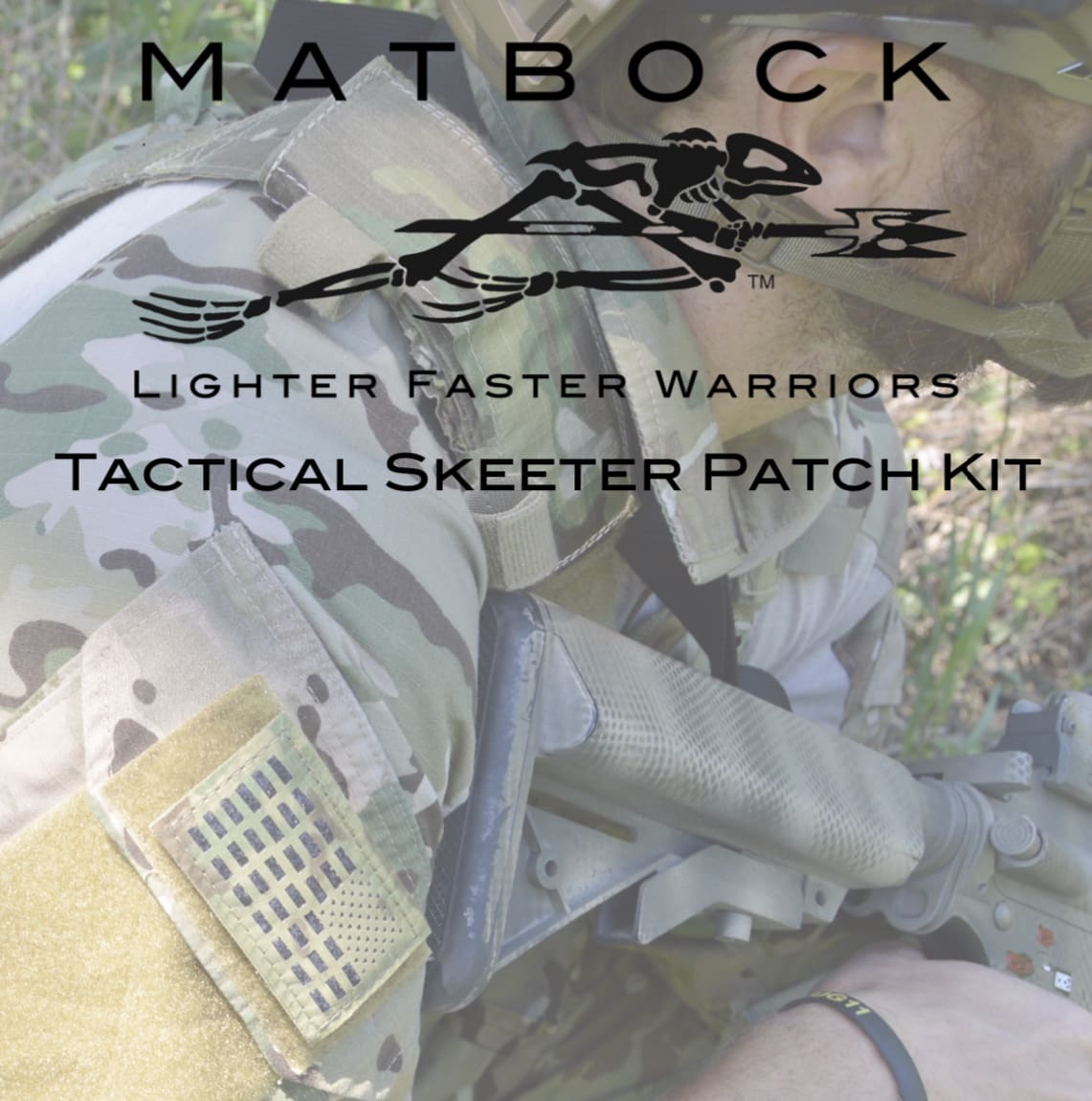
With warm weather right around the corner, we are all itching to get outdoors.  With the arrival of spring also comes the arrival of….BUGS!!!  Don’t worry, here at MATBOCK we got more than your back, we got you covered head to toe with the Skeeter Patch Kit.

The internal of each patch is a super absorbent antimicrobial lining for deet or any other anti-bug spray. The absorbent liner will hold the bug spray for hours to prevent insects from bothering you or from you spraying some of these very harmful chemicals onto your body directly.

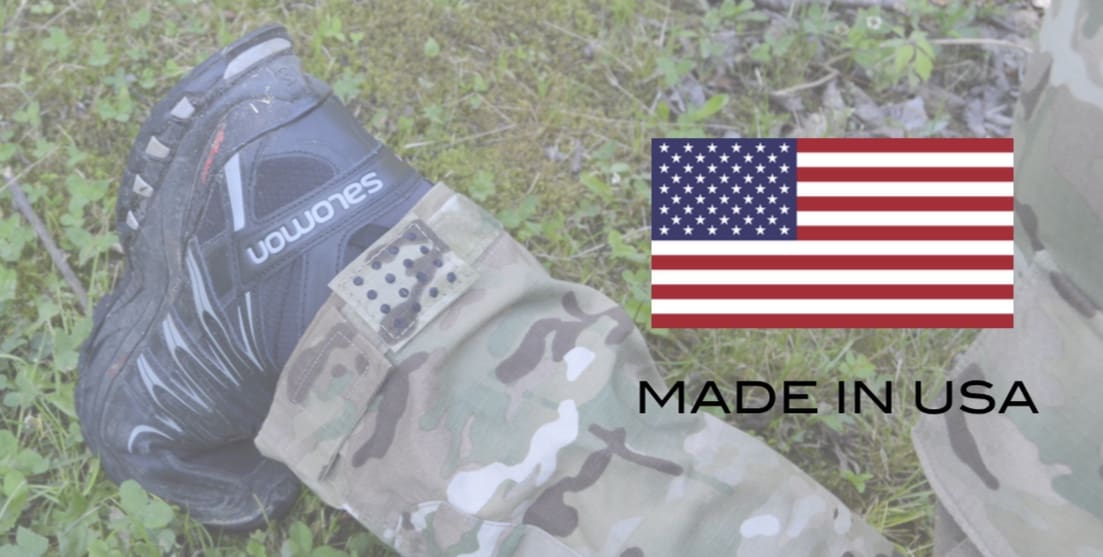
Each kit comes with 2 American Flag patches and 2 smaller patches. The 2 smaller patches are perfect to place around the ankles or below the knee. The American Flag patches are great to wear on your shoulders.

***For custom flag sets, please contact us at admin@matbock.com.  Custom sets must be purchased in sets of 100 kits***

Click below to order yours today!

www.matbock.com/collections/accessories/products/skeeter-patch-kit

USAF To Rename Lackland AFB’s Medina Annex in Honor of MSgt John Chapman

March 2nd, 2020

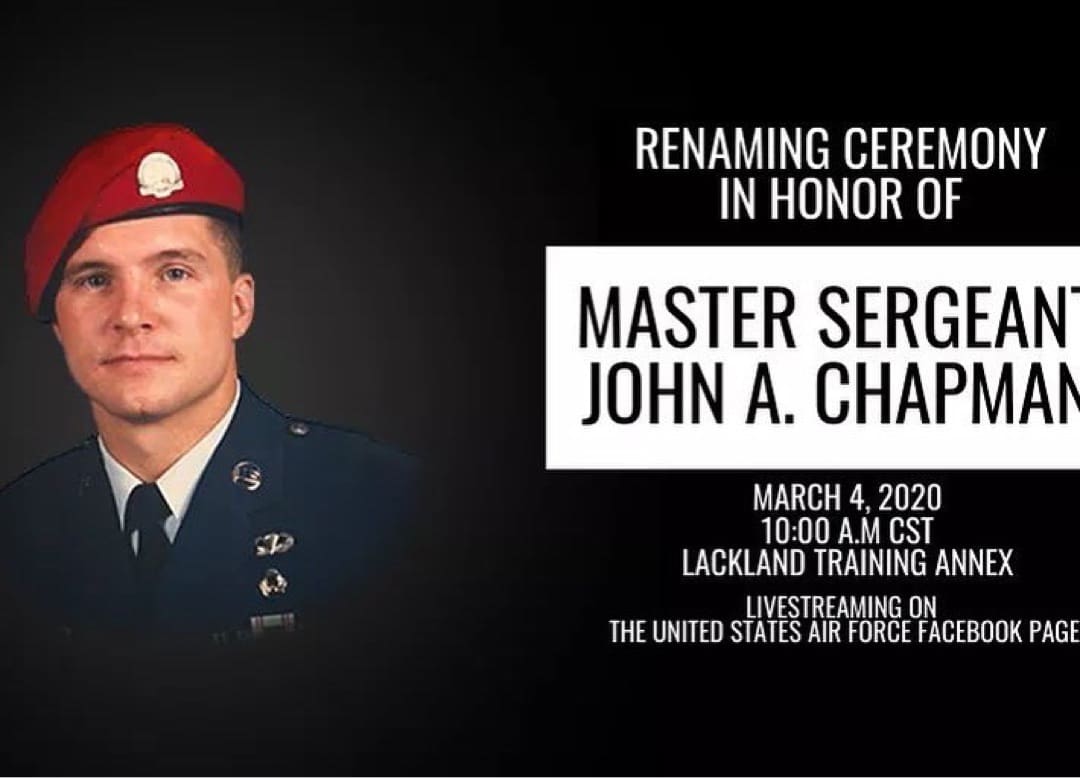
On Wednesday, the JBSA-Lackland (Medina) Training Annex will be renamed in remembrance of Medal of Honor recipient, MSgt John A. Chapman.

The renaming ceremony will be held at 10:00 AM CST on March 4, 2020, and is open to all DoD cardholders. It will also be live-streamed on several venues.

B&T USW-Chassis for CZ P-10 F and C

March 2nd, 2020

The success of the B&T USW as well as the B&T USW-G Chassis has stirred the interest to have this innovative and accurate system also available for other popular pistols. B&T is happy to fulfil these demands with the introduction of a USW Chassis for the CZ P-10 F and the CZ P-10 C.

The USW-P10 conversion kits are the ultimate add on for the CZ P-10 F and the P-10 C. They offer the operator the choice of using the pistol in the traditional way as well as with the built in folding stock, while the transition only requires less than a mere second. Due to its elaborated design, the operator can mount an optionally available red dot sight on top of the chassis and use the original open sights as back up.

www.bt-ag.ch

This was intended as an IWA release and will roll out in Europe first. Not available in the Us yet.

B&T RBS Reduced Backpressure Suppressor

March 2nd, 2020

As sensible as the use of silencers is in police and military applications, the escape of the retained gases from the ejection port is irritating for the shooter and has disadvantages in combat. B&T successfully solved this problem as early as 2013 when designing the MP9 suppressor with the invention of the low-pressure expansion chamber. Since the gases ejected backwards when firing a large numbers of shots with assault rifles or machine guns make it difficult for the shooter to breathe, B&T has now transferred the principle of the low-pressure expansion chamber to suppressor’s assault rifles and machine guns. The RBS suppressor significantly reduces the combustion gases ejected from the ejection window. The low-pressure expansion chamber only minimally increases the size and weight of the silencer compared to conventional silencers, while muzzle flash and noise are suppressed similarly well as with the proven B&T suppressors.

The RBS is available in calibers 5.56 (.223) and 7.62 (.308) each in a direct mountable version for various muzzle threads as well as with a newly developed quick release fitting all NATO A2 muzzle flash hiders.

www.bt-ag.ch

This was intended as an IWA release and will roll out in Europe first. Not available in the Us yet.

B&T Announces Telescopic Stock for MP5

March 2nd, 2020

Despite its advanced age, the HK MP5 is still in use by many police agencies worldwide. As part of the Mid-Live-Improvement, many users have upgraded and retrofitted the weapon in recent years with B&T parts (handguards, optical mounts, etc.). At the same time, various authorities have repeatedly asked B&T for a well thought-out telescopic stock. Since B&T offers such a telescopic stock for its own APC, the request was gladly granted. The new B&T telescopic stock for the MP5 is convincing in all areas. It is up to 62 mm shorter than known shoulder rests when inserted, it can be pulled out immediately without using a lever and it has 3 locking positions for optimal adaptation to the shooter and its equipment. In addition to these improvements, B&T has also succeeded in reducing the weight of the shoulder stock to 495 g, which is between 21 % and 47% lighter than comparable shoulder stocks.

www.bt-ag.ch

This was intended as an IWA release and will roll out in Europe first. Not available in the Us yet.

Impuls-OLS Pistol Suppressor from B&T

March 2nd, 2020

The product was especially designed for military users because for some missions, every gram of weight makes a difference. The Impuls-OLS™ pistol suppressor in 9 x 19 mm has been designed for minimum weight and excellent noise reduction. The Impuls-OLS is the same length but still more than 110 grams lighter than the standard Impuls-IIA™. The Impuls-OLS™ is a very good choice not only for military or police users but also for civilian users. It has been tested to be both reliable and effective with many different types of pistols.

According to customer requests, the Impuls-OLS is available with many different thread sizes and therefore can be used with basically every standard pistol. The Impuls-OLS™ is available in a standard length and in a compact version.

www.bt-ag.ch

This was intended as an IWA release and will roll out in Europe first. Not available in the Us yet.

Spatial Integrated Systems (SIS) Wins US Coast Guard Maritime Domain Awareness Pilot Study Contract

March 1st, 2020

SIS’s SMART™ Autonomy System is unmatched for cooperative missions

VIRGINIA BEACH, Va., February 25, 2020 – Spatial Integrated Systems Inc. (SIS) of Virginia Beach, VA, has been awarded a contract with the US Coast Guard (USCG) to demonstrate an autonomous Unmanned Surface Vessel (USV) System to examine the feasibility of improving Maritime Domain Awareness (MDA) in the remote Pacific Ocean. SIS partnered with MetalCraft Marine U.S. of Watertown, NY, and Navatek, based in Honolulu, HI.  The partnership marries two mature, commercially available products, the SIS Multi-Agent Robotic Teams (SMART™) Autonomy System and the MetalCraft 7m Interceptor Boat, for commercial sale as an intelligent, goal-oriented autonomous USV. The integration of SIS’s SMART™ Autonomy to MetalCraft’s 7m Interceptor is seamless, inexpensive and will demonstrate to the USCG the opportunity to optionally unman/man any auxiliary craft in their inventory. SMART™ Autonomy is COLREGS compliant and is the leader in multi-robot control, offering unmatched capability for swarm and cooperative missions with multiple UxVs. The 7m Interceptor, which is currently being employed by the USCG Cutter Boat-Large (CB-L) Program, was specifically chosen because it can operate in extreme conditions, has been proven for launch and recovery from USCG Cutters and has a large space for future payloads. 

SIS will demonstrate a comprehensive ability to detect threats and safeguard our homeland, prevent illegal fishing, and stop intrusion into protected marine sanctuaries. “We are excited to demonstrate the maturity of our technology and the flexibility to employ multiple optionally manned platforms affording a Coast Guard Commander tremendous opportunities,” said Sam Lewis, SIS’s President & Chief Operating Officer. The open ocean demonstration will be conducted this summer approximately 30 miles south of Oahu, HI, in a 20 square mile area. Spatial Integrated Systems is proud to have been chosen by the USCG to conduct this demonstration and to play a leading role in the sustainment of America’s edge in autonomy and unmanned systems. 

SCUBAPRO Sunday – Iran – Iraq War USSOCOM History

March 1st, 2020

Iraq attacked Iran in September 1980, launching a war that would last eight years. By 1982, more than 100,000 people had died. The war was costing each side about $1 billion a month and devastated both countries’ oil industries. In the so-called “tanker war,” both countries launched attacks on neutral merchant vessels transiting the Gulf (mostly Kuwaiti flagged ships). In December of 1986, the Kuwaiti government asked then-President Reagan to help protect their oil tankers from mine placed by the Iranian. Reagan sent the U.S. Navy, and the newly formed USSOCOM sent the SEALs, Special Boat Units (now Special Boat Teams), and the 160th Special Operation Aviation Regiment (SOAR). This was the first time in SOCOM history (its short history at the time) that these three groups would be deployed together. 
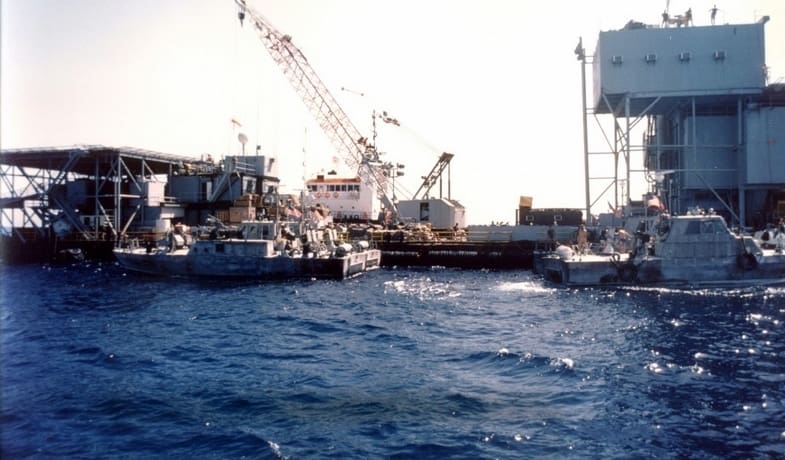
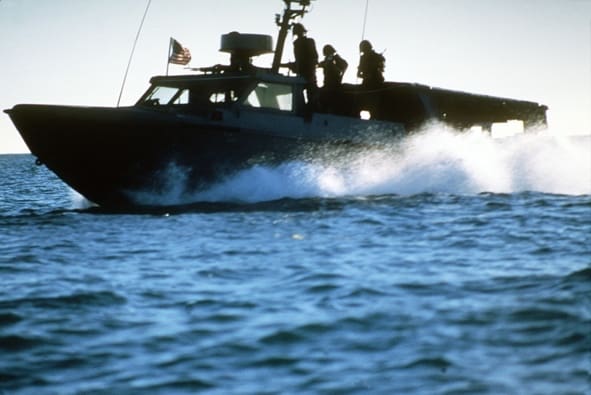
The Task Unit was deployed on two barges, Hercules and Wimbrown, that the Pentagon promptly converted into Mobile Sea Bases (MSBs)complete with their own extensive self-defense weapons. Naval Special Warfare Task Units (NSWTU) was run by a SEAL commander and answered to the regional Naval Special Warfare Task Group. Their mission was to stop Iranian forces from mining the Persian Gulf or otherwise attacking shipping. Each MSB had two detachments of Mark III patrol boats, a SEAL platoon, an EOD detachment, Marines to provide security, army MH-6, and AH-6 Little Bird helicopter gunships and Black Hawk rescue birds, and an air force combat controllers. MSB Hercules was manned by East Coast NSW, SEAL Team Two, and SBU 20 and 24. MSB Wimbrown 7 was manned by West Coast SEAL Team One and SBU 12 and 13. They also had other boats and helos available to them, like the SeaFox.
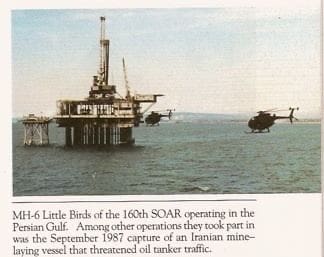
On September 21, a trio of Little Bird choppers flying off the frigate Jarrett was assigned to shadow the Iranian tank landing ship Iran Ajr,s suspected to have been converted for minelaying. An MH-6 helicopter equipped with a forward-looking infrared (FLIR) sensor and night-vision goggles led the way, escorted by two AH-6 gunships loaded with 7.62-millimeter miniguns and 2.75” rocket pods. The helicopter crews recorded the Iran Ajr’s crew deploying mines next to the Middle Shoals navigational buoy used by tankers. The Little Birds were ordered to open fire, and they opened up on the Iranians with their miniguns, the crew to take cover and did not return fire. The Iranian sailors resumed deploying the mines a half-hour later. This time the 160th pilots unleashed a sustained barrage, including rockets, killing three crew—and causing the remaining twenty-six to abandon ship. The following morning, SEALs on Mark III Patrol Boats rescued all but two of the Iranian sailors and boarded Iran Ajr. They found nine mines onboard and seized a logbook recording past minelaying activity, including maps showing the locations of those mines. Then the Navy towed Iran Ajr’s too deep water and blew her up.
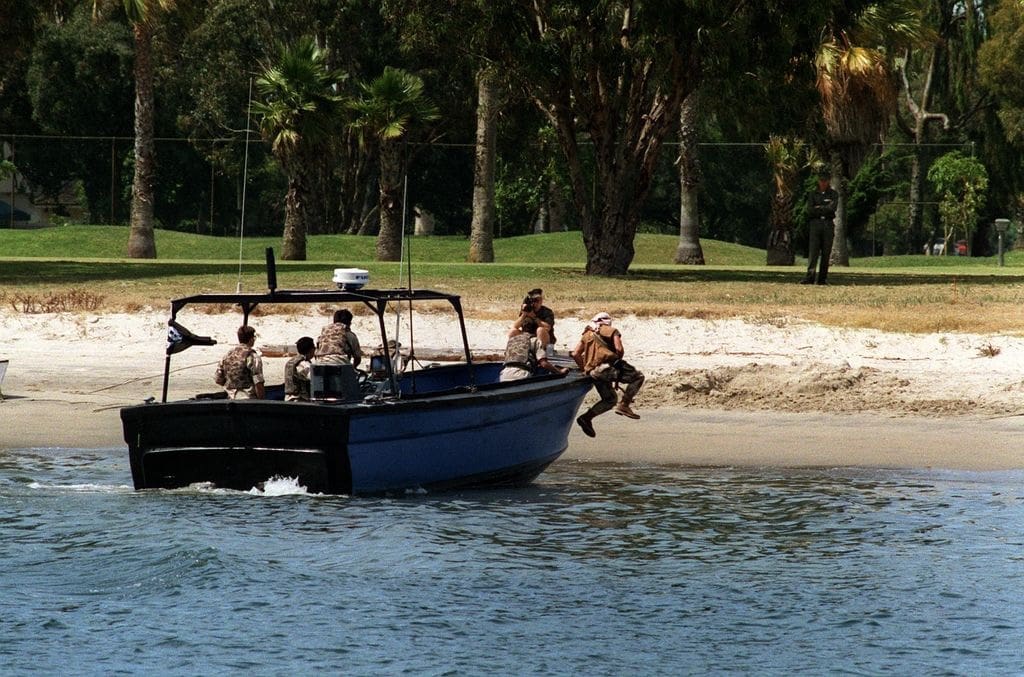
A trio of minigun-armed MH-6 helicopters tangled again with four Iranian ships approaching MSB Hercules on October 8, including a corvette, a Swedish-built Boghammar, and two Boston whaler type boats. The Boghammar’s crew fired Stinger missiles at the scout helicopters before being sunk by return fire. Eight Iranian crew were killed, and six more rescued from the water. One of the Boghammar’s was later brought back and used by SBU-12/13 for the Coronado July 4 demonstrations and as an aggressor boat for exercises in the San Diego area.
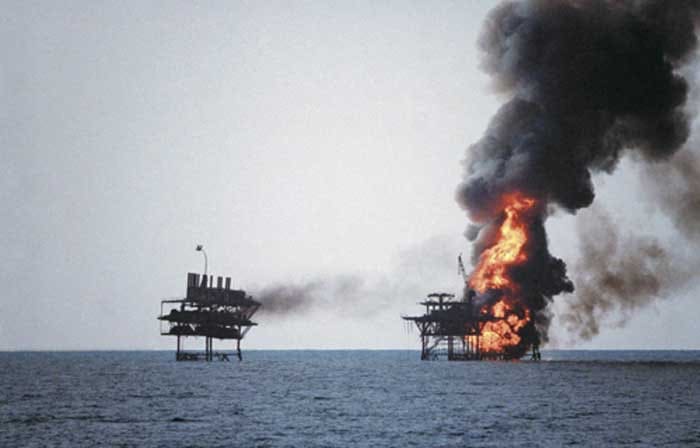
When an Iranian missile struck the U.S.-flagged Sea Island City on October 16, injuring eighteen crew, Washington authorized a counterattack three days later called Operation Nimble Archer, resulting in the destruction of two Iranian oil platforms used to host IRGCN boats. 

But Iranian minelaying continued. On April 14, 1988, the crew of the frigate Samuel B. Roberts spotted three Iranian mines and realized she had unwittingly cruised into a minefield. While attempting to back out of danger, Roberts struck a mine that nearly split her in two and injured ten sailors. A heroic damage control effort saved the ship and her crew. Navy divers later identified additional mines in the area—with serial numbers identical to those on the Iran Ajr’s. Four days later, the U.S. launched a second retaliatory strike targeting two more Iranian oil platforms called Operation Praying Mantis. This time frigates and gunboats of the regular Iranian Navy counter attacked, resulting in the U.S. Navy’s largest naval battle since World War II, in which half of Iran’s surface combatants were sunk or crippled.
The Iran-Iraq war ended four months later—but not before one final tragic incident. On July 3, the U.S. Aegis missile cruiser Vincennes was skirmishing with Iranian fast boats, having unknowingly entered Iranian territorial waters, when her radar reported an Iranian F-14 Tomcat fighter was approaching her. The cruiser fired two radar-guided SM-2 missiles at the contact—bringing down Iranian A300 airliner Flight 655, killing all 290 civilians aboard. 

Operation Earnest Will concluded September 26 when the USS Vandergrift escorted a final tanker into the Persian Gulf. The operatives involved in Prime Chance remained active, however, until June 1990.

www.defensemedianetwork.com/stories/ussocoms-first-test-of-fire-operations-prime-chance-and-praying-mantis