SIG SAUER - Never Settle

Safariland Launches New Customer Loyalty Program

November 13th, 2023

Jacksonville, Florida – Safariland®, a brand of The Safariland Group®, a leading global provider of safety products designed for the public safety, military, professional and outdoor markets and one of Cadre Holdings, Inc.’s (NYSE: CDRE) (“Cadre”) key brands announces the launch of its new online loyalty program. Designed to reward and show appreciation to its loyal customers, the Safariland Loyalty Program offers a range of benefits and exclusive discounts.

“We are constantly looking for ways to give back to our loyal customers,” said Tim Drnec, VP of Marketing for Safariland. “We understand the importance of building strong relationships with our customer base, and this new loyalty program is our way of saying thank you for their continued support.”

The Safariland Loyalty Program is free to join, making it accessible to all. Customers with existing Safariland accounts will automatically be enrolled in the loyalty program and receive 100 free points. New customers can easily register on the Safariland website to earn points towards discounts on future purchases.

For every dollar spent, customers will earn points. Additionally, by participating in Safariland’s promotions and through referring friends, customers can earn extra points. The “Earn Points” section on the website will provide an overview of current opportunities for customers to accumulate points.

Through point accumulation, customers can redeem various discounts on purchases and future giveaway items. Points redemption is simple, and customers select the desired reward at checkout. Customers can track their progress in their account on the Safariland website. Points earned through the loyalty program will never expire, providing customers with the flexibility to use them whenever they choose.

With the launch of its new loyalty program, Safariland aims to give back to those customers who continuously support them by providing exclusive benefits and discounts. Join the Safariland Loyalty Program today and start earning rewards for your continued support.

For more information about The Safariland Group, please visit www.safariland.com.

Improving ISR Missions Success Rates: The Growing Role of Change-Bitrate-on-the-Fly Technology

November 13th, 2023

Intelligence, Surveillance and Reconnaissance (ISR) missions are rarely executed in controlled laboratory environments — quite the opposite. The platforms — from airborne drones to terrestrial and underwater remotely piloted vehicles (RPVs) — that carry ISR payloads are often deployed in the harshest conditions and connected to users and operators over wildly inconsistent communication networks.

The ability to ensure high-quality images, regardless of network conditions in a theatre of operations, has emerged as a critical success factor for ISR activities that depend on video-based intelligence to establish situational awareness and support effective decision-making.

This is where Change-Bitrate-on-the-Fly technology comes in.

Here, Mark Rushton, Global Defense and Security Lead at VITEC: a global technology leader in the IPTV space, shares his insights on how Change-Bitrate-on-the-Fly technology improves ISR mission success rates.

Change-Bit-Rate-on-the-Fly technology: what is it and why is it essential to the ISR mission?

When talking about video streaming, we often focus on bitrates, which are measured by considering how many frames are taken every second, along with the size of each frame. The higher the video quality, the more images are needed to process for each second of video, which, of course, results in higher bitrate requirements.

Change-Bit-Rate-on-the-Fly technology is an increasingly important feature for the ISR community because it directly affects the quality and timeliness of tactical field intelligence. Receiving information too late because of network latency or being unable to understand what is being analyzed because of dropped packets that result in fuzzy or pixelated images can mean the difference between life and death.

In many ways, the need for Change-Bit-Rate-on-the-Fly capabilities reflects the technological progress that has allowed more sensors with greater capacity to be loaded on ISR platforms — such as drones or helicopters. Innovations around ISR have led to cameras that capture video images in stunning detail and sensors capable of detecting subtle temperature changes in the environment, including ground-penetrating radar. As a result, more information can be shared from a single ISR platform than before.

It does, however, create a challenge.

While devices to capture this wide array of data are becoming increasingly advanced, there are still challenges associated with the wireless networks used to access the data in terms of bandwidth, capability and change.

Change-Bit-Rate-on-the-Fly is a technology can help address network constraints by adapting the bitrate as it changes.

What challenges leads to network constraints or variability?

The ISR community has done a lot of excellent work in adopting standards across the technical elements needed to capture, share and act on digital intelligence. As a result, most platform and payload technologies can use almost any wireless network in the field to maintain connectivity — and, therefore, the flow of intelligence.

The agility and flexibility that enable drones and other RPVs to use multiple networks means these platforms can dynamically switch from a cellular network to a satellite link and then to a terrestrial mesh network.

However, as these platforms shift from one data carrier to another, they will likely experience a difference in bandwidth available to support the data traffic. Sometimes, that delta can be quite significant. A cellular network might deliver up to 100 megabits in connectivity only to switch to a satellite signal that supports a fraction of that capacity.

The other challenge revolves around the roving nature of ISR platforms. The quality and strength of wireless signals are better when platforms are near antennas. The signals weaken as the distance from antennas grows.

While the connectivity environment is highly dynamic – with bandwidth fluctuating from total capacity, only to be cut by half and then a third of capacity — the overall ISR objective of sharing the highest quality image possible remains the same.

That’s why Change-Bitrate-on-the-Fly is a differentiator for IP video applications on ISR platforms. With it, we can make changes dynamically in real-time to ensure the continuity of images at the highest possible quality. This can’t be underscored enough because video in a live environment is crucial for ISR. It represents a major improvement over the previous ISR video capabilities. With Change-Bitrate-on-the-Fly, ISR teams can execute their missions with confidence.

Mark Rushton is the Global Defence and Security Lead at VITEC.

VITEC is a global technology leader in the IPTV space, working within the Intelligence, Surveillance, Target Acquisition and Reconnaissance (ISTAR) arena for over 20 years.

Cellebrite’s 2024 Industry Trends Survey Reveals Urgent Digital Challenges in Law Enforcement

November 13th, 2023

Annual Public Sector Survey Highlights Growing Need for Digital Intelligence Integration and Solutions
TYSONS CORNER, VA and PETAH TIKVA, Israel – November 13, 2023 – Cellebrite DI Ltd. (Nasdaq: CLBT), a global leader in Digital Intelligence (DI) solutions, unveils the critical insights from its 2024 Industry Trends Survey for the Public Sector. Now in its fifth year, the survey findings reveal the urgent need for agencies to digitally transform key workflows to address severe staffing shortages and a growing volume of evidence.   

The survey, gathering insights from 2,000 law enforcement leaders and practitioners, underscores challenges in device access, data extraction, evidence management and analysis. A notable majority report increased overtime and insufficient training to tackle digitally driven crimes. Disturbingly, many still rely on outdated paper-based reviews or manual digital tools, resulting in a staggering 45 hours typically spent reviewing digital evidence per case. With three out of four practitioners agreeing digital evidence is pivotal in case resolution, it is critical for agencies to adopt technologies that will transform their workflows, increase productivity and create efficiencies to solve cases faster, smarter and more defensibly.  

“Technology has changed the nature of crime,” says Steve Foster, Special Agent in Charge at the Georgia Bureau of Investigations whose unit utilizes Cellebrite technology to solve crimes. “We need the tools and people in place to be able to work through the challenges.”  

“Digital evidence continues to play an important role in modern investigations. As criminal technology evolves, it is that much more critical agencies are equipped with the tools, solutions and training needed to identify and analyze all case data,” said Leeor Ben-Peretz, Chief Strategy Officer, Cellebrite. “This year’s survey validates our commitment to supporting agencies through their digital transformations, help them manage their growing caseloads, and reduce investigator and examiner fatigue.”   

Key survey revelations include:  

·       Increase in evidence sources: significant YoY increase from cryptocurrency, car infotainment systems and wearables 

·       Examiner reports to investigators: In 2021, it took an average of six days for investigators to receive an extraction report from examiners, which has now increased to 14 days 

·       Evidence Handling: 75-80% agencies use portable drives or USB sticks for evidence, risking chain-of-custody breaches 

·       Growing Backlogs: 52% see worsening case backlogs year-on-year 

·       Evidence Sources Expand: Smartphones dominate, but cryptocurrency, cars and wearables are on the rise 

·       Digital Evidence Power: 60% of practitioners deem digital evidence has more impact on case resolution than DNA 

·       Evidence Delays: 75% of investigators note device analysis can exceed two weeks, even in high profile cases  

·       Tech’s Role: 65% of agency managers believe technology can alleviate staffing strains  

The annual survey includes respondents from North America, Europe, Latin America, and the Asia-Pacific region. To view the full survey results, please click here

New Name Announced for a Trusted Brand in the Tactical Industry: Mehler Systems

November 13th, 2023

Fulda, Germany, 13.11.2023

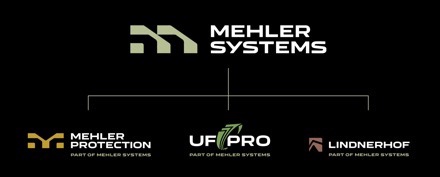
Mehler Vario System today introduced Mehler Systems, a significant milestone in the journey that brings all the company’s brands under one roof. This new name—Mehler Systems—unites the already renowned brands of UF PRO and Lindnerhof with that of Mehler Protection, itself a new brand that combines all existing ballistic-protection activities of Mehler Systems into one entity.

The move harmonises the name, image, and branding of the entire Group as a leading provider of high-end protection and tactical-equipment systems for worldwide defence and law enforcement customers.

The new brand-name Mehler Systems captures the essence of the total Group’s purpose as a provider of comprehensive solutions for defence and security missions of a challenging nature, but it does more than that. It also speaks to a commitment to continuously evolve and innovate to even better serve clients. “Under Mehler Systems, our new Group brand, we will present a new, unified, and comprehensive Group face to the market. The Mehler Systems brand stresses the breadth and depth of our complementary and corresponding capabilities throughout the Group in each of our companies, under one common roof”, said Mehler Systems CEO Thomas Homberg.

In a step parallel to the adoption of the new brand-name Mehler Systems and the Group-level uniting resulting from it, Mehler Systems has created Mehler Protection through a brand-blending of Mehler Vario System, Mehler Engineered Defence, and Mehler Law Enforcement. This new sub-brand specialises in providing body and platform armour.

Christian Vahldiek, Managing Director of Mehler Engineered Defence, expressed enthusiasm for this collaborative branding effort. “We are excited about this joint initiative and the opportunity to combine our expertise in platform protection with the body armour offerings under a single brand,” he said.

Importantly, however, the brand-blending of the three companies does not alter their individual legal structures.

Although Mehler Systems is now the Group’s overall brand, Mehler Protection, UF PRO, and Lindnerhof will continue as specialised sub-brands, according to UF PRO Managing Director Jože Kastelic and Linderhof Managing Director Jakob Kolbeck. “Each sub-brand brings its unique skillset and established reputation as a provider of integrated, top-quality solutions,” they said in a joint statement.

“Every sub-brand under Mehler Systems is committed to delivering excellence,” Homberg said. “We continuously utilise our combined strengths to ensure that you receive the best. Our dedicated customer group, who risk their health and lives for society’s security, is the reason we continuously strive for innovation. We are persistent in our efforts to enhance equipment and system performance that match the ever-changing mission- and threat-environments of our customers.”

Learn more about this transformation and the Group’s wide range of offerings by visiting the Mehler Systems website.

Galvion Announces Strategic Partnerships to Enhance Head Systems Offering

November 13th, 2023

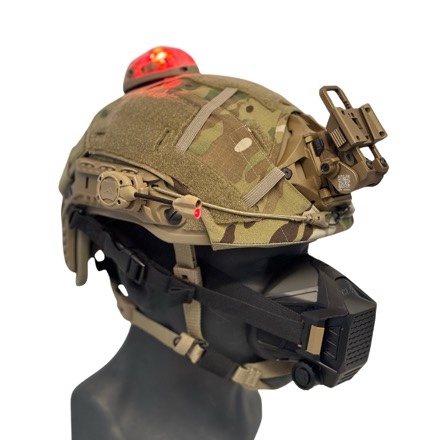
Galvion, a world leader in integrated head systems and intelligent power and data management solutions, is pleased to announce collaborations with selected industry partners to further enhance the portfolio of accessories for its head system solutions, under the banner of its Batlchk™ program.

This announcement coincides with MiliPol, taking place in Paris, 14-17 November 2023, where Galvion is exhibiting these value-add accessories alongside their wider product offering on booth #5A-E122.

Galvion is committed to delivering innovative solutions that meet the ever-evolving needs of demanding military and tactical teams around the world. Through collaboration and partnerships with respected industry partners and following a rigorous product verification and integration validation process, Galvion will offer a wide range of capability-enhancing products that integrate with, or are complementary to, their high-performance helmet systems. Today, Galvion announces the first Batlchk™ collaborations and agreements with the following industry partners:

Ventus Respiratory Technologies

– TR2™ Respirator: The Ventus TR2 Respiratory Mask is a compact and lightweight tactical respiratory solution that is CE-certified, conforming to European health, safety, and environmental protection standards. It offers >99% filtration of solid particulate at a diameter of 0.06?m (P2 certified to EN143) and oil-based particles down to 0.3?m, offering reliable protection against toxic exposure.

Adventure Lights

– Trilobyte™ Tactical Strobes: Adventure Lights Trilobyte Tactical Strobes offer programmable IR and visual light strobes, providing secure and tamper-proof signals. With customizable signatures, these strobes enable quick and easy identification. The form factor is optimized for maximum visibility, and the device offers a wide range of functionality in a simple and user-friendly design. A range of strobes, including models with unique features developed for Galvion, will be offered to meet diverse user requirements.

4D Tactical

– Night Vision SOF Cap: The 4D Tactical night vision device SOF Cap is a lightweight and comfortable platform that integrates seamlessly with night vision devices. Developed in collaboration with Galvion, and engineered using Galvion’s field-proven fitband technology, the SOF cap offers stability and convenience in situations where ballistic or bump protection is not required.

Todd Stirtzinger, CEO at Galvion said: “We are excited to work with like-minded industry partners and look forward to expanding our Batlchk integrated accessories program. These collaborations allow us to provide operators with more integrated and complementary products and select items will be available to NATO countries through the NSPA framework contract.” He added: “Whether100% Galvion engineered and manufactured, developed through intense collaborative efforts with partners or simply by recognizing and recommending best-in-class products that integrate well with our head systems, our aim remains the same: to support the warfighter by offering the most comprehensive portfolio of head systems and accessories we can so they can complete their missions and get home safely.”

Helikon-Tex Guardian Plate Carrier

November 13th, 2023

Build Your Own Set

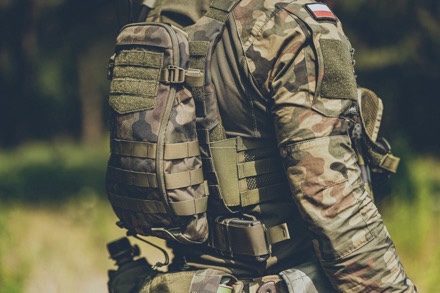
The Guardian Plate Carrier is a modern vest designed for carrying ballistic plates with the option of attaching additional gear thanks to its modular system compatible with MOLLE/PALS. The Guardian series includes the vest and 16 components that can be configured as you like. The Guardian Plate Carrier allows for carrying plates in the most popular standards: E-Cut (SAPI/ESAPI), Swimmer Cut, and Shooter Cut.

Elements of the Guardian Series:

To better tailor the products to users needs, we’ve prepared several components designed for various activities. Two types of cummerbunds: standard Guardian Cummerbund and Guardian Cummerbund Quick Release. For carrying equipment at the front, there is the Guardian Kangaroo Flap with hook & loop and the Guardian Flap equipped with MOLLE/PALS straps with room for three AK/AR magazines.

Specifically for police and similar services, we’ve developed the Law Enforcement Insert, which will accommodate two pistol magazines, a radio, and handcuffs. In addition, the Guardian series features two pockets for grenades: the Smoke Grenade Pouch for smoke grenades and the Flash Grenade Pouch for flashbangs.

Efficient organization of equipment is provided by various types of pouches and pockets: Double Horizontal Pouch for rifle magazines, Pistol Magazine Pouch for a single pistol magazine, Universal Pouch for flexible gear storage, Guardian Dangler drop pouch, and Radio Pouch for storing a radio unit. Also available in the series is the Guardian Admin Pouch, a universal tactical Mini Pouch, and the Tourniquet Pouch.

Anything that doesn’t fit at hand can be carried in the Guardian Smallpack with a 7.5 l capacity, which can be attached to the plate carrier thanks to detachable straps. The backpack opens almost entirely and has a separate pocket for a hydration insert.

OR CHOOSE A PRE-MADE SET

In addition to individual components, Helikon-Tex also offers complete sets tailored for specific types of services: the Guardian Military set designed for the armed forces comes with the Guardian Cummerbund and the front Guardian Flap. The Guardian Law Enforcement set was developed with the police and other uniformed services in mind. The base element here is the tactical Guardian Plate Carrier vest. It comes with a Guardian Cummerbund, a front Guardian Kangaroo Flap, and a dedicated Law Enforcement Insert.

2023 Black Friday / Cyber Monday Sales Page – Sponsored By Tactical Distributors

November 13th, 2023

Once again, our friends at Tactical Distributors are sponsoring our Black Friday/Cyber Monday master list. To see it, updated regularly with the latest sales info, click here.

Deals are updated daily, so check often!

LEON and the Corps’ Robotic Revolution in the Global Littorals

November 13th, 2023

Marine Corps Base Quantico, Va. —

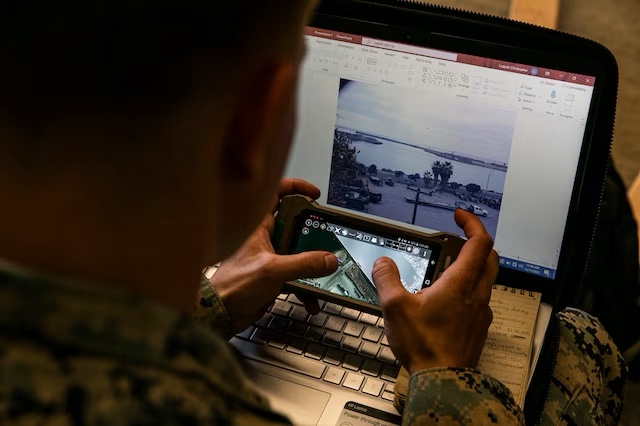
As the Marine Corps prepares to take the fight to the global littorals, Marine Corps Systems Command’s Program Manager for Explosive Hazard Defeat’s Littoral Explosive Ordnance Neutralization—LEON–integrated product team is working on fielding a family of systems to strengthen Marine Corps mine warfare capabilities. 

Designed to address the concerns outlined in the Littoral Operations in a Contested Environment guidance, these systems fortify Marines’ mine warfare capabilities as the Corps continues with the strategic modernization outlined in former Commandant of the Marine Corps, Gen. David H. Berger’s seminal Force Design guidance.

The LEON family of systems encompasses various capabilities, among which the Explosive Ordnance Disposal Remotely Operated Vehicle—or ROV—stands out as an integral component. This innovative amphibious, unmanned robot system is specifically designed to detect, locate, reacquire, mark to avoid, render safe/neutralize, recover, exploit, and dispose of underwater explosive threats in the very shallow water, surf zone, beach zone and littoral transition points.

This bleeding-edge robotic technology—along with its integrated family of capabilities—strives to secure safe maneuverability for Marines within the littoral regions, extending support to the explosive ordnance disposal community and enhancing the overall service proficiency.

According to Product Manager for Explosive Hazard Defeat Rick Daley, LEON is a tool which will allow the support of ship-to-shore and shore-to-ship lane clearing operations more safely and effectively. 

“If we aim to conduct operations as part of a MAGTF or drug task force, it necessitates a World War II style island-hopping campaign, requiring safe access to the islands. Our adversaries will be trying to stop us, though. With the advent of the LEON initiative, the strategy shifts to ‘tech to avoid’—identifying safe lanes through minefields and enabling forces to securely land on the beaches,” he said.

This innovative new system ultimately aligns with Force Design’s modernization guidance, which calls on the Corps to, “acknowledge the impacts of proliferated precision long-range fires, mines, and other smart weapons, and seek innovative ways to overcome these threat capabilities.”

The LEON team has certainly taken the call to innovate seriously. A notable facet of the team’s strength is its proactive stance towards embracing emergent technologies, thereby fostering state-of-the-art solutions tailored for the complexities of 21st-century naval warfare.

This forward-thinking approach not only underscores their commitment to enhancing maritime operational efficacy but also positions them at the vanguard of navigating the multifaceted challenges inherent in contemporary littoral combat scenarios.

According to Daley, “It’s imperative to note that unlike many unmanned capabilities, such as drones, our systems operate fully submerged. Until the acoustic communications are fully online, direct communication isn’t necessarily possible. Therefore, there’s a need for either pre-programming or having advanced software programming to enable complete autonomous operation. This allows the system to execute the required tasks and then return to a recoverable location, which is crucial. Without such measures, we’re merely deploying assets with the hope that they fulfill the intended objectives.”

 “If we aim to conduct operations as part of a MAGTF or drug task force, it necessitates a World War II style island-hopping campaign, requiring safe access to the islands. Our adversaries will be trying to stop us, though. With the advent of the LEON initiative, the strategy shifts to ‘tech to avoid’—identifying safe lanes through minefields and enabling forces to securely land on the beaches,” 

-Rick Daley, Product Manager for Explosive Hazard Defeat

One of the ways that the LEON team has been able to gain so much success here is through the fostering of untraditional partnerships across the Corps’ – with a special focus on direct feedback from the fleet. According to Ronald Diefenbach, LEON project officer, this has made all of the difference.

He noted, “Our collaboration with [Naval Information Warfare Center] Pacific has been pivotal in refining our platforms. Furthermore, we had the advantage of having a Marine from I Marine Expeditionary Force, I MEF, embedded with NIWC Pacific from the program’s outset, providing real-time feedback during the development process. This setup significantly bridged any communication gap, ensuring our technological advancements are aligned with practical operational needs from the very beginning of the development stage.”

Similarly, Diefenbach noted how always picking the right contract vehicle for specific parts of the project helps save time—and ultimately—taxpayer dollars. And with the LEON team moving so quickly, the future of the program certainly looks bright.

This was exemplified in a 2021 exercise when Marines from I and III MEF conducted a littoral mobility exercise, showcasing how this bleeding-edge tech can be utilized in joint-force operations with the Navy.

The collaboration between the 9th Engineer Support Battalion, 3d Marine Logistics Group, 7th ESB, 1st MLG and U.S. Navy Explosive Ordnance Disposal Mobile Unit 1 ultimately demonstrated the seamless integration of diverse capabilities to establish secure beachheads for amphibious operations.

The exercise highlighted the pivotal role of integrated capabilities in supporting naval maneuver, aligning with the tenets of Force Design 2030 to enhance real-time situational awareness and expedite decision-making in amphibious environments.

At the time, 1st Lt. Brandon Cavil, who then served as Littoral Engineer Reconnaissance Team officer in charge, noted the “exercise was all about honing the Marine Corps’ interoperability with the Navy, specifically addressing where we can provide redundant and complementary capabilities.”

Ultimately, the success of the LEON team is a testament to the foresight of the 2017 Littoral Operations in a Contested Environment document and underscores the growing importance of naval mine warfare as the Corps continues its strategic shift towards the Indo-Pacific.

This important advance in maritime technology has not gone unnoticed. In recognition for their efforts, the LEON Integrated Product Team received the Department of the Navy’s 2023 Ron Kiss Maritime Technology Transition Award, which honors outstanding achievement in the defense acquisition community for successfully transitioning a technology into a program of record or operational use.

By transcending traditional paradigms and fostering a culture of innovation and adaptability, Product Manager Explosive Hazard Defeat is not only responding to the shifting needs of the modern battlefield—it’s actively influencing the future of naval warfare. As the Marine Corps continues its strategic shift to the Indo-Pacific– guided by Force Design– the robotic technology that is being developed by the LEON team will play a vital role in navigating the dynamic and complex global littorals—ensuring the warfighter is prepared to fight and win when duty calls.

By Johannes Schmidt, Marine Corps Systems Command Office of Public Affairs and Communication | Marine Corps Systems Command