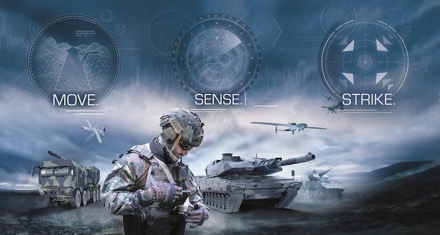
Eurosatory 2022, the most important defence show on the European mainland, takes place this year in Paris from 13 to 17 June. Under the motto “Move – Sense – Strike”, Rheinmetall will be on hand, presenting part of its extensive array of products, systems and activities for the digitized battlefields of the future. With an exhibition area of around 3,000 square metres, this will be Rheinmetall’s biggest-ever presence at Eurosatory. Here are some of the products making their debut at this year’s show:
Future Tanknology – KF51 main battle tank: The KF51 is the newest member of Rheinmetall’s family of tracked armoured fighting vehicles. Delivering dual-capability dominance, the platform sets new standards in every category – lethality, survivability, mobility, networkability and reconnaissance. Its 130mm main armament and other effectors endow the KF51 with superior firepower. The vehicle will be presented at a ceremony on 13 June at 14:00 hrs.
Rheinmetall Technology Cube: Now more than ever, defence technology systems are developed in close coordination with their future users. The Rheinmetall Technology Cube exploits cutting-edge technology, including augmented reality, to conduct a dialogue with users and procurement officials when developing next-generation combat vehicles. The aim is to rethink the future together – by integrating new kinds of drives, sensors, and subsystems into fully digitized, scalable vehicle platform concepts.
Airborne vehicle family: In cooperation with Mercedes-Benz and ACS Armoured Car Systems, Rheinmetall now offers a versatile, high mobility 4×4 vehicle family specially designed for light airmobile and special operations units. The vehicle system family will debut at Eurosatory.
Natter remote-controlled weapon station: Rheinmetall has developed a new family of remote-controlled weapon stations. Thanks to its high-performance sensors, modularity and independent stabilization, the Natter (“adder”) features excellent reconnaissance and engagement capabilities. Various versions of the Natter make it possible to arm tracked and wheeled armoured vehicles with a wide spectrum of effectors ranging from light machineguns to medium calibre cannon.
Unmanned systems and robotics: For the first time, Rheinmetall will be presenting the newly developed LUNA NG (Next Generation) unmanned aerial vehicle, designed for unmanned aerial reconnaissance, classification, and recognition of objects in real time. Rheinmetall will also be showing how various integrated, unmanned air-supported reconnaissance systems can reinforce the sensors of ground platforms and improve overall situational awareness. The Robotics-L walking robot and Mission Master models SP and XT demonstrate how robotics is already changing the modern battlefield. Robotics-L can carry out reconnaissance missions. The Mission Master SP vehicle is configured for a transporting cargo, while the XT is a designed for a fire support role with a launcher for loitering munitions.
Loitering munitions: These air-supported precision munitions combine the characteristics of drones and guided missiles. They enhance the ability of even small units to reconnoitre target zones from above, coupled with standoff, high-precision engagement of targets. Rheinmetall and its partner UVision have entered a cooperation agreement to market UV’s Hero family of loitering munitions in Europe. At Eurosatory, the two companies will be highlighting possibilities for integrating Hero LM systems into manned and unmanned vehicles.
In addition to these debuts, Rheinmetall will also be presenting various other products and projects. These include:
HX3 vehicle family: Rheinmetall’s new HX3 vehicle generation features improved protection, even better mobility, greater driving comfort and digital interface architecture, assuring heightened operational flexibility and abundant scope for future performance upgrades. At Eurosatory 2022, Rheinmetall’s wheeled self-propelled howitzer will be on display, mounted on a high mobility HX 10×10 chassis. The HX3 can also serve as the transport component for the Skynex air defence system.
Air defence: Mobile, modular, and scalable, ground-based air defence systems are gaining new importance now that NATO armed forces are focusing once again on defending national and allied territory and airspace. At Eurosatory, Rheinmetall is displaying a Boxer 8×8 wheeled armoured vehicle configured for an air defence role, topped with the Sykranger 30 turret and an integrated surface-to-air missile launcher. Also on show will be the Skynex air defence system, consisting of a 35mm Mk3 Revolver Gun, Multi Sensor Unit with AESA radar, and a Control Node 1 command centre, with a high-energy laser functioning as a future effector.
Force protection: Rheinmetall’s comprehensive expertise in the field of force protection ranges from individual passive ballistic solutions to advanced stand-off active protection systems for combat vehicles. Visitors to Eurosatory 2022 can inspect Rheinmetall’s StrikeShield, an integrated hybrid module for vehicles that combines active and passive protection technology.
Digitized battlefield: As a leading systems integrator, Rheinmetall possesses all the knowledge necessary for networking various entities on the digital battlefield of the future. At Eurosatory 2022, Rheinmetall will show how the interplay of sensors, effectors and human-machine interfaces can lift the “fog of war”. Rheinmetall will also be showcasing the current configuration of its Gladius 2.0 soldier system and how it can be networked with manned and unmanned vehicles and subsystems.
At Eurosatory 2022, furthermore Rheinmetall will be presenting its comprehensive expertise in practically every other capability category. These include weapons and ammunition for threat-commensurate, scalable application of force as well as innovative, networkable sensor systems for applications on land, at sea and in the air, in addition to high-performance simulation technology for top-of-the-line training. We look forward to welcoming you to Eurosatory 2022 at Stand F241-240 in the outdoor area behind Hall 6!



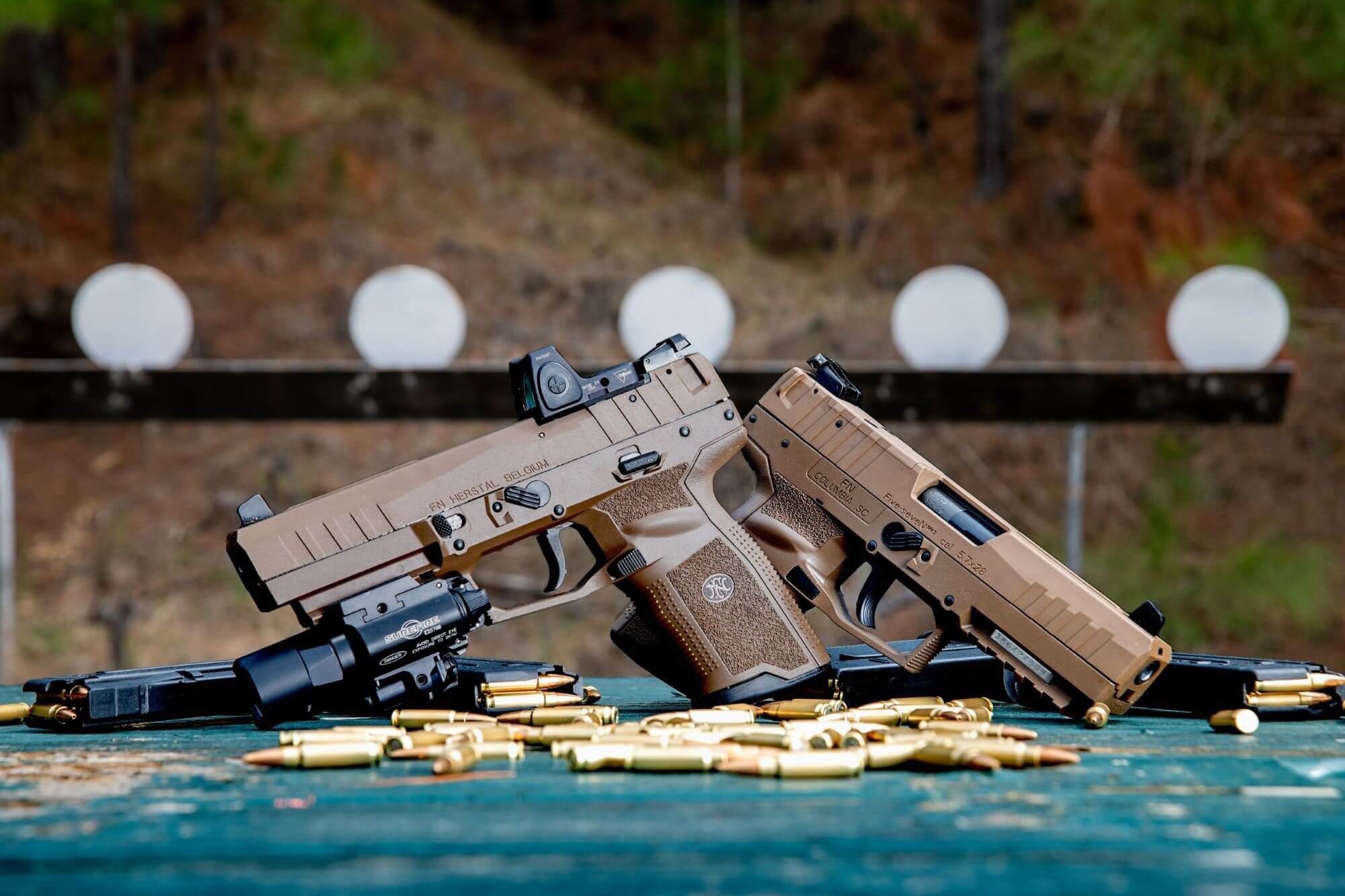
 “The FN Five-seveN pistol has been immensely popular since its introduction. Its original design capturing the performance of the FN-designed 5.7x28mm cartridge made it an instant success, and it’s positioned to do it yet again with the dramatic redesign of the FN Five-seveN MRD,” said Chris Cole, Vice President of Sales and Marketing for FN America, LLC. “With the addition of an integral optics mounting system on the slide, an already accurate pistol now redefines what handgun accuracy means. We’re truly excited to bring this new pistol to market with features our customers want in their favorite FN caliber.”